






Teacher Trajectories and Teacher Effectiveness:  the role of policy and leadershipSusanna LoebCEPPEMarch 11, 2011
A Collaborative EffortDon Boyd, Hamp Lankford & Jim Wyckoff Teacher workforcePam GrossmanTeachingJason Grissom, Eileen Horng, Demetra KalogridesSchool Leadership
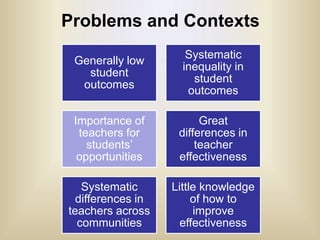
Problems and Contexts
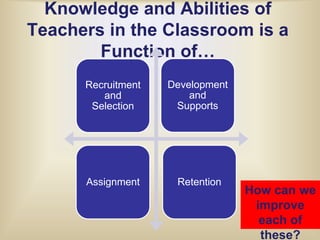
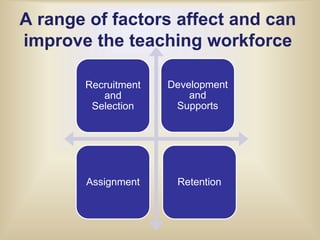
Knowledge and Abilities of Teachers in the Classroom is a Function of…How can we improve each of these?
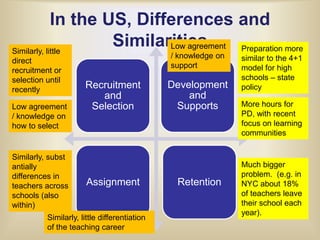
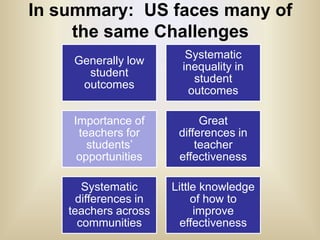
In the US, Differences and SimilaritiesLow agreement / knowledge on supportPreparation more similar to the 4+1 model for high schools – state policySimilarly, little direct recruitment or selection until recentlyMore hours for PD, with recent focus on learning communitiesLow agreement / knowledge on how to selectSimilarly, substantially differences in teachers across schools (also within)Much bigger problem.  (e.g. in NYC about 18% of teachers leave their school each year).Similarly, little differentiation of the teaching career
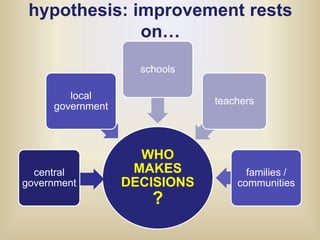
hypothesis: improvement rests on…
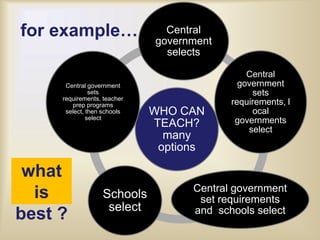
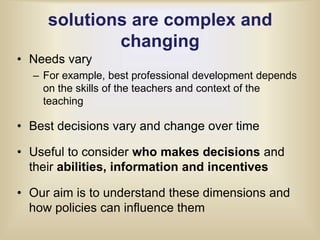
for example…what is best ?
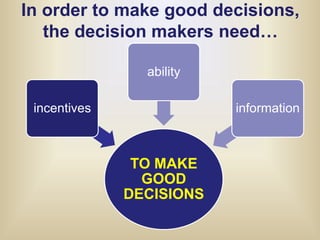
In order to make good decisions, the decision makers need…
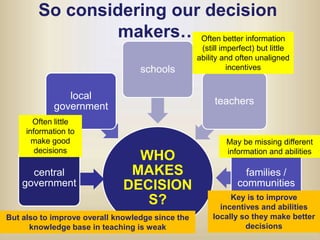
So considering our decision makers…Often better information (still imperfect) but little ability and often unaligned incentivesOften little information to make good decisionsMay be missing different information and abilitiesKey is to improve incentives and abilities locally so they make better decisionsBut also to improve overall knowledge since the knowledge base in teaching is weak
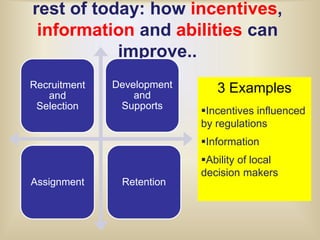
rest of today: how incentives, information and abilities can improve..3 ExamplesIncentives influenced by regulations
Information
Ability of local decision makers1. Federal Regulations Affecting Recruitment and Selection Incentivesconsidering the past decade in NYC
the starting place: year 2000, NY
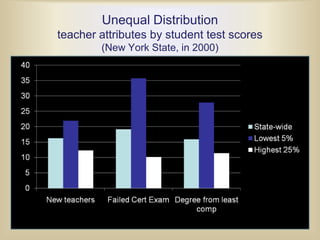
Unequal Distributionteacher attributes by student test scores (New York State, in 2000)
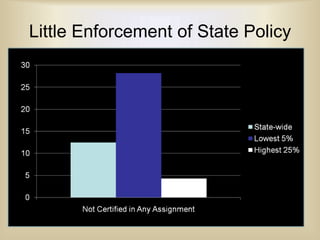
Little Enforcement of State Policy
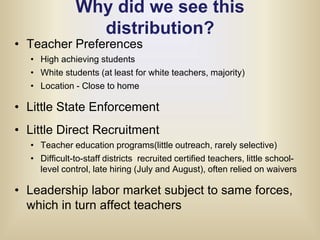
Why did we see this distribution?Teacher Preferences
High achieving students
White students (at least for white teachers, majority)
Location - Close to home
Little State Enforcement
Little Direct Recruitment
Teacher education programs(little outreach, rarely selective)
Difficult-to-staff districts  recruited certified teachers, little school-level control, late hiring (July and August), often relied on waivers
Leadership labor market subject to same forces, which in turn affect teachersA bit of change
Innovation in Direct Recruitment (prior to certification)Teach for America - 1990
The New Teacher Project – 1997
UTeachChange in AccountabilityState requirements no longer based solely on compliance (inputs)
Standardized tests used for accountability instead of just to inform parents or for student opportunities (e.g NY regents)
Started in the states but moved to Federal with NCLB – increased emphasis on subgroups (and teacher quality).Highly Qualified Teacher ProvisionIntent - all students have a good teachers and equity in teacher quality
State flexibility
Weak research base for defining HQ – use professional consensus & State policy process
defines HQT as: (1) fully State-certified; (2) holding a bachelor’s degree; (3) demonstrating competency in the core academic subject or subjects he or she teaches – multiple optionsHighly Qualified TeacherAll teachers have the option of passing a state exam.
Middle and secondary teachers may complete an undergraduate or graduate degree in their field or advanced certification or credential.
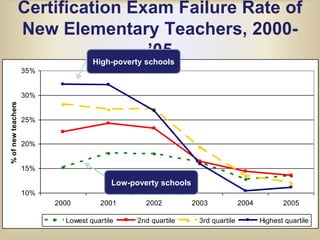
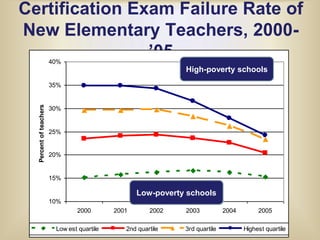
All veteran teachers also have the option of completing a High Objective Uniform State Standard of Evaluation (HOUSSE) a dramatic change in the workforceImplications for teachers
Certification Exam Failure Rate of New Elementary Teachers, 2000-’05 High-poverty schoolsLow-poverty schools
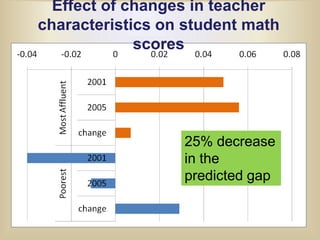
Effect of changes in teacher characteristics on student math scores25% decrease in the predicted gap
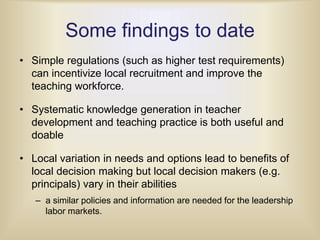
Conclusion 1A small change in regulation can create a large change in incentivesIncentives can inspire meaningful change in schools and for students
2. Improvements to a Weak Knowledge Baselinking teacher preparation to effectiveness to improve information
Current Knowledge BaseVirtually no research linking preparation experiences to teachers’ classroom performance and, particularly to student outcomesLack of information hinders simple decisions about certification policy at the state level as well as program design locally
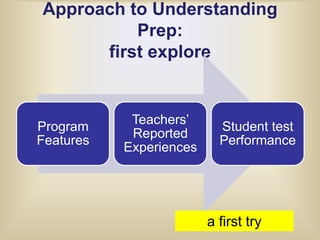
Approach to Understanding Prep:first explorea first try
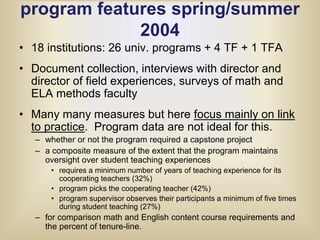
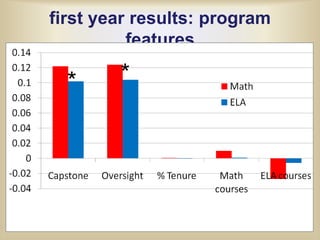
program features spring/summer 200418 institutions: 26 univ. programs + 4 TF + 1 TFADocument collection, interviews with director and director of field experiences, surveys of math and ELA methods facultyMany many measures but here focus mainly on link to practice.  Program data are not ideal for this.whether or not the program required a capstone project a composite measure of the extent that the program maintains oversight over student teaching experiencesrequires a minimum number of years of teaching experience for its cooperating teachers (32%)program picks the cooperating teacher (42%) program supervisor observes their participants a minimum of five times during student teaching (27%)for comparison math and English content course requirements and the percent of tenure-line.
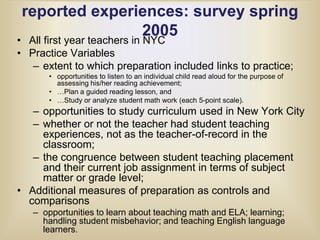
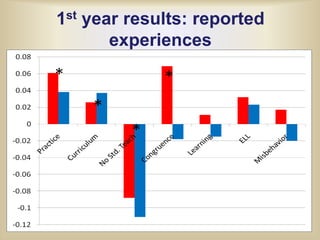
reported experiences: survey spring 2005All first year teachers in NYCPractice Variablesextent to which preparation included links to practice;opportunities to listen to an individual child read aloud for the purpose of assessing his/her reading achievement; …Plan a guided reading lesson, and …Study or analyze student math work (each 5-point scale). opportunities to study curriculum used in New York City whether or not the teacher had student teaching experiences, not as the teacher-of-record in the classroom; the congruence between student teaching placement and their current job assignment in terms of subject matter or grade level;Additional measures of preparation as controls and comparisonsopportunities to learn about teaching math and ELA; learning; handling student misbehavior; and teaching English language learners.
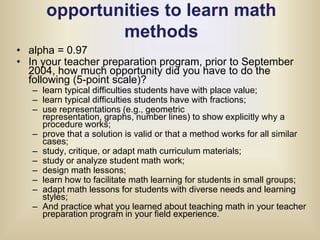
opportunities to learn math methodsalpha = 0.97In your teacher preparation program, prior to September 2004, how much opportunity did you have to do the following (5-point scale)?  learn typical difficulties students have with place value; learn typical difficulties students have with fractions; use representations (e.g., geometric representation, graphs, number lines) to show explicitly why a procedure works; prove that a solution is valid or that a method works for all similar cases; study, critique, or adapt math curriculum materials; study or analyze student math work; design math lessons; learn how to facilitate math learning for students in small groups; adapt math lessons for students with diverse needs and learning styles; And practice what you learned about teaching math in your teacher preparation program in your field experience.
first year results: program features**
1st year results: reported experiences
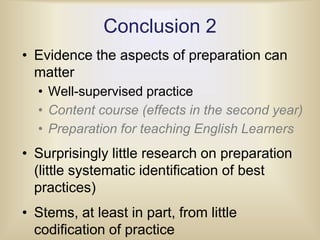
Conclusion 2Evidence the aspects of preparation can matter
Well-supervised practice
Content course (effects in the second year)
Preparation for teaching English Learners
Surprisingly little research on preparation  (little systematic identification of best practices)
Stems, at least in part, from little codification of practiceSimilar work linking teaching practice to student learningFind systematic differences in the practices of more effective teachersSimilarly still early on in developing the knowledge base.Useful because it can be used indecision making in generaland in developing supportsNot today…
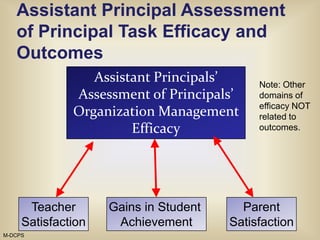
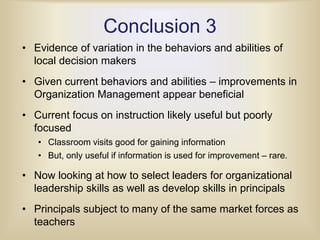
3. Understanding and Improving the Abilities of Local Decision Makersvariation in the abilities and behaviors of school principals
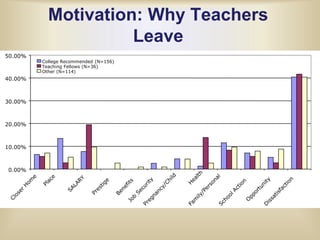
50.00%College Recommended (N=156)Teaching Fellows (N=36)Other (N=114) 40.00%30.00%20.00%10.00%0.00%HealthPlaceSALARYCloser HomePrestigeBenefitsPregnancy/ChildFamily/PersonalOpportunityJob SecurityDissatisfactionSchool ActionMotivation: Why Teachers Leave
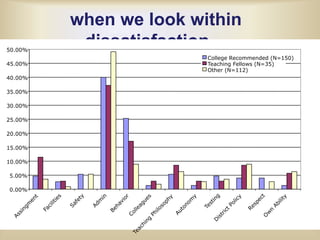
50.00%College Recommended (N=150)45.00%Teaching Fellows (N=35)Other (N=112) 40.00%35.00%30.00%25.00%20.00%15.00%10.00%5.00%0.00%AdminSafetyTestingRespectFacilitiesBehaviorAutonomyColleaguesOwn AbilityAssingmentDistrict PolicyTeaching Philosophywhen we look within dissatisfaction…

Ceppe march 2011 final (Susanna Loeb)

  • 1.
    Teacher Trajectories andTeacher Effectiveness: the role of policy and leadershipSusanna LoebCEPPEMarch 11, 2011
  • 2.
    A Collaborative EffortDonBoyd, Hamp Lankford & Jim Wyckoff Teacher workforcePam GrossmanTeachingJason Grissom, Eileen Horng, Demetra KalogridesSchool Leadership
  • 3.
  • 4.
    Knowledge and Abilitiesof Teachers in the Classroom is a Function of…How can we improve each of these?
  • 5.
    In the US,Differences and SimilaritiesLow agreement / knowledge on supportPreparation more similar to the 4+1 model for high schools – state policySimilarly, little direct recruitment or selection until recentlyMore hours for PD, with recent focus on learning communitiesLow agreement / knowledge on how to selectSimilarly, substantially differences in teachers across schools (also within)Much bigger problem. (e.g. in NYC about 18% of teachers leave their school each year).Similarly, little differentiation of the teaching career
  • 6.
  • 7.
  • 8.
    In order tomake good decisions, the decision makers need…
  • 9.
    So considering ourdecision makers…Often better information (still imperfect) but little ability and often unaligned incentivesOften little information to make good decisionsMay be missing different information and abilitiesKey is to improve incentives and abilities locally so they make better decisionsBut also to improve overall knowledge since the knowledge base in teaching is weak
  • 10.
    rest of today:how incentives, information and abilities can improve..3 ExamplesIncentives influenced by regulations
  • 11.
  • 12.
    Ability of localdecision makers1. Federal Regulations Affecting Recruitment and Selection Incentivesconsidering the past decade in NYC
  • 13.
    the starting place:year 2000, NY
  • 14.
    Unequal Distributionteacher attributesby student test scores (New York State, in 2000)
  • 15.
  • 16.
    Why did wesee this distribution?Teacher Preferences
  • 17.
  • 18.
    White students (atleast for white teachers, majority)
  • 19.
  • 20.
  • 21.
  • 22.
    Teacher education programs(littleoutreach, rarely selective)
  • 23.
    Difficult-to-staff districts recruited certified teachers, little school-level control, late hiring (July and August), often relied on waivers
  • 24.
    Leadership labor marketsubject to same forces, which in turn affect teachersA bit of change
  • 25.
    Innovation in DirectRecruitment (prior to certification)Teach for America - 1990
  • 26.
    The New TeacherProject – 1997
  • 27.
    UTeachChange in AccountabilityStaterequirements no longer based solely on compliance (inputs)
  • 28.
    Standardized tests usedfor accountability instead of just to inform parents or for student opportunities (e.g NY regents)
  • 29.
    Started in thestates but moved to Federal with NCLB – increased emphasis on subgroups (and teacher quality).Highly Qualified Teacher ProvisionIntent - all students have a good teachers and equity in teacher quality
  • 30.
  • 31.
    Weak research basefor defining HQ – use professional consensus & State policy process
  • 32.
    defines HQT as:(1) fully State-certified; (2) holding a bachelor’s degree; (3) demonstrating competency in the core academic subject or subjects he or she teaches – multiple optionsHighly Qualified TeacherAll teachers have the option of passing a state exam.
  • 33.
    Middle and secondaryteachers may complete an undergraduate or graduate degree in their field or advanced certification or credential.
  • 34.
    All veteran teachersalso have the option of completing a High Objective Uniform State Standard of Evaluation (HOUSSE) a dramatic change in the workforceImplications for teachers
  • 35.
    Certification Exam FailureRate of New Elementary Teachers, 2000-’05 High-poverty schoolsLow-poverty schools
  • 36.
    Certification Exam FailureRate of New Elementary Teachers, 2000-’05 High-poverty schoolsLow-poverty schools
  • 37.
    Certification Exam FailureRate of New Elementary Teachers, 2000-’05 High-poverty schoolsLow-poverty schools
  • 38.
    Effect of changesin teacher characteristics on student math scores25% decrease in the predicted gap
  • 39.
    Conclusion 1A smallchange in regulation can create a large change in incentivesIncentives can inspire meaningful change in schools and for students
  • 40.
    2. Improvements toa Weak Knowledge Baselinking teacher preparation to effectiveness to improve information
  • 41.
    Current Knowledge BaseVirtuallyno research linking preparation experiences to teachers’ classroom performance and, particularly to student outcomesLack of information hinders simple decisions about certification policy at the state level as well as program design locally
  • 42.
    Approach to UnderstandingPrep:first explorea first try
  • 43.
    program features spring/summer200418 institutions: 26 univ. programs + 4 TF + 1 TFADocument collection, interviews with director and director of field experiences, surveys of math and ELA methods facultyMany many measures but here focus mainly on link to practice. Program data are not ideal for this.whether or not the program required a capstone project a composite measure of the extent that the program maintains oversight over student teaching experiencesrequires a minimum number of years of teaching experience for its cooperating teachers (32%)program picks the cooperating teacher (42%) program supervisor observes their participants a minimum of five times during student teaching (27%)for comparison math and English content course requirements and the percent of tenure-line.
  • 44.
    reported experiences: surveyspring 2005All first year teachers in NYCPractice Variablesextent to which preparation included links to practice;opportunities to listen to an individual child read aloud for the purpose of assessing his/her reading achievement; …Plan a guided reading lesson, and …Study or analyze student math work (each 5-point scale). opportunities to study curriculum used in New York City whether or not the teacher had student teaching experiences, not as the teacher-of-record in the classroom; the congruence between student teaching placement and their current job assignment in terms of subject matter or grade level;Additional measures of preparation as controls and comparisonsopportunities to learn about teaching math and ELA; learning; handling student misbehavior; and teaching English language learners.
  • 45.
    opportunities to learnmath methodsalpha = 0.97In your teacher preparation program, prior to September 2004, how much opportunity did you have to do the following (5-point scale)? learn typical difficulties students have with place value; learn typical difficulties students have with fractions; use representations (e.g., geometric representation, graphs, number lines) to show explicitly why a procedure works; prove that a solution is valid or that a method works for all similar cases; study, critique, or adapt math curriculum materials; study or analyze student math work; design math lessons; learn how to facilitate math learning for students in small groups; adapt math lessons for students with diverse needs and learning styles; And practice what you learned about teaching math in your teacher preparation program in your field experience.
  • 46.
    first year results:program features**
  • 47.
    1st year results:reported experiences
  • 48.
    Conclusion 2Evidence theaspects of preparation can matter
  • 49.
  • 50.
    Content course (effectsin the second year)
  • 51.
    Preparation for teachingEnglish Learners
  • 52.
    Surprisingly little researchon preparation (little systematic identification of best practices)
  • 53.
    Stems, at leastin part, from little codification of practiceSimilar work linking teaching practice to student learningFind systematic differences in the practices of more effective teachersSimilarly still early on in developing the knowledge base.Useful because it can be used indecision making in generaland in developing supportsNot today…
  • 54.
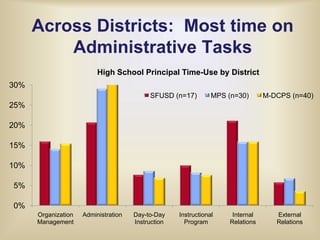
    3. Understanding andImproving the Abilities of Local Decision Makersvariation in the abilities and behaviors of school principals
  • 55.
    50.00%College Recommended (N=156)TeachingFellows (N=36)Other (N=114) 40.00%30.00%20.00%10.00%0.00%HealthPlaceSALARYCloser HomePrestigeBenefitsPregnancy/ChildFamily/PersonalOpportunityJob SecurityDissatisfactionSchool ActionMotivation: Why Teachers Leave
  • 56.
    50.00%College Recommended (N=150)45.00%TeachingFellows (N=35)Other (N=112) 40.00%35.00%30.00%25.00%20.00%15.00%10.00%5.00%0.00%AdminSafetyTestingRespectFacilitiesBehaviorAutonomyColleaguesOwn AbilityAssingmentDistrict PolicyTeaching Philosophywhen we look within dissatisfaction…