Single phase induction motors Jenneson chpt 10.6 p 232
Single phase motors Split phase Shaded pole Capacitor motors Universal motors
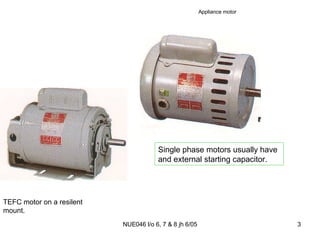
Single phase motors usually have and external starting capacitor. Appliance motor TEFC motor on a resilent mount.
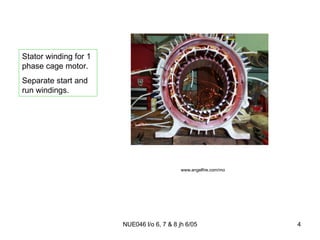
www.angelfire.com/mo Stator winding for 1 phase cage motor. Separate start and run windings.
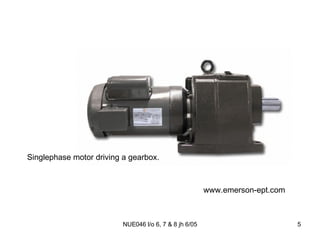
www.emerson-ept.com Singlephase motor driving a gearbox.
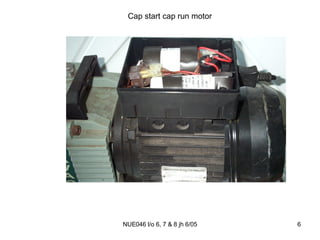
Cap start cap run motor
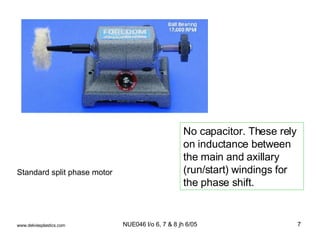
Standard split phase motor www.delviesplastics.com No capacitor. These rely on inductance between the main and axillary (run/start) windings for the phase shift.
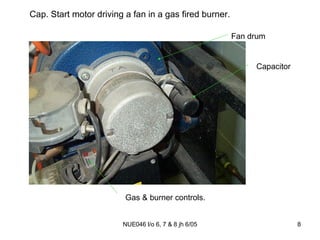
Cap. Start motor driving a fan in a gas fired burner. Capacitor Fan drum Gas & burner controls.
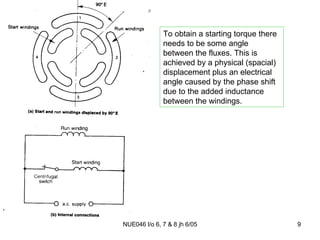
To obtain a starting torque there needs to be some angle between the fluxes. This is achieved by a physical (spacial) displacement plus an electrical angle caused by the phase shift due to the added inductance between the windings.
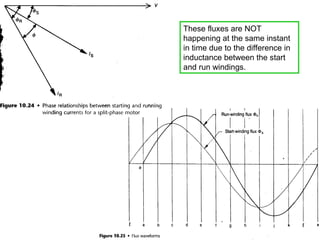
These fluxes are NOT happening at the same instant in time due to the difference in inductance between the start and run windings.
The start winding is normally made of finer wire and with fewer turns compared to the run winding. To increase the inductance of the run winding, the run winding is deeper in the core. The run winding has less resistance than the start winding. More current flows in the run winding. Most standard split phase motors have a centrifugal switch to remove the start winding from the circuit after it has run up to about 75% speed. Not all motors have switches, some are designed to leave both windings in the circuit.
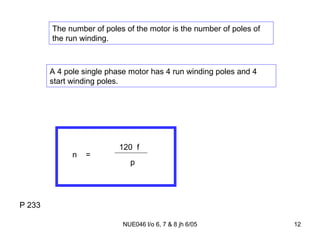
The number of poles of the motor is the number of poles of the run winding. A 4 pole single phase motor has 4 run winding poles and 4 start winding poles. 120  f p n  = P 233
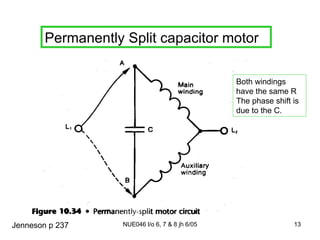
Permanently Split capacitor motor Jenneson p 237 Both windings have the same R The phase shift is due to the C.
Capacitor motors are the most popular type of single phase motor we find in industry. Cap. Start motors have high starting torque and good speed regulation. Cap. Start cap run motors have very high starting torque and very good running torque due to both windings being in circuit while the motor is running. Read carefully Jenneson p235 & 236 & 237. This is important !!
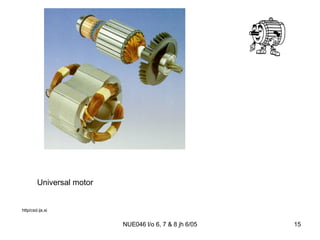
Universal motor http/csd.ijs.si
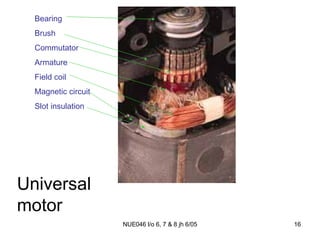
Bearing Brush Commutator Armature Field coil Magnetic circuit Slot insulation Universal motor
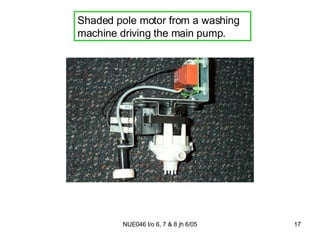
Shaded pole motor from a washing machine driving the main pump.
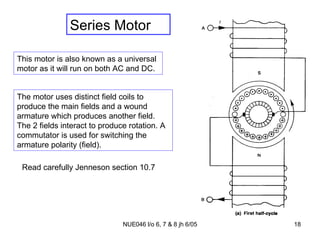
Series Motor This motor is also known as a universal motor as it will run on both AC and DC. Read carefully Jenneson section 10.7 The motor uses distinct field coils to produce the main fields and a wound armature which produces another field. The 2 fields interact to produce rotation. A commutator is used for switching the armature polarity (field).
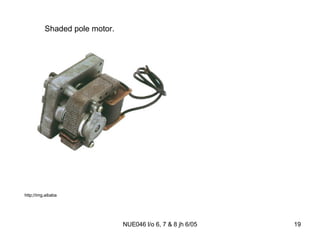
http;//img.aibaba Shaded pole motor.
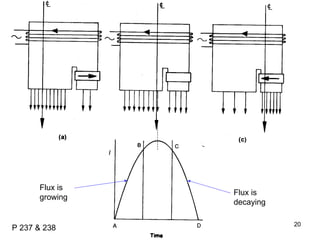
Flux is growing  Flux is decaying P 237 & 238
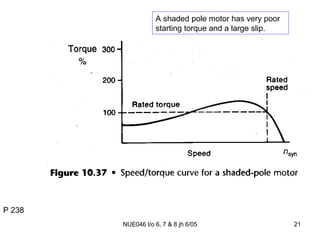
A shaded pole motor has very poor starting torque and a large slip. P 238
Check page 240 table 10.2 for a comparison of 1 phase motors.
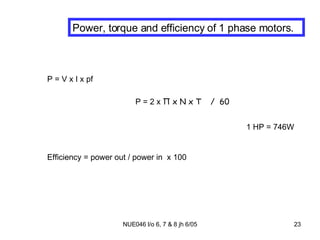
Power, torque and efficiency of 1 phase motors. P = V x I x pf P = 2 x  Π  x N x T  /  60 1 HP = 746W Efficiency = power out / power in  x 100

Alternating Current Machines 6

  • 1.
    Single phase inductionmotors Jenneson chpt 10.6 p 232
  • 2.
    Single phase motorsSplit phase Shaded pole Capacitor motors Universal motors
  • 3.
    Single phase motorsusually have and external starting capacitor. Appliance motor TEFC motor on a resilent mount.
  • 4.
    www.angelfire.com/mo Stator windingfor 1 phase cage motor. Separate start and run windings.
  • 5.
  • 6.
    Cap start caprun motor
  • 7.
    Standard split phasemotor www.delviesplastics.com No capacitor. These rely on inductance between the main and axillary (run/start) windings for the phase shift.
  • 8.
    Cap. Start motordriving a fan in a gas fired burner. Capacitor Fan drum Gas & burner controls.
  • 9.
    To obtain astarting torque there needs to be some angle between the fluxes. This is achieved by a physical (spacial) displacement plus an electrical angle caused by the phase shift due to the added inductance between the windings.
  • 10.
    These fluxes areNOT happening at the same instant in time due to the difference in inductance between the start and run windings.
  • 11.
    The start windingis normally made of finer wire and with fewer turns compared to the run winding. To increase the inductance of the run winding, the run winding is deeper in the core. The run winding has less resistance than the start winding. More current flows in the run winding. Most standard split phase motors have a centrifugal switch to remove the start winding from the circuit after it has run up to about 75% speed. Not all motors have switches, some are designed to leave both windings in the circuit.
  • 12.
    The number ofpoles of the motor is the number of poles of the run winding. A 4 pole single phase motor has 4 run winding poles and 4 start winding poles. 120 f p n = P 233
  • 13.
    Permanently Split capacitormotor Jenneson p 237 Both windings have the same R The phase shift is due to the C.
  • 14.
    Capacitor motors arethe most popular type of single phase motor we find in industry. Cap. Start motors have high starting torque and good speed regulation. Cap. Start cap run motors have very high starting torque and very good running torque due to both windings being in circuit while the motor is running. Read carefully Jenneson p235 & 236 & 237. This is important !!
  • 15.
  • 16.
    Bearing Brush CommutatorArmature Field coil Magnetic circuit Slot insulation Universal motor
  • 17.
    Shaded pole motorfrom a washing machine driving the main pump.
  • 18.
    Series Motor Thismotor is also known as a universal motor as it will run on both AC and DC. Read carefully Jenneson section 10.7 The motor uses distinct field coils to produce the main fields and a wound armature which produces another field. The 2 fields interact to produce rotation. A commutator is used for switching the armature polarity (field).
  • 19.
  • 20.
    Flux is growing Flux is decaying P 237 & 238
  • 21.
    A shaded polemotor has very poor starting torque and a large slip. P 238
  • 22.
    Check page 240table 10.2 for a comparison of 1 phase motors.
  • 23.
    Power, torque andefficiency of 1 phase motors. P = V x I x pf P = 2 x Π x N x T / 60 1 HP = 746W Efficiency = power out / power in x 100