Classification of single-
      phase induction motor
     (Starting methods of 1Ф
         induction motor)

9/28/2011       PRB/EEE Dept/SCE   1
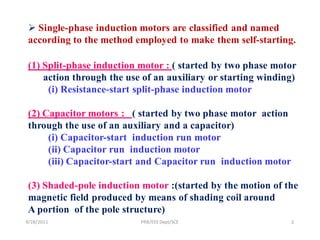
 Single-phase induction motors are classified and named
 according to the method employed to make them self-starting.

 (1) Split-phase induction motor : ( started by two phase motor
     action through the use of an auxiliary or starting winding)
      (i) Resistance-start split-phase induction motor

 (2) Capacitor motors : ( started by two phase motor action
 through the use of an auxiliary and a capacitor)
      (i) Capacitor-start induction run motor
      (ii) Capacitor run induction motor
      (iii) Capacitor-start and Capacitor run induction motor

 (3) Shaded-pole induction motor :(started by the motion of the
 magnetic field produced by means of shading coil around
 A portion of the pole structure)
9/28/2011                  PRB/EEE Dept/SCE                     2
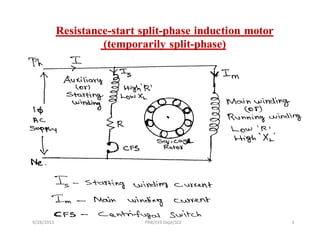
Resistance-start split-phase induction motor
                     (temporarily split-phase)


9/28/2011                     PRB/EEE Dept/SCE             3
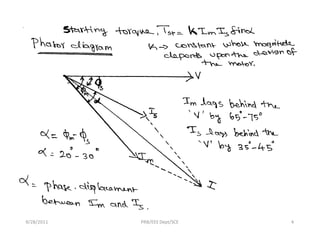
9/28/2011   PRB/EEE Dept/SCE   4
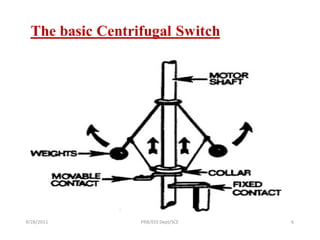
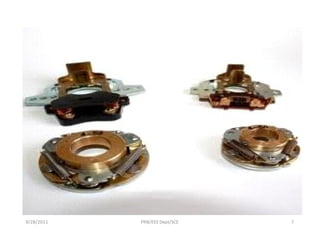
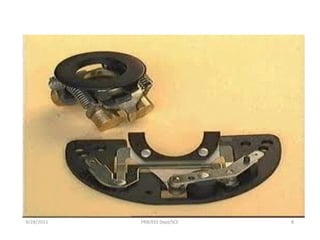
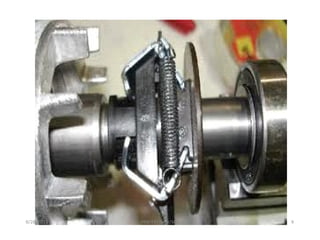
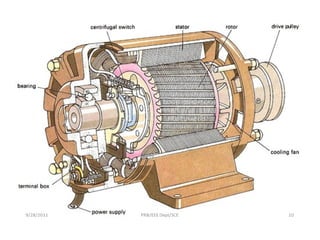
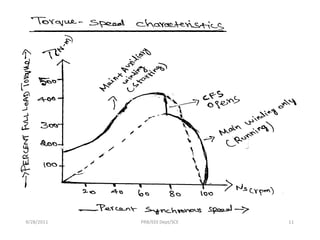
Centrifugal switch- operation

     It is connected in series with the auxiliary
winding and mounted on the rotor shaft. When
the motor started and reaches 75% of
synchronous speed, CFS is mechanically
opened and in running condition auxiliary
winding remains cutout from the circuit.
Therefore, the motor runs only with main
winding.


9/28/2011           PRB/EEE Dept/SCE           5
The basic Centrifugal Switch


9/28/2011         PRB/EEE Dept/SCE   6
9/28/2011   PRB/EEE Dept/SCE   7
9/28/2011   PRB/EEE Dept/SCE   8
9/28/2011   PRB/EEE Dept/SCE   9
9/28/2011   PRB/EEE Dept/SCE   10
9/28/2011   PRB/EEE Dept/SCE   11
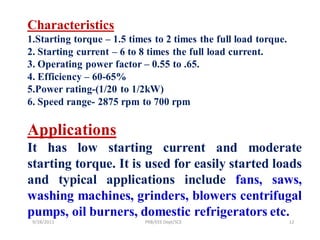
Characteristics
1.Starting torque – 1.5 times to 2 times the full load torque.
2. Starting current – 6 to 8 times the full load current.
3. Operating power factor – 0.55 to .65.
4. Efficiency – 60-65%
5.Power rating-(1/20 to 1/2kW)
6. Speed range- 2875 rpm to 700 rpm

Applications
It has low starting current and moderate
starting torque. It is used for easily started loads
and typical applications include fans, saws,
washing machines, grinders, blowers centrifugal
pumps, oil burners, domestic refrigerators etc.
 9/28/2011                  PRB/EEE Dept/SCE                     12
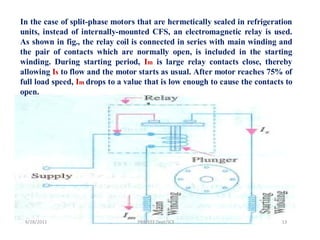
In the case of split-phase motors that are hermetically sealed in refrigeration
units, instead of internally-mounted CFS, an electromagnetic relay is used.
As shown in fig., the relay coil is connected in series with main winding and
the pair of contacts which are normally open, is included in the starting
winding. During starting period, Im is large relay contacts close, thereby
allowing Is to flow and the motor starts as usual. After motor reaches 75% of
full load speed, Im drops to a value that is low enough to cause the contacts to
open.


 9/28/2011                        PRB/EEE Dept/SCE                          13
Reversal of direction of rotation              – may be
reversed by reversing the line connections of either the
main winding or the starting winding only when it is at
rest.

   If reversal is attempted under running conditions,
nothing will happen because under normal operating
conditions the starting switch (CFS or RELAY) is in
open position and the motor is running as a pure 1Ф
induction motor and developing torque in the direction
of rotation.


 9/28/2011              PRB/EEE Dept/SCE             14
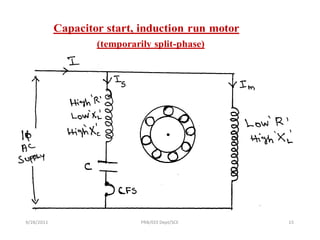
Capacitor start, induction run motor
                    (temporarily split-phase)


9/28/2011                     PRB/EEE Dept/SCE     15
9/28/2011   PRB/EEE Dept/SCE   16
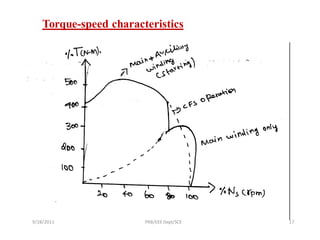
Torque-speed characteristics


9/28/2011               PRB/EEE Dept/SCE   17
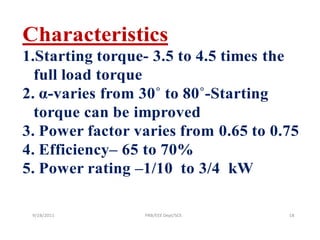
Characteristics
1.Starting torque- 3.5 to 4.5 times the
  full load torque
2. α-varies from 30˚ to 80˚-Starting
  torque can be improved
3. Power factor varies from 0.65 to 0.75
4. Efficiency– 65 to 70%
5. Power rating –1/10 to 3/4 kW

 9/28/2011       PRB/EEE Dept/SCE     18
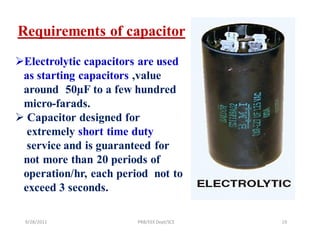
Requirements of capacitor
Electrolytic capacitors are used
 as starting capacitors ,value
 around 50µF to a few hundred
 micro-farads.
 Capacitor designed for
  extremely short time duty
  service and is guaranteed for
 not more than 20 periods of
 operation/hr, each period not to
 exceed 3 seconds.

 9/28/2011              PRB/EEE Dept/SCE   19
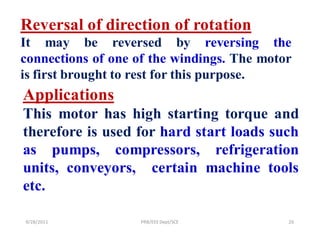
Reversal of direction of rotation
It may be reversed by reversing the
connections of one of the windings. The motor
is first brought to rest for this purpose.
Applications
This motor has high starting torque and
therefore is used for hard start loads such
as pumps, compressors, refrigeration
units, conveyors, certain machine tools
etc.

9/28/2011          PRB/EEE Dept/SCE         20
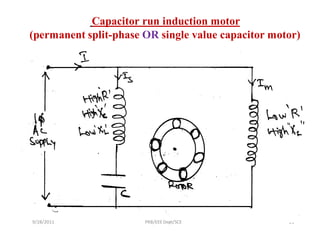
Capacitor run induction motor
(permanent split-phase OR single value capacitor motor)


9/28/2011              PRB/EEE Dept/SCE             21
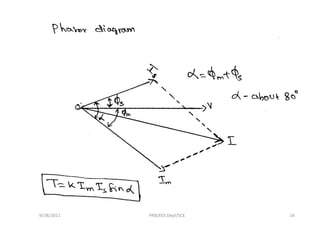
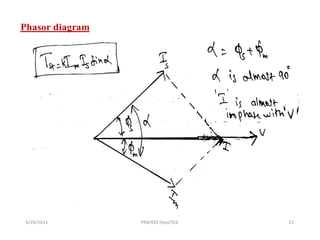
Phasor diagram


 9/28/2011       PRB/EEE Dept/SCE   22
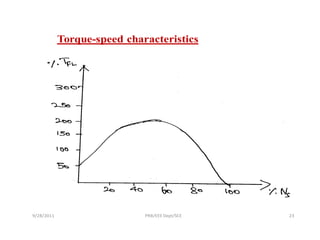
Torque-speed characteristics


9/28/2011                    PRB/EEE Dept/SCE   23
Characteristics
 1.Starting torque-0.5 to 0.8 times the full load
   torque.
 2.Higher power factor-0.8 t0 0.95
 3. Efficiency -55 to 65%
 4.Smaller full load current
 5.Power rating – 1/20 to 3/4 HP


9/28/2011            PRB/EEE Dept/SCE           24
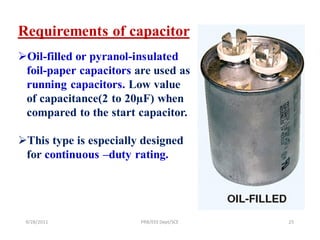
Requirements of capacitor
Oil-filled or pyranol-insulated
 foil-paper capacitors are used as
 running capacitors. Low value
 of capacitance(2 to 20µF) when
 compared to the start capacitor.

This type is especially designed
 for continuous –duty rating.


 9/28/2011              PRB/EEE Dept/SCE   25
Reversal of direction of rotation
It may be reversed by reversing the connections
of one of the winding. Reversing operation can
be done under running condition is possible.
Applications
It is used for both easy and hard to start loads.
Such motors are widely used in table and ceiling
fans, air circulators, hand blowers and other
portable tools etc. Because of the simplicity of
reversal, such motors are often used to operate
devices such as induction regulators, rheostats,
furnace valve control and arc welding control.
9/28/2011           PRB/EEE Dept/SCE          26
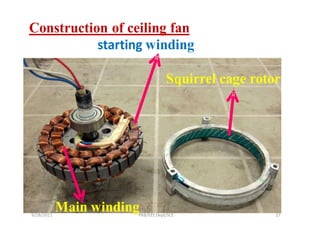
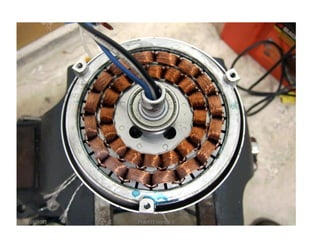
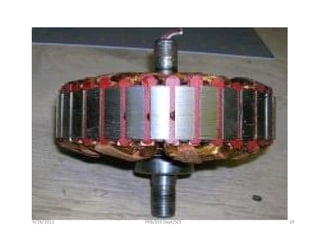
Construction of ceiling fan
           starting winding

                                   Squirrel cage rotor


9/28/2011
            Main winding
                       PRB/EEE Dept/SCE              27
9/28/2011   PRB/EEE Dept/SCE   28
9/28/2011   PRB/EEE Dept/SCE   29
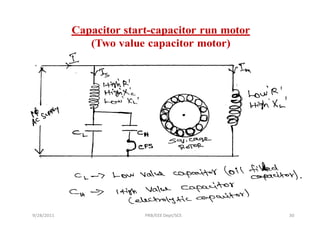
Capacitor start-capacitor run motor
               (Two value capacitor motor)


9/28/2011                 PRB/EEE Dept/SCE        30
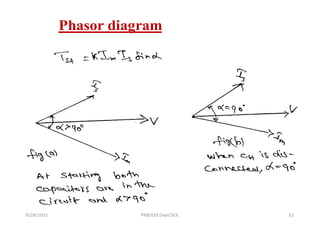
Phasor diagram


9/28/2011              PRB/EEE Dept/SCE   31
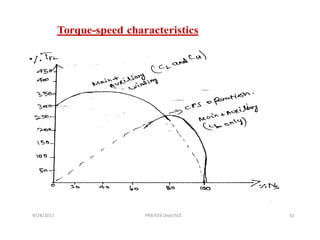
Torque-speed characteristics


9/28/2011                    PRB/EEE Dept/SCE   32
Characteristics
 1.Starting torque – 3 to 3.5 times the
   full load torque.
 2. Efficiency – 60% approx.
 3. Power factor-0.9 approx.
 4. Power rating- 1/8 to 3/4 HP
 5. Pull out torque- up to 260% of
   rated torque

9/28/2011        PRB/EEE Dept/SCE     33
Reversal of direction of rotation
  The direction of rotation of motor may be
  reversed by interchanging the connections to
  the supply of either the main winding or
  auxiliary winding.
Applications
It combines the advantages of capacitor start
and permanent-capacitors and is used for hard
to start loads such as compressors, refrigerators,
pumps, conveyors etc. These motors are often
employed requiring a quite operating motor
such as in hospitals, studios etc.
 9/28/2011           PRB/EEE Dept/SCE          34
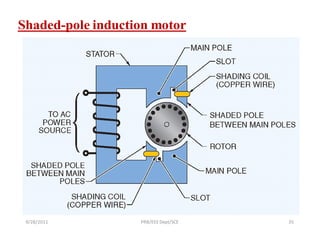
Shaded-pole induction motor


 9/28/2011         PRB/EEE Dept/SCE   35
9/28/2011   PRB/EEE Dept/SCE   36
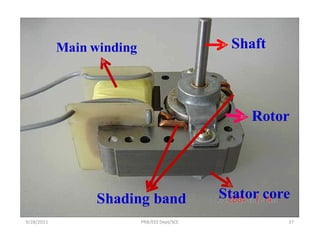
Main winding                       Shaft


                                                   Rotor


                  Shading band                Stator core
9/28/2011                  PRB/EEE Dept/SCE             37
9/28/2011   PRB/EEE Dept/SCE   38
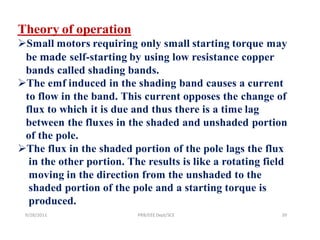
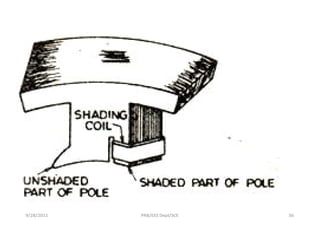
Theory of operation
Small motors requiring only small starting torque may
 be made self-starting by using low resistance copper
 bands called shading bands.
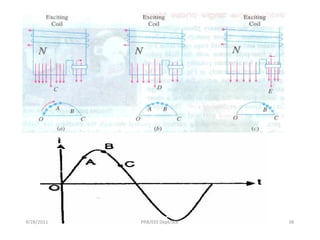
The emf induced in the shading band causes a current
 to flow in the band. This current opposes the change of
 flux to which it is due and thus there is a time lag
 between the fluxes in the shaded and unshaded portion
 of the pole.
The flux in the shaded portion of the pole lags the flux
  in the other portion. The results is like a rotating field
  moving in the direction from the unshaded to the
  shaded portion of the pole and a starting torque is
  produced.
 9/28/2011                PRB/EEE Dept/SCE                39
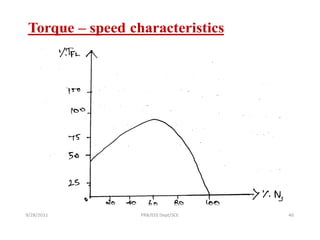
Torque – speed characteristics


9/28/2011         PRB/EEE Dept/SCE   40
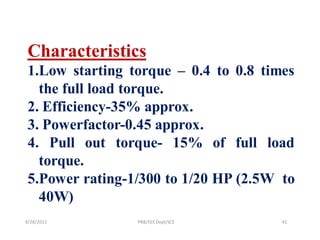
Characteristics
 1.Low starting torque – 0.4 to 0.8 times
   the full load torque.
 2. Efficiency-35% approx.
 3. Powerfactor-0.45 approx.
 4. Pull out torque- 15% of full load
   torque.
 5.Power rating-1/300 to 1/20 HP (2.5W to
   40W)
9/28/2011        PRB/EEE Dept/SCE      41
Reversal of direction of rotation
The direction of rotation depends upon
the position of the shading coil on the
pole. i.e., unless the machine is
constructed so that the shading coil can be
shifted to the other side of pole, the
direction of rotation of such a machine
cannot be reversed.

9/28/2011         PRB/EEE Dept/SCE       42
Applications
Because of their poor starting torque,
low power factor and poor efficiency
such motors are only suitable for low
power applications such as for toys,
portable fans , electric clocks, hair
dryers, slide projectors, humidifiers,
small business machines such        as
photo copying machines, vending
machines, advertising displays etc.
9/28/2011       PRB/EEE Dept/SCE    43

Singletypes

  • 1.
    Classification of single- phase induction motor (Starting methods of 1Ф induction motor) 9/28/2011 PRB/EEE Dept/SCE 1
  • 2.
     Single-phase inductionmotors are classified and named according to the method employed to make them self-starting. (1) Split-phase induction motor : ( started by two phase motor action through the use of an auxiliary or starting winding) (i) Resistance-start split-phase induction motor (2) Capacitor motors : ( started by two phase motor action through the use of an auxiliary and a capacitor) (i) Capacitor-start induction run motor (ii) Capacitor run induction motor (iii) Capacitor-start and Capacitor run induction motor (3) Shaded-pole induction motor :(started by the motion of the magnetic field produced by means of shading coil around A portion of the pole structure) 9/28/2011 PRB/EEE Dept/SCE 2
  • 3.
    Resistance-start split-phase inductionmotor (temporarily split-phase) 9/28/2011 PRB/EEE Dept/SCE 3
  • 4.
    9/28/2011 PRB/EEE Dept/SCE 4
  • 5.
    Centrifugal switch- operation It is connected in series with the auxiliary winding and mounted on the rotor shaft. When the motor started and reaches 75% of synchronous speed, CFS is mechanically opened and in running condition auxiliary winding remains cutout from the circuit. Therefore, the motor runs only with main winding. 9/28/2011 PRB/EEE Dept/SCE 5
  • 6.
    The basic CentrifugalSwitch 9/28/2011 PRB/EEE Dept/SCE 6
  • 7.
    9/28/2011 PRB/EEE Dept/SCE 7
  • 8.
    9/28/2011 PRB/EEE Dept/SCE 8
  • 9.
    9/28/2011 PRB/EEE Dept/SCE 9
  • 10.
    9/28/2011 PRB/EEE Dept/SCE 10
  • 11.
    9/28/2011 PRB/EEE Dept/SCE 11
  • 12.
    Characteristics 1.Starting torque –1.5 times to 2 times the full load torque. 2. Starting current – 6 to 8 times the full load current. 3. Operating power factor – 0.55 to .65. 4. Efficiency – 60-65% 5.Power rating-(1/20 to 1/2kW) 6. Speed range- 2875 rpm to 700 rpm Applications It has low starting current and moderate starting torque. It is used for easily started loads and typical applications include fans, saws, washing machines, grinders, blowers centrifugal pumps, oil burners, domestic refrigerators etc. 9/28/2011 PRB/EEE Dept/SCE 12
  • 13.
    In the caseof split-phase motors that are hermetically sealed in refrigeration units, instead of internally-mounted CFS, an electromagnetic relay is used. As shown in fig., the relay coil is connected in series with main winding and the pair of contacts which are normally open, is included in the starting winding. During starting period, Im is large relay contacts close, thereby allowing Is to flow and the motor starts as usual. After motor reaches 75% of full load speed, Im drops to a value that is low enough to cause the contacts to open. 9/28/2011 PRB/EEE Dept/SCE 13
  • 14.
    Reversal of directionof rotation – may be reversed by reversing the line connections of either the main winding or the starting winding only when it is at rest. If reversal is attempted under running conditions, nothing will happen because under normal operating conditions the starting switch (CFS or RELAY) is in open position and the motor is running as a pure 1Ф induction motor and developing torque in the direction of rotation. 9/28/2011 PRB/EEE Dept/SCE 14
  • 15.
    Capacitor start, inductionrun motor (temporarily split-phase) 9/28/2011 PRB/EEE Dept/SCE 15
  • 16.
    9/28/2011 PRB/EEE Dept/SCE 16
  • 17.
  • 18.
    Characteristics 1.Starting torque- 3.5to 4.5 times the full load torque 2. α-varies from 30˚ to 80˚-Starting torque can be improved 3. Power factor varies from 0.65 to 0.75 4. Efficiency– 65 to 70% 5. Power rating –1/10 to 3/4 kW 9/28/2011 PRB/EEE Dept/SCE 18
  • 19.
    Requirements of capacitor Electrolyticcapacitors are used as starting capacitors ,value around 50µF to a few hundred micro-farads.  Capacitor designed for extremely short time duty service and is guaranteed for not more than 20 periods of operation/hr, each period not to exceed 3 seconds. 9/28/2011 PRB/EEE Dept/SCE 19
  • 20.
    Reversal of directionof rotation It may be reversed by reversing the connections of one of the windings. The motor is first brought to rest for this purpose. Applications This motor has high starting torque and therefore is used for hard start loads such as pumps, compressors, refrigeration units, conveyors, certain machine tools etc. 9/28/2011 PRB/EEE Dept/SCE 20
  • 21.
    Capacitor run inductionmotor (permanent split-phase OR single value capacitor motor) 9/28/2011 PRB/EEE Dept/SCE 21
  • 22.
    Phasor diagram 9/28/2011 PRB/EEE Dept/SCE 22
  • 23.
  • 24.
    Characteristics 1.Starting torque-0.5to 0.8 times the full load torque. 2.Higher power factor-0.8 t0 0.95 3. Efficiency -55 to 65% 4.Smaller full load current 5.Power rating – 1/20 to 3/4 HP 9/28/2011 PRB/EEE Dept/SCE 24
  • 25.
    Requirements of capacitor Oil-filledor pyranol-insulated foil-paper capacitors are used as running capacitors. Low value of capacitance(2 to 20µF) when compared to the start capacitor. This type is especially designed for continuous –duty rating. 9/28/2011 PRB/EEE Dept/SCE 25
  • 26.
    Reversal of directionof rotation It may be reversed by reversing the connections of one of the winding. Reversing operation can be done under running condition is possible. Applications It is used for both easy and hard to start loads. Such motors are widely used in table and ceiling fans, air circulators, hand blowers and other portable tools etc. Because of the simplicity of reversal, such motors are often used to operate devices such as induction regulators, rheostats, furnace valve control and arc welding control. 9/28/2011 PRB/EEE Dept/SCE 26
  • 27.
    Construction of ceilingfan starting winding Squirrel cage rotor 9/28/2011 Main winding PRB/EEE Dept/SCE 27
  • 28.
    9/28/2011 PRB/EEE Dept/SCE 28
  • 29.
    9/28/2011 PRB/EEE Dept/SCE 29
  • 30.
    Capacitor start-capacitor runmotor (Two value capacitor motor) 9/28/2011 PRB/EEE Dept/SCE 30
  • 31.
    Phasor diagram 9/28/2011 PRB/EEE Dept/SCE 31
  • 32.
  • 33.
    Characteristics 1.Starting torque– 3 to 3.5 times the full load torque. 2. Efficiency – 60% approx. 3. Power factor-0.9 approx. 4. Power rating- 1/8 to 3/4 HP 5. Pull out torque- up to 260% of rated torque 9/28/2011 PRB/EEE Dept/SCE 33
  • 34.
    Reversal of directionof rotation The direction of rotation of motor may be reversed by interchanging the connections to the supply of either the main winding or auxiliary winding. Applications It combines the advantages of capacitor start and permanent-capacitors and is used for hard to start loads such as compressors, refrigerators, pumps, conveyors etc. These motors are often employed requiring a quite operating motor such as in hospitals, studios etc. 9/28/2011 PRB/EEE Dept/SCE 34
  • 35.
    Shaded-pole induction motor 9/28/2011 PRB/EEE Dept/SCE 35
  • 36.
    9/28/2011 PRB/EEE Dept/SCE 36
  • 37.
    Main winding Shaft Rotor Shading band Stator core 9/28/2011 PRB/EEE Dept/SCE 37
  • 38.
    9/28/2011 PRB/EEE Dept/SCE 38
  • 39.
    Theory of operation Smallmotors requiring only small starting torque may be made self-starting by using low resistance copper bands called shading bands. The emf induced in the shading band causes a current to flow in the band. This current opposes the change of flux to which it is due and thus there is a time lag between the fluxes in the shaded and unshaded portion of the pole. The flux in the shaded portion of the pole lags the flux in the other portion. The results is like a rotating field moving in the direction from the unshaded to the shaded portion of the pole and a starting torque is produced. 9/28/2011 PRB/EEE Dept/SCE 39
  • 40.
    Torque – speedcharacteristics 9/28/2011 PRB/EEE Dept/SCE 40
  • 41.
    Characteristics 1.Low startingtorque – 0.4 to 0.8 times the full load torque. 2. Efficiency-35% approx. 3. Powerfactor-0.45 approx. 4. Pull out torque- 15% of full load torque. 5.Power rating-1/300 to 1/20 HP (2.5W to 40W) 9/28/2011 PRB/EEE Dept/SCE 41
  • 42.
    Reversal of directionof rotation The direction of rotation depends upon the position of the shading coil on the pole. i.e., unless the machine is constructed so that the shading coil can be shifted to the other side of pole, the direction of rotation of such a machine cannot be reversed. 9/28/2011 PRB/EEE Dept/SCE 42
  • 43.
    Applications Because of theirpoor starting torque, low power factor and poor efficiency such motors are only suitable for low power applications such as for toys, portable fans , electric clocks, hair dryers, slide projectors, humidifiers, small business machines such as photo copying machines, vending machines, advertising displays etc. 9/28/2011 PRB/EEE Dept/SCE 43