PHYSICS
INVESTIGATORY
PROJECT
DETERMINING THE SPECIFIC HEAT
OF DIFFERENT LIQUID’S USING
JOULE’S CALORIMETER
NIRANJAN.S
XII – C
2023 -2024
CERTIFICATE
This is to certify that NIRANJAN.S of CLASS 12 has successfully
completed her physics project ‘DETERMINING THE
SPECIFIC HEAT CAPACITY OF DIFFERENT LIQUID USING JOULE’S
CALORIMETER’ prescribed by the Central Board of Secondary
Education towards the partial fulfilment of AISSCE course during
the academic year 2023-24.
This project Is certified to be the Bonafide work of the student.
TEACHER INCHARGE EXTERNAL EXAMINER
INTERNAL EXAMINER PRINCIPAL
DATE :
ACKNOWLEDGMENT
Firstly, I would like to think the director Mr. Vijai Krishna
Rajagopal and our principal, Mrs. Vasuma S Achar for
giving this wonderful opportunity. I would like to express
profound gratitude to our physics teacher, Mrs. Dinesh
Rajan for their invaluable support, encouragement
supervision and useful suggestions throughout this
project work.
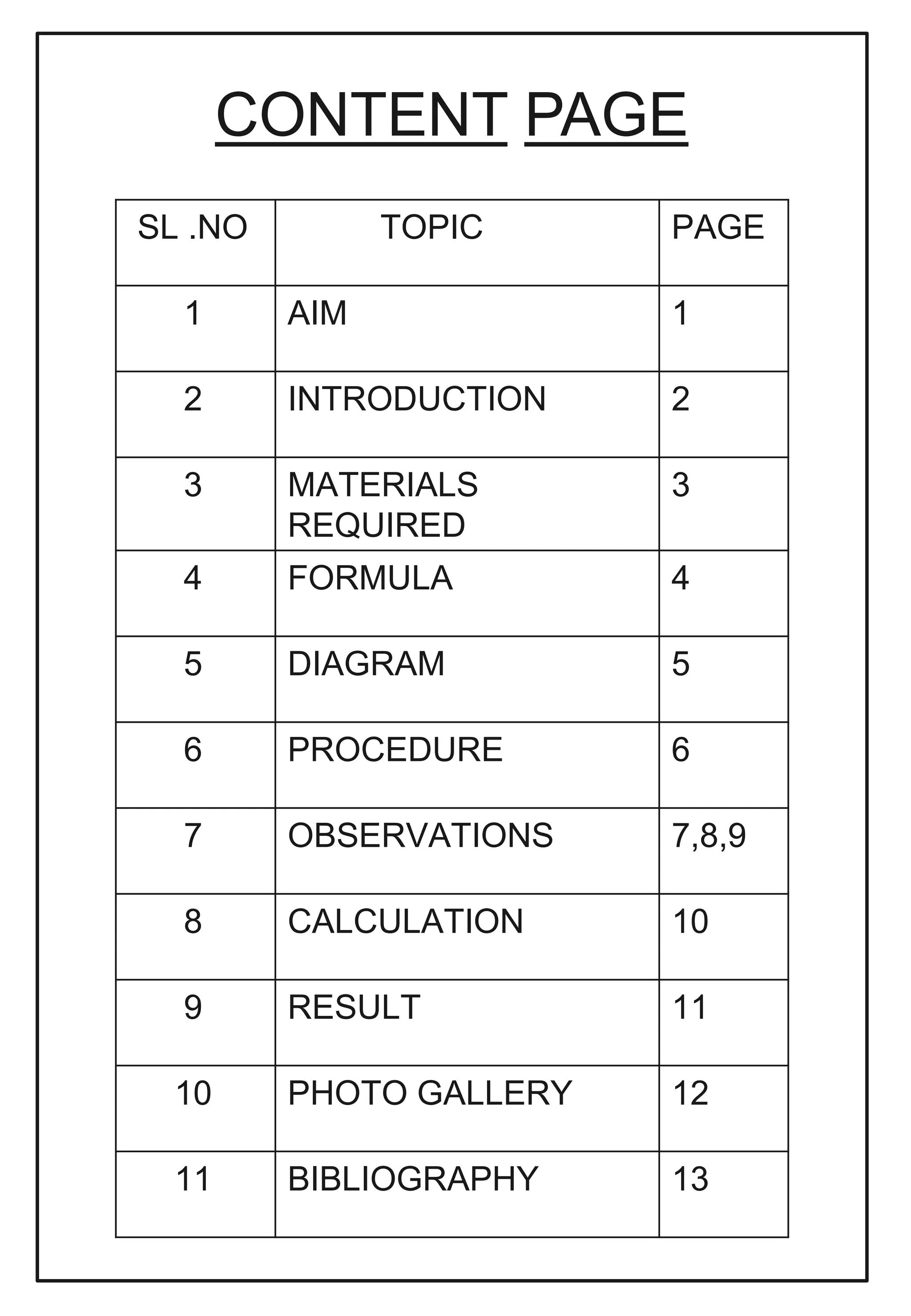
CONTENT PAGE
SL .NO TOPIC PAGE
1 AIM 1
2 INTRODUCTION 2
3 MATERIALS
REQUIRED
3
4 FORMULA 4
5 DIAGRAM 5
6 PROCEDURE 6
7 OBSERVATIONS 7,8,9
8 CALCULATION 10
9 RESULT 11
10 PHOTO GALLERY 12
11 BIBLIOGRAPHY 13
AIM
TO DETERMINE THE SPECIFIC HEAT OF DIFFERENT
LIQUID’S UDING JOULE’S CALORIMETER
1
INTRODUCTION
Joule’s law is a mathematical description of the rate at
which resistance in a circuit converts electric energy
into heat energy.
The English physicist James Prescott discovered that
the amount of heat per second that develops in a
current-carrying conductor is proportional to the
electrical resistance of the wire and the square of the
current.
In this exeriment, we investigate how the temperature
of the water and calorimeter change with the current
flowing through the heating element. The ends of the
coil are connected to two terminals, fixed to the lid of
the calorimeter. A stirrer and a thermometer T are
inserted through two holes in the lid. Two-thirds of the
volume of the calorimeter is filled with water. The
calorimeter is enclosed in a wooden box to minimize
the loss of heat
2
MATERIALS
REQUIRED
 Joule’s Calorimeter
 Weighing balance
 Battery
 Ammeter
 Voltmeter
 Thermometer
 Rheostat
 Stop clock
 Plug key
 Connecting wires
 Etc
3
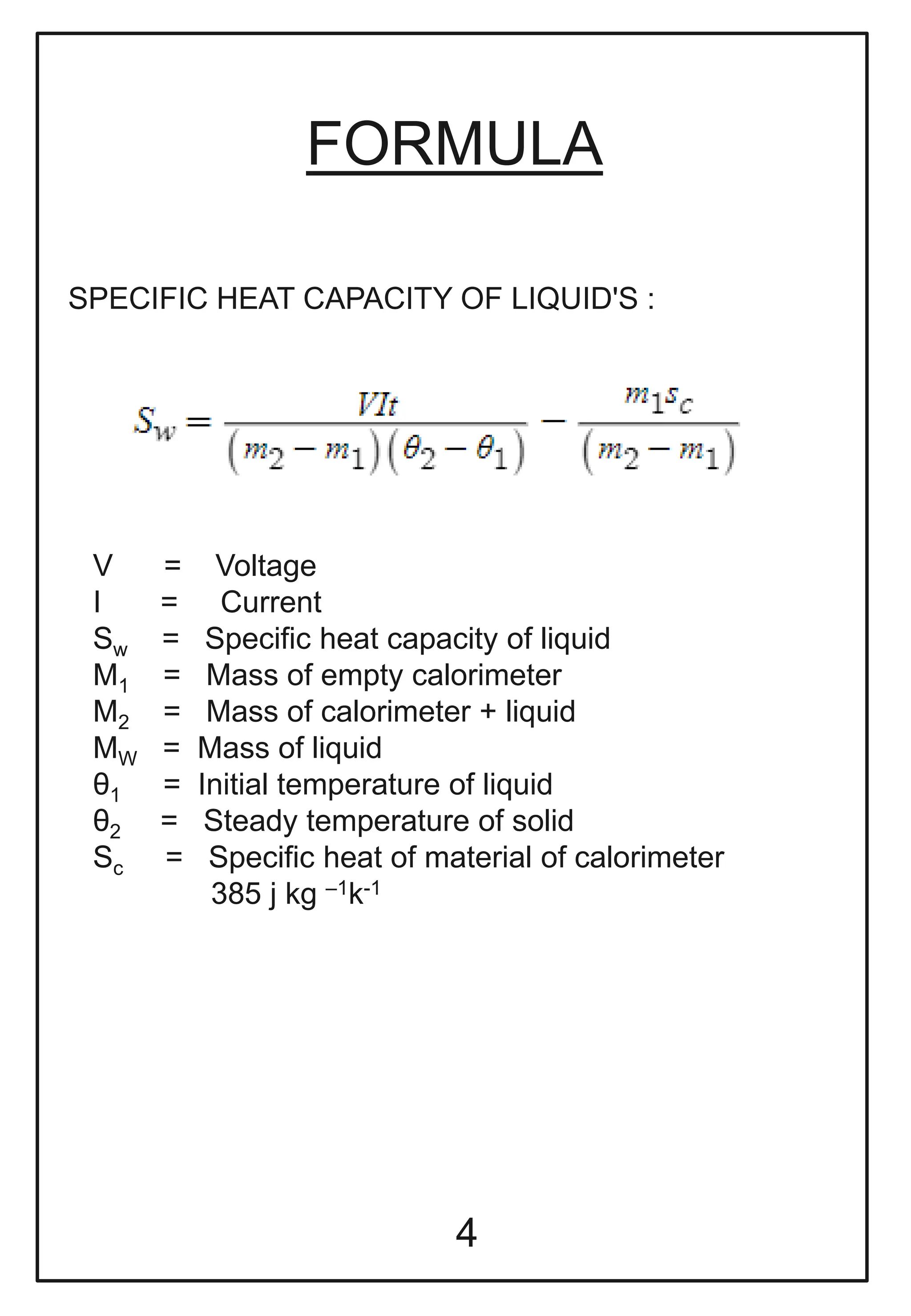
FORMULA
SPECIFIC HEAT CAPACITY OF LIQUID'S :
V = Voltage
I = Current
Sw = Specific heat capacity of liquid
M1 = Mass of empty calorimeter
M2 = Mass of calorimeter + liquid
MW = Mass of liquid
θ1 = Initial temperature of liquid
θ2 = Steady temperature of solid
Sc = Specific heat of material of calorimeter
385 j kg –1k-1
4
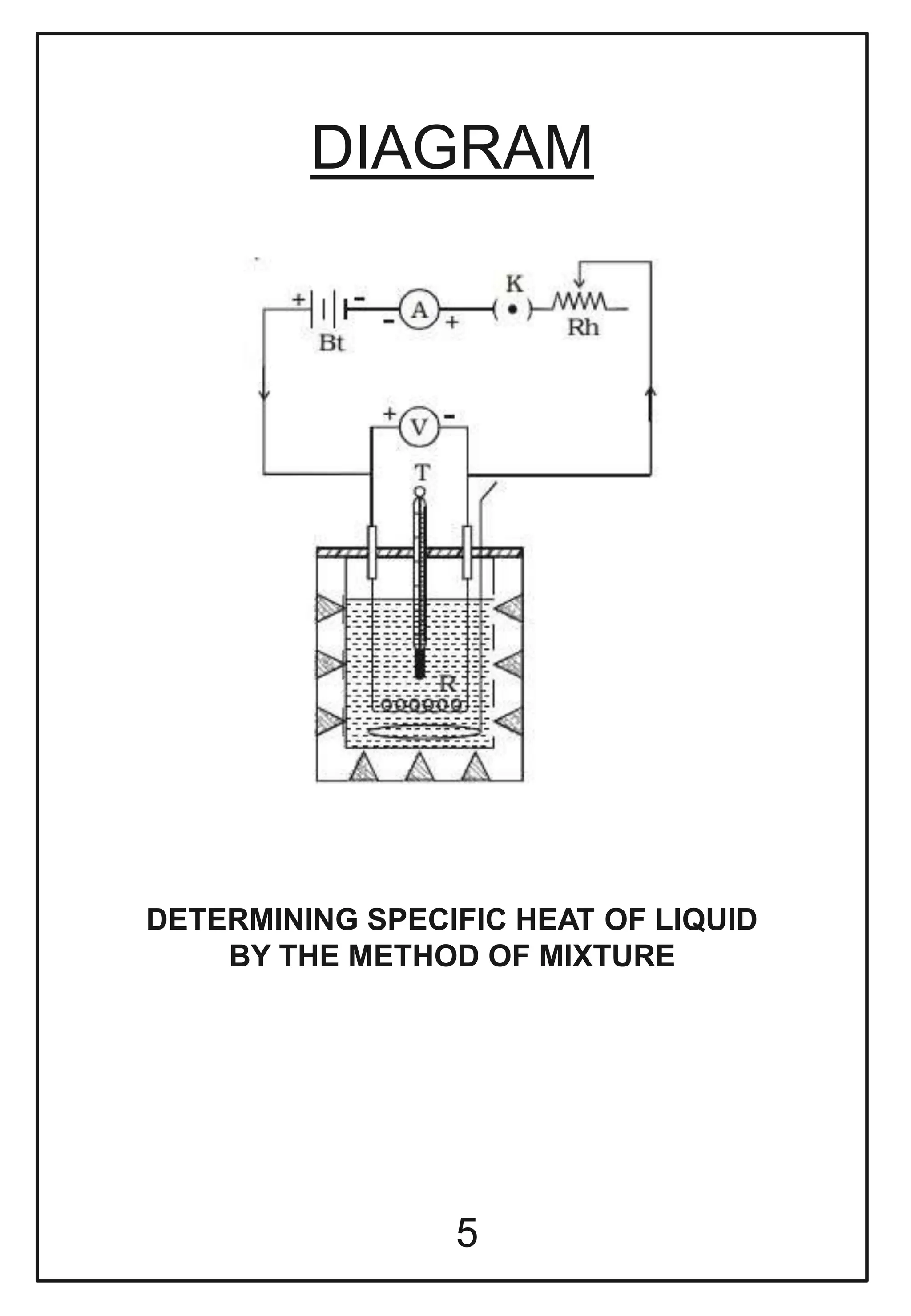
DIAGRAM
DETERMINING SPECIFIC HEAT OF LIQUID
BY THE METHOD OF MIXTURE
5
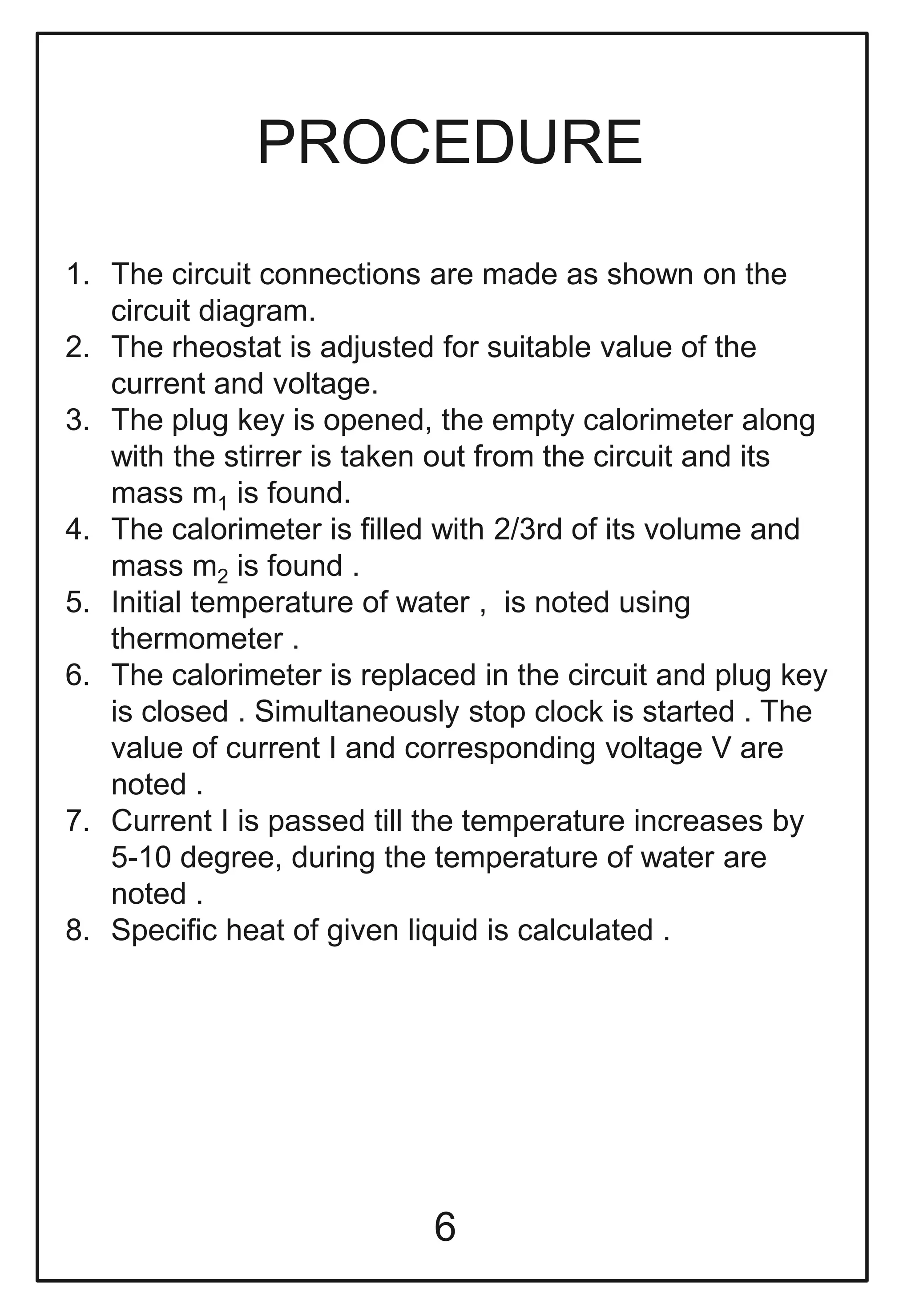
PROCEDURE
1. The circuit connections are made as shown on the
circuit diagram.
2. The rheostat is adjusted for suitable value of the
current and voltage.
3. The plug key is opened, the empty calorimeter along
with the stirrer is taken out from the circuit and its
mass m1 is found.
4. The calorimeter is filled with 2/3rd of its volume and
mass m2 is found .
5. Initial temperature of water , is noted using
thermometer .
6. The calorimeter is replaced in the circuit and plug key
is closed . Simultaneously stop clock is started . The
value of current I and corresponding voltage V are
noted .
7. Current I is passed till the temperature increases by
5-10 degree, during the temperature of water are
noted .
8. Specific heat of given liquid is calculated .
6
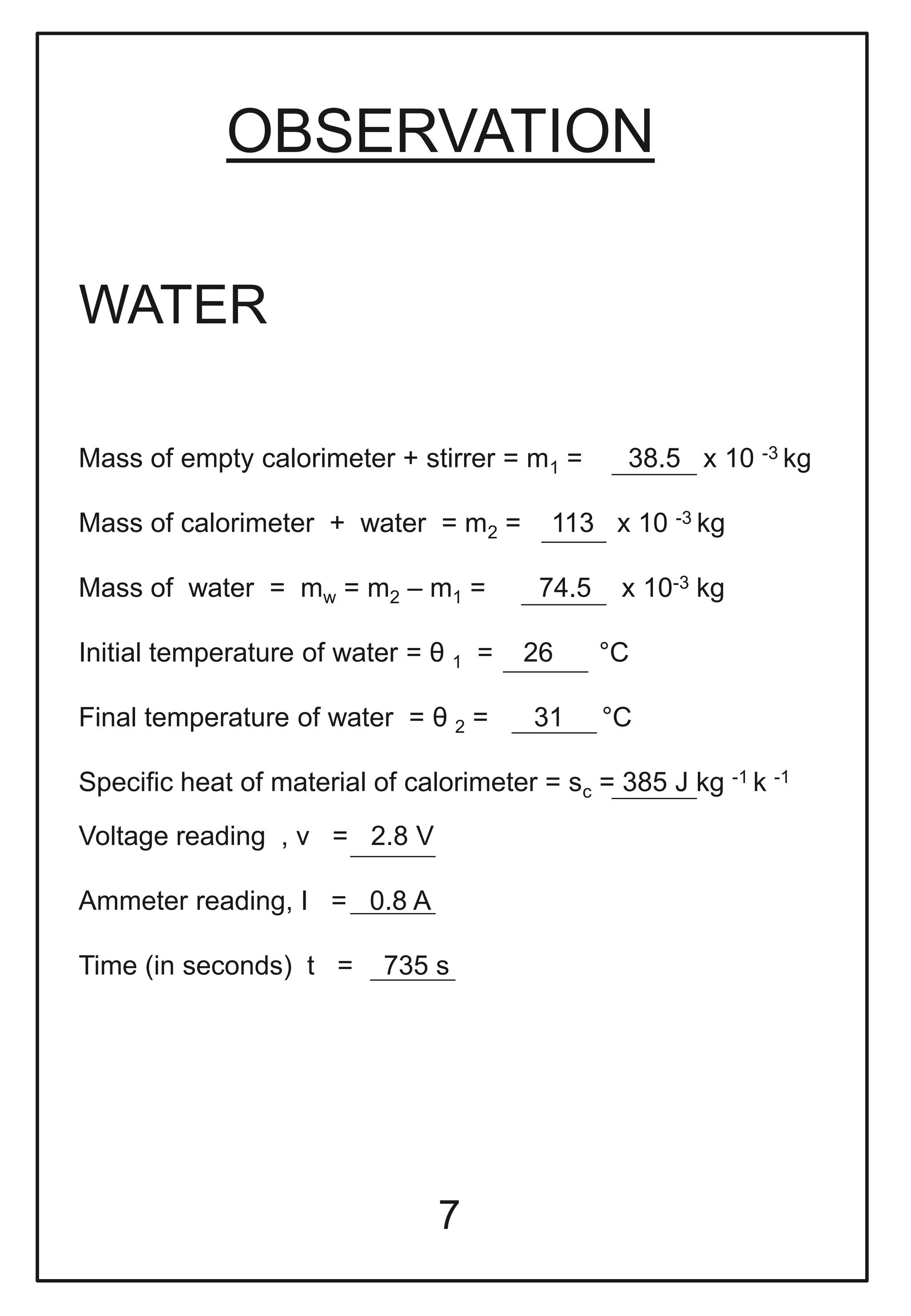
OBSERVATION
7
Mass of empty calorimeter + stirrer = m1 = 38.5 x 10 -3 kg
Mass of calorimeter + water = m2 = 113 x 10 -3 kg
Mass of water = mw = m2 – m1 = 74.5 x 10⁻³ kg
Initial temperature of water = θ 1 = 26 °C
Final temperature of water = θ 2 = 31 °C
Specific heat of material of calorimeter = sc = 385 J kg -1 k -1
Voltage reading , v = 2.8 V
Ammeter reading, I = 0.8 A
Time (in seconds) t = 735 s
WATER
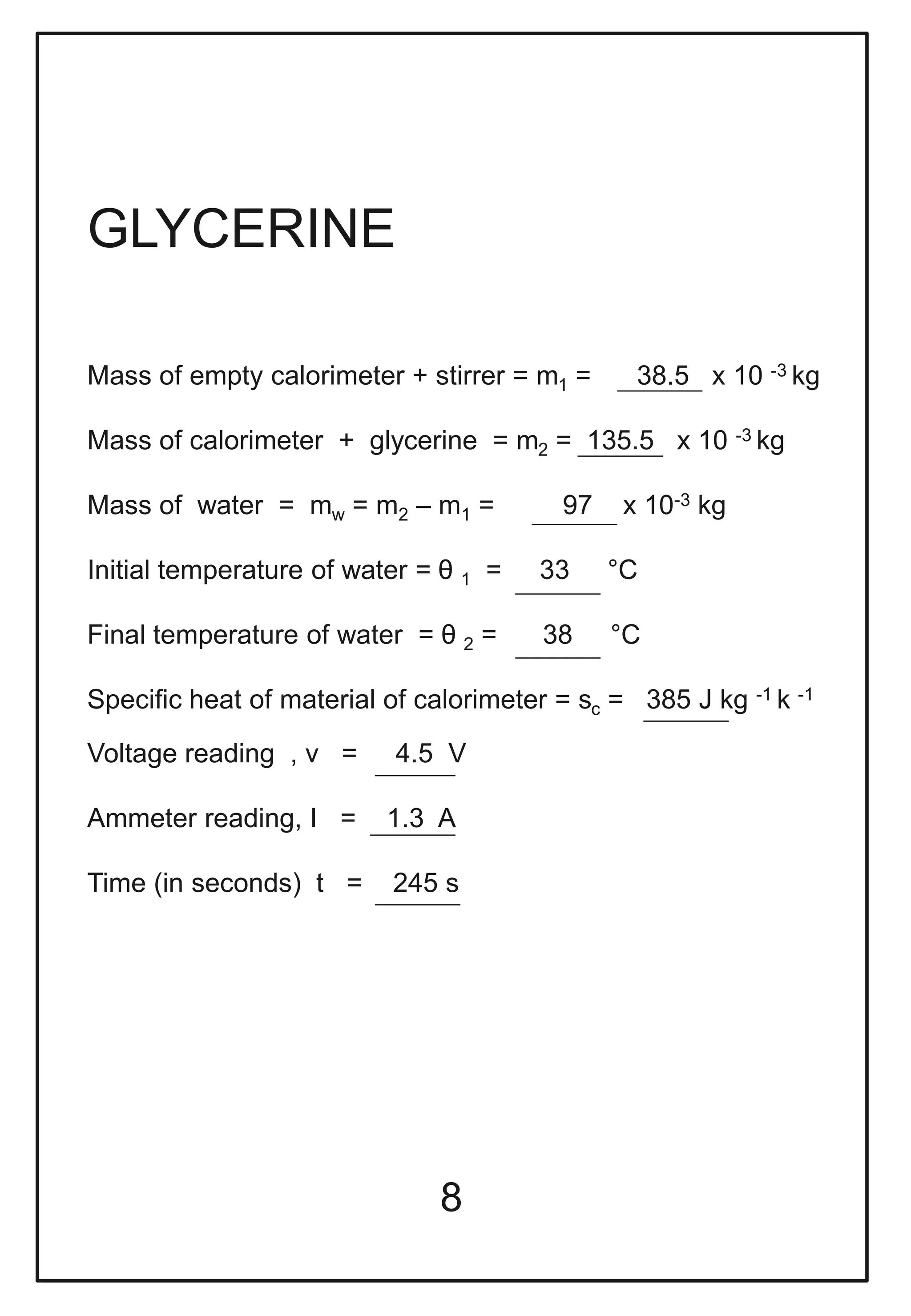
8
GLYCERINE
Mass of empty calorimeter + stirrer = m1 = 38.5 x 10 -3 kg
Mass of calorimeter + glycerine = m2 = 135.5 x 10 -3 kg
Mass of water = mw = m2 – m1 = 97 x 10-3 kg
Initial temperature of water = θ 1 = 33 °C
Final temperature of water = θ 2 = 38 °C
Specific heat of material of calorimeter = sc = 385 J kg -1 k -1
Voltage reading , v = 4.5 V
Ammeter reading, I = 1.3 A
Time (in seconds) t = 245 s
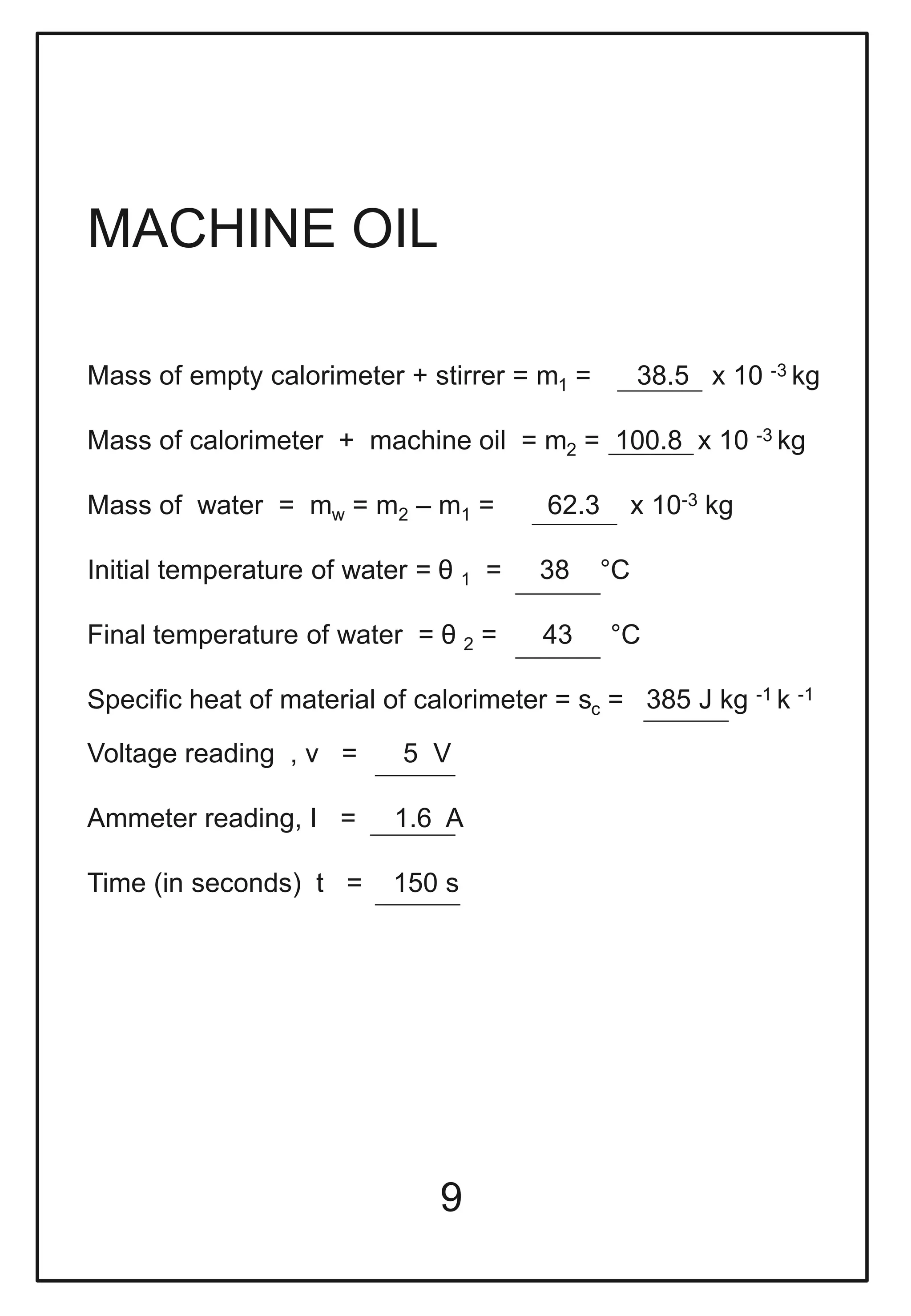
9
MACHINE OIL
Mass of empty calorimeter + stirrer = m1 = 38.5 x 10 -3 kg
Mass of calorimeter + machine oil = m2 = 100.8 x 10 -3 kg
Mass of water = mw = m2 – m1 = 62.3 x 10⁻³ kg
Initial temperature of water = θ 1 = 38 °C
Final temperature of water = θ 2 = 43 °C
Specific heat of material of calorimeter = sc = 385 J kg -1 k -1
Voltage reading , v = 5 V
Ammeter reading, I = 1.6 A
Time (in seconds) t = 150 s
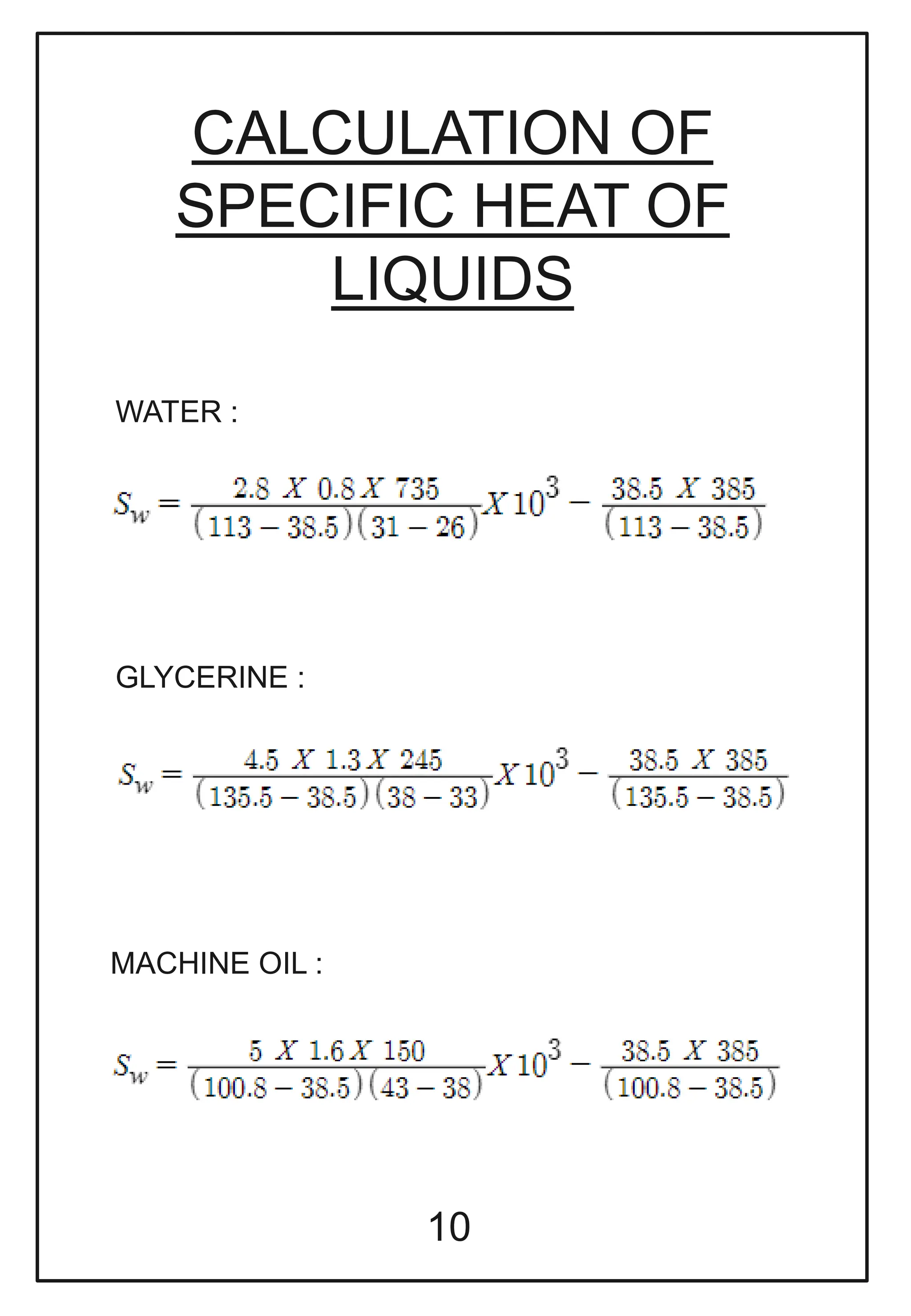
CALCULATION OF
SPECIFIC HEAT OF
LIQUIDS
10
WATER :
GLYCERINE :
MACHINE OIL :
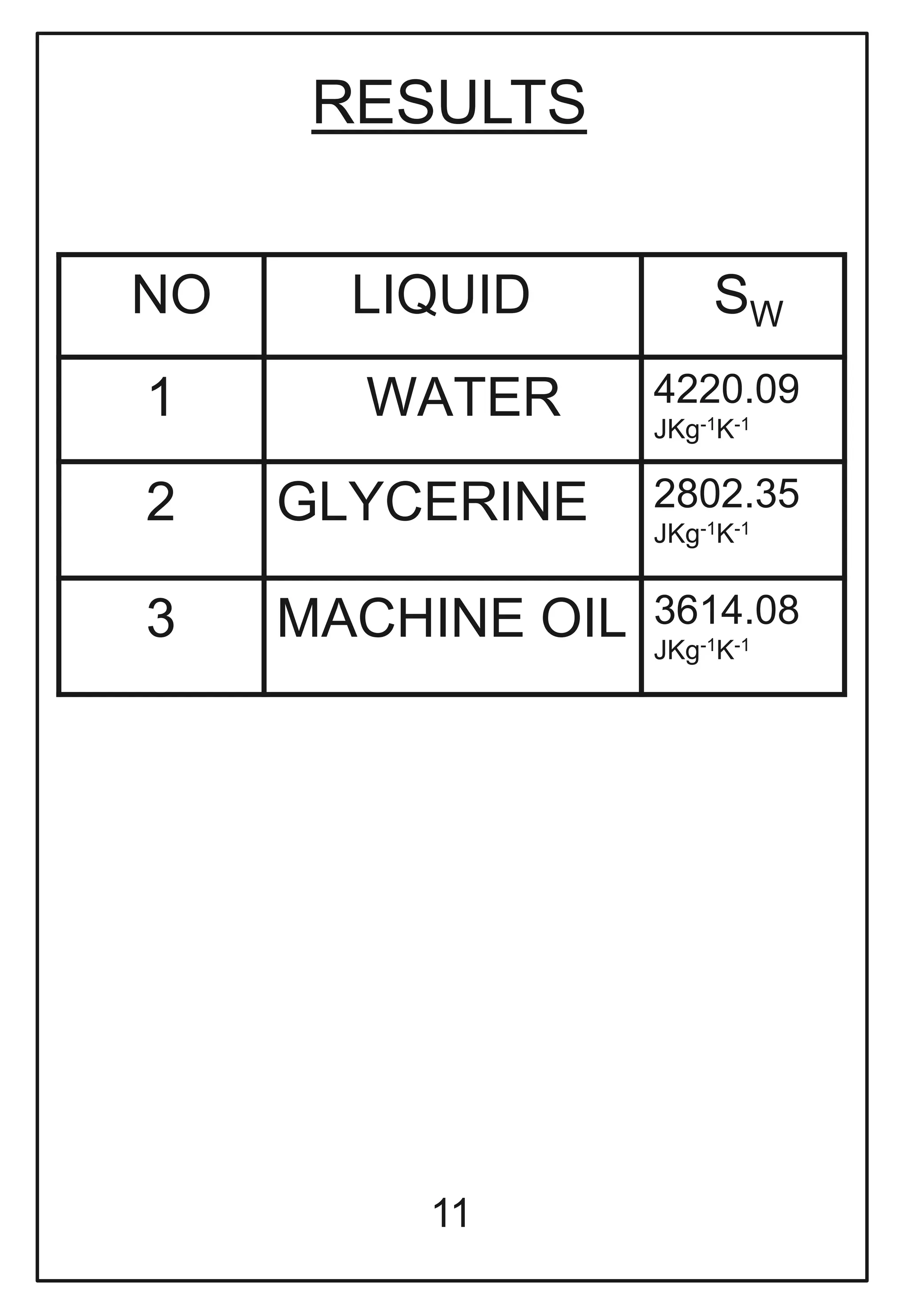
RESULTS
NO LIQUID SW
1 WATER 4220.09
JKg-1K-1
2 GLYCERINE 2802.35
JKg-1K-1
3 MACHINE OIL 3614.08
JKg-1K-1
11
PHOTO GALLERY
12
BIBLIOGRAPHY
 NCERT TEXTBOOK
 WWW.THERMTEST.COM
 WWW.BYJUS.COM
 WWW.VEDANTU.COM
13

class 12 physics investigatory project

  • 1.
    PHYSICS INVESTIGATORY PROJECT DETERMINING THE SPECIFICHEAT OF DIFFERENT LIQUID’S USING JOULE’S CALORIMETER NIRANJAN.S XII – C 2023 -2024
  • 2.
    CERTIFICATE This is tocertify that NIRANJAN.S of CLASS 12 has successfully completed her physics project ‘DETERMINING THE SPECIFIC HEAT CAPACITY OF DIFFERENT LIQUID USING JOULE’S CALORIMETER’ prescribed by the Central Board of Secondary Education towards the partial fulfilment of AISSCE course during the academic year 2023-24. This project Is certified to be the Bonafide work of the student. TEACHER INCHARGE EXTERNAL EXAMINER INTERNAL EXAMINER PRINCIPAL DATE :
  • 3.
    ACKNOWLEDGMENT Firstly, I wouldlike to think the director Mr. Vijai Krishna Rajagopal and our principal, Mrs. Vasuma S Achar for giving this wonderful opportunity. I would like to express profound gratitude to our physics teacher, Mrs. Dinesh Rajan for their invaluable support, encouragement supervision and useful suggestions throughout this project work.
  • 4.
    CONTENT PAGE SL .NOTOPIC PAGE 1 AIM 1 2 INTRODUCTION 2 3 MATERIALS REQUIRED 3 4 FORMULA 4 5 DIAGRAM 5 6 PROCEDURE 6 7 OBSERVATIONS 7,8,9 8 CALCULATION 10 9 RESULT 11 10 PHOTO GALLERY 12 11 BIBLIOGRAPHY 13
  • 5.
    AIM TO DETERMINE THESPECIFIC HEAT OF DIFFERENT LIQUID’S UDING JOULE’S CALORIMETER 1
  • 6.
    INTRODUCTION Joule’s law isa mathematical description of the rate at which resistance in a circuit converts electric energy into heat energy. The English physicist James Prescott discovered that the amount of heat per second that develops in a current-carrying conductor is proportional to the electrical resistance of the wire and the square of the current. In this exeriment, we investigate how the temperature of the water and calorimeter change with the current flowing through the heating element. The ends of the coil are connected to two terminals, fixed to the lid of the calorimeter. A stirrer and a thermometer T are inserted through two holes in the lid. Two-thirds of the volume of the calorimeter is filled with water. The calorimeter is enclosed in a wooden box to minimize the loss of heat 2
  • 7.
    MATERIALS REQUIRED  Joule’s Calorimeter Weighing balance  Battery  Ammeter  Voltmeter  Thermometer  Rheostat  Stop clock  Plug key  Connecting wires  Etc 3
  • 8.
    FORMULA SPECIFIC HEAT CAPACITYOF LIQUID'S : V = Voltage I = Current Sw = Specific heat capacity of liquid M1 = Mass of empty calorimeter M2 = Mass of calorimeter + liquid MW = Mass of liquid θ1 = Initial temperature of liquid θ2 = Steady temperature of solid Sc = Specific heat of material of calorimeter 385 j kg –1k-1 4
  • 9.
    DIAGRAM DETERMINING SPECIFIC HEATOF LIQUID BY THE METHOD OF MIXTURE 5
  • 10.
    PROCEDURE 1. The circuitconnections are made as shown on the circuit diagram. 2. The rheostat is adjusted for suitable value of the current and voltage. 3. The plug key is opened, the empty calorimeter along with the stirrer is taken out from the circuit and its mass m1 is found. 4. The calorimeter is filled with 2/3rd of its volume and mass m2 is found . 5. Initial temperature of water , is noted using thermometer . 6. The calorimeter is replaced in the circuit and plug key is closed . Simultaneously stop clock is started . The value of current I and corresponding voltage V are noted . 7. Current I is passed till the temperature increases by 5-10 degree, during the temperature of water are noted . 8. Specific heat of given liquid is calculated . 6
  • 11.
    OBSERVATION 7 Mass of emptycalorimeter + stirrer = m1 = 38.5 x 10 -3 kg Mass of calorimeter + water = m2 = 113 x 10 -3 kg Mass of water = mw = m2 – m1 = 74.5 x 10⁻³ kg Initial temperature of water = θ 1 = 26 °C Final temperature of water = θ 2 = 31 °C Specific heat of material of calorimeter = sc = 385 J kg -1 k -1 Voltage reading , v = 2.8 V Ammeter reading, I = 0.8 A Time (in seconds) t = 735 s WATER
  • 12.
    8 GLYCERINE Mass of emptycalorimeter + stirrer = m1 = 38.5 x 10 -3 kg Mass of calorimeter + glycerine = m2 = 135.5 x 10 -3 kg Mass of water = mw = m2 – m1 = 97 x 10-3 kg Initial temperature of water = θ 1 = 33 °C Final temperature of water = θ 2 = 38 °C Specific heat of material of calorimeter = sc = 385 J kg -1 k -1 Voltage reading , v = 4.5 V Ammeter reading, I = 1.3 A Time (in seconds) t = 245 s
  • 13.
    9 MACHINE OIL Mass ofempty calorimeter + stirrer = m1 = 38.5 x 10 -3 kg Mass of calorimeter + machine oil = m2 = 100.8 x 10 -3 kg Mass of water = mw = m2 – m1 = 62.3 x 10⁻³ kg Initial temperature of water = θ 1 = 38 °C Final temperature of water = θ 2 = 43 °C Specific heat of material of calorimeter = sc = 385 J kg -1 k -1 Voltage reading , v = 5 V Ammeter reading, I = 1.6 A Time (in seconds) t = 150 s
  • 14.
    CALCULATION OF SPECIFIC HEATOF LIQUIDS 10 WATER : GLYCERINE : MACHINE OIL :
  • 15.
    RESULTS NO LIQUID SW 1WATER 4220.09 JKg-1K-1 2 GLYCERINE 2802.35 JKg-1K-1 3 MACHINE OIL 3614.08 JKg-1K-1 11
  • 16.
  • 17.
    BIBLIOGRAPHY  NCERT TEXTBOOK WWW.THERMTEST.COM  WWW.BYJUS.COM  WWW.VEDANTU.COM 13