 Brassicaceae is the name of a medium-sized and
economically important family of angiosperm which
was previously known as Cruciferae, or the cabbage
family.
 The name Brassicaceae is derived from the
included genus Brassica. Cruciferae, an older name,
meaning "cross-bearing", describes the four petals of
flowers, which resemble a cross; it is one of eight plant
family names without the suffix '-aceae' that are
authorized alternative names (according to ICBN Act.
18.5 and 18.6 Vienna Code); thus both Cruciferae and
Brassicaceae are used.
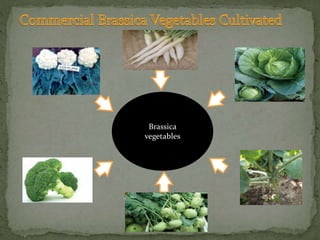
 The family contains 372 genera and 4060 accepted species.
 These vegetables are widely cultivated, with many genera,
species, and cultivars being raised for food production such
as Cauliflower , Cabbage , Knolkhol, Bokchoy, Kale,
Pakchoi, Sprouting broccoli, Brussels sprouts etc..These
are also known as “Cole crops” because they originated
from same ancestor known as “Cliff cabbage” or
“Colewort”(Brassica sylvestris).
 Other vegetables under this family are Cress, Radish,
Turnip, Rutabaga, etc.
,
 Chemicals contained in crucifer vegetables induce the
expression of the liver enzyme CYP1A2. Furthermore
some drugs such as haloperidol and theophyllin are
metabolized by CYP1A2. Consequently consumption
of cruciferous vegetables may decrease bioavailability
and half-life of these drugs.
 Brassicaceae contain a number of compounds under
preliminary research for potential hepato protective
properties. Cruciferous vegetable consumption may
induce glutathione S transferases, uridine
diphosphate-glucuronosyl transferases and quinone
reductasesall of which are potentially involved
in detoxification of carcinogens such as aflatoxin.
Brassica
vegetables
 Alternaria Blight (A.brassicae/A.brassicicola)
 Black Leg (Phoma lingam)
 Cercospora leaf spot (Cercospora brassicicola)
 Clubroot of Crucifers (Plasmodiophora brassicae)
 Damping off(Pythium sp, Fusarium sp,Rhizoctonia sp)
 Downy Mildew (Perenospora cubensis)
 Phytophthora Root Rot (Phytophthora megasperma)
 Scletotinia Stalk Rot (Sclerotinia sclerotiorum)
 White Leaf Spot (Mycosphaerella capsellae)
 White Rust (Albugo candida)
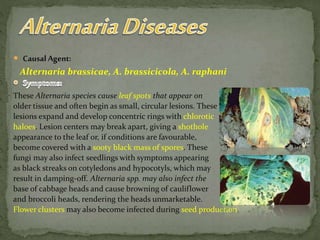
 Causal Agent:
Alternaria brassicae, A. brassicicola, A. raphani
These Alternaria species cause leaf spots that appear on
older tissue and often begin as small, circular lesions. These
lesions expand and develop concentric rings with chlorotic
haloes. Lesion centers may break apart, giving a shothole
appearance to the leaf or, if conditions are favourable,
become covered with a sooty black mass of spores. These
fungi may also infect seedlings with symptoms appearing
as black streaks on cotyledons and hypocotyls, which may
result in damping-off. Alternaria spp. may also infect the
base of cabbage heads and cause browning of cauliflower
and broccoli heads, rendering the heads unmarketable.
Flower clusters may also become infected during seed production
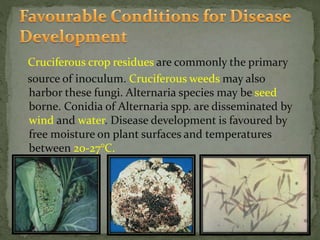
Cruciferous crop residues are commonly the primary
source of inoculum. Cruciferous weeds may also
harbor these fungi. Alternaria species may be seed
borne. Conidia of Alternaria spp. are disseminated by
wind and water. Disease development is favoured by
free moisture on plant surfaces and temperatures
between 20-27°C.
 Disease can be managed through Integrated way,
which are shown schematically underneath.
Integrated Disease
Management
Cultural
method
Biological
Methods
Resistant
varieties
Chemical
application
 Incorporate cruciferous residues of previous season,
as these may overwinter in the crop residues..
 Use of disease free or treated seeds.
 Adequate N fertilizer application in the field
 Crop rotation with non Cruciferous crops
 Timely sowing of crop, and maintaining the proper
spacing.
 Removal of alternate weed host in which the pathogen
may overwinter.
 Avoidance of irrigation in susceptible stage of the crop
by this pathogen attack.(45 and 75 days).
 Soil application of potash and other mineral matters
like S, B, K, Zn etc.
 High degree of resistance against Alternaria blight
has found in B. alba, Eruca sativa, and Sinapis alba.
 The highest degree of resistance to A. brassicae was
found in the wild relatives of Brassica outside the
tribe Brassicaceae. These are False Flax(Camelina
sativa),Neslia paniculata, Capsella bursa-pastoris.
 Gene transformation in Brassica sp can be done
using particle bombardment to resist the crop
against Alternaria attack. The uid4 gene has been
incorporated with CaMV35S or Actin promoters. The
uid4 gene encodes the 1,Beta-glucuronidase(GUS)
enzyme which is responsible to resist the attack of
Alternaria in the crops.
 Spraying of Eucalyptus leaf extract reduces the
number of spores/leaves.
 Spray of Calotropis, Ocimum, Polyanthi extracts
can also significantly reduce the minimum size of
spots and minimum disease index.
 Foliar spray of aqueous bulb extract of Allium
sativum(garlic) effectively reduces the disease
severity in the leaves.
 Foliar application of soil inhabitant isolates of
Trichoderma harzianum and Pseudomonas
fluorescens were found effective in management
of Alternaria blight.
 Multiple application of fungicides are required to
achieve economic yield and acceptable quality in
infected crops.
 Three systemic fungicides Thiophanate methyl,
Ridomil MZ(Mancozeb,64%+Metalaxyl,8%) and
Carbendazim alone and in combination of four non
systemic fungicides Captan, Mancozeb, Zineb, Thiram
in the field @0.2% a.i/l can effectively control the
disease.
 Ridomil MZ was found most effective followed by a
combination of Carbendazim+Captan.
 Foliar spray of Mancozeb(2 g/l of water) have been
found most effective in disease management.
 Causal Agent:
Plasmodiophora brassicae(many races are identified)
 Symptoms:
 This soilborne fungus infects nearly all cultivated crucifers.
The disease is difficult to detect as affected plants wilt on
hot days but may recover after sundown.
 Plasmodiophora brassicae enters through root hairs, and
root cells stimulated by the pathogen multiply rapidly in
size and number, forming club-like galls on roots.
 Deformed roots no longer function normally and are
susceptible to rot by secondary soilborne organisms. Young
plants affected by this disease often die. Older plants grow to
maturity, but are unable to produce a marketable product.
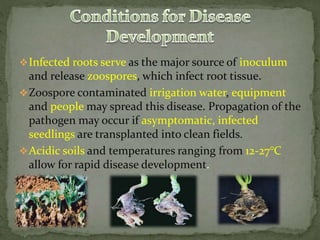
Infected roots serve as the major source of inoculum
and release zoospores, which infect root tissue.
Zoospore contaminated irrigation water, equipment
and people may spread this disease. Propagation of the
pathogen may occur if asymptomatic, infected
seedlings are transplanted into clean fields.
Acidic soils and temperatures ranging from 12-27°C
allow for rapid disease development.
The main objective is to reduce resting spore population/inoculum
load in soil or to create unfavorable condition in soil which inhibit
resting spor germination and movement of primary zoospores
 Clubroot can be effectively controlled by using trap crop cultivated
before main crop to reduce inoculum load in main crop by
stimulating resting spore germination.
 These require carefully formulated combinations of husbandry
measures, manipulation of soil structure, water table and alkalinity
control of calcium, boron, nitrogen and irrigation applications, use
(where feasible) of resistant cultivars and pesticides.
Cultural
practices
 Enhancing soil pH using lime Cao. According to
Webster & Dixon (1991), the disease is more severe
at pH lower than 5.7. Between pH 5.7 and 6.2
disease severity decreases and above pH 7.8 the
pathogen is completely inhibited.
 Application of calcium, Cyanide fertilizer and
boron.
 Practice simple and practical hygiene guideline
 Trap/Bait Cropping with resistant and non
brassicas where applicable can be followed.
 Field studies in France for sources of resistance to P.
brassicae identified two resistant kale (B. oleracea var.
acephala) that could be used in breeding cauliflower and
broccoli hybrids (Manzanares-Dauleux et al., 2000b).
 In Chinese cabbage (B. rapa ssp. pekinensis) the dominant
gene for resistance CRb has been identified(Piao et al 2004)
 Resistance in radish (Raphanus spp.) may be utilized to
produce cultivars of Daikon (R. sativus var. longipinnatus)
(Buniand Yoshikawa, 1991) and in the amphidiploid
Raphanobrassica (McNaughton, 1973).
 In Germany Clubroot resistant B. napus variety
Mendel and Tosca derived from resynthesised form
(stubble turnip x kale), resistance from stubble
turnip (B. rapa, ECD-04) (Diederichsen etal2006).
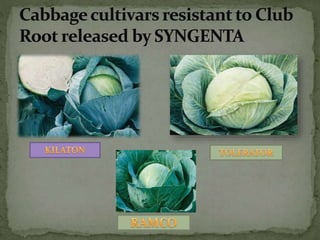
 Syngenta Cabbage cultivars B. oleracea var
capitata (Kilaton, Kilafur, Clapton) carry
monogenic resistance from Chinese cabbage
Parkin ‚Parkin received resistance from
stubble turnip (B. rapa) (Diederichsen et al
2006).
 Calcium nitrate [Ca(NO3)2] is effective as a nitrogen source
because of its alkalinizing properties (Dobson et al., 1983).
 Another N source Calcium Cyanamide “Perlka” – a very popular
fertilizer in Europe manufactured by Syngenta contain 50%
calcium oxide, 19.8 % nitrogen, 1.5 % magnesium oxide.
 Calcium cynamide have both herbicidal and fungicidal
properties and has shown good potential for clubroot control
(Klasse, 1996) provided that the application be made 1 week
before planting.
 Moderate to high-risk sites, additional protection in the form of
and boron and/or a protectant fungicide such as fluazinam can
prevent the disease .
Chemical control is difficult because it is a pathogen of soil.
 Causal Agent:-Pythium spp.,Fusarium spp., Rhizoctonia
solani
 Symptoms:
 Pre-emergence damping-off is generally caused by the
invasion of the host by the fungus prior to plant
emergence from soil.
 This is due to conditions that inhibit or slow seed
germination, while allowing the pathogen to grow
 Post-emergence damping-off occurs on young seedlings at
or near the soil line, although, Pythium spp. may infect at
the roots or root hairs. The host tissue appears water-
soaked and constricted, eventually leading to seedling
collapse.
 Damping-off becomes less of a problem as the host plants
mature.
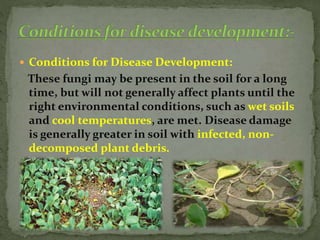
 Conditions for Disease Development:
These fungi may be present in the soil for a long
time, but will not generally affect plants until the
right environmental conditions, such as wet soils
and cool temperatures, are met. Disease damage
is generally greater in soil with infected, non-
decomposed plant debris.
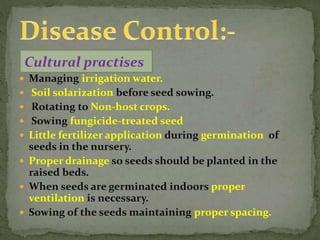
Cultural practises
 Managing irrigation water.
 Soil solarization before seed sowing.
 Rotating to Non-host crops.
 Sowing fungicide-treated seed
 Little fertilizer application during germination of
seeds in the nursery.
 Proper drainage so seeds should be planted in the
raised beds.
 When seeds are germinated indoors proper
ventilation is necessary.
 Sowing of the seeds maintaining proper spacing.
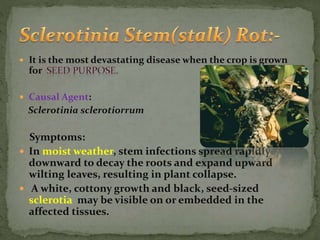
 It is the most devastating disease when the crop is grown
for
 Causal Agent:
Sclerotinia sclerotiorrum
Symptoms:
 In moist weather, stem infections spread rapidly
downward to decay the roots and expand upward
wilting leaves, resulting in plant collapse.
 A white, cottony growth and black, seed-sized
sclerotia may be visible on or embedded in the
affected tissues.
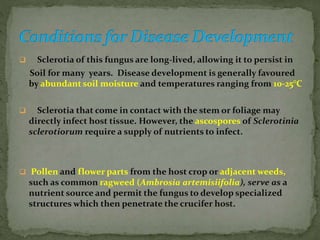
 Sclerotia of this fungus are long-lived, allowing it to persist in
Soil for many years. Disease development is generally favoured
by abundant soil moisture and temperatures ranging from 10-25°C
 Sclerotia that come in contact with the stem or foliage may
directly infect host tissue. However, the ascospores of Sclerotinia
sclerotiorum require a supply of nutrients to infect.
 Pollen and flower parts from the host crop or adjacent weeds,
such as common ragweed (Ambrosia artemisiifolia), serve as a
nutrient source and permit the fungus to develop specialized
structures which then penetrate the crucifer host.
 Implement good sanitation practices and long
rotations to non-host crops.
 Cultivate to help promote good soil drainage. Flood
fields for a long period of time during warm weather
to destroy sclerotia.
 Manage weeds.
 Soil sterilization with steam in greenhouse
 Maintain proper spacing for air drainage.
 This pathogen can survive very well in alkaline soil, so
soil pH should be maintained <5.2 for effective
control.
Cultural practises
Biological control
 Numerous species of fungi, bacteria, insects, and
other organisms have been reported to parasitize
or to interfere with the growth of Sclerotinia spp.
 Encouraging results with biological control of
Sclerotinia diseases in Brassica crops have been
obtained by incorporating the mycoparasitic
fungi which are enlisted below-
Coniothyrium minitans
Gliocladium roseum
Trichoderma viridae
Sporodesimum sclerotivorum
These method
of control till
not
comercialized
in farmers
level till date..
 The genotypes of cauliflower Janavon , EC 162587
and RSK 1301 were found to be resistant with less
than 10% incidence of stalk rot.
 Janavon S3, Pyramis and KN 81 cauliflower
varieties with 11-20% disease incidence were
moderately resistant.
 Among commercial varieties varieties like Pusa
Snowball K1, Pusa Subhra of cauliflower can be
used.
Pusa Snowball
K-1
 The maximum reduction in disease
incidence to 9.7 % was recorded with 1.5 g/l
Bavistin( 50% ) by 15.3 % with 5.25 g/l
Sailaxyl-MZ (72 %), 16.7 % with 8.3 g/l
Mancozeb (75%), 20.8% with 1.1 g/l
Topsin-M (70% ). The above fungicides also
reduced disease index.
 Bavistin 50% also gave highest seed yield.
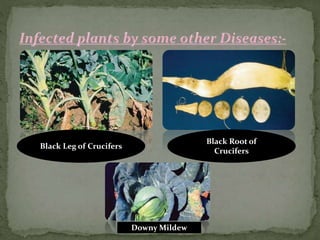
Black Leg of Crucifers
Black Root of
Crucifers
Downy Mildew
 To control Black Leg disease hot water treatment of seeds
in 50°c for half an hour is done.
 Use of resistant varieties (like Pusa Drumhead variety of
Cabbage).
 To control Black Root Use high-quality
seed free from crop residues. Implement
good field sanitation practices, manage
irrigation water, practice three-to-four year crop rotations
to non-host and apply chemical soil treatments.
 Black Rot (Xanthomonas campestris pv.
campestris)
 Bacterial Leaf Spot (Pseudomonas syringae pv.
maculicola)
 Bacterial Soft Rot (Erwinia spp)
 Scab (Streptomyces scabies)
 Xanthomonas Leaf Spot (Xanthomonas
campestris pv. armoraciae)
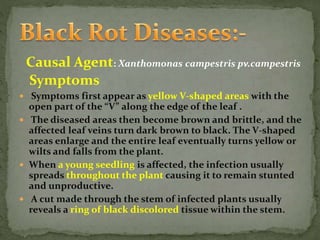
Causal Agent: Xanthomonas campestris pv.campestris
Symptoms
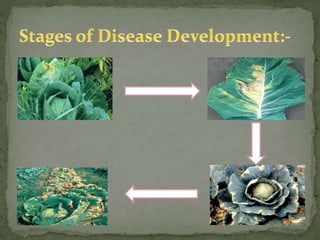
 Symptoms first appear as yellow V-shaped areas with the
open part of the “V” along the edge of the leaf .
 The diseased areas then become brown and brittle, and the
affected leaf veins turn dark brown to black. The V-shaped
areas enlarge and the entire leaf eventually turns yellow or
wilts and falls from the plant.
 When a young seedling is affected, the infection usually
spreads throughout the plant causing it to remain stunted
and unproductive.
 A cut made through the stem of infected plants usually
reveals a ring of black discolored tissue within the stem.
The black rot bacterium is seed borne and can
survive the winter on plant parts left in the
field. Cruciferous weeds, such as wild
mustards, are hosts of this and can serve as
reservoirs of inoculum. The bacterium can be
carried to the field on infected transplants
and it can be spread within the field by
splashing rain, insects and windblown plant
debris. Warm(27-30°C), rainy weather favours
the spread of the black rot bacterium.
Cultural control:
 Use high-quality seed free of X. campestris pv.
campestris.
 Implement a three-year rotation to non
cruciferous crops.
 Seed beds should be geographically isolated from
commercial crucifer crops. Do not mow or clip
transplants.
 Plant crops in well-drained soils and use
irrigation practices that minimize leaf wetness.
 Keep fields free of cruciferous weeds.
Manage and weeds (especially weeds in the
cruciferae family). The following cruciferous
weeds are susceptible to black rot: Birdsrape
mustard (Brassica rapa), Indian mustard (B.
juncea), black mustard (B. nigra), Shortpod
mustard (Hirshfeldia incana),Virginia pepper
weed and other Pepper grasses (Lepidium spp.),
Shepherds purse (Capsella bursa-pastoris),
Radish (Raphanus sativus), Wild radish
(R.raphanistrum), Hedge mustard (Sisymbrium
officinale), Swinecress (Coronopus didymus)and
Hairy Whitetop (Cardaria pubescens).
Resistant Varieties
 Plant varieties of cabbage and
broccoli with partial
resistance (tolerance) to black
rot are reported. Cabbage
varieties reported to be
tolerant include Alantis”,
‘BlueDynasty’, ‘Bronco’,
‘Cecile’, and Ramada’.
 The Broccoli varieties
Arcadia’, ‘Eureka’, and
Greenbelt’ have shown
tolerance to black rot.
Chemical control
 Chemical against this disease are
not so much effective.
 Seed treatment with
Streptocycline @ 100 ppm before
sowing.
 The spread of black rot in fields
may be slowed in some instances
through applications of fixed
coppers.
 Actigard, a chemical that induces
resistance to certain diseases in
some plants, is labeled for
suppression of black rot on
commercially grown crucifers;
however, results have been
disappointing with this material
in general.
 Application Streptocycline @100
ppm(100mg/l of water) can be
effective.
Causal Agent: Pseudomonas syringae. pv.
maculicola
Symptoms:
 The disease occurs mainly on cauliflower, though
Broccoli, cabbage, Brussels sprouts and turnips can
also be affected.
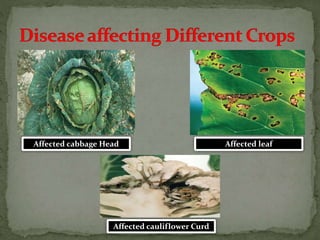
 Symptoms consist of leaf spots that begin as small,
water soaked pinpoint lesions. Later, these lesions
become dark brown or purple with translucent haloes.
 Individual spots are slightly sunken and up to 3 mm
(1/8 in.) in size. Often spots will coalesce to form an
irregular angular lesion, giving a puckered, ragged
appearance to the leaf.
Affected cabbage Head Affected leaf
Affected cauliflower Curd
 Use seed free of Pseudomonas syringae pv.
maculicola
 Sow into seed beds free from the organism.
 If the disease occurred previously in the seed bed,
the soil should be sterilized before planting.
 Rotate to a non-host seed bed for at least one year
following a cruciferous crop.
 Use of streptocycline @100ppm (100mg/l of water)
after the disease infection has taken place.
 Clean cultivation and sanitation.
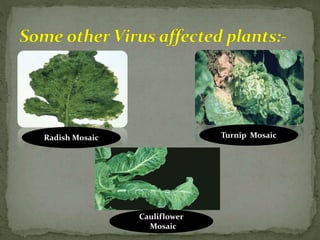
 Cauliflower Mosaic Disease caused by
Cauliflower Mosaic Virus(CaMV)
 Radish Mosaic Disease caused by Radish
Mosaic Virus (RaMV)
 Turnip Mosaic Disease caused by Turnip
Mosaic Virus (TuMV)
 Turnip Yellow Mosaic Disease caused by
Turnip Yellow Mosaic Virus(TYMV)
 Causal Agent: Turnip Yellow Mosaic Virus
(TYMV).It is the most devastating disease in
Turnip.
Symptoms:
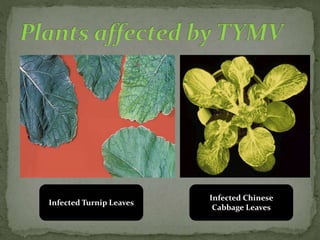
 This virus only infects crucifers. In Turnip,
symptoms begin as vein clearing, but subsequently
develop into permanent yellow patches on older
leaves.
 Symptoms on Chinese cabbage develop into bright
yellow and dark green mosaic patterns.
 During cool weather, infected plants remain
stunted. Symptoms are mild in other Brassicas.
It is transmitted by sap as well as a host of insect
vectors. The most prominent of these are in
the Phylotreta and Psylliodes genera of flea
beetles although Phaedon cochleariae and
its larva have also been known to help spread this
virus. The larva lose their ability to transmit the
disease once they converted to pupal stage,
suggesting a mechanical infection process.This
virus overwinters in cruciferous weeds.
Temperatures near 25° are optimal for symptom
development.
 Implement an insecticide spray program to help
control vectors.
 Eradicate cruciferous weeds and volunteers.
 Incorporate plant residues immediately after
harvest.
 Isolate transplant beds from crucifer crop fields.
 Picking out of the infected plants from the field,
burying them deep in the field or burning them.
 Planting the resistant varieties.
 Planting the trap crops to reduce the attack of
insect vectors.
Infected Turnip Leaves
Infected Chinese
Cabbage Leaves
Radish Mosaic Turnip Mosaic
Cauliflower
Mosaic
 Cabbage Cyst caused by Cabbage
Cyst Nematode (Heterodera
cruciferae)
 Crucifer Root Knot Disease caused
by Root Knot Nematode
(Meloidogyne spp)
Causal Agent: Meloidogyne spp.
 Symptoms:
 Symptoms of this disease are similar to those of
clubroot, but clubroot affected plants produce larger
more continuous swellings on the older portion of
their roots. Root-knot nematodes on crucifers induce
prolific root branching and galling above the point of
infection.
 Invasion of infected roots by fungi may occur. Above
ground symptoms include stunting, chlorosis and
wilting. Though infected plants may survive a growing
season, the resulting crop is generally small and may
be unmarketable.
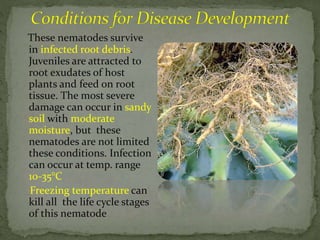
These nematodes survive
in infected root debris.
Juveniles are attracted to
root exudates of host
plants and feed on root
tissue. The most severe
damage can occur in sandy
soil with moderate
moisture, but these
nematodes are not limited
these conditions. Infection
can occur at temp. range
10-35°C
Freezing temperature can
kill all the life cycle stages
of this nematode
 Soil fumigation is very effective to reduce the
population of nematodes.
 Flooding or fallow farming help control
populations of root knot nematodes.
 Avoid cultivation in light sandy soils.
 No effective chemical control is so far
recorded.
 Clean cultivation, proper field sanitation.
 Using Marigold as trap crop in between the
main crop.
Brassicaceae family comprises vegetables with both
regional and national importance in India. These are the
major vegetables (eg-cabbage, cauliflower ,radish) which
are grown almost through out the India during cool season.
These are very much nutritious and remunerative crop now
a days especially after the release of heat tolerant variety
which makes possible its cultivation year round. The
demand of exotic crop like Sprouting Broccoli, Brussels
Sprout are also increasing day by day. But these crops are
very much sensitive to different devastating diseases,
which significantly reduces the yield and cut off the net
profit..so we have to think of a integrated management
practise which makes the crop cultivation profitable by
efficiently managing the infection in such a way that will
be ecofriendly, and non harmful to other beneficial
creatures.
 “Crucifer Disease Guide” by SEMINIS
 Research papers entitled-
 “ Inheritance of Resistance to Stalk Rot in Cauliflower (Brassica
oleracea var. botrytis L.)” by Bhupinder Singh Thakur
 “Integrated management of major diseases of cauliflower (Brassica
oleracea var botrytis subvar cauliflora)” by Sharma Pratibha et al.
 “Controlling Damping off Disease” By Master Gardener
 “Alternaria Blight Of Oilseed Brassicas: A Comparative Review” by
Kumar Dharmendra et al.
 “Black Rot of Crucifers” by Kenny Seebold et al from Plant
Pathology Fact Sheet
 Different pictures of crop Varieties are taken from IARI , Seminis,
Syngenta official website.
 Management of Clubroot Disease (Plasmodiophora brassicae) of
Brassicas Using Trap Cropping Techniques by Bhattacharjee I et al.
 Class notes
Submitted to-
Dr. Sandeep Kansal
&
Dr. Shalini Verma

Idm practises on brassica vegetables

  • 2.
     Brassicaceae isthe name of a medium-sized and economically important family of angiosperm which was previously known as Cruciferae, or the cabbage family.  The name Brassicaceae is derived from the included genus Brassica. Cruciferae, an older name, meaning "cross-bearing", describes the four petals of flowers, which resemble a cross; it is one of eight plant family names without the suffix '-aceae' that are authorized alternative names (according to ICBN Act. 18.5 and 18.6 Vienna Code); thus both Cruciferae and Brassicaceae are used.
  • 3.
     The familycontains 372 genera and 4060 accepted species.  These vegetables are widely cultivated, with many genera, species, and cultivars being raised for food production such as Cauliflower , Cabbage , Knolkhol, Bokchoy, Kale, Pakchoi, Sprouting broccoli, Brussels sprouts etc..These are also known as “Cole crops” because they originated from same ancestor known as “Cliff cabbage” or “Colewort”(Brassica sylvestris).  Other vegetables under this family are Cress, Radish, Turnip, Rutabaga, etc. ,
  • 4.
     Chemicals containedin crucifer vegetables induce the expression of the liver enzyme CYP1A2. Furthermore some drugs such as haloperidol and theophyllin are metabolized by CYP1A2. Consequently consumption of cruciferous vegetables may decrease bioavailability and half-life of these drugs.  Brassicaceae contain a number of compounds under preliminary research for potential hepato protective properties. Cruciferous vegetable consumption may induce glutathione S transferases, uridine diphosphate-glucuronosyl transferases and quinone reductasesall of which are potentially involved in detoxification of carcinogens such as aflatoxin.
  • 5.
  • 6.
     Alternaria Blight(A.brassicae/A.brassicicola)  Black Leg (Phoma lingam)  Cercospora leaf spot (Cercospora brassicicola)  Clubroot of Crucifers (Plasmodiophora brassicae)  Damping off(Pythium sp, Fusarium sp,Rhizoctonia sp)  Downy Mildew (Perenospora cubensis)  Phytophthora Root Rot (Phytophthora megasperma)  Scletotinia Stalk Rot (Sclerotinia sclerotiorum)  White Leaf Spot (Mycosphaerella capsellae)  White Rust (Albugo candida)
  • 7.
     Causal Agent: Alternariabrassicae, A. brassicicola, A. raphani These Alternaria species cause leaf spots that appear on older tissue and often begin as small, circular lesions. These lesions expand and develop concentric rings with chlorotic haloes. Lesion centers may break apart, giving a shothole appearance to the leaf or, if conditions are favourable, become covered with a sooty black mass of spores. These fungi may also infect seedlings with symptoms appearing as black streaks on cotyledons and hypocotyls, which may result in damping-off. Alternaria spp. may also infect the base of cabbage heads and cause browning of cauliflower and broccoli heads, rendering the heads unmarketable. Flower clusters may also become infected during seed production
  • 8.
    Cruciferous crop residuesare commonly the primary source of inoculum. Cruciferous weeds may also harbor these fungi. Alternaria species may be seed borne. Conidia of Alternaria spp. are disseminated by wind and water. Disease development is favoured by free moisture on plant surfaces and temperatures between 20-27°C.
  • 9.
     Disease canbe managed through Integrated way, which are shown schematically underneath. Integrated Disease Management Cultural method Biological Methods Resistant varieties Chemical application
  • 10.
     Incorporate cruciferousresidues of previous season, as these may overwinter in the crop residues..  Use of disease free or treated seeds.  Adequate N fertilizer application in the field  Crop rotation with non Cruciferous crops  Timely sowing of crop, and maintaining the proper spacing.  Removal of alternate weed host in which the pathogen may overwinter.  Avoidance of irrigation in susceptible stage of the crop by this pathogen attack.(45 and 75 days).  Soil application of potash and other mineral matters like S, B, K, Zn etc.
  • 11.
     High degreeof resistance against Alternaria blight has found in B. alba, Eruca sativa, and Sinapis alba.  The highest degree of resistance to A. brassicae was found in the wild relatives of Brassica outside the tribe Brassicaceae. These are False Flax(Camelina sativa),Neslia paniculata, Capsella bursa-pastoris.  Gene transformation in Brassica sp can be done using particle bombardment to resist the crop against Alternaria attack. The uid4 gene has been incorporated with CaMV35S or Actin promoters. The uid4 gene encodes the 1,Beta-glucuronidase(GUS) enzyme which is responsible to resist the attack of Alternaria in the crops.
  • 12.
     Spraying ofEucalyptus leaf extract reduces the number of spores/leaves.  Spray of Calotropis, Ocimum, Polyanthi extracts can also significantly reduce the minimum size of spots and minimum disease index.  Foliar spray of aqueous bulb extract of Allium sativum(garlic) effectively reduces the disease severity in the leaves.  Foliar application of soil inhabitant isolates of Trichoderma harzianum and Pseudomonas fluorescens were found effective in management of Alternaria blight.
  • 13.
     Multiple applicationof fungicides are required to achieve economic yield and acceptable quality in infected crops.  Three systemic fungicides Thiophanate methyl, Ridomil MZ(Mancozeb,64%+Metalaxyl,8%) and Carbendazim alone and in combination of four non systemic fungicides Captan, Mancozeb, Zineb, Thiram in the field @0.2% a.i/l can effectively control the disease.  Ridomil MZ was found most effective followed by a combination of Carbendazim+Captan.  Foliar spray of Mancozeb(2 g/l of water) have been found most effective in disease management.
  • 14.
     Causal Agent: Plasmodiophorabrassicae(many races are identified)  Symptoms:  This soilborne fungus infects nearly all cultivated crucifers. The disease is difficult to detect as affected plants wilt on hot days but may recover after sundown.  Plasmodiophora brassicae enters through root hairs, and root cells stimulated by the pathogen multiply rapidly in size and number, forming club-like galls on roots.  Deformed roots no longer function normally and are susceptible to rot by secondary soilborne organisms. Young plants affected by this disease often die. Older plants grow to maturity, but are unable to produce a marketable product.
  • 15.
    Infected roots serveas the major source of inoculum and release zoospores, which infect root tissue. Zoospore contaminated irrigation water, equipment and people may spread this disease. Propagation of the pathogen may occur if asymptomatic, infected seedlings are transplanted into clean fields. Acidic soils and temperatures ranging from 12-27°C allow for rapid disease development.
  • 16.
    The main objectiveis to reduce resting spore population/inoculum load in soil or to create unfavorable condition in soil which inhibit resting spor germination and movement of primary zoospores  Clubroot can be effectively controlled by using trap crop cultivated before main crop to reduce inoculum load in main crop by stimulating resting spore germination.  These require carefully formulated combinations of husbandry measures, manipulation of soil structure, water table and alkalinity control of calcium, boron, nitrogen and irrigation applications, use (where feasible) of resistant cultivars and pesticides. Cultural practices
  • 17.
     Enhancing soilpH using lime Cao. According to Webster & Dixon (1991), the disease is more severe at pH lower than 5.7. Between pH 5.7 and 6.2 disease severity decreases and above pH 7.8 the pathogen is completely inhibited.  Application of calcium, Cyanide fertilizer and boron.  Practice simple and practical hygiene guideline  Trap/Bait Cropping with resistant and non brassicas where applicable can be followed.
  • 18.
     Field studiesin France for sources of resistance to P. brassicae identified two resistant kale (B. oleracea var. acephala) that could be used in breeding cauliflower and broccoli hybrids (Manzanares-Dauleux et al., 2000b).  In Chinese cabbage (B. rapa ssp. pekinensis) the dominant gene for resistance CRb has been identified(Piao et al 2004)  Resistance in radish (Raphanus spp.) may be utilized to produce cultivars of Daikon (R. sativus var. longipinnatus) (Buniand Yoshikawa, 1991) and in the amphidiploid Raphanobrassica (McNaughton, 1973).
  • 19.
     In GermanyClubroot resistant B. napus variety Mendel and Tosca derived from resynthesised form (stubble turnip x kale), resistance from stubble turnip (B. rapa, ECD-04) (Diederichsen etal2006).  Syngenta Cabbage cultivars B. oleracea var capitata (Kilaton, Kilafur, Clapton) carry monogenic resistance from Chinese cabbage Parkin ‚Parkin received resistance from stubble turnip (B. rapa) (Diederichsen et al 2006).
  • 21.
     Calcium nitrate[Ca(NO3)2] is effective as a nitrogen source because of its alkalinizing properties (Dobson et al., 1983).  Another N source Calcium Cyanamide “Perlka” – a very popular fertilizer in Europe manufactured by Syngenta contain 50% calcium oxide, 19.8 % nitrogen, 1.5 % magnesium oxide.  Calcium cynamide have both herbicidal and fungicidal properties and has shown good potential for clubroot control (Klasse, 1996) provided that the application be made 1 week before planting.  Moderate to high-risk sites, additional protection in the form of and boron and/or a protectant fungicide such as fluazinam can prevent the disease . Chemical control is difficult because it is a pathogen of soil.
  • 22.
     Causal Agent:-Pythiumspp.,Fusarium spp., Rhizoctonia solani  Symptoms:  Pre-emergence damping-off is generally caused by the invasion of the host by the fungus prior to plant emergence from soil.  This is due to conditions that inhibit or slow seed germination, while allowing the pathogen to grow  Post-emergence damping-off occurs on young seedlings at or near the soil line, although, Pythium spp. may infect at the roots or root hairs. The host tissue appears water- soaked and constricted, eventually leading to seedling collapse.  Damping-off becomes less of a problem as the host plants mature.
  • 23.
     Conditions forDisease Development: These fungi may be present in the soil for a long time, but will not generally affect plants until the right environmental conditions, such as wet soils and cool temperatures, are met. Disease damage is generally greater in soil with infected, non- decomposed plant debris.
  • 24.
    Cultural practises  Managingirrigation water.  Soil solarization before seed sowing.  Rotating to Non-host crops.  Sowing fungicide-treated seed  Little fertilizer application during germination of seeds in the nursery.  Proper drainage so seeds should be planted in the raised beds.  When seeds are germinated indoors proper ventilation is necessary.  Sowing of the seeds maintaining proper spacing.
  • 26.
     It isthe most devastating disease when the crop is grown for  Causal Agent: Sclerotinia sclerotiorrum Symptoms:  In moist weather, stem infections spread rapidly downward to decay the roots and expand upward wilting leaves, resulting in plant collapse.  A white, cottony growth and black, seed-sized sclerotia may be visible on or embedded in the affected tissues.
  • 27.
     Sclerotia ofthis fungus are long-lived, allowing it to persist in Soil for many years. Disease development is generally favoured by abundant soil moisture and temperatures ranging from 10-25°C  Sclerotia that come in contact with the stem or foliage may directly infect host tissue. However, the ascospores of Sclerotinia sclerotiorum require a supply of nutrients to infect.  Pollen and flower parts from the host crop or adjacent weeds, such as common ragweed (Ambrosia artemisiifolia), serve as a nutrient source and permit the fungus to develop specialized structures which then penetrate the crucifer host.
  • 28.
     Implement goodsanitation practices and long rotations to non-host crops.  Cultivate to help promote good soil drainage. Flood fields for a long period of time during warm weather to destroy sclerotia.  Manage weeds.  Soil sterilization with steam in greenhouse  Maintain proper spacing for air drainage.  This pathogen can survive very well in alkaline soil, so soil pH should be maintained <5.2 for effective control. Cultural practises
  • 29.
    Biological control  Numerousspecies of fungi, bacteria, insects, and other organisms have been reported to parasitize or to interfere with the growth of Sclerotinia spp.  Encouraging results with biological control of Sclerotinia diseases in Brassica crops have been obtained by incorporating the mycoparasitic fungi which are enlisted below- Coniothyrium minitans Gliocladium roseum Trichoderma viridae Sporodesimum sclerotivorum These method of control till not comercialized in farmers level till date..
  • 30.
     The genotypesof cauliflower Janavon , EC 162587 and RSK 1301 were found to be resistant with less than 10% incidence of stalk rot.  Janavon S3, Pyramis and KN 81 cauliflower varieties with 11-20% disease incidence were moderately resistant.  Among commercial varieties varieties like Pusa Snowball K1, Pusa Subhra of cauliflower can be used. Pusa Snowball K-1
  • 31.
     The maximumreduction in disease incidence to 9.7 % was recorded with 1.5 g/l Bavistin( 50% ) by 15.3 % with 5.25 g/l Sailaxyl-MZ (72 %), 16.7 % with 8.3 g/l Mancozeb (75%), 20.8% with 1.1 g/l Topsin-M (70% ). The above fungicides also reduced disease index.  Bavistin 50% also gave highest seed yield.
  • 32.
    Black Leg ofCrucifers Black Root of Crucifers Downy Mildew
  • 33.
     To controlBlack Leg disease hot water treatment of seeds in 50°c for half an hour is done.  Use of resistant varieties (like Pusa Drumhead variety of Cabbage).  To control Black Root Use high-quality seed free from crop residues. Implement good field sanitation practices, manage irrigation water, practice three-to-four year crop rotations to non-host and apply chemical soil treatments.
  • 34.
     Black Rot(Xanthomonas campestris pv. campestris)  Bacterial Leaf Spot (Pseudomonas syringae pv. maculicola)  Bacterial Soft Rot (Erwinia spp)  Scab (Streptomyces scabies)  Xanthomonas Leaf Spot (Xanthomonas campestris pv. armoraciae)
  • 35.
    Causal Agent: Xanthomonascampestris pv.campestris Symptoms  Symptoms first appear as yellow V-shaped areas with the open part of the “V” along the edge of the leaf .  The diseased areas then become brown and brittle, and the affected leaf veins turn dark brown to black. The V-shaped areas enlarge and the entire leaf eventually turns yellow or wilts and falls from the plant.  When a young seedling is affected, the infection usually spreads throughout the plant causing it to remain stunted and unproductive.  A cut made through the stem of infected plants usually reveals a ring of black discolored tissue within the stem.
  • 37.
    The black rotbacterium is seed borne and can survive the winter on plant parts left in the field. Cruciferous weeds, such as wild mustards, are hosts of this and can serve as reservoirs of inoculum. The bacterium can be carried to the field on infected transplants and it can be spread within the field by splashing rain, insects and windblown plant debris. Warm(27-30°C), rainy weather favours the spread of the black rot bacterium.
  • 38.
    Cultural control:  Usehigh-quality seed free of X. campestris pv. campestris.  Implement a three-year rotation to non cruciferous crops.  Seed beds should be geographically isolated from commercial crucifer crops. Do not mow or clip transplants.  Plant crops in well-drained soils and use irrigation practices that minimize leaf wetness.  Keep fields free of cruciferous weeds.
  • 39.
    Manage and weeds(especially weeds in the cruciferae family). The following cruciferous weeds are susceptible to black rot: Birdsrape mustard (Brassica rapa), Indian mustard (B. juncea), black mustard (B. nigra), Shortpod mustard (Hirshfeldia incana),Virginia pepper weed and other Pepper grasses (Lepidium spp.), Shepherds purse (Capsella bursa-pastoris), Radish (Raphanus sativus), Wild radish (R.raphanistrum), Hedge mustard (Sisymbrium officinale), Swinecress (Coronopus didymus)and Hairy Whitetop (Cardaria pubescens).
  • 40.
    Resistant Varieties  Plantvarieties of cabbage and broccoli with partial resistance (tolerance) to black rot are reported. Cabbage varieties reported to be tolerant include Alantis”, ‘BlueDynasty’, ‘Bronco’, ‘Cecile’, and Ramada’.  The Broccoli varieties Arcadia’, ‘Eureka’, and Greenbelt’ have shown tolerance to black rot. Chemical control  Chemical against this disease are not so much effective.  Seed treatment with Streptocycline @ 100 ppm before sowing.  The spread of black rot in fields may be slowed in some instances through applications of fixed coppers.  Actigard, a chemical that induces resistance to certain diseases in some plants, is labeled for suppression of black rot on commercially grown crucifers; however, results have been disappointing with this material in general.  Application Streptocycline @100 ppm(100mg/l of water) can be effective.
  • 41.
    Causal Agent: Pseudomonassyringae. pv. maculicola Symptoms:  The disease occurs mainly on cauliflower, though Broccoli, cabbage, Brussels sprouts and turnips can also be affected.  Symptoms consist of leaf spots that begin as small, water soaked pinpoint lesions. Later, these lesions become dark brown or purple with translucent haloes.  Individual spots are slightly sunken and up to 3 mm (1/8 in.) in size. Often spots will coalesce to form an irregular angular lesion, giving a puckered, ragged appearance to the leaf.
  • 42.
    Affected cabbage HeadAffected leaf Affected cauliflower Curd
  • 43.
     Use seedfree of Pseudomonas syringae pv. maculicola  Sow into seed beds free from the organism.  If the disease occurred previously in the seed bed, the soil should be sterilized before planting.  Rotate to a non-host seed bed for at least one year following a cruciferous crop.  Use of streptocycline @100ppm (100mg/l of water) after the disease infection has taken place.  Clean cultivation and sanitation.
  • 44.
     Cauliflower MosaicDisease caused by Cauliflower Mosaic Virus(CaMV)  Radish Mosaic Disease caused by Radish Mosaic Virus (RaMV)  Turnip Mosaic Disease caused by Turnip Mosaic Virus (TuMV)  Turnip Yellow Mosaic Disease caused by Turnip Yellow Mosaic Virus(TYMV)
  • 45.
     Causal Agent:Turnip Yellow Mosaic Virus (TYMV).It is the most devastating disease in Turnip. Symptoms:  This virus only infects crucifers. In Turnip, symptoms begin as vein clearing, but subsequently develop into permanent yellow patches on older leaves.  Symptoms on Chinese cabbage develop into bright yellow and dark green mosaic patterns.  During cool weather, infected plants remain stunted. Symptoms are mild in other Brassicas.
  • 46.
    It is transmittedby sap as well as a host of insect vectors. The most prominent of these are in the Phylotreta and Psylliodes genera of flea beetles although Phaedon cochleariae and its larva have also been known to help spread this virus. The larva lose their ability to transmit the disease once they converted to pupal stage, suggesting a mechanical infection process.This virus overwinters in cruciferous weeds. Temperatures near 25° are optimal for symptom development.
  • 47.
     Implement aninsecticide spray program to help control vectors.  Eradicate cruciferous weeds and volunteers.  Incorporate plant residues immediately after harvest.  Isolate transplant beds from crucifer crop fields.  Picking out of the infected plants from the field, burying them deep in the field or burning them.  Planting the resistant varieties.  Planting the trap crops to reduce the attack of insect vectors.
  • 48.
    Infected Turnip Leaves InfectedChinese Cabbage Leaves
  • 49.
    Radish Mosaic TurnipMosaic Cauliflower Mosaic
  • 50.
     Cabbage Cystcaused by Cabbage Cyst Nematode (Heterodera cruciferae)  Crucifer Root Knot Disease caused by Root Knot Nematode (Meloidogyne spp)
  • 51.
    Causal Agent: Meloidogynespp.  Symptoms:  Symptoms of this disease are similar to those of clubroot, but clubroot affected plants produce larger more continuous swellings on the older portion of their roots. Root-knot nematodes on crucifers induce prolific root branching and galling above the point of infection.  Invasion of infected roots by fungi may occur. Above ground symptoms include stunting, chlorosis and wilting. Though infected plants may survive a growing season, the resulting crop is generally small and may be unmarketable.
  • 52.
    These nematodes survive ininfected root debris. Juveniles are attracted to root exudates of host plants and feed on root tissue. The most severe damage can occur in sandy soil with moderate moisture, but these nematodes are not limited these conditions. Infection can occur at temp. range 10-35°C Freezing temperature can kill all the life cycle stages of this nematode
  • 53.
     Soil fumigationis very effective to reduce the population of nematodes.  Flooding or fallow farming help control populations of root knot nematodes.  Avoid cultivation in light sandy soils.  No effective chemical control is so far recorded.  Clean cultivation, proper field sanitation.  Using Marigold as trap crop in between the main crop.
  • 54.
    Brassicaceae family comprisesvegetables with both regional and national importance in India. These are the major vegetables (eg-cabbage, cauliflower ,radish) which are grown almost through out the India during cool season. These are very much nutritious and remunerative crop now a days especially after the release of heat tolerant variety which makes possible its cultivation year round. The demand of exotic crop like Sprouting Broccoli, Brussels Sprout are also increasing day by day. But these crops are very much sensitive to different devastating diseases, which significantly reduces the yield and cut off the net profit..so we have to think of a integrated management practise which makes the crop cultivation profitable by efficiently managing the infection in such a way that will be ecofriendly, and non harmful to other beneficial creatures.
  • 55.
     “Crucifer DiseaseGuide” by SEMINIS  Research papers entitled-  “ Inheritance of Resistance to Stalk Rot in Cauliflower (Brassica oleracea var. botrytis L.)” by Bhupinder Singh Thakur  “Integrated management of major diseases of cauliflower (Brassica oleracea var botrytis subvar cauliflora)” by Sharma Pratibha et al.  “Controlling Damping off Disease” By Master Gardener  “Alternaria Blight Of Oilseed Brassicas: A Comparative Review” by Kumar Dharmendra et al.  “Black Rot of Crucifers” by Kenny Seebold et al from Plant Pathology Fact Sheet  Different pictures of crop Varieties are taken from IARI , Seminis, Syngenta official website.  Management of Clubroot Disease (Plasmodiophora brassicae) of Brassicas Using Trap Cropping Techniques by Bhattacharjee I et al.  Class notes
  • 57.
    Submitted to- Dr. SandeepKansal & Dr. Shalini Verma