Effective practice in setting up and implementing staff-student 
partnerships: lessons learnt from Change Agents Network 
Peter Chatterton, Sarah Knight, Mark Kerrigan, Simon Walker 
02/09/2014 
#CAN2014 www.changeagentsnetwork.co.uk
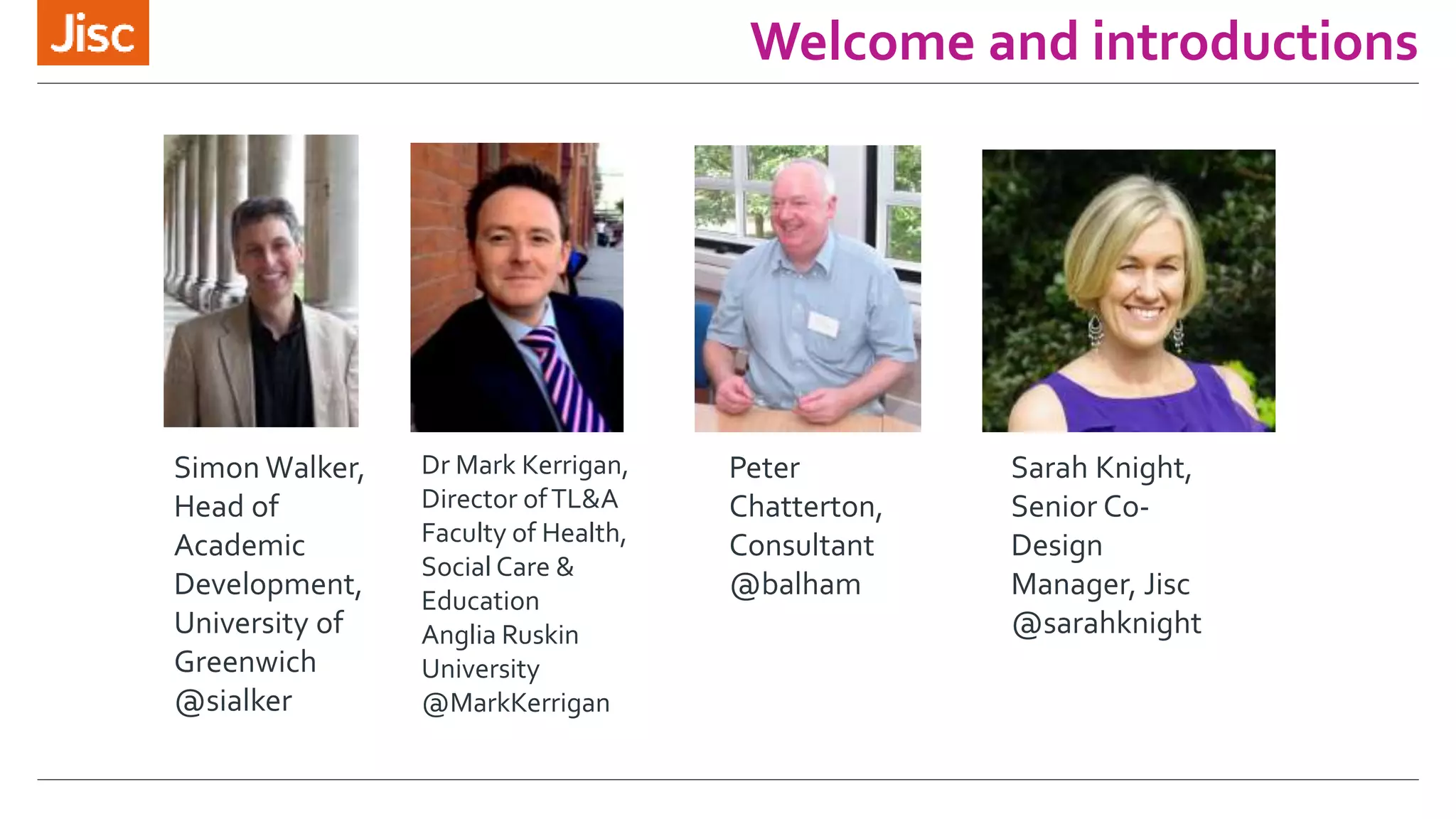
Welcome and introductions 
Sarah Knight, 
Senior Co- 
Design 
Manager, Jisc 
@sarahknight 
Peter 
Chatterton, 
Consultant 
@balham 
Simon Walker, 
Head of 
Academic 
Development, 
University of 
Greenwich 
@sialker 
Dr Mark Kerrigan, 
Director of TL&A 
Faculty of Health, 
Social Care & 
Education 
Anglia Ruskin 
University 
@MarkKerrigan
3 
Change Agents’ Network – Students as partners 
Rachel Wenstone, Vice President (Higher Education), NUS 
‘Students as partners is not just a nice-to-have, I believe it has the potential to 
help bring about social and educational transformation, as long as we know 
what we are trying to do and we maintain a critical attitude about the ways 
the concept is adopted and used.’ 
A Manifesto for Partnership (November 2012)
Background and context 
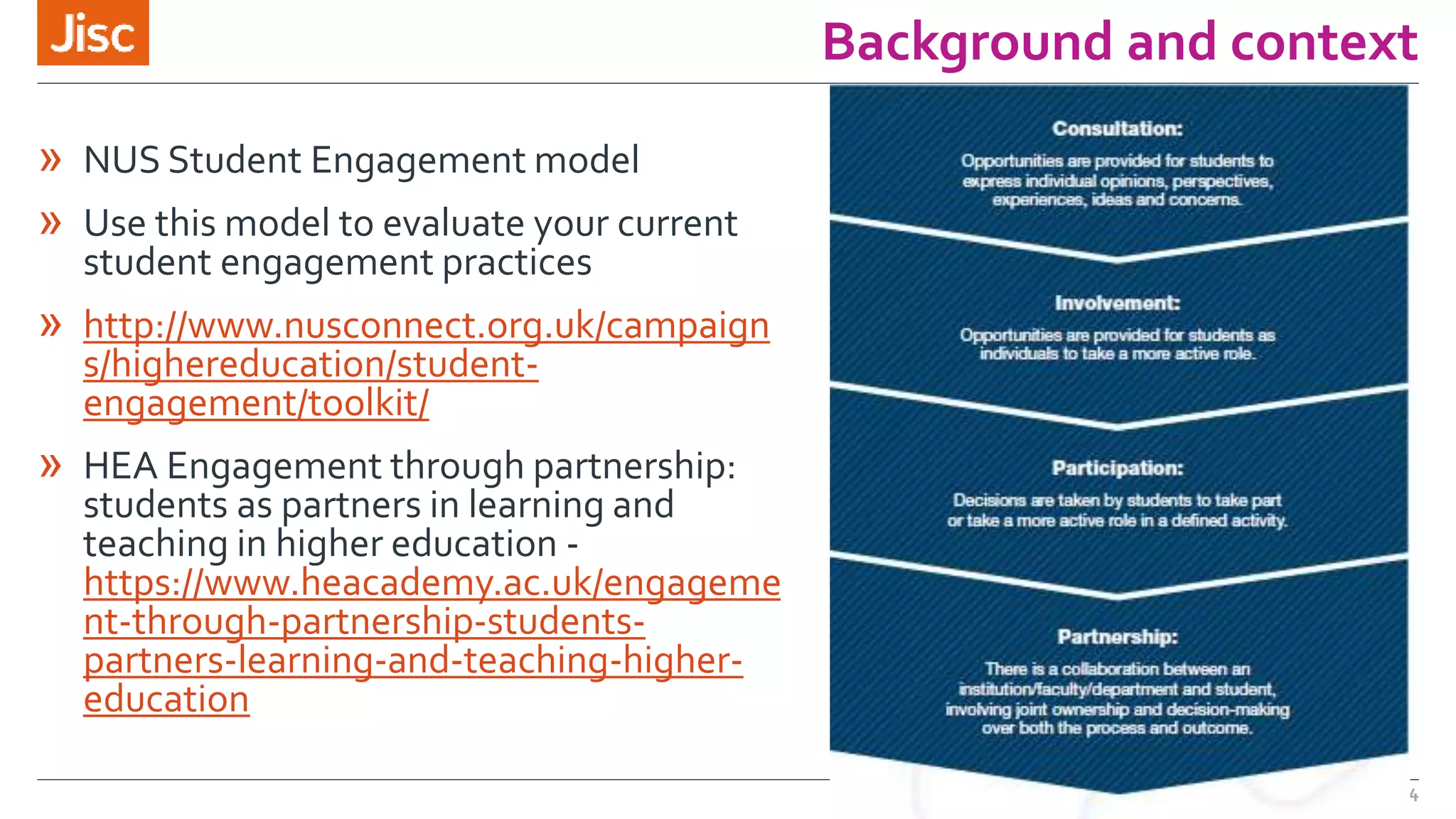
» NUS Student Engagement model 
» Use this model to evaluate your current 
student engagement practices 
» http://www.nusconnect.org.uk/campaign 
s/highereducation/student-engagement/ 
toolkit/ 
» HEA Engagement through partnership: 
students as partners in learning and 
teaching in higher education - 
https://www.heacademy.ac.uk/engageme 
nt-through-partnership-students-partners- 
learning-and-teaching-higher-education 
4
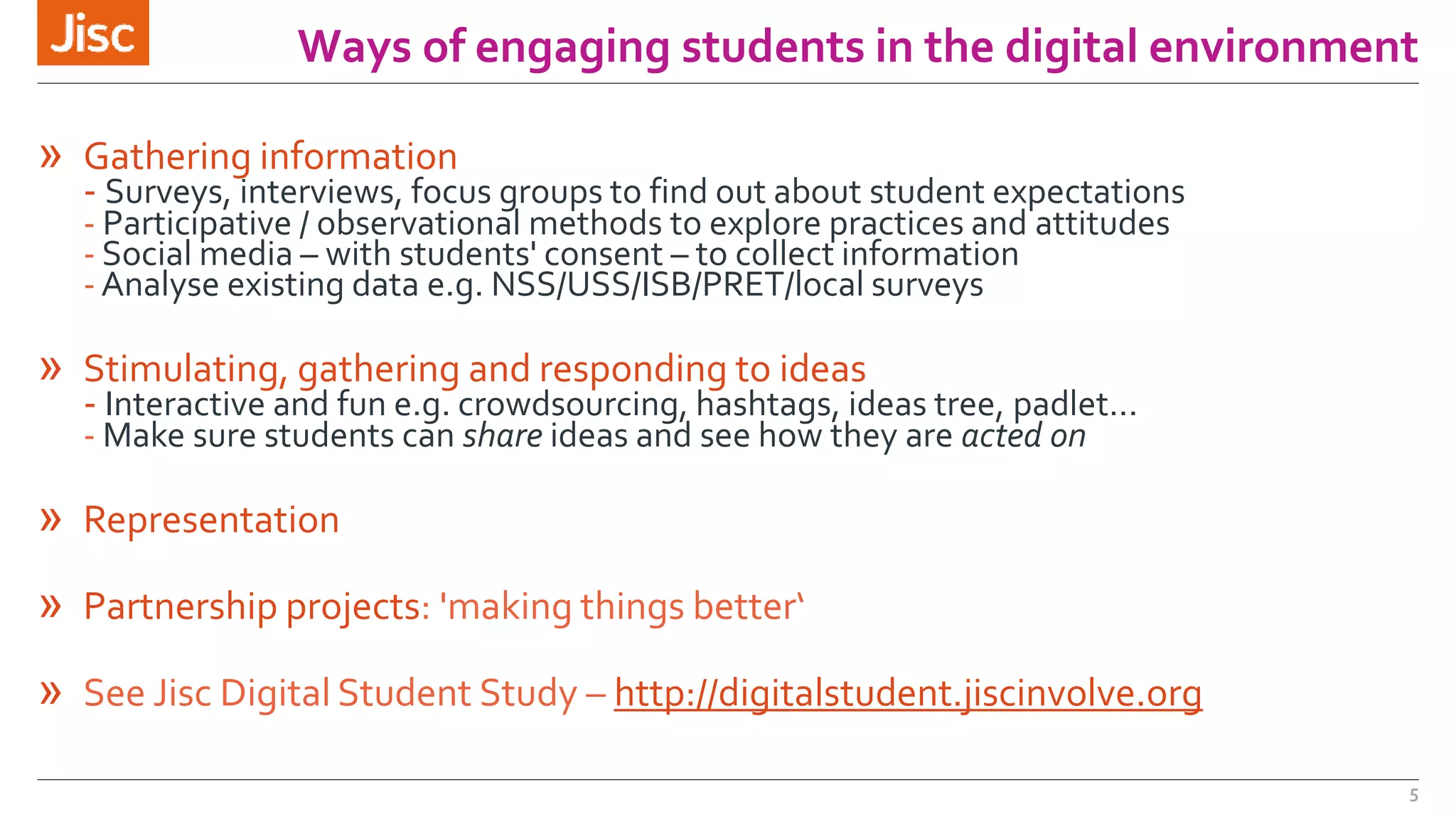
Ways of engaging students in the digital environment 
» Gathering information 
- Surveys, interviews, focus groups to find out about student expectations 
- Participative / observational methods to explore practices and attitudes 
- Social media – with students' consent – to collect information 
- Analyse existing data e.g. NSS/USS/ISB/PRET/local surveys 
» Stimulating, gathering and responding to ideas 
- Interactive and fun e.g. crowdsourcing, hashtags, ideas tree, padlet... 
-Make sure students can share ideas and see how they are acted on 
» Representation 
» Partnership projects: 'making things better‘ 
» See Jisc Digital Student Study – http://digitalstudent.jiscinvolve.org 
5
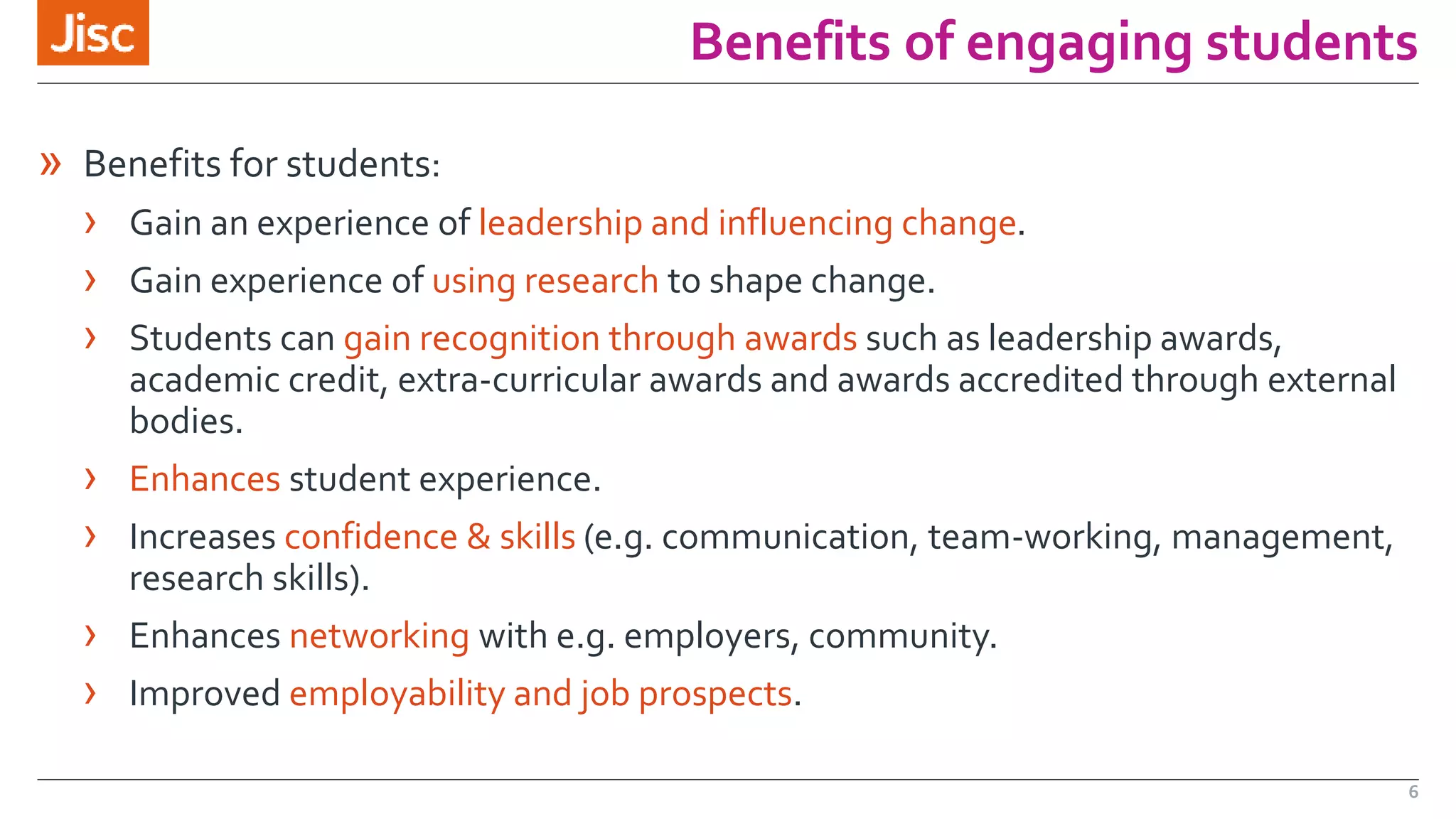
Benefits of engaging students 
» Benefits for students: 
› Gain an experience of leadership and influencing change. 
› Gain experience of using research to shape change. 
› Students can gain recognition through awards such as leadership awards, 
academic credit, extra-curricular awards and awards accredited through external 
bodies. 
› Enhances student experience. 
› Increases confidence & skills (e.g. communication, team-working, management, 
research skills). 
› Enhances networking with e.g. employers, community. 
› Improved employability and job prospects. 
6
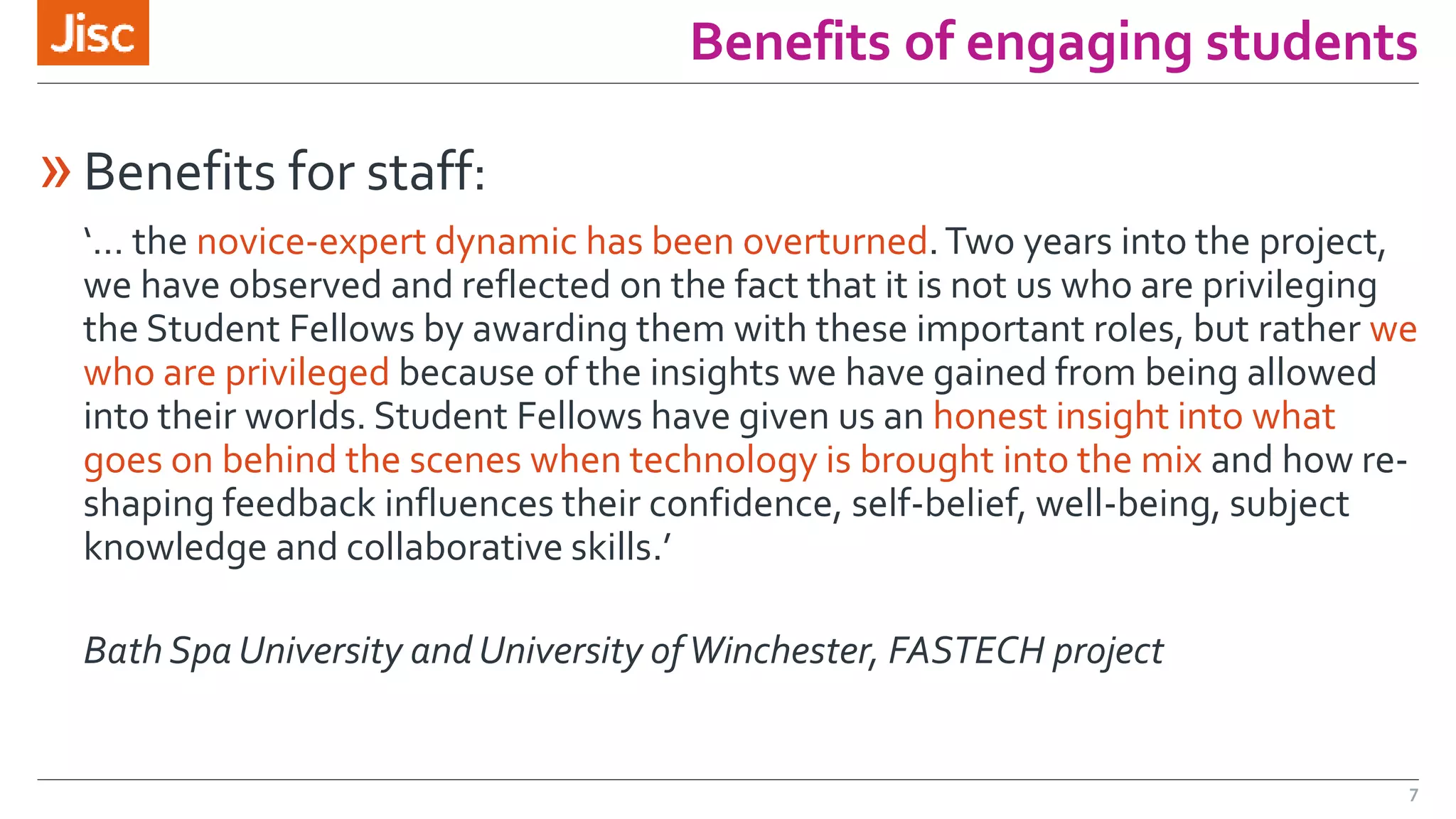
Benefits of engaging students 
»Benefits for staff: 
‘… the novice-expert dynamic has been overturned. Two years into the project, 
we have observed and reflected on the fact that it is not us who are privileging 
the Student Fellows by awarding them with these important roles, but rather we 
who are privileged because of the insights we have gained from being allowed 
into their worlds. Student Fellows have given us an honest insight into what 
goes on behind the scenes when technology is brought into the mix and how re-shaping 
feedback influences their confidence, self-belief, well-being, subject 
knowledge and collaborative skills.’ 
Bath Spa University and University of Winchester, FASTECH project 
7
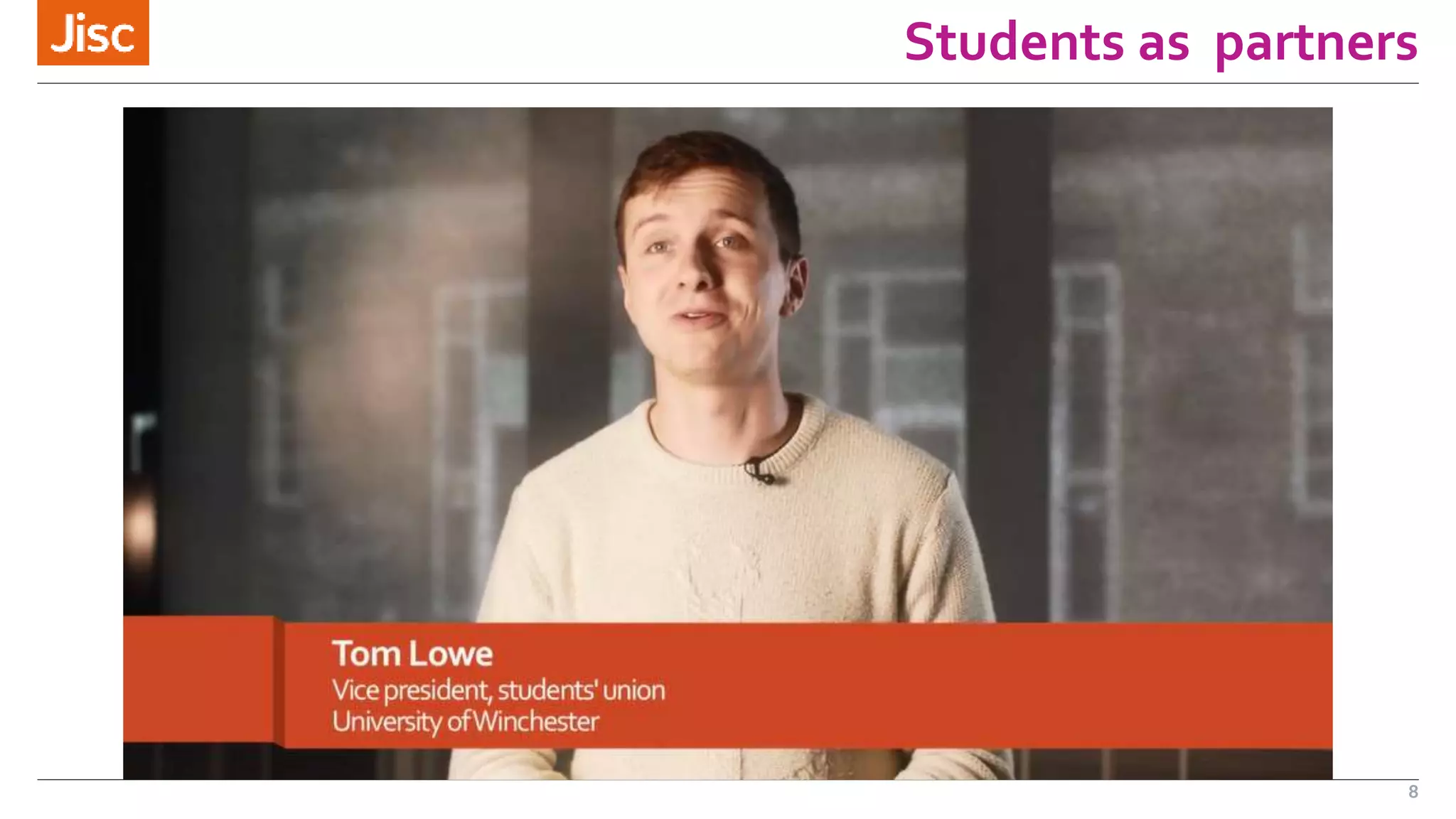
Students as partners 
8
Change Agents Network 
» Supports students working as change agents, digital 
pioneers, student fellows and students working in partnership 
with staff on technology related change projects 
» Networks and connects staff and students in colleges and 
universities across the UK working on such projects 
» Communicates, disseminates and influences the sharing of 
good practice 
» Publishes the open access Journal of Educational Innovation, 
Partnership & Change 
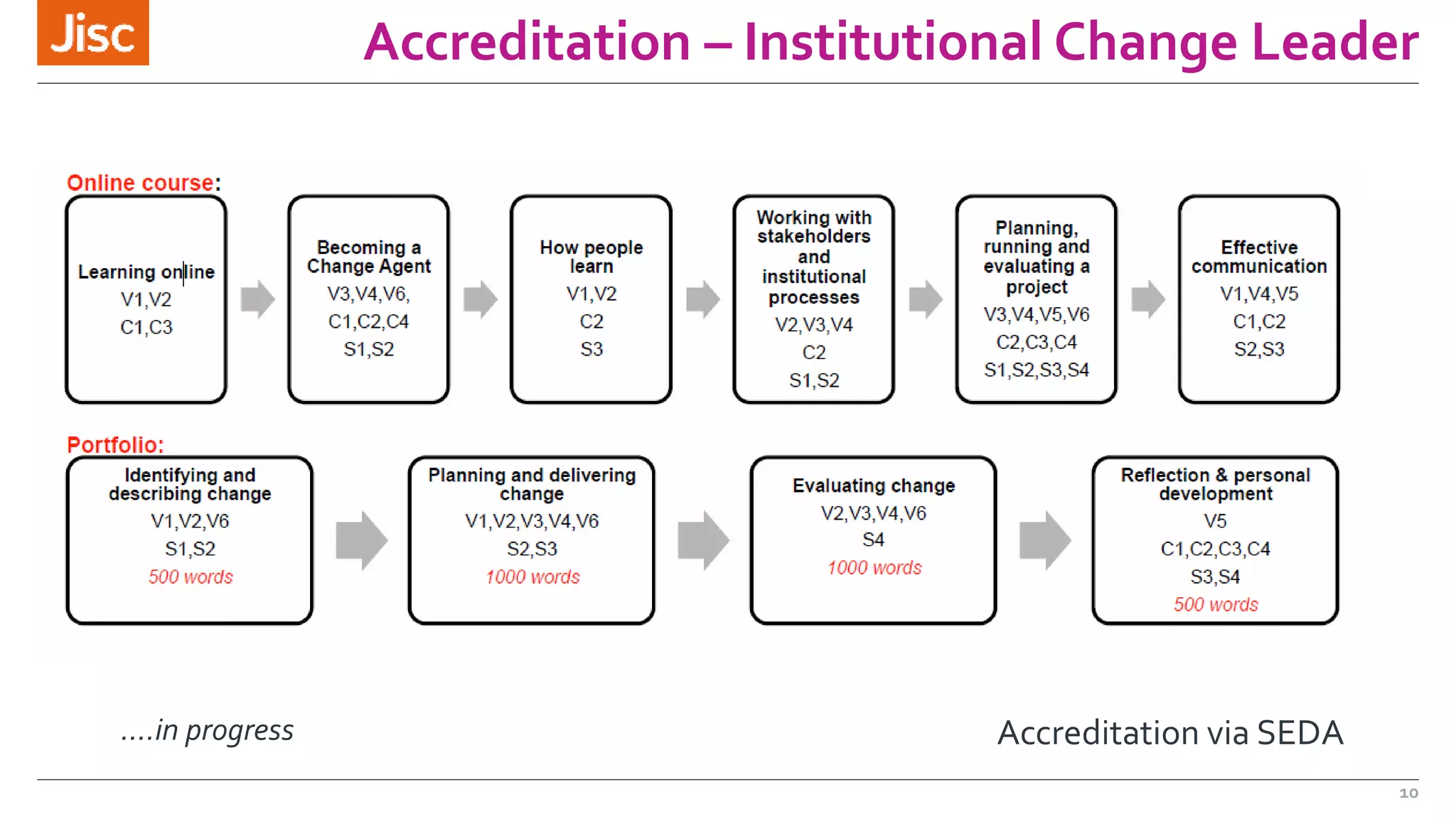
» Runs an accredited course on being a Change 
Agent/Institutional Change Leader through SEDA 
9
Accreditation – Institutional Change Leader 
10 
….in progress Accreditation via SEDA
Journal of Educational Innovation , Partnership &Change 
11 
• Opinion Pieces 
• Case Studies / Project reports 
• Research Articles 
• Book Reviews 
• Technology Reviews 
• Deadline for submissions 20 
October 2014 
https://journals.gre.ac.uk/index.php/studentchangeagents
Supporting staff and student partnerships 
12 
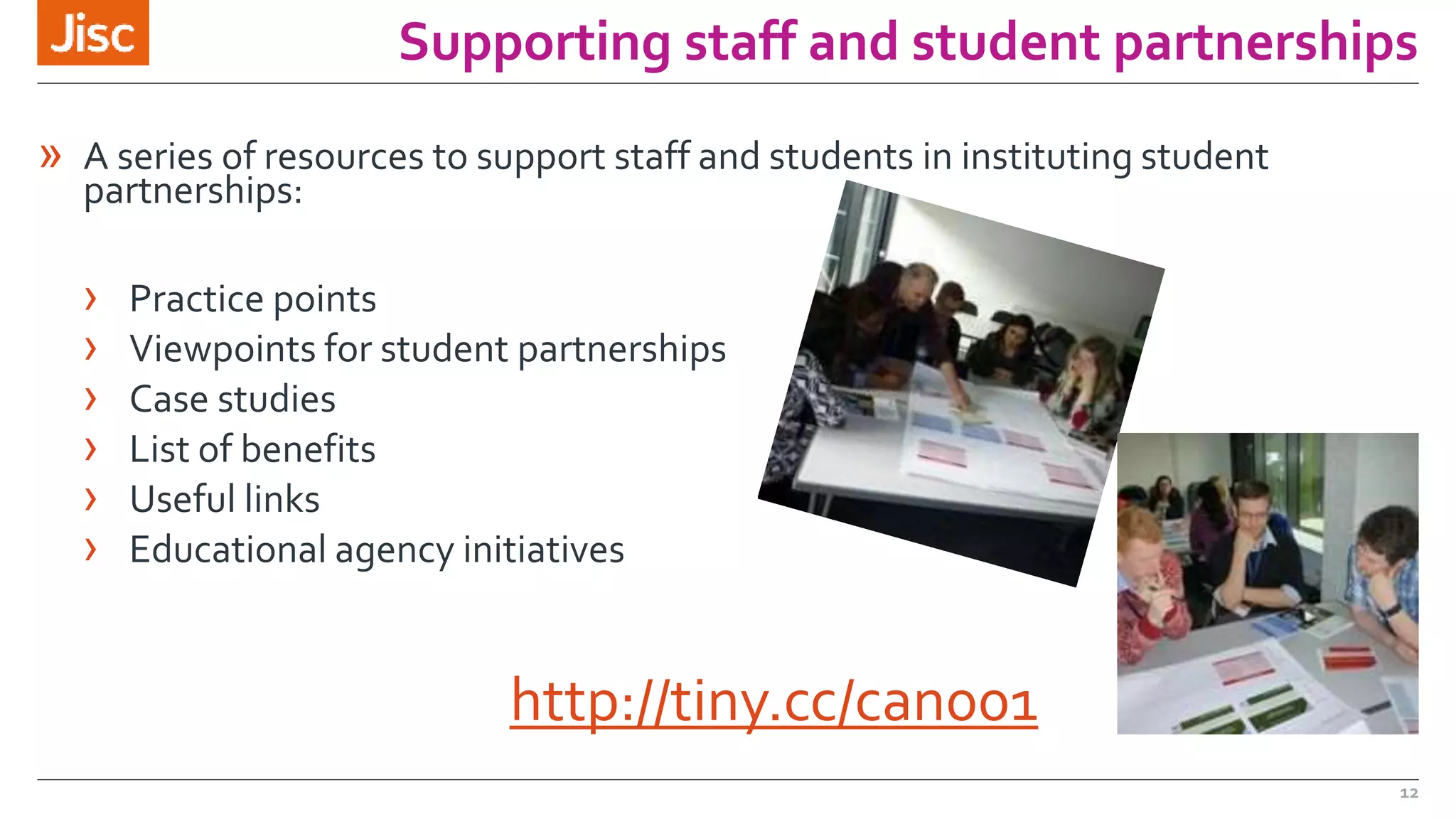
» A series of resources to support staff and students in instituting student 
partnerships: 
› Practice points 
› Viewpoints for student partnerships 
› Case studies 
› List of benefits 
› Useful links 
› Educational agency initiatives 
http://tiny.cc/can001
Viewpoints: a framework/process to support change 
» Originally developed by the University of Ulster 
» Funded by Jisc Institutional Approaches to Curriculum Design Programme (2008-2012) 
» Original focus on curriculum design, assessment and feedback 
» Adapted to different contexts e.g. 
› Flexible Curriculum 
› Student Partnerships 
› Digital Literacy 
› Work-based learning 
http://wiki.ulster.ac.uk Jisc Design Studio page: http://tinyurl.com/vpointswiki
Change Agents’ Network – Viewpoints Toolkit 
» Supporting staff and students in: 
› setting up and implementing partnerships with students (including students as change agents) 
› developing student and staff capabilities (including implementing accreditation) 
› evaluating and sustaining student partnerships 
» The toolkit: 
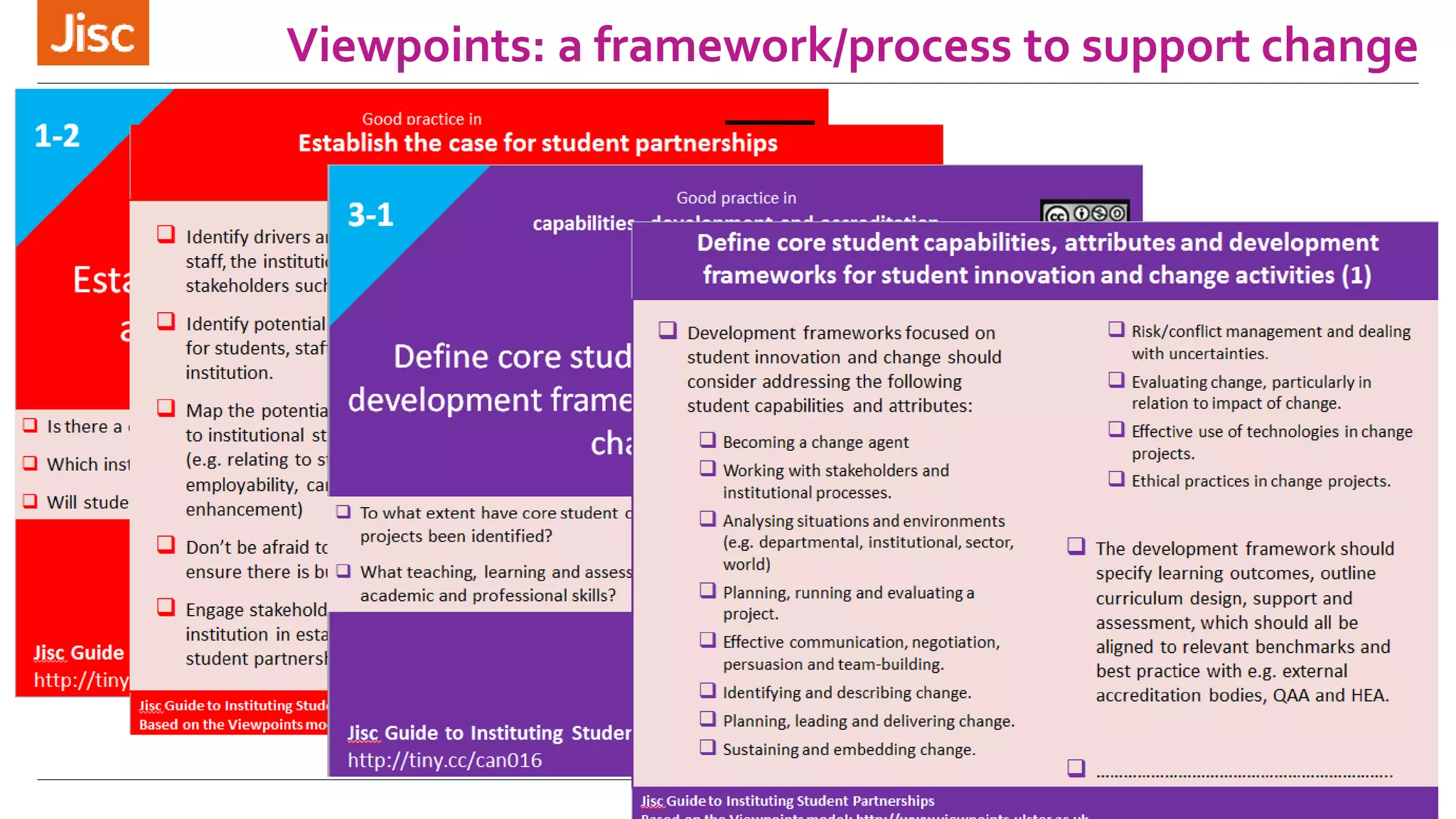
› a set of (good practice) “Viewpoints” cards (practice points/top tips) 
› a web-site with resources – linked to the Viewpoint cards http://tiny.cc/can001 
› a proposed methodology for using the toolkit 
» A community of practice: 
› helping to inform and shape the toolkit join CAN@jiscmail.ac.uk 
› using it (piloting…….. embedding) 
› refining it and maintaining its currency
Viewpoints: a framework/process to support change
The Resource Kit for Staff 
»Questions about the resources? 
16
Opportunity to experience the Viewpoints toolkit 
› Partnership set-up 
“Your VC/Principal wants to improve your NSS ratings and believes that student partnerships can help this and 
has tasked you and your colleagues to take this forward. Use the Viewpoints cards to create a prioritised plan”. 
› Partnership implementation 
“Your VC/Principal wants to improve your NSS ratings and believes that student partnerships can help this - 
another member of staff has developed an outline plan and you and your colleagues are now tasked to take this 
forward. Use the Viewpoints cards to create a prioritised plan”. 
› Capabilities, development and accreditation 
“You and your colleagues have been tasked by the PVC/Vice-Principal (Student Experience) to focus on 
developing capabilities and accreditation for students and staff involved with student partnership initiatives. Use 
the Viewpoints cards to create a prioritised plan”. 
› Evaluation, impact and sustainability 
“Your institution has undertaken two successful pilot student partnership projects and you and your colleagues 
have been tasked to sustain and embed these -Use the Viewpoints cards to create a prioritised plan.”
Discussion 
» Would the Viewpoints toolkit be useful in your institution? 
» Does it need amending/developing further? 
» Would you want to customise it? 
» Do you have any case studies to add to it? 
» http://padlet.com/sarahknight/CANJuly2014
Find out more… 
19 
Change Agents’ Network: 
s.knight@jisc.ac.uk 
peter.chatterton@daedalus-e-world.com 
mark.Kerrigan@anglia.ac.uk 
S.Walker@greenwich.ac.uk 
www.changeagentsnetwork.co.uk 
Follow us @CANagogy 
can@jiscmail.ac.uk visit www.jiscmail.ac.uk/CAN 
Except where otherwise noted, this 
work is licensed under CC-BY-NC-ND

Effective practice in setting up and implementing staff-student partnerships: lessons learnt from Change Agents Network

  • 1.
    Effective practice insetting up and implementing staff-student partnerships: lessons learnt from Change Agents Network Peter Chatterton, Sarah Knight, Mark Kerrigan, Simon Walker 02/09/2014 #CAN2014 www.changeagentsnetwork.co.uk
  • 2.
    Welcome and introductions Sarah Knight, Senior Co- Design Manager, Jisc @sarahknight Peter Chatterton, Consultant @balham Simon Walker, Head of Academic Development, University of Greenwich @sialker Dr Mark Kerrigan, Director of TL&A Faculty of Health, Social Care & Education Anglia Ruskin University @MarkKerrigan
  • 3.
    3 Change Agents’Network – Students as partners Rachel Wenstone, Vice President (Higher Education), NUS ‘Students as partners is not just a nice-to-have, I believe it has the potential to help bring about social and educational transformation, as long as we know what we are trying to do and we maintain a critical attitude about the ways the concept is adopted and used.’ A Manifesto for Partnership (November 2012)
  • 4.
    Background and context » NUS Student Engagement model » Use this model to evaluate your current student engagement practices » http://www.nusconnect.org.uk/campaign s/highereducation/student-engagement/ toolkit/ » HEA Engagement through partnership: students as partners in learning and teaching in higher education - https://www.heacademy.ac.uk/engageme nt-through-partnership-students-partners- learning-and-teaching-higher-education 4
  • 5.
    Ways of engagingstudents in the digital environment » Gathering information - Surveys, interviews, focus groups to find out about student expectations - Participative / observational methods to explore practices and attitudes - Social media – with students' consent – to collect information - Analyse existing data e.g. NSS/USS/ISB/PRET/local surveys » Stimulating, gathering and responding to ideas - Interactive and fun e.g. crowdsourcing, hashtags, ideas tree, padlet... -Make sure students can share ideas and see how they are acted on » Representation » Partnership projects: 'making things better‘ » See Jisc Digital Student Study – http://digitalstudent.jiscinvolve.org 5
  • 6.
    Benefits of engagingstudents » Benefits for students: › Gain an experience of leadership and influencing change. › Gain experience of using research to shape change. › Students can gain recognition through awards such as leadership awards, academic credit, extra-curricular awards and awards accredited through external bodies. › Enhances student experience. › Increases confidence & skills (e.g. communication, team-working, management, research skills). › Enhances networking with e.g. employers, community. › Improved employability and job prospects. 6
  • 7.
    Benefits of engagingstudents »Benefits for staff: ‘… the novice-expert dynamic has been overturned. Two years into the project, we have observed and reflected on the fact that it is not us who are privileging the Student Fellows by awarding them with these important roles, but rather we who are privileged because of the insights we have gained from being allowed into their worlds. Student Fellows have given us an honest insight into what goes on behind the scenes when technology is brought into the mix and how re-shaping feedback influences their confidence, self-belief, well-being, subject knowledge and collaborative skills.’ Bath Spa University and University of Winchester, FASTECH project 7
  • 8.
  • 9.
    Change Agents Network » Supports students working as change agents, digital pioneers, student fellows and students working in partnership with staff on technology related change projects » Networks and connects staff and students in colleges and universities across the UK working on such projects » Communicates, disseminates and influences the sharing of good practice » Publishes the open access Journal of Educational Innovation, Partnership & Change » Runs an accredited course on being a Change Agent/Institutional Change Leader through SEDA 9
  • 10.
    Accreditation – InstitutionalChange Leader 10 ….in progress Accreditation via SEDA
  • 11.
    Journal of EducationalInnovation , Partnership &Change 11 • Opinion Pieces • Case Studies / Project reports • Research Articles • Book Reviews • Technology Reviews • Deadline for submissions 20 October 2014 https://journals.gre.ac.uk/index.php/studentchangeagents
  • 12.
    Supporting staff andstudent partnerships 12 » A series of resources to support staff and students in instituting student partnerships: › Practice points › Viewpoints for student partnerships › Case studies › List of benefits › Useful links › Educational agency initiatives http://tiny.cc/can001
  • 13.
    Viewpoints: a framework/processto support change » Originally developed by the University of Ulster » Funded by Jisc Institutional Approaches to Curriculum Design Programme (2008-2012) » Original focus on curriculum design, assessment and feedback » Adapted to different contexts e.g. › Flexible Curriculum › Student Partnerships › Digital Literacy › Work-based learning http://wiki.ulster.ac.uk Jisc Design Studio page: http://tinyurl.com/vpointswiki
  • 14.
    Change Agents’ Network– Viewpoints Toolkit » Supporting staff and students in: › setting up and implementing partnerships with students (including students as change agents) › developing student and staff capabilities (including implementing accreditation) › evaluating and sustaining student partnerships » The toolkit: › a set of (good practice) “Viewpoints” cards (practice points/top tips) › a web-site with resources – linked to the Viewpoint cards http://tiny.cc/can001 › a proposed methodology for using the toolkit » A community of practice: › helping to inform and shape the toolkit join CAN@jiscmail.ac.uk › using it (piloting…….. embedding) › refining it and maintaining its currency
  • 15.
  • 16.
    The Resource Kitfor Staff »Questions about the resources? 16
  • 17.
    Opportunity to experiencethe Viewpoints toolkit › Partnership set-up “Your VC/Principal wants to improve your NSS ratings and believes that student partnerships can help this and has tasked you and your colleagues to take this forward. Use the Viewpoints cards to create a prioritised plan”. › Partnership implementation “Your VC/Principal wants to improve your NSS ratings and believes that student partnerships can help this - another member of staff has developed an outline plan and you and your colleagues are now tasked to take this forward. Use the Viewpoints cards to create a prioritised plan”. › Capabilities, development and accreditation “You and your colleagues have been tasked by the PVC/Vice-Principal (Student Experience) to focus on developing capabilities and accreditation for students and staff involved with student partnership initiatives. Use the Viewpoints cards to create a prioritised plan”. › Evaluation, impact and sustainability “Your institution has undertaken two successful pilot student partnership projects and you and your colleagues have been tasked to sustain and embed these -Use the Viewpoints cards to create a prioritised plan.”
  • 18.
    Discussion » Wouldthe Viewpoints toolkit be useful in your institution? » Does it need amending/developing further? » Would you want to customise it? » Do you have any case studies to add to it? » http://padlet.com/sarahknight/CANJuly2014
  • 19.
    Find out more… 19 Change Agents’ Network: s.knight@jisc.ac.uk peter.chatterton@daedalus-e-world.com mark.Kerrigan@anglia.ac.uk S.Walker@greenwich.ac.uk www.changeagentsnetwork.co.uk Follow us @CANagogy can@jiscmail.ac.uk visit www.jiscmail.ac.uk/CAN Except where otherwise noted, this work is licensed under CC-BY-NC-ND

Editor's Notes

  • #5 Using the four-stage picture of engagement as a reflective tool, this exercise challenges students’ representatives and institution managers and academics to evaluate their current student engagement practices. The focus of this task is to think about the outcomes of engagement activities and the impact that policies and practices have on students. Feedback from students Representation Curriculum design
  • #7 Peter
  • #8 Peter
  • #9 Video will be live for ALT –C on Jisc site at http://www.jisc.ac.uk/publications/programmerelated/2010/digiassess.aspx Current access is via password – AF-SAP Was wondering whether to play the video to illustrate the benefits – it has some excellent messages. Link on youTube - https://www.youtube.com/watch?v=j6uDpnlwXk8&list=PLbKeiLya4JyDJ2soh2cTlSAdTquLp8Kr0#t=11
  • #14 Sarah
  • #15 Peter
  • #16 Peter
  • #20 Go to ‘View’ menu > ‘Header and Footer…’ to edit the footers on this slide (click ‘Apply’ to change only the currently selected slide, or ‘Apply to All’ to change the footers on all slides).