Digital discovery tool pilot 2018
http://ji.sc/building-digicap #digitalcapability
10/01/18
Overview of today’s webinar
»Welcome and introductions (Sarah)
»Journey so far (Sarah)
»Using the discovery tool in your context (Helen)
»Question sets or ‘assessments’ (Helen)
»The digital discovery tool - what you need to know (Heather)
»Key resources and overall timeframes (Lisa)
»Discussion
Questions and comments throughout – please raise your hand to speak
or just contribute in the chat window
10/01/17 #digitalcapability http://ji.sc/building-digicap
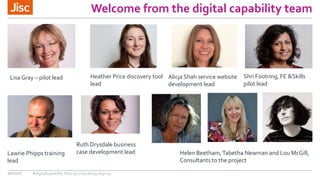
Welcome from the digital capability team
30/11/17 #digitalcapability http://ji.sc/building-digicap
Lisa Gray – pilot lead Alicja Shah service website
development lead
Heather Price discovery tool
lead
Ruth Drysdale business
case development lead
Shri Footring, FE &Skills
pilot lead
Lawrie Phipps training
lead
Helen Beetham,Tabetha Newman and Lou McGill,
Consultants to the project
Introducing yourselves

»In the chat window, please introduce yourself by name,
role and institution
»Then please say something about how you see the Digital
Discovery tool supporting your organisations’
developments in this area
10/01/17 #digitalcapability http://ji.sc/building-digicap
The journey so far
Sarah Knight
10/01/17 #digitalcapability http://ji.sc/building-digicap
A potted history

»Thriving in the 21st century:
Learning Literacies for the
Digital Age (2008-2009) -
https://www.llida.uk/
»Developing digital literacies
(2011-2013) -
http://bit.ly/15Exo3J
»Building digital capability
project (2014- 2018) -
http://ji.sc/building-digicap
10/01/17 #digitalcapability http://ji.sc/building-digicap
»Building digital capability is a
strategic priority for Jisc and
continues to be recognised as
an area of importance in
feedback from stakeholders
» Evidence from our 2017
Student digital experience
tracker supports the
importance of developing both
staff and students’ digital
capabilities
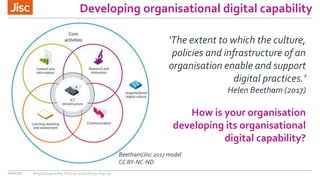
Developing organisational digital capability
10/01/17 #digitalcapability http://ji.sc/building-digicap
Beetham/Jisc 2017 model
CC BY-NC-ND
‘The extent to which the culture,
policies and infrastructure of an
organisation enable and support
digital practices.’
Helen Beetham (2017)
How is your organisation
developing its organisational
digital capability?
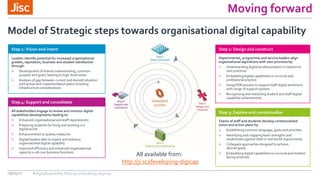
Step 2: Design and construct
Departmental, programme and service leaders align
organisational aspirations with own priorities by:
> Understanding digital professionalism in relation to
own practices
> Embedding digital capabilities in curricula and
professional practice
> Using PDR process to support staff digital ambitions
with range of support options
> Recognising and rewarding student and staff digital
capability achievements
Step 3: Explore and contextualise
Teams of staff and students develop contextualised
vision and action plans by:
> Establishing common language, goals and priorities
> Identifying and mapping team strengths and
weaknesses against ideal or real world requirements
> Collegiate approaches designed to achieve
desired goals
> Embedding digital capabilities in curricula and student-
facing activities
Moving forward
Model of Strategic steps towards organisational digital capability
All available from:
http://ji.sc/developing-digicap
09/05/17 #digitalcapability http://ji.sc/building-digicap
Step 1: Vision and intent
Leaders identify potential for increased organisational
growth, reputation, business and student satisfaction
through:
> Development of shared understanding, common
purpose and goals, leading to high-level vision
> Analysis of gap between current and desired situation
with action and implementation plans including
infrastructure considerations
Step 4: Support and consolidate
All stakeholders engage to review and monitor digital
capabilities developments leading to:
> Enhanced organisational andstaff reputation(s)
> Preparing students for living and working in a
digital world
> Enhancements to quality measures
> Digital leaders able to inspire and enhance
organisational digital capability
> Improved efficiency and enhanced organisational
capacity in all core business functions
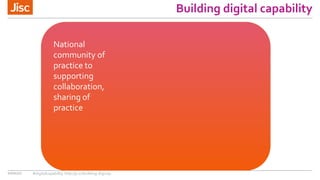
Building digital capability
10/01/17 #digitalcapability http://ji.sc/building-digicap
National
community of
practice to
supporting
collaboration,
sharing of
practice
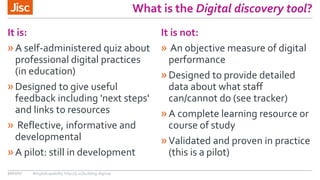
What is the Digital discovery tool?
It is:
»A self-administered quiz about
professional digital practices
(in education)
»Designed to give useful
feedback including 'next steps'
and links to resources
» Reflective, informative and
developmental
»A pilot: still in development
It is not:
» An objective measure of digital
performance
»Designed to provide detailed
data about what staff
can/cannot do (see tracker)
»A complete learning resource or
course of study
»Validated and proven in practice
(this is a pilot)
30/11/17 #digitalcapability http://ji.sc/building-digicap
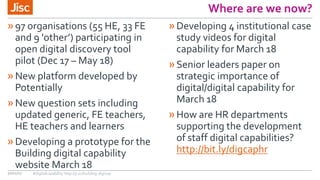
Where are we now?
»97 organisations (55 HE, 33 FE
and 9 'other’) participating in
open digital discovery tool
pilot (Dec 17 – May 18)
»New platform developed by
Potentially
»New question sets including
updated generic, FE teachers,
HE teachers and learners
»Developing a prototype for the
Building digital capability
website March 18
»Developing 4 institutional case
study videos for digital
capability for March 18
»Senior leaders paper on
strategic importance of
digital/digital capability for
March 18
»How are HR departments
supporting the development
of staff digital capabilities?
http://bit.ly/digcaphr
30/11/17 #digitalcapability http://ji.sc/building-digicap
Questions?
10/01/17 #digitalcapability http://ji.sc/building-digicap
Using the discovery tool in your context
Helen Beetham
10/01/17 #digitalcapability http://ji.sc/building-digicap
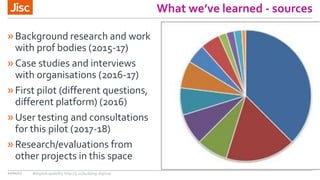
What we’ve learned - sources
»Background research and work
with prof bodies (2015-17)
»Case studies and interviews
with organisations (2016-17)
»First pilot (different questions,
different platform) (2016)
»User testing and consultations
for this pilot (2017-18)
»Research/evaluations from
other projects in this space
10/01/17 #digitalcapability http://ji.sc/building-digicap
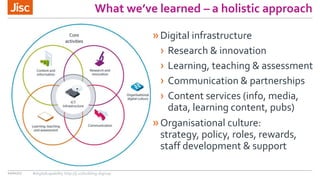
What we’ve learned – a holistic approach
10/01/17 #digitalcapability http://ji.sc/building-digicap
»Digital infrastructure
â€ș Research & innovation
â€ș Learning, teaching & assessment
â€ș Communication & partnerships
â€ș Content services (info, media,
data, learning content, pubs)
»Organisational culture:
strategy, policy, roles, rewards,
staff development & support
Different organisational cultures

10/01/17 #digitalcapability http://ji.sc/building-digicap
»  different ways of supporting and developing staff.
From sign-up data:
â€ș 41% mentioned voluntary staff development e.g. workshops
â€ș 13% made mandatory interventions e.g. at appraisal, PDR, or
induction
â€ș 19% mentioned IT support and 12% TEL support
â€ș 19% mentioned online materials: subscription services
(Lynda.com) or bespoke (3:1)
â€ș 26% said provision for staff was currently insufficient, declining
or ‘ad hoc’
Decide what will work in your setting

10/01/17 #digitalcapability http://ji.sc/building-digicap
»  then plan, prepare, engage, communicate
bit.ly/digidiscoveryguide
â€ș Senior leaders initiate messages
â€ș Stakeholder champions in different teams/depts (+ students)
â€ș Promotional campaign with clear, visual messages
â€ș Timing: coincide with other initiatives, avoid peak workload
â€ș Focus on benefits to end-users: awareness, reflection,
confidence, tailored resources, self-directed
â€ș Other incentives: digital badges, support for accreditation,
chocolate!
Put in place support for end-users
10/01/17 #digitalcapability http://ji.sc/building-digicap
»Such as:
â€ș opportunity to share and discuss results
â€ș links to local resources/development opportunities (signposting
must be in place)
â€ș completion in live, supported, f2f settings
â€ș join a staff network or community of practice
â€ș tailored training mapped to the content of the discovery tool
»Median = 2-3 different forms of support
Designing the Digital discovery tool
Helen Beetham
10/01/17 #digitalcapability http://ji.sc/building-digicap
Key principles
10/01/17 #digitalcapability http://ji.sc/building-digicap
»Practice based – from practical issues to broader concepts
»Self-assessment – tempered with (objective?) self-reporting
»High level terms – but with specific examples
»Collegial tone – but hopefully not patronising
»Generic capabilities – minimal sector and role differences
»Specialist capabilities – focus on role-related practices and tasks
»Nudge - questions themselves clarify, exemplify and inform
All of these have been/are being user tested and will be evaluated
Two types of assessment
10/01/17 #digitalcapability http://ji.sc/building-digicap
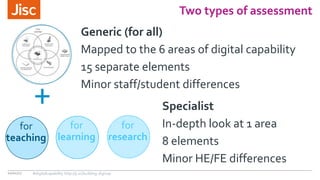
Generic (for all)
Mapped to the 6 areas of digital capability
15 separate elements
Minor staff/student differences
Specialist
In-depth look at 1 area
8 elements
Minor HE/FE differences
for
teaching
for
learning
for
research
+
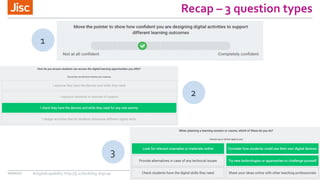
Three question types in every element
[Question type 1]
10/01/17 #digitalcapability http://ji.sc/building-digicap
Confidence: rate your confidence with a digital practice
or skill
Three question types in every element
[Question type 2]
10/01/17 #digitalcapability http://ji.sc/building-digicap
‘Best fit’: select the one response out of four that best
describes your approach to a digital task
Three question types in every element
[Question type 3]
10/01/17 #digitalcapability http://ji.sc/building-digicap
‘Grid’: select all the digital activities you do, from a grid
of six
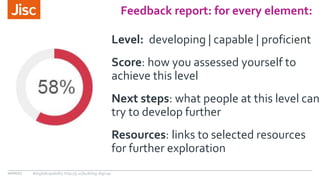
Feedback report: for every element:
10/01/17 #digitalcapability http://ji.sc/building-digicap
Level: developing | capable | proficient
Score: how you assessed yourself to
achieve this level
Next steps: what people at this level can
try to develop further
Resources: links to selected resources
for further exploration
Questions?
10/01/17 #digitalcapability http://ji.sc/building-digicap
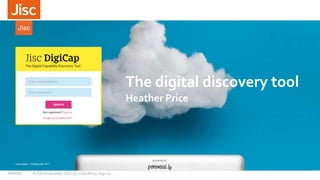
The digital discovery tool
Heather Price
10/01/17 #digitalcapability http://ji.sc/building-digicap
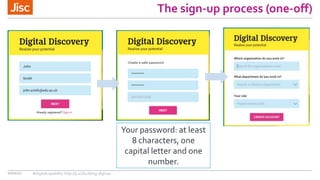
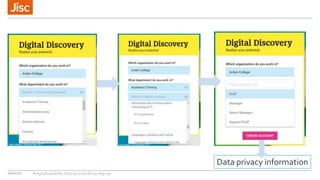
The sign-up process (one-off)
10/01/17 #digitalcapability http://ji.sc/building-digicap
Your password: at least
8 characters, one
capital letter and one
number.
10/01/17 #digitalcapability http://ji.sc/building-digicap
Data privacy information
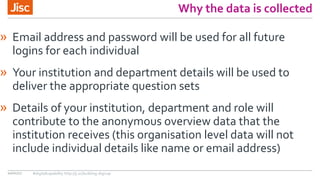
Why the data is collected
10/01/17 #digitalcapability http://ji.sc/building-digicap
» Email address and password will be used for all future
logins for each individual
» Your institution and department details will be used to
deliver the appropriate question sets
» Details of your institution, department and role will
contribute to the anonymous overview data that the
institution receives (this organisation level data will not
include individual details like name or email address)
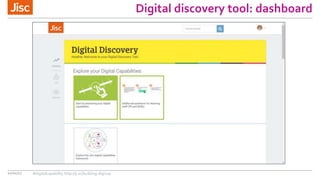
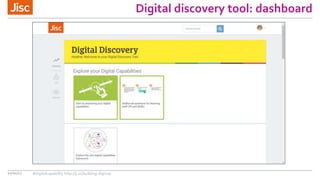
Digital discovery tool: dashboard
10/01/17 #digitalcapability http://ji.sc/building-digicap
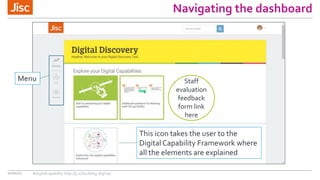
Navigating the dashboard
10/01/17 #digitalcapability http://ji.sc/building-digicap
Staff
evaluation
feedback
form link
here
This icon takes the user to the
Digital Capability Framework where
all the elements are explained
Menu
10/01/17 #digitalcapability http://ji.sc/building-digicap
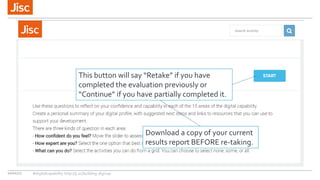
This button will say “Retake” if you have
completed the evaluation previously or
“Continue” if you have partially completed it.
Download a copy of your current
results report BEFORE re-taking.
Recap – 3 question types
10/01/17 #digitalcapability http://ji.sc/building-digicap
1
2
3
The question screen
10/01/17 #digitalcapability http://ji.sc/building-digicap
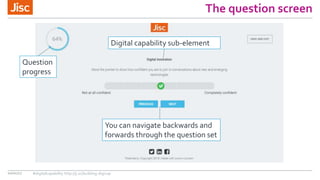
Question
progress
You can navigate backwards and
forwards through the question set
Digital capability sub-element
Grid and list selections
10/01/17 #digitalcapability http://ji.sc/building-digicap
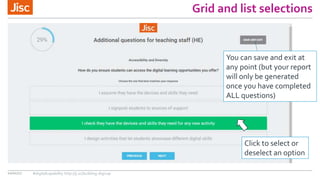
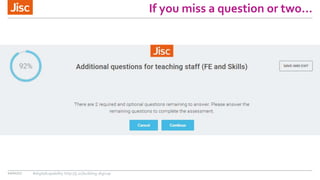
You can save and exit at
any point (but your report
will only be generated
once you have completed
ALL questions)
Click to select or
deselect an option
If you miss a question or two

10/01/17 #digitalcapability http://ji.sc/building-digicap
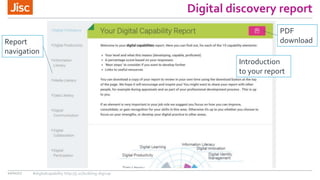
Digital discovery report
10/01/17 #digitalcapability http://ji.sc/building-digicap
Report
navigation
PDF
download
Introduction
to your report
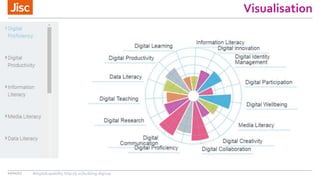
Visualisation
10/01/17 #digitalcapability http://ji.sc/building-digicap
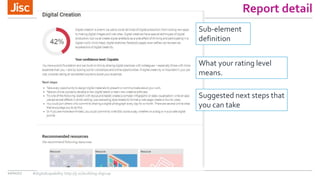
Report detail
10/01/17 #digitalcapability http://ji.sc/building-digicap
Sub-element
definition
What your rating level
means.
Suggested next steps that
you can take
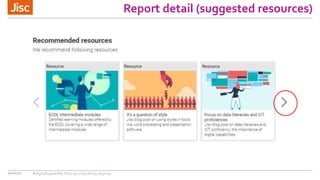
Report detail (suggested resources)
10/01/17 #digitalcapability http://ji.sc/building-digicap
Digital discovery tool: dashboard
10/01/17 #digitalcapability http://ji.sc/building-digicap
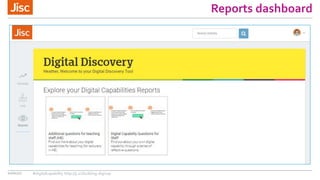
Reports dashboard
10/01/17 #digitalcapability http://ji.sc/building-digicap
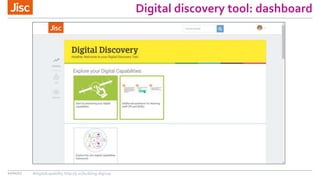
Digital discovery tool: dashboard
10/01/17 #digitalcapability http://ji.sc/building-digicap
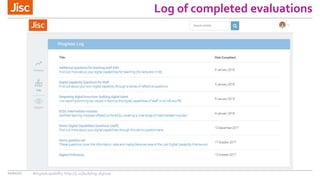
Log of completed evaluations
10/01/17 #digitalcapability http://ji.sc/building-digicap
Questions?
10/01/17 #digitalcapability http://ji.sc/building-digicap
Key resources and pilot timeframes
Lisa Gray
10/01/17 #digitalcapability http://ji.sc/building-digicap
The six-elements of digital capability
08/11/17 #digitalcapability http://ji.sc/building-digicap
Available from:
http://ji.sc/building-digicap
‘It gives us that common vocabulary
and I think that is important: [it]
allows us to
have conversations on common
ground.’ NTU case study
Framework and role profiles
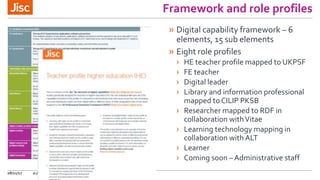
» Digital capability framework – 6
elements, 15 sub elements
» Eight role profiles
â€ș HE teacher profile mapped to UKPSF
â€ș FE teacher
â€ș Digital leader
â€ș Library and information professional
mapped to CILIP PKSB
â€ș Researcher mapped to RDF in
collaboration withVitae
â€ș Learning technology mapping in
collaboration with ALT
â€ș Learner
â€ș Coming soon – Administrative staff
08/11/17 #digitalcapability http://ji.sc/building-digicap
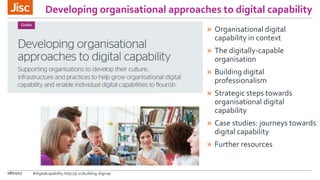
Developing organisational approaches to digital capability
» Organisational digital
capability in context
» The digitally-capable
organisation
» Building digital
professionalism
» Strategic steps towards
organisational digital
capability
» Case studies: journeys towards
digital capability
» Further resources
08/11/17 #digitalcapability http://ji.sc/building-digicap
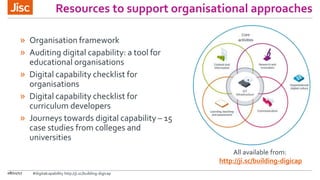
Resources to support organisational approaches
» Organisation framework
» Auditing digital capability: a tool for
educational organisations
» Digital capability checklist for
organisations
» Digital capability checklist for
curriculum developers
» Journeys towards digital capability – 15
case studies from colleges and
universities
All available from:
http://ji.sc/building-digicap
08/11/17 #digitalcapability http://ji.sc/building-digicap
Community of Practice
08/11/17 #digitalcapability http://ji.sc/building-digicap
» Launched in May 2017, ran again in
November 2017 with 100 delegates at
from across FE and HE
» See our summaries of these events at:
â€ș http://ji.sc/community-of-practice
â€ș http://bit.ly/2CKZu1e
» Join CoP mailing list
www.jiscmail.ac.uk/jisc-digcap-ug
» Next event taking place on 22nd May
at the University of Leicester
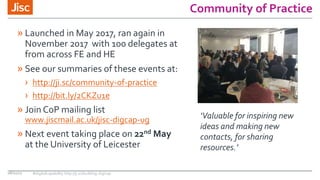
‘Valuable for inspiring new
ideas and making new
contacts, for sharing
resources.’
Training offers
» Digital leaders course running 25/26 Jan & 15/16 Feb 18
» Developing TEL Leaders / Managers Strategy Course (1 day with online follow
up)
» Curriculum confidence: designing for digital capabilities in the curriculum – 1
day course running in 2018 and on site delivery options
» Online training: Supporting learners digital well being and identity – ran on
14/12
www.jisc.ac.uk/training
Developing a suite of training for developing digital capability
08/11/17 #digitalcapability http://ji.sc/building-digicap
Guidance
»Guidance for institutional
leads
»Digital discovery: essential
information
»Digital discovery: planning
»Digital discovery: engaging
users
»To come: Responding to your
data
08/11/17 #digitalcapability http://ji.sc/building-digicap
www.bit.ly/digidiscoveryguide
Useful background posts
» Analysis of the pilot sign up forms:
http://bit.ly/2DdM8eR
» What we learned from the previous
pilot and where we go next:
» http://bit.ly/2mdy2SC
» Six institutional stories from the first
pilot
â€ș http://bit.ly/2mikt5e
» Coming soon – XXX
08/11/17 #digitalcapability http://ji.sc/building-digicap
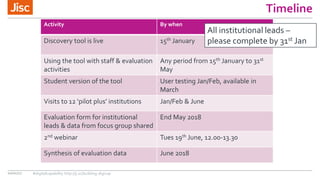
Timeline
10/01/17 #digitalcapability http://ji.sc/building-digicap
Activity By when
Discovery tool is live 15th January
Using the tool with staff & evaluation
activities
Any period from 15th January to 31st
May
Student version of the tool User testing Jan/Feb, available in
March
Visits to 12 ‘pilot plus’ institutions Jan/Feb & June
Evaluation form for institutional
leads & data from focus group shared
End May 2018
2nd webinar Tues 19th June, 12.00-13.30
Synthesis of evaluation data June 2018
All institutional leads –
please complete by 31st Jan
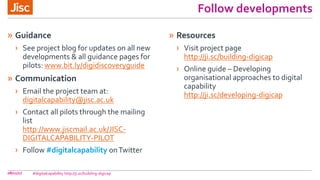
Follow developments
» Guidance
â€ș See project blog for updates on all new
developments & all guidance pages for
pilots: www.bit.ly/digidiscoveryguide
» Communication
â€ș Email the project team at:
digitalcapability@jisc.ac.uk
â€ș Contact all pilots through the mailing
list
http://www.jiscmail.ac.uk/JISC-
DIGITALCAPABILITY-PILOT
â€ș Follow #digitalcapability onTwitter
» Resources
â€ș Visit project page
http://ji.sc/building-digicap
â€ș Online guide – Developing
organisational approaches to digital
capability
http://ji.sc/developing-digicap
08/11/17 #digitalcapability http://ji.sc/building-digicap
Discussion and questions
10/01/17 #digitalcapability http://ji.sc/building-digicap

JIsc Digital discovery tool pilot 2018 Webinar

  • 1.
    Digital discovery toolpilot 2018 http://ji.sc/building-digicap #digitalcapability 10/01/18
  • 2.
    Overview of today’swebinar »Welcome and introductions (Sarah) »Journey so far (Sarah) »Using the discovery tool in your context (Helen) »Question sets or ‘assessments’ (Helen) »The digital discovery tool - what you need to know (Heather) »Key resources and overall timeframes (Lisa) »Discussion Questions and comments throughout – please raise your hand to speak or just contribute in the chat window 10/01/17 #digitalcapability http://ji.sc/building-digicap
  • 3.
    Welcome from thedigital capability team 30/11/17 #digitalcapability http://ji.sc/building-digicap Lisa Gray – pilot lead Alicja Shah service website development lead Heather Price discovery tool lead Ruth Drysdale business case development lead Shri Footring, FE &Skills pilot lead Lawrie Phipps training lead Helen Beetham,Tabetha Newman and Lou McGill, Consultants to the project
  • 4.
    Introducing yourselves
 »In thechat window, please introduce yourself by name, role and institution »Then please say something about how you see the Digital Discovery tool supporting your organisations’ developments in this area 10/01/17 #digitalcapability http://ji.sc/building-digicap
  • 5.
    The journey sofar Sarah Knight 10/01/17 #digitalcapability http://ji.sc/building-digicap
  • 6.
    A potted history
 »Thrivingin the 21st century: Learning Literacies for the Digital Age (2008-2009) - https://www.llida.uk/ »Developing digital literacies (2011-2013) - http://bit.ly/15Exo3J »Building digital capability project (2014- 2018) - http://ji.sc/building-digicap 10/01/17 #digitalcapability http://ji.sc/building-digicap »Building digital capability is a strategic priority for Jisc and continues to be recognised as an area of importance in feedback from stakeholders » Evidence from our 2017 Student digital experience tracker supports the importance of developing both staff and students’ digital capabilities
  • 7.
    Developing organisational digitalcapability 10/01/17 #digitalcapability http://ji.sc/building-digicap Beetham/Jisc 2017 model CC BY-NC-ND ‘The extent to which the culture, policies and infrastructure of an organisation enable and support digital practices.’ Helen Beetham (2017) How is your organisation developing its organisational digital capability?
  • 8.
    Step 2: Designand construct Departmental, programme and service leaders align organisational aspirations with own priorities by: > Understanding digital professionalism in relation to own practices > Embedding digital capabilities in curricula and professional practice > Using PDR process to support staff digital ambitions with range of support options > Recognising and rewarding student and staff digital capability achievements Step 3: Explore and contextualise Teams of staff and students develop contextualised vision and action plans by: > Establishing common language, goals and priorities > Identifying and mapping team strengths and weaknesses against ideal or real world requirements > Collegiate approaches designed to achieve desired goals > Embedding digital capabilities in curricula and student- facing activities Moving forward Model of Strategic steps towards organisational digital capability All available from: http://ji.sc/developing-digicap 09/05/17 #digitalcapability http://ji.sc/building-digicap Step 1: Vision and intent Leaders identify potential for increased organisational growth, reputation, business and student satisfaction through: > Development of shared understanding, common purpose and goals, leading to high-level vision > Analysis of gap between current and desired situation with action and implementation plans including infrastructure considerations Step 4: Support and consolidate All stakeholders engage to review and monitor digital capabilities developments leading to: > Enhanced organisational andstaff reputation(s) > Preparing students for living and working in a digital world > Enhancements to quality measures > Digital leaders able to inspire and enhance organisational digital capability > Improved efficiency and enhanced organisational capacity in all core business functions
  • 9.
    Building digital capability 10/01/17#digitalcapability http://ji.sc/building-digicap National community of practice to supporting collaboration, sharing of practice
  • 10.
    What is theDigital discovery tool? It is: »A self-administered quiz about professional digital practices (in education) »Designed to give useful feedback including 'next steps' and links to resources » Reflective, informative and developmental »A pilot: still in development It is not: » An objective measure of digital performance »Designed to provide detailed data about what staff can/cannot do (see tracker) »A complete learning resource or course of study »Validated and proven in practice (this is a pilot) 30/11/17 #digitalcapability http://ji.sc/building-digicap
  • 11.
    Where are wenow? »97 organisations (55 HE, 33 FE and 9 'other’) participating in open digital discovery tool pilot (Dec 17 – May 18) »New platform developed by Potentially »New question sets including updated generic, FE teachers, HE teachers and learners »Developing a prototype for the Building digital capability website March 18 »Developing 4 institutional case study videos for digital capability for March 18 »Senior leaders paper on strategic importance of digital/digital capability for March 18 »How are HR departments supporting the development of staff digital capabilities? http://bit.ly/digcaphr 30/11/17 #digitalcapability http://ji.sc/building-digicap
  • 12.
  • 13.
    Using the discoverytool in your context Helen Beetham 10/01/17 #digitalcapability http://ji.sc/building-digicap
  • 14.
    What we’ve learned- sources »Background research and work with prof bodies (2015-17) »Case studies and interviews with organisations (2016-17) »First pilot (different questions, different platform) (2016) »User testing and consultations for this pilot (2017-18) »Research/evaluations from other projects in this space 10/01/17 #digitalcapability http://ji.sc/building-digicap
  • 15.
    What we’ve learned– a holistic approach 10/01/17 #digitalcapability http://ji.sc/building-digicap »Digital infrastructure â€ș Research & innovation â€ș Learning, teaching & assessment â€ș Communication & partnerships â€ș Content services (info, media, data, learning content, pubs) »Organisational culture: strategy, policy, roles, rewards, staff development & support
  • 16.
    Different organisational cultures
 10/01/17#digitalcapability http://ji.sc/building-digicap »  different ways of supporting and developing staff. From sign-up data: â€ș 41% mentioned voluntary staff development e.g. workshops â€ș 13% made mandatory interventions e.g. at appraisal, PDR, or induction â€ș 19% mentioned IT support and 12% TEL support â€ș 19% mentioned online materials: subscription services (Lynda.com) or bespoke (3:1) â€ș 26% said provision for staff was currently insufficient, declining or ‘ad hoc’
  • 17.
    Decide what willwork in your setting
 10/01/17 #digitalcapability http://ji.sc/building-digicap »  then plan, prepare, engage, communicate bit.ly/digidiscoveryguide â€ș Senior leaders initiate messages â€ș Stakeholder champions in different teams/depts (+ students) â€ș Promotional campaign with clear, visual messages â€ș Timing: coincide with other initiatives, avoid peak workload â€ș Focus on benefits to end-users: awareness, reflection, confidence, tailored resources, self-directed â€ș Other incentives: digital badges, support for accreditation, chocolate!
  • 18.
    Put in placesupport for end-users 10/01/17 #digitalcapability http://ji.sc/building-digicap »Such as: â€ș opportunity to share and discuss results â€ș links to local resources/development opportunities (signposting must be in place) â€ș completion in live, supported, f2f settings â€ș join a staff network or community of practice â€ș tailored training mapped to the content of the discovery tool »Median = 2-3 different forms of support
  • 19.
    Designing the Digitaldiscovery tool Helen Beetham 10/01/17 #digitalcapability http://ji.sc/building-digicap
  • 20.
    Key principles 10/01/17 #digitalcapabilityhttp://ji.sc/building-digicap »Practice based – from practical issues to broader concepts »Self-assessment – tempered with (objective?) self-reporting »High level terms – but with specific examples »Collegial tone – but hopefully not patronising »Generic capabilities – minimal sector and role differences »Specialist capabilities – focus on role-related practices and tasks »Nudge - questions themselves clarify, exemplify and inform All of these have been/are being user tested and will be evaluated
  • 21.
    Two types ofassessment 10/01/17 #digitalcapability http://ji.sc/building-digicap Generic (for all) Mapped to the 6 areas of digital capability 15 separate elements Minor staff/student differences Specialist In-depth look at 1 area 8 elements Minor HE/FE differences for teaching for learning for research +
  • 22.
    Three question typesin every element [Question type 1] 10/01/17 #digitalcapability http://ji.sc/building-digicap Confidence: rate your confidence with a digital practice or skill
  • 23.
    Three question typesin every element [Question type 2] 10/01/17 #digitalcapability http://ji.sc/building-digicap ‘Best fit’: select the one response out of four that best describes your approach to a digital task
  • 24.
    Three question typesin every element [Question type 3] 10/01/17 #digitalcapability http://ji.sc/building-digicap ‘Grid’: select all the digital activities you do, from a grid of six
  • 25.
    Feedback report: forevery element: 10/01/17 #digitalcapability http://ji.sc/building-digicap Level: developing | capable | proficient Score: how you assessed yourself to achieve this level Next steps: what people at this level can try to develop further Resources: links to selected resources for further exploration
  • 26.
  • 27.
    The digital discoverytool Heather Price 10/01/17 #digitalcapability http://ji.sc/building-digicap
  • 28.
    The sign-up process(one-off) 10/01/17 #digitalcapability http://ji.sc/building-digicap Your password: at least 8 characters, one capital letter and one number.
  • 29.
  • 30.
    Why the datais collected 10/01/17 #digitalcapability http://ji.sc/building-digicap » Email address and password will be used for all future logins for each individual » Your institution and department details will be used to deliver the appropriate question sets » Details of your institution, department and role will contribute to the anonymous overview data that the institution receives (this organisation level data will not include individual details like name or email address)
  • 31.
    Digital discovery tool:dashboard 10/01/17 #digitalcapability http://ji.sc/building-digicap
  • 32.
    Navigating the dashboard 10/01/17#digitalcapability http://ji.sc/building-digicap Staff evaluation feedback form link here This icon takes the user to the Digital Capability Framework where all the elements are explained Menu
  • 33.
    10/01/17 #digitalcapability http://ji.sc/building-digicap Thisbutton will say “Retake” if you have completed the evaluation previously or “Continue” if you have partially completed it. Download a copy of your current results report BEFORE re-taking.
  • 34.
    Recap – 3question types 10/01/17 #digitalcapability http://ji.sc/building-digicap 1 2 3
  • 35.
    The question screen 10/01/17#digitalcapability http://ji.sc/building-digicap Question progress You can navigate backwards and forwards through the question set Digital capability sub-element
  • 36.
    Grid and listselections 10/01/17 #digitalcapability http://ji.sc/building-digicap You can save and exit at any point (but your report will only be generated once you have completed ALL questions) Click to select or deselect an option
  • 37.
    If you missa question or two
 10/01/17 #digitalcapability http://ji.sc/building-digicap
  • 38.
    Digital discovery report 10/01/17#digitalcapability http://ji.sc/building-digicap Report navigation PDF download Introduction to your report
  • 39.
  • 40.
    Report detail 10/01/17 #digitalcapabilityhttp://ji.sc/building-digicap Sub-element definition What your rating level means. Suggested next steps that you can take
  • 41.
    Report detail (suggestedresources) 10/01/17 #digitalcapability http://ji.sc/building-digicap
  • 42.
    Digital discovery tool:dashboard 10/01/17 #digitalcapability http://ji.sc/building-digicap
  • 43.
    Reports dashboard 10/01/17 #digitalcapabilityhttp://ji.sc/building-digicap
  • 44.
    Digital discovery tool:dashboard 10/01/17 #digitalcapability http://ji.sc/building-digicap
  • 45.
    Log of completedevaluations 10/01/17 #digitalcapability http://ji.sc/building-digicap
  • 46.
  • 47.
    Key resources andpilot timeframes Lisa Gray 10/01/17 #digitalcapability http://ji.sc/building-digicap
  • 48.
    The six-elements ofdigital capability 08/11/17 #digitalcapability http://ji.sc/building-digicap Available from: http://ji.sc/building-digicap ‘It gives us that common vocabulary and I think that is important: [it] allows us to have conversations on common ground.’ NTU case study
  • 49.
    Framework and roleprofiles » Digital capability framework – 6 elements, 15 sub elements » Eight role profiles â€ș HE teacher profile mapped to UKPSF â€ș FE teacher â€ș Digital leader â€ș Library and information professional mapped to CILIP PKSB â€ș Researcher mapped to RDF in collaboration withVitae â€ș Learning technology mapping in collaboration with ALT â€ș Learner â€ș Coming soon – Administrative staff 08/11/17 #digitalcapability http://ji.sc/building-digicap
  • 50.
    Developing organisational approachesto digital capability » Organisational digital capability in context » The digitally-capable organisation » Building digital professionalism » Strategic steps towards organisational digital capability » Case studies: journeys towards digital capability » Further resources 08/11/17 #digitalcapability http://ji.sc/building-digicap
  • 51.
    Resources to supportorganisational approaches » Organisation framework » Auditing digital capability: a tool for educational organisations » Digital capability checklist for organisations » Digital capability checklist for curriculum developers » Journeys towards digital capability – 15 case studies from colleges and universities All available from: http://ji.sc/building-digicap 08/11/17 #digitalcapability http://ji.sc/building-digicap
  • 52.
    Community of Practice 08/11/17#digitalcapability http://ji.sc/building-digicap » Launched in May 2017, ran again in November 2017 with 100 delegates at from across FE and HE » See our summaries of these events at: â€ș http://ji.sc/community-of-practice â€ș http://bit.ly/2CKZu1e » Join CoP mailing list www.jiscmail.ac.uk/jisc-digcap-ug » Next event taking place on 22nd May at the University of Leicester ‘Valuable for inspiring new ideas and making new contacts, for sharing resources.’
  • 53.
    Training offers » Digitalleaders course running 25/26 Jan & 15/16 Feb 18 » Developing TEL Leaders / Managers Strategy Course (1 day with online follow up) » Curriculum confidence: designing for digital capabilities in the curriculum – 1 day course running in 2018 and on site delivery options » Online training: Supporting learners digital well being and identity – ran on 14/12 www.jisc.ac.uk/training Developing a suite of training for developing digital capability 08/11/17 #digitalcapability http://ji.sc/building-digicap
  • 54.
    Guidance »Guidance for institutional leads »Digitaldiscovery: essential information »Digital discovery: planning »Digital discovery: engaging users »To come: Responding to your data 08/11/17 #digitalcapability http://ji.sc/building-digicap www.bit.ly/digidiscoveryguide
  • 55.
    Useful background posts »Analysis of the pilot sign up forms: http://bit.ly/2DdM8eR » What we learned from the previous pilot and where we go next: » http://bit.ly/2mdy2SC » Six institutional stories from the first pilot â€ș http://bit.ly/2mikt5e » Coming soon – XXX 08/11/17 #digitalcapability http://ji.sc/building-digicap
  • 56.
    Timeline 10/01/17 #digitalcapability http://ji.sc/building-digicap ActivityBy when Discovery tool is live 15th January Using the tool with staff & evaluation activities Any period from 15th January to 31st May Student version of the tool User testing Jan/Feb, available in March Visits to 12 ‘pilot plus’ institutions Jan/Feb & June Evaluation form for institutional leads & data from focus group shared End May 2018 2nd webinar Tues 19th June, 12.00-13.30 Synthesis of evaluation data June 2018 All institutional leads – please complete by 31st Jan
  • 57.
    Follow developments » Guidance â€șSee project blog for updates on all new developments & all guidance pages for pilots: www.bit.ly/digidiscoveryguide » Communication â€ș Email the project team at: digitalcapability@jisc.ac.uk â€ș Contact all pilots through the mailing list http://www.jiscmail.ac.uk/JISC- DIGITALCAPABILITY-PILOT â€ș Follow #digitalcapability onTwitter » Resources â€ș Visit project page http://ji.sc/building-digicap â€ș Online guide – Developing organisational approaches to digital capability http://ji.sc/developing-digicap 08/11/17 #digitalcapability http://ji.sc/building-digicap
  • 58.
    Discussion and questions 10/01/17#digitalcapability http://ji.sc/building-digicap

Editor's Notes

  • #8 Our work and understanding of digital literacies for individuals has evolved over the years to now expressing these as digital capabilities. At an individual level, we define digital literacies as the capabilities which fit someone for living, learning and working in a digital society. At an organisational level, we need to look beyond the capabilities of individuals and be concerned with the extent to which the identity, culture and infrastructure of an institution enables and motivates digital practices. How is your organisation developing its organisational digital capability?
  • #9 Our model suggests some practical actions and activities for you to consider to build digital capability in your organisation. The focus is on equipping your organisation, your staff and your students to operate effectively in an increasingly digital world. Because each organisation differs in terms of size, priorities, structure, role composition, culture and many other factors it is important to work with stakeholders to develop a contextualised model appropriate to your needs. The advice has been divided into four practical steps to get you started and is informed by the good practice identified in our model of the digitally capable organisation
  • #10 Our work in this area will help organisations to plan for their digital transformation, by providing support for digital leaders; providing a common language for thinking about what skills and capabilities are required, through our frameworks; resources to help raise awareness of the range and importance of digital capabilities; guidance on planning a holistic approach towards organisational digital capability, through our online guide; digital discovery tool to assess staff and student digital capability and monitor progress; data that can help inform institutional planning and CPD for staff; and support which ultimately helps colleges and universities to enhance their student experience and realise the return on their investment in technology. The proposal for rolling out the Building digital capability service will be considered in February and if approval is received we would aim to transition the project to service ready for Sept 2018. The Building digital capability project has developed a beta version of the Digital discovery tool (a self-reflective set of questions) for staff and students which is currently being piloted with 97 colleges and universities across the UK. In addition, the project has created; online guidance for organisations to develop a strategic approach to supporting digital capabilities run a successful course for academic staff to design digital capabilities into the curriculum established an active community of practice with over 200 members delivered 6 iterations of the Digital leaders’ residential course and 3 bespoke onsite courses for universities
  • #50 Underneath the top 6 levels are 15 sub-elements and each has a full description. Library and information prof - It was developed with highly valued input from the Information literacy special interest group of the Chartered Institute of Library and Information Professionals (CILIP), who have helped to map this to the Professional Knowledge and Skills base (PKSB) These provide a snapshot of the skills required for different roles. These aren’t to suggest that all staff have to have all capabilities, but can be used as a starter for conversations around the sorts of skills that may be required across a team perhaps, and to identify where there might be skill gaps. We have 7 role profiles in total, HE teacher, FE teacher, Digital leader, library and information professional, researcher, learning technologist and learner. Many have been mapped to their respective professional framework in collaboration with the professional bodies – for example the learning technology mapping was developed alongside ALT, and the HE teacher mapped to the UKPSF. The HE teacher profile talks for example about the digital skills required to find, evaluate, manage, curate organise and share content for learning, teaching and assessment; Using digital communications to support learning for example through webinars or online tutorials, and support learners to present themselves in appropriate ways in different settings Use digital networks to support CPD Managing a range of digital profiles as an educator and manage digital reputation across platforms.
  • #51  The guide covers the themes discussed, shares insights and experiences from a range of practices and provides some shared models for thinking about building org digital capability
  • #55 Go to the blog, headings on top right – ‘Digital discovery tool’ – to see all guidance.
  • #57 Second webinar Pilot plus visits
  • #58  And full resource set available from the project page. Community of practice – join mailing list. Next gathering in November, date tbc. Mention plan for larger open pilot from October 2017 using a newly revised tool based on feedback on a new platform