FUTURE OF WORK
Division of Student Affairs and Academic Support
FUTURE OF WORK
• National context, our context, plans in motion – Stacey Bradley
• Adaptive examples from Student Life – Anna Edwards
• Role of leaders and supervisors – Kirsten Kennedy
• Q&A - All
CONTEXT
Stacey Bradley
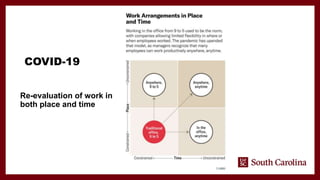
COVID-19
Re-evaluation of work in
both place and time
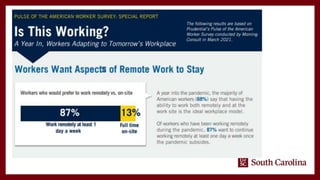
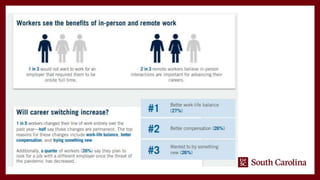
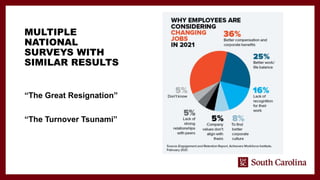
MULTIPLE
NATIONAL
SURVEYS WITH
SIMILAR RESULTS
“The Great Resignation”
“The Turnover Tsunami”
FROM NATIONAL CONTEXT TO LOCAL
CONTEXT
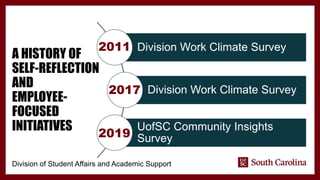
A HISTORY OF
SELF-REFLECTION
AND
EMPLOYEE-
FOCUSED
INITIATIVES
Division Work Climate Survey
UofSC Community Insights
Survey
2011
2017
2019
Division of Student Affairs and Academic Support
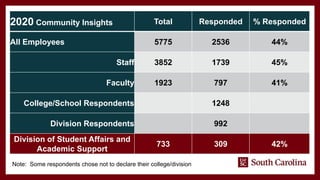
2020 Community Insights Total Responded % Responded
All Employees 5775 2536 44%
Staff 3852 1739 45%
Faculty 1923 797 41%
College/School Respondents 1248
Division Respondents 992
Division of Student Affairs and
Academic Support
733 309 42%
Note: Some respondents chose not to declare their college/division
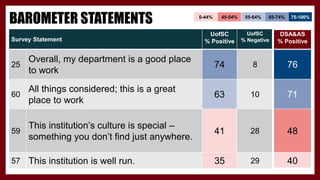
BAROMETER STATEMENTS
Survey Statement
UofSC
% Positive
UofSC
% Negative
DSA&AS
% Positive
25
Overall, my department is a good place
to work
74 8 76
60
All things considered; this is a great
place to work
63 10 71
59
This institution’s culture is special –
something you don’t find just anywhere.
41 28 48
57 This institution is well run. 35 29 40
0-44% 45-54% 55-64% 65-74% 75-100%
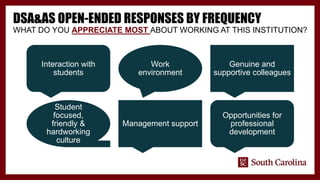
DSA&AS OPEN-ENDED RESPONSES BY FREQUENCY
WHAT DO YOU APPRECIATE MOST ABOUT WORKING AT THIS INSTITUTION?
Interaction with
students
Work
environment
Genuine and
supportive colleagues
Student
focused,
friendly &
hardworking
culture
Management support
Opportunities for
professional
development
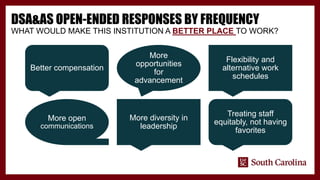
DSA&AS OPEN-ENDED RESPONSES BY FREQUENCY
WHAT WOULD MAKE THIS INSTITUTION A BETTER PLACE TO WORK?
Better compensation
More
opportunities
for
advancement
Flexibility and
alternative work
schedules
More open
communications
More diversity in
leadership
Treating staff
equitably, not having
favorites
DIVISION FOCUS AREAS
From 2019-2020 UofSC Community Insights Survey
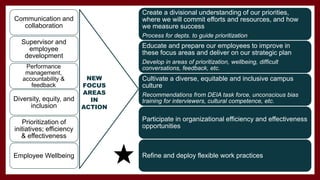
NEW
FOCUS
AREAS
IN
ACTION
Communication and
collaboration
Supervisor and
employee
development
Performance
management,
accountability &
feedback
Diversity, equity, and
inclusion
Prioritization of
initiatives; efficiency
& effectiveness
Employee Wellbeing
Create a divisional understanding of our priorities,
where we will commit efforts and resources, and how
we measure success
Process for depts. to guide prioritization
Educate and prepare our employees to improve in
these focus areas and deliver on our strategic plan
Develop in areas of prioritization, wellbeing, difficult
conversations, feedback, etc.
Cultivate a diverse, equitable and inclusive campus
culture
Recommendations from DEIA task force, unconscious bias
training for interviewers, cultural competence, etc.
Participate in organizational efficiency and effectiveness
opportunities
Refine and deploy flexible work practices
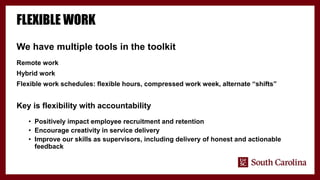
FLEXIBLE WORK
We have multiple tools in the toolkit
Remote work
Hybrid work
Flexible work schedules: flexible hours, compressed work week, alternate “shifts”
Key is flexibility with accountability
• Positively impact employee recruitment and retention
• Encourage creativity in service delivery
• Improve our skills as supervisors, including delivery of honest and actionable
feedback
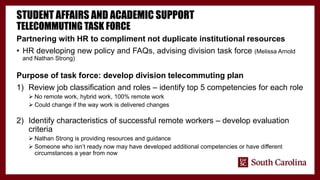
STUDENT AFFAIRS AND ACADEMIC SUPPORT
TELECOMMUTING TASK FORCE
Partnering with HR to compliment not duplicate institutional resources
• HR developing new policy and FAQs, advising division task force (Melissa Arnold
and Nathan Strong)
Purpose of task force: develop division telecommuting plan
1) Review job classification and roles – identify top 5 competencies for each role
 No remote work, hybrid work, 100% remote work
 Could change if the way work is delivered changes
2) Identify characteristics of successful remote workers – develop evaluation
criteria
 Nathan Strong is providing resources and guidance
 Someone who isn’t ready now may have developed additional competencies or have different
circumstances a year from now
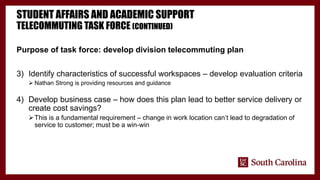
STUDENT AFFAIRS AND ACADEMIC SUPPORT
TELECOMMUTING TASK FORCE (CONTINUED)
Purpose of task force: develop division telecommuting plan
3) Identify characteristics of successful workspaces – develop evaluation criteria
 Nathan Strong is providing resources and guidance
4) Develop business case – how does this plan lead to better service delivery or
create cost savings?
This is a fundamental requirement – change in work location can’t lead to degradation of
service to customer; must be a win-win
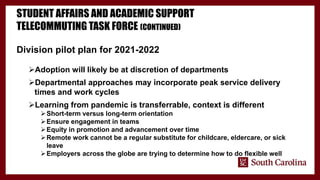
STUDENT AFFAIRS AND ACADEMIC SUPPORT
TELECOMMUTING TASK FORCE (CONTINUED)
Division pilot plan for 2021-2022
Adoption will likely be at discretion of departments
Departmental approaches may incorporate peak service delivery
times and work cycles
Learning from pandemic is transferrable, context is different
Short-term versus long-term orientation
Ensure engagement in teams
Equity in promotion and advancement over time
Remote work cannot be a regular substitute for childcare, eldercare, or sick
leave
Employers across the globe are trying to determine how to do flexible well
ADAPTIVE EXAMPLES
Anna Edwards
HOW ONE DEPARTMENT IS DOING IT…
• Acknowledge departmental culture
• Careful examination of roles, duties, job expectations and
accountability
• Mission alignment and impact on students (customer)
• Flexible work schedules – seasons and roles
• Innovation - consider new ways to deliver programs, services
ROLE OF LEADERS & SUPERVISORS
Kirsten Kennedy
FOR MANAGERS
• All hybrid/flexible work schedules must fulfill the department’s
mission
• Must work for both manager and employee
• Job role w/no adjustment to service to customer
• Characteristics of successful remote workers & remote space
• Set accountability measures
• May require re-design of current practices
• Consider how to maintain a sense of team
• Harder to detect mental health and other issues
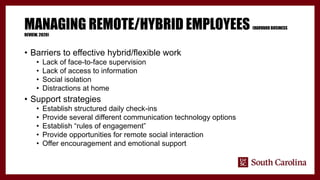
MANAGING REMOTE/HYBRID EMPLOYEES (HARVARD BUSINESS
REVIEW, 2020)
• Barriers to effective hybrid/flexible work
• Lack of face-to-face supervision
• Lack of access to information
• Social isolation
• Distractions at home
• Support strategies
• Establish structured daily check-ins
• Provide several different communication technology options
• Establish “rules of engagement”
• Provide opportunities for remote social interaction
• Offer encouragement and emotional support
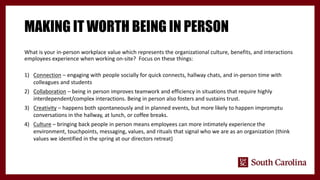
MAKING IT WORTH BEING IN PERSON
What is your in-person workplace value which represents the organizational culture, benefits, and interactions
employees experience when working on-site? Focus on these things:
1) Connection – engaging with people socially for quick connects, hallway chats, and in-person time with
colleagues and students
2) Collaboration – being in person improves teamwork and efficiency in situations that require highly
interdependent/complex interactions. Being in person also fosters and sustains trust.
3) Creativity – happens both spontaneously and in planned events, but more likely to happen impromptu
conversations in the hallway, at lunch, or coffee breaks.
4) Culture – bringing back people in person means employees can more intimately experience the
environment, touchpoints, messaging, values, and rituals that signal who we are as an organization (think
values we identified in the spring at our directors retreat)
QUESTIONS?
THANKS!

"Future of Work," presented July 30, 2021

  • 1.
    FUTURE OF WORK Divisionof Student Affairs and Academic Support
  • 2.
    FUTURE OF WORK •National context, our context, plans in motion – Stacey Bradley • Adaptive examples from Student Life – Anna Edwards • Role of leaders and supervisors – Kirsten Kennedy • Q&A - All
  • 3.
  • 4.
    COVID-19 Re-evaluation of workin both place and time
  • 7.
    MULTIPLE NATIONAL SURVEYS WITH SIMILAR RESULTS “TheGreat Resignation” “The Turnover Tsunami”
  • 8.
    FROM NATIONAL CONTEXTTO LOCAL CONTEXT
  • 9.
    A HISTORY OF SELF-REFLECTION AND EMPLOYEE- FOCUSED INITIATIVES DivisionWork Climate Survey Division Work Climate Survey UofSC Community Insights Survey 2011 2017 2019 Division of Student Affairs and Academic Support
  • 10.
    2020 Community InsightsTotal Responded % Responded All Employees 5775 2536 44% Staff 3852 1739 45% Faculty 1923 797 41% College/School Respondents 1248 Division Respondents 992 Division of Student Affairs and Academic Support 733 309 42% Note: Some respondents chose not to declare their college/division
  • 11.
    BAROMETER STATEMENTS Survey Statement UofSC %Positive UofSC % Negative DSA&AS % Positive 25 Overall, my department is a good place to work 74 8 76 60 All things considered; this is a great place to work 63 10 71 59 This institution’s culture is special – something you don’t find just anywhere. 41 28 48 57 This institution is well run. 35 29 40 0-44% 45-54% 55-64% 65-74% 75-100%
  • 12.
    DSA&AS OPEN-ENDED RESPONSESBY FREQUENCY WHAT DO YOU APPRECIATE MOST ABOUT WORKING AT THIS INSTITUTION? Interaction with students Work environment Genuine and supportive colleagues Student focused, friendly & hardworking culture Management support Opportunities for professional development
  • 13.
    DSA&AS OPEN-ENDED RESPONSESBY FREQUENCY WHAT WOULD MAKE THIS INSTITUTION A BETTER PLACE TO WORK? Better compensation More opportunities for advancement Flexibility and alternative work schedules More open communications More diversity in leadership Treating staff equitably, not having favorites
  • 14.
    DIVISION FOCUS AREAS From2019-2020 UofSC Community Insights Survey
  • 15.
    NEW FOCUS AREAS IN ACTION Communication and collaboration Supervisor and employee development Performance management, accountability& feedback Diversity, equity, and inclusion Prioritization of initiatives; efficiency & effectiveness Employee Wellbeing Create a divisional understanding of our priorities, where we will commit efforts and resources, and how we measure success Process for depts. to guide prioritization Educate and prepare our employees to improve in these focus areas and deliver on our strategic plan Develop in areas of prioritization, wellbeing, difficult conversations, feedback, etc. Cultivate a diverse, equitable and inclusive campus culture Recommendations from DEIA task force, unconscious bias training for interviewers, cultural competence, etc. Participate in organizational efficiency and effectiveness opportunities Refine and deploy flexible work practices
  • 16.
    FLEXIBLE WORK We havemultiple tools in the toolkit Remote work Hybrid work Flexible work schedules: flexible hours, compressed work week, alternate “shifts” Key is flexibility with accountability • Positively impact employee recruitment and retention • Encourage creativity in service delivery • Improve our skills as supervisors, including delivery of honest and actionable feedback
  • 17.
    STUDENT AFFAIRS ANDACADEMIC SUPPORT TELECOMMUTING TASK FORCE Partnering with HR to compliment not duplicate institutional resources • HR developing new policy and FAQs, advising division task force (Melissa Arnold and Nathan Strong) Purpose of task force: develop division telecommuting plan 1) Review job classification and roles – identify top 5 competencies for each role  No remote work, hybrid work, 100% remote work  Could change if the way work is delivered changes 2) Identify characteristics of successful remote workers – develop evaluation criteria  Nathan Strong is providing resources and guidance  Someone who isn’t ready now may have developed additional competencies or have different circumstances a year from now
  • 18.
    STUDENT AFFAIRS ANDACADEMIC SUPPORT TELECOMMUTING TASK FORCE (CONTINUED) Purpose of task force: develop division telecommuting plan 3) Identify characteristics of successful workspaces – develop evaluation criteria  Nathan Strong is providing resources and guidance 4) Develop business case – how does this plan lead to better service delivery or create cost savings? This is a fundamental requirement – change in work location can’t lead to degradation of service to customer; must be a win-win
  • 19.
    STUDENT AFFAIRS ANDACADEMIC SUPPORT TELECOMMUTING TASK FORCE (CONTINUED) Division pilot plan for 2021-2022 Adoption will likely be at discretion of departments Departmental approaches may incorporate peak service delivery times and work cycles Learning from pandemic is transferrable, context is different Short-term versus long-term orientation Ensure engagement in teams Equity in promotion and advancement over time Remote work cannot be a regular substitute for childcare, eldercare, or sick leave Employers across the globe are trying to determine how to do flexible well
  • 20.
  • 21.
    HOW ONE DEPARTMENTIS DOING IT… • Acknowledge departmental culture • Careful examination of roles, duties, job expectations and accountability • Mission alignment and impact on students (customer) • Flexible work schedules – seasons and roles • Innovation - consider new ways to deliver programs, services
  • 22.
    ROLE OF LEADERS& SUPERVISORS Kirsten Kennedy
  • 23.
    FOR MANAGERS • Allhybrid/flexible work schedules must fulfill the department’s mission • Must work for both manager and employee • Job role w/no adjustment to service to customer • Characteristics of successful remote workers & remote space • Set accountability measures • May require re-design of current practices • Consider how to maintain a sense of team • Harder to detect mental health and other issues
  • 24.
    MANAGING REMOTE/HYBRID EMPLOYEES(HARVARD BUSINESS REVIEW, 2020) • Barriers to effective hybrid/flexible work • Lack of face-to-face supervision • Lack of access to information • Social isolation • Distractions at home • Support strategies • Establish structured daily check-ins • Provide several different communication technology options • Establish “rules of engagement” • Provide opportunities for remote social interaction • Offer encouragement and emotional support
  • 25.
    MAKING IT WORTHBEING IN PERSON What is your in-person workplace value which represents the organizational culture, benefits, and interactions employees experience when working on-site? Focus on these things: 1) Connection – engaging with people socially for quick connects, hallway chats, and in-person time with colleagues and students 2) Collaboration – being in person improves teamwork and efficiency in situations that require highly interdependent/complex interactions. Being in person also fosters and sustains trust. 3) Creativity – happens both spontaneously and in planned events, but more likely to happen impromptu conversations in the hallway, at lunch, or coffee breaks. 4) Culture – bringing back people in person means employees can more intimately experience the environment, touchpoints, messaging, values, and rituals that signal who we are as an organization (think values we identified in the spring at our directors retreat)
  • 26.
  • 27.

Editor's Notes

  • #2 Setup of the survey Results
  • #10 Caring about employees and employee feedback is not new Slide from 2020 presentation of division workplace survey results Early surveys resulted in GEMS program, dramatic increase in EPMS completion rates, piloting supervisory training with HR that resulted in LEAD curriculum and requirement; changes to StayInformed and other communications, etc.
  • #11 36-46% normal for 1st time sending out Similar percentage of employees open StayInformed
  • #12 Great place to work barometer statements 25- dept a great place to work – managers have a lot of control over the things noted below in 60 too 60 - Great place to work – sense of community, psychological safety, trust, do good work 59 - Culture is special – something you don’t find just anywhere <no singularly understood narrative> 57 – Credibility and capability of senior leadership <in question>
  • #15 Worked with HR to develop focus areas; reviewed and revised by AVP group
  • #16 Stop the “more is better” culture Setting goals; prioritizing DEI Accountability, poor performance
  • #17 We were piloting before the pandemic; had a few departments participating in a formal pilot, also had departments using flexible schedules over the summer and many of us were providing emergency flexibility to employees (work from home while furniture being delivered, child unexpectedly out of school, etc)
  • #18 Thanks to Alicia Bervine for chairing this group – participation from HR contacts across the division (Sammie Burt, Tam Pringle, Heather Wheeler, Catherine Sturm) Employee may develop more independence, become more confident with policies and procedures
  • #19 Safe, comfortable workspace conducive to focus – without major interruptions Business case – clearly retention can be part of the business case, but must also be service delivery
  • #20 Has to align with work practices – opportunity to incorporate new workflows and work practices What’s possible over the summer may not be possible at the end of August Pandemic was a surge – we learned a lot and made rapid changes that would have taken years otherwise; surges aren’t sustainable; need sustainable practices that ensure people will still be engaged in teams, have equitable opportunities for advancement Remote work shouldn’t be a substitute for childcare or eldercare; we should also still continue to take sick leave when we’re ill (it’s why we have it) Everyone is grappling with implementing effective flexible work practices – we are not alone!