ALS
Amyotrophic Lateral Sclerosis
(Lou Gehrig’s)
By: Tautiana Bellamy, Trey Urban, Tyler Roper, Skye Perez, Caitlin Lucero, and
Gretchen Berg
Tautiana Bellamy
Overview
What is ALS?
A disease of the parts of the nervous system that
controls voluntary muscle movement
Named after a Yankees Baseball player who died from it
in 1941
ALS is often called motor neurone disease in reference
to the cells that are lost in this disorder
Who gets ALS?
Middle age (late 50s)
Men are more likely to develop ALS than women
1.2 men to every women who develops ALS
Tautiana Bellamy
Etiology
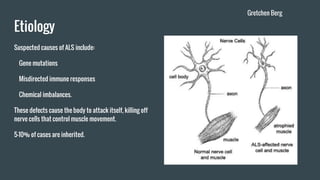
Suspected causes of ALS include:
Gene mutations
Misdirected immune responses
Chemical imbalances.
These defects cause the body to attack itself, killing off
nerve cells that control muscle movement.
5-10% of cases are inherited.
Gretchen Berg
Signs and Symptoms
Twitching or cramping in the muscles of the hands
and feet
Slurred speech
Muscles weakening
Difficulty chewing or swallowing
Loss of motor control in the limbs
There are many signs and symptoms of ALS. Many of them are related. Some of the signs and
symptoms are as follows:
Uncontrollable periods of laughing or
crying
Tripping and falling
Dropping things
Fatigue
Trey Urban
Signs and Symptoms cont.
These signs and symptoms are usually very
hard to deal with, especially for the families of the patients.
They tend to be very frustrating. It is extremely difficult for
the people that are affected by ALS to go on with their daily
lives. Another tough thing to deal with is the fact that the
patient’s time would eventually be cut short.
Trey Urban
Diagnosis and Tests
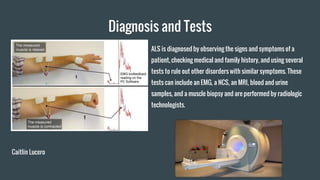
ALS is diagnosed by observing the signs and symptoms of a
patient, checking medical and family history, and using several
tests to rule out other disorders with similar symptoms. These
tests can include an EMG, a NCS, an MRI, blood and urine
samples, and a muscle biopsy and are performed by radiologic
technologists.
Caitlin Lucero
Treatment and Care
Although ALS can't be cured, doctors focus on slowing the progression of your
condition, relieving your symptoms, helping you maintain function through
rehabilitation and improving your quality of life. The team partners with you
and your family to provide care and support. Your doctor will decide what
medications to put you on, your physical therapy plan, speech therapy plan,
assistive devices to best aid you, nutritional support, mental health care, and
follow up care plan. Your doctor decides whether to manage your condition
with medications based on your symptoms and the severity of your condition.
In physical therapy, you may perform low-impact exercises such as walking,
swimming and stationary-bicycle riding to strengthen your muscles, improve
your heart (cardiovascular) health and fight fatigue and depression. Lou
Gehrig's disease affects the muscles you use to speak. A speech therapist can
teach you how to speak more clearly to be better understood.
Tyler J.Roper
Treatment and Care: Continued
Tyler J. Roper
Assistive devices can help you maintain as much mobility as possible. Braces can
support weakened muscles in your limbs. Canes, walkers and wheelchairs also can
help with mobility. As Lou Gehrig's disease weakens muscles you use to breathe, you
may need a breathing machine (a mask or a ventilator) to assist with your breathing.
As Lou Gehrig's disease progresses, your mind, personality, intelligence, memory
and senses usually aren't affected. You're usually aware that you're losing muscle
function. Some people become anxious and depressed and benefit from medication
and counseling. Your family members may need help coping with your disease and
its challenges. Your treatment team offers various resources, education and
information for your family. Also, your family members can ask your treatment team
for information about connecting with local ALS support groups. The doctors provide
coordinated treatment and follow-up care for people who have Lou Gehrig's disease
and will work closely with your primary care or local doctor.
Living and Managing
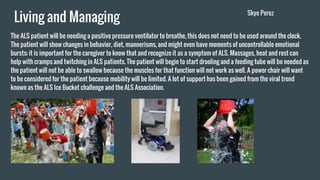
The ALS patient will be needing a positive pressure ventilator to breathe, this does not need to be used around the clock.
The patient will show changes in behavior, diet, mannerisms, and might even have moments of uncontrollable emotional
bursts; it is important for the caregiver to know that and recognize it as a symptom of ALS. Massages, heat and rest can
help with cramps and twitching in ALS patients. The patient will begin to start drooling and a feeding tube will be needed as
the patient will not be able to swallow because the muscles for that function will not work as well. A power chair will want
to be considered for the patient because mobility will be limited. A lot of support has been gained from the viral trend
known as the ALS Ice Bucket challenge and the ALS Association.
Skye Perez
References
http://www.ninds.nih.gov/disorders/amyotrophiclateralsclerosis/detail_ALS.htm
http://www.mayoclinic.org/diseases-conditions/amyotrophic-lateral-sclerosis/basics/causes/con-20024397
http://www.mda.org/disease/amyotrophic-lateral-sclerosis/medical-management
http://www.mayoclinic.org/diseases-conditions/amyotrophic-lateral-sclerosis/care-at-mayo-clinic/treatment/con-
20024397
http://www.evenbetterhealth.com/als-symptoms.asp
http://www.medicinenet.com/amyotrophic_lateral_sclerosis/page3.htm
https://www.mda.org/disease/amyotrophic-lateral-sclerosis/overview

Als (lou gehrig's) (1)

  • 1.
    ALS Amyotrophic Lateral Sclerosis (LouGehrig’s) By: Tautiana Bellamy, Trey Urban, Tyler Roper, Skye Perez, Caitlin Lucero, and Gretchen Berg Tautiana Bellamy
  • 2.
    Overview What is ALS? Adisease of the parts of the nervous system that controls voluntary muscle movement Named after a Yankees Baseball player who died from it in 1941 ALS is often called motor neurone disease in reference to the cells that are lost in this disorder Who gets ALS? Middle age (late 50s) Men are more likely to develop ALS than women 1.2 men to every women who develops ALS Tautiana Bellamy
  • 3.
    Etiology Suspected causes ofALS include: Gene mutations Misdirected immune responses Chemical imbalances. These defects cause the body to attack itself, killing off nerve cells that control muscle movement. 5-10% of cases are inherited. Gretchen Berg
  • 4.
    Signs and Symptoms Twitchingor cramping in the muscles of the hands and feet Slurred speech Muscles weakening Difficulty chewing or swallowing Loss of motor control in the limbs There are many signs and symptoms of ALS. Many of them are related. Some of the signs and symptoms are as follows: Uncontrollable periods of laughing or crying Tripping and falling Dropping things Fatigue Trey Urban
  • 5.
    Signs and Symptomscont. These signs and symptoms are usually very hard to deal with, especially for the families of the patients. They tend to be very frustrating. It is extremely difficult for the people that are affected by ALS to go on with their daily lives. Another tough thing to deal with is the fact that the patient’s time would eventually be cut short. Trey Urban
  • 6.
    Diagnosis and Tests ALSis diagnosed by observing the signs and symptoms of a patient, checking medical and family history, and using several tests to rule out other disorders with similar symptoms. These tests can include an EMG, a NCS, an MRI, blood and urine samples, and a muscle biopsy and are performed by radiologic technologists. Caitlin Lucero
  • 7.
    Treatment and Care AlthoughALS can't be cured, doctors focus on slowing the progression of your condition, relieving your symptoms, helping you maintain function through rehabilitation and improving your quality of life. The team partners with you and your family to provide care and support. Your doctor will decide what medications to put you on, your physical therapy plan, speech therapy plan, assistive devices to best aid you, nutritional support, mental health care, and follow up care plan. Your doctor decides whether to manage your condition with medications based on your symptoms and the severity of your condition. In physical therapy, you may perform low-impact exercises such as walking, swimming and stationary-bicycle riding to strengthen your muscles, improve your heart (cardiovascular) health and fight fatigue and depression. Lou Gehrig's disease affects the muscles you use to speak. A speech therapist can teach you how to speak more clearly to be better understood. Tyler J.Roper
  • 8.
    Treatment and Care:Continued Tyler J. Roper Assistive devices can help you maintain as much mobility as possible. Braces can support weakened muscles in your limbs. Canes, walkers and wheelchairs also can help with mobility. As Lou Gehrig's disease weakens muscles you use to breathe, you may need a breathing machine (a mask or a ventilator) to assist with your breathing. As Lou Gehrig's disease progresses, your mind, personality, intelligence, memory and senses usually aren't affected. You're usually aware that you're losing muscle function. Some people become anxious and depressed and benefit from medication and counseling. Your family members may need help coping with your disease and its challenges. Your treatment team offers various resources, education and information for your family. Also, your family members can ask your treatment team for information about connecting with local ALS support groups. The doctors provide coordinated treatment and follow-up care for people who have Lou Gehrig's disease and will work closely with your primary care or local doctor.
  • 9.
    Living and Managing TheALS patient will be needing a positive pressure ventilator to breathe, this does not need to be used around the clock. The patient will show changes in behavior, diet, mannerisms, and might even have moments of uncontrollable emotional bursts; it is important for the caregiver to know that and recognize it as a symptom of ALS. Massages, heat and rest can help with cramps and twitching in ALS patients. The patient will begin to start drooling and a feeding tube will be needed as the patient will not be able to swallow because the muscles for that function will not work as well. A power chair will want to be considered for the patient because mobility will be limited. A lot of support has been gained from the viral trend known as the ALS Ice Bucket challenge and the ALS Association. Skye Perez
  • 10.