
MENTAL ILLNESS
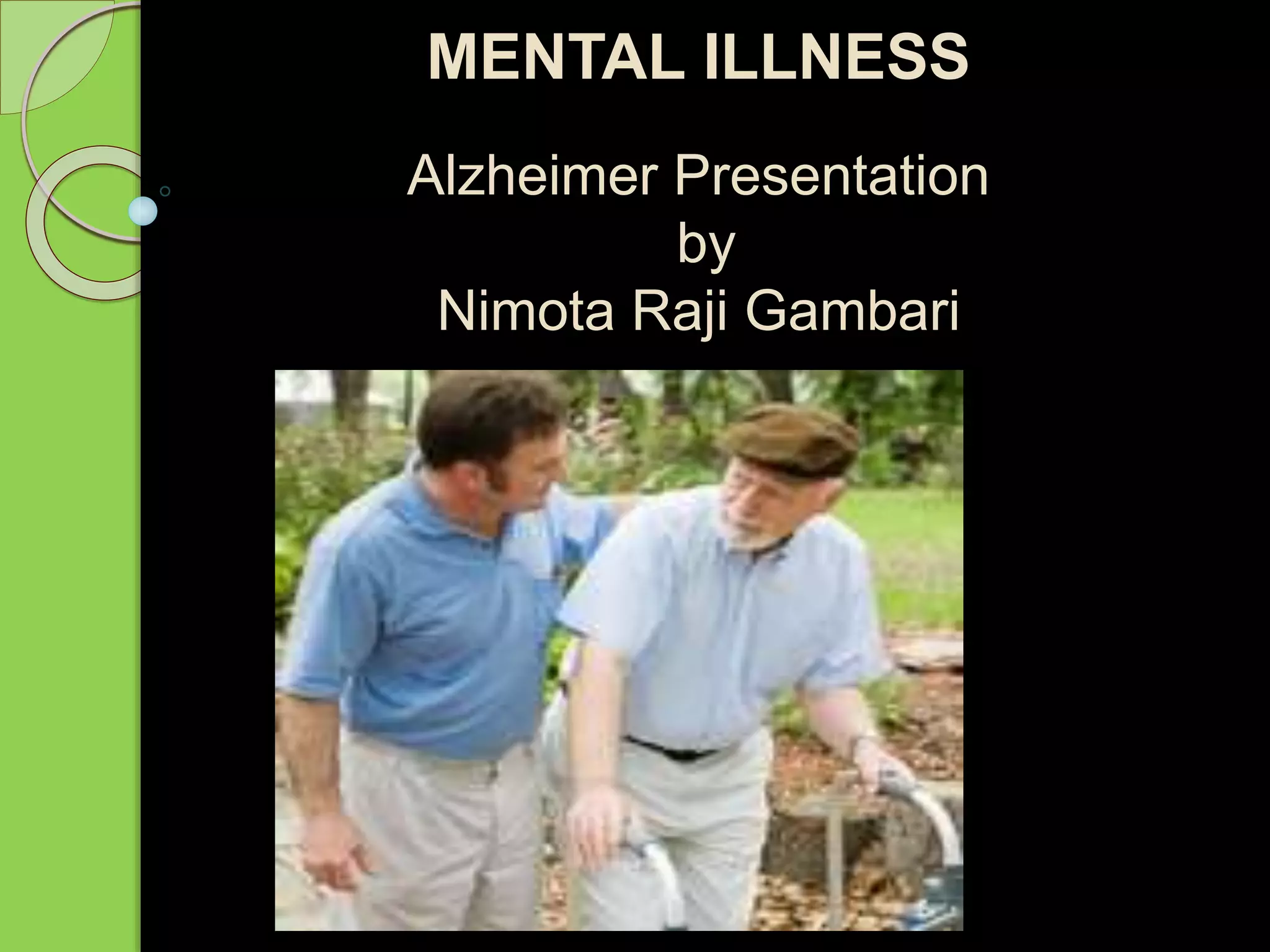
Alzheimer Presentation
by
Nimota Raji Gambari
What is Alzheimer Disease
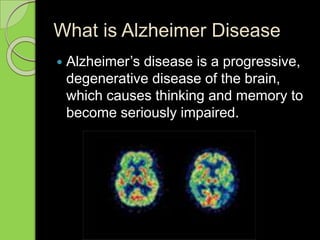
 Alzheimer’s disease is a progressive,
degenerative disease of the brain,
which causes thinking and memory to
become seriously impaired.
Stages of Alzheimer
 Early stage
 Early in the disease, short-term memory loss
occurs. Other problems go along with this:
 being unusually forgetful;
 having a hard time concentrating;
 having a hard time coming up with the right word;
 making poor choices or showing bad judgment.
 During this stage, subtle changes in personality
may occur. The person may also not be able to
adapt to changes in old routines.
Stages cont-
 Middle stage
 The middle stage of Alzheimer's disease is characterized by
more and more severe memory loss. The person is often not
able to recognize family and friends. The person's judgment
gets worse and worse. Sometimes the patient has delusions.
He or she is less and less able to learn or adapt to new
situations. The person may also have striking personality
changes, become very active and lose language abilities. The
impaired person may become unable to remember even
basic safety rules. Thus daily activities such as cooking,
driving or using appliances may pose a danger. The impaired
person may also be subject to restlessness, wandering and
sleep disturbances. You may have to watch over the person
closely. You may have to keep the person from doing things
he or she is used to. This part of care giving can be very hard.
Stages cont-
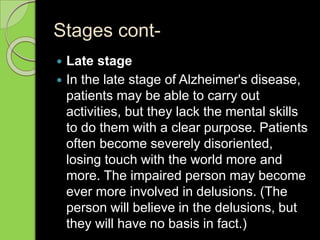
 Late stage
 In the late stage of Alzheimer's disease,
patients may be able to carry out
activities, but they lack the mental skills
to do them with a clear purpose. Patients
often become severely disoriented,
losing touch with the world more and
more. The impaired person may become
ever more involved in delusions. (The
person will believe in the delusions, but
they will have no basis in fact.)
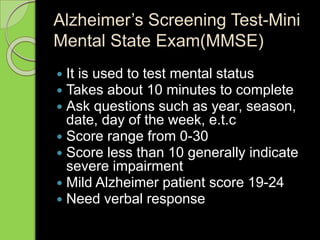
Alzheimer’s Screening Test-Mini
Mental State Exam(MMSE)
 It is used to test mental status
 Takes about 10 minutes to complete
 Ask questions such as year, season,
date, day of the week, e.t.c
 Score range from 0-30
 Score less than 10 generally indicate
severe impairment
 Mild Alzheimer patient score 19-24
 Need verbal response
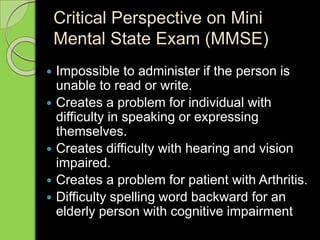
Critical Perspective on Mini
Mental State Exam (MMSE)
 Impossible to administer if the person is
unable to read or write.
 Creates a problem for individual with
difficulty in speaking or expressing
themselves.
 Creates difficulty with hearing and vision
impaired.
 Creates a problem for patient with Arthritis.
 Difficulty spelling word backward for an
elderly person with cognitive impairment
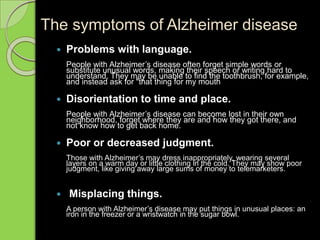
The symptoms of Alzheimer disease
 Problems with language.
People with Alzheimer’s disease often forget simple words or
substitute unusual words, making their speech or writing hard to
understand. They may be unable to find the toothbrush, for example,
and instead ask for "that thing for my mouth
 Disorientation to time and place.
People with Alzheimer’s disease can become lost in their own
neighborhood, forget where they are and how they got there, and
not know how to get back home.
 Poor or decreased judgment.
Those with Alzheimer’s may dress inappropriately, wearing several
layers on a warm day or little clothing in the cold. They may show poor
judgment, like giving away large sums of money to telemarketers.
 Misplacing things.
A person with Alzheimer’s disease may put things in unusual places: an
iron in the freezer or a wristwatch in the sugar bowl.
Symptoms Cont-
 Memory Loss
People with Alzheimer’s experience difficulties
communicating, learning, thinking and reasoning
 Someone with Alzheimer’s disease may show rapid mood
swings – from calm to tears to anger – for no apparent reason
 Difficulty performing familiar tasks.
People with dementia often find it hard to plan or complete
everyday tasks. Individuals may lose track of the steps
involved in preparing a meal, placing a telephone call or
playing a game.
 Loss of initiative.
A person with Alzheimer’s disease may become very passive,
sitting in front of the TV for hours, sleeping more than usual or
not wanting to do usual activities
Risk factors of Alzheimer
disease
 Age
Advancing age is the number one risk factor for developing
Alzheimer’s disease. One out of eight people over the age of
65 has Alzheimer’s disease, and almost one out of every two
people over the age of 85 has Alzheimer’s.
 Family History
People who have a parent or sibling that developed
Alzheimer’s disease are two to three times more likely to
develop the disease than those with no family history of
Alzheimer’s.
 Gene
The first gene is ApoE4 and the second gene is the
Deterministic Gene. These could transfer from one
generation to the other.
Causes of Alzheimer disease
 Head Injury
 Cardiovascular Problems like heart
attack
 Too much consumption of alcohol
 Diabetes
 High blood pressure
 Strokes
 Stress
 MCI- Mild Cognitive impairment
Caring for Alzheimer patients
Environment
 Place picture signs on rooms, bathrooms, dining rooms, and
other areas.
 Keep personal items where the person can see them.
 Stay in the persons sight to the extent possible.
 Keep memory aids (large clocks, calendars) where the person
can see them.
 Keep noise level low
 Play music and show movies from the person’s past.
 Keep tasks and activities simple.
Communication
 Approach the person in a calm and quiet manner.
Caring for Alzheimer patients
Cont-
 Promote communication
 Give simple explanations of all procedures and activities.
 Give consistent response
Safety
 Remove harmful sharp, and breakable object from the
environment. this include knives, scissors, glass, dishes, razors,
and tools.
 Provide plastic eating and drinking utensils when need. This
helps prevent breakage and cuts.
 Place safety plugs in electrical outlets.
 Keep cords and electrical items out of reach.
 Store personal care items(e.g., shampoo, deodorant, lotion) in a
safe place.
Caring for Alzheimer patients
Cont-
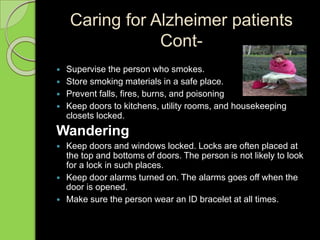
 Supervise the person who smokes.
 Store smoking materials in a safe place.
 Prevent falls, fires, burns, and poisoning
 Keep doors to kitchens, utility rooms, and housekeeping
closets locked.
Wandering
 Keep doors and windows locked. Locks are often placed at
the top and bottoms of doors. The person is not likely to look
for a lock in such places.
 Keep door alarms turned on. The alarms goes off when the
door is opened.
 Make sure the person wear an ID bracelet at all times.
Caring for Alzheimer patients
Cont-
 Do not use restraints. They tend to increase confusion and
disorientation.
 Do not argue with the person who wants to leave. Remember
that the person does not understand what you are saying.
 patients who are at risk of wandering should be registered
with the Alzheimer society of Canada's safely home registry
www.safelyhome.ca/en/safelyhome/safelyhome.asp .
Sundowning
 Provide calm and quiet late in the day. Complete treatment
and activities early in the day.
 Dim lights, and play soft music.
 Promote elimination. A full ladder or constipation can increase
restlessness.
Caring for Alzheimer patients
Cont-
 Do not try to reason with the person. He or she cannot
understand what you are saying.
 Do not ask the person what is bothering him or her.
Communication is impaired. The person does not understand
what you are asking and cannot think or speak clearly.
Hallucinations and delusions
 Do not argue with the person .he or she does not understand
what you are saying.
 Reassure the person. Tell him or her that you will provide
protection from harm.
 Distract the person with some item or activity.
 Use touch to calm and reassure the person.
Caring for Alzheimer patients
Cont-
Basic needs
 Meet food ad fluid needs. Provide finger
foods. Cut food and pour liquids as
needed.
 Provide good skin care. Keep the person’s
skin free of urine and feces.
 Promote hygiene. Do not force the person
into a shower or tub. People with AD are
often afraid of bathing. Try bathing them
when he or she is calm. Use the bathing
method preferred by the person do not
rush the person.
Ecological Framework
The Role of The Social worker
 To support and empower these individuals who are “aging
in place” and making all attempts to remain independent
and residing in their own homes.
 To coordinate services for individuals in order to maintain
their living environment for as long as possible.
 To provide personalized services to clients and contribute
by enhancing their quality of life through consistent
intervention.
The Role of The Social worker
Cont-
 To conduct in-home or facility
assessment (Evaluation)
 To develop a care plan including
client’s need for community resources
such as home care, home delivered
meals
The Role of The Social worker
Cont-
 In case of moving to a Retirement
Community, Long Term Homes,
Nursing Homes, and Assisted Living.
A review of financial, legal, and
medical issues will be conducted. In
addition, make appropriate referral for
specific follow ups
Psychosocial Impact on
Alzheimer Patients
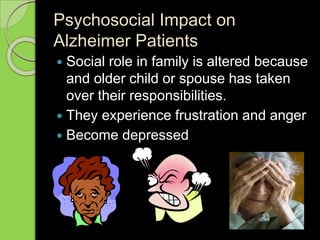
 Social role in family is altered because
and older child or spouse has taken
over their responsibilities.
 They experience frustration and anger
 Become depressed
PSYCHODYNAMIC FRAMEWORK
(Psychosocial Intervention for Alzheimer patient)
 Music Therapy: which can elevate
agitation and apathy.
 Snoezelen (Controlled Multisensory
Stimulation): Might help with apathy.
 Psychomotor Therapy: Might alleviate
agitation
 Reminiscence therapy helps to reflect
on past life which can help with
depression. i.e pictures, music, etc.
 Education and support program for staff
and caregivers are also effective
Alzheimer Medications
 Ebixa has been conditionally approved by Health Canada to
relieve the symptoms of people with moderate to severe
Alzheimer's disease. It has been approved pending the results of
further studies to verify its clinical benefit.
Ebixa may cause some undesirable reactions. These may
include fatigue, dizziness, sleepiness, headache, hypertension
(high blood pressure), constipation, vomiting, anxiety, confusion,
hallucinations and sleep disturbance. If you develop any other
side effects while taking this medication, consult the doctor. If
you suffer from epileptic seizures, there is a slight possibility that
the medication may increase the chances of one occurring. Also,
as this product may cause sleepiness or dizziness, do not drive
or operate machinery under these conditions.
Alzheimer Medications Cont-
 Aricept is one of a group of drugs called "cholinesterase
inhibitors" which is used to treat symptoms in people with mild to
moderate and advanced Alzheimer's disease.
Aricept may cause some undesirable reactions. The most
common side effects include nausea, diarrhea, insomnia,
vomiting, muscle cramps, fatigue and loss of appetite. In
clinical studies these effects were often mild, and generally
went away with continued treatment. In clinical studies
some people treated with the drug experienced fainting. If
you feel unwell in any other way or have any symptoms
that you do not understand, or find distressing, you should
contact your doctor immediately.
Alzheimer Medications Cont-
 Exelon is one of a group of drugs called
"cholinesterase inhibitors" which is used to treat
symptoms in people with mild to moderate
Alzheimer's disease and It comes in capsules and
patch.
 Common side effects, in addition to nausea,
vomiting, loss of appetite and weight loss, include
diarrhea, heartburn, stomach pains, dizziness,
headache, weakness, fatigue. Some people also
experienced fainting. Side effects are most likely to
occur after an increase in dose and may go away
with continued treatment.
Alzheimer Medications Cont-
 Reminyl (extended release
galantamine hydrobromide)
Reminyl ER is one of a group of drugs called
"cholinesterase inhibitors" which is used to treat
symptoms in people with mild to moderate
Alzheimer's disease.
 Reminyl ER may cause some undesirable
reactions. The most common side effects are
nausea and vomiting. These adverse events
should be monitored and the doctor informed,
if they occur.
Alzheimer Medications Cont-
 Other possible side effects include:
abdominal pain, diarrhea, indigestion,
decreased appetite, difficulty swallowing,
bleeding in the digestive system, weight loss,
low blood potassium, low blood pressure,
dehydration (sometimes severe), seizures,
agitation, aggression, hallucinations,
weakness, fever, malaise, leg cramps,
tingling in the hands or feet, ringing in the
ears, headache, dizziness, tiredness,
sleeplessness, runny nose, urinary tract
infection, falling (sometimes resulting in
injury), fainting or fluttering of the heart.
REFERENCES
 Alzheimer Society Canada. (2009, March 17). Retrieved
January, 2011, from www.alzheimer.ca
 Alzheimer Society of Peel. (n.d.). Retrieved January 20, 2011,
from www.alzheimerpeel.com
 Alzheimer's Foundation for Caregiving in Canada. (2009).
Retrieved January 20, 2011, from www.alzfdn.ca
 Premier Homecare Services. (2008). Retrieved January 20,
2011, from www.premierhomecareservices.com
 Sorrentino, S. A., & Gorek, B. (1997). Mosby's Essentials for
Nursing Assistants. Colorado: Mosby Inc.
 Dementia Stages Can Be Detected and Gauged by the Mini
Mental State Exam. (2011).Retrieved February 2, 2011, from
www.aginghomehealthcare.com/dementia_stages.html
Alzheimer Presentation

Alzheimer Presentation

  • 1.
  • 2.
    What is AlzheimerDisease  Alzheimer’s disease is a progressive, degenerative disease of the brain, which causes thinking and memory to become seriously impaired.
  • 3.
    Stages of Alzheimer Early stage  Early in the disease, short-term memory loss occurs. Other problems go along with this:  being unusually forgetful;  having a hard time concentrating;  having a hard time coming up with the right word;  making poor choices or showing bad judgment.  During this stage, subtle changes in personality may occur. The person may also not be able to adapt to changes in old routines.
  • 4.
    Stages cont-  Middlestage  The middle stage of Alzheimer's disease is characterized by more and more severe memory loss. The person is often not able to recognize family and friends. The person's judgment gets worse and worse. Sometimes the patient has delusions. He or she is less and less able to learn or adapt to new situations. The person may also have striking personality changes, become very active and lose language abilities. The impaired person may become unable to remember even basic safety rules. Thus daily activities such as cooking, driving or using appliances may pose a danger. The impaired person may also be subject to restlessness, wandering and sleep disturbances. You may have to watch over the person closely. You may have to keep the person from doing things he or she is used to. This part of care giving can be very hard.
  • 5.
    Stages cont-  Latestage  In the late stage of Alzheimer's disease, patients may be able to carry out activities, but they lack the mental skills to do them with a clear purpose. Patients often become severely disoriented, losing touch with the world more and more. The impaired person may become ever more involved in delusions. (The person will believe in the delusions, but they will have no basis in fact.)
  • 6.
    Alzheimer’s Screening Test-Mini MentalState Exam(MMSE)  It is used to test mental status  Takes about 10 minutes to complete  Ask questions such as year, season, date, day of the week, e.t.c  Score range from 0-30  Score less than 10 generally indicate severe impairment  Mild Alzheimer patient score 19-24  Need verbal response
  • 7.
    Critical Perspective onMini Mental State Exam (MMSE)  Impossible to administer if the person is unable to read or write.  Creates a problem for individual with difficulty in speaking or expressing themselves.  Creates difficulty with hearing and vision impaired.  Creates a problem for patient with Arthritis.  Difficulty spelling word backward for an elderly person with cognitive impairment
  • 8.
    The symptoms ofAlzheimer disease  Problems with language. People with Alzheimer’s disease often forget simple words or substitute unusual words, making their speech or writing hard to understand. They may be unable to find the toothbrush, for example, and instead ask for "that thing for my mouth  Disorientation to time and place. People with Alzheimer’s disease can become lost in their own neighborhood, forget where they are and how they got there, and not know how to get back home.  Poor or decreased judgment. Those with Alzheimer’s may dress inappropriately, wearing several layers on a warm day or little clothing in the cold. They may show poor judgment, like giving away large sums of money to telemarketers.  Misplacing things. A person with Alzheimer’s disease may put things in unusual places: an iron in the freezer or a wristwatch in the sugar bowl.
  • 9.
    Symptoms Cont-  MemoryLoss People with Alzheimer’s experience difficulties communicating, learning, thinking and reasoning  Someone with Alzheimer’s disease may show rapid mood swings – from calm to tears to anger – for no apparent reason  Difficulty performing familiar tasks. People with dementia often find it hard to plan or complete everyday tasks. Individuals may lose track of the steps involved in preparing a meal, placing a telephone call or playing a game.  Loss of initiative. A person with Alzheimer’s disease may become very passive, sitting in front of the TV for hours, sleeping more than usual or not wanting to do usual activities
  • 10.
    Risk factors ofAlzheimer disease  Age Advancing age is the number one risk factor for developing Alzheimer’s disease. One out of eight people over the age of 65 has Alzheimer’s disease, and almost one out of every two people over the age of 85 has Alzheimer’s.  Family History People who have a parent or sibling that developed Alzheimer’s disease are two to three times more likely to develop the disease than those with no family history of Alzheimer’s.  Gene The first gene is ApoE4 and the second gene is the Deterministic Gene. These could transfer from one generation to the other.
  • 11.
    Causes of Alzheimerdisease  Head Injury  Cardiovascular Problems like heart attack  Too much consumption of alcohol  Diabetes  High blood pressure  Strokes  Stress  MCI- Mild Cognitive impairment
  • 12.
    Caring for Alzheimerpatients Environment  Place picture signs on rooms, bathrooms, dining rooms, and other areas.  Keep personal items where the person can see them.  Stay in the persons sight to the extent possible.  Keep memory aids (large clocks, calendars) where the person can see them.  Keep noise level low  Play music and show movies from the person’s past.  Keep tasks and activities simple. Communication  Approach the person in a calm and quiet manner.
  • 13.
    Caring for Alzheimerpatients Cont-  Promote communication  Give simple explanations of all procedures and activities.  Give consistent response Safety  Remove harmful sharp, and breakable object from the environment. this include knives, scissors, glass, dishes, razors, and tools.  Provide plastic eating and drinking utensils when need. This helps prevent breakage and cuts.  Place safety plugs in electrical outlets.  Keep cords and electrical items out of reach.  Store personal care items(e.g., shampoo, deodorant, lotion) in a safe place.
  • 14.
    Caring for Alzheimerpatients Cont-  Supervise the person who smokes.  Store smoking materials in a safe place.  Prevent falls, fires, burns, and poisoning  Keep doors to kitchens, utility rooms, and housekeeping closets locked. Wandering  Keep doors and windows locked. Locks are often placed at the top and bottoms of doors. The person is not likely to look for a lock in such places.  Keep door alarms turned on. The alarms goes off when the door is opened.  Make sure the person wear an ID bracelet at all times.
  • 15.
    Caring for Alzheimerpatients Cont-  Do not use restraints. They tend to increase confusion and disorientation.  Do not argue with the person who wants to leave. Remember that the person does not understand what you are saying.  patients who are at risk of wandering should be registered with the Alzheimer society of Canada's safely home registry www.safelyhome.ca/en/safelyhome/safelyhome.asp . Sundowning  Provide calm and quiet late in the day. Complete treatment and activities early in the day.  Dim lights, and play soft music.  Promote elimination. A full ladder or constipation can increase restlessness.
  • 16.
    Caring for Alzheimerpatients Cont-  Do not try to reason with the person. He or she cannot understand what you are saying.  Do not ask the person what is bothering him or her. Communication is impaired. The person does not understand what you are asking and cannot think or speak clearly. Hallucinations and delusions  Do not argue with the person .he or she does not understand what you are saying.  Reassure the person. Tell him or her that you will provide protection from harm.  Distract the person with some item or activity.  Use touch to calm and reassure the person.
  • 17.
    Caring for Alzheimerpatients Cont- Basic needs  Meet food ad fluid needs. Provide finger foods. Cut food and pour liquids as needed.  Provide good skin care. Keep the person’s skin free of urine and feces.  Promote hygiene. Do not force the person into a shower or tub. People with AD are often afraid of bathing. Try bathing them when he or she is calm. Use the bathing method preferred by the person do not rush the person.
  • 18.
    Ecological Framework The Roleof The Social worker  To support and empower these individuals who are “aging in place” and making all attempts to remain independent and residing in their own homes.  To coordinate services for individuals in order to maintain their living environment for as long as possible.  To provide personalized services to clients and contribute by enhancing their quality of life through consistent intervention.
  • 19.
    The Role ofThe Social worker Cont-  To conduct in-home or facility assessment (Evaluation)  To develop a care plan including client’s need for community resources such as home care, home delivered meals
  • 20.
    The Role ofThe Social worker Cont-  In case of moving to a Retirement Community, Long Term Homes, Nursing Homes, and Assisted Living. A review of financial, legal, and medical issues will be conducted. In addition, make appropriate referral for specific follow ups
  • 21.
    Psychosocial Impact on AlzheimerPatients  Social role in family is altered because and older child or spouse has taken over their responsibilities.  They experience frustration and anger  Become depressed
  • 22.
    PSYCHODYNAMIC FRAMEWORK (Psychosocial Interventionfor Alzheimer patient)  Music Therapy: which can elevate agitation and apathy.  Snoezelen (Controlled Multisensory Stimulation): Might help with apathy.  Psychomotor Therapy: Might alleviate agitation  Reminiscence therapy helps to reflect on past life which can help with depression. i.e pictures, music, etc.  Education and support program for staff and caregivers are also effective
  • 23.
    Alzheimer Medications  Ebixahas been conditionally approved by Health Canada to relieve the symptoms of people with moderate to severe Alzheimer's disease. It has been approved pending the results of further studies to verify its clinical benefit. Ebixa may cause some undesirable reactions. These may include fatigue, dizziness, sleepiness, headache, hypertension (high blood pressure), constipation, vomiting, anxiety, confusion, hallucinations and sleep disturbance. If you develop any other side effects while taking this medication, consult the doctor. If you suffer from epileptic seizures, there is a slight possibility that the medication may increase the chances of one occurring. Also, as this product may cause sleepiness or dizziness, do not drive or operate machinery under these conditions.
  • 24.
    Alzheimer Medications Cont- Aricept is one of a group of drugs called "cholinesterase inhibitors" which is used to treat symptoms in people with mild to moderate and advanced Alzheimer's disease. Aricept may cause some undesirable reactions. The most common side effects include nausea, diarrhea, insomnia, vomiting, muscle cramps, fatigue and loss of appetite. In clinical studies these effects were often mild, and generally went away with continued treatment. In clinical studies some people treated with the drug experienced fainting. If you feel unwell in any other way or have any symptoms that you do not understand, or find distressing, you should contact your doctor immediately.
  • 25.
    Alzheimer Medications Cont- Exelon is one of a group of drugs called "cholinesterase inhibitors" which is used to treat symptoms in people with mild to moderate Alzheimer's disease and It comes in capsules and patch.  Common side effects, in addition to nausea, vomiting, loss of appetite and weight loss, include diarrhea, heartburn, stomach pains, dizziness, headache, weakness, fatigue. Some people also experienced fainting. Side effects are most likely to occur after an increase in dose and may go away with continued treatment.
  • 26.
    Alzheimer Medications Cont- Reminyl (extended release galantamine hydrobromide) Reminyl ER is one of a group of drugs called "cholinesterase inhibitors" which is used to treat symptoms in people with mild to moderate Alzheimer's disease.  Reminyl ER may cause some undesirable reactions. The most common side effects are nausea and vomiting. These adverse events should be monitored and the doctor informed, if they occur.
  • 27.
    Alzheimer Medications Cont- Other possible side effects include: abdominal pain, diarrhea, indigestion, decreased appetite, difficulty swallowing, bleeding in the digestive system, weight loss, low blood potassium, low blood pressure, dehydration (sometimes severe), seizures, agitation, aggression, hallucinations, weakness, fever, malaise, leg cramps, tingling in the hands or feet, ringing in the ears, headache, dizziness, tiredness, sleeplessness, runny nose, urinary tract infection, falling (sometimes resulting in injury), fainting or fluttering of the heart.
  • 28.
    REFERENCES  Alzheimer SocietyCanada. (2009, March 17). Retrieved January, 2011, from www.alzheimer.ca  Alzheimer Society of Peel. (n.d.). Retrieved January 20, 2011, from www.alzheimerpeel.com  Alzheimer's Foundation for Caregiving in Canada. (2009). Retrieved January 20, 2011, from www.alzfdn.ca  Premier Homecare Services. (2008). Retrieved January 20, 2011, from www.premierhomecareservices.com  Sorrentino, S. A., & Gorek, B. (1997). Mosby's Essentials for Nursing Assistants. Colorado: Mosby Inc.  Dementia Stages Can Be Detected and Gauged by the Mini Mental State Exam. (2011).Retrieved February 2, 2011, from www.aginghomehealthcare.com/dementia_stages.html