INTRODUCTION
TO
MACHINE
LEARNING
3RD EDITION
ETHEM ALPAYDIN
© The MIT Press, 2014
alpaydin@boun.edu.tr
http://www.cmpe.boun.edu.tr/~ethem/i2ml3e
Lecture Slides for
CHAPTER 2:
SUPERVISED
LEARNING
Learning a Class from
Examples
3
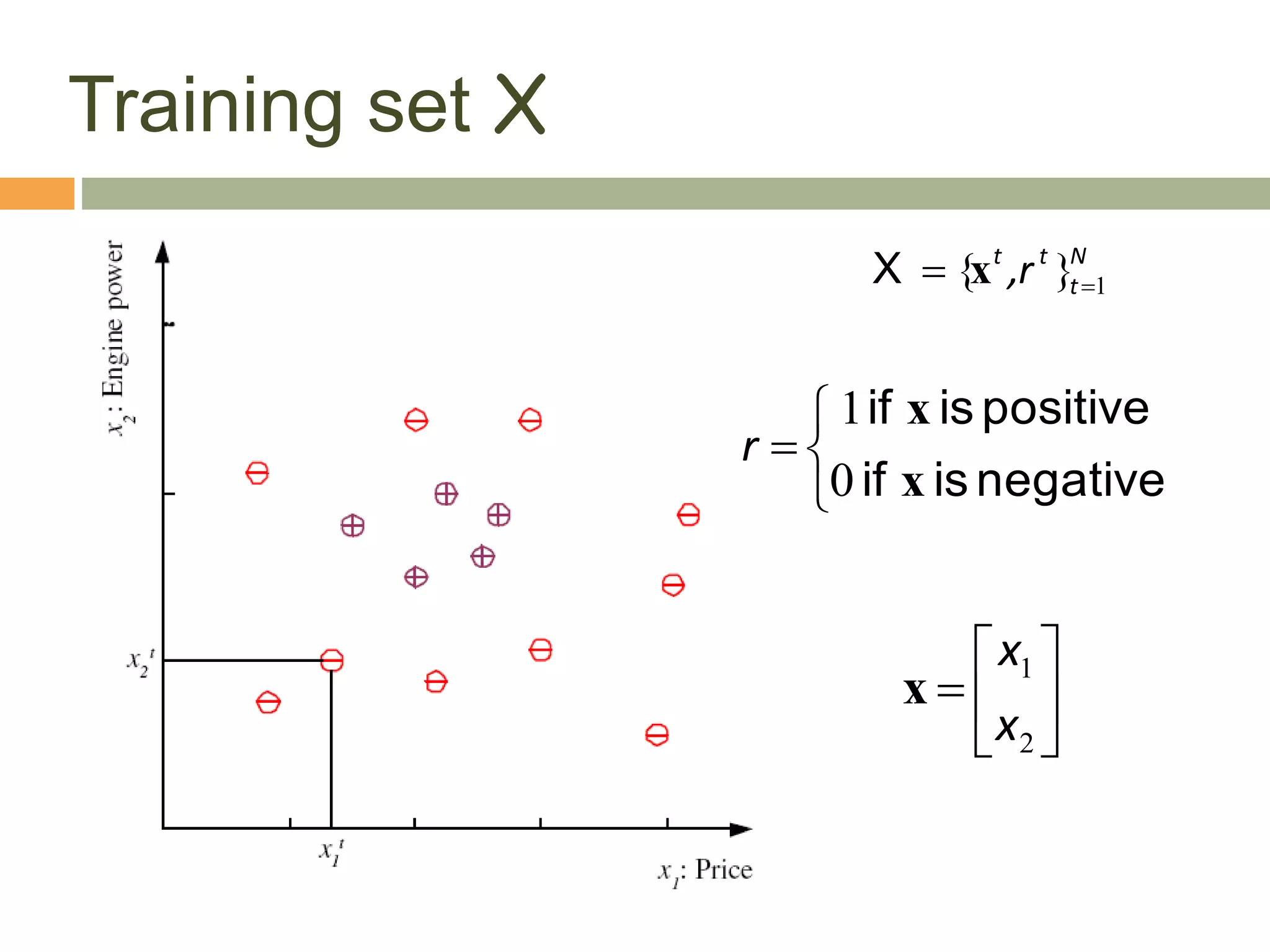
 Class C of a “family car”
 Prediction: Is car x a family car?
 Knowledge extraction: What do people expect from a
family car?
 Output:
Positive (+) and negative (–) examples
 Input representation:
x1: price, x2 : engine power
Training set X
N
t
t
t
,r 1
}
{ 
 x
X




negative
is
if
positive
is
if
x
x
0
1
r
4







2
1
x
x
x
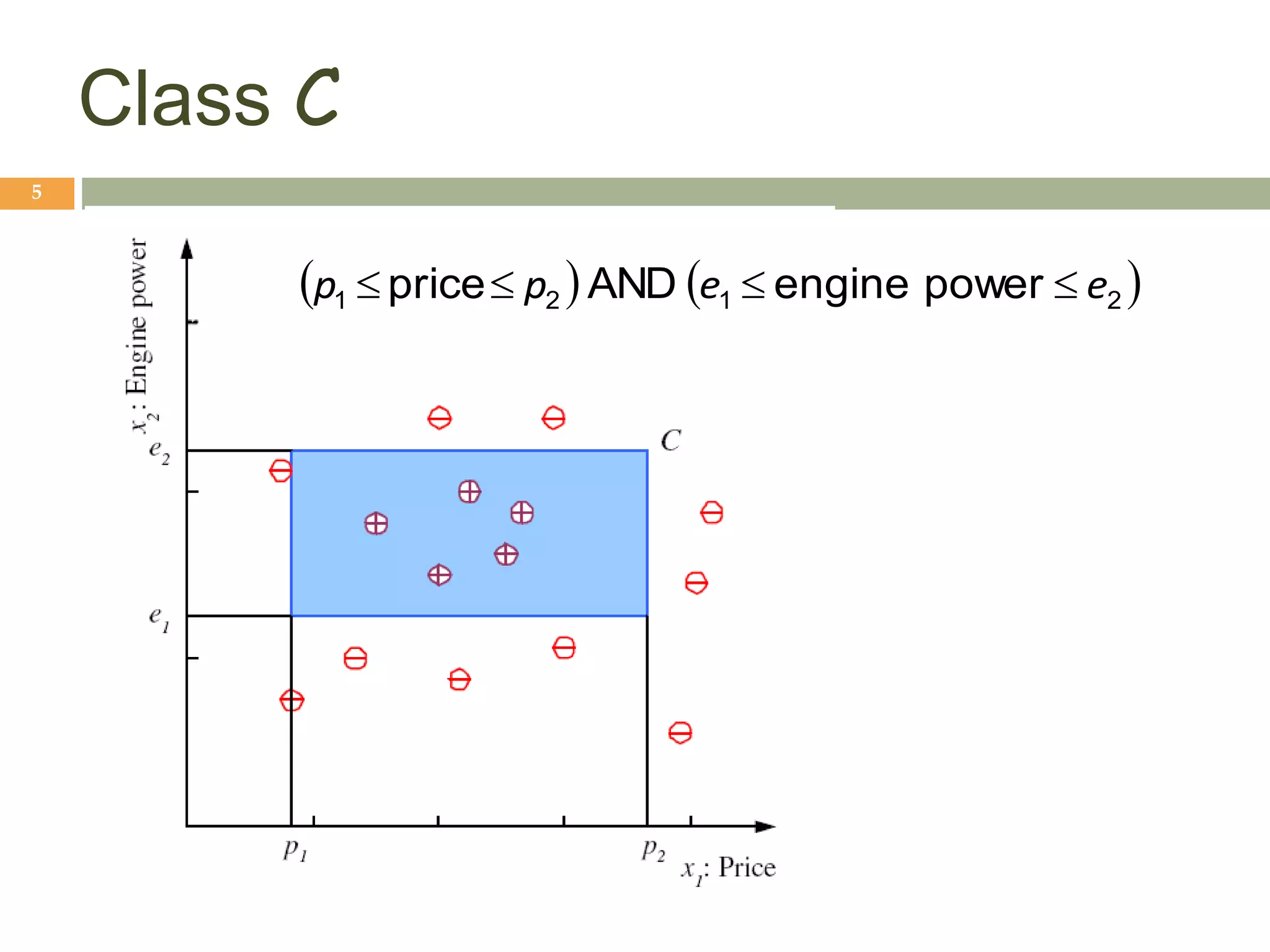
Class C
5
   
2
1
2
1 power
engine
AND
price e
e
p
p 



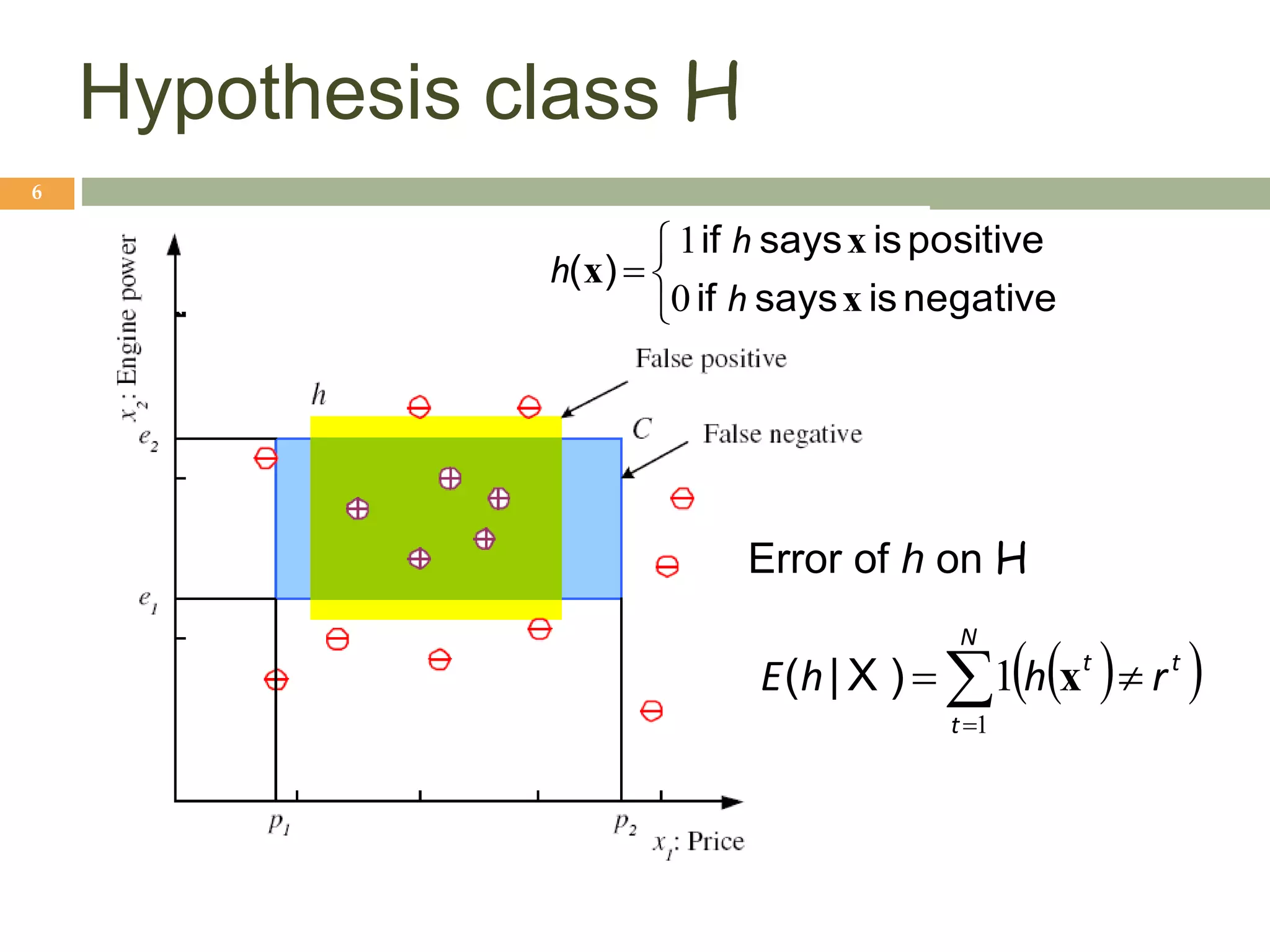
Hypothesis class H




negative
is
says
if
positive
is
says
if
)
(
x
x
x
h
h
h
0
1
 
 




N
t
t
t
r
h
h
E
1
1 x
)
|
( X
6
Error of h on H
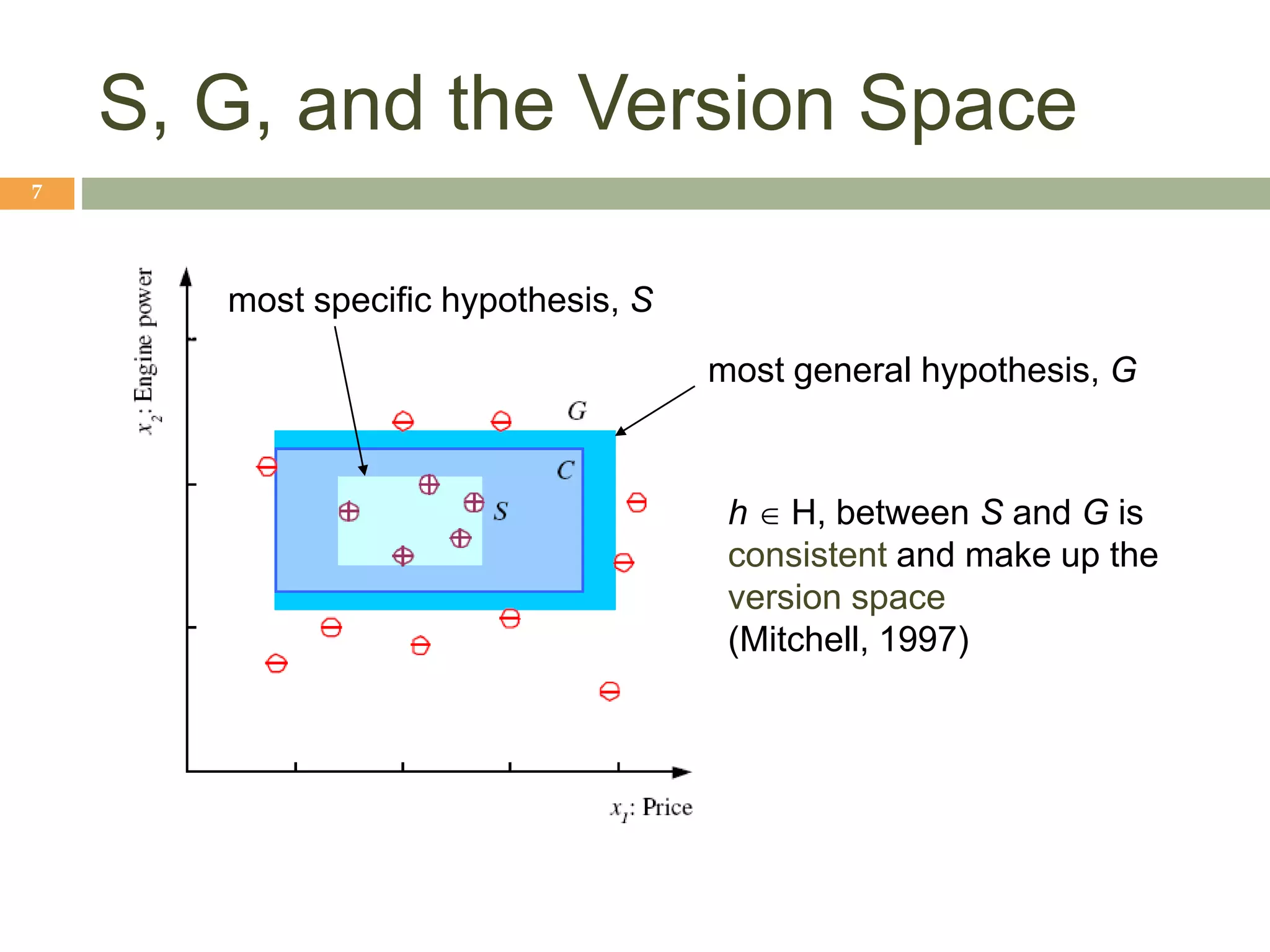
S, G, and the Version Space
7
most specific hypothesis, S
most general hypothesis, G
h H, between S and G is
consistent and make up the
version space
(Mitchell, 1997)
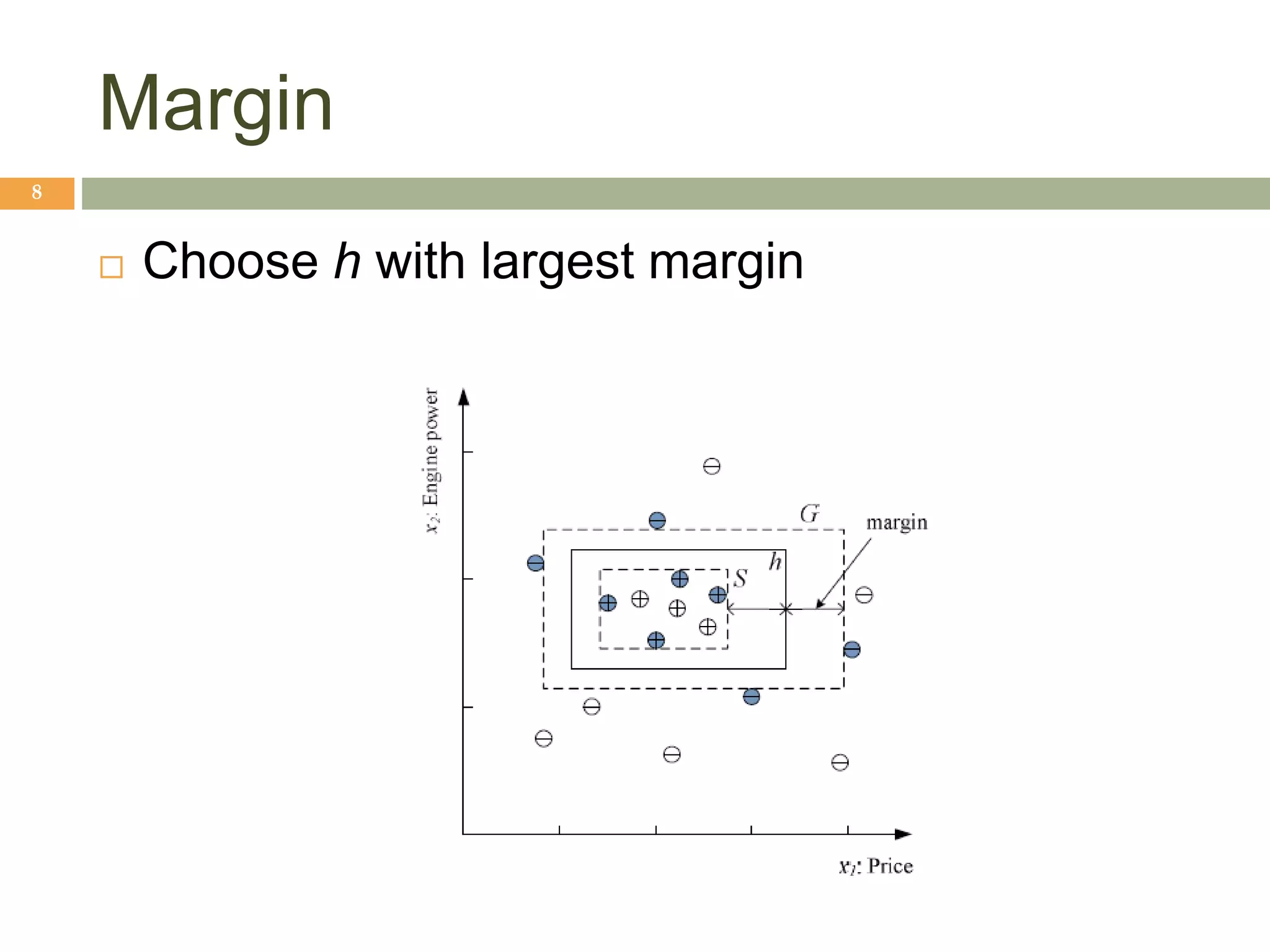
Margin
8
 Choose h with largest margin
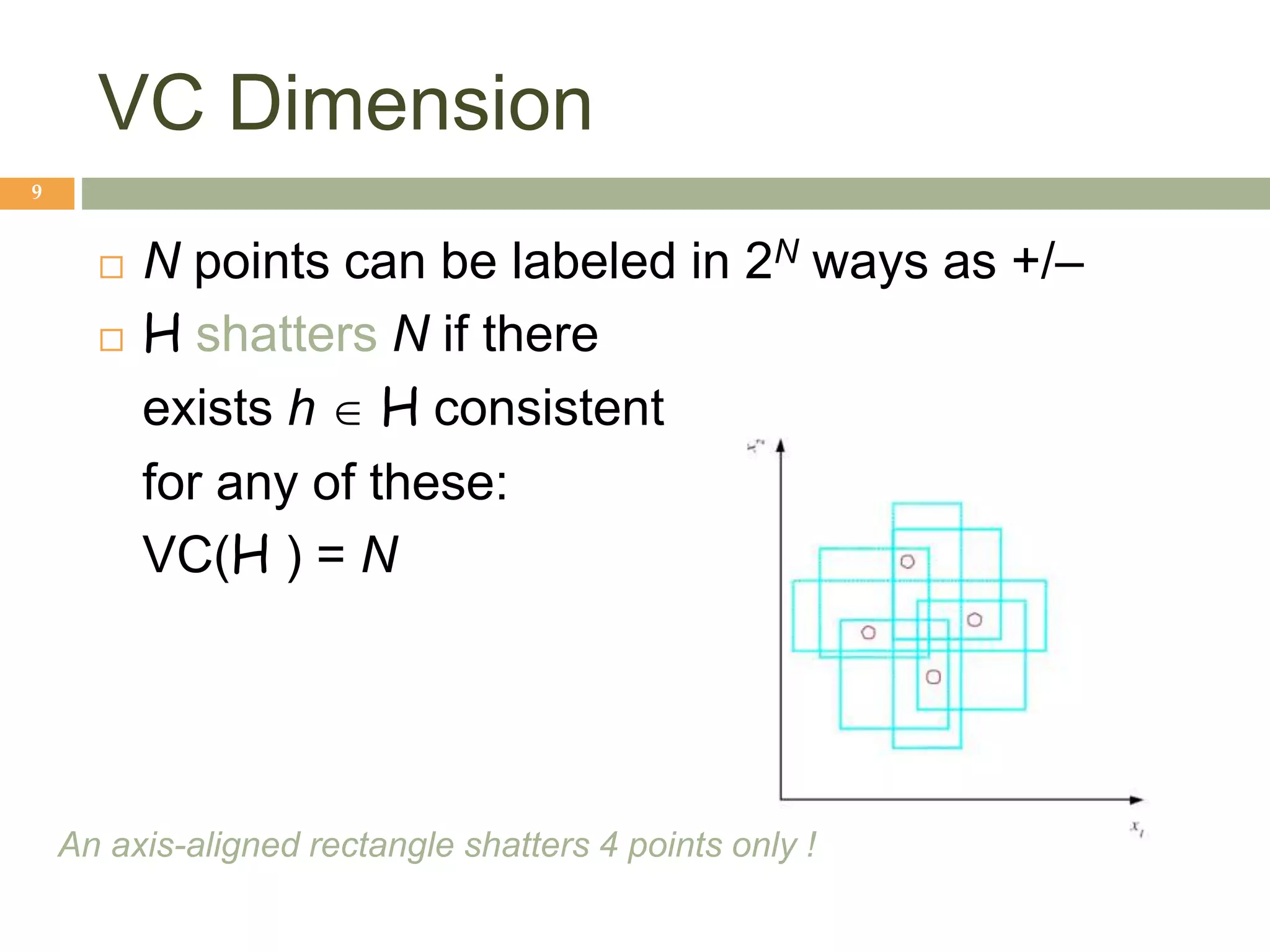
VC Dimension
9
 N points can be labeled in 2N ways as +/–
 H shatters N if there
exists h  H consistent
for any of these:
VC(H ) = N
An axis-aligned rectangle shatters 4 points only !
Probably Approximately Correct
(PAC) Learning
10
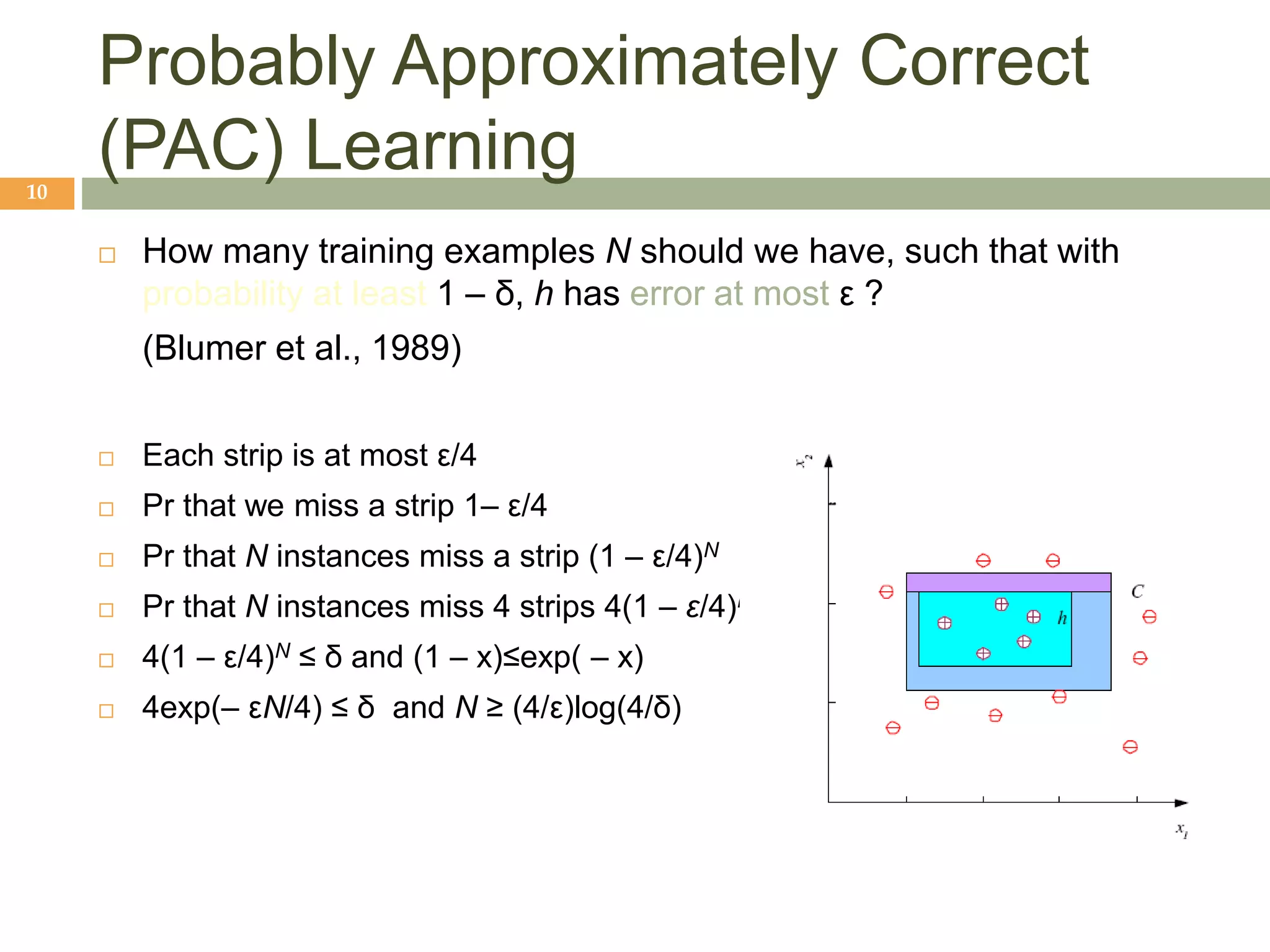
 How many training examples N should we have, such that with
probability at least 1 ‒ δ, h has error at most ε ?
(Blumer et al., 1989)
 Each strip is at most ε/4
 Pr that we miss a strip 1‒ ε/4
 Pr that N instances miss a strip (1 ‒ ε/4)N
 Pr that N instances miss 4 strips 4(1 ‒ ε/4)N
 4(1 ‒ ε/4)N ≤ δ and (1 ‒ x)≤exp( ‒ x)
 4exp(‒ εN/4) ≤ δ and N ≥ (4/ε)log(4/δ)
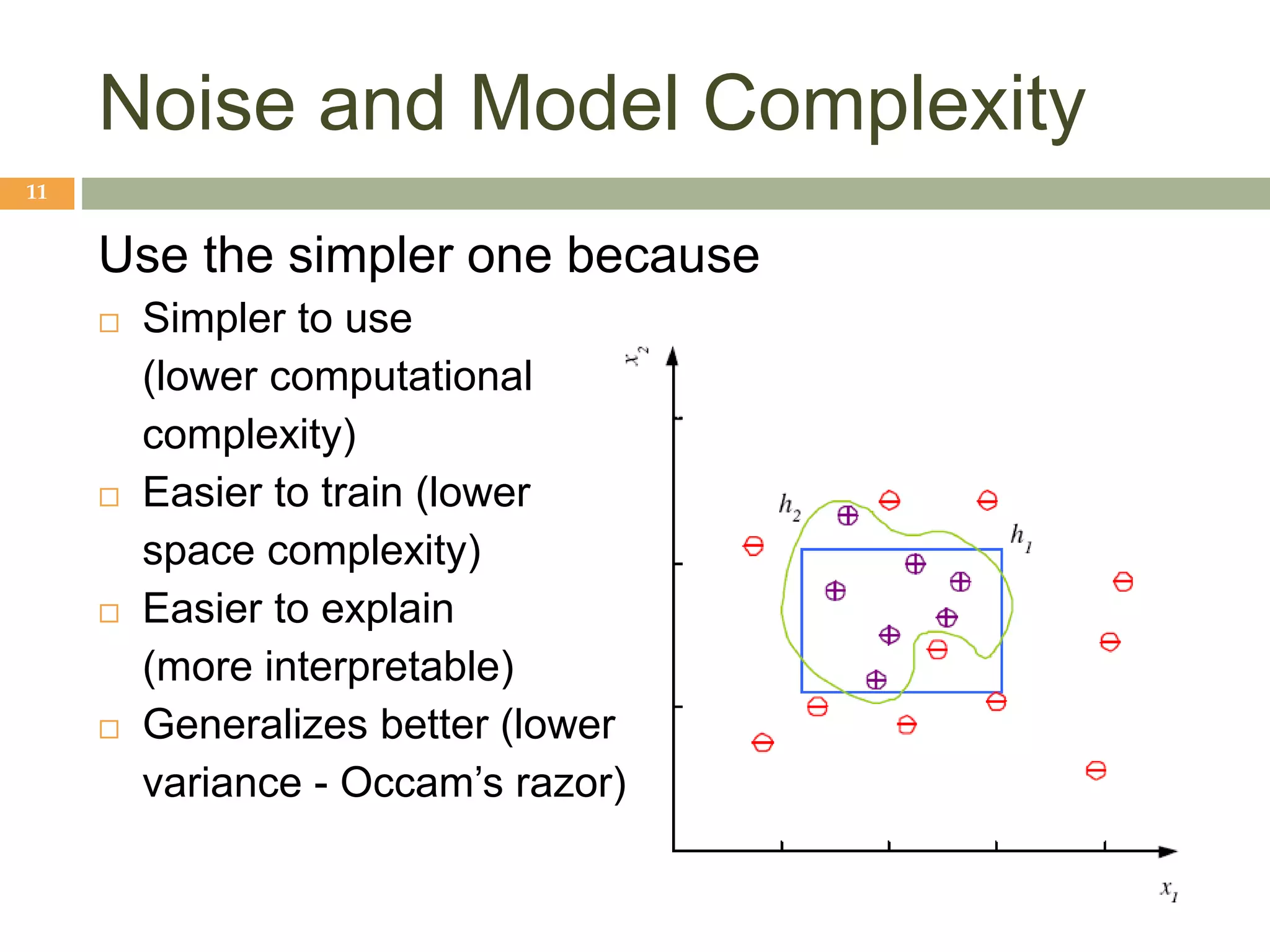
Noise and Model Complexity
11
Use the simpler one because
 Simpler to use
(lower computational
complexity)
 Easier to train (lower
space complexity)
 Easier to explain
(more interpretable)
 Generalizes better (lower
variance - Occam’s razor)
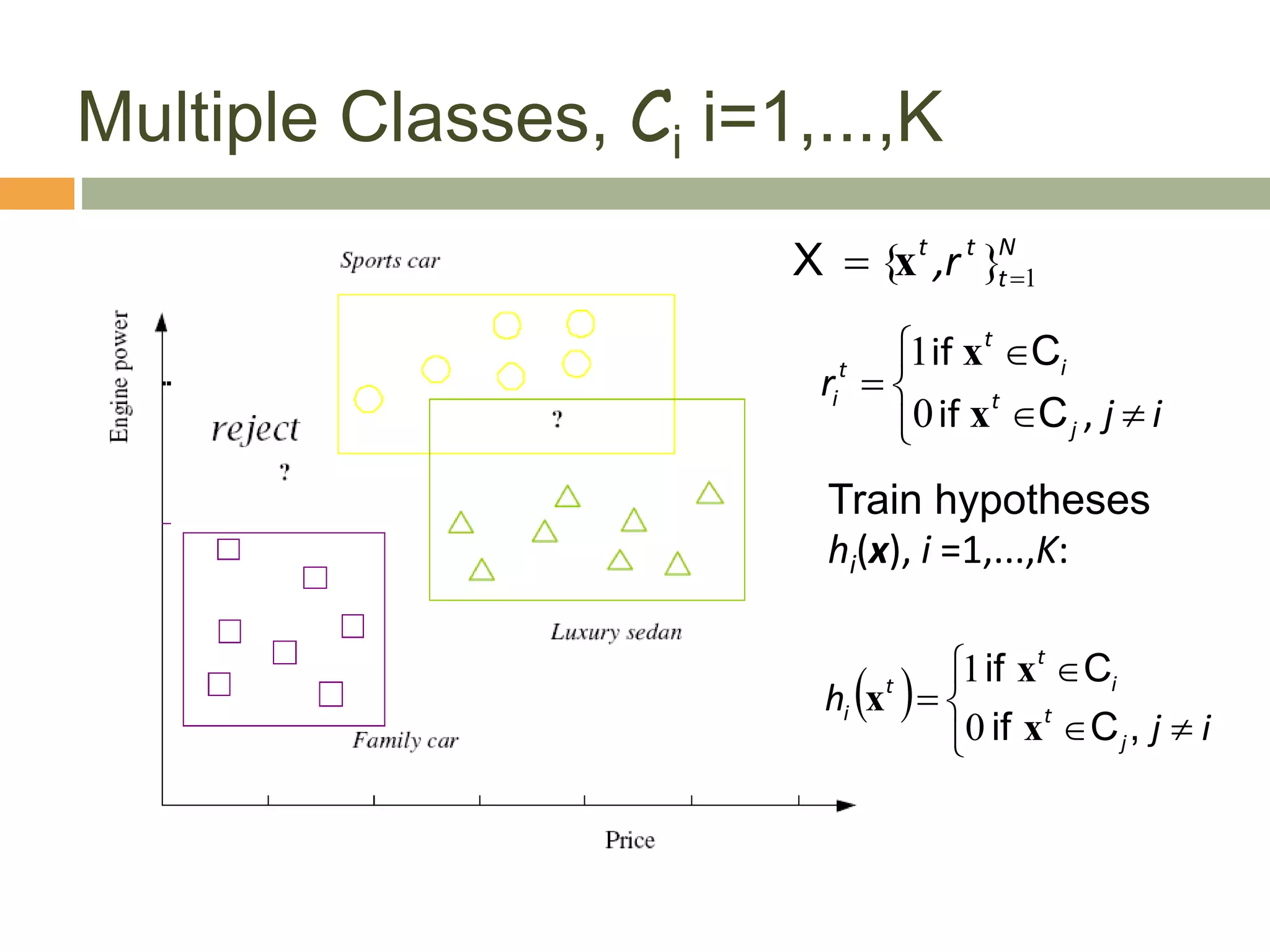
Multiple Classes, Ci i=1,...,K
N
t
t
t
,r 1
}
{ 
 x
X







,
if
if
i
j
r
j
t
i
t
t
i
C
C
x
x
0
1
 







,
if
if
i
j
h
j
t
i
t
t
i
C
C
x
x
x
0
1
12
Train hypotheses
hi(x), i =1,...,K:
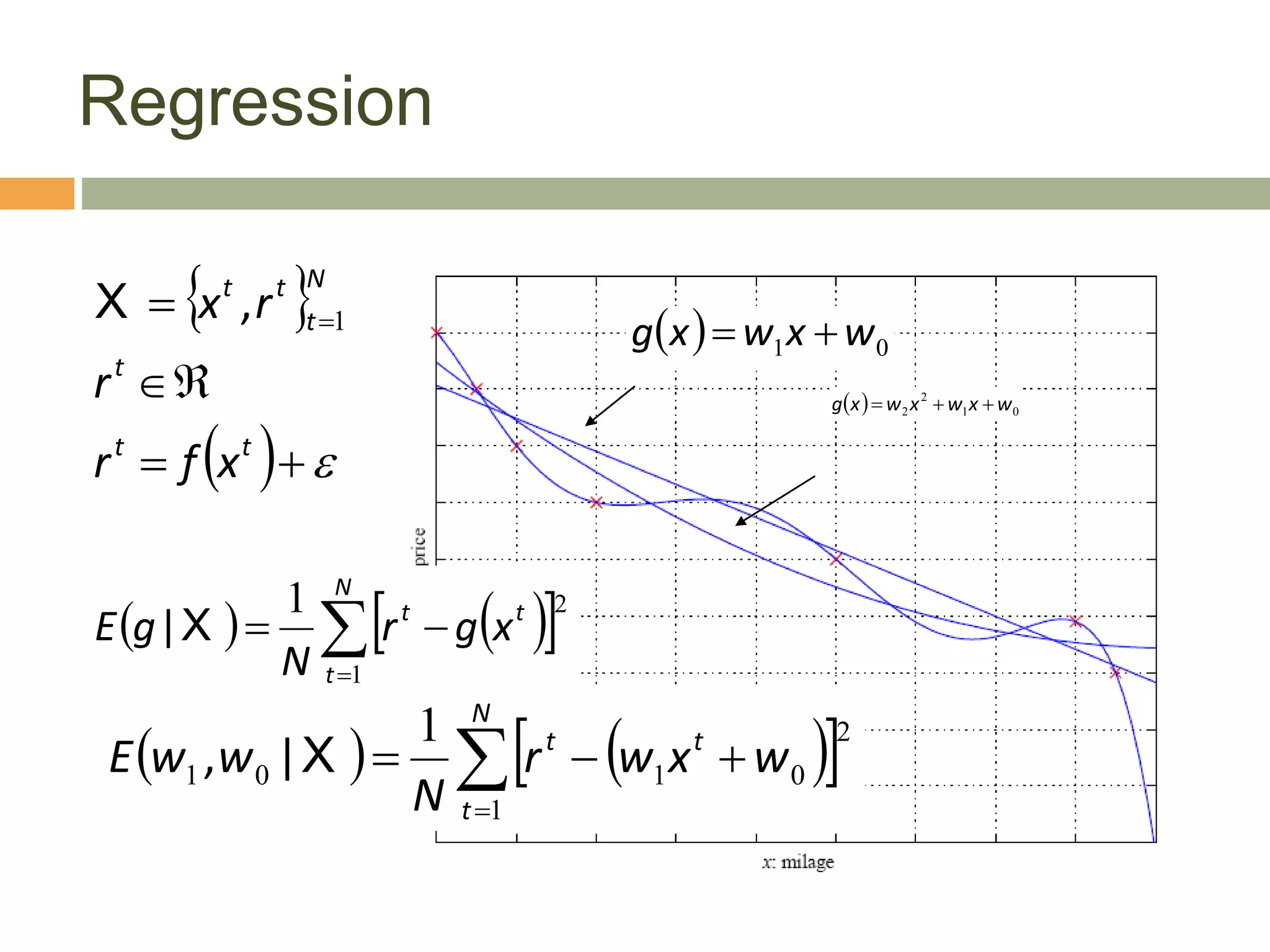
Regression
  0
1 w
x
w
x
g 

  0
1
2
2 w
x
w
x
w
x
g 


   
 




N
t
t
t
x
g
r
N
g
E
1
2
1
X
|
13
   
 





N
t
t
t
w
x
w
r
N
w
w
E
1
2
0
1
0
1
1
X
|
,
 
  




 
t
t
t
N
t
t
t
x
f
r
r
r
x 1
,
X
Model Selection &
Generalization
14
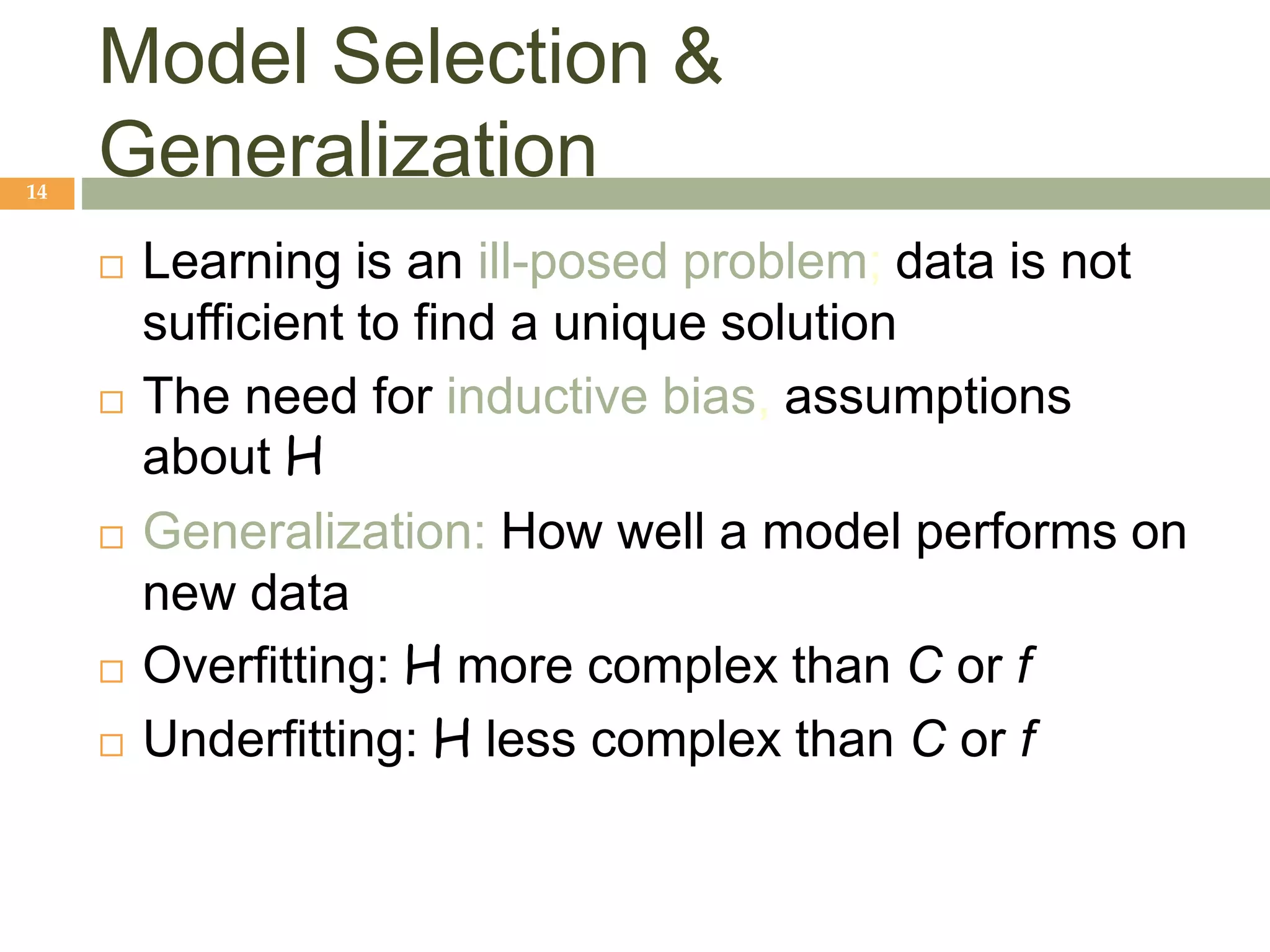
 Learning is an ill-posed problem; data is not
sufficient to find a unique solution
 The need for inductive bias, assumptions
about H
 Generalization: How well a model performs on
new data
 Overfitting: H more complex than C or f
 Underfitting: H less complex than C or f
Triple Trade-Off
15
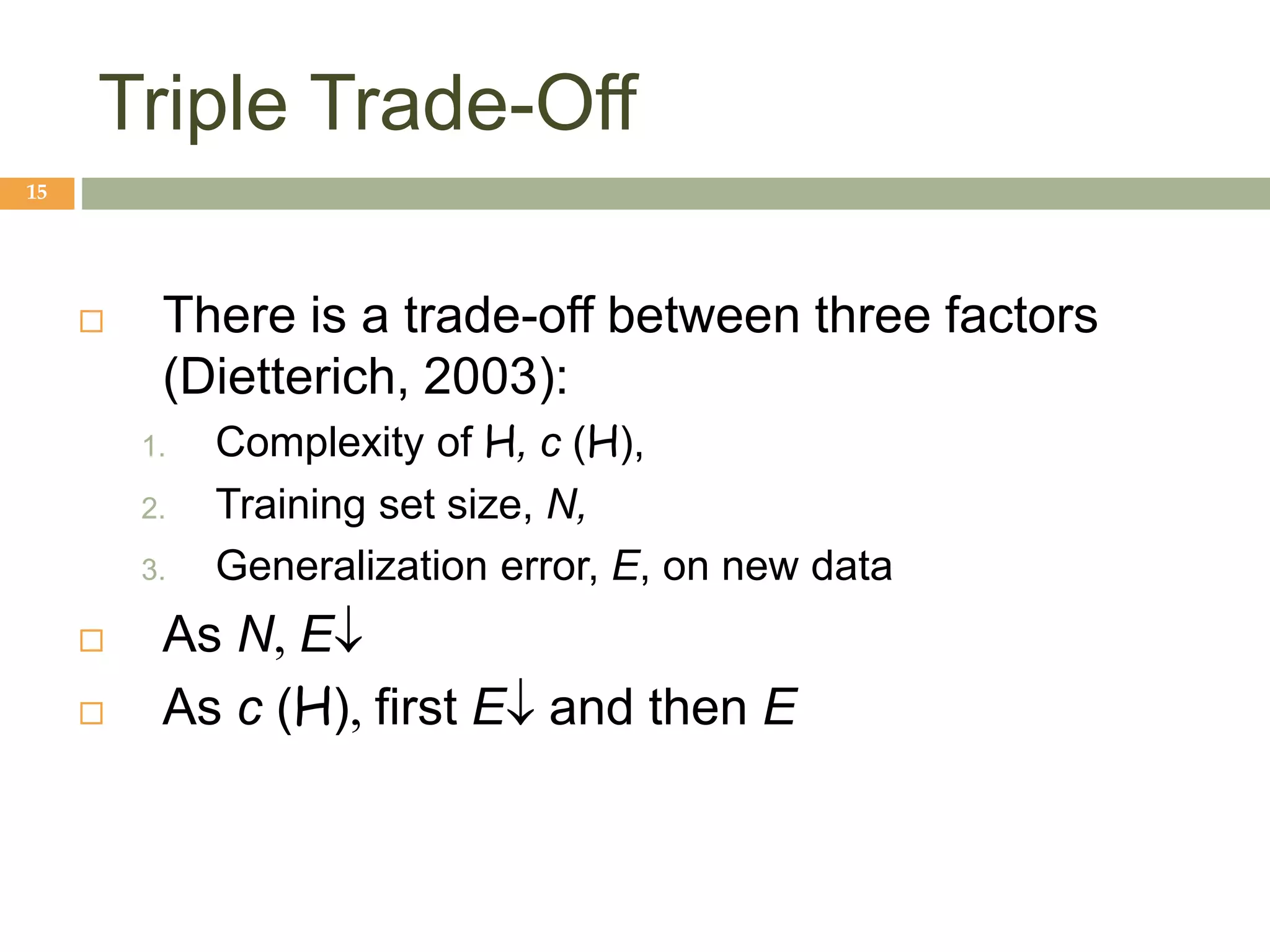
 There is a trade-off between three factors
(Dietterich, 2003):
1. Complexity of H, c (H),
2. Training set size, N,
3. Generalization error, E, on new data
 As N,E
 As c (H),first Eand then E
Cross-Validation
16
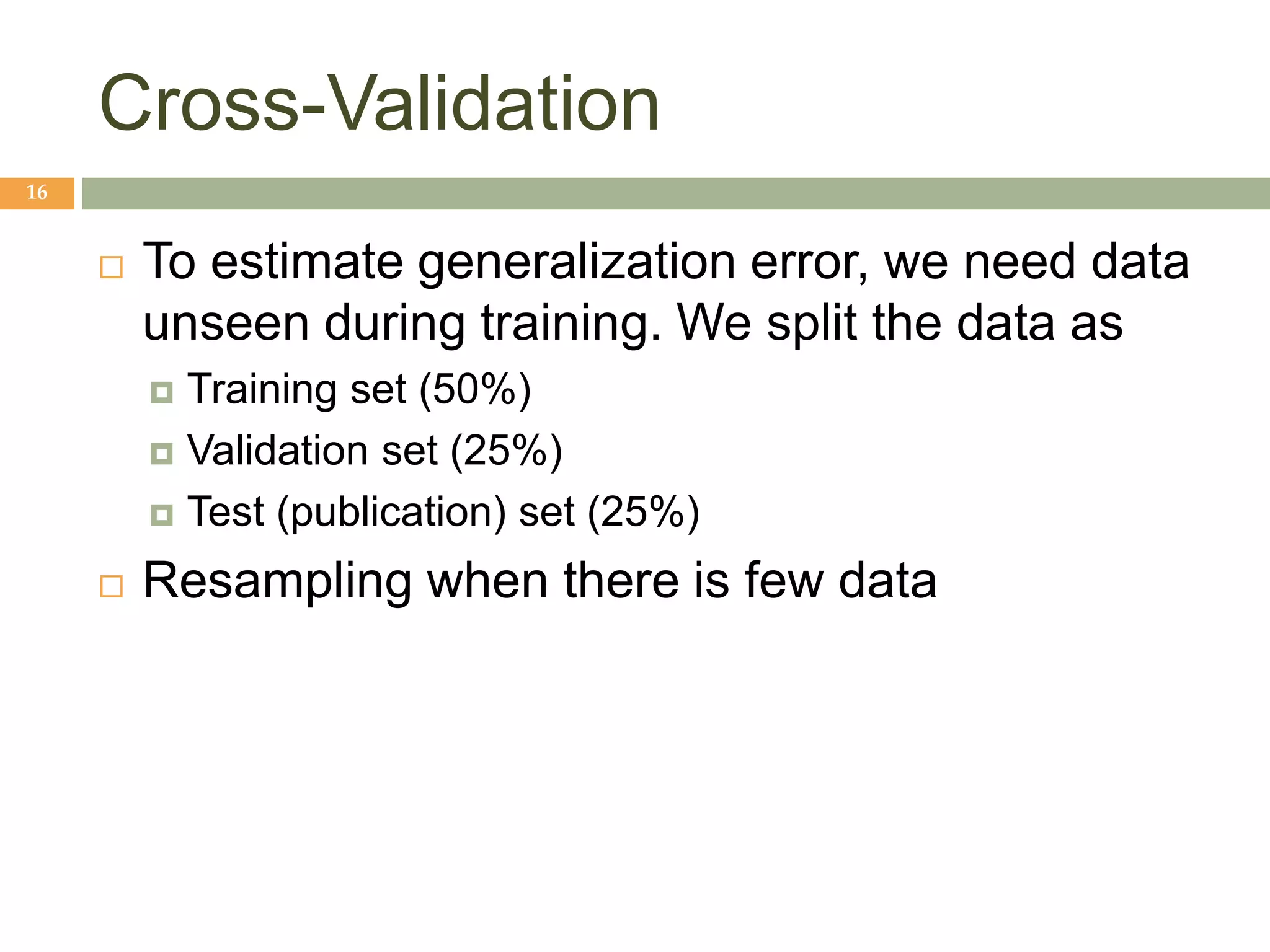
 To estimate generalization error, we need data
unseen during training. We split the data as
 Training set (50%)
 Validation set (25%)
 Test (publication) set (25%)
 Resampling when there is few data
Dimensions of a Supervised
Learner
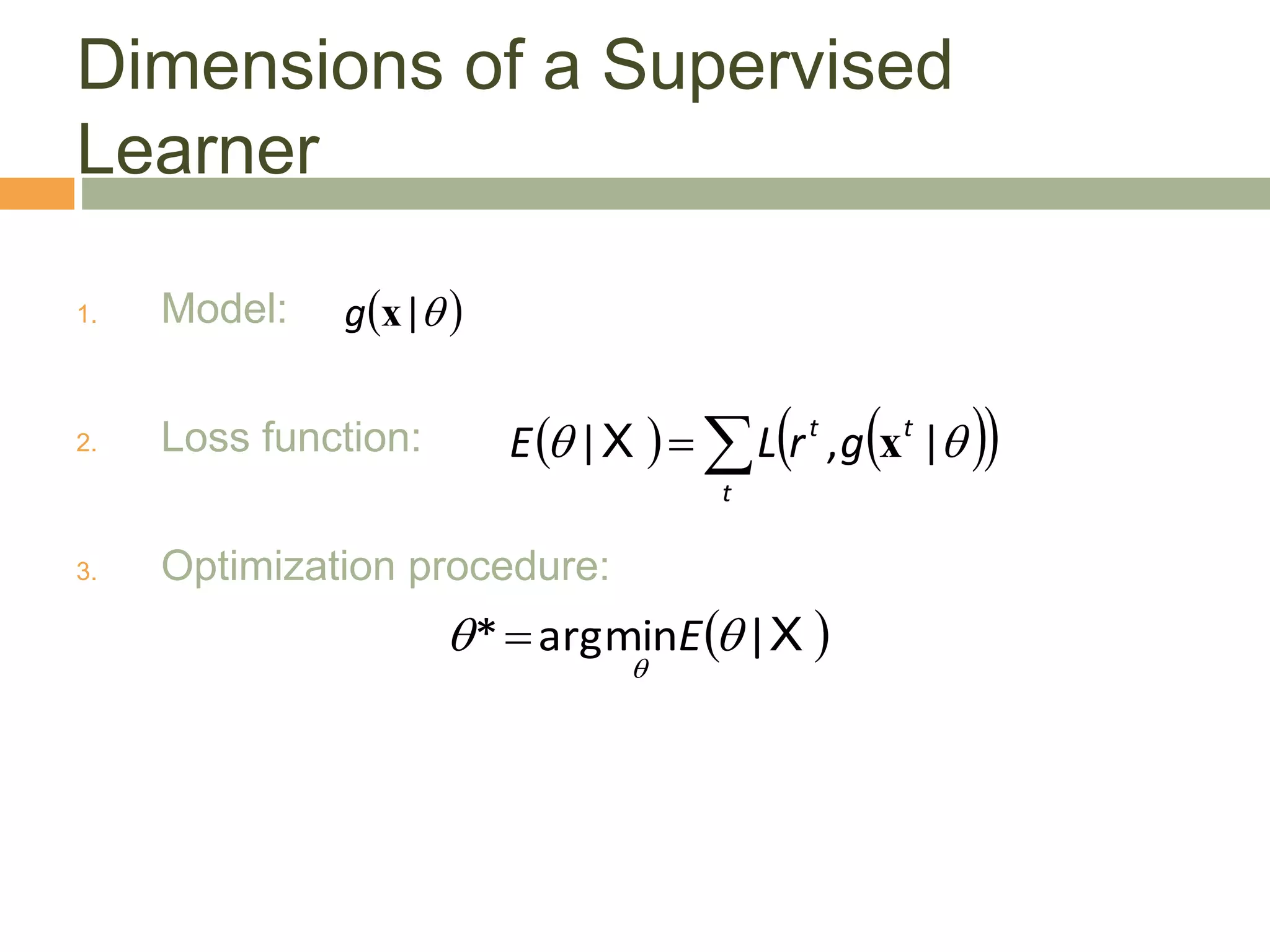
1. Model:
2. Loss function:
3. Optimization procedure:
 

|
x
g
   
 


t
t
t
g
r
L
E 
 |
,
| x
X
17
 
X
|
min
arg
* 


E


I2ml3e chap2

  • 1.
    INTRODUCTION TO MACHINE LEARNING 3RD EDITION ETHEM ALPAYDIN ©The MIT Press, 2014 alpaydin@boun.edu.tr http://www.cmpe.boun.edu.tr/~ethem/i2ml3e Lecture Slides for
  • 2.
  • 3.
    Learning a Classfrom Examples 3  Class C of a “family car”  Prediction: Is car x a family car?  Knowledge extraction: What do people expect from a family car?  Output: Positive (+) and negative (–) examples  Input representation: x1: price, x2 : engine power
  • 4.
    Training set X N t t t ,r1 } {   x X     negative is if positive is if x x 0 1 r 4        2 1 x x x
  • 5.
    Class C 5    2 1 2 1 power engine AND price e e p p    
  • 6.
    Hypothesis class H     negative is says if positive is says if ) ( x x x h h h 0 1        N t t t r h h E 1 1 x ) | ( X 6 Error of h on H
  • 7.
    S, G, andthe Version Space 7 most specific hypothesis, S most general hypothesis, G h H, between S and G is consistent and make up the version space (Mitchell, 1997)
  • 8.
    Margin 8  Choose hwith largest margin
  • 9.
    VC Dimension 9  Npoints can be labeled in 2N ways as +/–  H shatters N if there exists h  H consistent for any of these: VC(H ) = N An axis-aligned rectangle shatters 4 points only !
  • 10.
    Probably Approximately Correct (PAC)Learning 10  How many training examples N should we have, such that with probability at least 1 ‒ δ, h has error at most ε ? (Blumer et al., 1989)  Each strip is at most ε/4  Pr that we miss a strip 1‒ ε/4  Pr that N instances miss a strip (1 ‒ ε/4)N  Pr that N instances miss 4 strips 4(1 ‒ ε/4)N  4(1 ‒ ε/4)N ≤ δ and (1 ‒ x)≤exp( ‒ x)  4exp(‒ εN/4) ≤ δ and N ≥ (4/ε)log(4/δ)
  • 11.
    Noise and ModelComplexity 11 Use the simpler one because  Simpler to use (lower computational complexity)  Easier to train (lower space complexity)  Easier to explain (more interpretable)  Generalizes better (lower variance - Occam’s razor)
  • 12.
    Multiple Classes, Cii=1,...,K N t t t ,r 1 } {   x X        , if if i j r j t i t t i C C x x 0 1          , if if i j h j t i t t i C C x x x 0 1 12 Train hypotheses hi(x), i =1,...,K:
  • 13.
    Regression   0 1w x w x g     0 1 2 2 w x w x w x g              N t t t x g r N g E 1 2 1 X | 13            N t t t w x w r N w w E 1 2 0 1 0 1 1 X | ,            t t t N t t t x f r r r x 1 , X
  • 14.
    Model Selection & Generalization 14 Learning is an ill-posed problem; data is not sufficient to find a unique solution  The need for inductive bias, assumptions about H  Generalization: How well a model performs on new data  Overfitting: H more complex than C or f  Underfitting: H less complex than C or f
  • 15.
    Triple Trade-Off 15  Thereis a trade-off between three factors (Dietterich, 2003): 1. Complexity of H, c (H), 2. Training set size, N, 3. Generalization error, E, on new data  As N,E  As c (H),first Eand then E
  • 16.
    Cross-Validation 16  To estimategeneralization error, we need data unseen during training. We split the data as  Training set (50%)  Validation set (25%)  Test (publication) set (25%)  Resampling when there is few data
  • 17.
    Dimensions of aSupervised Learner 1. Model: 2. Loss function: 3. Optimization procedure:    | x g         t t t g r L E   | , | x X 17   X | min arg *    E 