Allergiccontactdermatitis
SHIKHAR
GROUP- III
Outline
⚫ Epidemiology
⚫ Pathophysiology
⚫ Clinical evaluation
⚫ Treatment
Introduction
⚫ Occurs after direct or indirect contact with
substances
⚫ Major cause of occupational skin disease
⚫ Common inflammatory skin disease
Classification
⚫ Allergic contact dermatitis
⚫ Inflammation caused by allergen specific
T lymphocytes
⚫ Prior sensitization necessary
Epidemiology
⚫ In USA
⚫ Cohort overall prevalence 24,400 /100,000
people
⚫ population-based studies in Europe
⚫ Prevalence 0.7% - 18.6% for ACD
⚫ Incidence of OCD in other countries 1.3 - 19
cases per 10,000
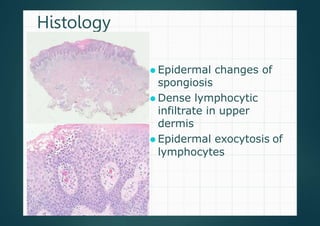
Histology
⚫ Epidermal changes of
spongiosis
⚫ Dense lymphocytic
infiltrate in upper
dermis
⚫ Epidermal exocytosis of
lymphocytes
PATHOPHYSIOLOGY AND
CLINICAL EVALUATION
⚫ ACD
⚫ Prototype of
type IV cell-
mediated
hypersensitivit
y reaction
 Diagnosis of ACD
suspected from clinical
presentation and possible
exposure to contact
allergen
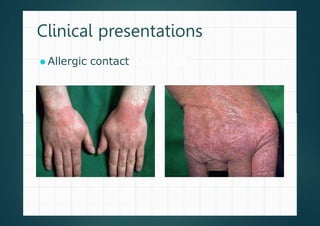
Clinical presentations
⚫ Allergic contact dermatitis
Investigation : Patch testing 1
⚫ Indicated in patients with chronic, pruritic eczematous or
lichenified dermatitis in whom ACD is suspected
⚫ Affected by
⚫ Oral corticosteroid [>20 mg of prednisolone/day or
equivalent]
⚫ Cancer chemotherapy or immunosuppressive drug
⚫ Topical corticosteroid should be discontinued for 5-7 days
before patch testing
⚫ Not affected by antihistamines
Investigation : Patch testing 2
⚫ Sources of allergens
T.R.U.E. TEST : Not US FDA approved but
recommended by CD experts
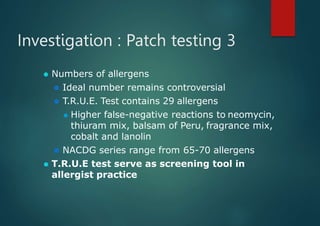
Investigation : Patch testing 3
⚫ Numbers of allergens
⚫ Ideal number remains controversial
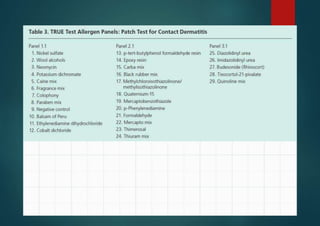
⚫ T.R.U.E. Test contains 29 allergens
⚫ Higher false-negative reactions to neomycin,
thiuram mix, balsam of Peru, fragrance mix,
cobalt and lanolin
⚫ NACDG series range from 65-70 allergens
⚫ T.R.U.E test serve as screening tool in
allergist practice
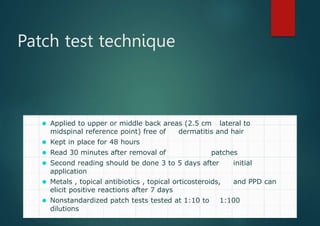
Patch test technique
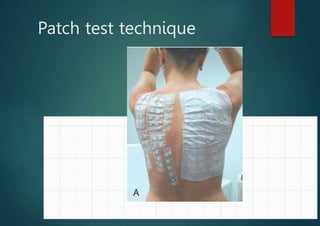
⚫ Applied to upper or middle back areas (2.5 cm lateral to
midspinal reference point) free of dermatitis and hair
⚫ Kept in place for 48 hours
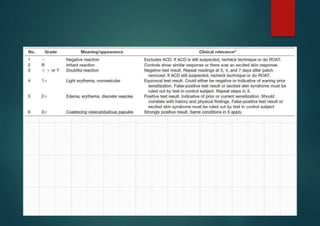
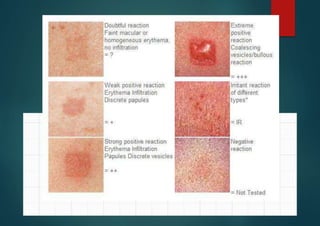
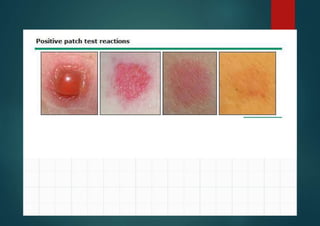
⚫ Read 30 minutes after removal of patches
⚫ Second reading should be done 3 to 5 days after initial
application
⚫ Metals , topical antibiotics , topical orticosteroids, and PPD can
elicit positive reactions after 7 days
⚫ Nonstandardized patch tests tested at 1:10 to 1:100
dilutions
Patch test technique
Investigation : ROAT
⚫ Improving reliability of interpreting tests for
leave-on products
⚫ Suspected allergens are applied to antecubital fossa
twice daily for 7 days and observed for dermatitis
⚫ Absence of reaction makes CD unlikely
⚫ If eyelid dermatitis is considered
⚫ ROAT can be performed on back of ear
Occupational contact dermatitis
⚫ 4 of 7 criteria must be positive to conclude OCD
⚫ Clinical appearance consistent with CD
⚫ Cutaneous irritants or allergens present in workplace
⚫ Anatomic distribution of dermatitis consistent with skin exposure to
chemicals in course of various job tasks
⚫ Temporal relationship between exposure and onset of symptoms
consistent with CD
⚫ Nonoccupational exposures excluded as probable causes of dermatitis
⚫ Dermatitis improves away from work exposure and reexposure causes
exacerbation
⚫ There are positive-reaction and relevant patch tests performed
according to established guidelines
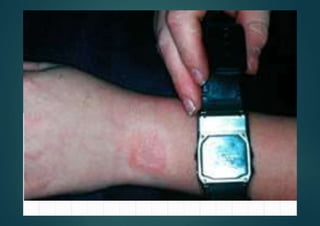
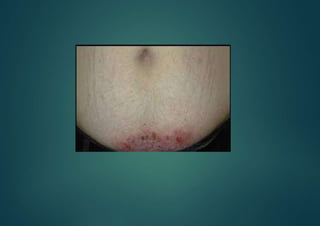
Selected contact dermatitis : Metals 1
Nickel
⚫ 18.7% positive patch test reaction to
nickel
⚫ Female sensitization to nickel higher
⚫ 1% of nickel allergy have systemic
reactions to nickel content of normal diet
Luz S. Fonacier et al J Allergy Clin Immunol 2010;125:138-49
www.
Selected contact dermatitis : Metals 2
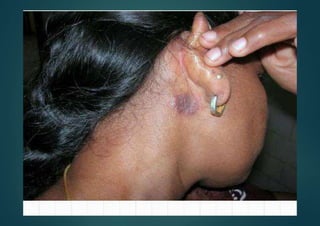
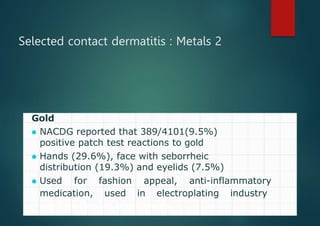
Gold
⚫ NACDG reported that 389/4101(9.5%)
positive patch test reactions to gold
⚫ Hands (29.6%), face with seborrheic
distribution (19.3%) and eyelids (7.5%)
⚫ Used for fashion appeal, anti-inflammatory
medication, used in electroplating industry,
part of dental appliances
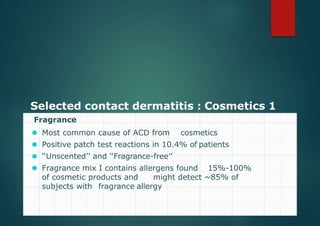
Selected contact dermatitis : Cosmetics 1
Fragrance
⚫ Most common cause of ACD from cosmetics
⚫ Positive patch test reactions in 10.4% of patients
⚫ ‘‘Unscented’’ and ‘‘Fragrance-free’’
⚫ Fragrance mix I contains allergens found 15%-100%
of cosmetic products and might detect ~85% of
subjects with fragrance allergy
Selected contact dermatitis : Cosmetics 2
Preservatives and excipients
⚫ Lanolin
⚫ Common component of consumer
products
⚫ Weak sensitizer on normal skin but stronger
sensitizer on damaged skin
⚫ Stasis dermatitis, higher risk of lanolin
sensitivity
Selected contact dermatitis : Cosmetics 3
Preservatives and excipients
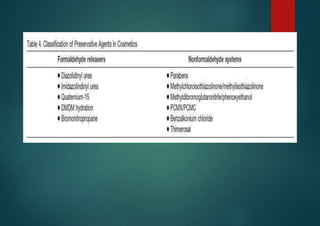
⚫ Cosmetic preservatives
⚫ Formaldehyde releasers
⚫ Non–formaldehyde releasers : Paraben
Selected contact dermatitis : Cosmetics 4
Hair products
⚫ PPD (Paraphenylenediamine)
⚫ Most common cause of CD in
hairdressers
⚫ PPD cross-reacts with COX-2 inhibitor
(celecoxib), sunscreens, and antioxidants
used in manufacture of rubber products
Selected contact dermatitis :
Cosmetics 5
Hair products
⚫ CAPB ( Cocoamidopropyl betaine )
⚫ Amphoteric surfactant often found in
shampoos, bath products, and eye and
facial cleaners
Selected contact dermatitis : Cosmetics 6
Hair products
⚫ Glycerol thioglycolate
⚫ Active ingredient in permanent wave
solution
⚫ Might remain allergenic in hair long
after rinsed out
Medications 1
Antibiotics and antiseptics
⚫ Neomycin and nitrofurazone potent
sensitizers
⚫ Neomycin sulfate cross-sensitize with
gentamicin, kanamycin, streptomycin,
spectinomycin, tobramycin and
paromomycin
Medications 2
Corticosteroid
⚫ Patients with worsening of previous dermatitis or initial
improvement followed by deterioration of dermatitis after
application of corticosteroids should be evaluated for
corticosteroid allergy
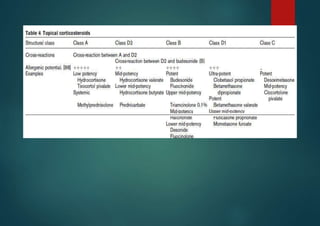
⚫ Cross-reactivity between groups A and D2 and groups B
and D2 has been reported
⚫ 30% of ACD to corticosteroids be missed if delayed 7-
day reading not done
Surgical implant devices 1
⚫ Use of nickel in biomedical devices,led to
increasing concern about safety in
suspected nickel-sensitized patients
⚫ No large, evidence-based guidelines
Surgical implant devices 2
⚫ Criteria for diagnosis of cutaneous implant–induced
reaction
⚫ Dermatitis (localized/generalized) appearing after
implant surgery
⚫ Persistent dermatitis (resistant to appropriate
therapies)
⚫ Positive patch test (history to metallic component of
implant or to commonly used acrylic glues)
⚫ Resolution of dermatitis after removal of implant
Treatment 1
⚫ Allergen identification to improve contact avoidance
⚫ Alternatives and substitutes to cosmetics should be offered
to patient to increase compliance
⚫ Supportive care and relief of pruritus
⚫ Excessive handwashing and nonirritating or sensitizing
moisturizers must be used after washing
Treatment 2
⚫ TC is first-line treatment for ACD
⚫ Extensive(>20% BSA) and severe CD,
systemic corticosteroids might offer faster
relief (12-24hr)
⚫ Recommended dose is 0.5 to 1 mg/kg daily for
5 to 7 days, and only if patient is comfortable
at that time is dose reduced by 50% for next 5
to 7 days Luz S. Fonacier et al J Allergy Clin Immunol 2010;125:138-49
Vincent S. Beltrani et al Annals of Allergy, Asthma and Immunology 2006;97:1-30
THANK YOU

Allergic contact dermatitis shikhar.pptx

  • 1.
  • 2.
    Outline ⚫ Epidemiology ⚫ Pathophysiology ⚫Clinical evaluation ⚫ Treatment
  • 3.
    Introduction ⚫ Occurs afterdirect or indirect contact with substances ⚫ Major cause of occupational skin disease ⚫ Common inflammatory skin disease
  • 4.
    Classification ⚫ Allergic contactdermatitis ⚫ Inflammation caused by allergen specific T lymphocytes ⚫ Prior sensitization necessary
  • 5.
    Epidemiology ⚫ In USA ⚫Cohort overall prevalence 24,400 /100,000 people ⚫ population-based studies in Europe ⚫ Prevalence 0.7% - 18.6% for ACD ⚫ Incidence of OCD in other countries 1.3 - 19 cases per 10,000
  • 6.
    Histology ⚫ Epidermal changesof spongiosis ⚫ Dense lymphocytic infiltrate in upper dermis ⚫ Epidermal exocytosis of lymphocytes
  • 7.
    PATHOPHYSIOLOGY AND CLINICAL EVALUATION ⚫ACD ⚫ Prototype of type IV cell- mediated hypersensitivit y reaction  Diagnosis of ACD suspected from clinical presentation and possible exposure to contact allergen
  • 10.
  • 11.
    Investigation : Patchtesting 1 ⚫ Indicated in patients with chronic, pruritic eczematous or lichenified dermatitis in whom ACD is suspected ⚫ Affected by ⚫ Oral corticosteroid [>20 mg of prednisolone/day or equivalent] ⚫ Cancer chemotherapy or immunosuppressive drug ⚫ Topical corticosteroid should be discontinued for 5-7 days before patch testing ⚫ Not affected by antihistamines
  • 12.
    Investigation : Patchtesting 2 ⚫ Sources of allergens T.R.U.E. TEST : Not US FDA approved but recommended by CD experts
  • 13.
    Investigation : Patchtesting 3 ⚫ Numbers of allergens ⚫ Ideal number remains controversial ⚫ T.R.U.E. Test contains 29 allergens ⚫ Higher false-negative reactions to neomycin, thiuram mix, balsam of Peru, fragrance mix, cobalt and lanolin ⚫ NACDG series range from 65-70 allergens ⚫ T.R.U.E test serve as screening tool in allergist practice
  • 15.
    Patch test technique ⚫Applied to upper or middle back areas (2.5 cm lateral to midspinal reference point) free of dermatitis and hair ⚫ Kept in place for 48 hours ⚫ Read 30 minutes after removal of patches ⚫ Second reading should be done 3 to 5 days after initial application ⚫ Metals , topical antibiotics , topical orticosteroids, and PPD can elicit positive reactions after 7 days ⚫ Nonstandardized patch tests tested at 1:10 to 1:100 dilutions
  • 16.
  • 21.
    Investigation : ROAT ⚫Improving reliability of interpreting tests for leave-on products ⚫ Suspected allergens are applied to antecubital fossa twice daily for 7 days and observed for dermatitis ⚫ Absence of reaction makes CD unlikely ⚫ If eyelid dermatitis is considered ⚫ ROAT can be performed on back of ear
  • 22.
    Occupational contact dermatitis ⚫4 of 7 criteria must be positive to conclude OCD ⚫ Clinical appearance consistent with CD ⚫ Cutaneous irritants or allergens present in workplace ⚫ Anatomic distribution of dermatitis consistent with skin exposure to chemicals in course of various job tasks ⚫ Temporal relationship between exposure and onset of symptoms consistent with CD ⚫ Nonoccupational exposures excluded as probable causes of dermatitis ⚫ Dermatitis improves away from work exposure and reexposure causes exacerbation ⚫ There are positive-reaction and relevant patch tests performed according to established guidelines
  • 23.
    Selected contact dermatitis: Metals 1 Nickel ⚫ 18.7% positive patch test reaction to nickel ⚫ Female sensitization to nickel higher ⚫ 1% of nickel allergy have systemic reactions to nickel content of normal diet
  • 24.
    Luz S. Fonacieret al J Allergy Clin Immunol 2010;125:138-49
  • 26.
  • 28.
    Selected contact dermatitis: Metals 2 Gold ⚫ NACDG reported that 389/4101(9.5%) positive patch test reactions to gold ⚫ Hands (29.6%), face with seborrheic distribution (19.3%) and eyelids (7.5%) ⚫ Used for fashion appeal, anti-inflammatory medication, used in electroplating industry, part of dental appliances
  • 29.
    Selected contact dermatitis: Cosmetics 1 Fragrance ⚫ Most common cause of ACD from cosmetics ⚫ Positive patch test reactions in 10.4% of patients ⚫ ‘‘Unscented’’ and ‘‘Fragrance-free’’ ⚫ Fragrance mix I contains allergens found 15%-100% of cosmetic products and might detect ~85% of subjects with fragrance allergy
  • 30.
    Selected contact dermatitis: Cosmetics 2 Preservatives and excipients ⚫ Lanolin ⚫ Common component of consumer products ⚫ Weak sensitizer on normal skin but stronger sensitizer on damaged skin ⚫ Stasis dermatitis, higher risk of lanolin sensitivity
  • 31.
    Selected contact dermatitis: Cosmetics 3 Preservatives and excipients ⚫ Cosmetic preservatives ⚫ Formaldehyde releasers ⚫ Non–formaldehyde releasers : Paraben
  • 33.
    Selected contact dermatitis: Cosmetics 4 Hair products ⚫ PPD (Paraphenylenediamine) ⚫ Most common cause of CD in hairdressers ⚫ PPD cross-reacts with COX-2 inhibitor (celecoxib), sunscreens, and antioxidants used in manufacture of rubber products
  • 34.
    Selected contact dermatitis: Cosmetics 5 Hair products ⚫ CAPB ( Cocoamidopropyl betaine ) ⚫ Amphoteric surfactant often found in shampoos, bath products, and eye and facial cleaners
  • 35.
    Selected contact dermatitis: Cosmetics 6 Hair products ⚫ Glycerol thioglycolate ⚫ Active ingredient in permanent wave solution ⚫ Might remain allergenic in hair long after rinsed out
  • 36.
    Medications 1 Antibiotics andantiseptics ⚫ Neomycin and nitrofurazone potent sensitizers ⚫ Neomycin sulfate cross-sensitize with gentamicin, kanamycin, streptomycin, spectinomycin, tobramycin and paromomycin
  • 37.
    Medications 2 Corticosteroid ⚫ Patientswith worsening of previous dermatitis or initial improvement followed by deterioration of dermatitis after application of corticosteroids should be evaluated for corticosteroid allergy ⚫ Cross-reactivity between groups A and D2 and groups B and D2 has been reported ⚫ 30% of ACD to corticosteroids be missed if delayed 7- day reading not done
  • 39.
    Surgical implant devices1 ⚫ Use of nickel in biomedical devices,led to increasing concern about safety in suspected nickel-sensitized patients ⚫ No large, evidence-based guidelines
  • 40.
    Surgical implant devices2 ⚫ Criteria for diagnosis of cutaneous implant–induced reaction ⚫ Dermatitis (localized/generalized) appearing after implant surgery ⚫ Persistent dermatitis (resistant to appropriate therapies) ⚫ Positive patch test (history to metallic component of implant or to commonly used acrylic glues) ⚫ Resolution of dermatitis after removal of implant
  • 41.
    Treatment 1 ⚫ Allergenidentification to improve contact avoidance ⚫ Alternatives and substitutes to cosmetics should be offered to patient to increase compliance ⚫ Supportive care and relief of pruritus ⚫ Excessive handwashing and nonirritating or sensitizing moisturizers must be used after washing
  • 42.
    Treatment 2 ⚫ TCis first-line treatment for ACD ⚫ Extensive(>20% BSA) and severe CD, systemic corticosteroids might offer faster relief (12-24hr) ⚫ Recommended dose is 0.5 to 1 mg/kg daily for 5 to 7 days, and only if patient is comfortable at that time is dose reduced by 50% for next 5 to 7 days Luz S. Fonacier et al J Allergy Clin Immunol 2010;125:138-49 Vincent S. Beltrani et al Annals of Allergy, Asthma and Immunology 2006;97:1-30
  • 43.

Editor's Notes