Dermatological
pharmacology
Dr. Ankita Bist
Assistant Professor
Department of Pharmacology
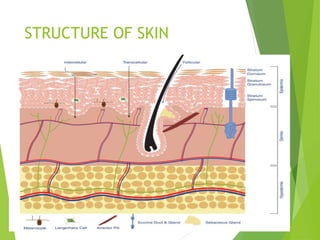
STRUCTURE OF SKIN
GLUCOCORTICOIDS
 Immunosuppressive and anti-inflammatory properties
 Administration: locally and systemically.
 Systemic therapy restricted to severe dermatological illnesses.
 Side effects: Skin atrophy, striae, telangiectasias, purpura, and
acneiform eruptions.
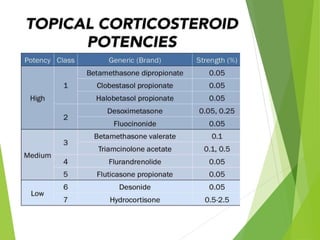
 Topical glucocorticoids have been grouped into seven classes in
order of decreasing potency.
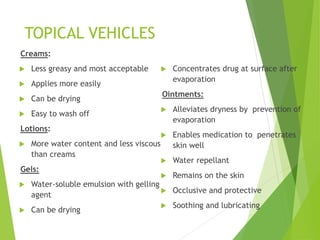
TOPICAL VEHICLES
Creams:
 Less greasy and most acceptable
 Applies more easily
 Can be drying
 Easy to wash off
Lotions:
 More water content and less viscous
than creams
Gels:
 Water-soluble emulsion with gelling
agent
 Can be drying
 Concentrates drug at surface after
evaporation
Ointments:
 Alleviates dryness by prevention of
evaporation
 Enables medication to penetrates
skin well
 Water repellant
 Remains on the skin
 Occlusive and protective
 Soothing and lubricating
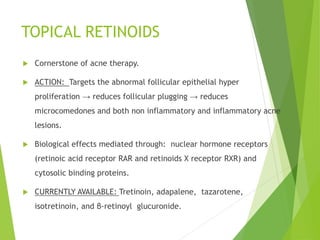
TOPICAL RETINOIDS
 Cornerstone of acne therapy.
 ACTION: Targets the abnormal follicular epithelial hyper
proliferation → reduces follicular plugging → reduces
microcomedones and both non inflammatory and inflammatory acne
lesions.
 Biological effects mediated through: nuclear hormone receptors
(retinoic acid receptor RAR and retinoids X receptor RXR) and
cytosolic binding proteins.
 CURRENTLY AVAILABLE: Tretinoin, adapalene, tazarotene,
isotretinoin, and β-retinoyl glucuronide.
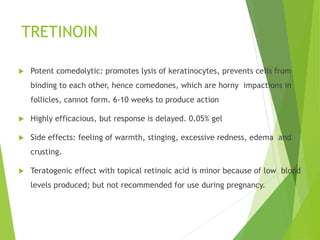
TRETINOIN
 Potent comedolytic: promotes lysis of keratinocytes, prevents cells from
binding to each other, hence comedones, which are horny impactions in
follicles, cannot form. 6-10 weeks to produce action
 Highly efficacious, but response is delayed. 0.05% gel
 Side effects: feeling of warmth, stinging, excessive redness, edema and
crusting.
 Teratogenic effect with topical retinoic acid is minor because of low blood
levels produced; but not recommended for use during pregnancy.
ADAPALENE
 Newer synthetic tretinoin like drug which binds directly to the
nuclear retinoic acid receptor and modulates keratinization and
differentiation of follicular epithelial cells.
 Also exerts anti-inflammatory action, comedone formation is
suppressed. 0. 1% gel
 In acne vulgaris, as effective but less irritating than tretinoin.
TAZAROTENE
 Topical synthetic retinoid used for psoriasis (0.05%-1 %)
gel
 Prodrug is hydrolysed in the skin to tezarotenic acid
that exerts antiproliferative and anti inflammatory
action by binding to retinoic acid receptor: modification
of gene function.
ADVERSE EFFECTS
 The main adverse effect - primary irritant dermatitis, which can
present as erythema, scaling, burning sensation and can vary
depending on skin type, sensitivity, and formulations.
 Lessened by concomitant use of emollients.
 Photosensitivity reactions.
ORAL ISOTRETINOIN
 Indication - moderate-to-severe acne or lesser degree of acne producing
physical or psychological scarring, unresponsive to conventional therapy.
 The approved dose - 0.5–1 mg/kg/day, usually given for 20 weeks.
Alternatively, lower dose can be used for longer period, with a total
cumulative dose of 120 mg/kg.
 Reduces production of sebum, corrects abnormal keratinization of follicles
and causes dramatic improvement.
 Systemic retinoids approved for the treatment of acne, psoriasis, and
Cutaneous T cell Lymphoma.
ACITRETIN
 Synthetic retinoid for oral use
 Recalcitrant, pustular and severe forms of psoriasis
 A/E: Dryness of skin and eyes, arthralgis, myalgia, liver damage,
lipid abnormalities
BEXAROTENE
 CTCL
ADVERSE EFFECTS
 Retinoid dermatitis: characterized by erythema, pruritus, and
scaling.
 Very rarely, patients may develop pseudotumor cerebri, especially
when combined with tetracyclines.
 chronic administration at higher doses can cause diffuse idiopathic
skeletal hyperostosis (DISH) syndrome, premature epiphyseal
closure, and other skeletal abnormalities
 Teratogenic (accutane embryopathy) craniofacial, heart, CNS
abnormalities.
VITAMIN ANALOGUES
Calcipotriene:
 Topical vitamin D analogue used in the treatment of plaque psoriasis.
 Mild to moderate psoriasis.
 Adverse effects: Skin irritation, scaling,hypercalcemia and
hypercalciuria
 Used off label for multiple conditions, including morphea, vitiligo, and
congenital ichthyoses.
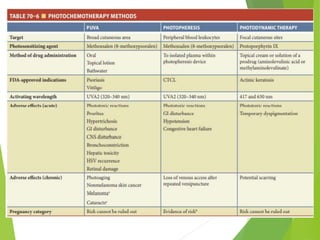
PHOTOCHEMOTHERAPY
 UV or visible radiation is used to induce a therapeutic
response either alone (phototherapy) or in the presence of
an exogenous photosensitizing drug (photochemotherapy).
 PUVA- Photoreactions interfere with pyrimidine bases and
inhibit DNA synthesis and epithelial cell turnover.
 Photopheresis: Peripheral blood mononuclear cells are
treated with psoralens
 Photodynamic therapy: Photodynamic drugs and visible light
SUNSCREEN
 Sunscreen is a lotion, spray, gel or other topical product that
absorbs or reflects the sun's ultraviolet (UV) radiation and
provide temporary photoprotection to the skin.
 Regular use is efficacious in reducing photocarcinogenesis and
photoaging.
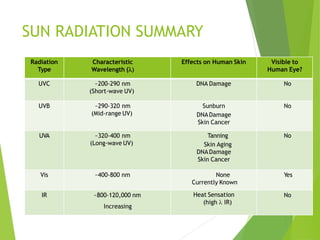
SUN RADIATION SUMMARY
Radiation
Type
Characteristic
Wavelength (
Effects on Human Skin Visible to
Human Eye?
UVC ~200-290 nm
(Short-wave UV)
DNA Damage No
UVB ~290-320 nm
(Mid-range UV)
Sunburn
DNADamage
Skin Cancer
No
UVA ~320-400 nm
(Long-wave UV)
Tanning
Skin Aging
DNADamage
Skin Cancer
No
Vis ~400-800 nm None
Currently Known
Yes
IR ~800-120,000 nm
Increasing
Heat Sensation
(high  IR)
No
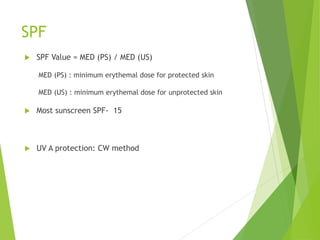
SPF
 SPF Value = MED (PS) / MED (US)
MED (PS) : minimum erythemal dose for protected skin
MED (US) : minimum erythemal dose for unprotected skin
 Most sunscreen SPF- 15
 UV A protection: CW method
SOME ACTIVE SUNSCREEN INGREDIENTS
 Inorganic Agents: zinc oxide and titanium dioxide. They provide UVA
and UVB protection.
 Organic UVA Filters: Include benzophenones (oxybenzone,
dioxybenzone, sulisobenzone); dibenzoylmethanes (avobenzone);
anthralates (meradimate); and camphors (ecamsule).
 Organic UVB Filters: There are numerous UVB filters, including
aminobenzoates (PABA and padimate O); cinnamates (cinoxate,
octinoxate); salicylates (trolamine salicylate, homosalate, octisalate);
octocrylene; and ensulizole.
ANTIHISTAMINES
 Oral antihistamines, particularly H1 receptor antagonists,
hydroxyzine, diphenhydramine, promethazine, cetirizine,
levocetirizine etc. are useful for the control of pruritus.
ANTIBIOTICS
 Agents such as tetracyclines, macrolides, and dapsone, also have
anti-inflammatory properties, which make them useful for non-
infectious conditions, such as acne vulgaris, rosacea, granulomatous
diseases, neutrophilic dermatoses, and autoimmune bullous diseases.
 Topical agents are very effective for the treatment of superficial
bacterial infections and acne vulgaris.
 Systemic antibiotics also are prescribed commonly for acne,
cutaneous Bacterial Infections and deeper bacterial infections.
ACNE
 A multifactorial chronic inflammatory disease of pilosebaceous units.
 Pathogenesis—
• Increased sebum productions
• Follicular hyperkeratinization
• Propionibacterium acne (P. acne) colonization and
• Inflammation
 Lesions may present as non inflammatory comedones or inflammatory
papules.
 Inflammatory cysts may leave behind hyper-pigmentation and
sometimes scarring.
CLINICAL FEATURES - SEVERITY
 MILD: Mainly comedones with few papules/pustules.
 MODERATE: Moderate papules and pustules (10-40) and comedones (10-
40).
 MODERATELY SEVERE: Numerous papules and pustules (40-100) and many
comedones (40-100). May have nodular inflamed lesions (upto 5). Wide
spread involvement of face, chest and back.
 SEVERE: Nodulocystic acne and acne conglobata with many nodular or
pustular lesions.
TOPICAL ANTIMICROBIALS
 Commonly used in acne include benzoyl peroxide, clindamycin,
erythromycin, and antibiotic–benzoyl peroxide combinations.
 Topical monotherapy with clindamycin or erythromycin is not
recommended.
 Other topical antimicrobials used in treating acne include azelaic acid,
dapsone, metronidazole, sulfacetamide, and sulfacetamide/sulfur
combinations.
SYSTEMIC THERAPY
 For patients with acne vulgaris that is more extensive or resistant to
topical therapy.
 Commonly used: tetracyclines (doxycycline, minocycline,) macrolides
(azithromycin, erythromycin); and trimethoprim-sulfamethoxazole.
 6–8 weeks is required for visible clinical results
ANTIFUNGAL THERAPY
 COMMON SUPERFICIAL CUTANEOUS MYCOSES: The dermatophyte
infections (tinea corporis, crurus, and pedis)- Azoles, griseofulvin,
terbinafine, nystatins etc.
 SUPERFICIAL MUCOCUTANEOUS MYCOSES: Such Tinea, pityriasis
versicolor, seborrheic dermatitis, cutaneous candidiasis etc
respond to Nystatin, Azoles, allylamines, Ciclopirox, butenafine
etc.
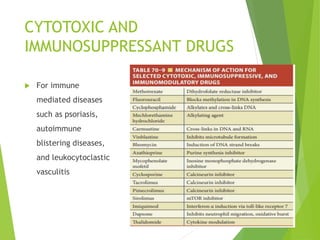
CYTOTOXIC AND
IMMUNOSUPPRESSANT DRUGS
 For immune
mediated diseases
such as psoriasis,
autoimmune
blistering diseases,
and leukocytoclastic
vasculitis
BIOLOGICAL IMMUNOMODULATORS
AND OTHER AGENTS
 A number of biologic medications have been introduced to treat
psoriasis and other autoimmune diseases as Atopic Dermatitis by
binding to TNF alpha and preventing it from communicating with
cells.
 Adalimumab, Etanercept, Infliximab, Secukinumab and
Ustekinumab which are mainly monoclonal antibodies directed
against TNF- alpha.
 Intravenous Immunoglobulin
 Targeted Antineoplastic Agents: Vismodegib and sonidegib (basal
cell carcinoma)
TREATMENT OF
HYPERPIGMENTATION
 Sun protection or avoidance is a vital component of any treatment regimen.
 Hydroquinone- decreases melanocyte pigment production by inhibiting
tyrosinase. In addition, it causes degradation of melanosomes and
destruction of melanocytes
 Azelaic acid, inhibits tyrosinase activity but is less effective than
hydroquinone. Has mild comedolytic, antimicrobial, and anti-inflammatory
properties, so often used in acne.
 Mequinol a competitive inhibitor of tyrosinase- permanent depigmentation.
 Glycolic acid is an α-hydroxy acid used in chemical peels.
THANK YOU

Dermatological pharmacology

  • 1.
    Dermatological pharmacology Dr. Ankita Bist AssistantProfessor Department of Pharmacology
  • 2.
  • 3.
    GLUCOCORTICOIDS  Immunosuppressive andanti-inflammatory properties  Administration: locally and systemically.  Systemic therapy restricted to severe dermatological illnesses.  Side effects: Skin atrophy, striae, telangiectasias, purpura, and acneiform eruptions.  Topical glucocorticoids have been grouped into seven classes in order of decreasing potency.
  • 5.
    TOPICAL VEHICLES Creams:  Lessgreasy and most acceptable  Applies more easily  Can be drying  Easy to wash off Lotions:  More water content and less viscous than creams Gels:  Water-soluble emulsion with gelling agent  Can be drying  Concentrates drug at surface after evaporation Ointments:  Alleviates dryness by prevention of evaporation  Enables medication to penetrates skin well  Water repellant  Remains on the skin  Occlusive and protective  Soothing and lubricating
  • 6.
    TOPICAL RETINOIDS  Cornerstoneof acne therapy.  ACTION: Targets the abnormal follicular epithelial hyper proliferation → reduces follicular plugging → reduces microcomedones and both non inflammatory and inflammatory acne lesions.  Biological effects mediated through: nuclear hormone receptors (retinoic acid receptor RAR and retinoids X receptor RXR) and cytosolic binding proteins.  CURRENTLY AVAILABLE: Tretinoin, adapalene, tazarotene, isotretinoin, and β-retinoyl glucuronide.
  • 7.
    TRETINOIN  Potent comedolytic:promotes lysis of keratinocytes, prevents cells from binding to each other, hence comedones, which are horny impactions in follicles, cannot form. 6-10 weeks to produce action  Highly efficacious, but response is delayed. 0.05% gel  Side effects: feeling of warmth, stinging, excessive redness, edema and crusting.  Teratogenic effect with topical retinoic acid is minor because of low blood levels produced; but not recommended for use during pregnancy.
  • 8.
    ADAPALENE  Newer synthetictretinoin like drug which binds directly to the nuclear retinoic acid receptor and modulates keratinization and differentiation of follicular epithelial cells.  Also exerts anti-inflammatory action, comedone formation is suppressed. 0. 1% gel  In acne vulgaris, as effective but less irritating than tretinoin.
  • 9.
    TAZAROTENE  Topical syntheticretinoid used for psoriasis (0.05%-1 %) gel  Prodrug is hydrolysed in the skin to tezarotenic acid that exerts antiproliferative and anti inflammatory action by binding to retinoic acid receptor: modification of gene function.
  • 10.
    ADVERSE EFFECTS  Themain adverse effect - primary irritant dermatitis, which can present as erythema, scaling, burning sensation and can vary depending on skin type, sensitivity, and formulations.  Lessened by concomitant use of emollients.  Photosensitivity reactions.
  • 11.
    ORAL ISOTRETINOIN  Indication- moderate-to-severe acne or lesser degree of acne producing physical or psychological scarring, unresponsive to conventional therapy.  The approved dose - 0.5–1 mg/kg/day, usually given for 20 weeks. Alternatively, lower dose can be used for longer period, with a total cumulative dose of 120 mg/kg.  Reduces production of sebum, corrects abnormal keratinization of follicles and causes dramatic improvement.  Systemic retinoids approved for the treatment of acne, psoriasis, and Cutaneous T cell Lymphoma.
  • 12.
    ACITRETIN  Synthetic retinoidfor oral use  Recalcitrant, pustular and severe forms of psoriasis  A/E: Dryness of skin and eyes, arthralgis, myalgia, liver damage, lipid abnormalities BEXAROTENE  CTCL
  • 13.
    ADVERSE EFFECTS  Retinoiddermatitis: characterized by erythema, pruritus, and scaling.  Very rarely, patients may develop pseudotumor cerebri, especially when combined with tetracyclines.  chronic administration at higher doses can cause diffuse idiopathic skeletal hyperostosis (DISH) syndrome, premature epiphyseal closure, and other skeletal abnormalities  Teratogenic (accutane embryopathy) craniofacial, heart, CNS abnormalities.
  • 14.
    VITAMIN ANALOGUES Calcipotriene:  Topicalvitamin D analogue used in the treatment of plaque psoriasis.  Mild to moderate psoriasis.  Adverse effects: Skin irritation, scaling,hypercalcemia and hypercalciuria  Used off label for multiple conditions, including morphea, vitiligo, and congenital ichthyoses.
  • 15.
    PHOTOCHEMOTHERAPY  UV orvisible radiation is used to induce a therapeutic response either alone (phototherapy) or in the presence of an exogenous photosensitizing drug (photochemotherapy).  PUVA- Photoreactions interfere with pyrimidine bases and inhibit DNA synthesis and epithelial cell turnover.  Photopheresis: Peripheral blood mononuclear cells are treated with psoralens  Photodynamic therapy: Photodynamic drugs and visible light
  • 17.
    SUNSCREEN  Sunscreen isa lotion, spray, gel or other topical product that absorbs or reflects the sun's ultraviolet (UV) radiation and provide temporary photoprotection to the skin.  Regular use is efficacious in reducing photocarcinogenesis and photoaging.
  • 18.
    SUN RADIATION SUMMARY Radiation Type Characteristic Wavelength( Effects on Human Skin Visible to Human Eye? UVC ~200-290 nm (Short-wave UV) DNA Damage No UVB ~290-320 nm (Mid-range UV) Sunburn DNADamage Skin Cancer No UVA ~320-400 nm (Long-wave UV) Tanning Skin Aging DNADamage Skin Cancer No Vis ~400-800 nm None Currently Known Yes IR ~800-120,000 nm Increasing Heat Sensation (high  IR) No
  • 19.
    SPF  SPF Value= MED (PS) / MED (US) MED (PS) : minimum erythemal dose for protected skin MED (US) : minimum erythemal dose for unprotected skin  Most sunscreen SPF- 15  UV A protection: CW method
  • 20.
    SOME ACTIVE SUNSCREENINGREDIENTS  Inorganic Agents: zinc oxide and titanium dioxide. They provide UVA and UVB protection.  Organic UVA Filters: Include benzophenones (oxybenzone, dioxybenzone, sulisobenzone); dibenzoylmethanes (avobenzone); anthralates (meradimate); and camphors (ecamsule).  Organic UVB Filters: There are numerous UVB filters, including aminobenzoates (PABA and padimate O); cinnamates (cinoxate, octinoxate); salicylates (trolamine salicylate, homosalate, octisalate); octocrylene; and ensulizole.
  • 21.
    ANTIHISTAMINES  Oral antihistamines,particularly H1 receptor antagonists, hydroxyzine, diphenhydramine, promethazine, cetirizine, levocetirizine etc. are useful for the control of pruritus.
  • 22.
    ANTIBIOTICS  Agents suchas tetracyclines, macrolides, and dapsone, also have anti-inflammatory properties, which make them useful for non- infectious conditions, such as acne vulgaris, rosacea, granulomatous diseases, neutrophilic dermatoses, and autoimmune bullous diseases.  Topical agents are very effective for the treatment of superficial bacterial infections and acne vulgaris.  Systemic antibiotics also are prescribed commonly for acne, cutaneous Bacterial Infections and deeper bacterial infections.
  • 23.
    ACNE  A multifactorialchronic inflammatory disease of pilosebaceous units.  Pathogenesis— • Increased sebum productions • Follicular hyperkeratinization • Propionibacterium acne (P. acne) colonization and • Inflammation  Lesions may present as non inflammatory comedones or inflammatory papules.  Inflammatory cysts may leave behind hyper-pigmentation and sometimes scarring.
  • 24.
    CLINICAL FEATURES -SEVERITY  MILD: Mainly comedones with few papules/pustules.  MODERATE: Moderate papules and pustules (10-40) and comedones (10- 40).  MODERATELY SEVERE: Numerous papules and pustules (40-100) and many comedones (40-100). May have nodular inflamed lesions (upto 5). Wide spread involvement of face, chest and back.  SEVERE: Nodulocystic acne and acne conglobata with many nodular or pustular lesions.
  • 25.
    TOPICAL ANTIMICROBIALS  Commonlyused in acne include benzoyl peroxide, clindamycin, erythromycin, and antibiotic–benzoyl peroxide combinations.  Topical monotherapy with clindamycin or erythromycin is not recommended.  Other topical antimicrobials used in treating acne include azelaic acid, dapsone, metronidazole, sulfacetamide, and sulfacetamide/sulfur combinations.
  • 26.
    SYSTEMIC THERAPY  Forpatients with acne vulgaris that is more extensive or resistant to topical therapy.  Commonly used: tetracyclines (doxycycline, minocycline,) macrolides (azithromycin, erythromycin); and trimethoprim-sulfamethoxazole.  6–8 weeks is required for visible clinical results
  • 27.
    ANTIFUNGAL THERAPY  COMMONSUPERFICIAL CUTANEOUS MYCOSES: The dermatophyte infections (tinea corporis, crurus, and pedis)- Azoles, griseofulvin, terbinafine, nystatins etc.  SUPERFICIAL MUCOCUTANEOUS MYCOSES: Such Tinea, pityriasis versicolor, seborrheic dermatitis, cutaneous candidiasis etc respond to Nystatin, Azoles, allylamines, Ciclopirox, butenafine etc.
  • 28.
    CYTOTOXIC AND IMMUNOSUPPRESSANT DRUGS For immune mediated diseases such as psoriasis, autoimmune blistering diseases, and leukocytoclastic vasculitis
  • 29.
    BIOLOGICAL IMMUNOMODULATORS AND OTHERAGENTS  A number of biologic medications have been introduced to treat psoriasis and other autoimmune diseases as Atopic Dermatitis by binding to TNF alpha and preventing it from communicating with cells.  Adalimumab, Etanercept, Infliximab, Secukinumab and Ustekinumab which are mainly monoclonal antibodies directed against TNF- alpha.  Intravenous Immunoglobulin  Targeted Antineoplastic Agents: Vismodegib and sonidegib (basal cell carcinoma)
  • 30.
    TREATMENT OF HYPERPIGMENTATION  Sunprotection or avoidance is a vital component of any treatment regimen.  Hydroquinone- decreases melanocyte pigment production by inhibiting tyrosinase. In addition, it causes degradation of melanosomes and destruction of melanocytes  Azelaic acid, inhibits tyrosinase activity but is less effective than hydroquinone. Has mild comedolytic, antimicrobial, and anti-inflammatory properties, so often used in acne.  Mequinol a competitive inhibitor of tyrosinase- permanent depigmentation.  Glycolic acid is an α-hydroxy acid used in chemical peels.
  • 31.