Alkyl Halides
Prepared by:
Hina Sharif
Lecturer (Pharmaceutical Chemistry)
The University of Faisalabad
Introduction
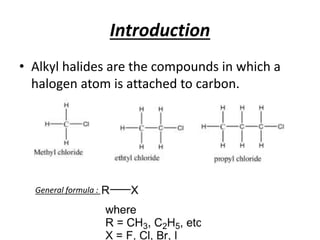
• Alkyl halides are the compounds in which a
halogen atom is attached to carbon.
General formula :
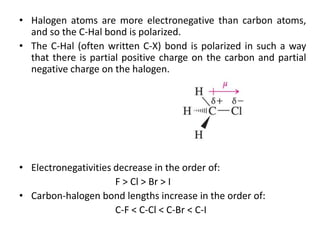
• Halogen atoms are more electronegative than carbon atoms,
and so the C-Hal bond is polarized.
• The C-Hal (often written C-X) bond is polarized in such a way
that there is partial positive charge on the carbon and partial
negative charge on the halogen.
• Electronegativities decrease in the order of:
F > Cl > Br > I
• Carbon-halogen bond lengths increase in the order of:
C-F < C-Cl < C-Br < C-I
Types of Alkyl Halides
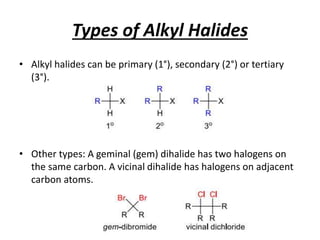
• Alkyl halides can be primary (1°), secondary (2°) or tertiary
(3°).
• Other types: A geminal (gem) dihalide has two halogens on
the same carbon. A vicinal dihalide has halogens on adjacent
carbon atoms.
Nomenclature
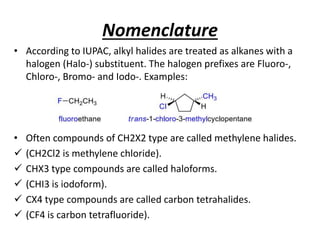
• According to IUPAC, alkyl halides are treated as alkanes with a
halogen (Halo-) substituent. The halogen prefixes are Fluoro-,
Chloro-, Bromo- and Iodo-. Examples:
• Often compounds of CH2X2 type are called methylene halides.
 (CH2Cl2 is methylene chloride).
 CHX3 type compounds are called haloforms.
 (CHI3 is iodoform).
 CX4 type compounds are called carbon tetrahalides.
 (CF4 is carbon tetrafluoride).
Structure
Physical Properties
 Lower alkyl halides are gases at room temperature. Other
alkyl halides upto C18 are colorless liquids. Those beyond C18
are colorless solids.
 they are insoluble in water but soluble in organic solvents.
 Alkyl bromides and iodides are denser than water while alkyl
chlorides and flourides are lighter than water.
 They have high boiling points than alkanes of corresponding
molecular weights.
Methods of preparation
1. Direct halogenation of alkanes
2. Addition of hydrogen halides to alkenes and
alkynes
3. Action of hydrogen halides on alcohols
4. Action of phosphorous halides on alcohol
5. Action of thionyl chloride on alcohols
6. Halogen exchange
7. Hunsdieker reaction
1) Halogenation of alkanes
• Alkanes react with Cl2 or Br2 in the presence of UV light or at
high temperature. This method is not used in laboratory
because of difficulty of separating the products.
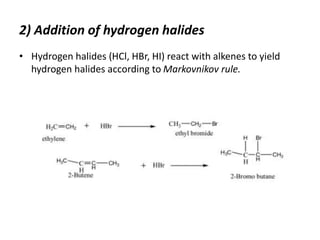
2) Addition of hydrogen halides
• Hydrogen halides (HCl, HBr, HI) react with alkenes to yield
hydrogen halides according to Markovnikov rule.
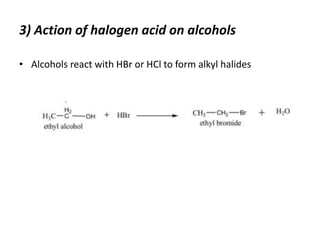
3) Action of halogen acid on alcohols
• Alcohols react with HBr or HCl to form alkyl halides
4) Action of phophorous halides on alcohols
• Alcohols react with phosphorous halides (PX5 or PX3) to form
alkyl halides.
5) Action of thionyl chloride on alcohols
• Alcohols react with thionyl chloride in the presence of
pyridine to produce alkyl chlorides
6) Halogen exchange reaction
Chemical properties
 The alkyl halides are chemically versatile.
 The halogen atom may leave with its bonding pair of electrons to
give a halide ion which is stable – a halide is called a good leaving
group.
 If an atom replaces the halide the overall reaction is a substitution.
 If the halide loss is accompanied by the loss of another atom, the
overall reaction is called an elimination. Very often the other atom
lost is a hydrogen (as H+ ).
 The elimination of H-X is common, and is called a
dehydrohalogenation. Often substitution and elimination
reactions will occur in competition with each other.
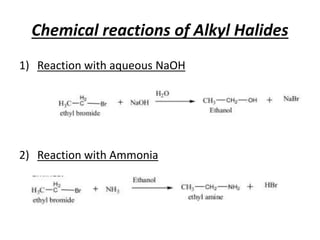
Chemical reactions of Alkyl Halides
1) Reaction with aqueous NaOH
2) Reaction with Ammonia
3) Reaction with Sodium alkoxides
4) Reaction with acetylides
5) Reduction
6) Wurtz reaction
Pharmaceutical Applications of alkyl
halides
• Chloroform is used as general anesthetic but it is
toxic and carcinogen.
• Halothane is also used as a anesthetic.
• Freons is used as refrigerants and foaming
agents. But freons can react with ozone layer.
• Some pesticides also are alkyl halides chemically.
• Chloroethane is also used as thickening agent and
binder in paints, cosmetics and similar products.
• Iodoform is used as disinfectant and antiseptic.

Alkyl Halides.pptx

  • 1.
    Alkyl Halides Prepared by: HinaSharif Lecturer (Pharmaceutical Chemistry) The University of Faisalabad
  • 2.
    Introduction • Alkyl halidesare the compounds in which a halogen atom is attached to carbon. General formula :
  • 3.
    • Halogen atomsare more electronegative than carbon atoms, and so the C-Hal bond is polarized. • The C-Hal (often written C-X) bond is polarized in such a way that there is partial positive charge on the carbon and partial negative charge on the halogen. • Electronegativities decrease in the order of: F > Cl > Br > I • Carbon-halogen bond lengths increase in the order of: C-F < C-Cl < C-Br < C-I
  • 4.
    Types of AlkylHalides • Alkyl halides can be primary (1°), secondary (2°) or tertiary (3°). • Other types: A geminal (gem) dihalide has two halogens on the same carbon. A vicinal dihalide has halogens on adjacent carbon atoms.
  • 5.
    Nomenclature • According toIUPAC, alkyl halides are treated as alkanes with a halogen (Halo-) substituent. The halogen prefixes are Fluoro-, Chloro-, Bromo- and Iodo-. Examples: • Often compounds of CH2X2 type are called methylene halides.  (CH2Cl2 is methylene chloride).  CHX3 type compounds are called haloforms.  (CHI3 is iodoform).  CX4 type compounds are called carbon tetrahalides.  (CF4 is carbon tetrafluoride).
  • 6.
  • 7.
    Physical Properties  Loweralkyl halides are gases at room temperature. Other alkyl halides upto C18 are colorless liquids. Those beyond C18 are colorless solids.  they are insoluble in water but soluble in organic solvents.  Alkyl bromides and iodides are denser than water while alkyl chlorides and flourides are lighter than water.  They have high boiling points than alkanes of corresponding molecular weights.
  • 8.
    Methods of preparation 1.Direct halogenation of alkanes 2. Addition of hydrogen halides to alkenes and alkynes 3. Action of hydrogen halides on alcohols 4. Action of phosphorous halides on alcohol 5. Action of thionyl chloride on alcohols 6. Halogen exchange 7. Hunsdieker reaction
  • 9.
    1) Halogenation ofalkanes • Alkanes react with Cl2 or Br2 in the presence of UV light or at high temperature. This method is not used in laboratory because of difficulty of separating the products.
  • 10.
    2) Addition ofhydrogen halides • Hydrogen halides (HCl, HBr, HI) react with alkenes to yield hydrogen halides according to Markovnikov rule.
  • 11.
    3) Action ofhalogen acid on alcohols • Alcohols react with HBr or HCl to form alkyl halides
  • 12.
    4) Action ofphophorous halides on alcohols • Alcohols react with phosphorous halides (PX5 or PX3) to form alkyl halides.
  • 13.
    5) Action ofthionyl chloride on alcohols • Alcohols react with thionyl chloride in the presence of pyridine to produce alkyl chlorides 6) Halogen exchange reaction
  • 14.
    Chemical properties  Thealkyl halides are chemically versatile.  The halogen atom may leave with its bonding pair of electrons to give a halide ion which is stable – a halide is called a good leaving group.  If an atom replaces the halide the overall reaction is a substitution.  If the halide loss is accompanied by the loss of another atom, the overall reaction is called an elimination. Very often the other atom lost is a hydrogen (as H+ ).  The elimination of H-X is common, and is called a dehydrohalogenation. Often substitution and elimination reactions will occur in competition with each other.
  • 15.
    Chemical reactions ofAlkyl Halides 1) Reaction with aqueous NaOH 2) Reaction with Ammonia
  • 16.
    3) Reaction withSodium alkoxides 4) Reaction with acetylides
  • 17.
  • 18.
    Pharmaceutical Applications ofalkyl halides • Chloroform is used as general anesthetic but it is toxic and carcinogen. • Halothane is also used as a anesthetic. • Freons is used as refrigerants and foaming agents. But freons can react with ozone layer. • Some pesticides also are alkyl halides chemically. • Chloroethane is also used as thickening agent and binder in paints, cosmetics and similar products. • Iodoform is used as disinfectant and antiseptic.