ALGORITHMS II LAB
PRESENTATION
Presented By:-
Rishabh Kumar Sharma, Gx-05
Aman Prasad, Gx-07
Abhishek Chandra, Gx-25
Debtanu Pal, Gx-24
IIEST SHIBPUR
CONTENTS
• Assignment on Dynamic Programming
– Matrix Chain Multiplication
• Naive Recursive Approach
• Dynamic Programming Approach
• Memoized Matrix Chain
• Comparison between the 2 approaches
• Extension of the Dynamic Programming Approach for
Matrix Multiplication to Polygon Triangulation
CONTENTS
• Assignment on Greedy Algorithms
– Huffman Compression Algorithm
● Study variation of average codeword length with change
in the probability of occurrence of a symbol
DYNAMIC PROGRAMMING
• A Dynamic Programming Approach to a problem is taken
when a problem has the following 2 properties:-
– Optimal Substructure :- Optimal Solution to a problem
includes within it the optimal solution to a subproblem.
– Overlapping Subproblems
RECURSIVE MATRIX CHAIN
RMC(p,i,j)
if i==j then return zero
m[i,j]=INF
for k=i to j-1
q=RMC(p,i,k)+RMC(p,k+1,j)+p(i-1)*p(k)*p(j)
if q<m[i,j]
m[i,j]=q
Return m[i,j]
Time Complexity of running this one:
T(n) ≥ 1+∑(T(k)+T(n-k)+1) ≥ 2 ∑ T(i) +n ≥ 2^n - 1
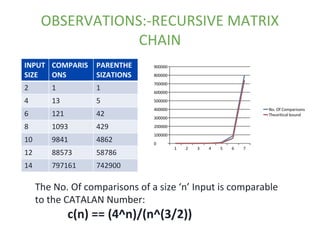
OBSERVATIONS:-RECURSIVE MATRIX
CHAIN
INPUT
SIZE
COMPARIS
ONS
PARENTHE
SIZATIONS
2 1 1
4 13 5
6 121 42
8 1093 429
10 9841 4862
12 88573 58786
14 797161 742900
The No. Of comparisons of a size ‘n’ Input is comparable
to the CATALAN Number:
c(n) == (4^n)/(n^(3/2))
REASON
We have to check each and every possible parenthesization
and hence solve a large no. Of problems repeatedly.
MATRIX CHAIN MUL. USING DP
MATRIX-CHAIN-ORDER (p)
n=length[p]-1
for i=1 to n
m[i,i]=0
for l=2 to n
for i=1 to n-l+1
j=i+l-1
m[i,j]=INF
for k=i to j-1
q=m[i,k]+m[k+1,j]+pi-1pkpj
if q< m[i,j]
m[i,j]=q ; s[i,j]=k
Return m and s
HISTOGRAM COMPARISON
MATRIX CHAIN MULTIPLICATION
USING BRUTE FORCE APPROACH
MATRIX CHAIN MULTIPLICATION
USING DP
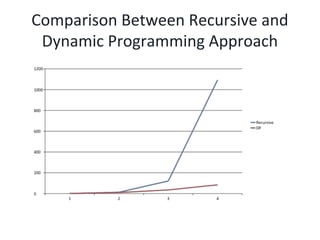
Comparison Between Recursive and
Dynamic Programming Approach
MATRIX CHAIN MULTIPLICATION USING
MEMOIZATION
Mem-Matrix-Chain(array p, int i, int j) {
if (m[i, j] != UNDEFINED) then 
     return m[i, j];     // already defined
    else if ( i = = j) then 
        m[i, i] = 0;     // basic case
    else {
       m[i, j] = infinity;    // initialize
       for k = i to j − 1 do {// try all splits
          cost = Mem-Matrix-Chain(p,i,k) +
Mem-Matrix-Chain(p,k+1,j)+ p[i−1]p[k]p[j];
    if (cost < m[i, j]) then   // update if better
              m[i, j] = cost; 
       } 
      } 
      return m[i, j];           // return final cost
}
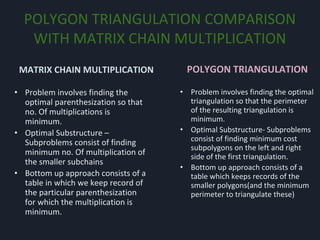
POLYGON TRIANGULATION COMPARISON
WITH MATRIX CHAIN MULTIPLICATION
MATRIX CHAIN MULTIPLICATION
• Problem involves finding the
optimal parenthesization so that
no. Of multiplications is
minimum.
• Optimal Substructure –
Subproblems consist of finding
minimum no. Of multiplication of
the smaller subchains
• Bottom up approach consists of a
table in which we keep record of
the particular parenthesization
for which the multiplication is
minimum.
POLYGON TRIANGULATION
• Problem involves finding the optimal
triangulation so that the perimeter
of the resulting triangulation is
minimum.
• Optimal Substructure- Subproblems
consist of finding minimum cost
subpolygons on the left and right
side of the first triangulation.
• Bottom up approach consists of a
table which keeps records of the
smaller polygons(and the minimum
perimeter to triangulate these)
ALGORITHM
for (int gap = 0; gap < n; gap++)
for (int i = 0, j = gap; j < n; i++, j++)
if (j < i+2){
table[i][j] = 0 ;
//INITIALIZATION OF THE TABLE TO STORE MINIMAL TRIANGULATION COST
tri[i][j]=0;
}
else{
table[i][j] = MAX;
for (int k = i+1; k < j; k++){
double val = table[i][k] + table[k][j] + cost(points,i,j,k);
//CALCULATING THE COST OF THE GIVEN TRIANGULATION
if (table[i][j] > val) {
// COMPARING WITH THE VALUES IN TABLE TO FIND MINIMAL TRIANGULATION
table[i][j] = val;
tri[i][j]=k;
} c++;
}
return table[0][n-1];
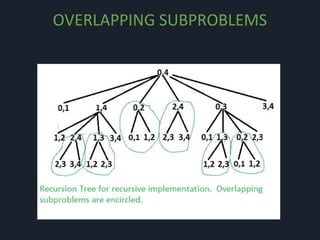
OVERLAPPING SUBPROBLEMS
A SMALL EXAMPLE
OPTIMAL
TRIANGULATION:
COST – 15.30
ANOTHER
TRIANGULATION:
COST – 15.77
KRUSKAL'S ALGORITHM
• 1. Sort all the edges in non-decreasing order of their weight.
• 2. Pick the smallest edge. Check if it forms a cycle with the spanning tree
formed so far. If cycle is not formed, include this edge. Else, discard it. //
GREEDY ELEMENT
• 3. To check the existence of cycle, check whether for two vertices x and
y. Find_set(x)==Find_set(y), or not. If equal they already belong to the
same disjoint set(tree), hence will form a cycle if they are joined. So
edge(x,y) will not belong to the MST. // DISJOINT SETS
• 4. Repeat step 2 until there are (V-1) edges in the spanning tree.
TIME COMPLEXITY
• Time Complexity: O(ElogE) or O(ElogV).
• Sorting of edges takes O(ELogE) time.
• After sorting, we iterate through all edges and apply
find-union algorithm.
• The find and union operations can take atmost O(LogV) time.
• So overall complexity is O(ELogE + ELogV) time.
• The value of E can be atmost O(V2
), so O(LogV) are O(LogE)
same.
• Therefore, overall time complexity is O(ElogE) or O(ElogV)
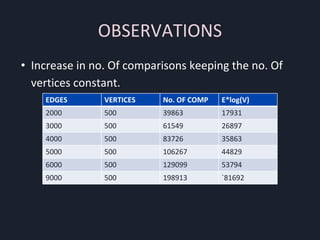
OBSERVATIONS
• Increase in no. Of comparisons keeping the no. Of
vertices constant.
EDGES VERTICES No. OF COMP E*log(V)
2000 500 39863 17931
3000 500 61549 26897
4000 500 83726 35863
5000 500 106267 44829
6000 500 129099 53794
9000 500 198913 `81692
Graphical Representation
X-axis: Input number Y-axis: No. Of Comparisons
OBSERVATIONS
• Increase in no. Of comparisons keeping the
no. Of vertices constant.
EDGES VERTICES COMP
5000 500 106267
5000 600 107582
5000 700 108694
5000 800 109657
5000 900 111267
Graphical Representation
COMPARISON
EDGES INC. VERTICES CONST. VERTICES INC. EDGES CONST.
COMPARISON
EDGES INC. VERTICES CONST.
EDGES VERTICES COMP.
5000 500 106267
5100 500 108539
5200 500 110812
5300 500 114089
VERTICES CONST. EDGES INC.
EDGES VERTICES COMP.
5000 500 106267
5000 600 107583
5000 700 108695
5000 800 109658
VALUE OF c and n0.... QUICKSORT
ASSIGNMENT
• We have the no. Of comparisons(yi) and the corresponding
input size(xi).
• Fit these points to the curve f(x)=axlogx +bx +c.
• Use the method of least squares.
• R^2 = (yi-f(xi))^2.
• Take Partial derivative of R^2 w.r.t a,b and c... And equate to
0.
• We get 3 variables and 3 equations.
• Finally, a=1.792, b= -7.48, c=79.8962.

Algorithms Lab PPT

  • 1.
    ALGORITHMS II LAB PRESENTATION PresentedBy:- Rishabh Kumar Sharma, Gx-05 Aman Prasad, Gx-07 Abhishek Chandra, Gx-25 Debtanu Pal, Gx-24 IIEST SHIBPUR
  • 2.
    CONTENTS • Assignment onDynamic Programming – Matrix Chain Multiplication • Naive Recursive Approach • Dynamic Programming Approach • Memoized Matrix Chain • Comparison between the 2 approaches • Extension of the Dynamic Programming Approach for Matrix Multiplication to Polygon Triangulation
  • 3.
    CONTENTS • Assignment onGreedy Algorithms – Huffman Compression Algorithm ● Study variation of average codeword length with change in the probability of occurrence of a symbol
  • 4.
    DYNAMIC PROGRAMMING • ADynamic Programming Approach to a problem is taken when a problem has the following 2 properties:- – Optimal Substructure :- Optimal Solution to a problem includes within it the optimal solution to a subproblem. – Overlapping Subproblems
  • 5.
    RECURSIVE MATRIX CHAIN RMC(p,i,j) ifi==j then return zero m[i,j]=INF for k=i to j-1 q=RMC(p,i,k)+RMC(p,k+1,j)+p(i-1)*p(k)*p(j) if q<m[i,j] m[i,j]=q Return m[i,j] Time Complexity of running this one: T(n) ≥ 1+∑(T(k)+T(n-k)+1) ≥ 2 ∑ T(i) +n ≥ 2^n - 1
  • 6.
    OBSERVATIONS:-RECURSIVE MATRIX CHAIN INPUT SIZE COMPARIS ONS PARENTHE SIZATIONS 2 11 4 13 5 6 121 42 8 1093 429 10 9841 4862 12 88573 58786 14 797161 742900 The No. Of comparisons of a size ‘n’ Input is comparable to the CATALAN Number: c(n) == (4^n)/(n^(3/2))
  • 7.
    REASON We have tocheck each and every possible parenthesization and hence solve a large no. Of problems repeatedly.
  • 8.
    MATRIX CHAIN MUL.USING DP MATRIX-CHAIN-ORDER (p) n=length[p]-1 for i=1 to n m[i,i]=0 for l=2 to n for i=1 to n-l+1 j=i+l-1 m[i,j]=INF for k=i to j-1 q=m[i,k]+m[k+1,j]+pi-1pkpj if q< m[i,j] m[i,j]=q ; s[i,j]=k Return m and s
  • 9.
    HISTOGRAM COMPARISON MATRIX CHAINMULTIPLICATION USING BRUTE FORCE APPROACH MATRIX CHAIN MULTIPLICATION USING DP
  • 10.
    Comparison Between Recursiveand Dynamic Programming Approach
  • 11.
    MATRIX CHAIN MULTIPLICATIONUSING MEMOIZATION Mem-Matrix-Chain(array p, int i, int j) { if (m[i, j] != UNDEFINED) then       return m[i, j];     // already defined     else if ( i = = j) then          m[i, i] = 0;     // basic case     else {        m[i, j] = infinity;    // initialize        for k = i to j − 1 do {// try all splits           cost = Mem-Matrix-Chain(p,i,k) + Mem-Matrix-Chain(p,k+1,j)+ p[i−1]p[k]p[j];     if (cost < m[i, j]) then   // update if better               m[i, j] = cost;         }        }        return m[i, j];           // return final cost }
  • 12.
    POLYGON TRIANGULATION COMPARISON WITHMATRIX CHAIN MULTIPLICATION MATRIX CHAIN MULTIPLICATION • Problem involves finding the optimal parenthesization so that no. Of multiplications is minimum. • Optimal Substructure – Subproblems consist of finding minimum no. Of multiplication of the smaller subchains • Bottom up approach consists of a table in which we keep record of the particular parenthesization for which the multiplication is minimum. POLYGON TRIANGULATION • Problem involves finding the optimal triangulation so that the perimeter of the resulting triangulation is minimum. • Optimal Substructure- Subproblems consist of finding minimum cost subpolygons on the left and right side of the first triangulation. • Bottom up approach consists of a table which keeps records of the smaller polygons(and the minimum perimeter to triangulate these)
  • 13.
    ALGORITHM for (int gap= 0; gap < n; gap++) for (int i = 0, j = gap; j < n; i++, j++) if (j < i+2){ table[i][j] = 0 ; //INITIALIZATION OF THE TABLE TO STORE MINIMAL TRIANGULATION COST tri[i][j]=0; } else{ table[i][j] = MAX; for (int k = i+1; k < j; k++){ double val = table[i][k] + table[k][j] + cost(points,i,j,k); //CALCULATING THE COST OF THE GIVEN TRIANGULATION if (table[i][j] > val) { // COMPARING WITH THE VALUES IN TABLE TO FIND MINIMAL TRIANGULATION table[i][j] = val; tri[i][j]=k; } c++; } return table[0][n-1];
  • 14.
  • 15.
    A SMALL EXAMPLE OPTIMAL TRIANGULATION: COST– 15.30 ANOTHER TRIANGULATION: COST – 15.77
  • 16.
    KRUSKAL'S ALGORITHM • 1.Sort all the edges in non-decreasing order of their weight. • 2. Pick the smallest edge. Check if it forms a cycle with the spanning tree formed so far. If cycle is not formed, include this edge. Else, discard it. // GREEDY ELEMENT • 3. To check the existence of cycle, check whether for two vertices x and y. Find_set(x)==Find_set(y), or not. If equal they already belong to the same disjoint set(tree), hence will form a cycle if they are joined. So edge(x,y) will not belong to the MST. // DISJOINT SETS • 4. Repeat step 2 until there are (V-1) edges in the spanning tree.
  • 17.
    TIME COMPLEXITY • TimeComplexity: O(ElogE) or O(ElogV). • Sorting of edges takes O(ELogE) time. • After sorting, we iterate through all edges and apply find-union algorithm. • The find and union operations can take atmost O(LogV) time. • So overall complexity is O(ELogE + ELogV) time. • The value of E can be atmost O(V2 ), so O(LogV) are O(LogE) same. • Therefore, overall time complexity is O(ElogE) or O(ElogV)
  • 18.
    OBSERVATIONS • Increase inno. Of comparisons keeping the no. Of vertices constant. EDGES VERTICES No. OF COMP E*log(V) 2000 500 39863 17931 3000 500 61549 26897 4000 500 83726 35863 5000 500 106267 44829 6000 500 129099 53794 9000 500 198913 `81692
  • 19.
    Graphical Representation X-axis: Inputnumber Y-axis: No. Of Comparisons
  • 20.
    OBSERVATIONS • Increase inno. Of comparisons keeping the no. Of vertices constant. EDGES VERTICES COMP 5000 500 106267 5000 600 107582 5000 700 108694 5000 800 109657 5000 900 111267
  • 21.
  • 22.
    COMPARISON EDGES INC. VERTICESCONST. VERTICES INC. EDGES CONST.
  • 23.
    COMPARISON EDGES INC. VERTICESCONST. EDGES VERTICES COMP. 5000 500 106267 5100 500 108539 5200 500 110812 5300 500 114089 VERTICES CONST. EDGES INC. EDGES VERTICES COMP. 5000 500 106267 5000 600 107583 5000 700 108695 5000 800 109658
  • 24.
    VALUE OF cand n0.... QUICKSORT ASSIGNMENT • We have the no. Of comparisons(yi) and the corresponding input size(xi). • Fit these points to the curve f(x)=axlogx +bx +c. • Use the method of least squares. • R^2 = (yi-f(xi))^2. • Take Partial derivative of R^2 w.r.t a,b and c... And equate to 0. • We get 3 variables and 3 equations. • Finally, a=1.792, b= -7.48, c=79.8962.