DISCRETEMATHEMATICS
BSc IT semester 2
Name: Muhama Mark
BT0069
Roll: 1210000081
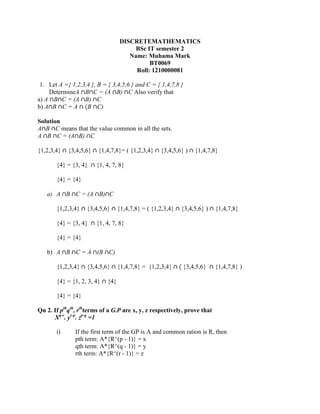
1. Let A ={ 1,2,3,4 }, B = { 3,4,5,6 } and C = { 1,4,7,8 }
DetermineA B C = (A B) C Also verify that
a) A B C = (A B) C
b) A B C = A B C)
Solution
A B C means that the value common in all the sets.
A B C = (A B) C
{1,2,3,4} {3,4,5,6} {1,4,7,8}= ( {1,2,3,4} {3,4,5,6} ) {1,4,7,8}
{4} = {3, 4} {1, 4, 7, 8}
{4} = {4}
a) A B C = (A B) C
{1,2,3,4} {3,4,5,6} {1,4,7,8} = ( {1,2,3,4} {3,4,5,6} ) {1,4,7,8}
{4} = {3, 4} {1, 4, 7, 8}
{4} = {4}
b) A B C = A (B C)
{1,2,3,4} {3,4,5,6} {1,4,7,8} = {1,2,3,4} {3,4,5,6} {1,4,7,8} )
{4} = {1, 2, 3, 4} {4}
{4} = {4}
Qn 2. If pth
qth
, rth
terms of a G.P are x, y, z respectively, prove that
Xq-r
. yr-p
. zp-q
=1
i) If the first term of the GP is A and common ration is R, then
pth term: A*{R^(p - 1)} = x
qth term: A*{R^(q - 1)} = y
rth term: A*{R^(r - 1)} = z
So, x^(q - r)*y^(r - p)*z^(p - q) =
= [A*{R^(p - 1)}}^(q - r) x [A*{R^(q - 1)}]^(r - p) x [A*{R^(r - 1)}]^(p - q)
= [A^(q - r)*A^(r - p)*A^(p - q)]*[R^{(p - 1)(q - r)]* .....
= [A^(q - r + r - p + p - q)]*[R^{(p - 1)(q - r) + (q - 1)(r - p) + (r - 1)(p - q)}]
= (A^0)*[R^(pq - q - pr + r + qr - r - pq + p + pr - p - qr + q)]
= 1*[R^0] = 1*1 = 1 [Proved]
3. How many different two digit positive integers can be formed from the digits?
0, 1, 2, 3,4, 5, 6, 7, 8, 9.
(i) When repetition is not allowed,
Solution
Let’s take the first number to be 10 and the second to be 9
Hence
1st
= 10
2nd
= 9
So the number of ways that the two digit numbers can be formed without repetition
Is
10*9 = 90 ways
(ii) When repetition is allowed.
Here it means that the number can be picked twice without restriction
Solution
Let
1st
= 10
2nd
= 10
10*10 = 100
So there are 100 ways the two digit number can be formed with repetition allowed
4. Solve the recurrence an = -3an-1 + 10an-2, n ≥2, given a0 = 1, a1 = 4.
an=-3an-1+10an-2, n 2
a0=1, a1=4
It’s a quadratic equation
Solution:
C1 = -3 and C2 = 10
r2
- C1r – C2 = 0
r2
+3r - 10 = 0
r1=2 and r2=-5
General solution
an=α1(r1)n
+ α2(r2)n
an=α1(2)n
+ α2(-5)n
when n =0
a0=α1(2)0
+ α2(-5)0
a0=α1+ α2
a0=1
1=α1+ α2----------------equation 1
when n=1
a1=α1(2)1
+ α2(-5)1
a1= 2α1- 5α2
a1=4
4= 2α1- 5α2---------------------equation 2
We generate two simultaneous equations
α1+ α2=1----------------equation 1
2α1- 5α2=4---------------------equation 2
Elimination method
2(α1 + α2=1)
1(2α1 - 5α2=4)
2α1 +2α2=2
2α1 - 5α2=4
2α1 + 2α2=2
- 2α1 - 5α2=4
7α2= -2
Divide through both sides by 7
α2 = -2/7
Substitute
α1+ α2=1----------------equation 1
α1 - 2/7=1
α1 = 1 + 2/7
α1= 9/7
Replace values
an=α1(r1)n
+ α2(r2)n
an = 9/7(2)n
– 2/7(-5)n
an = (-2/7*-5n
) + 9/7*2n
Consider the lattice A = {0, a1, a2, a3, a4, a5, 1} given below.
i) Is A is a distributive lattice
Laws of distributive are
a (a2 ˅ a3) = (a1 ˅ a2)˅(a1 ˅ a3)
a1˅a2= a1˅a1
a1 = a1
a1˅(a2 ˅a3) = (a1 ˅ a2)˅(a1 ˅ a3)
a1˅a2 = a2 ˅a3
a2 = a2
The lattice above complies with the distributive laws hence it is a distributive lattice.
ii) What are the complements of a1 and a2?
The complement of a1 is a5
The complement of a2 is a4
Qn 5.Check whether the following set of vectors is LD or LI
(i) {(1, 0, 0), (2 , 0, 0), (0, 0, 1)},
(ii) {(1, 0, 1) ,(1, 1, 0), (1, 1, -1)}
Soln
Let (1, 0, 0) be vector 3, (2, 0, 0) be vector 1, (0, 0, 1) be vector 2
(i)
1=2c1
0=0
0=c2
This shows that the set of vectors is linear dependent
Let (1, 0, 1) be vector 3, (1, 1, 0) be vector 1, (1, 1, -1) be vector 2
(ii)
1=c1+c2
0=c1+c2
1= – c2 or c2 is = -1
This shows that the above set of vectors in (ii) is LI
6. Prove the theorem:
(i)Let (L, ≤) be a lattice ordered set. Define x˄y=inf(x,y), and x˄y=sup(x,y).Then(L, ˄, ˄)
is an algebraic lattice.
Solution
Let (L, ≤)be a lattice ordered set and x,y, z L.
We apply commutative laws first
x = inf (x, y)
=inf (y,x)
=yx.
x y = sup (x,y)
=sup (y,x)
=y x
Associative laws
x˅(y˅z) =x˅inf(y, z)
=inf(x, inf(y, z))
=inf (x, y, z)
=inf (inf(x, y),z)
=inf (x, y) ˅ z
=(x ˅ y) z.
x˅ (y˅z) =(x ˅ y) ˅z
Absorption laws
x˅(x˅y) =x˅sup(x, y)
=inf (x, sup (x, y))
=x also x˅ (x˅y)
=x˅ inf (x, y)
=sup (x, inf (x, y))
=x
Let (L, ˅) be an algebraic lattice. Let x, y, z L
Proof that (L, ≤) is a partially ordered set.
Reflexive
If x ˅ x = x and x ˅ x = xand so x ≤ x
Anti-symmetric
Take x ≤ y and y ≤ x
x ˅ y =x and y ˅ x = y
x =x ˅ y = y ˅ x this is a commutative law.
=y
x = y
Transitive
Take x ≤ y and y ≤ z
x ˅ y =x and y ˅ z=y
x=x˅ y = x ˅ (y ˅ z)
=(x ˅ y)˅z associative law is employed here
=x˅z x=x˅z x ≤ z
This shows that ≤ is transitive. So we can conclude that (L,≤) is a poset.
Proof that sup (x, y) = x ˅y
X ≤y x ˅y = y x ˅y = x …. (i)
Let
x, y L.
Then x ˅(x˅y) = x x ≤x ˅y.
Similarly
y≤ x ˅y.
x˅y is an upper bound for {x, y}.
Suppose z L be an upper bound for {x, y}.
Then
x≤ z and y ≤ z.
x ˅z = z and y ˅z = z.
Now
(x˅y) ˅z = x ˅(y ˅z) associative law
= x ˅z
= z.
This implies x ˅ y ≤ z
Sup(x, y) = x ˅ y
From the above working on step 1 and 2
I conclude that (L,≤) is a lattice ordered set.
Math

Math

  • 1.
    DISCRETEMATHEMATICS BSc IT semester2 Name: Muhama Mark BT0069 Roll: 1210000081 1. Let A ={ 1,2,3,4 }, B = { 3,4,5,6 } and C = { 1,4,7,8 } DetermineA B C = (A B) C Also verify that a) A B C = (A B) C b) A B C = A B C) Solution A B C means that the value common in all the sets. A B C = (A B) C {1,2,3,4} {3,4,5,6} {1,4,7,8}= ( {1,2,3,4} {3,4,5,6} ) {1,4,7,8} {4} = {3, 4} {1, 4, 7, 8} {4} = {4} a) A B C = (A B) C {1,2,3,4} {3,4,5,6} {1,4,7,8} = ( {1,2,3,4} {3,4,5,6} ) {1,4,7,8} {4} = {3, 4} {1, 4, 7, 8} {4} = {4} b) A B C = A (B C) {1,2,3,4} {3,4,5,6} {1,4,7,8} = {1,2,3,4} {3,4,5,6} {1,4,7,8} ) {4} = {1, 2, 3, 4} {4} {4} = {4} Qn 2. If pth qth , rth terms of a G.P are x, y, z respectively, prove that Xq-r . yr-p . zp-q =1 i) If the first term of the GP is A and common ration is R, then pth term: A*{R^(p - 1)} = x qth term: A*{R^(q - 1)} = y rth term: A*{R^(r - 1)} = z
  • 2.
    So, x^(q -r)*y^(r - p)*z^(p - q) = = [A*{R^(p - 1)}}^(q - r) x [A*{R^(q - 1)}]^(r - p) x [A*{R^(r - 1)}]^(p - q) = [A^(q - r)*A^(r - p)*A^(p - q)]*[R^{(p - 1)(q - r)]* ..... = [A^(q - r + r - p + p - q)]*[R^{(p - 1)(q - r) + (q - 1)(r - p) + (r - 1)(p - q)}] = (A^0)*[R^(pq - q - pr + r + qr - r - pq + p + pr - p - qr + q)] = 1*[R^0] = 1*1 = 1 [Proved] 3. How many different two digit positive integers can be formed from the digits? 0, 1, 2, 3,4, 5, 6, 7, 8, 9. (i) When repetition is not allowed, Solution Let’s take the first number to be 10 and the second to be 9 Hence 1st = 10 2nd = 9 So the number of ways that the two digit numbers can be formed without repetition Is 10*9 = 90 ways (ii) When repetition is allowed. Here it means that the number can be picked twice without restriction Solution Let 1st = 10 2nd = 10 10*10 = 100 So there are 100 ways the two digit number can be formed with repetition allowed 4. Solve the recurrence an = -3an-1 + 10an-2, n ≥2, given a0 = 1, a1 = 4. an=-3an-1+10an-2, n 2 a0=1, a1=4 It’s a quadratic equation
  • 3.
    Solution: C1 = -3and C2 = 10 r2 - C1r – C2 = 0 r2 +3r - 10 = 0 r1=2 and r2=-5 General solution an=α1(r1)n + α2(r2)n an=α1(2)n + α2(-5)n when n =0 a0=α1(2)0 + α2(-5)0 a0=α1+ α2 a0=1 1=α1+ α2----------------equation 1 when n=1 a1=α1(2)1 + α2(-5)1 a1= 2α1- 5α2 a1=4 4= 2α1- 5α2---------------------equation 2 We generate two simultaneous equations α1+ α2=1----------------equation 1 2α1- 5α2=4---------------------equation 2 Elimination method
  • 4.
    2(α1 + α2=1) 1(2α1- 5α2=4) 2α1 +2α2=2 2α1 - 5α2=4 2α1 + 2α2=2 - 2α1 - 5α2=4 7α2= -2 Divide through both sides by 7 α2 = -2/7 Substitute α1+ α2=1----------------equation 1 α1 - 2/7=1 α1 = 1 + 2/7 α1= 9/7 Replace values an=α1(r1)n + α2(r2)n an = 9/7(2)n – 2/7(-5)n an = (-2/7*-5n ) + 9/7*2n Consider the lattice A = {0, a1, a2, a3, a4, a5, 1} given below. i) Is A is a distributive lattice Laws of distributive are a (a2 ˅ a3) = (a1 ˅ a2)˅(a1 ˅ a3) a1˅a2= a1˅a1 a1 = a1 a1˅(a2 ˅a3) = (a1 ˅ a2)˅(a1 ˅ a3) a1˅a2 = a2 ˅a3 a2 = a2 The lattice above complies with the distributive laws hence it is a distributive lattice.
  • 5.
    ii) What arethe complements of a1 and a2? The complement of a1 is a5 The complement of a2 is a4 Qn 5.Check whether the following set of vectors is LD or LI (i) {(1, 0, 0), (2 , 0, 0), (0, 0, 1)}, (ii) {(1, 0, 1) ,(1, 1, 0), (1, 1, -1)} Soln Let (1, 0, 0) be vector 3, (2, 0, 0) be vector 1, (0, 0, 1) be vector 2 (i) 1=2c1 0=0 0=c2 This shows that the set of vectors is linear dependent Let (1, 0, 1) be vector 3, (1, 1, 0) be vector 1, (1, 1, -1) be vector 2 (ii) 1=c1+c2 0=c1+c2 1= – c2 or c2 is = -1 This shows that the above set of vectors in (ii) is LI 6. Prove the theorem: (i)Let (L, ≤) be a lattice ordered set. Define x˄y=inf(x,y), and x˄y=sup(x,y).Then(L, ˄, ˄) is an algebraic lattice. Solution Let (L, ≤)be a lattice ordered set and x,y, z L. We apply commutative laws first x = inf (x, y) =inf (y,x) =yx.
  • 6.
    x y =sup (x,y) =sup (y,x) =y x Associative laws x˅(y˅z) =x˅inf(y, z) =inf(x, inf(y, z)) =inf (x, y, z) =inf (inf(x, y),z) =inf (x, y) ˅ z =(x ˅ y) z. x˅ (y˅z) =(x ˅ y) ˅z Absorption laws x˅(x˅y) =x˅sup(x, y) =inf (x, sup (x, y)) =x also x˅ (x˅y) =x˅ inf (x, y) =sup (x, inf (x, y)) =x Let (L, ˅) be an algebraic lattice. Let x, y, z L Proof that (L, ≤) is a partially ordered set. Reflexive If x ˅ x = x and x ˅ x = xand so x ≤ x Anti-symmetric Take x ≤ y and y ≤ x x ˅ y =x and y ˅ x = y
  • 7.
    x =x ˅y = y ˅ x this is a commutative law. =y x = y Transitive Take x ≤ y and y ≤ z x ˅ y =x and y ˅ z=y x=x˅ y = x ˅ (y ˅ z) =(x ˅ y)˅z associative law is employed here =x˅z x=x˅z x ≤ z This shows that ≤ is transitive. So we can conclude that (L,≤) is a poset. Proof that sup (x, y) = x ˅y X ≤y x ˅y = y x ˅y = x …. (i) Let x, y L. Then x ˅(x˅y) = x x ≤x ˅y. Similarly y≤ x ˅y. x˅y is an upper bound for {x, y}. Suppose z L be an upper bound for {x, y}. Then x≤ z and y ≤ z. x ˅z = z and y ˅z = z. Now (x˅y) ˅z = x ˅(y ˅z) associative law = x ˅z = z. This implies x ˅ y ≤ z Sup(x, y) = x ˅ y From the above working on step 1 and 2 I conclude that (L,≤) is a lattice ordered set.