RAGHU INSTITUTE OFTECHNOLOGY
AUTONOMOUS
DEPARTMENT OF ELECTRONICS & COMMUNICATION ENGINEERING
II BTECH I SEM
SWITCHING THEORY AND LOGIC DESIGN
UNIT II
Prepared By:
Mr. B.S.S.V. Ramesh Babu
Associate Professor
Mrs. Sushmi Naidu
Assistant Professor
B.S.S.V.RAMESH BABU, SUSHMI NAIDU STLD Dept of ECE RIT
2.
Contents
• Booleantheorems
• Rules & Laws
• Principle of duality
• Demorgan’s Theorem
• Minimization of logic functions using Boolean
theorems
• K-Map
• Minimization of switching functions using K-Map
• Don’t care condition
• Tabular minimization
B.S.S.V.RAMESH BABU, SUSHMI NAIDU ‖ STLD ‖ Dept of ECE ‖ RIT 1
3.
References
• “SwitchingTheory and Logic Design” by Hill and Peterson Mc-
Graw Hill TMH edition.
• “Switching Theory and Logic Design” by A. Anand Kumar
• “Fundamentals of Logic Design” by Charles H. Roth Jr, Jaico
Publishers
• www.nptel.ac.in
• www.nesoacademy.org/electronics-engineering/digital-
electronics/digital
B.S.S.V.RAMESH BABU, SUSHMI NAIDU ‖ STLD ‖ Dept of ECE ‖ RIT 2
4.
Boolean theorems
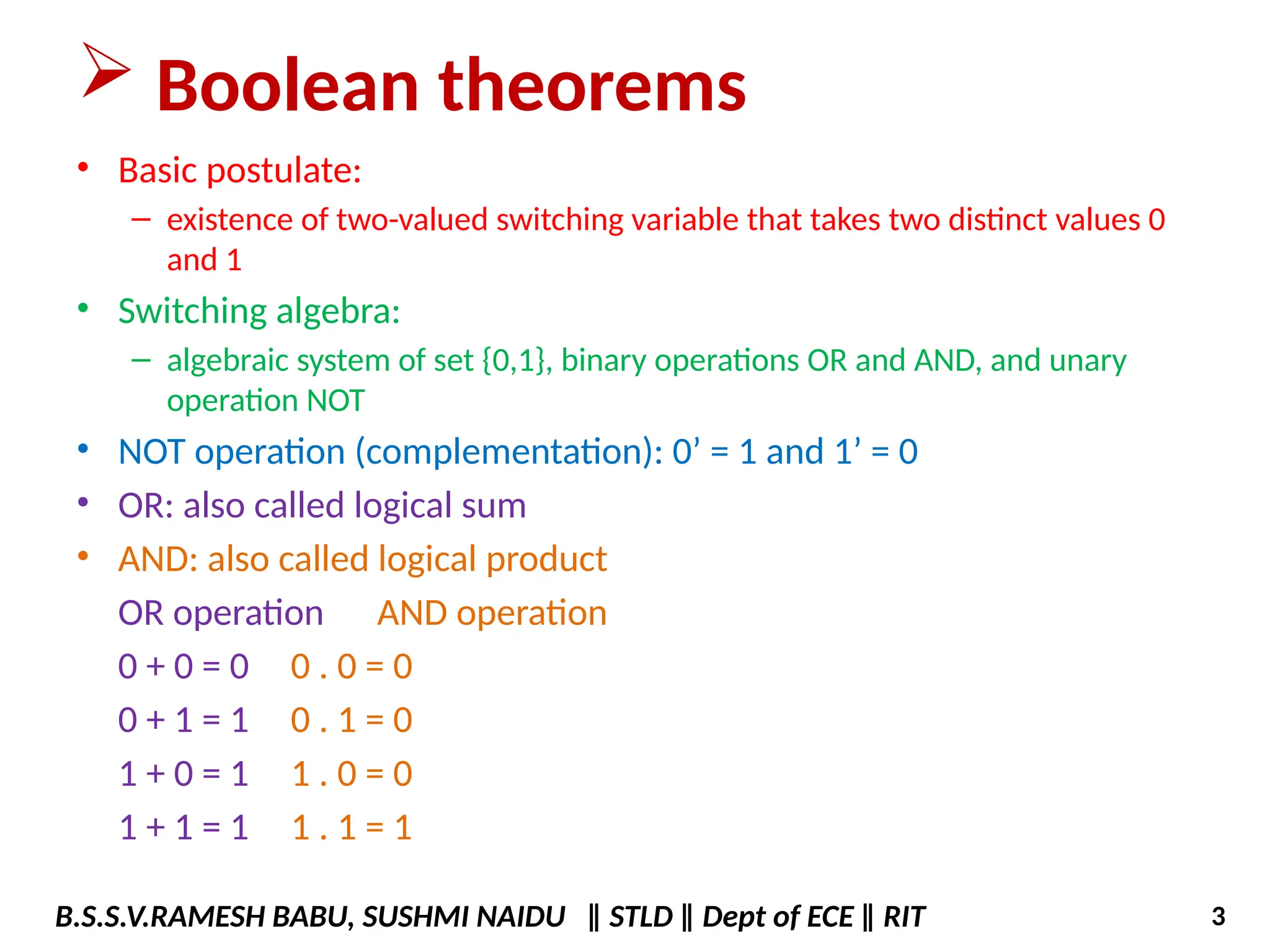
•Basic postulate:
– existence of two-valued switching variable that takes two distinct values 0
and 1
• Switching algebra:
– algebraic system of set {0,1}, binary operations OR and AND, and unary
operation NOT
• NOT operation (complementation): 0’ = 1 and 1’ = 0
• OR: also called logical sum
• AND: also called logical product
OR operation AND operation
0 + 0 = 0 0 . 0 = 0
0 + 1 = 1 0 . 1 = 0
1 + 0 = 1 1 . 0 = 0
1 + 1 = 1 1 . 1 = 1
B.S.S.V.RAMESH BABU, SUSHMI NAIDU ‖ STLD ‖ Dept of ECE ‖ RIT 3
6.
Rules &Laws
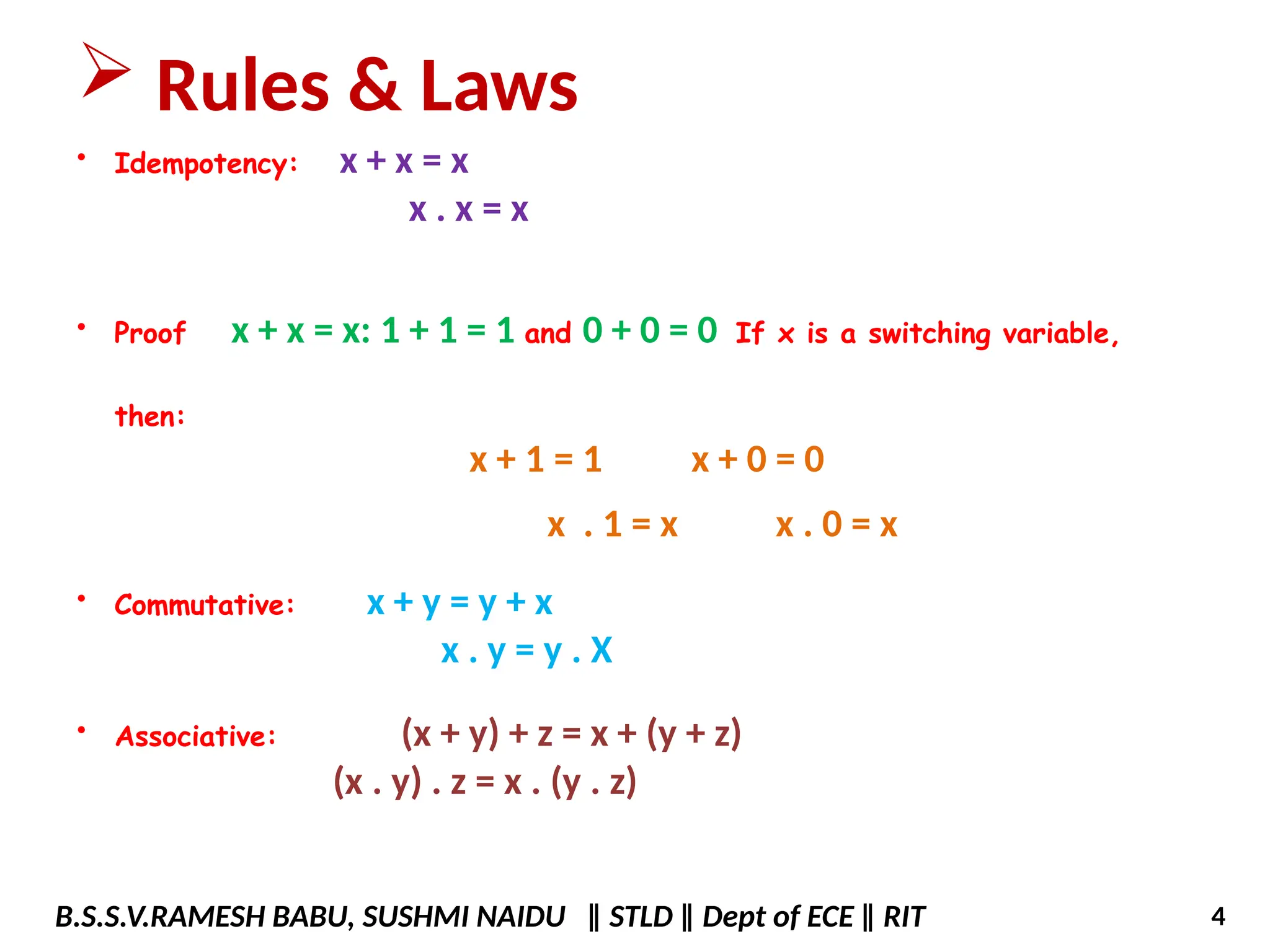
• Idempotency: x + x = x
x . x = x
• Proof x + x = x: 1 + 1 = 1 and 0 + 0 = 0 If x is a switching variable,
then:
x + 1 = 1 x + 0 = 0
x . 1 = x x . 0 = x
• Commutative: x + y = y + x
x . y = y . X
• Associative: (x + y) + z = x + (y + z)
(x . y) . z = x . (y . z)
B.S.S.V.RAMESH BABU, SUSHMI NAIDU ‖ STLD ‖ Dept of ECE ‖ RIT 4
7.
Rules & Laws(Contd…)
• Complémentation: x + x’ = 1
x . x’ = 0
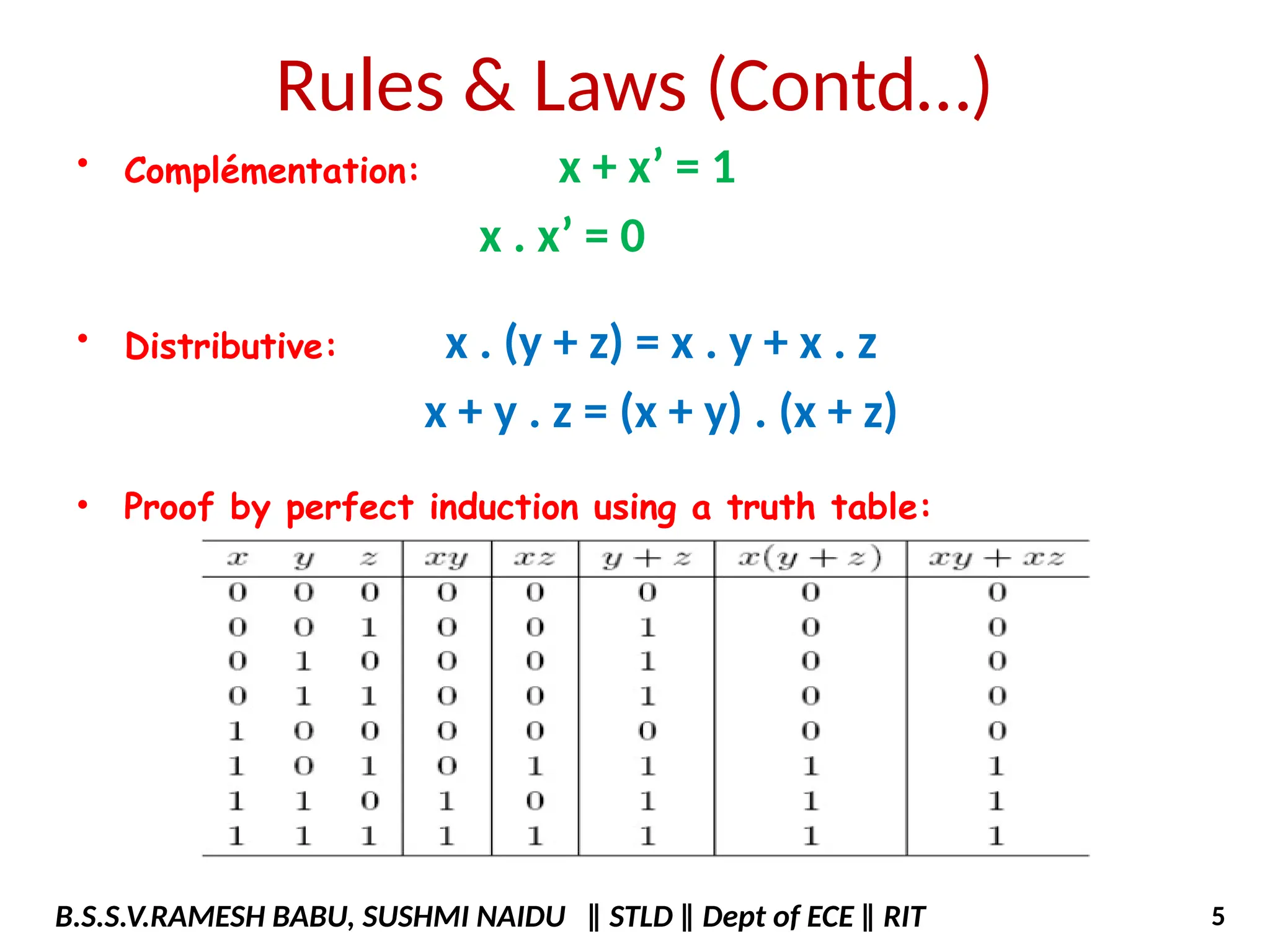
• Distributive: x . (y + z) = x . y + x . z
x + y . z = (x + y) . (x + z)
• Proof by perfect induction using a truth table:
B.S.S.V.RAMESH BABU, SUSHMI NAIDU ‖ STLD ‖ Dept of ECE ‖ RIT 5
8.
Rules & Laws(Contd…)
• Absorption law: x + xy = x
x(x + y) = x
• Proof: x + xy = x1 + xy [basic property]
= x(1 + y) [distributive]
= x1 [commutative and basic
property]
= x [basic property]
• Another important law: x + x’y = x + y
x(x’ + y) = xy
B.S.S.V.RAMESH BABU, SUSHMI NAIDU ‖ STLD ‖ Dept of ECE ‖ RIT 6
Principle ofDuality
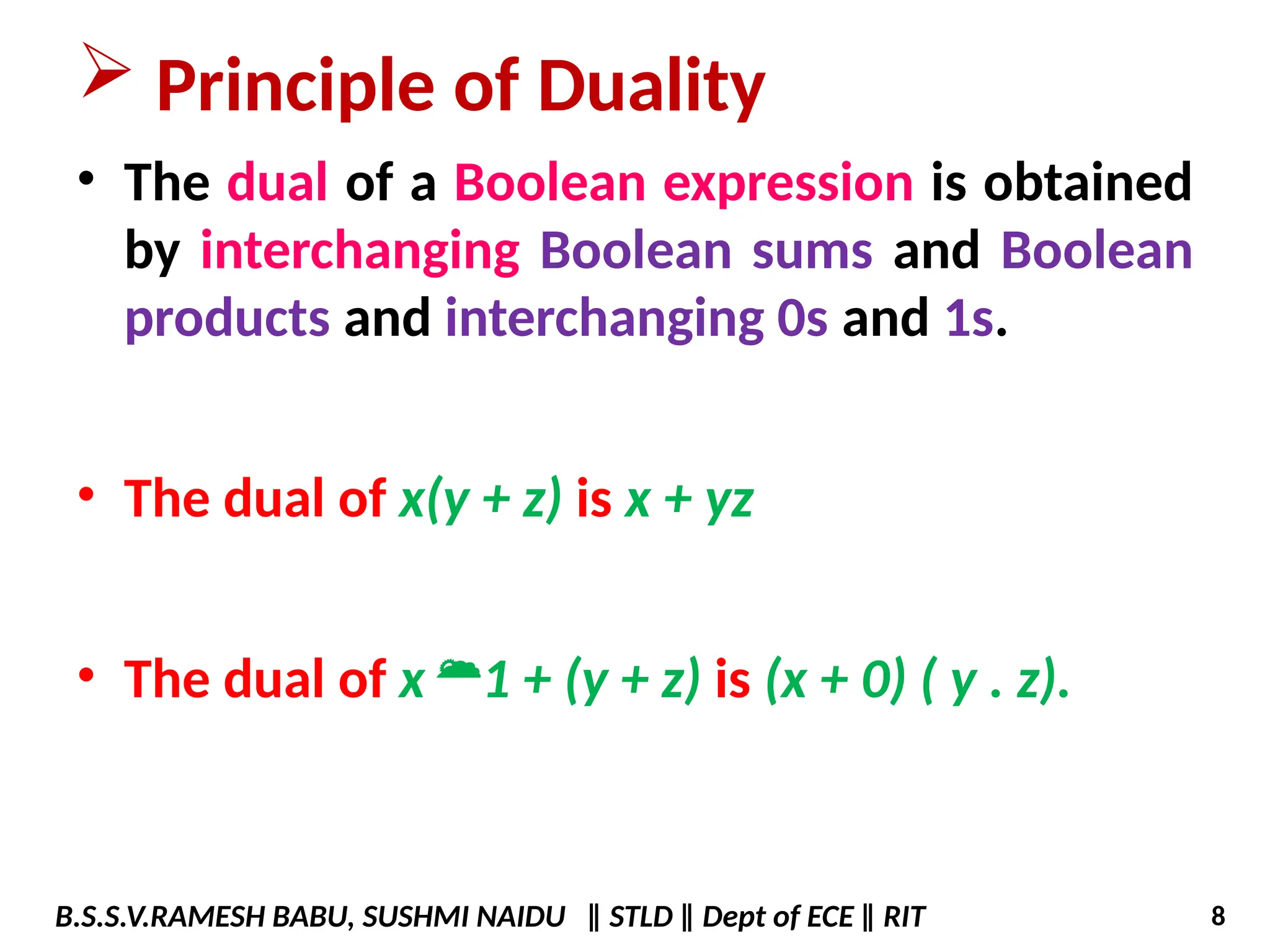
• The dual of a Boolean expression is obtained
by interchanging Boolean sums and Boolean
products and interchanging 0s and 1s.
• The dual of x(y + z) is x + yz
• The dual of x1 + (y + z) is (x + 0) ( y . z).
B.S.S.V.RAMESH BABU, SUSHMI NAIDU ‖ STLD ‖ Dept of ECE ‖ RIT 8
11.
De Morgan’stheorem
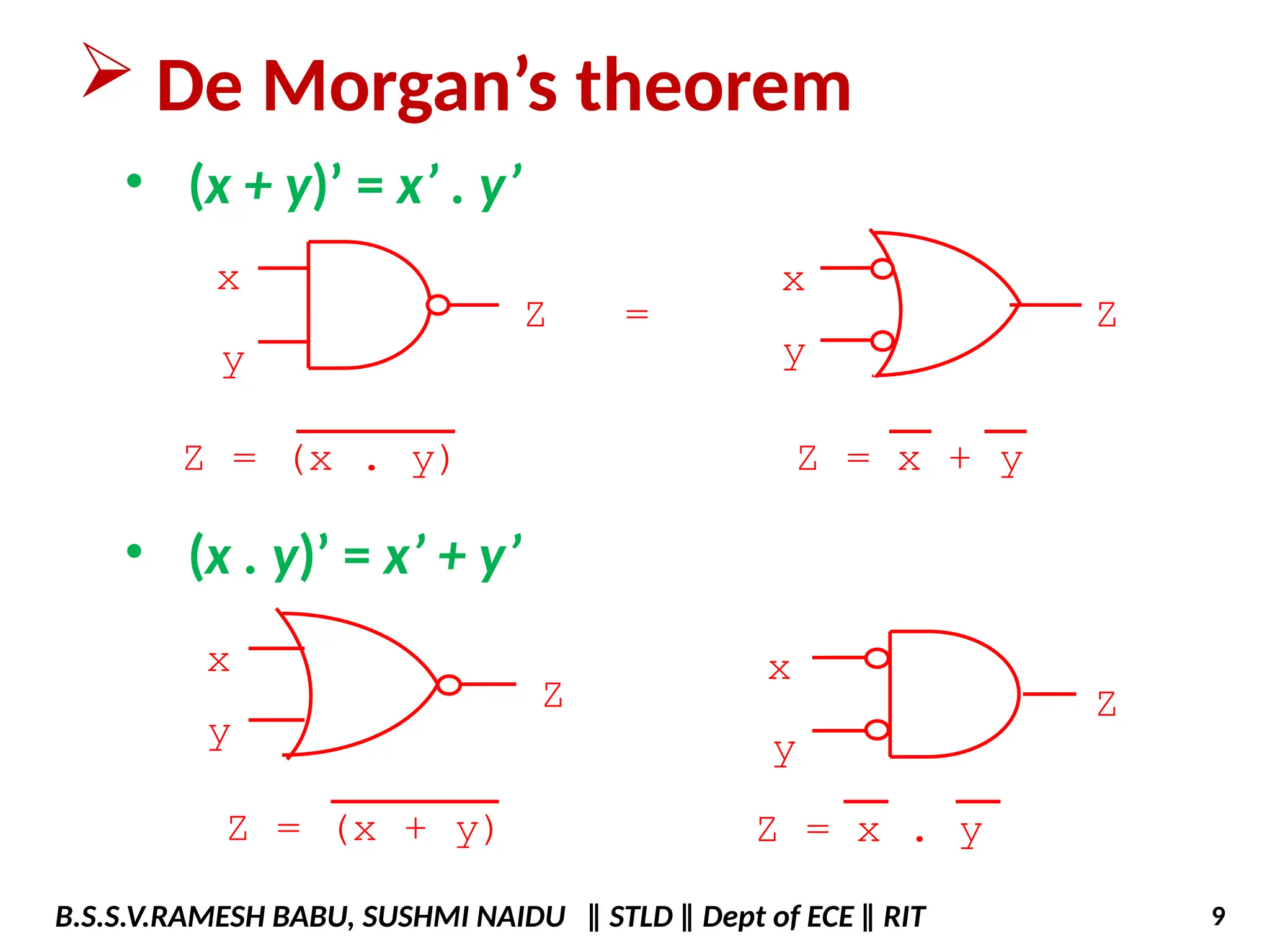
• (x + y)’ = x’ . y’
• (x . y)’ = x’ + y’
x
y
x
y
Z Z
Z = (x . y) Z = x + y
=
x
y
Z
Z = (x + y)
x
y
Z
Z = x . y
B.S.S.V.RAMESH BABU, SUSHMI NAIDU ‖ STLD ‖ Dept of ECE ‖ RIT 9
12.
Proof
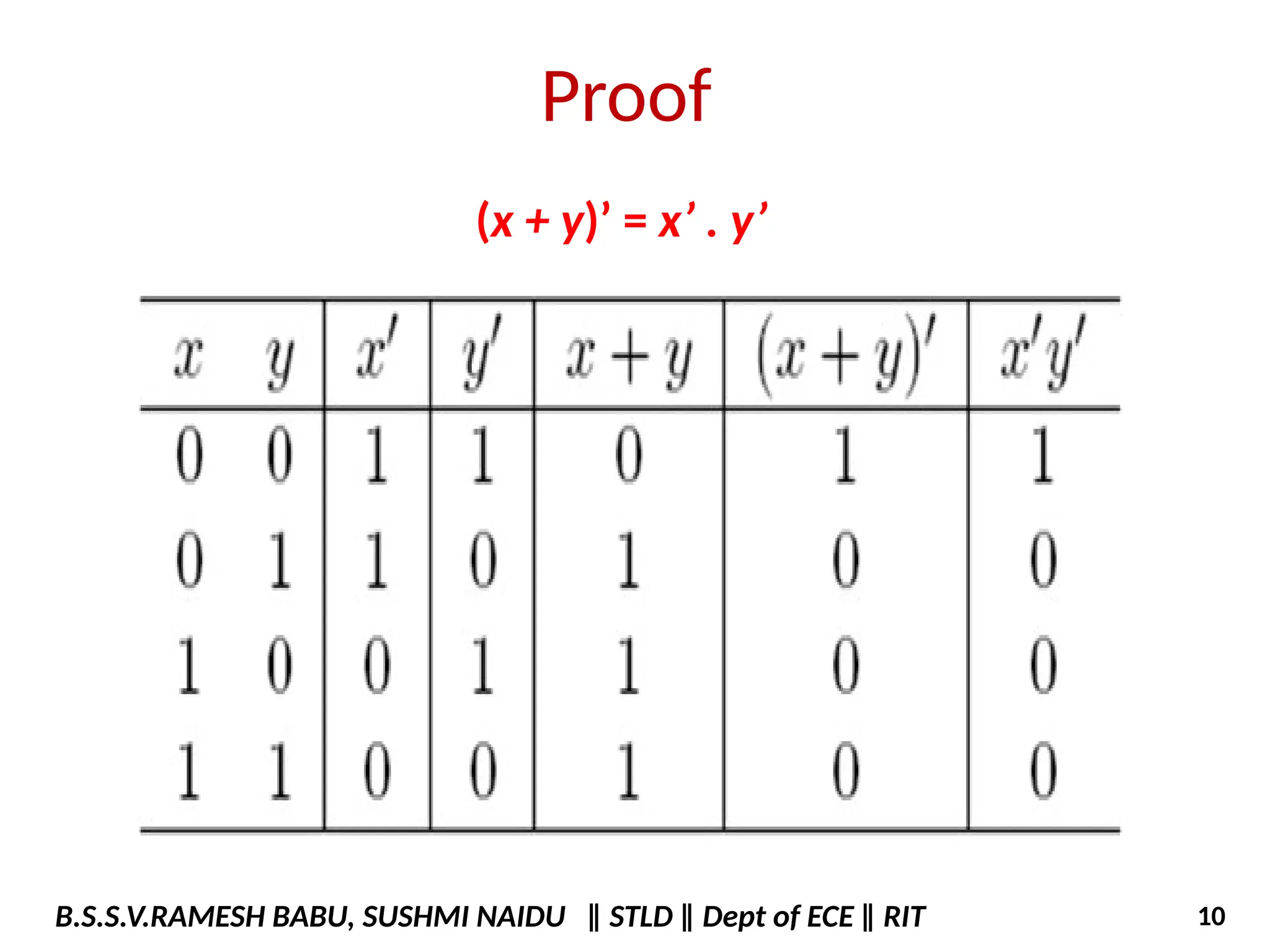
(x + y)’= x’ . y’
B.S.S.V.RAMESH BABU, SUSHMI NAIDU ‖ STLD ‖ Dept of ECE ‖ RIT 10
13.
Minimization of logicfunctions using
Boolean theorems
• Example:
Simplify
T(x,y,z) = (x + y)[x’(y’ + z’)]’ + x’y’ + x’z’
(x + y)[x’(y’ + z’)]’ + x’y’ + x’z’
= (x + y)(x + yz) + x’y’ + x’z’
= (x + xyz + yx + yz) + x’y’ + x’z’
= x + yz + x’y’ + x’z’
= x + yz + y’ + z’
= x + z + y’ + z’
= x + y’ + 1
= 1
B.S.S.V.RAMESH BABU, SUSHMI NAIDU ‖ STLD ‖ Dept of ECE ‖ RIT 11
Example:
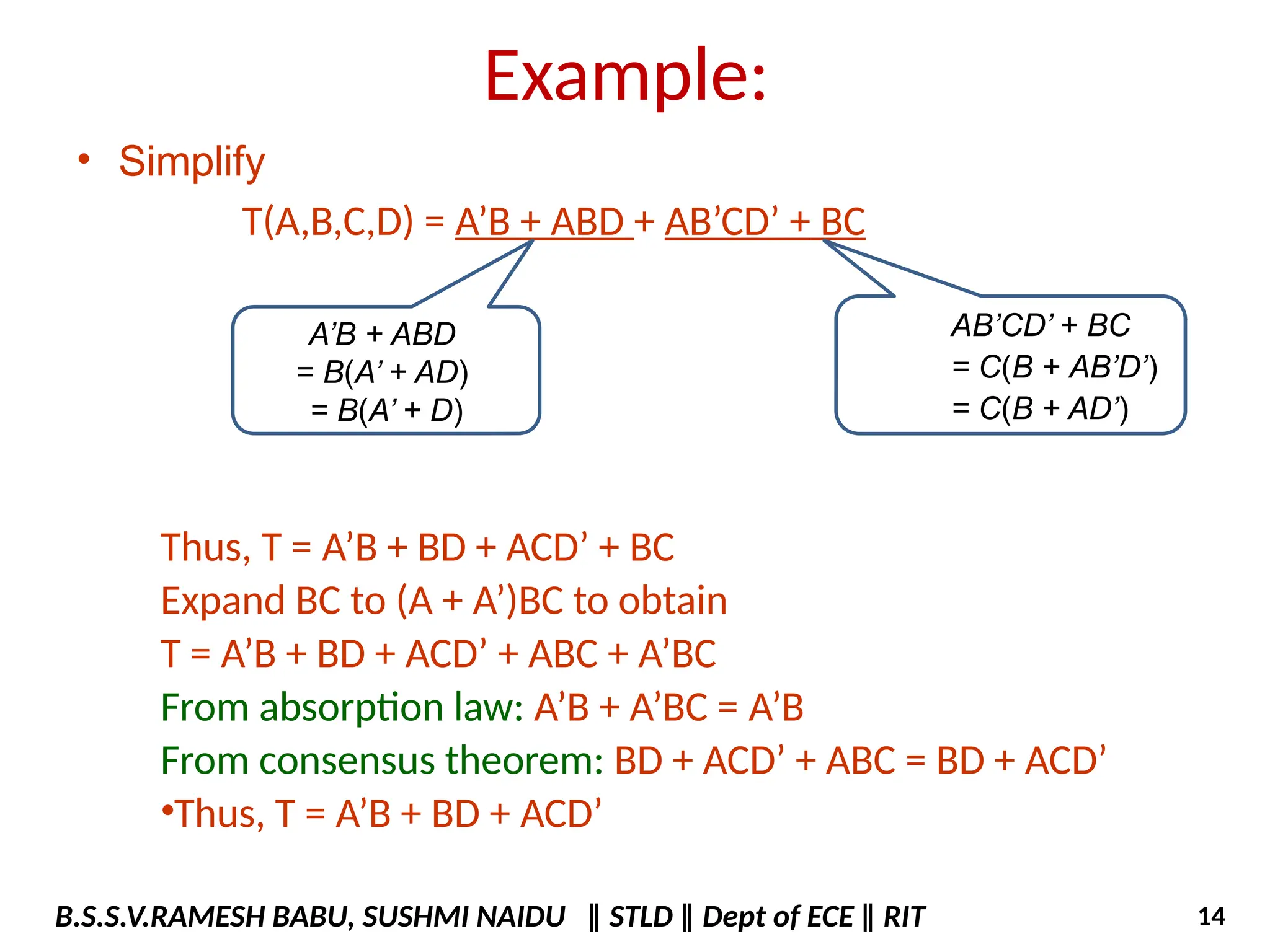
• Simplify
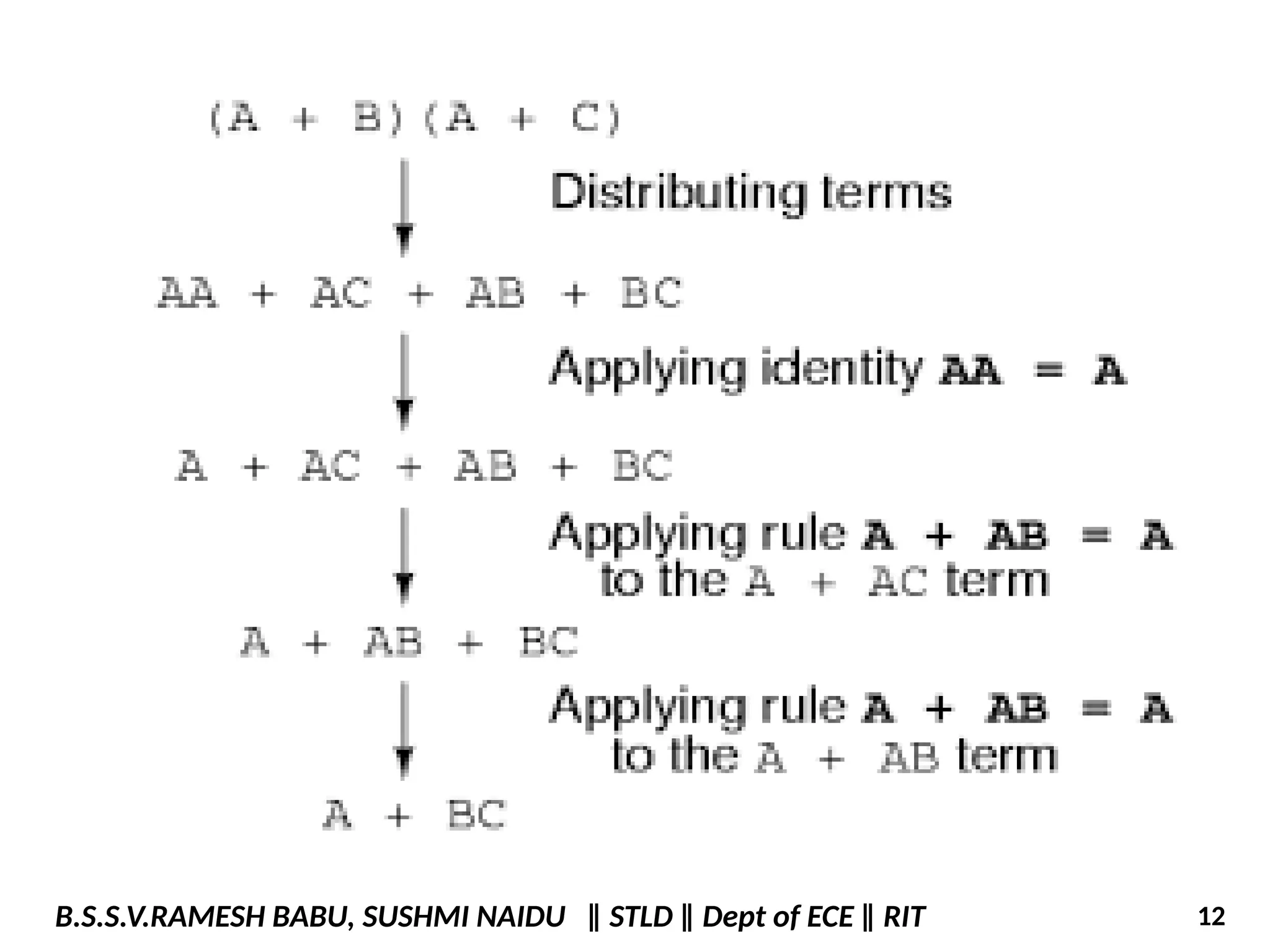
T(A,B,C,D) =A’B + ABD + AB’CD’ + BC
Thus, T = A’B + BD + ACD’ + BC
Expand BC to (A + A’)BC to obtain
T = A’B + BD + ACD’ + ABC + A’BC
From absorption law: A’B + A’BC = A’B
From consensus theorem: BD + ACD’ + ABC = BD + ACD’
•Thus, T = A’B + BD + ACD’
A’B + ABD
= B(A’ + AD)
= B(A’ + D)
AB’CD’ + BC
= C(B + AB’D’)
= C(B + AD’)
B.S.S.V.RAMESH BABU, SUSHMI NAIDU ‖ STLD ‖ Dept of ECE ‖ RIT 14
17.
K(Karnaugh)-Map
• K-mapuses the following rules for the
simplification of expressions by grouping
together adjacent cells containing ones.
• No zeros
• No diagonals
• Each group should be as large as possible and
as fewest it can be.
• Groups may overlap
• Groups may wrap around the table
B.S.S.V.RAMESH BABU, SUSHMI NAIDU ‖ STLD ‖ Dept of ECE ‖ RIT 15
19.
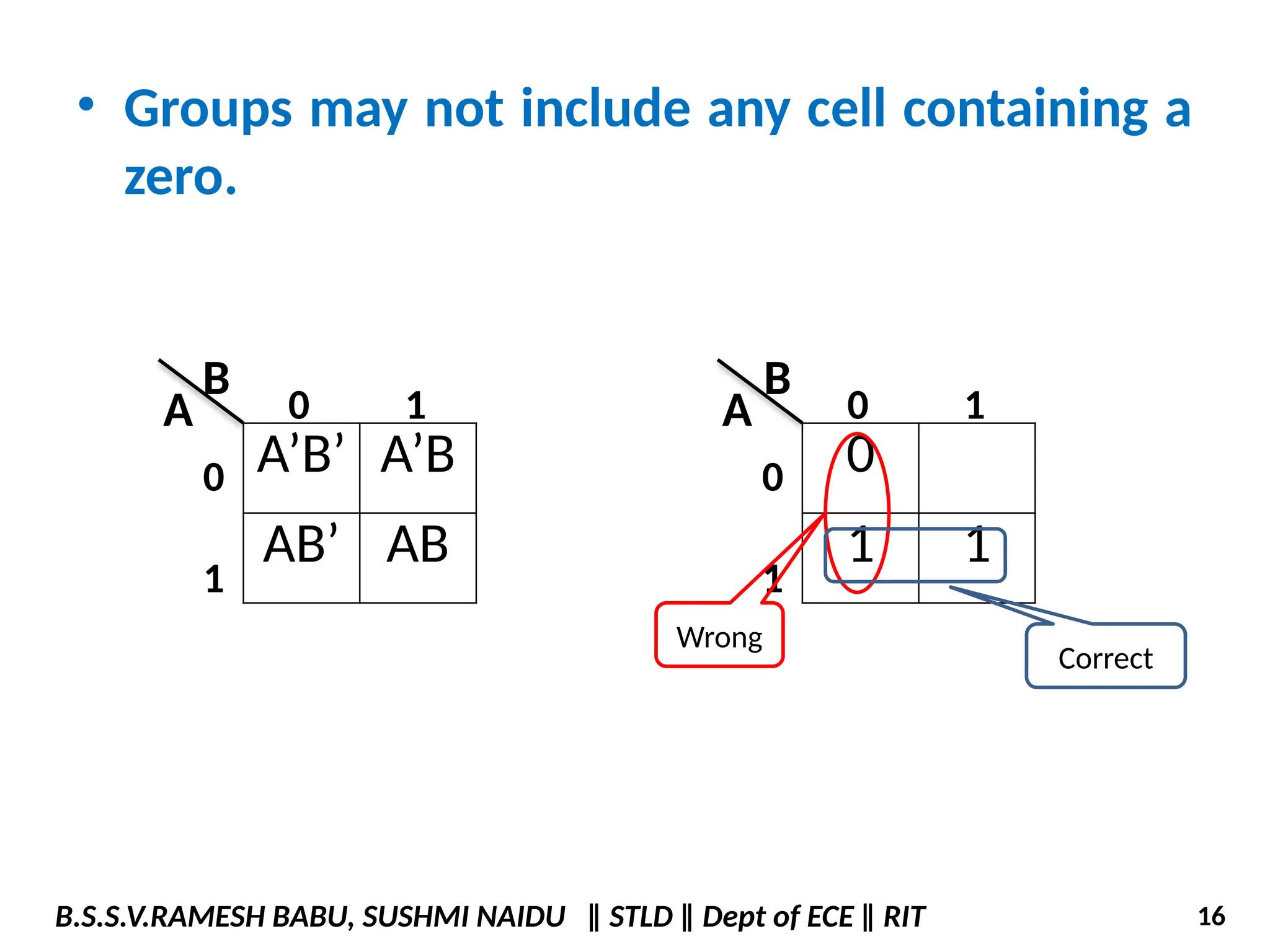
• Groups maynot include any cell containing a
zero.
A’B’ A’B
AB’ AB
B
A 0 1
0
1
0
1 1
A 0 1
0
1
B
Wrong
Correct
B.S.S.V.RAMESH BABU, SUSHMI NAIDU ‖ STLD ‖ Dept of ECE ‖ RIT 16
20.
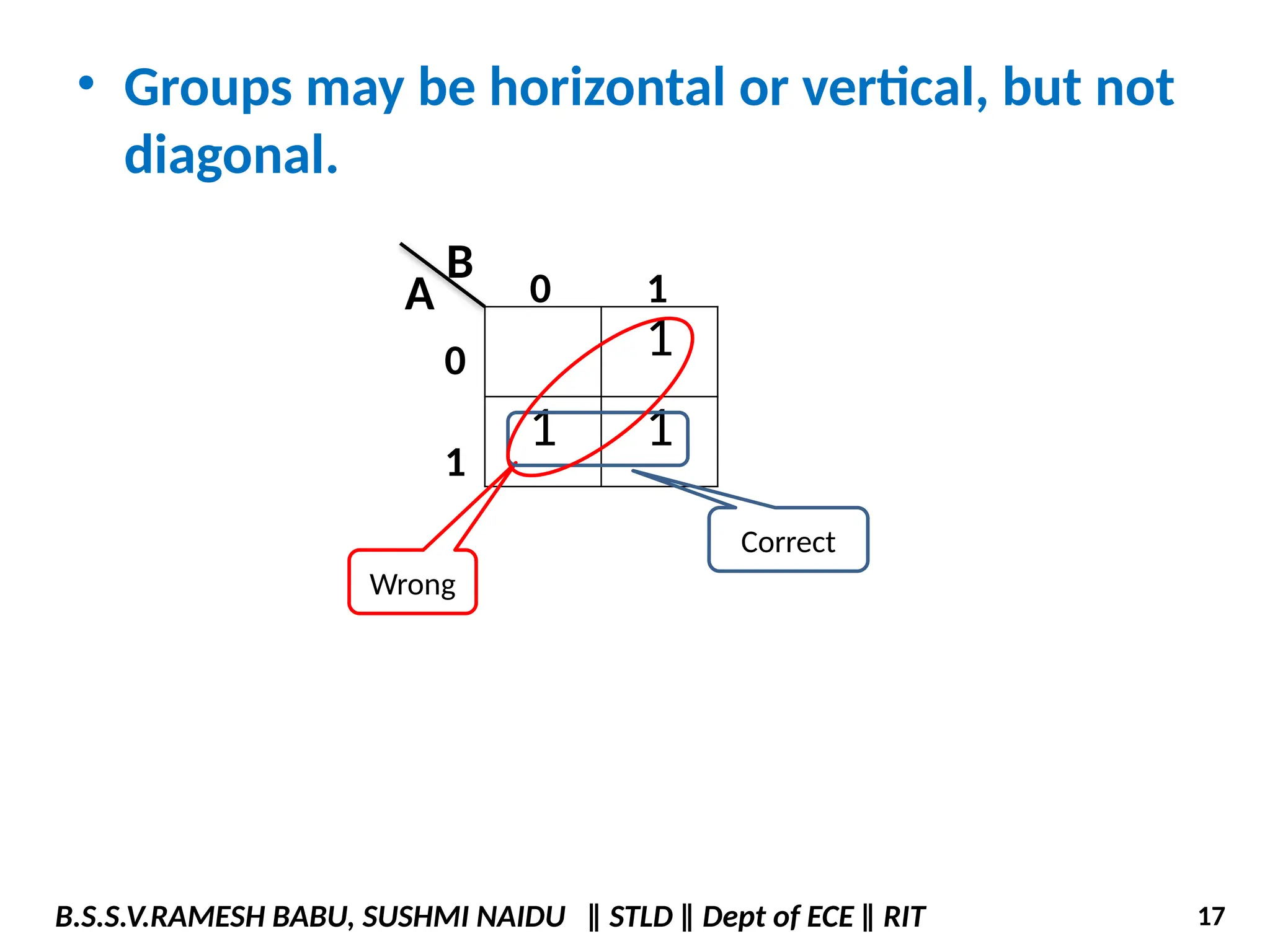
• Groups maybe horizontal or vertical, but not
diagonal.
1
1 1
A 0 1
0
1
B
Wrong
Correct
B.S.S.V.RAMESH BABU, SUSHMI NAIDU ‖ STLD ‖ Dept of ECE ‖ RIT 17
21.
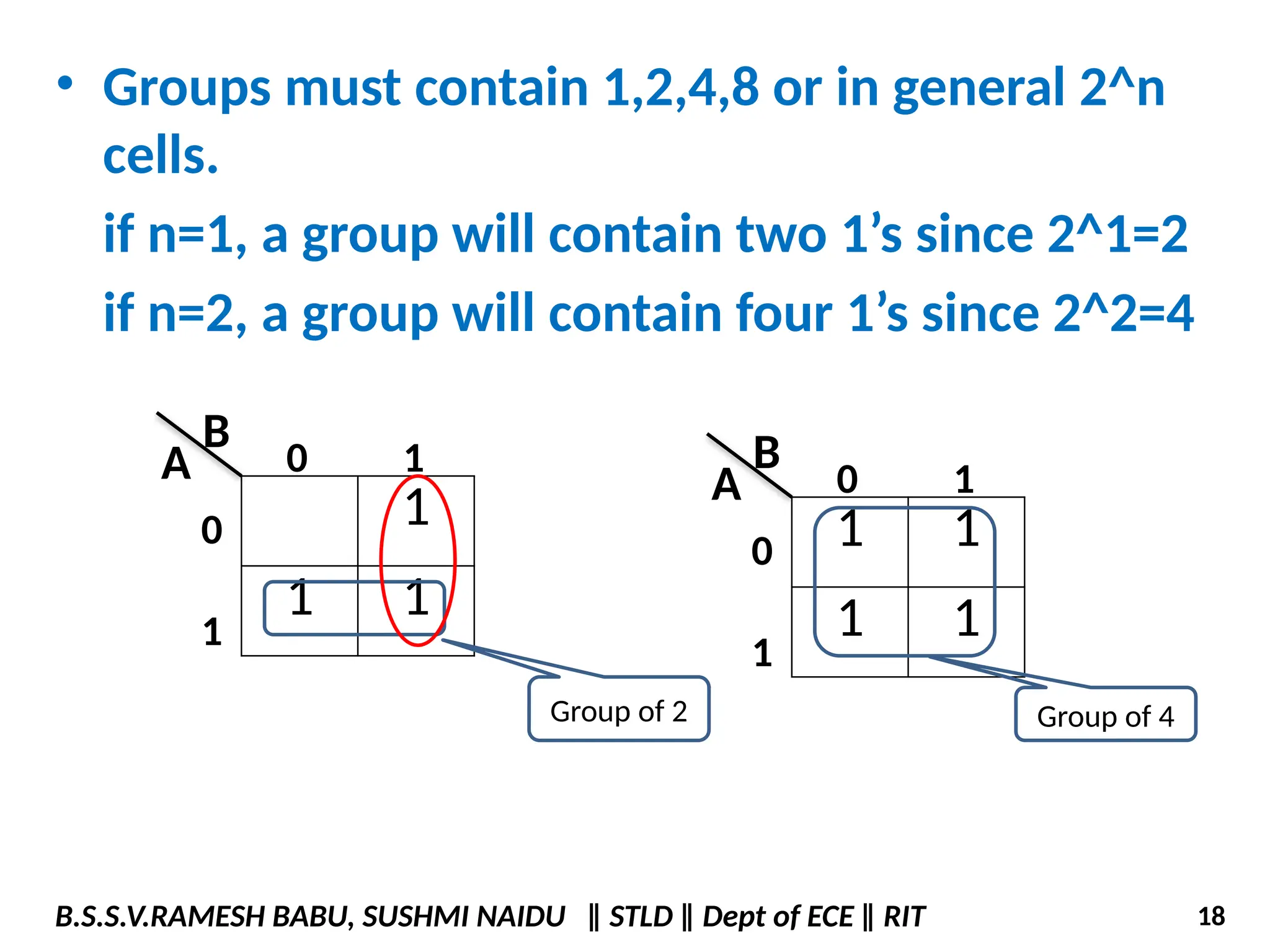
• Groups mustcontain 1,2,4,8 or in general 2^n
cells.
if n=1, a group will contain two 1’s since 2^1=2
if n=2, a group will contain four 1’s since 2^2=4
1
1 1
A 0 1
0
1
B
Group of 2
1 1
1 1
A 0 1
0
1
B
Group of 4
B.S.S.V.RAMESH BABU, SUSHMI NAIDU ‖ STLD ‖ Dept of ECE ‖ RIT 18
22.
1 1 1
11
A 00 01 11 10
0
1
BC
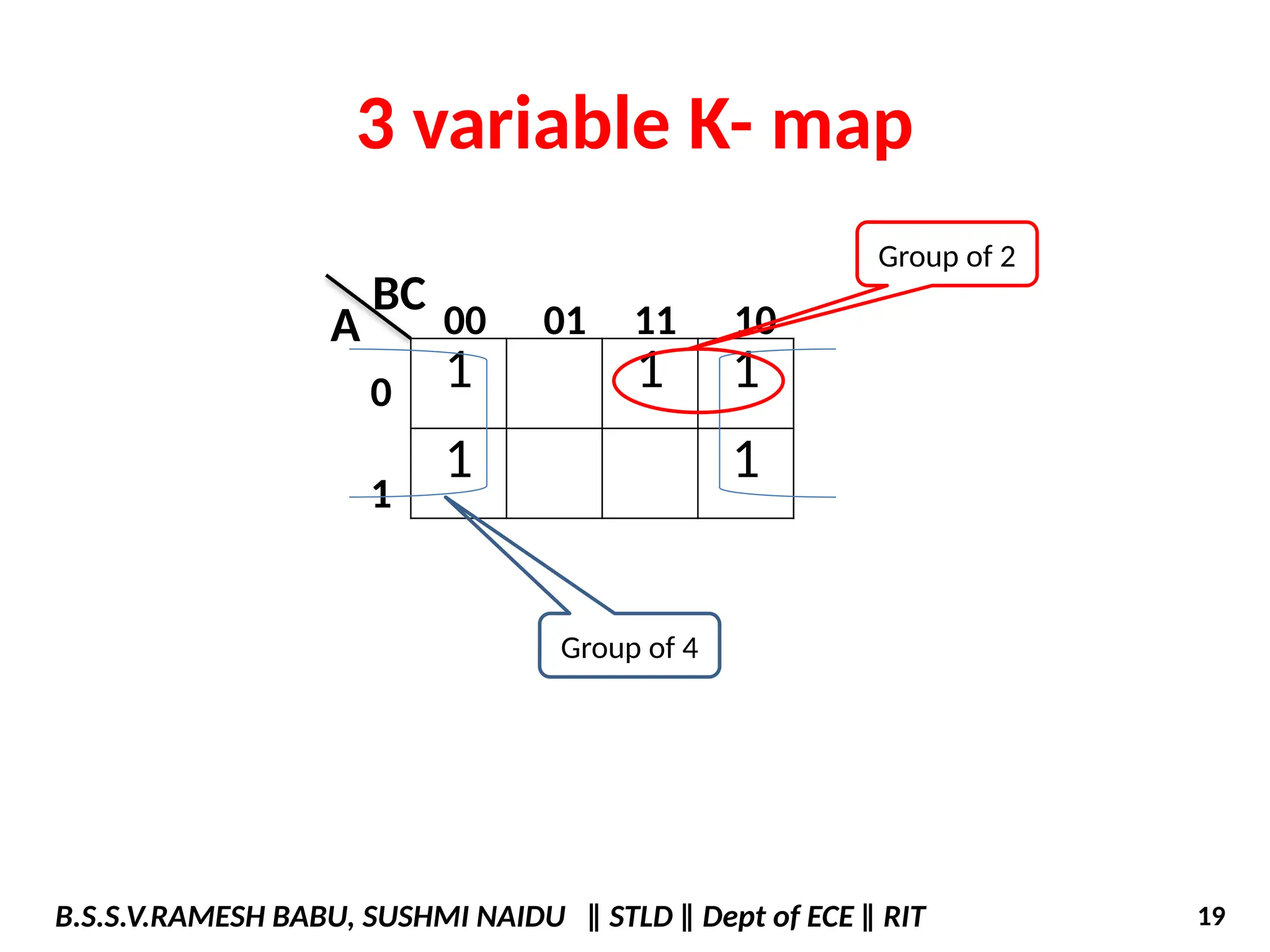
Group of 4
Group of 2
3 variable K- map
B.S.S.V.RAMESH BABU, SUSHMI NAIDU ‖ STLD ‖ Dept of ECE ‖ RIT 19
23.
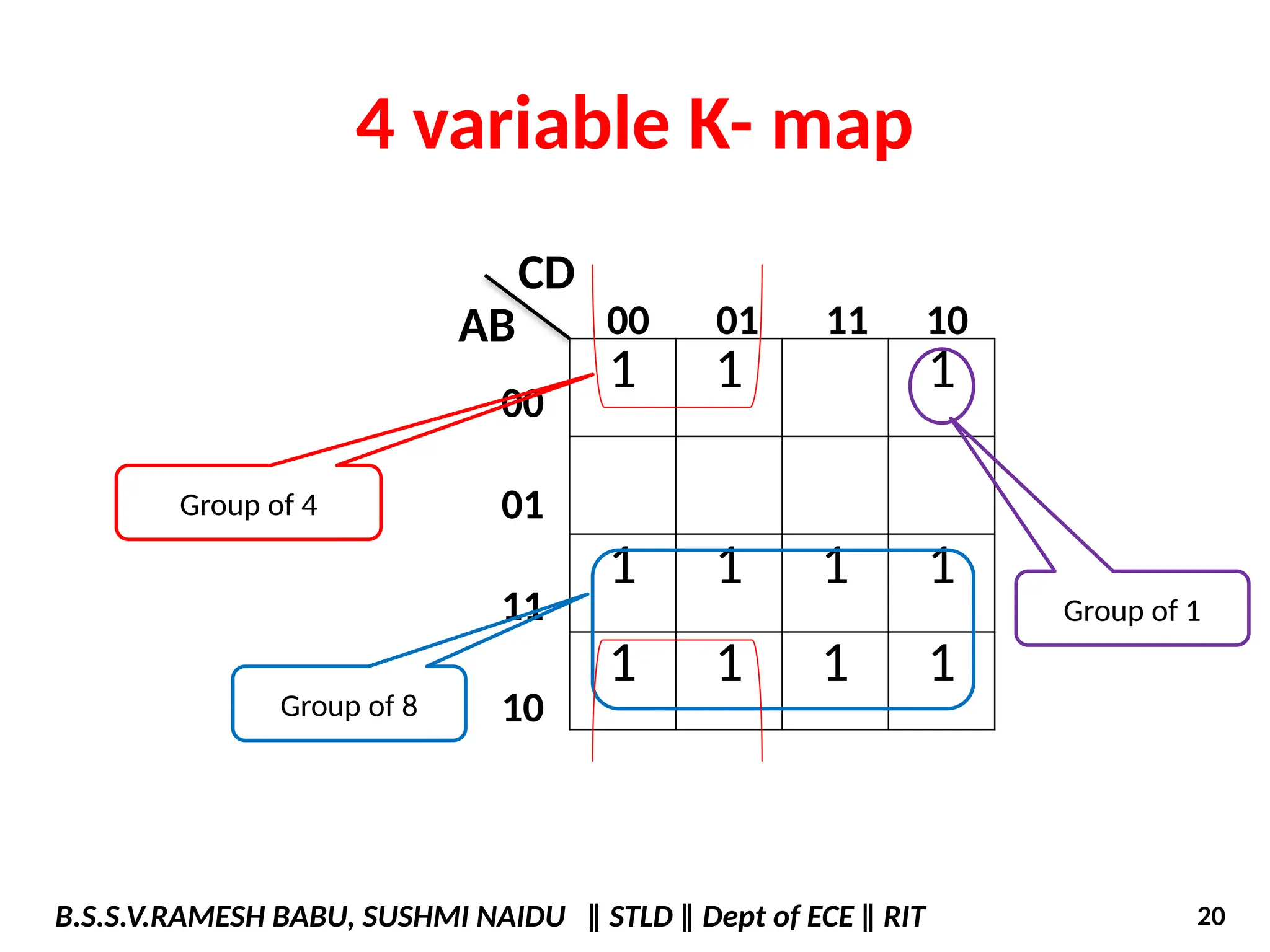
4 variable K-map
1 1 1
1 1 1 1
1 1 1 1
AB 00 01 11 10
00
01
11
10
Group of 4
Group of 1
Group of 8
CD
B.S.S.V.RAMESH BABU, SUSHMI NAIDU ‖ STLD ‖ Dept of ECE ‖ RIT 20
24.
Minimization of switchingfunctions using
K-Map
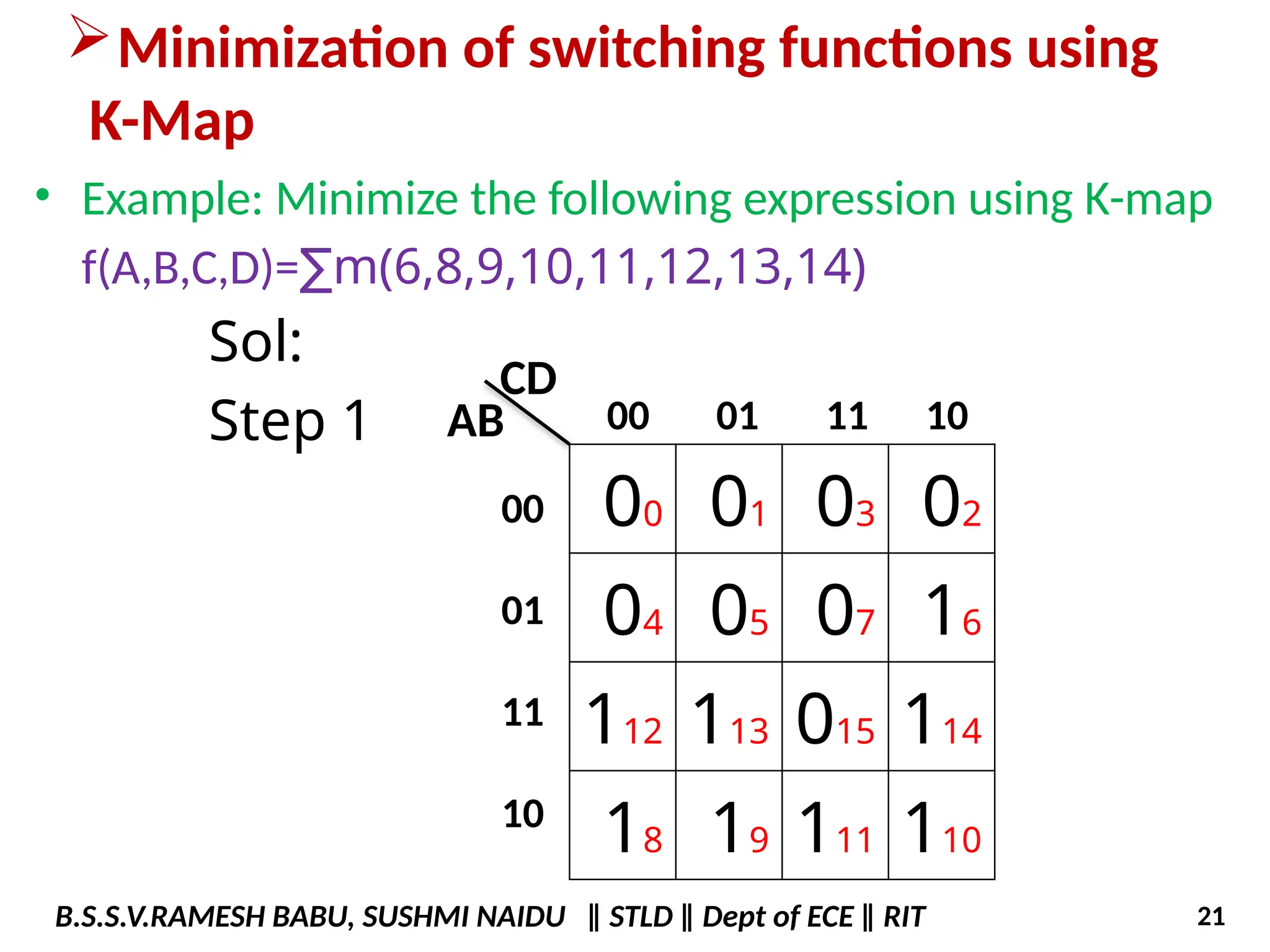
• Example: Minimize the following expression using K-map
f(A,B,C,D)= m(6,8,9,10,11,12,13,14)
∑
Sol:
Step 1
00 01 03 02
04 05 07 16
112 113 015 114
18 19 111 110
AB 00 01 11 10
00
01
11
10
CD
B.S.S.V.RAMESH BABU, SUSHMI NAIDU ‖ STLD ‖ Dept of ECE ‖ RIT 21
25.
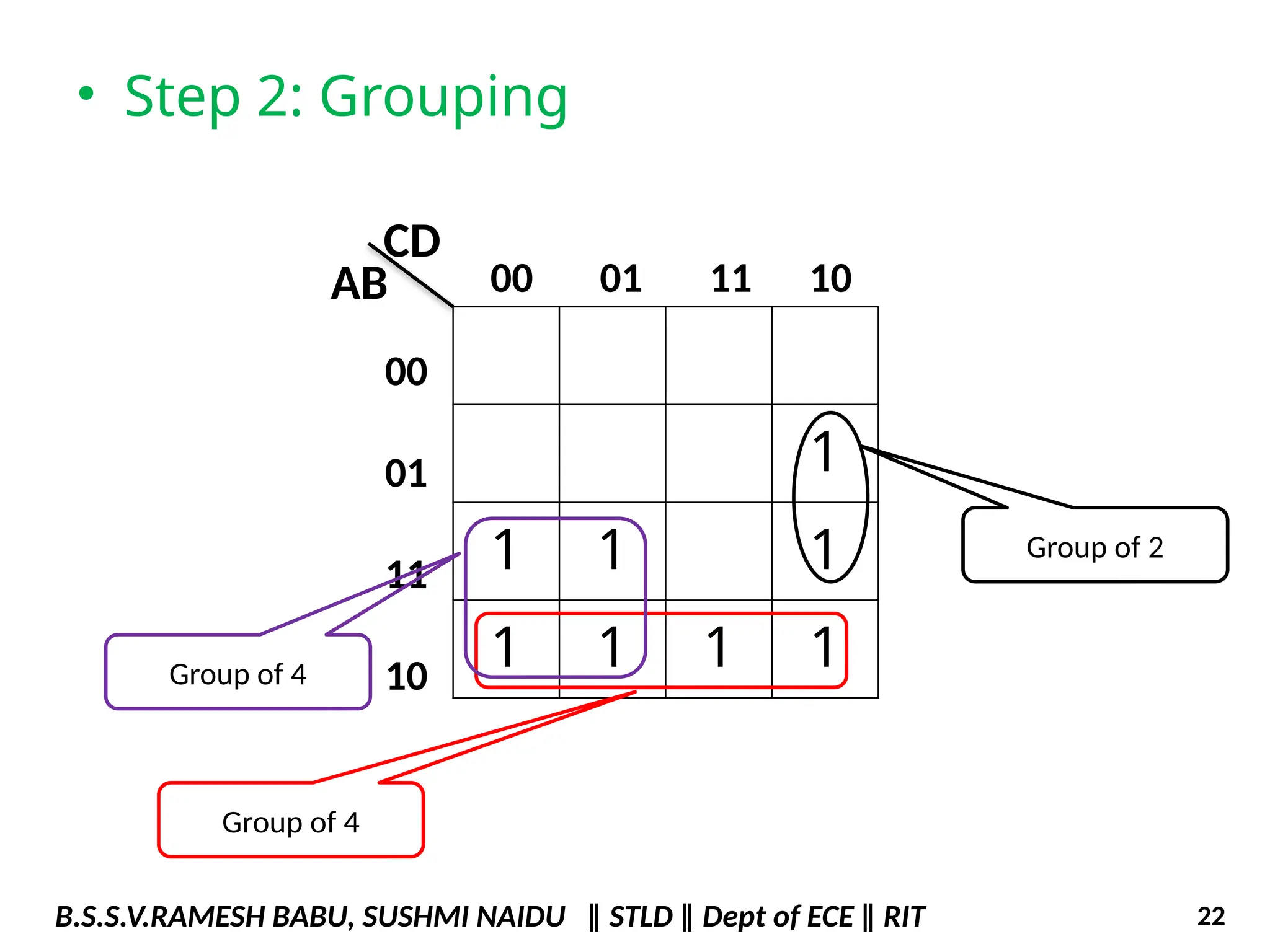
• Step 2:Grouping
AB 00 01 11 10
00
01
11
10
CD
1
1 1 1
1 1 1 1
Group of 2
Group of 4
Group of 4
B.S.S.V.RAMESH BABU, SUSHMI NAIDU ‖ STLD ‖ Dept of ECE ‖ RIT 22
26.
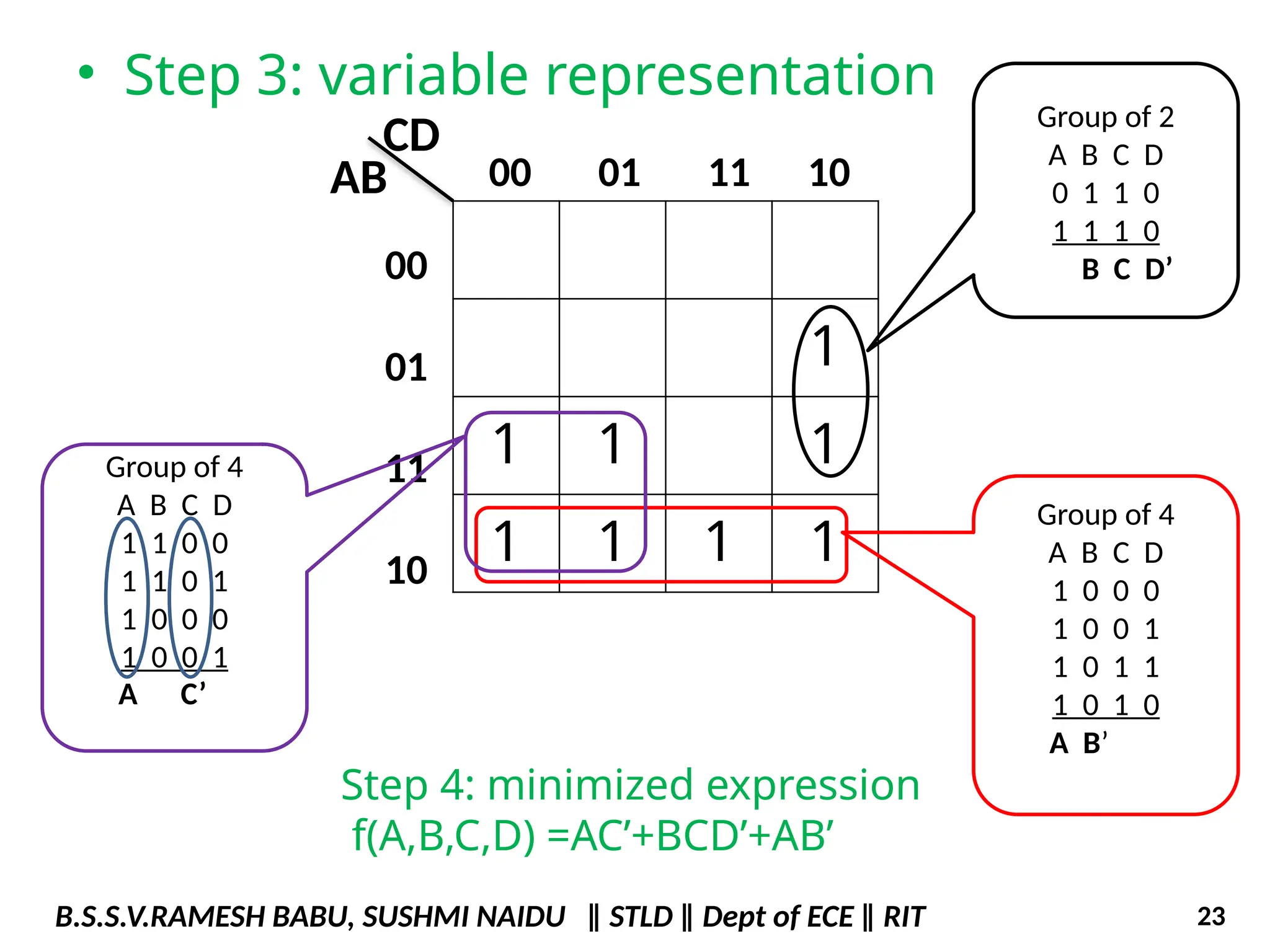
• Step 3:variable representation
AB 00 01 11 10
00
01
11
10
CD
1
1 1 1
1 1 1 1
Group of 2
A B C D
0 1 1 0
1 1 1 0
B C D’
Group of 4
A B C D
1 0 0 0
1 0 0 1
1 0 1 1
1 0 1 0
A B’
Step 4: minimized expression
f(A,B,C,D) =AC’+BCD’+AB’
Group of 4
A B C D
1 1 0 0
1 1 0 1
1 0 0 0
1 0 0 1
A C’
B.S.S.V.RAMESH BABU, SUSHMI NAIDU ‖ STLD ‖ Dept of ECE ‖ RIT 23
27.
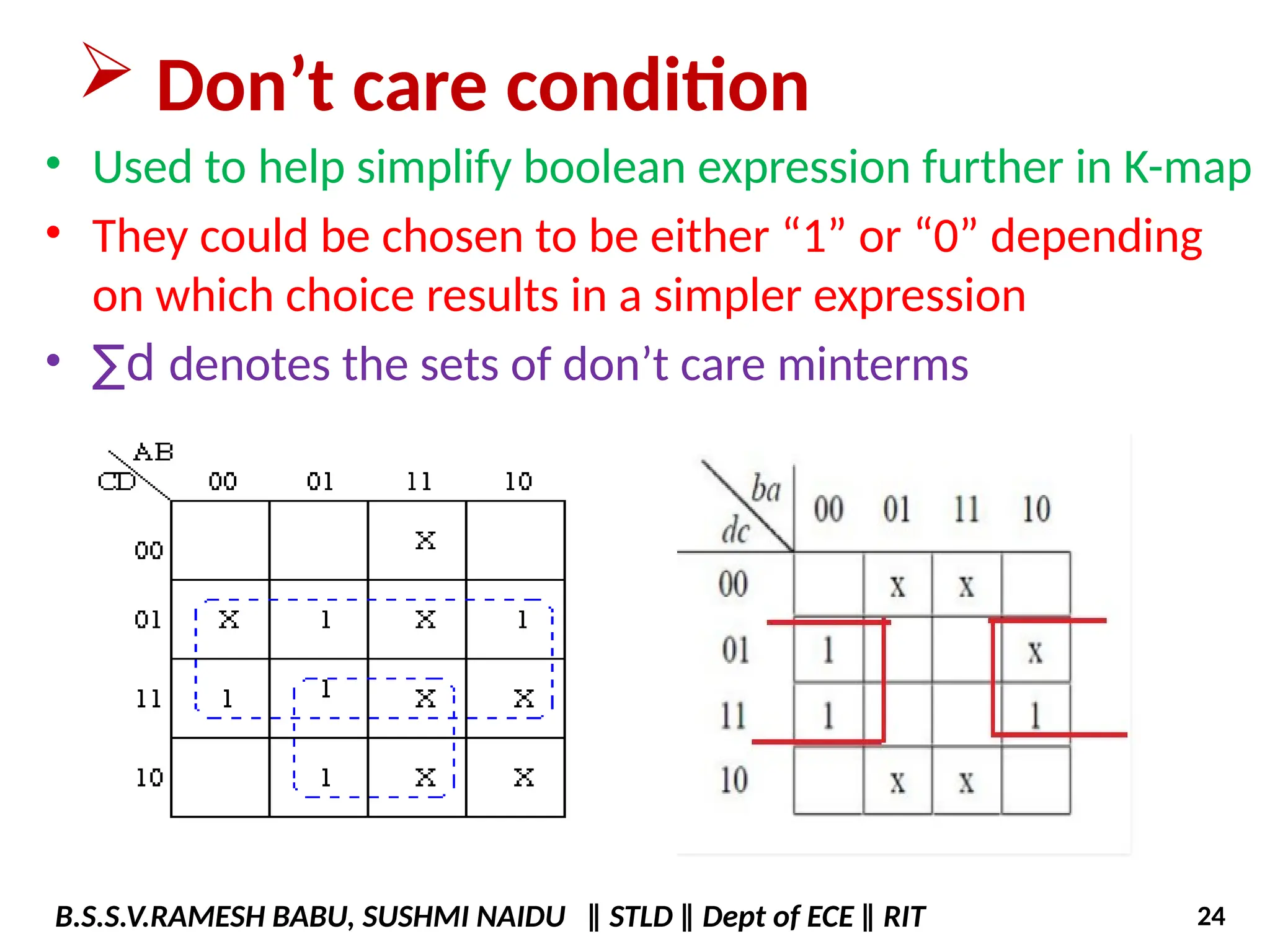
Don’t carecondition
• Used to help simplify boolean expression further in K-map
• They could be chosen to be either “1” or “0” depending
on which choice results in a simpler expression
• ∑d denotes the sets of don’t care minterms
B.S.S.V.RAMESH BABU, SUSHMI NAIDU ‖ STLD ‖ Dept of ECE ‖ RIT 24
28.
• It alsoknown as Tabular method.
• More systematic method of minimizing
expressions of even larger number of
variables.
• Suitable for hand computation as well as
computation by machines i.e., programmable.
• The procedure is based on repeated
application of the combining theorem.
Tabular minimization
B.S.S.V.RAMESH BABU, SUSHMI NAIDU ‖ STLD ‖ Dept of ECE ‖ RIT 25
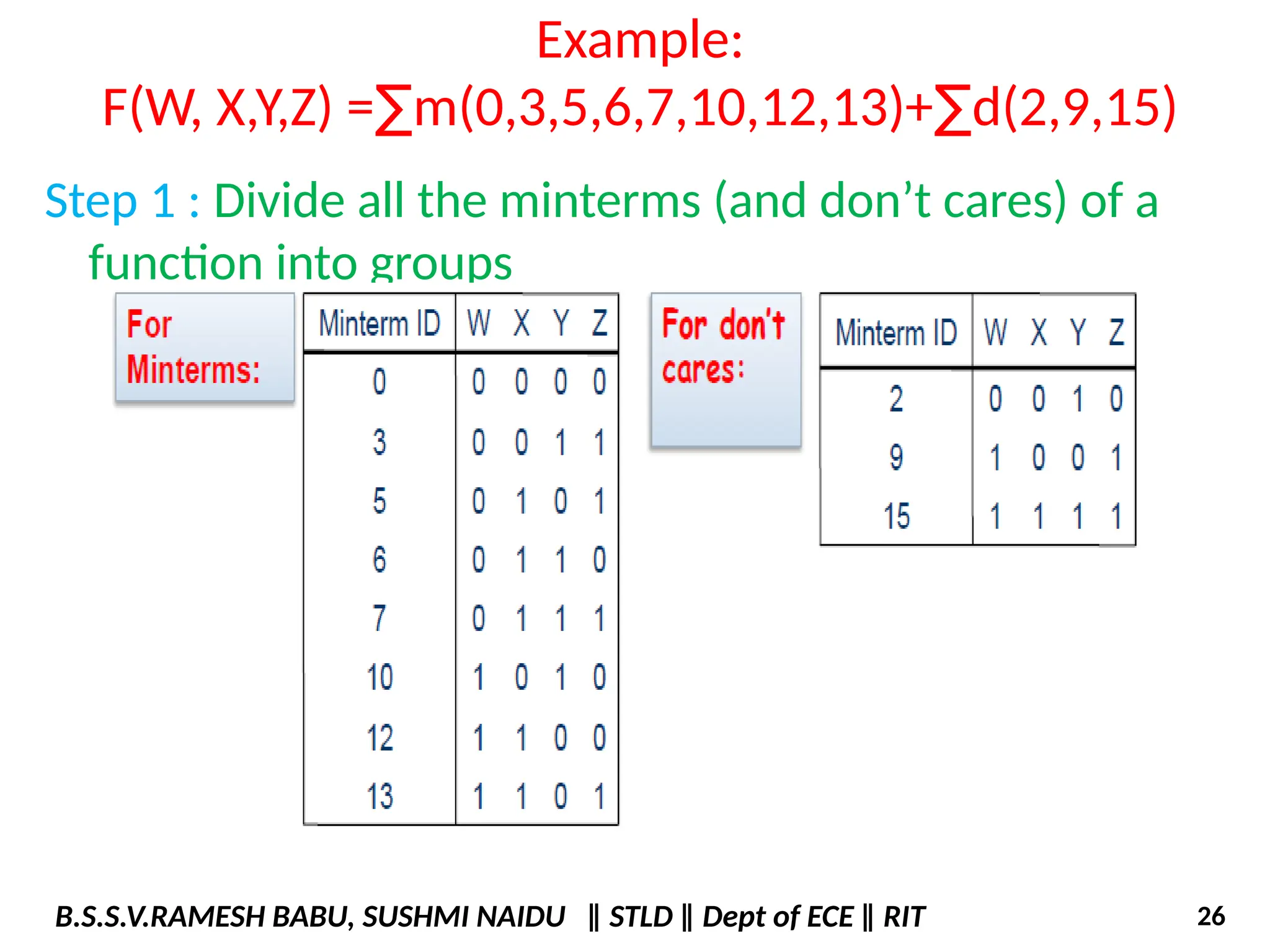
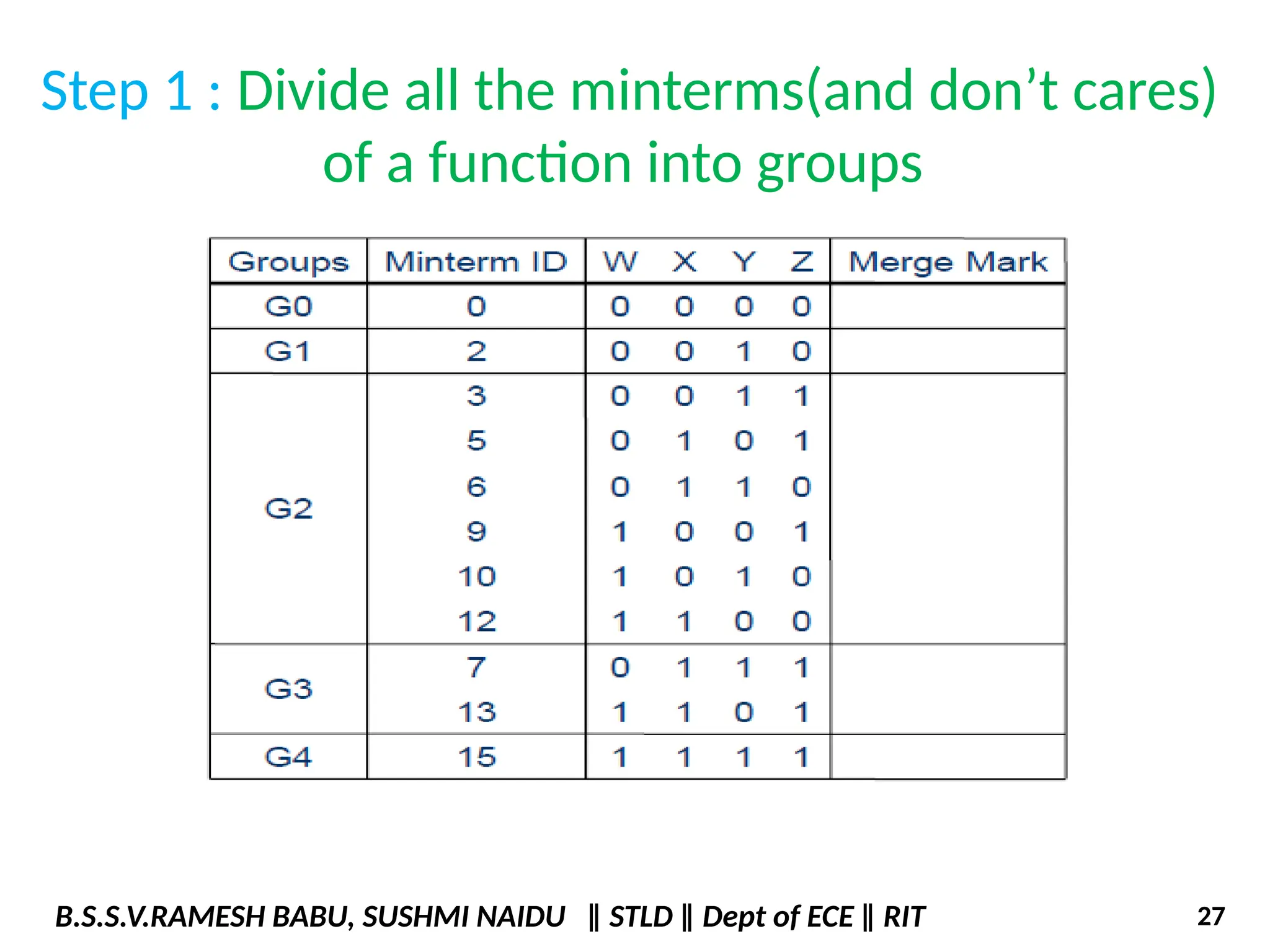
Step 1 :Divide all the minterms(and don’t cares)
of a function into groups
B.S.S.V.RAMESH BABU, SUSHMI NAIDU ‖ STLD ‖ Dept of ECE ‖ RIT 27
31.
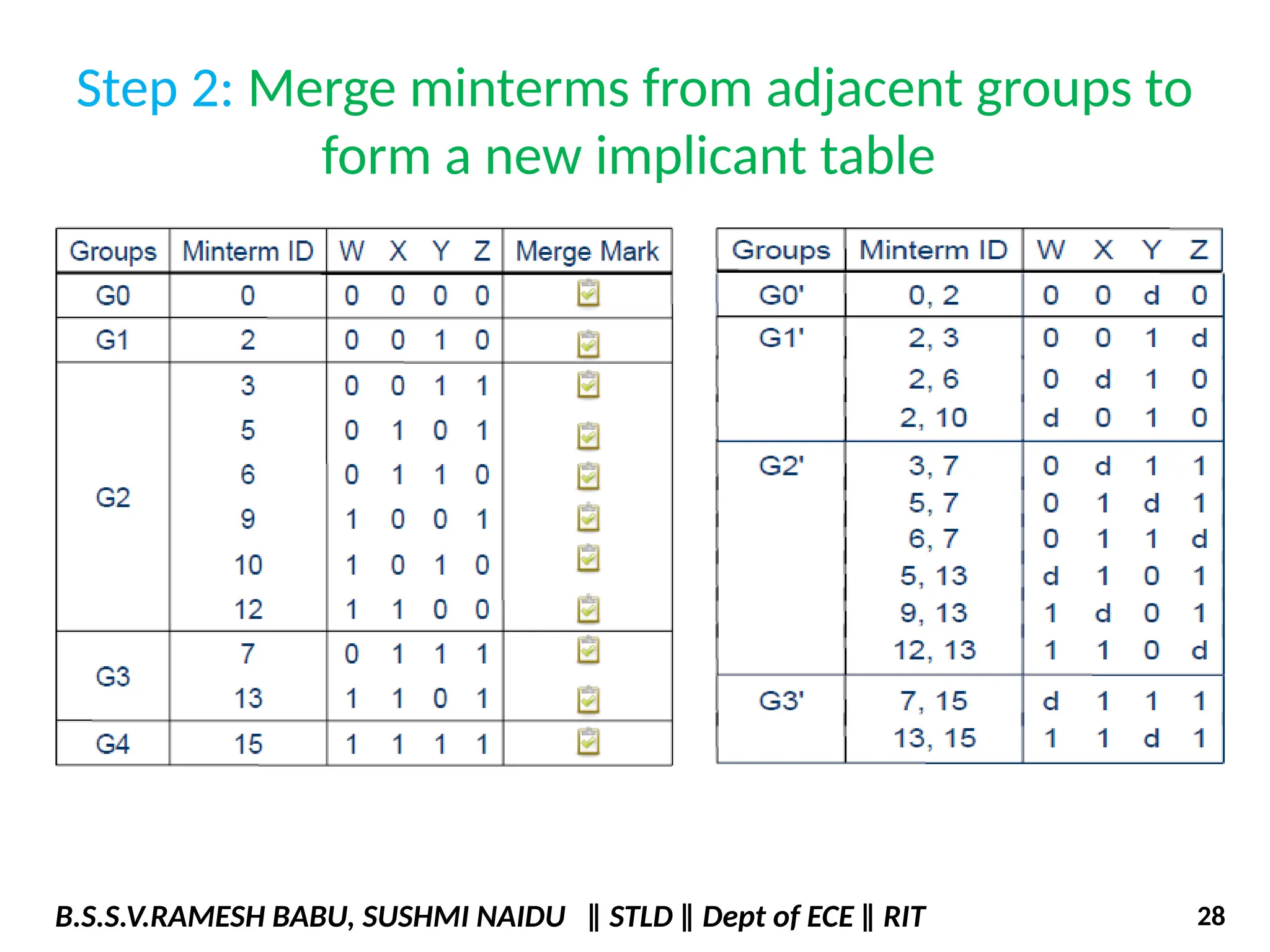
Step 2: Mergeminterms from adjacent groups to
form a new implicant table
B.S.S.V.RAMESH BABU, SUSHMI NAIDU ‖ STLD ‖ Dept of ECE ‖ RIT 28
32.
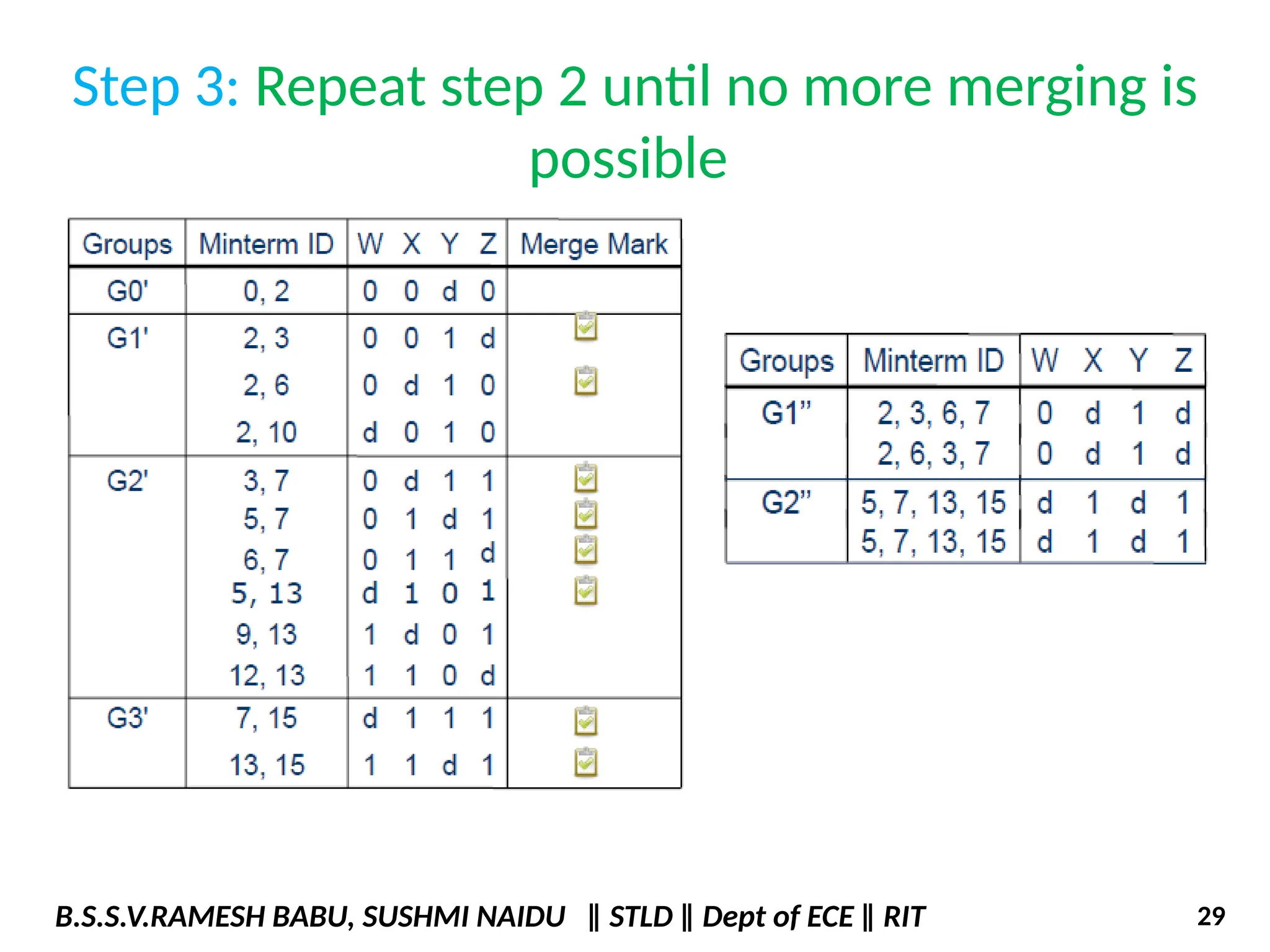
Step 3: Repeatstep 2 until no more merging is
possible
B.S.S.V.RAMESH BABU, SUSHMI NAIDU ‖ STLD ‖ Dept of ECE ‖ RIT 29
33.
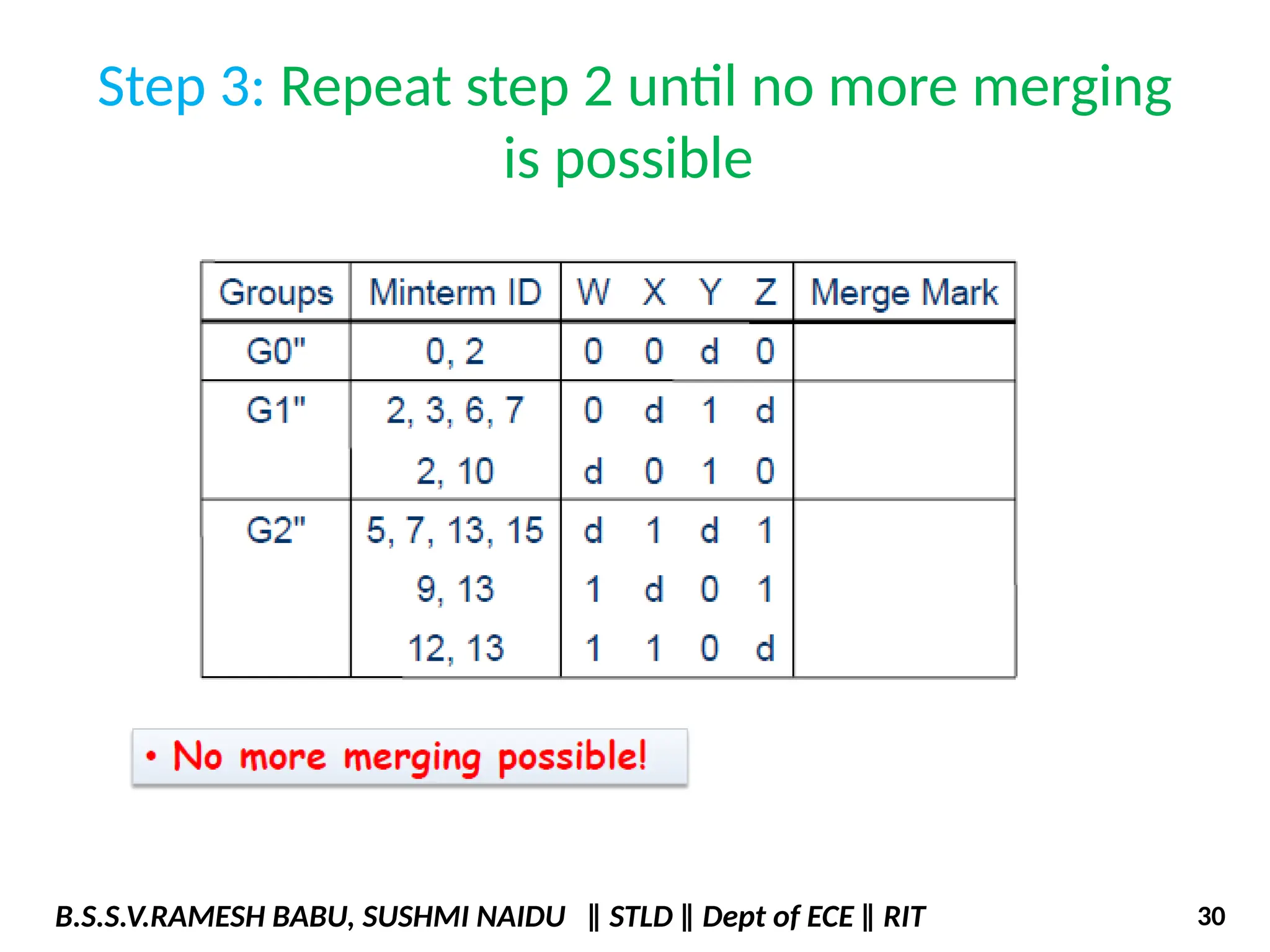
Step 3: Repeatstep 2 until no more merging
is possible
B.S.S.V.RAMESH BABU, SUSHMI NAIDU ‖ STLD ‖ Dept of ECE ‖ RIT 30
34.
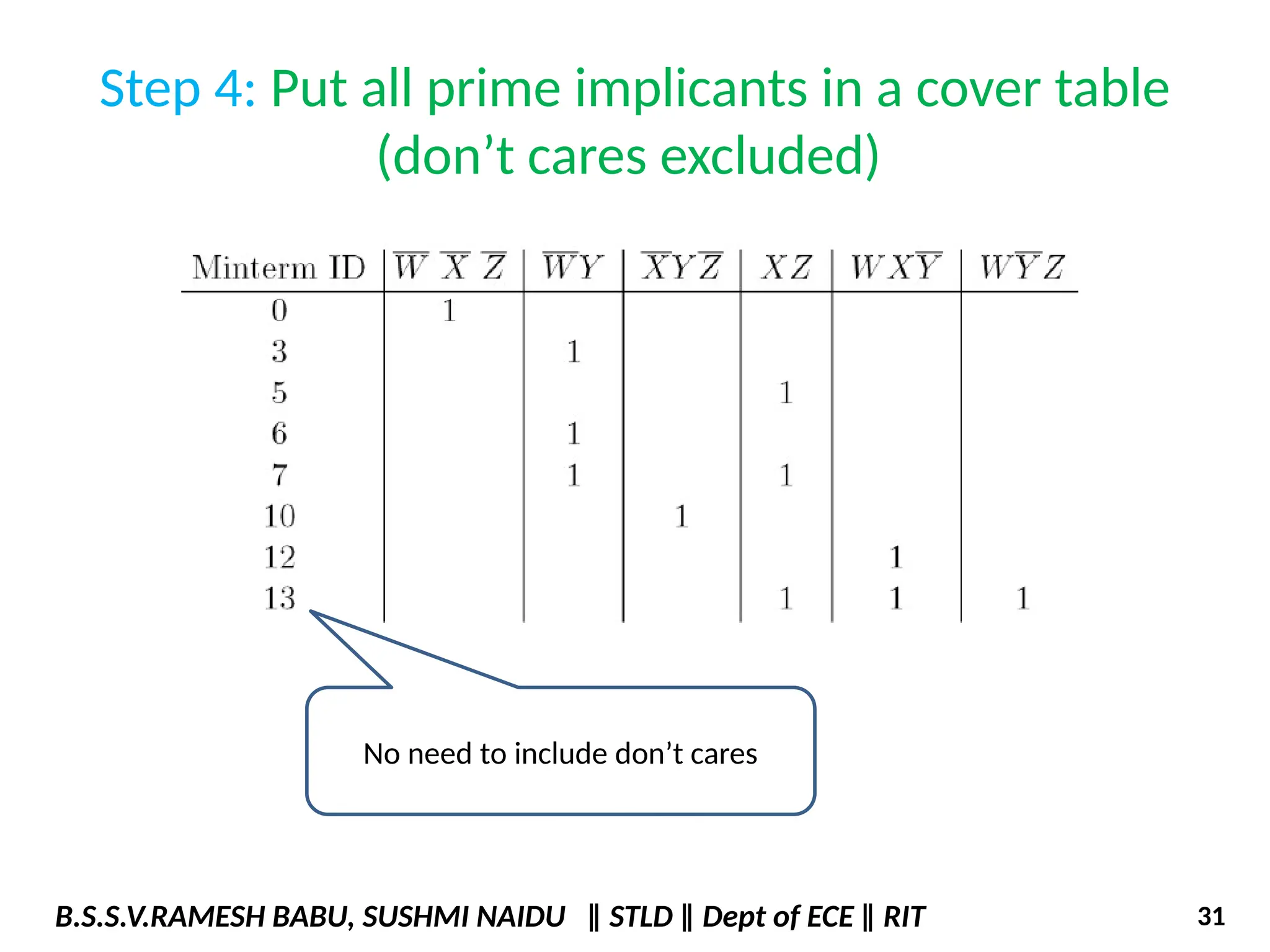
Step 4: Putall prime implicants in a cover table
(don’t cares excluded)
No need to include don’t cares
B.S.S.V.RAMESH BABU, SUSHMI NAIDU ‖ STLD ‖ Dept of ECE ‖ RIT 31
35.
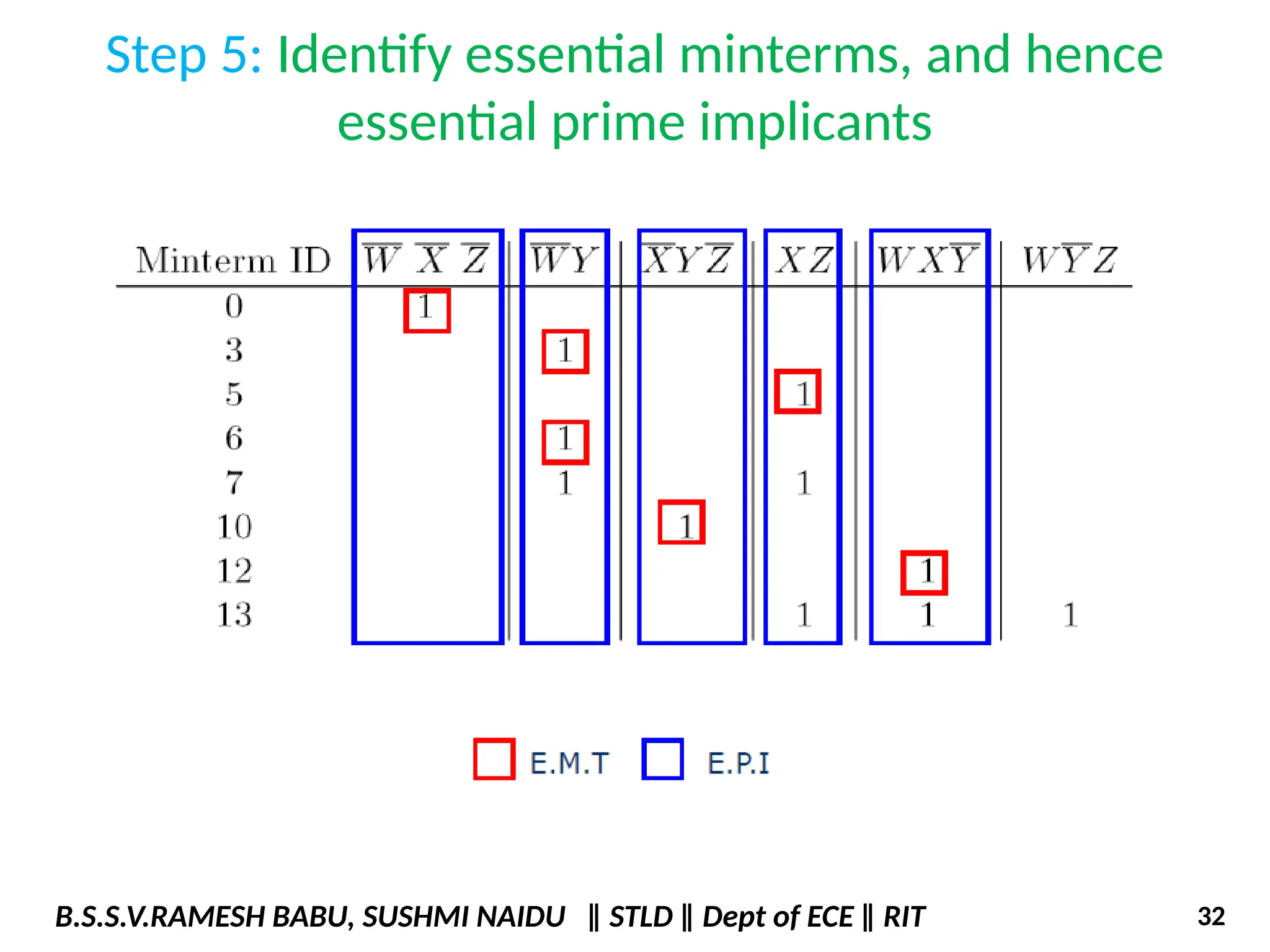
Step 5: Identifyessential minterms, and hence
essential prime implicants
B.S.S.V.RAMESH BABU, SUSHMI NAIDU ‖ STLD ‖ Dept of ECE ‖ RIT 32
36.
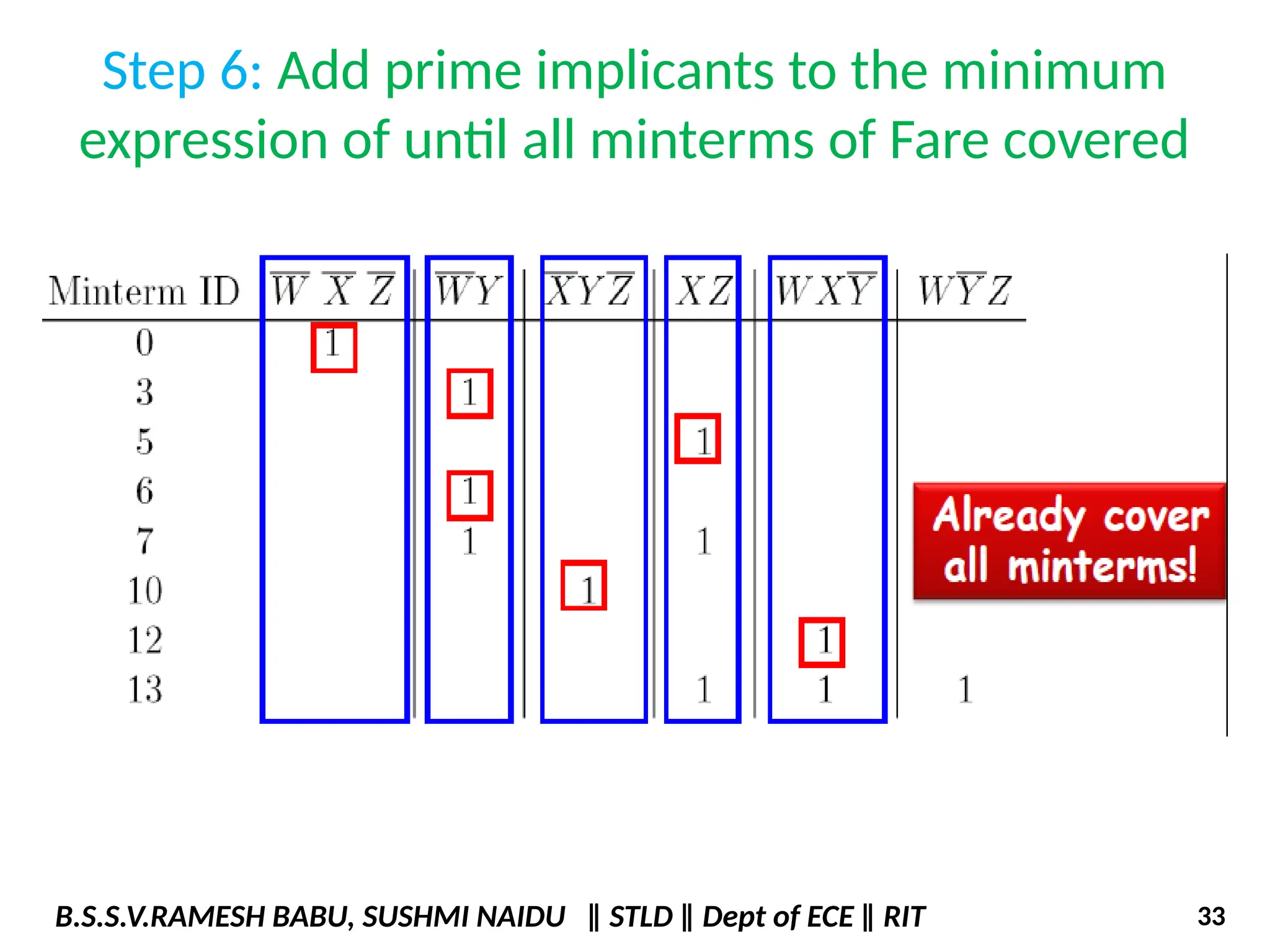
Step 6: Addprime implicants to the minimum
expression of until all minterms of Fare covered
B.S.S.V.RAMESH BABU, SUSHMI NAIDU ‖ STLD ‖ Dept of ECE ‖ RIT 33
37.
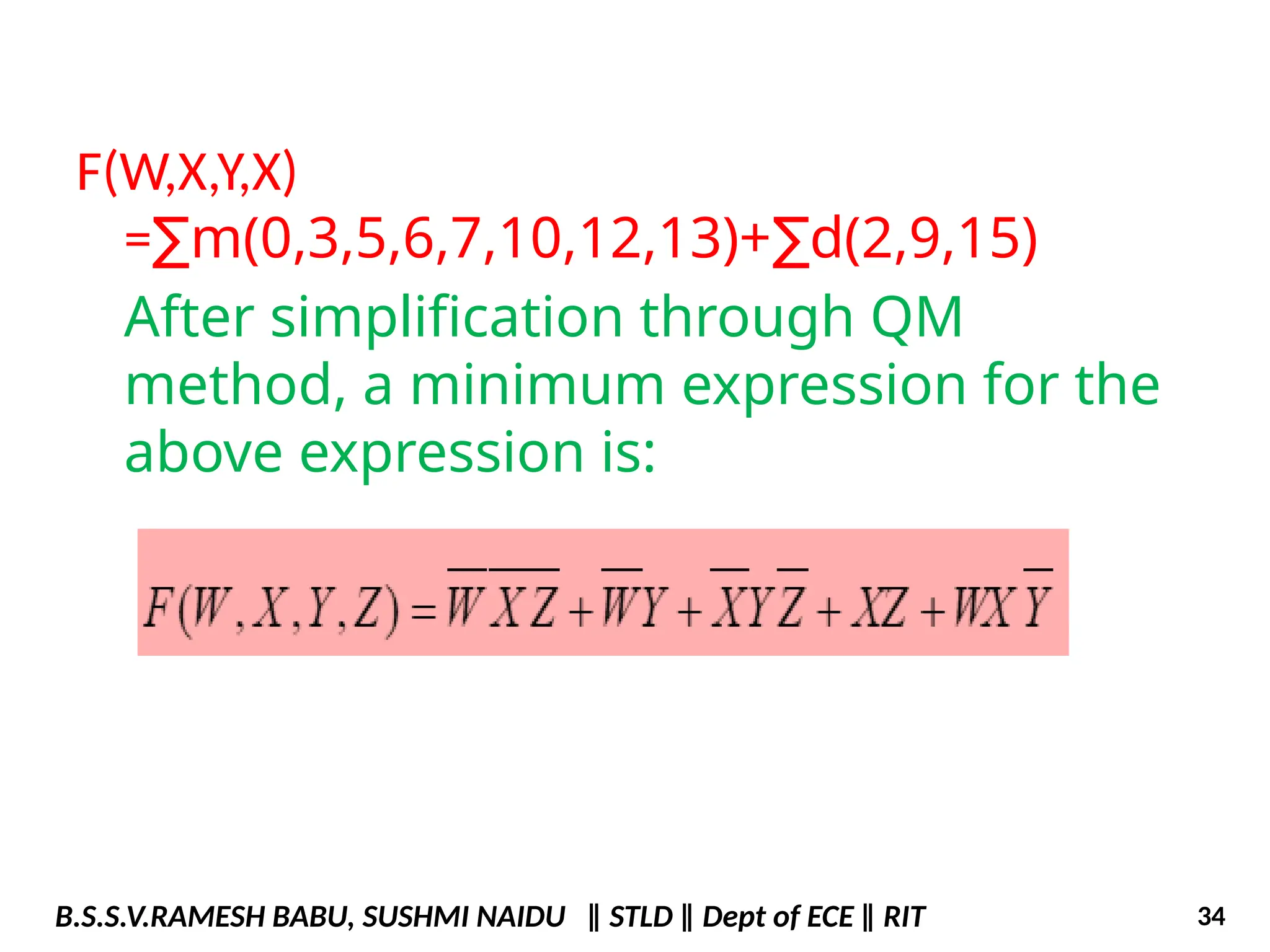
F(W,X,Y,X)
= m(0,3,5,6,7,10,12,13)+ d(2,9,15)
∑∑
After simplification through QM
method, a minimum expression for the
above expression is:
B.S.S.V.RAMESH BABU, SUSHMI NAIDU ‖ STLD ‖ Dept of ECE ‖ RIT 34
38.
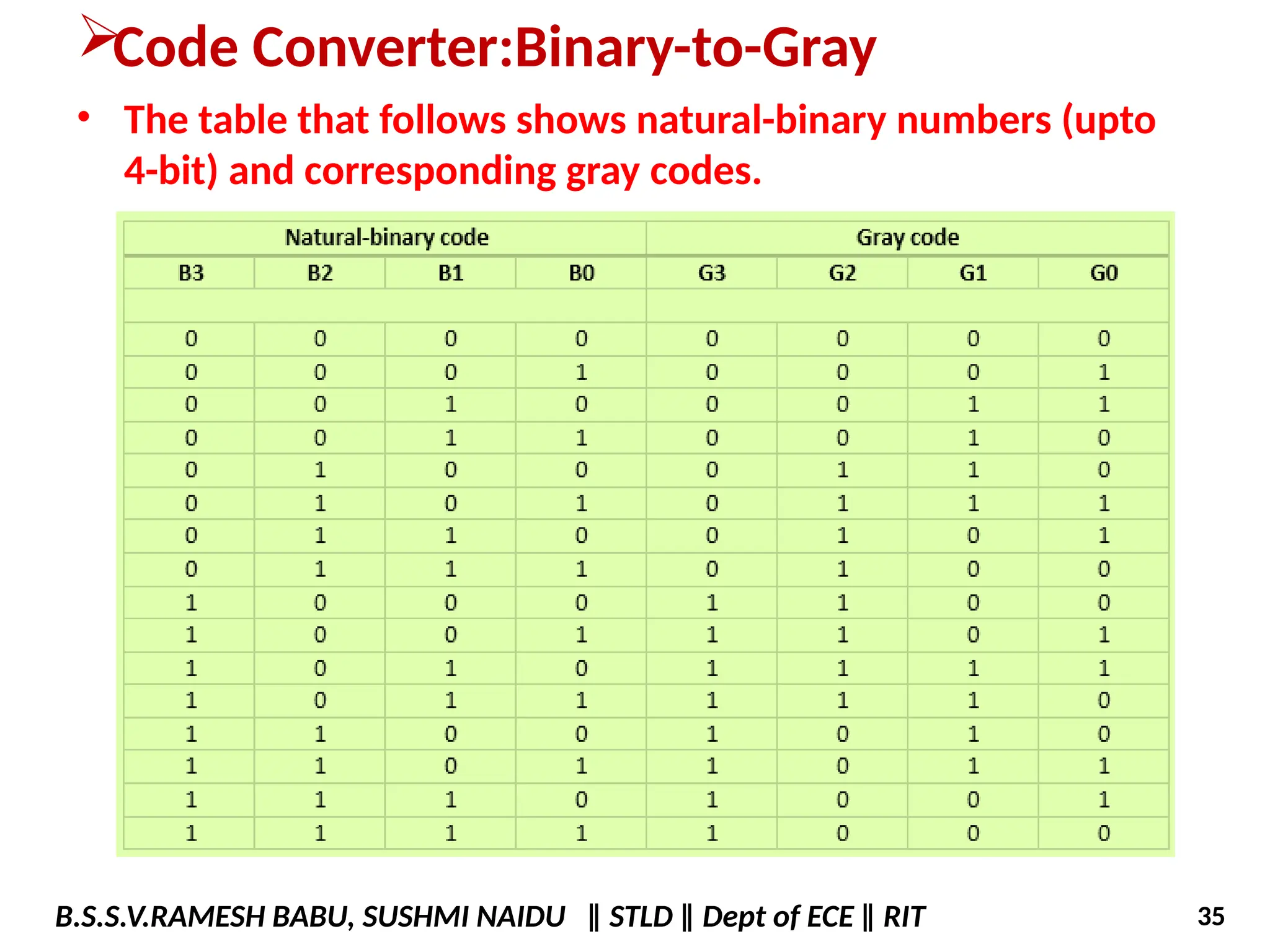
Code Converter:Binary-to-Gray
• Thetable that follows shows natural-binary numbers (upto
4-bit) and corresponding gray codes.
B.S.S.V.RAMESH BABU, SUSHMI NAIDU ‖ STLD ‖ Dept of ECE ‖ RIT 35
39.
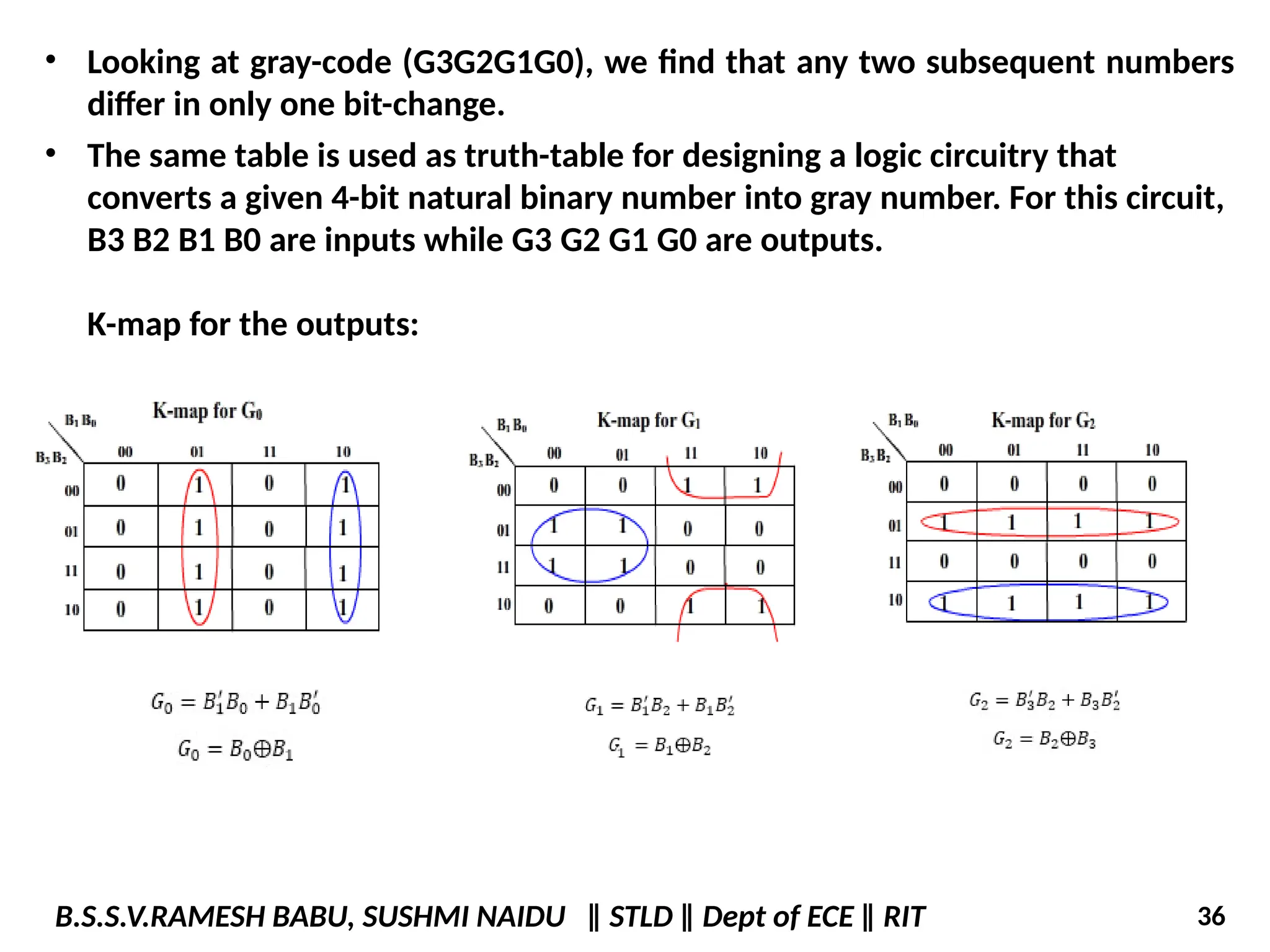
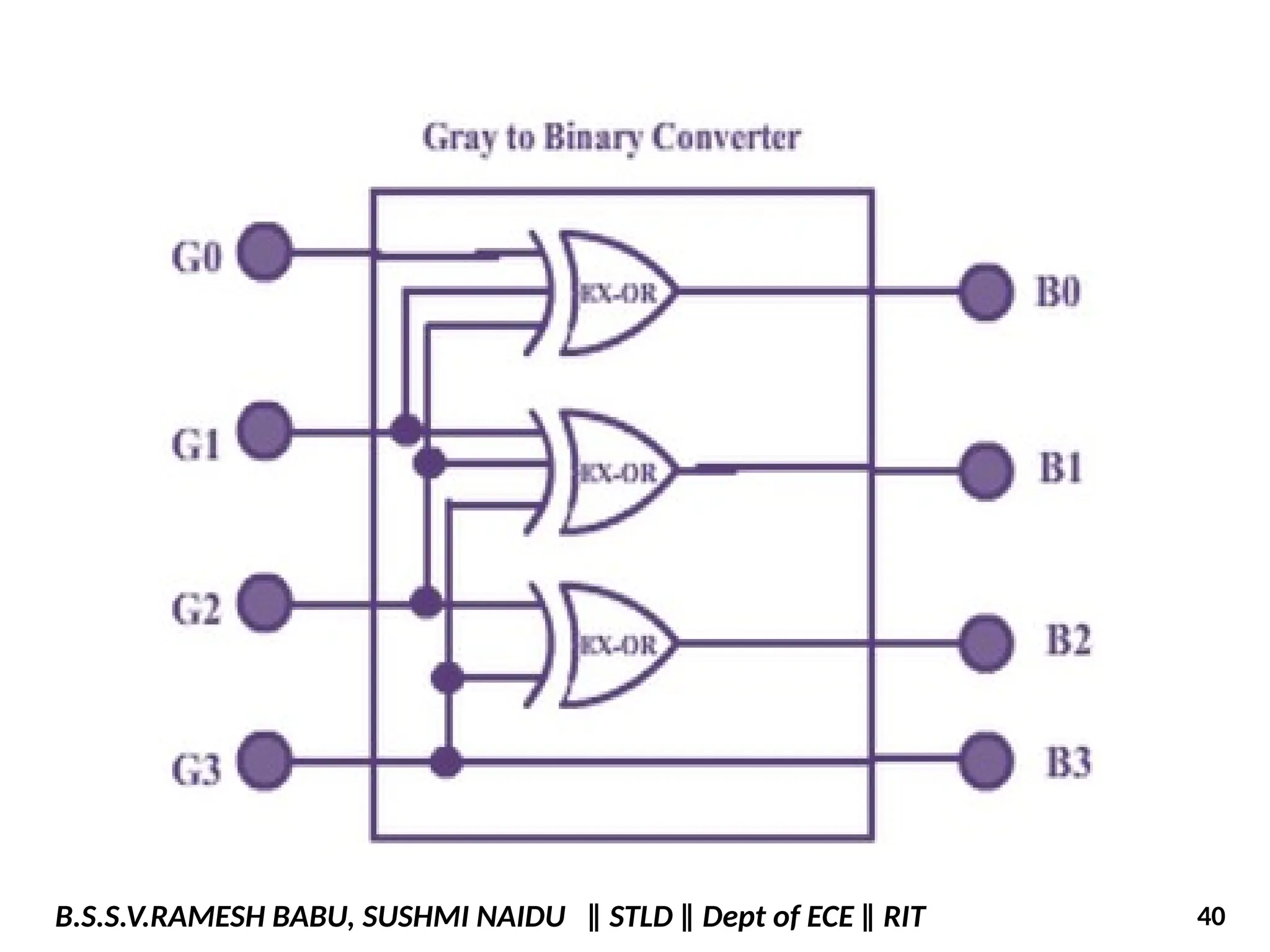
• Looking atgray-code (G3G2G1G0), we find that any two subsequent numbers
differ in only one bit-change.
• The same table is used as truth-table for designing a logic circuitry that
converts a given 4-bit natural binary number into gray number. For this circuit,
B3 B2 B1 B0 are inputs while G3 G2 G1 G0 are outputs.
K-map for the outputs:
B.S.S.V.RAMESH BABU, SUSHMI NAIDU ‖ STLD ‖ Dept of ECE ‖ RIT 36
40.
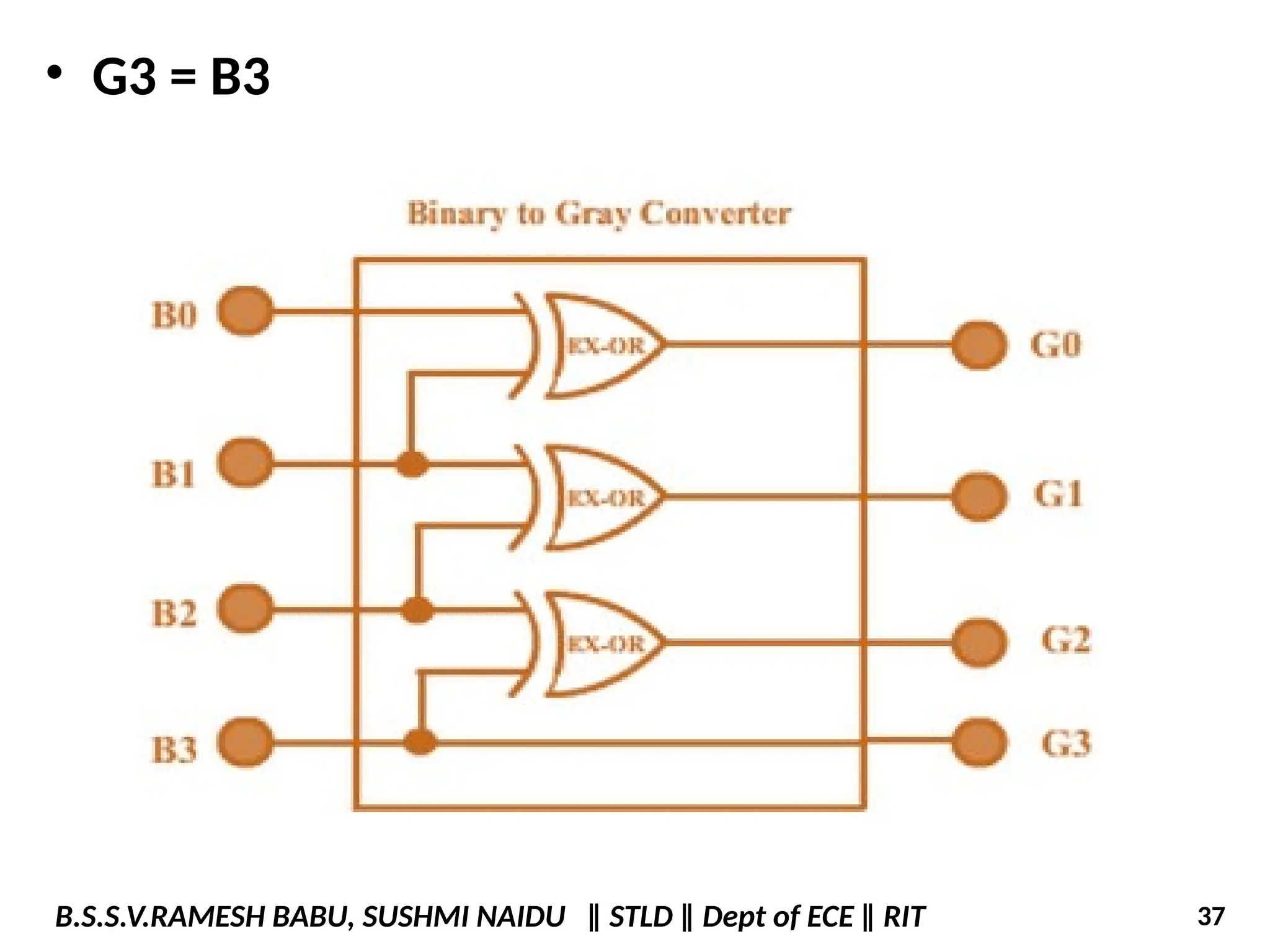
• G3 =B3
B.S.S.V.RAMESH BABU, SUSHMI NAIDU ‖ STLD ‖ Dept of ECE ‖ RIT 37
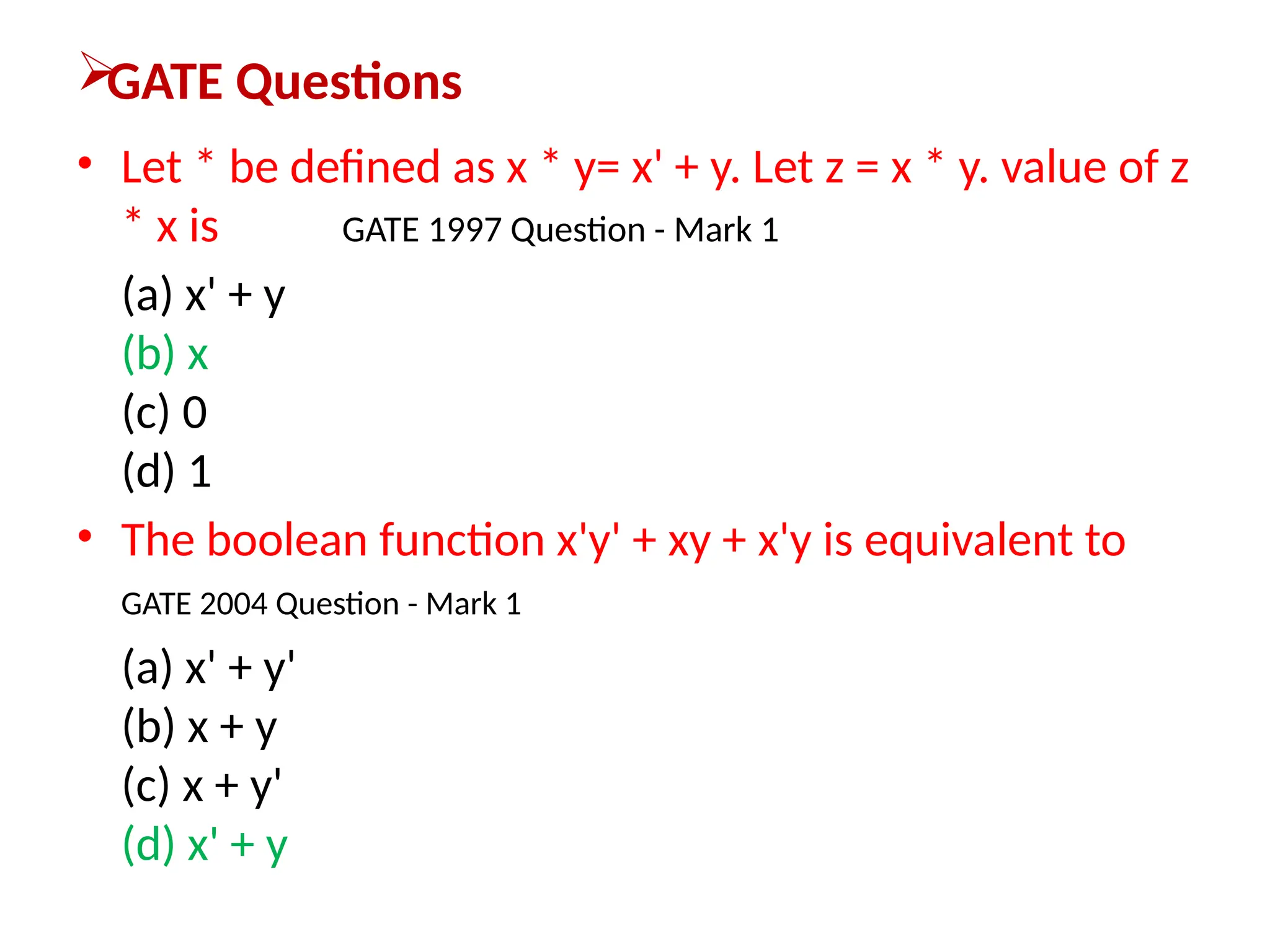
GATE Questions
• Let* be defined as x * y= x' + y. Let z = x * y. value of z
* x is GATE 1997 Question - Mark 1
(a) x' + y
(b) x
(c) 0
(d) 1
• The boolean function x'y' + xy + x'y is equivalent to
GATE 2004 Question - Mark 1
(a) x' + y'
(b) x + y
(c) x + y'
(d) x' + y
45.
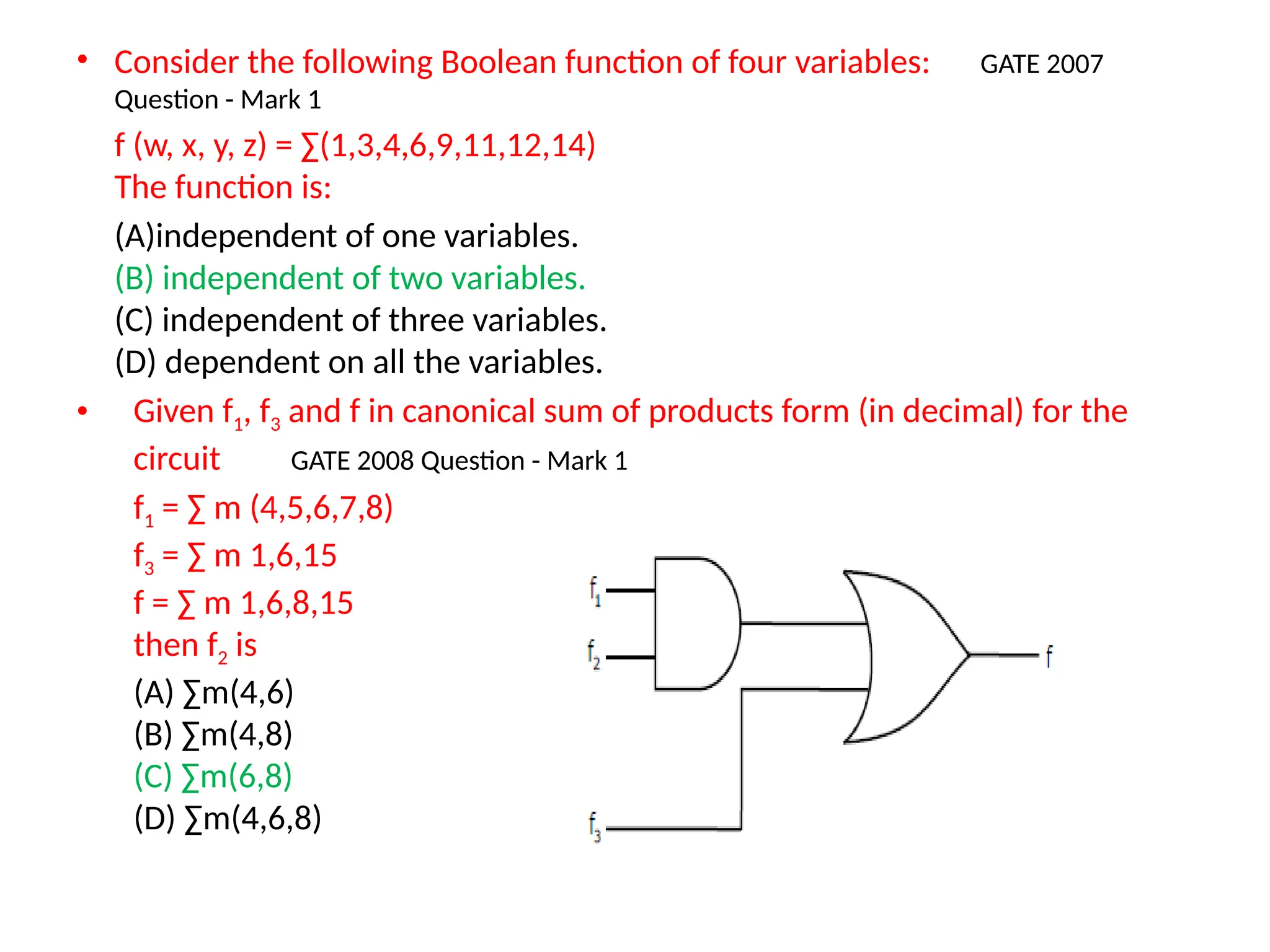
• Consider thefollowing Boolean function of four variables: GATE 2007
Question - Mark 1
f (w, x, y, z) = ∑(1,3,4,6,9,11,12,14)
The function is:
(A)independent of one variables.
(B) independent of two variables.
(C) independent of three variables.
(D) dependent on all the variables.
• Given f1, f3 and f in canonical sum of products form (in decimal) for the
circuit GATE 2008 Question - Mark 1
f1 = ∑ m (4,5,6,7,8)
f3 = ∑ m 1,6,15
f = ∑ m 1,6,8,15
then f2 is
(A) ∑m(4,6)
(B) ∑m(4,8)
(C) ∑m(6,8)
(D) ∑m(4,6,8)
46.
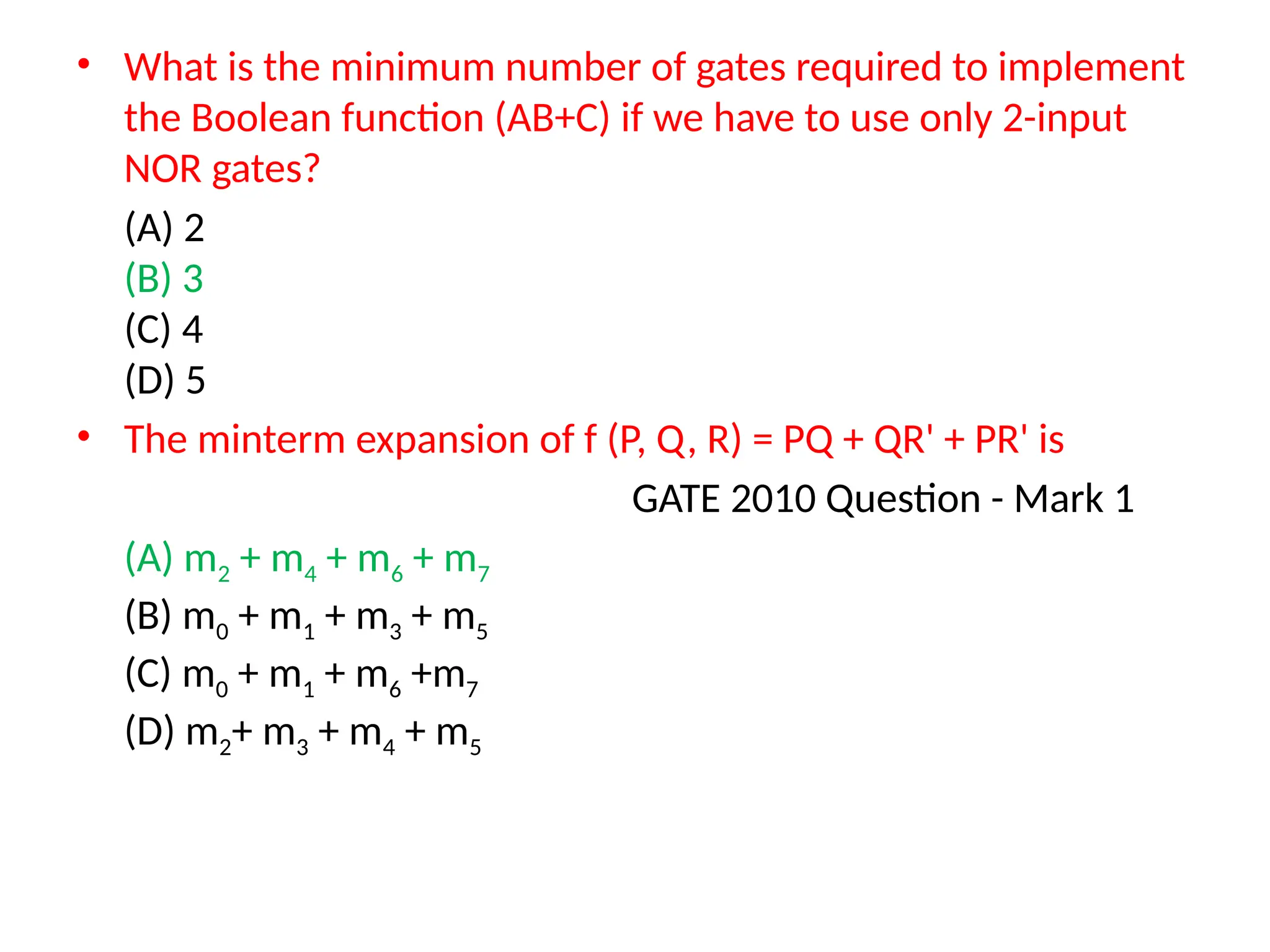
• What isthe minimum number of gates required to implement
the Boolean function (AB+C) if we have to use only 2-input
NOR gates?
(A) 2
(B) 3
(C) 4
(D) 5
• The minterm expansion of f (P, Q, R) = PQ + QR' + PR' is
GATE 2010 Question - Mark 1
(A) m2 + m4 + m6 + m7
(B) m0 + m1 + m3 + m5
(C) m0 + m1 + m6 +m7
(D) m2+ m3 + m4 + m5
47.
• The simplifiedSOP (Sum of Product) form of the Boolean
expression (P + Q' + R').(P + Q' + R).(P + Q + R') is
GATE 2011 1st Question - Mark 1
(A) (P'Q + R')
(B) (P + Q'R')
(C) (P'Q + R)
(D) (PQ + R)
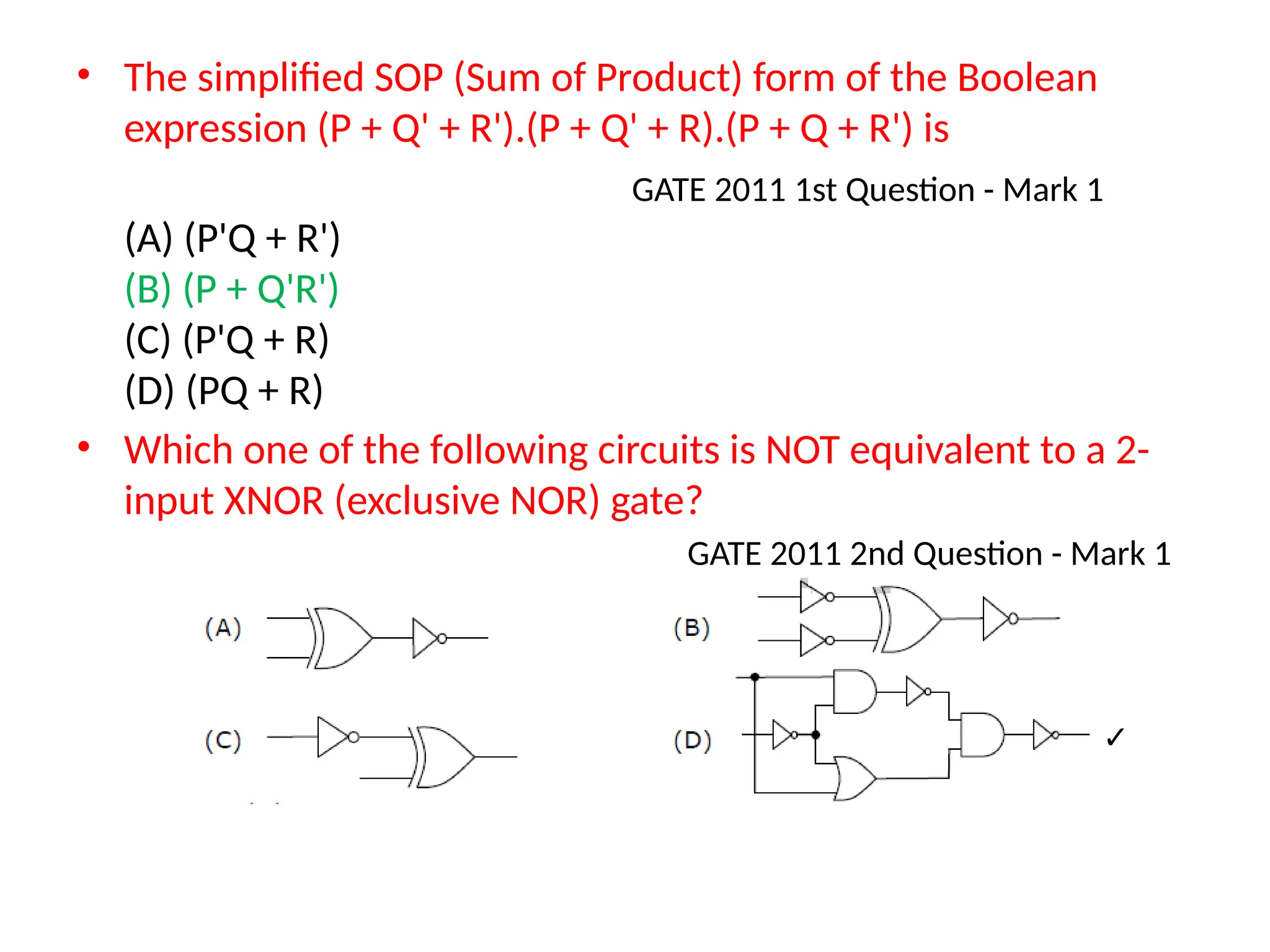
• Which one of the following circuits is NOT equivalent to a 2-
input XNOR (exclusive NOR) gate?
GATE 2011 2nd Question - Mark 1
✓
48.
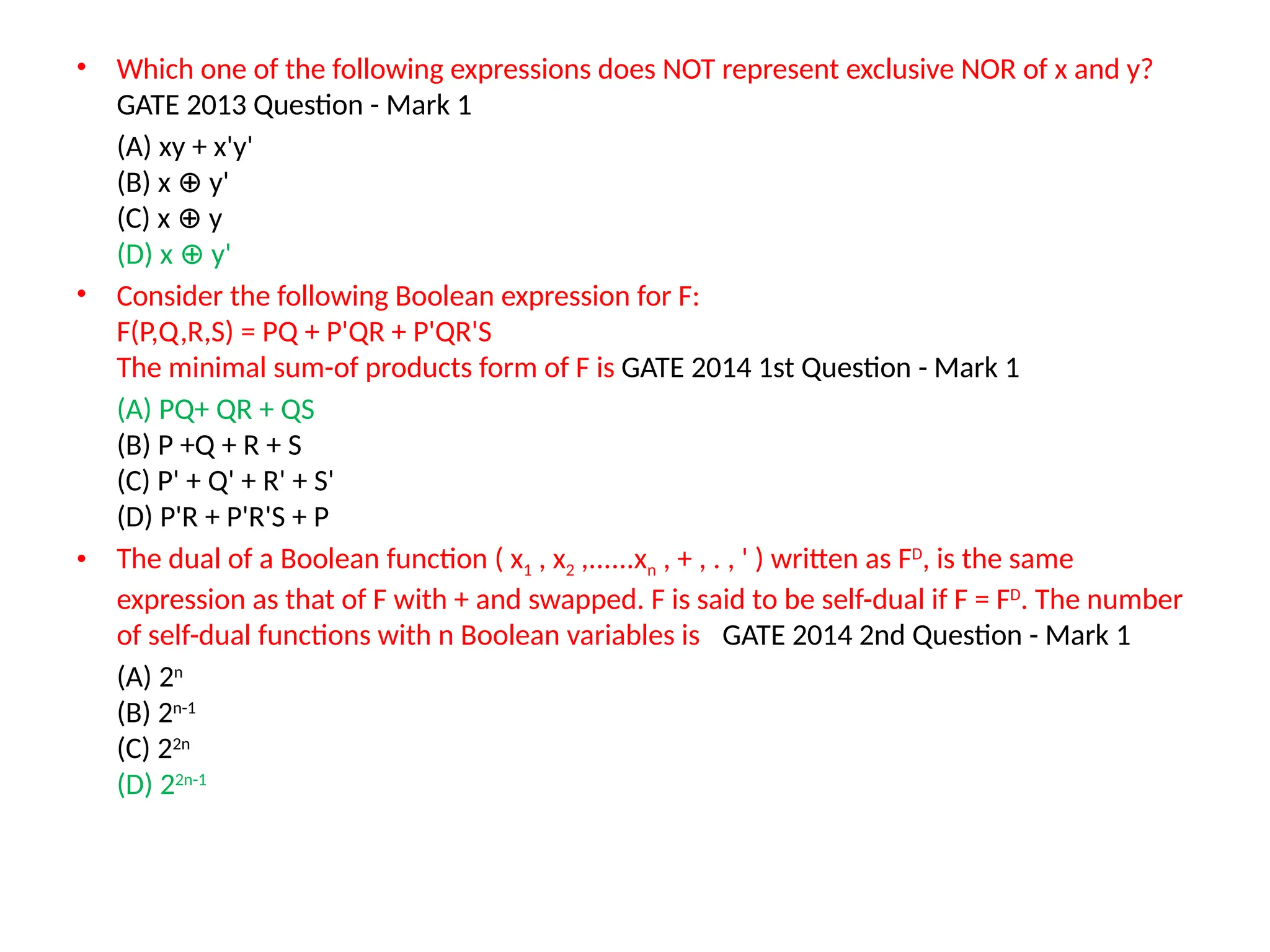
• Which oneof the following expressions does NOT represent exclusive NOR of x and y?
GATE 2013 Question - Mark 1
(A) xy + x'y'
(B) x y'
⊕
(C) x y
⊕
(D) x y'
⊕
• Consider the following Boolean expression for F:
F(P,Q,R,S) = PQ + P'QR + P'QR'S
The minimal sum-of products form of F is GATE 2014 1st Question - Mark 1
(A) PQ+ QR + QS
(B) P +Q + R + S
(C) P' + Q' + R' + S'
(D) P'R + P'R'S + P
• The dual of a Boolean function ( x1 , x2 ,......xn , + , . , ' ) written as FD
, is the same
expression as that of F with + and swapped. F is said to be self-dual if F = FD
. The number
of self-dual functions with n Boolean variables is GATE 2014 2nd Question - Mark 1
(A) 2n
(B) 2n-1
(C) 22n
(D) 22n-1
49.
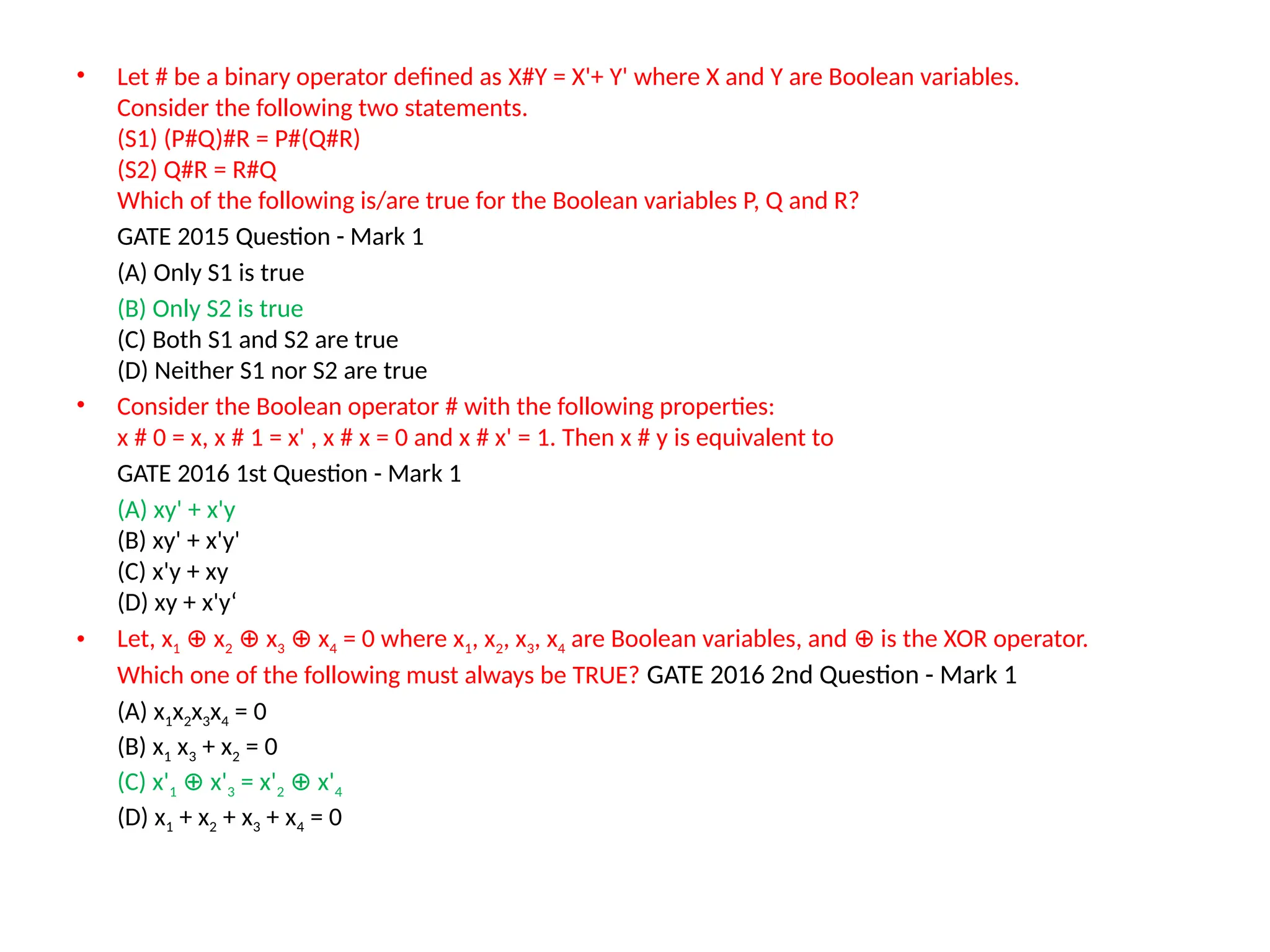
• Let #be a binary operator defined as X#Y = X'+ Y' where X and Y are Boolean variables.
Consider the following two statements.
(S1) (P#Q)#R = P#(Q#R)
(S2) Q#R = R#Q
Which of the following is/are true for the Boolean variables P, Q and R?
GATE 2015 Question - Mark 1
(A) Only S1 is true
(B) Only S2 is true
(C) Both S1 and S2 are true
(D) Neither S1 nor S2 are true
• Consider the Boolean operator # with the following properties:
x # 0 = x, x # 1 = x' , x # x = 0 and x # x' = 1. Then x # y is equivalent to
GATE 2016 1st Question - Mark 1
(A) xy' + x'y
(B) xy' + x'y'
(C) x'y + xy
(D) xy + x'y‘
• Let, x1 x
⊕ 2 x
⊕ 3 x
⊕ 4 = 0 where x1, x2, x3, x4 are Boolean variables, and is the XOR operator.
⊕
Which one of the following must always be TRUE? GATE 2016 2nd Question - Mark 1
(A) x1x2x3x4 = 0
(B) x1 x3 + x2 = 0
(C) x'1 x'
⊕ 3 = x'2 x'
⊕ 4
(D) x1 + x2 + x3 + x4 = 0
50.
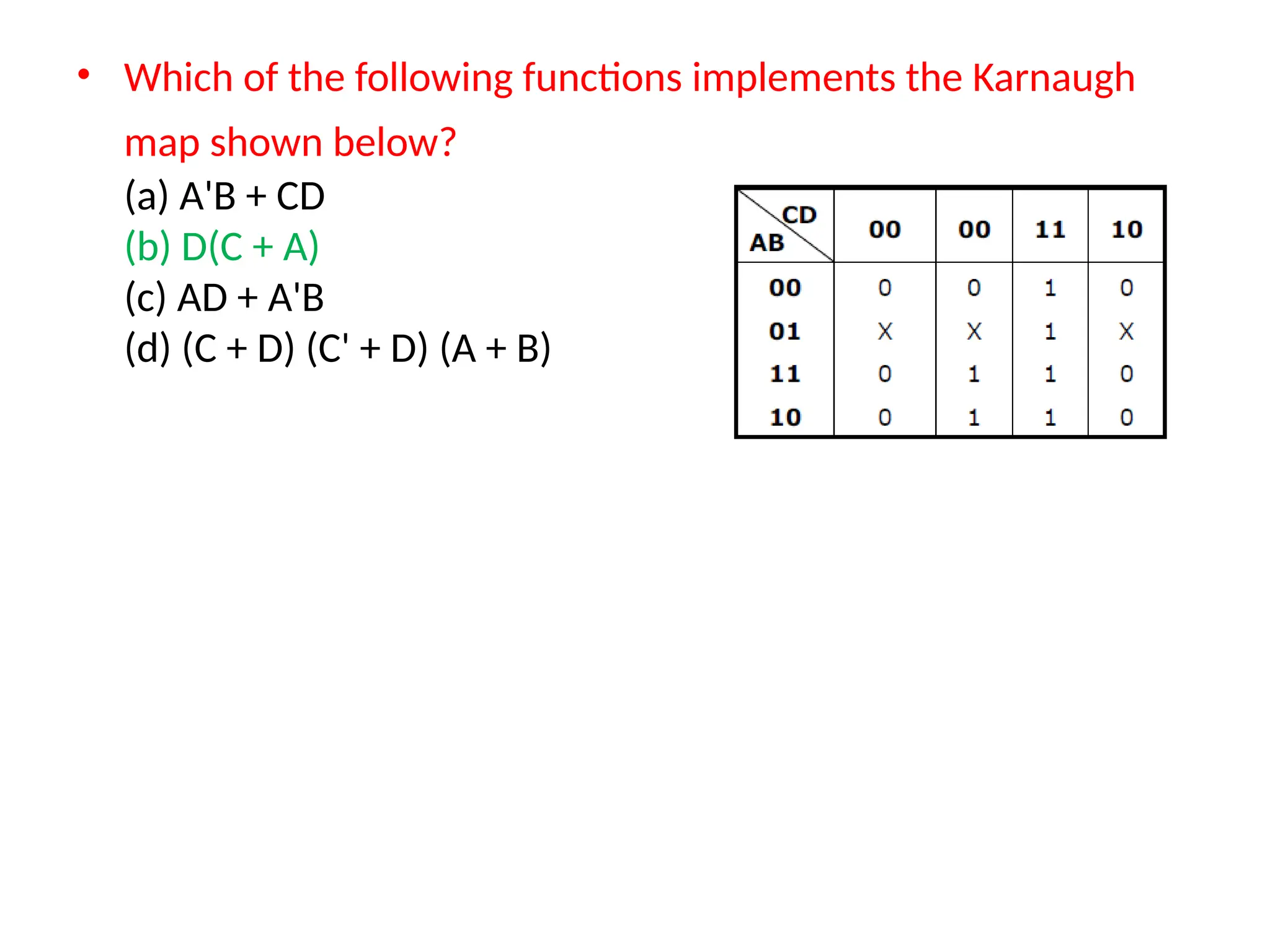
• Which ofthe following functions implements the Karnaugh
map shown below?
(a) A'B + CD
(b) D(C + A)
(c) AD + A'B
(d) (C + D) (C' + D) (A + B)



![Rules & Laws (Contd…)
• Absorption law: x + xy = x
x(x + y) = x
• Proof: x + xy = x1 + xy [basic property]
= x(1 + y) [distributive]
= x1 [commutative and basic
property]
= x [basic property]
• Another important law: x + x’y = x + y
x(x’ + y) = xy
B.S.S.V.RAMESH BABU, SUSHMI NAIDU ‖ STLD ‖ Dept of ECE ‖ RIT 6](https://image.slidesharecdn.com/stldunit2-250722132424-b1edaa45/75/STLD-UNIT-2-to-design-for-logic-circuits-8-2048.jpg)
![Rules & Laws (Contd…)
• Proof: x + x’y = (x + x’)(x + y) [distributive]
= 1(x + y) [complementation]
= x + y [commutative and basic property]
• Consensus theorem: xy + x’z + yz = xy + x’z
(x + y)(x’ + z)(y + z) = (x + y)(x’ + z)
• Proof: xy + x’z + yz = xy + x’z + yz1
= xy + x’z + yz(x+x’)
= xy(1 + z) + x’z(1 + y)
= xy + x’z
Involution: (x’)’ = x
B.S.S.V.RAMESH BABU, SUSHMI NAIDU ‖ STLD ‖ Dept of ECE ‖ RIT 7](https://image.slidesharecdn.com/stldunit2-250722132424-b1edaa45/75/STLD-UNIT-2-to-design-for-logic-circuits-9-2048.jpg)
![Minimization of logic functions using
Boolean theorems
• Example:
Simplify
T(x,y,z) = (x + y)[x’(y’ + z’)]’ + x’y’ + x’z’
(x + y)[x’(y’ + z’)]’ + x’y’ + x’z’
= (x + y)(x + yz) + x’y’ + x’z’
= (x + xyz + yx + yz) + x’y’ + x’z’
= x + yz + x’y’ + x’z’
= x + yz + y’ + z’
= x + z + y’ + z’
= x + y’ + 1
= 1
B.S.S.V.RAMESH BABU, SUSHMI NAIDU ‖ STLD ‖ Dept of ECE ‖ RIT 11](https://image.slidesharecdn.com/stldunit2-250722132424-b1edaa45/75/STLD-UNIT-2-to-design-for-logic-circuits-13-2048.jpg)



![Structures_and_Files[1] - Read-Only.pptx](https://cdn.slidesharecdn.com/ss_thumbnails/structuresandfiles1-read-only-250228040208-49ef0751-thumbnail.jpg?width=640&height=640&fit=bounds)


