16of38
Successful People Replace the words like; "wish", "try" & "should" with "I Will". Ineffective People don't.
TEKOCLASSES,H.O.D.MATHS:SUHAGR.KARIYA(S.R.K.Sir)PH:(0755)-3200000,09893058881,BHOPAL,(M.P.)
FREEDownloadStudyPackagefromwebsite:www.tekoclasses.com
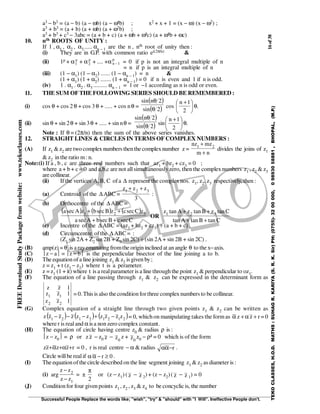
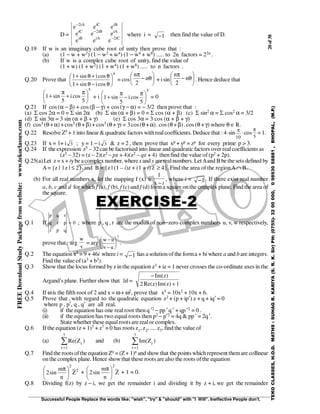
a3 − b3 = (a − b) (a − ωb) (a − ω²b) ; x2 + x + 1 = (x − ω) (x − ω2) ;
a3 + b3 = (a + b) (a + ωb) (a + ω2b) ;
a3 + b3 + c3 − 3abc = (a + b + c) (a + ωb + ω²c) (a + ω²b + ωc)
10. nth ROOTS OF UNITY :
If 1 , α1 , α2 , α3 ..... αn − 1 are the n , nth root of unity then :
(i) They are in G.P. with common ratio ei(2π/n) &
(ii) 1p + α1
p
+ α2
p
+ .... +α n
p
−1 = 0 if p is not an integral multiple of n
= n if p is an integral multiple of n
(iii) (1 − α1) (1 − α2) ...... (1 − αn − 1) = n &
(1 + α1) (1 + α2) ....... (1 + αn − 1) = 0 if n is even and 1 if n is odd.
(iv) 1 . α1 . α2 . α3 ......... αn − 1 = 1 or −1 according as n is odd or even.
11. THE SUM OF THE FOLLOWING SERIES SHOULD BE REMEMBERED :
(i) cos θ + cos 2 θ + cos 3 θ + ..... + cos nθ =
( )
( )2sin
2nsin
θ
θ
cos 




 +
2
1n
θ.
(ii) sin θ + sin 2θ + sin 3θ + ..... + sin nθ =
( )
( )2sin
2nsin
θ
θ
sin 




 +
2
1n
θ.
Note : If θ = (2π/n) then the sum of the above series vanishes.
12. STRAIGHT LINES & CIRCLES IN TERMS OF COMPLEX NUMBERS :
(A) If z1 &z2 are two complex numbersthenthecomplexnumber z =
nm
mznz 21
+
+
divides the joins of z1
& z2 in the ratio m: n.
Note:(i) If a , b , c are three real numbers such that az1 + bz2 + cz3 = 0 ;
where a + b + c = 0 and a,b,c are not allsimultaneouslyzero, then the complexnumbers z1 , z2 & z3
are collinear.
(ii) Ifthe vertices A, B, C ofa ∆ represent the complexnos. z1, z2, z3 respectively, then :
(a) Centroid of the ∆ABC =
3
zzz 321 ++
:
(b) Orthocentre of the ∆ABC =
( ) ( ) ( )
CseccBsecbAseca
zCsecczBsecbzAseca 321
++
++
OR
CtanBtanAtan
CtanzBtanzAtanz 321
++
++
(c) Incentre of the ∆ ABC = (az1 + bz2 + cz3) ÷ (a + b + c) .
(d) Circumcentre ofthe ∆ABC= :
(Z1 sin 2A + Z2 sin 2B + Z3 sin 2C) ÷ (sin 2A + sin 2B + sin 2C) .
(B) amp(z) = θ is arayemanating fromthe origin inclined at an angle θ to the x−axis.
(C) z − a = z − b is the perpendicular bisector of the line joining a to b.
(D) The equation ofa line joining z1 & z2 is given by;
z = z1 + t (z1 − z2) where t is a perameter.
(E) z = z1 (1 + it) where t is a realparameter is a line through the point z1 &perpendicular to oz1.
(F) The equation of a line passing through z1 & z2 can be expressed in the determinant form as
1zz
1zz
1zz
22
11 = 0. This is also the condition for three complex numbers to be collinear..
(G) Complex equation of a straight line through two given points z1 & z2 can be written as
( ) ( ) ( )21212121 zzzzzzzzzz −+−−− = 0, which on manipulating takes the formas rzz +α+α = 0
where r is realand α isa non zero complex constant.
(H) The equation of circle having centre z0 & radius ρ is :
z − z0 = ρ or z z − z0 z − 0z z + 0z z0 − ρ² = 0 which is of the form
rzzzz +α+α+ = 0 , r is real centre − α & radius r−αα .
Circle willbe realif 0r ≥−αα .
(I) The equation ofthe circle described on the line segment joining z1 &z2 asdiameter is :
(i) arg
1
2
zz
zz
−
−
= ±
2
π
or (z − z1) ( z − z 2) + (z − z2)( z − z 1) = 0
(J) Condition for four given points z1 , z2 , z3 & z4 to be concyclicis, the number
17of38
Successful People Replace the words like; "wish", "try" & "should" with "I Will". Ineffective People don't.
TEKOCLASSES,H.O.D.MATHS:SUHAGR.KARIYA(S.R.K.Sir)PH:(0755)-3200000,09893058881,BHOPAL,(M.P.)
FREEDownloadStudyPackagefromwebsite:www.tekoclasses.com
14
24
23
13
zz
zz
.
zz
zz
−
−
−
−
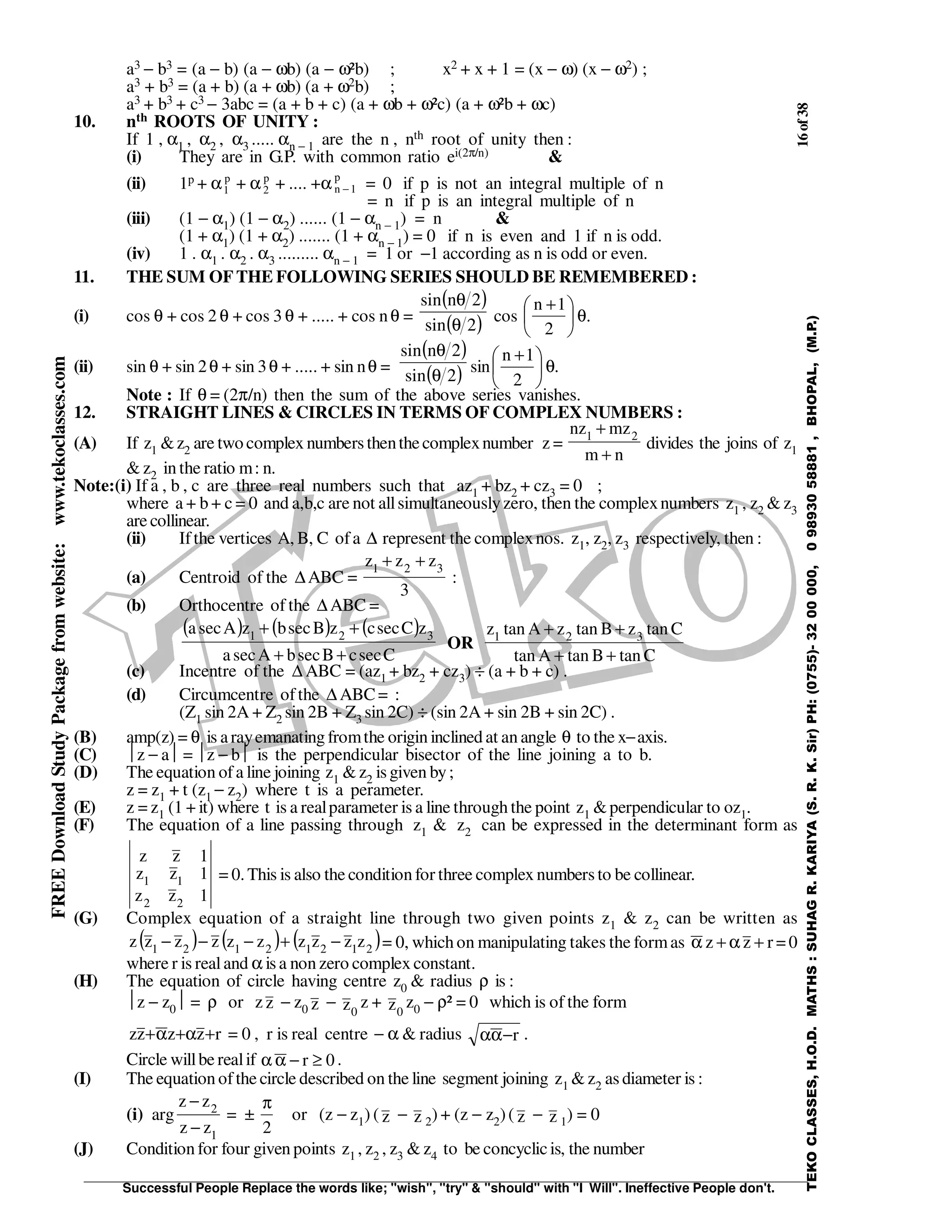
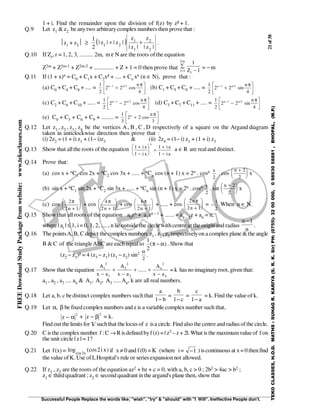
is real. Hence theequationofa circle through3noncollinear pointsz1, z2 &z3 canbe
taken as
( )( )
( )( )231
132
zzzz
zzzz
−−
−−
is real ⇒
( )( )
( )( )231
132
zzzz
zzzz
−−
−−
=
( )( )
( )( )231
132
zzzz
zzzz
−−
−−
13.(a) Reflection points for a straight line :
Two given points P & Q are the reflection points for a given straight line if the given line is the right
bisector of the segment PQ. Notethat thetwo points denoted bythe complexnumbers z1 &z2 willbe
the reflection pointsforthe straight line 0rzz =+α+α ifand onlyif; 0rzz 21
=+α+α , wherer is
realand α is nonzero complex constant.
(b) Inverse points w.r.t. a circle :
Two points P& Q are said to be inverse w.r.t. a circle with centre 'O' and radius ρ, if :
(i) the point O, P, Q are collinear and on the same side of O. (ii) OP . OQ = ρ2.
Note that the two points z1 &z2 willbe the inverse points w.r.t. the circle
0rzzzz =+α+α+ if and only if 0rzzzz 2121 =+α+α+ .
14. PTOLEMY’S THEOREM :It states that the product of the lengths of the diagonals of a
convex quadrilateral inscribed in a circle is equal to the sum of the lengths of the two pairs of
its opposite sides. i.e. z1 − z3 z2 − z4 = z1 − z2 z3 − z4 + z1 − z4 z2 − z3.
15. LOGARITHM OF A COMPLEX QUANTITY:
(i) Loge (α + i β) =
2
1
Loge (α² + β²) + i 





α
β
+π −1
tann2 where n ∈ I.
(ii) ii represents a set of positive real numbers given by





 π
+π−
2
n2
e , n ∈ I.
VERY ELEMENTARY EXERCISE
Q.1 Simplifyand expressthe result in theformof a + bi
(a)
2
i2
i21






+
+
(b) −i (9 + 6 i) (2 − i)−1 (c)
2
3
1i2
ii4








+
−
(d)
i52
i23
i52
i23
+
−
+
−
+
(e)
( ) ( )
i2
i2
i2
i2 22
+
−
−
−
+
Q.2 Given that x , y ∈ R, solve : (a) (x + 2y) + i (2x − 3y) = 5 − 4i (b) (x + iy) + (7 − 5i) = 9 + 4i
(c) x² − y² − i (2x + y) = 2i (d) (2 + 3i) x² − (3 − 2i) y = 2x − 3y + 5i
(e) 4x² + 3xy + (2xy − 3x²)i = 4y² − (x2/2) + (3xy − 2y²)i
Q.3 Find the square root of : (a) 9 + 40 i (b) −11 − 60 i (c) 50 i
Q.4 (a) If f (x) = x4 + 9x3 + 35x2 − x + 4, find f ( – 5 + 4i)
(b) If g (x) = x4 − x3 + x2 + 3x − 5, find g(2 + 3i)
Q.5 Among the complex numbersz satisfying thecondition z i+ − =3 3 3 , find the number having the
least positiveargument.
Q.6 Solve the following equations over C and expressthe result in theform a + ib, a, b ∈R.
(a) ix2 − 3x − 2i = 0 (b) 2 (1 + i) x2 − 4 (2 − i) x − 5 − 3 i = 0
Q.7 Locate the points representing the complexnumber zon theArgand plane:
(a) z +1 −2i = 7 ; (b) z z− + +1 1
2 2
= 4 ; (c)
z
z
−
+
3
3
= 3 ; (d) z −3 = z−6
Q.8 If a & b are real numbers between 0 & 1 such that the points z1 = a + i, z2 = 1 + bi & z3 = 0 forman
equilateraltriangle, then find the valuesof'a' and 'b'.
Q.9 For what real values of x & y are the numbers −3 + ix2 y & x2 + y + 4iconjugate complex?
Q.10 Find the modulus, argument and the principal argument of the complex numbers.
(i) 6 (cos310° − i sin 310°) (ii) −2 (cos 30° + i sin 30°) (iii)
2
4 1 2
+
+ +
i
i i( )
Q.11 If (x + iy)1/3 = a + bi ; prove that 4(a2 − b2) =
x
a
y
b
+ .
Q.12(a) If
a ib
c id
+
+
= p + qi , prove that p2 + q2 =
a b
c d
2 2
2 2
+
+
.
(b) Let z1, z2, z3 be the complex numbers such that
z1 + z2 + z3 = z1z2 + z2z3 + z3z1 = 0. Prove that | z1 | = | z2 | = | z3 |.
Q.13 Let z be a complex number such that z ∈ cR and 2
2
zz1
zz1
+−
++
∈ R, then prove that | z | =1.
Q.14 Prove the identity, ( )( )2
2
2
1
2
21
2
21 |z|1|z|1|zz||zz1| −−=−−−
18of38
Successful People Replace the words like; "wish", "try" & "should" with "I Will". Ineffective People don't.
TEKOCLASSES,H.O.D.MATHS:SUHAGR.KARIYA(S.R.K.Sir)PH:(0755)-3200000,09893058881,BHOPAL,(M.P.)
FREEDownloadStudyPackagefromwebsite:www.tekoclasses.com
Q.15 For any two complex numbers, prove that z z z z1 2
2
1 2
2
+ + − = 2 [ ]z z1
2
2
2
+ . Also give the
geometricalinterpretationofthisidentity.
Q.16 (a) Find all non−zero complex numbers Z satisfying Z = i Z².
(b) Ifthe complex numbers z1, z2, .................zn lieon the unit circle|z| = 1 then show that
|z1 + z2 + ..............+zn| = |z1
–1+ z2
–1+................+zn
–1| .
Q.17 Find the Cartesianequation ofthe locus of'z' in the complexplane satisfying, | z – 4 | + | z + 4 | = 16.
Q.18 If ω is an imaginary cube root of unity then prove that :
(a) (1 + ω − ω²)3 − (1− ω + ω²)3 = 0 (b) (1 − ω + ω²)5 + (1+ ω − ω²)5 = 32
(c) If ωis the cube root of unity, Find the value of, (1 + 5ω2 + ω4) (1+ 5ω4 + ω2) (5ω3 + ω+ ω2).
Q.19 If ωis a cube root of unity, prove that ; (i) (1 + ω− ω2)3 − (1 − ω+ ω2)3
(ii)
a b c
c a b
+ +
+ +
ω ω
ω ω
2
2
= ω2 (iii) (1 − ω) (1 − ω2) (1 − ω4) (1 − ω8) = 9
Q.20 If x = a + b ; y = aω + bω2 ; z = aω2 + bω, show that
(i) xyz = a3 + b3 (ii) x2 + y2 + z2 = 6ab (iii) x3 + y3 + z3 = 3 (a3 + b3)
Q.21 If (w ≠ 1) is a cube root ofunity then
11wii
1w1i1
wwi11
2
22
−−+−−
−−−
++
=
(A) 0 (B) 1 (C) i (D) w
Q.22(a) (1 + w)7 =A+ Bw where w is the imaginarycube root of a unity andA, B ∈ R, find the ordered pair
(A, B).
(b) The value of the expression ;
1. (2 − w) (2 − w²) + 2. (3 − w) (3 − w²) + ............. + (n − 1) . (n − w) (n − w²), where w is an
imaginary cube root of unity is ________.
Q.23 If n ∈ N, prove that (1 + i)n + (1 − i)n = 22
1n +
. cos
nπ
4
.
Q.24 Show that thesum
k
n
=
∑1
2
sin cos
2
2 1
2
2 1
π πk
n
i
k
n+
−
+





 simplifiesto apure imaginarynumber..
Q.25 If x = cosθ + i sinθ & 1+ 1 2
− a = na, prove that 1 + a cosθ =
a
n2
(1 + nx) 1 +






n
x
.
Q.26 The number t isrealand not anintegralmultiple ofπ/2. Thecomplex number x1 and x2 aretherootsof
the equation, tan2(t) · x2 + tan (t) · x + 1 = 0
Show that (x1)n + (x2)n = 




 π
3
n2
cos2 cotn(t).
EXERCISE-1
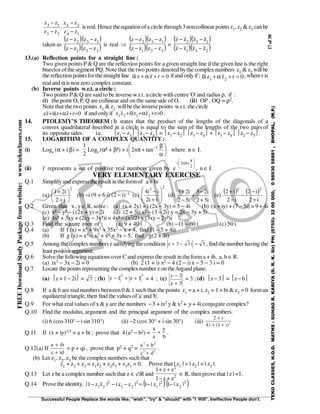
Q.1 Simplifyand expressthe result in the formof a +bi :
(a) −i (9 + 6 i) (2 − i)−1 (b)
23
1i2
ii4








+
−
(c)
i52
i23
i52
i23
+
−
+
−
+
(d)
( ) ( )
i2
i2
i2
i2 22
+
−
−
−
+
(e) ii −+
Q.2 Find the modulus , argument and the principal argument of the complex numbers.
(i) z = 1 + cos 




 π
9
10
+ i sin 




 π
9
10
(ii) (tan1 – i)2
(iii) z =
i125i125
i125i125
−−+
−++ (iv)
5
2
sin
5
2
cos1i
1i
π
+




 π
−
−
Q.3 Given that x, y ∈ R, solve :
(a) (x + 2y) + i (2x − 3y) = 5 − 4i (b)
1i8
i65
i23
y
i21
x
−
+
=
+
+
+
(c) x² − y² − i (2x + y) = 2i (d) (2 + 3i) x² − (3 − 2i) y = 2x − 3y + 5i
(e) 4x² + 3xy + (2xy − 3x²)i = 4y² − (x2/2) + (3xy − 2y²)i
Q.4(a) Let Z is complex satisfying the equation, z2 – (3 + i)z + m + 2i= 0, where m ∈R.
19of38
Successful People Replace the words like; "wish", "try" & "should" with "I Will". Ineffective People don't.
TEKOCLASSES,H.O.D.MATHS:SUHAGR.KARIYA(S.R.K.Sir)PH:(0755)-3200000,09893058881,BHOPAL,(M.P.)
FREEDownloadStudyPackagefromwebsite:www.tekoclasses.com
Suppose the equation has a realroot, then find the value ofm.
(b) a, b, c are real numbers in the polynomial, P(Z) = 2Z4 + aZ3 + bZ2 + cZ + 3
If two roots of the equation P(Z) = 0 are 2 and i, then find thevalue of'a'.
Q.5(a) Find the real values of x & y for which z1 = 9y2 − 4 − 10 ix and
z2 = 8y2 − 20 i are conjugate complex of each other.
(b) Find the value of x4 − x3 + x2 + 3x − 5 if x = 2 + 3i
Q.6 Solve the following for z : (a) z2 – (3 – 2 i)z = (5i – 5) (b) z+ z = 2 + i
Q.7(a) If iZ3 + Z2 − Z + i = 0, then show that | Z | = 1.
(b) Let z1 and z2 be two complex numbers such that
21
21
zz2
z2z
−
−
= 1 and | z2 | ≠ 1, find | z1 |.
(c) Let z1 =10 +6i &z2 = 4 +6i. If z isanycomplexnumber suchthat theargument of,
2
1
zz
zz
−
−
is
4
π
, then
prove that z − 7 − 9i= 3 2 .
Q.8 Show that theproduct,













 +
+













 +
+













 +
+










 +
+
n2
222
2
i1
1......
2
i1
1
2
i1
1
2
i1
1 is equal to 1
1
22
−





n
(1+ i) where n ≥ 2 .
Q.9 Let a &b be complex numbers (which may bereal) and let,
Z = z3 + (a + b + 3i) z2 + (ab + 3 ia + 2 ib − 2) z + 2 abi − 2a.
(i) Show that Z is divisible by, z + b + i. (ii) Find all complex numbers z for which Z= 0.
(iii) Find all purelyimaginary numbers a &b when z = 1 + i and Z is a real number.
Q.10 Interpret the following locii in z ∈C.
(a) 1 < z − 2i < 3 (b) Re 4
2zi
i2z
≤





+
+
(z ≠ 2i)
(c) Arg (z + i) −Arg (z − i) = π/2 (d) Arg (z − a) = π/3 where a = 3 + 4i.
Q.11 Prove that thecomplexnumbers z1 and z2 and the origin forman isosceles trianglewithverticalangle
2π/3 if 0zzzz 21
2
2
2
1 =++ .
Q.12 Pis apoint on theAraganddiagram. Onthe circlewith OPas diameter two points Q & Raretakensuch
that ∠ POQ = ∠ QOR = θ. If ‘O’is the origin & P, Q & R are represented bythe complex numbers
ZZZZ
1 , Z2 & Z3 respectively, show that : Z2
2 . cos 2θ = Z1 . Z3 cos²θ.
Q.13 Let z1, z2, z3 are three pair wise distinct complexnumbers and t1, t2, t3 are non-negative realnumbers
such that t1 + t2 + t3 = 1. Prove that the complexnumber z = t1z1 + t2z2 + t3z3 lies inside a triangle with
vertices z1, z2, z3 or on its boundry.
Q.14 If a CiSα, b CiSβ, c CiSγ represent three distinct collinear points in anArgand's plane, then prove
thefollowing:
(i) Σ ab sin (α − β) = 0.
(ii) (a CiS α) )cos(bc2cb 22
γ−β−+ ± (b CiS β) )cos(ac2ca 22
γ−α−+
(c CiS γ) )cos(ab2ba 22
β−α−+ = 0.
Q.15 Find allrealvalues of the parameter a for which the equation
(a − 1)z4 − 4z2 + a + 2 = 0 has only pure imaginary roots.
Q.16 LetA≡z1 ;B ≡ z2;C ≡ z3 are three complex numbers denotingthe vertices ofanacuteangled triangle.
Iftheorigin ‘O’is theorthocentreofthe triangle,thenprovethat
z1 z2
+ z1
z2 = z2 z3
+ z2
z3 = z3 z1
+ z3
z1
hence show that the ∆ABC is a right angled triangle ⇔ z1 z2
+ z1
z2 = z2 z3
+ z2
z3 = z3 z1
+ z3
z1 = 0
Q.17 If the complex number P(w) lies on the standard unit circle in an Argand's plane and
z = (aw+b)(w – c)–1 then, find the locus ofz and interpret it. Given a, b, c are real.
Q.18(a) Without expanding the determinant at anystage , find RK∈ suchthat
i8iKi4
ii16i8
i34i8i4
+−
+−
++
haspurelyimaginaryvalue.
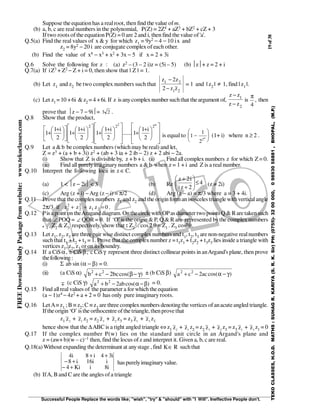
(b) IfA, Band C are the angles ofa triangle
20of38
Successful People Replace the words like; "wish", "try" & "should" with "I Will". Ineffective People don't.
TEKOCLASSES,H.O.D.MATHS:SUHAGR.KARIYA(S.R.K.Sir)PH:(0755)-3200000,09893058881,BHOPAL,(M.P.)
FREEDownloadStudyPackagefromwebsite:www.tekoclasses.com
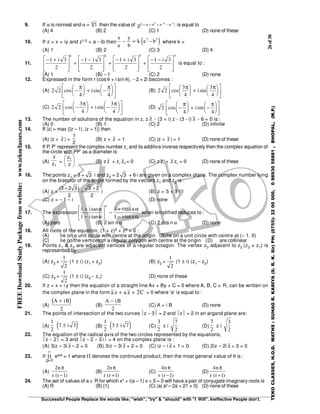
D =
iC2iAiB
iAiB2iC
iBiCiA2
eee
eee
eee
−
−
−
where i = −1 then find the value of D.
Q.19 If w is an imaginary cube root of unity then prove that :
(a) (1 − w + w2) (1 − w2 + w4) (1 − w4 + w8) ..... to 2n factors = 22n .
(b) If w is a complex cube root of unity, find the value of
(1 + w) (1 + w2) (1 + w4) (1 + w8) ..... to n factors .
Q.20 Prove that
n
cosisin1
cosisin1






θ−θ+
θ+θ+
= cos 





θ−
π
n
2
n
+ isin 





θ−
π
n
2
n
. Hence deduce that
5
5
cosi
5
sin1 




 π
+
π
+ + i
5
5
cosi
5
sin1 




 π
−
π
+ = 0
Q.21 If cos (α − β) + cos(β − γ) + cos (γ − α) = − 3/2 then prove that :
(a) Σ cos 2α = 0 = Σ sin 2α (b) Σ sin (α + β) = 0 = Σ cos (α + β) (c) Σ sin2 α = Σ cos2 α = 3/2
(d) Σ sin 3α = 3 sin (α + β + γ) (e) Σ cos 3α = 3 cos (α + β + γ)
(f) cos3 (θ+α)+cos3 (θ+β)+ cos3 (θ+γ) = 3cos(θ +α). cos (θ+β). cos (θ+γ) where θ ∈R.
Q.22 Resolve Z5 + 1 into linear& quadratic factors withrealcoefficients. Deduce that : 4·sin π
10
·cos
π
5
= 1.
Q.23 If x = 1+ i 3 ; y = 1 − i 3 & z = 2 , then prove that xp + yp = zp for every prime p > 3.
Q.24 If the expression z5 – 32 can be factorised into linear and quadratic factors over realcoefficients as
(z5 – 32) = (z – 2)(z2 – pz + 4)(z2 – qz + 4) then find the value of (p2 + 2p).
Q.25(a)Let z= x + iybeacomplexnumber, wherexand y arerealnumbers. LetAand B bethesets defined by
A= {z | | z | ≤ 2} and B = {z | (1 – i)z + (1 + i) z ≥ 4}. Find the area of the regionA∩ B.
(b) For all real numbers x, let the mapping f (x) =
i−x
1
, where i = 1− . If there exist real number
a, b, c and d for which f (a), f (b), f (c) and f (d) forma square onthe complex plane. Find the area of
the square.
EXERCISE-2
Q.1 If
p q r
q r p
r p q
= 0 ; where p , q , r are the moduli of non−zero complex numbers u, v, w respectively,,
prove that, arg
w
v
= arg
w u
v u
−
−






2
.
Q.2 The equation x3 = 9 + 46i where i = 1− has a solution ofthe forma + bi where a and bare integers.
Find the value of(a3 + b3).
Q.3 Show that the locus formed by z in the equation z3 + iz = 1 never crosses the co-ordinate axes in the
Argand’s plane. Further show that |z| =
−
+
Im( )
Re( )Im( )
z
z z2 1
Q.4 If ωis the fifth root of 2 and x = ω+ ω2, prove that x5 = 10x2 + 10x + 6.
Q.5 Prove that , with regard to the quadratic equation z2 + (p + ip′) z + q + iq′ = 0
where p , p′, q , q′ are all real.
(i) if the equation has one real root then q ′2 − pp ′q′ + qp′2 = 0 .
(ii) if the equation has two equal roots then p2 − p′2 = 4q & pp′ = 2q′.
State whether these equalrootsarerealor complex.
Q.6 If the equation (z + 1)7 + z7 = 0 has roots z1, z2, .... z7, find the value of
(a) ∑
=
7
1r
r )ZRe( and (b) ∑
=
7
1r
r )ZIm(
Q.7 Find the roots oftheequation Zn = (Z+ 1)n and show that thepoints whichrepresent themare collinear
on the complex plane. Hence showthat these roots are also the roots ofthe equation
2
2
Z
n
m
sin2 




 π
+ Z
n
m
sin2
2





 π
+ 1 = 0.
Q.8 Dividing f(z) by z − i, we get the remainder i and dividing it by z + i, we get the remainder
21of38
Successful People Replace the words like; "wish", "try" & "should" with "I Will". Ineffective People don't.
TEKOCLASSES,H.O.D.MATHS:SUHAGR.KARIYA(S.R.K.Sir)PH:(0755)-3200000,09893058881,BHOPAL,(M.P.)
FREEDownloadStudyPackagefromwebsite:www.tekoclasses.com
1 + i. Find the remainder upon the division of f(z) by z² + 1.
Q.9 Let z1 & z2 be anytwo arbitrarycomplex numbers then prove that :
z1 + z2 ≥ ( )
|z|
z
|z|
z
|z||z|
2
1
2
2
1
1
21
++ .
Q.10 If Zr, r = 1, 2, 3, ......... 2m, m ε N are the roots ofthe equation
Z2m + Z2m-1 + Z2m-2 + ............. + Z + 1 = 0 then prove that ∑
−=r
m
rZ1
2
1
1 = −m
Q.11 If (1 + x)n = C0 + C1x + C2x² + .... + Cn xn (n ∈ N), prove that :
(a) C0 + C4 + C8 + .... =
1
2
2 2
4
1 2n n n−
+






/
cos
π
(b) C1 + C5 + C9 + .... =
1
2
2 2
4
1 2n n n−
+






/
sin
π
(c) C2 + C6 + C10 + ..... = 1
2
2 2
4
1 2n n n−
−






/
cos
π
(d) C3 + C7 + C11 + .... = 1
2
2 2
4
1 2n n n−
−






/
sin
π
(e) C0 + C3 + C6 + C9 + ........ =
1
3
2 2
3
n n
+





cos
π
Q.12 Let z1 , z2 , z3 , z4 be the vertices A, B , C , D respectively of a square on the Argand diagram
taken in anticlockwise direction then prove that :
(i) 2z2 = (1 + i) z1 + (1− i)z3 & (ii) 2z4 = (1− i) z1 + (1 + i) z3
Q.13 Show that allthe roots of the equation 1
1
1
1
+
−





 =
+
−
ix
ix
ia
ia
n
a ∈ R are realand distinct.
Q.14 Prove that:
(a) cos x + nC1 cos 2x + nC2 cos 3x + ..... + nCn cos (n + 1) x = 2n . cosn x
2
. cos
n +





2
2
x
(b) sin x + nC1 sin 2x + nC2 sin 3x + ..... + nCn sin (n + 1) x = 2n . cosn x
2
. sin
n +





2
2
x
(c) cos
2
2 1
π
n +





 + cos
4
2 1
π
n +





 + cos
6
2 1
π
n +





 + ..... + cos
2
2 1
n
n
π
+





 = −
1
2
When n ∈ N.
Q.15 Show that all roots of the equation a0zn + a1zn – 1 + ...... + an – 1z + an = n,
where | ai | ≤ 1, i= 0, 1, 2, .... , n lie outside the circle withcentre at the originand radius
n
1n −
.
Q.16 The pointsA, B, Cdepict thecomplexnumbers z1 , z2 , z3 respectivelyon a complex plane &the angle
B & C of the triangleABC are each equal to )(
2
1
α−π . Show that
(z2 − z3)² = 4 (z3 − z1) (z1 − z2) sin2 α
2
.
Q.17 Show that the equation
A
x a
A
x a
A
x a
n
n
1
2
1
2
2
2
2
−
+
−
+ +
−
...... = k hasno imaginaryroot, given that:
a1 , a2 , a3 .... an & A1, A2, A3 ..... An, k are all real numbers.
Q.18 Let a, b, c bedistinct complex numbers such that
b1
a
−
=
c1
b
−
=
a1
c
−
= k. Find the valueof k.
Q.19 Let α, β be fixed complex numbers and z is a variable complexnumber such that,
z − α
2
+ z − β
2
= k.
Find out thelimits for 'k' suchthat thelocus of z isa circle. Find also thecentreand radius ofthe circle.
Q.20 C is the complexnumber. f : C →R isdefined byf(z) =| z3 – z+ 2|.What is the maximumvalueof f on
the unit circle | z | = 1?
Q.21 Let f(x) = )xi2(coslog x3cos
if x≠ 0 and f(0) =K (where i= 1− ) iscontinuous at x= 0 thenfind
the value ofK. Use ofLHospital’s rule or series expansion not allowed.
Q.22 If z1 , z2 are the roots of the equation az2 + bz + c = 0, with a, b, c > 0 ; 2b2 > 4ac > b2 ;
z1 ∈ third quadrant ; z2 ∈ second quadrant in the argand's plane then, show that
22of38
Successful People Replace the words like; "wish", "try" & "should" with "I Will". Ineffective People don't.
TEKOCLASSES,H.O.D.MATHS:SUHAGR.KARIYA(S.R.K.Sir)PH:(0755)-3200000,09893058881,BHOPAL,(M.P.)
FREEDownloadStudyPackagefromwebsite:www.tekoclasses.com
arg 







2
1
z
z
= 2cos–1
2/12
ac4
b








Q.23 Find the set ofpoints on theargand plane for whichthe realpart ofthe complex number
(1 + i) z2 is positive where z = x + iy , x, y ∈ R and i = −1 .
Q.24 If a and b are positive integer such that N = (a + ib)3 – 107i is a positive integer. Find N.
Q.25 If the biquadratic x4 + ax3 + bx2 + cx + d = 0 (a, b, c, d ∈ R) has 4 non real roots, two with sum
3 + 4iand the other two with product 13 + i. Find the value of 'b'.
EXERCISE-3
Q.1 Evaluate: ( ) sin cos3 2
2
11
2
111
10
1
32
p
q
i
q
q
p
p
+ −














==
∑∑
π π
. [REE '97, 6]
Q.2(a) Let z1 and z2 be roots of the equation z2 + pz + q = 0 , where the co−efficients p and q may be
complex numbers. Let A and B represent z1 and z2 in the complex plane. If ∠AOB = α ≠ 0 and
OA = OB, where O is the origin . Prove that p2 = 4qcos2 α
2





 . [JEE '97 , 5]
(b) Prove that
k
n
=
−
∑
1
1
(n − k) cos
2k
n
π
= −
n
2
where n ≥ 3 is an integer . [JEE '97, 5]
Q.3(a) If ωis animaginarycube root of unity, then (1 + ω− ω2)7 equals
(A) 128ω (B) − 128ω (C) 128ω2 (D) − 128ω2
(b) The value of the sum ( )i in n
n
+ +
=
∑ 1
1
13
, where i = −1 , equals
(A) i (B) i − 1 (C) − i (D) 0 [JEE' 98, 2 + 2 ]
Q.4 Find allthe roots ofthe equation (3z − 1)4 + (z − 2)4 = 0 in the simplified form ofa + ib.
[REE ’98, 6 ]
Q.5(a) If i = −1 , then 4 + 5 − +






1
2
3
2
334
i
+ 3 − +






1
2
3
2
365
i
is equal to :
(A) 1 − i 3 (B) − 1 + i 3 (C) i 3 (D) − i 3
(b) For complex numbers z & ω, prove that, z
2
ω− ω
2
z = z − ω if and only if,
z = ω or zω = 1 [JEE '99, 2 + 10 (out of 200)]
Q.6 If α = e
i2
7
π
and f(x) =AA0 +
k =
∑
1
20
Ak xk, then find the value of,
f(x) + f(αx) + ...... + f(α6x) independent of α . [REE '99, 6]
Q.7(a) If z1 , z2 , z3 are complex numbers such that z1 = z2 = z3 =
1 1 1
1 2 3z z z
+ +





 = 1, then
z1 + z2 + z3 is :
(A) equalto 1 (B) less than 1 (C) greater than 3 (D) equal to 3
(b) If arg (z) < 0, then arg (−z) − arg (z) =
(A) π (B) − π (C) −
π
2
(D)
π
2
[ JEE 2000 (Screening) 1 + 1 out of35 ]
Q.8 Given , z = cos
2
2 1
π
n +
+ i sin
2
2 1
π
n +
, 'n' a positive integer, find the equation whose roots are,
α = z + z3 + ...... + z2n − 1 & β = z2 + z4 + ...... + z2n .
[ REE 2000 (Mains) 3 out of100 ]
Q.9(a) The complex numbers z1, z2 and z3 satisfying
z z
z z
i1 3
2 3
1 3
2
−
−
=
−
arethevertices of atrianglewhich is
(A) ofarea zero (B) right-angled isosceles
(C) equilateral (D) obtuse – angled isosceles
23of38
Successful People Replace the words like; "wish", "try" & "should" with "I Will". Ineffective People don't.
TEKOCLASSES,H.O.D.MATHS:SUHAGR.KARIYA(S.R.K.Sir)PH:(0755)-3200000,09893058881,BHOPAL,(M.P.)
FREEDownloadStudyPackagefromwebsite:www.tekoclasses.com
(b) Let z1 and z2 benth roots ofunitywhich subtend a right angle at the origin. Thenn must be ofthe form
(A) 4k + 1 (B) 4k + 2 (C) 4k + 3 (D) 4k
[ JEE 2001 (Scr) 1 + 1 out of 35 ]
Q.10 Find allthose roots of the equation z12 – 56z6 – 512 = 0 whose imaginarypart is positive.
[ REE 2000, 3 out of100 ]
Q.11(a) Let ω = − +
1
2
3
2
i . Thenthe value of thedeterminant
1 1 1
1 1
1
2 2
2 4
− − ω ω
ω ω
is
(A) 3ω (B) 3ω (ω– 1) (C) 3ω2 (D) 3ω(1 – ω)
(b) For all complex numbers z1, z2 satisfying |z1| = 12 and |z2 – 3 – 4i| = 5, the minimum value of
|z1 – z2| is
(A) 0 (B) 2 (C) 7 (D) 17
[JEE 2002(Scr) 3+3]
(c) Let a complex number α , α ≠ 1, be aroot ofthe equation
zp+q – zp – zq + 1 = 0 where p, q are distinct primes.
Show that either 1 + α + α2 + ...... + αp–1 = 0 or 1 + α + α2 + ...... + αq–1 = 0 , but not both together.
[JEE 2002, (5) ]
Q.12(a) If z1 and z2 are two complex numbers such that | z1 | < 1 < | z2 | then prove that 1
zz
zz1
21
21
<
−
−
.
(b) Prove that there exists no complex number z such that | z | <
3
1
and ∑
=
n
1r
r
r za = 1 where |ar |<2.
[JEE-03, 2 +2 out of 60]
Q.13(a) ωis animaginarycube root ofunity. If(1 + ω2)m = (1 + ω4)m , then least positiveintegralvalue ofmis
(A) 6 (B) 5 (C) 4 (D) 3
[JEE 2004 (Scr)]
(b) Findcentreandradius ofthecircle determinedbyallcomplexnumbersz=x+iysatisfying k
)z(
)z(
=
β−
α−
,
where 2121 i,i β+β=βα+α=α are fixed complex and k ≠ 1. [JEE 2004, 2 out of60 ]
Q.14(a) The locus ofz which lies in shaded region is best represented by
(A) z : |z + 1| > 2, |arg(z + 1)| < π/4
(B) z : |z - 1| > 2, |arg(z – 1)| < π/4
(C) z : |z + 1| < 2, |arg(z + 1)| < π/2
(D) z : |z - 1| < 2, |arg(z - 1)| < π/2
(b) If a, b, c are integers not all equaland w is a cube root ofunity(w ≠ 1), then the minimumvalue of
|a + bw + cw2
| is
(A) 0 (B) 1 (C)
2
3
(D)
2
1
[JEE 2005 (Scr), 3 + 3]
(c) If one ofthe vertices of the squarecircumscribing the circle |z – 1| = 2 is i32 + . Find the other
vertices ofsquare. [JEE 2005 (Mains), 4]
Q.15 If w = α + iβ where β ≠ 0 and z ≠ 1, satisfies the conditionthat
z1
zww
−
−
is purelyreal, then theset of
values ofz is
(A) {z : | z | = 1} (B) {z: z = z ) (C) {z : z ≠ 1} (D) {z : | z | = 1, z ≠ 1}
[JEE 2006, 3]
ANSWER KEY
VERY ELEMENTARY EXERCISE
Q.1 (a)
25
24
25
7
+ i; (b)
5
12
5
21
− i; (c) 3 + 4i; (d)
29
8
− + 0i; (e)
5
22
i
Q.2 (a) x =1, y = 2; (b) (2, 9); (c) (−2 , 2) or − −






2
3
2
3
, ; (d) (1 ,1) 0
5
2
,





 (e) x = K, y =
3
2
K
, K∈R
24of38
Successful People Replace the words like; "wish", "try" & "should" with "I Will". Ineffective People don't.
TEKOCLASSES,H.O.D.MATHS:SUHAGR.KARIYA(S.R.K.Sir)PH:(0755)-3200000,09893058881,BHOPAL,(M.P.)
FREEDownloadStudyPackagefromwebsite:www.tekoclasses.com
Q.3 (a) ± (5 + 4i) ; (b) ± (5 − 6i) (c) ± 5(1 + i) Q.4 (a) −160 ; (b) − (77 +108 i)
Q.5 –
3
2
3 3
2
+ i Q.6 (a) − i, − 2i (b)
3 5
2
− i
or −
1
2
+ i
Q.7 (a) on a circle of radius 7 with centre (−1, 2) ; (b) ona unit circle withcentre at origin
(c) on a circle with centre (−15/4, 0) & radius 9/4 ; (d) astraight line
Q.8 a = b = 2 − 3 ; Q.9 x = 1, y = − 4 or x = − 1, y = − 4
Q.10 (i) Modulus = 6 , Arg = 2 k π +
5
18
π
(K ∈ I) , Principal Arg =
5
18
π
(K ∈ I)
(ii) Modulus = 2 , Arg = 2 kπ +
7
6
π
, Principal Arg = −
5
6
π
(iii) Modulus =
5
6
, Arg = 2k π − tan−1 2 (K ∈ I) , Principal Arg = − tan−12
Q.16 (a)
3
2 2
−
i
, − −
3
2 2
i
, i ; Q.17 1
48
y
64
x 22
=+ ; Q.18 (c) 64 ; Q.21 A
Q.22 (a) (1, 1) ; (b)
( )n n
n
+







−
1
2
2
EXERCISE-1
Q.1 (a)
21
5
12
5
− i (b) 3 + 4 i (c) −
8
29
+ 0 i (d)
22
5
i (e) + i02 + or i20±
Q.2 (i) Principal Arg z = −
4
9
π
; z = 2 cos
4
9
π
; Arg z = 2 k π −
4
9
π
k ∈ I
(ii) Modulus = sec21 , Arg = 2 nπ + (2 – π ) , Principal Arg = (2 – π )
(iii) Principal value of Agr z = −
π
2
& z =
3
2
; Principal value ofArg z =
π
2
& z =
2
3
(iv) Modulus =
5
eccos
2
1 π
, Arg z =
20
11
n2
π
+π , Principal Arg =
20
11π
Q.3(a) x = 1, y = 2; (b) x = 1 & y = 2 ; (c) (−2, 2) or − −






2
3
2
3
, ; (d) (1 ,1) 0
5
2
,





 ; (e) x =K, y =
3
2
K
K∈R
Q.4 (a) 2, (b) – 11/2 Q.5 (a) [(− 2, 2) ; (− 2, − 2)] (b) − (77 +108 i)
Q.6 (a) z = (2 + i) or (1 – 3i); (b) z =
3 4
4
+ i
Q.7 (b) 2
Q.9 (ii) z = − (b + i) ; − 2 i , − a (iii) 





+
− ti,
5t3
ti2
where t ∈ R −






−
3
5
Q.10 (a) Theregion between the co encentric circles withcentre at (0 , 2) & radii1 & 3 units
(b) regionoutside or on the circlewith centre
2
1
+ 2iand radius
2
1
.
(c) semi circle (in the 1st & 4th quadrant) x² + y² = 1 (d) a rayemanating fromthe point
(3 + 4i) directed awayfromthe origin & having equation 3 4 3 3 0x y− + − =
Q.15 [−3 , −2] Q.17 (1 – c2) | z |2 – 2(a + bc) (Re z) + a2 – b2 = 0
Q.18 (a) K = 3 , (b) – 4 Q.19 (b) one if n is even ; − w² if n is odd
Q.22 (Z + 1) (Z² − 2Z cos 36° + 1) (Z² − 2Z cos 108° + 1) Q.24 4
Q.25 (a) π – 2 ; (b) 1/2
EXERCISE-2
Q.2 35 Q.6 (a) –
2
7
, (b) zero Q.8 i z
i
2
1
2
+ + Q.18 – ω or – ω2
Q.19 k >
1
2
2
α β− Q.20 | f(z) | ismaximumwhenz= ω, whereωisthe cuberoot unityand |f(z)| = 13
Q.21 K = –
9
4
25of38
Successful People Replace the words like; "wish", "try" & "should" with "I Will". Ineffective People don't.
TEKOCLASSES,H.O.D.MATHS:SUHAGR.KARIYA(S.R.K.Sir)PH:(0755)-3200000,09893058881,BHOPAL,(M.P.)
FREEDownloadStudyPackagefromwebsite:www.tekoclasses.com
Q.23 required set is constituted by the angles without their boundaries, whose sides are the straight lines
y = )12( − x and y + )12( + x = 0 containing the x − axis
Q.24 198 Q.25 51
EXERCISE-3
Q.1 48(1 − i) Q.3 (a) D (b) B
Q.4 Z =
( ) ( )29 20 2 15 25 2
82
+ + ± +i
,
( ) ( )29 20 2 15 25 2
82
− + ± −i
Q.5 (a) C
Q.6 7 A0 + 7 A7 x7 + 7 A14 x14 Q.7 (a) A (b) A Q.8 z2 + z +
sin
sin
2
2
n θ
θ
= 0, where θ =
2
2 1
π
n +
Q.9 (a) C, (b) D Q.10 +1 + i 3 ,
( )± +3
2
i
, 2 i Q.11 (a) B ; (b) B
Q.13 (a) D ; (b) Centre ≡
1k
k
2
2
−
α−β
, Radius = ( )( )1k.||||.k|k|
)1k(
1 222222
2
−α−β−β−α
−
Q.14 (a) A, (b) B, (c) z2 = – 3 i ; z3 = ( ) i31 +− ; z4 = ( ) i31 −+ Q.15 D
EXERCISE-4
Part : (A) Only one correct option
1. If |z| = 1 and ω =
1z
1z
+
−
(where z ≠ –1), the Re(ω) is [IIT – 2003, 3]
(A) 0 (B) 2
|1z|
1
+
− (C) 2
|1z|
1
.
1z
z
++ (D) 2
|1z|
2
+
2. The locus of z which lies in shaded region (excluding the boundaries) is best represented by
[IIT – 2005, 3]
(A) z : |z + 1| > 2 and |arg (z + 1)| < π/4 (B) z : |z – 1| > 2 and |arg (z – 1)| < π/4
(C) z : |z + 1| < 2 and |arg (z + 1)| < π/2 (D) z : |z – 1| < 2 and |arg (z + 1)| < π/2
3. If w = α, + iβ, where β ≠ 0 and z ≠ 1, satisfies the condition that 





−
−
z1
zww
is purely real, then the set of
values of z is [IIT – 2006, (3, –1)]
(A) {z : |z| = 1} (B) {z : z = z } (C) {z : z ≠ 1} (D) {z : |z| = 1, z ≠1}
4. If ( 3 + i)100
= 299
(a + ib), then b is equal to
(A) 3 (B) 2 (C) 1 (D) none of these
5. If Re 





+
−
6z
i8z
= 0, then z lies on the curve
(A) x2
+ y2
+ 6x – 8y = 0 (B) 4x – 3y + 24 = 0 (C) 4ab (D) none of these
6. If n1
, n2
are positive integers then : 1n
)i1( + + 1n3
)i1( + + 2n5
)i1( − + 2n7
)i1( − is a real number if and only if
(A) n1
= n2
+ 1 (B) n1
+ 1 = n2
(C) n1
= n2
(D) n1
, n2
are any two positive integers
7. The three vertices of a triangle are represented by the complex numbers, 0, z1
and z2
. If the triangle is
equilateral, then
(A) z1
2
– z2
2
= z1
z2
(B) z2
2
– z1
2
= z1
z2
(C) z1
2
+ z2
2
= z1
z2
(D) z1
2
+ z2
2
+ z1
z2
= 0
8. If x2
– x + 1 = 0 then the value of
25
1n
n
n
x
1
x∑=






+ is
(A) 8 (B) 10 (C) 12 (D) none of these
26of38
Successful People Replace the words like; "wish", "try" & "should" with "I Will". Ineffective People don't.
TEKOCLASSES,H.O.D.MATHS:SUHAGR.KARIYA(S.R.K.Sir)PH:(0755)-3200000,09893058881,BHOPAL,(M.P.)
FREEDownloadStudyPackagefromwebsite:www.tekoclasses.com
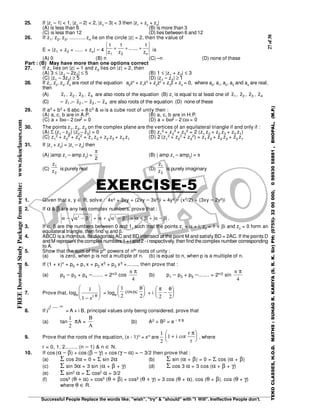
9. If α is nonreal and α = 5
1 then the value of |1| 122
2
−−
α−α+α+α+ is equal to
(A) 4 (B) 2 (C) 1 (D) none of these
10. If z = x + iy and z1/3 = a − ib then ( )x
a
y
b
k a b− = −2 2
where k =
(A) 1 (B) 2 (C) 3 (D) 4
11.
− +







+
− −







+
− +







+
− −







1 3
2
1 3
2
1 3
2
1 3
2
6 6 5 5
i i i i
is equal to :
(A) 1 (B) − 1 (C) 2 (D) none
12. Expressed in the form r (cos θ + i sin θ), − 2 + 2i becomes :
(A) 2 2
4 4
cos sin−





 + −












π π
i (B) 2 2
3
4
3
4
cos sin
π π




 +











i
(C) 2 2
3
4
3
4
cos sin−





 + −












π π
i (D) 2
4 4
cos sin−





 + −












π π
i
13. The number of solutions of the equation in z, z z - (3 + i) z - (3 - i) z - 6 = 0 is :
(A) 0 (B) 1 (C) 2 (D) infinite
14. If |z| = max {|z – 1|, |z + 1|} then
(A) |z + z | =
2
1
(B) z + z = 1 (C) |z + z | = 1 (D) none of these
15. If P, P′ represent the complex number z1
and its additive inverse respectively then the complex equation of
the circle with PP′ as a diameter is
(A)
1z
z
= 





z
z1
(B) z z + z1 1z = 0 (C) z 1z + z z1
= 0 (D) none of these
16. The points z1 = 3 + 3 i and z2 = 2 3 + 6 i are given on a complex plane. The complex number lying
on the bisector of the angle formed by the vectors z1 and z2 is :
(A) z =
2
23
2
)323( +
+
+
i (B) z = 5 + 5 i
(C) z = − 1 − i (D) none
17. The expression
1
1
1
1
+
−





 −
+
−
i
i
i n
i n
n
tan
tan
tan
tan
α
α
α
α
when simplified reduces to :
(A) zero (B) 2 sin n α (C) 2 cos n α (D) none
18. All roots of the equation, (1 + z)6 + z6 = 0 :
(A) lie on a unit circle with centre at the origin (B)lie on a unit circle with centre at (− 1, 0)
(C) lie on the vertices of a regular polygon with centre at the origin (D) are collinear
19. Points z1 & z2 are adjacent vertices of a regular octagon. The vertex z3 adjacent to z2 (z3 ≠ z1) is
represented by :
(A) z2 +
1
2
(1 ± i) (z1 + z2) (B) z2 +
1
2
(1 ± i) (z1 − z2)
(C) z2 +
1
2
(1 ± i) (z2 − z1) (D) none of these
20. If z = x + i y then the equation of a straight line Ax + By + C = 0 where A, B, C ∈ R, can be written on
the complex plane in the form a z a z C+ + 2 = 0 where 'a' is equal to :
(A)
( )A iB+
2
(B)
A iB−
2
(C) A + i B (D) none
21. The points of intersection of the two curves z − 3 = 2 and z = 2 in an argand plane are:
(A)
1
2
( )7 3± i (B)
1
2
( )3 7± i (C)
3
2
± i
7
2
(D)
7
2
± i
3
2
22. The equation of the radical axis of the two circles represented by the equations,
z − 2 = 3 and z − 2 − 3 i = 4 on the complex plane is :
(A) 3iz – 3i z – 2 = 0 (B) 3iz – 3i z + 2 = 0 (C) iz – i z + 1 = 0 (D) 2iz – 2i z + 3 = 0
23. If
r
1p=
Π eipθ = 1 where Π denotes the continued product, then the most general value of θ is :
(A)
2
1
n
r r
π
( )−
(B)
2
1
n
r r
π
( )+
(C)
4
1
n
r r
π
( )−
(D)
4
1
n
r r
π
( )+
24. The set of values of a ∈ R for which x2
+ i(a – 1) x + 5 = 0 will have a pair of conjugate imaginary roots is
(A) R (B) {1} (C) |a| a2
– 2a + 21 > 0} (D) none of these
27of38
Successful People Replace the words like; "wish", "try" & "should" with "I Will". Ineffective People don't.
TEKOCLASSES,H.O.D.MATHS:SUHAGR.KARIYA(S.R.K.Sir)PH:(0755)-3200000,09893058881,BHOPAL,(M.P.)
FREEDownloadStudyPackagefromwebsite:www.tekoclasses.com 25. If |z1
– 1| < 1, |z2
– 2| < 2, |z3
– 3| < 3 then |z1
+ z2
+ z3
|
(A) is less than 6 (B) is more than 3
(C) is less than 12 (D) lies between 6 and 12
26. If z1, z2, z3, ........., zn lie on the circle |z| = 2, then the value of
E = |z1 + z2 + ..... + zn| – 4
n21 z
1
.......
z
1
z
1
+++ is
(A) 0 (B) n (C) –n (D) none of these
Part : (B) May have more than one options correct
27. If z1 lies on |z| = 1 and z2 lies on |z| = 2, then
(A) 3 ≤ |z1 – 2z2| ≤ 5 (B) 1 ≤ |z1 + z2| ≤ 3
(C) |z1 – 3z2| ≥ 5 (D) |z1 – z2| ≥ 1
28. If z1
, z2
, z3
, z4
are root of the equation a0
z4
+ z1
z3
+ z2
z2
+ z3
z + z4
= 0, where a0
, a1
, a2
, a3
and a4
are real,
then
(A) 1z , 2z , 3z , 4z are also roots of the equation (B) z1
is equal to at least one of 1z , 2z , 3z , 4z
(C) – 1z ,– 2z , – 3z , – 4z are also roots of the equation (D) none of these
29. If a3 + b3 + 6 abc = 8 c3 & ω is a cube root of unity then :
(A) a, c, b are in A.P. (B) a, c, b are in H.P.
(C) a + bω − 2 cω2 = 0 (D) a + bω2 − 2 cω = 0
30. The points z1, z2, z3 on the complex plane are the vertices of an equilateral triangle if and only if :
(A) Σ (z1 − z2) (z2 − z3) = 0 (B) z1
2 + z2
2 + z3
2 = 2 (z1 z2 + z2 z3 + z3 z1)
(C) z1
2 + z2
2 + z3
2 = z1 z2 + z2 z3 + z3 z1 (D) 2 (z1
2 + z2
2 + z3
2) = z1 z2 + z2 z3 + z3 z1
31. If |z1
+ z2
| = |z1
– z2
| then
(A) |amp z1
– amp z2
| =
2
π
(B) | amp z1
– amp2
| = π
(C)
2
1
z
z
is purely real (D)
2
1
z
z
is purely imaginary
EXERCISE-5
1. Given that x, y ∈ R, solve : 4x² + 3xy + (2xy − 3x²)i = 4y² − (x2/2) + (3xy − 2y²)i
2. If α & β are any two complex numbers, prove that :
α α β α α β α β α β− − + + − = + + −2 2 2 2
.
3. If α, β are the numbers between 0 and 1, such that the points z1
= α + i, z2
= 1 + βi and z3
= 0 form an
equilateral triangle, then find α and β.
4. ABCD is a rhombus. Its diagonalsAC and BD intersect at the point M and satisfy BD = 2AC. If the points D
and M represent the complex numbers1 + i and 2 - i respectively, then find the complex number corresponding
to A.
5. Show that the sum of the pth powers of nth roots of unity :
(a) is zero, when p is not a multiple of n. (b) is equal to n, when p is a multiple of n.
6. If (1 + x)n = p0 + p1 x + p2 x2 + p3 x3 +......., then prove that :
(a) p0 − p2 + p4 −....... = 2n/2 cos
n π
4
(b) p1 − p3 + p5 −....... = 2n/2 sin
n π
4
7. Prove that, loge
1
1 −








ei θ
= loge
1
2 2
cosec
θ




 + i
π θ
2 2
−






8. If iii ....... ∞
= A + i B, principal values only being considered, prove that
(a) tan
1
2
πA =
B
A
(b) A2 + B2 = e − π B
9. Prove that the roots of the equation, (x - 1)n = xn are
1
2
1 +





i
r
r
cot
π
, where
r = 0, 1, 2,....... (n − 1) & n ∈ N.
10. If cos (α − β) + cos (β − γ) + cos (γ − α) = − 3/2 then prove that :
(a) Σ cos 2α = 0 = Σ sin 2α (b) Σ sin (α + β) = 0 = Σ cos (α + β)
(c) Σ sin 3α = 3 sin (α + β + γ) (d) Σ cos 3 α = 3 cos (α + β + γ)
(e) Σ sin2 α = Σ cos2 α = 3/2
(f) cos3 (θ + α) + cos3 (θ + β) + cos3 (θ + γ) = 3 cos (θ + α). cos (θ + β). cos (θ + γ)
where θ ∈ R.
28of38
Successful People Replace the words like; "wish", "try" & "should" with "I Will". Ineffective People don't.
TEKOCLASSES,H.O.D.MATHS:SUHAGR.KARIYA(S.R.K.Sir)PH:(0755)-3200000,09893058881,BHOPAL,(M.P.)
FREEDownloadStudyPackagefromwebsite:www.tekoclasses.com
11. If α, β, γ are roots of x3 − 3 x2 + 3 x + 7 = 0 (and ωis imaginary cube root of unity), then find the value
of
α
β
−
−
1
1
+
β
γ
−
−
1
1
+
γ
α
−
−
1
1
.
12. Given that, |z − 1| = 1, where ' z ' is a point on the argand plane. Show that
z
z
− 2
= i tan (arg z).
13. P is a point on the Argand diagram. On the circle with OP as diameter two points Q & R are taken such
that ∠ POQ = ∠ QOR = θ. If ‘O’ is the origin & P, Q & R are represented by the complex numbers
Z1, Z2 & Z3 respectively, show that : Z2
2
. cos 2 θ = Z1. Z3 cos² θ.
14. Find an expression for tan 7θ in terms of tan θ, using complex numbers. By considering
tan 7θ = 0, show that x = tan2 (3 π/7) satisfies the cubic equation x3 − 21x2 + 35x − 7 = 0.
15. If (1 + x)n = C0 + C1x + C2x² +.... + Cn xn (n ∈ N), prove that : C2 + C6 + C10 +..... =
1
2
2 2
4
1 2n n n−
−






/
cos
π
16. Prove that : cos
2
2 1
π
n +





 + cos
4
2 1
π
n +





 + cos
6
2 1
π
n +





 +..... + cos
2
2 1
n
n
π
+





 = −
1
2
When n ∈ N.
17. Show that all the roots of the equation a1
z3
+ a2
z2
+ a3
z + a4
= 3, where |ai
| ≤ 1, i = 1, 2, 3, 4 lie outside the
circle with centre origin and radius 2/3.
18. Prove that ∑
−
=
−
1n
1k
)kn( cos
n
k2 π
= –
2
n
, where n ≥ 3 is an integer
19. Show that the equation
A
x a
A
x a
A
x a
n
n
1
2
1
2
2
2
2
−
+
−
+ +
−
...... = k has no imaginary root, given that :
a1, a2, a3.... an & A1, A2, A3..... An, k are all real numbers.
20. Let z1, z2, z3 be three distinct complex numbers satisfying, ½z1-1½ = ½z2-1½ = ½z3-1½. Let A, B & C
be the points represented in the Argand plane corresponding to z1, z2 and z3 resp. Prove that z1 + z2 +
z3 = 3 if and only if D ABC is an equilateral triangle.
21. Let α, β be fixed complex numbers and z is a variable complex number such that,
z − α
2
+ z − β
2
= k.
Find out the limits for 'k' such that the locus of z is a circle. Find also the centre and radius of the
circle.
22. If 1, α1, α2, α3,......., αn − 1 are the n, nth roots of unity, then prove that
(1 − α1) (1 − α2) (1 − α3)........ (1 − αn − 1) = n.
Hence prove that sin
π
n
. sin
2 π
n
. sin
3 π
n
........ sin
( )n
n
− 1 π
=
n
n
2 1− .
23. Find the real values of the parameter ‘a’ for which at least one complex number
z = x + iy satisfies both the equality z − ai = a + 4 and the inequality z − 2 < 1.
24. Prove that, with regard to the quadratic equation z2 + (p + ip′) z + q + iq′ = 0; where p, p′, q, q′ are all
real.
(a) if the equation has one real root then q ′2 − pp ′ q ′ + qp ′2 = 0.
(b) if the equation has two equal roots then p2 − p′2 = 4q & pp ′ = 2q ′.
State whether these equal roots are real or complex.
25. The points A, B, C depict the complex numbers z1, z2, z3 respectively on a complex plane & the angle
B & C of the triangle ABC are each equal to
1
2
( )π α− . Show that
(z2 − z3)² = 4 (z3 − z1) (z1 − z2) sin2
α
2
.
26. If z1, z2 & z3 are the affixes of three points A, B & C respectively and satisfy the condition
|z1 – z2| = |z1| + |z2| and |(2 - i) z1 + iz3 | = |z1| + |(1 – i) z1 + iz3| then prove that ∆ ABC in a right angled.
27. If 1, α1, α2, α3, α4 be the roots of x5 − 1 = 0, then prove that
1
2
1
α−ω
α−ω .
2
2
2
α−ω
α−ω
.
3
2
3
α−ω
α−ω
.
4
2
4
α−ω
α−ω
= ω.
28. If one the vertices of the square circumscribing the circle |z – 1| = 2 is 2 + 3 i. Find the other vertices of
the square. [IIT – 2005, 4]
29of38
Successful People Replace the words like; "wish", "try" & "should" with "I Will". Ineffective People don't.
TEKOCLASSES,H.O.D.MATHS:SUHAGR.KARIYA(S.R.K.Sir)PH:(0755)-3200000,09893058881,BHOPAL,(M.P.)
FREEDownloadStudyPackagefromwebsite:www.tekoclasses.com
EXERCISE-4
1. A 2. C 3. D 4. A
5. A 6. D 7. C 8. A
9. A 11. D 12. A 13. B
14. D 15. D 16. A 17. B
18. A 19. D 20. C 21. C
22. B 23. B 24. D 25. B
26. C 27. A 28. ABCD29. AB
30. ACD 31. AC 10. AD
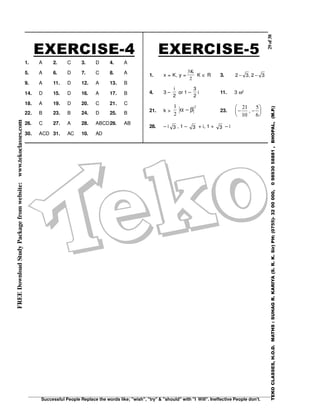
EXERCISE-5
1. x = K, y =
3
2
K
K ∈ R 3. 32,32 −−
4. 3 –
2
i
or 1 –
2
3
i 11. 3 ω2
21. k >
1
2
2
α β− 23. − −






21
10
5
6
,
28. – i 3 , 1 – 3 + i, 1 + 3 – i

2 complex numbers part 2 of 3

  • 1.
    16of38 Successful People Replacethe words like; "wish", "try" & "should" with "I Will". Ineffective People don't. TEKOCLASSES,H.O.D.MATHS:SUHAGR.KARIYA(S.R.K.Sir)PH:(0755)-3200000,09893058881,BHOPAL,(M.P.) FREEDownloadStudyPackagefromwebsite:www.tekoclasses.com a3 − b3 = (a − b) (a − ωb) (a − ω²b) ; x2 + x + 1 = (x − ω) (x − ω2) ; a3 + b3 = (a + b) (a + ωb) (a + ω2b) ; a3 + b3 + c3 − 3abc = (a + b + c) (a + ωb + ω²c) (a + ω²b + ωc) 10. nth ROOTS OF UNITY : If 1 , α1 , α2 , α3 ..... αn − 1 are the n , nth root of unity then : (i) They are in G.P. with common ratio ei(2π/n) & (ii) 1p + α1 p + α2 p + .... +α n p −1 = 0 if p is not an integral multiple of n = n if p is an integral multiple of n (iii) (1 − α1) (1 − α2) ...... (1 − αn − 1) = n & (1 + α1) (1 + α2) ....... (1 + αn − 1) = 0 if n is even and 1 if n is odd. (iv) 1 . α1 . α2 . α3 ......... αn − 1 = 1 or −1 according as n is odd or even. 11. THE SUM OF THE FOLLOWING SERIES SHOULD BE REMEMBERED : (i) cos θ + cos 2 θ + cos 3 θ + ..... + cos nθ = ( ) ( )2sin 2nsin θ θ cos       + 2 1n θ. (ii) sin θ + sin 2θ + sin 3θ + ..... + sin nθ = ( ) ( )2sin 2nsin θ θ sin       + 2 1n θ. Note : If θ = (2π/n) then the sum of the above series vanishes. 12. STRAIGHT LINES & CIRCLES IN TERMS OF COMPLEX NUMBERS : (A) If z1 &z2 are two complex numbersthenthecomplexnumber z = nm mznz 21 + + divides the joins of z1 & z2 in the ratio m: n. Note:(i) If a , b , c are three real numbers such that az1 + bz2 + cz3 = 0 ; where a + b + c = 0 and a,b,c are not allsimultaneouslyzero, then the complexnumbers z1 , z2 & z3 are collinear. (ii) Ifthe vertices A, B, C ofa ∆ represent the complexnos. z1, z2, z3 respectively, then : (a) Centroid of the ∆ABC = 3 zzz 321 ++ : (b) Orthocentre of the ∆ABC = ( ) ( ) ( ) CseccBsecbAseca zCsecczBsecbzAseca 321 ++ ++ OR CtanBtanAtan CtanzBtanzAtanz 321 ++ ++ (c) Incentre of the ∆ ABC = (az1 + bz2 + cz3) ÷ (a + b + c) . (d) Circumcentre ofthe ∆ABC= : (Z1 sin 2A + Z2 sin 2B + Z3 sin 2C) ÷ (sin 2A + sin 2B + sin 2C) . (B) amp(z) = θ is arayemanating fromthe origin inclined at an angle θ to the x−axis. (C) z − a = z − b is the perpendicular bisector of the line joining a to b. (D) The equation ofa line joining z1 & z2 is given by; z = z1 + t (z1 − z2) where t is a perameter. (E) z = z1 (1 + it) where t is a realparameter is a line through the point z1 &perpendicular to oz1. (F) The equation of a line passing through z1 & z2 can be expressed in the determinant form as 1zz 1zz 1zz 22 11 = 0. This is also the condition for three complex numbers to be collinear.. (G) Complex equation of a straight line through two given points z1 & z2 can be written as ( ) ( ) ( )21212121 zzzzzzzzzz −+−−− = 0, which on manipulating takes the formas rzz +α+α = 0 where r is realand α isa non zero complex constant. (H) The equation of circle having centre z0 & radius ρ is : z − z0 = ρ or z z − z0 z − 0z z + 0z z0 − ρ² = 0 which is of the form rzzzz +α+α+ = 0 , r is real centre − α & radius r−αα . Circle willbe realif 0r ≥−αα . (I) The equation ofthe circle described on the line segment joining z1 &z2 asdiameter is : (i) arg 1 2 zz zz − − = ± 2 π or (z − z1) ( z − z 2) + (z − z2)( z − z 1) = 0 (J) Condition for four given points z1 , z2 , z3 & z4 to be concyclicis, the number
  • 2.
    17of38 Successful People Replacethe words like; "wish", "try" & "should" with "I Will". Ineffective People don't. TEKOCLASSES,H.O.D.MATHS:SUHAGR.KARIYA(S.R.K.Sir)PH:(0755)-3200000,09893058881,BHOPAL,(M.P.) FREEDownloadStudyPackagefromwebsite:www.tekoclasses.com 14 24 23 13 zz zz . zz zz − − − − is real. Hence theequationofa circle through3noncollinear pointsz1, z2 &z3 canbe taken as ( )( ) ( )( )231 132 zzzz zzzz −− −− is real ⇒ ( )( ) ( )( )231 132 zzzz zzzz −− −− = ( )( ) ( )( )231 132 zzzz zzzz −− −− 13.(a) Reflection points for a straight line : Two given points P & Q are the reflection points for a given straight line if the given line is the right bisector of the segment PQ. Notethat thetwo points denoted bythe complexnumbers z1 &z2 willbe the reflection pointsforthe straight line 0rzz =+α+α ifand onlyif; 0rzz 21 =+α+α , wherer is realand α is nonzero complex constant. (b) Inverse points w.r.t. a circle : Two points P& Q are said to be inverse w.r.t. a circle with centre 'O' and radius ρ, if : (i) the point O, P, Q are collinear and on the same side of O. (ii) OP . OQ = ρ2. Note that the two points z1 &z2 willbe the inverse points w.r.t. the circle 0rzzzz =+α+α+ if and only if 0rzzzz 2121 =+α+α+ . 14. PTOLEMY’S THEOREM :It states that the product of the lengths of the diagonals of a convex quadrilateral inscribed in a circle is equal to the sum of the lengths of the two pairs of its opposite sides. i.e. z1 − z3 z2 − z4 = z1 − z2 z3 − z4 + z1 − z4 z2 − z3. 15. LOGARITHM OF A COMPLEX QUANTITY: (i) Loge (α + i β) = 2 1 Loge (α² + β²) + i       α β +π −1 tann2 where n ∈ I. (ii) ii represents a set of positive real numbers given by       π +π− 2 n2 e , n ∈ I. VERY ELEMENTARY EXERCISE Q.1 Simplifyand expressthe result in theformof a + bi (a) 2 i2 i21       + + (b) −i (9 + 6 i) (2 − i)−1 (c) 2 3 1i2 ii4         + − (d) i52 i23 i52 i23 + − + − + (e) ( ) ( ) i2 i2 i2 i2 22 + − − − + Q.2 Given that x , y ∈ R, solve : (a) (x + 2y) + i (2x − 3y) = 5 − 4i (b) (x + iy) + (7 − 5i) = 9 + 4i (c) x² − y² − i (2x + y) = 2i (d) (2 + 3i) x² − (3 − 2i) y = 2x − 3y + 5i (e) 4x² + 3xy + (2xy − 3x²)i = 4y² − (x2/2) + (3xy − 2y²)i Q.3 Find the square root of : (a) 9 + 40 i (b) −11 − 60 i (c) 50 i Q.4 (a) If f (x) = x4 + 9x3 + 35x2 − x + 4, find f ( – 5 + 4i) (b) If g (x) = x4 − x3 + x2 + 3x − 5, find g(2 + 3i) Q.5 Among the complex numbersz satisfying thecondition z i+ − =3 3 3 , find the number having the least positiveargument. Q.6 Solve the following equations over C and expressthe result in theform a + ib, a, b ∈R. (a) ix2 − 3x − 2i = 0 (b) 2 (1 + i) x2 − 4 (2 − i) x − 5 − 3 i = 0 Q.7 Locate the points representing the complexnumber zon theArgand plane: (a) z +1 −2i = 7 ; (b) z z− + +1 1 2 2 = 4 ; (c) z z − + 3 3 = 3 ; (d) z −3 = z−6 Q.8 If a & b are real numbers between 0 & 1 such that the points z1 = a + i, z2 = 1 + bi & z3 = 0 forman equilateraltriangle, then find the valuesof'a' and 'b'. Q.9 For what real values of x & y are the numbers −3 + ix2 y & x2 + y + 4iconjugate complex? Q.10 Find the modulus, argument and the principal argument of the complex numbers. (i) 6 (cos310° − i sin 310°) (ii) −2 (cos 30° + i sin 30°) (iii) 2 4 1 2 + + + i i i( ) Q.11 If (x + iy)1/3 = a + bi ; prove that 4(a2 − b2) = x a y b + . Q.12(a) If a ib c id + + = p + qi , prove that p2 + q2 = a b c d 2 2 2 2 + + . (b) Let z1, z2, z3 be the complex numbers such that z1 + z2 + z3 = z1z2 + z2z3 + z3z1 = 0. Prove that | z1 | = | z2 | = | z3 |. Q.13 Let z be a complex number such that z ∈ cR and 2 2 zz1 zz1 +− ++ ∈ R, then prove that | z | =1. Q.14 Prove the identity, ( )( )2 2 2 1 2 21 2 21 |z|1|z|1|zz||zz1| −−=−−−
  • 3.
    18of38 Successful People Replacethe words like; "wish", "try" & "should" with "I Will". Ineffective People don't. TEKOCLASSES,H.O.D.MATHS:SUHAGR.KARIYA(S.R.K.Sir)PH:(0755)-3200000,09893058881,BHOPAL,(M.P.) FREEDownloadStudyPackagefromwebsite:www.tekoclasses.com Q.15 For any two complex numbers, prove that z z z z1 2 2 1 2 2 + + − = 2 [ ]z z1 2 2 2 + . Also give the geometricalinterpretationofthisidentity. Q.16 (a) Find all non−zero complex numbers Z satisfying Z = i Z². (b) Ifthe complex numbers z1, z2, .................zn lieon the unit circle|z| = 1 then show that |z1 + z2 + ..............+zn| = |z1 –1+ z2 –1+................+zn –1| . Q.17 Find the Cartesianequation ofthe locus of'z' in the complexplane satisfying, | z – 4 | + | z + 4 | = 16. Q.18 If ω is an imaginary cube root of unity then prove that : (a) (1 + ω − ω²)3 − (1− ω + ω²)3 = 0 (b) (1 − ω + ω²)5 + (1+ ω − ω²)5 = 32 (c) If ωis the cube root of unity, Find the value of, (1 + 5ω2 + ω4) (1+ 5ω4 + ω2) (5ω3 + ω+ ω2). Q.19 If ωis a cube root of unity, prove that ; (i) (1 + ω− ω2)3 − (1 − ω+ ω2)3 (ii) a b c c a b + + + + ω ω ω ω 2 2 = ω2 (iii) (1 − ω) (1 − ω2) (1 − ω4) (1 − ω8) = 9 Q.20 If x = a + b ; y = aω + bω2 ; z = aω2 + bω, show that (i) xyz = a3 + b3 (ii) x2 + y2 + z2 = 6ab (iii) x3 + y3 + z3 = 3 (a3 + b3) Q.21 If (w ≠ 1) is a cube root ofunity then 11wii 1w1i1 wwi11 2 22 −−+−− −−− ++ = (A) 0 (B) 1 (C) i (D) w Q.22(a) (1 + w)7 =A+ Bw where w is the imaginarycube root of a unity andA, B ∈ R, find the ordered pair (A, B). (b) The value of the expression ; 1. (2 − w) (2 − w²) + 2. (3 − w) (3 − w²) + ............. + (n − 1) . (n − w) (n − w²), where w is an imaginary cube root of unity is ________. Q.23 If n ∈ N, prove that (1 + i)n + (1 − i)n = 22 1n + . cos nπ 4 . Q.24 Show that thesum k n = ∑1 2 sin cos 2 2 1 2 2 1 π πk n i k n+ − +       simplifiesto apure imaginarynumber.. Q.25 If x = cosθ + i sinθ & 1+ 1 2 − a = na, prove that 1 + a cosθ = a n2 (1 + nx) 1 +       n x . Q.26 The number t isrealand not anintegralmultiple ofπ/2. Thecomplex number x1 and x2 aretherootsof the equation, tan2(t) · x2 + tan (t) · x + 1 = 0 Show that (x1)n + (x2)n =       π 3 n2 cos2 cotn(t). EXERCISE-1 Q.1 Simplifyand expressthe result in the formof a +bi : (a) −i (9 + 6 i) (2 − i)−1 (b) 23 1i2 ii4         + − (c) i52 i23 i52 i23 + − + − + (d) ( ) ( ) i2 i2 i2 i2 22 + − − − + (e) ii −+ Q.2 Find the modulus , argument and the principal argument of the complex numbers. (i) z = 1 + cos       π 9 10 + i sin       π 9 10 (ii) (tan1 – i)2 (iii) z = i125i125 i125i125 −−+ −++ (iv) 5 2 sin 5 2 cos1i 1i π +      π − − Q.3 Given that x, y ∈ R, solve : (a) (x + 2y) + i (2x − 3y) = 5 − 4i (b) 1i8 i65 i23 y i21 x − + = + + + (c) x² − y² − i (2x + y) = 2i (d) (2 + 3i) x² − (3 − 2i) y = 2x − 3y + 5i (e) 4x² + 3xy + (2xy − 3x²)i = 4y² − (x2/2) + (3xy − 2y²)i Q.4(a) Let Z is complex satisfying the equation, z2 – (3 + i)z + m + 2i= 0, where m ∈R.
  • 4.
    19of38 Successful People Replacethe words like; "wish", "try" & "should" with "I Will". Ineffective People don't. TEKOCLASSES,H.O.D.MATHS:SUHAGR.KARIYA(S.R.K.Sir)PH:(0755)-3200000,09893058881,BHOPAL,(M.P.) FREEDownloadStudyPackagefromwebsite:www.tekoclasses.com Suppose the equation has a realroot, then find the value ofm. (b) a, b, c are real numbers in the polynomial, P(Z) = 2Z4 + aZ3 + bZ2 + cZ + 3 If two roots of the equation P(Z) = 0 are 2 and i, then find thevalue of'a'. Q.5(a) Find the real values of x & y for which z1 = 9y2 − 4 − 10 ix and z2 = 8y2 − 20 i are conjugate complex of each other. (b) Find the value of x4 − x3 + x2 + 3x − 5 if x = 2 + 3i Q.6 Solve the following for z : (a) z2 – (3 – 2 i)z = (5i – 5) (b) z+ z = 2 + i Q.7(a) If iZ3 + Z2 − Z + i = 0, then show that | Z | = 1. (b) Let z1 and z2 be two complex numbers such that 21 21 zz2 z2z − − = 1 and | z2 | ≠ 1, find | z1 |. (c) Let z1 =10 +6i &z2 = 4 +6i. If z isanycomplexnumber suchthat theargument of, 2 1 zz zz − − is 4 π , then prove that z − 7 − 9i= 3 2 . Q.8 Show that theproduct,               + +               + +               + +            + + n2 222 2 i1 1...... 2 i1 1 2 i1 1 2 i1 1 is equal to 1 1 22 −      n (1+ i) where n ≥ 2 . Q.9 Let a &b be complex numbers (which may bereal) and let, Z = z3 + (a + b + 3i) z2 + (ab + 3 ia + 2 ib − 2) z + 2 abi − 2a. (i) Show that Z is divisible by, z + b + i. (ii) Find all complex numbers z for which Z= 0. (iii) Find all purelyimaginary numbers a &b when z = 1 + i and Z is a real number. Q.10 Interpret the following locii in z ∈C. (a) 1 < z − 2i < 3 (b) Re 4 2zi i2z ≤      + + (z ≠ 2i) (c) Arg (z + i) −Arg (z − i) = π/2 (d) Arg (z − a) = π/3 where a = 3 + 4i. Q.11 Prove that thecomplexnumbers z1 and z2 and the origin forman isosceles trianglewithverticalangle 2π/3 if 0zzzz 21 2 2 2 1 =++ . Q.12 Pis apoint on theAraganddiagram. Onthe circlewith OPas diameter two points Q & Raretakensuch that ∠ POQ = ∠ QOR = θ. If ‘O’is the origin & P, Q & R are represented bythe complex numbers ZZZZ 1 , Z2 & Z3 respectively, show that : Z2 2 . cos 2θ = Z1 . Z3 cos²θ. Q.13 Let z1, z2, z3 are three pair wise distinct complexnumbers and t1, t2, t3 are non-negative realnumbers such that t1 + t2 + t3 = 1. Prove that the complexnumber z = t1z1 + t2z2 + t3z3 lies inside a triangle with vertices z1, z2, z3 or on its boundry. Q.14 If a CiSα, b CiSβ, c CiSγ represent three distinct collinear points in anArgand's plane, then prove thefollowing: (i) Σ ab sin (α − β) = 0. (ii) (a CiS α) )cos(bc2cb 22 γ−β−+ ± (b CiS β) )cos(ac2ca 22 γ−α−+ (c CiS γ) )cos(ab2ba 22 β−α−+ = 0. Q.15 Find allrealvalues of the parameter a for which the equation (a − 1)z4 − 4z2 + a + 2 = 0 has only pure imaginary roots. Q.16 LetA≡z1 ;B ≡ z2;C ≡ z3 are three complex numbers denotingthe vertices ofanacuteangled triangle. Iftheorigin ‘O’is theorthocentreofthe triangle,thenprovethat z1 z2 + z1 z2 = z2 z3 + z2 z3 = z3 z1 + z3 z1 hence show that the ∆ABC is a right angled triangle ⇔ z1 z2 + z1 z2 = z2 z3 + z2 z3 = z3 z1 + z3 z1 = 0 Q.17 If the complex number P(w) lies on the standard unit circle in an Argand's plane and z = (aw+b)(w – c)–1 then, find the locus ofz and interpret it. Given a, b, c are real. Q.18(a) Without expanding the determinant at anystage , find RK∈ suchthat i8iKi4 ii16i8 i34i8i4 +− +− ++ haspurelyimaginaryvalue. (b) IfA, Band C are the angles ofa triangle
  • 5.
    20of38 Successful People Replacethe words like; "wish", "try" & "should" with "I Will". Ineffective People don't. TEKOCLASSES,H.O.D.MATHS:SUHAGR.KARIYA(S.R.K.Sir)PH:(0755)-3200000,09893058881,BHOPAL,(M.P.) FREEDownloadStudyPackagefromwebsite:www.tekoclasses.com D = iC2iAiB iAiB2iC iBiCiA2 eee eee eee − − − where i = −1 then find the value of D. Q.19 If w is an imaginary cube root of unity then prove that : (a) (1 − w + w2) (1 − w2 + w4) (1 − w4 + w8) ..... to 2n factors = 22n . (b) If w is a complex cube root of unity, find the value of (1 + w) (1 + w2) (1 + w4) (1 + w8) ..... to n factors . Q.20 Prove that n cosisin1 cosisin1       θ−θ+ θ+θ+ = cos       θ− π n 2 n + isin       θ− π n 2 n . Hence deduce that 5 5 cosi 5 sin1       π + π + + i 5 5 cosi 5 sin1       π − π + = 0 Q.21 If cos (α − β) + cos(β − γ) + cos (γ − α) = − 3/2 then prove that : (a) Σ cos 2α = 0 = Σ sin 2α (b) Σ sin (α + β) = 0 = Σ cos (α + β) (c) Σ sin2 α = Σ cos2 α = 3/2 (d) Σ sin 3α = 3 sin (α + β + γ) (e) Σ cos 3α = 3 cos (α + β + γ) (f) cos3 (θ+α)+cos3 (θ+β)+ cos3 (θ+γ) = 3cos(θ +α). cos (θ+β). cos (θ+γ) where θ ∈R. Q.22 Resolve Z5 + 1 into linear& quadratic factors withrealcoefficients. Deduce that : 4·sin π 10 ·cos π 5 = 1. Q.23 If x = 1+ i 3 ; y = 1 − i 3 & z = 2 , then prove that xp + yp = zp for every prime p > 3. Q.24 If the expression z5 – 32 can be factorised into linear and quadratic factors over realcoefficients as (z5 – 32) = (z – 2)(z2 – pz + 4)(z2 – qz + 4) then find the value of (p2 + 2p). Q.25(a)Let z= x + iybeacomplexnumber, wherexand y arerealnumbers. LetAand B bethesets defined by A= {z | | z | ≤ 2} and B = {z | (1 – i)z + (1 + i) z ≥ 4}. Find the area of the regionA∩ B. (b) For all real numbers x, let the mapping f (x) = i−x 1 , where i = 1− . If there exist real number a, b, c and d for which f (a), f (b), f (c) and f (d) forma square onthe complex plane. Find the area of the square. EXERCISE-2 Q.1 If p q r q r p r p q = 0 ; where p , q , r are the moduli of non−zero complex numbers u, v, w respectively,, prove that, arg w v = arg w u v u − −       2 . Q.2 The equation x3 = 9 + 46i where i = 1− has a solution ofthe forma + bi where a and bare integers. Find the value of(a3 + b3). Q.3 Show that the locus formed by z in the equation z3 + iz = 1 never crosses the co-ordinate axes in the Argand’s plane. Further show that |z| = − + Im( ) Re( )Im( ) z z z2 1 Q.4 If ωis the fifth root of 2 and x = ω+ ω2, prove that x5 = 10x2 + 10x + 6. Q.5 Prove that , with regard to the quadratic equation z2 + (p + ip′) z + q + iq′ = 0 where p , p′, q , q′ are all real. (i) if the equation has one real root then q ′2 − pp ′q′ + qp′2 = 0 . (ii) if the equation has two equal roots then p2 − p′2 = 4q & pp′ = 2q′. State whether these equalrootsarerealor complex. Q.6 If the equation (z + 1)7 + z7 = 0 has roots z1, z2, .... z7, find the value of (a) ∑ = 7 1r r )ZRe( and (b) ∑ = 7 1r r )ZIm( Q.7 Find the roots oftheequation Zn = (Z+ 1)n and show that thepoints whichrepresent themare collinear on the complex plane. Hence showthat these roots are also the roots ofthe equation 2 2 Z n m sin2       π + Z n m sin2 2       π + 1 = 0. Q.8 Dividing f(z) by z − i, we get the remainder i and dividing it by z + i, we get the remainder
  • 6.
    21of38 Successful People Replacethe words like; "wish", "try" & "should" with "I Will". Ineffective People don't. TEKOCLASSES,H.O.D.MATHS:SUHAGR.KARIYA(S.R.K.Sir)PH:(0755)-3200000,09893058881,BHOPAL,(M.P.) FREEDownloadStudyPackagefromwebsite:www.tekoclasses.com 1 + i. Find the remainder upon the division of f(z) by z² + 1. Q.9 Let z1 & z2 be anytwo arbitrarycomplex numbers then prove that : z1 + z2 ≥ ( ) |z| z |z| z |z||z| 2 1 2 2 1 1 21 ++ . Q.10 If Zr, r = 1, 2, 3, ......... 2m, m ε N are the roots ofthe equation Z2m + Z2m-1 + Z2m-2 + ............. + Z + 1 = 0 then prove that ∑ −=r m rZ1 2 1 1 = −m Q.11 If (1 + x)n = C0 + C1x + C2x² + .... + Cn xn (n ∈ N), prove that : (a) C0 + C4 + C8 + .... = 1 2 2 2 4 1 2n n n− +       / cos π (b) C1 + C5 + C9 + .... = 1 2 2 2 4 1 2n n n− +       / sin π (c) C2 + C6 + C10 + ..... = 1 2 2 2 4 1 2n n n− −       / cos π (d) C3 + C7 + C11 + .... = 1 2 2 2 4 1 2n n n− −       / sin π (e) C0 + C3 + C6 + C9 + ........ = 1 3 2 2 3 n n +      cos π Q.12 Let z1 , z2 , z3 , z4 be the vertices A, B , C , D respectively of a square on the Argand diagram taken in anticlockwise direction then prove that : (i) 2z2 = (1 + i) z1 + (1− i)z3 & (ii) 2z4 = (1− i) z1 + (1 + i) z3 Q.13 Show that allthe roots of the equation 1 1 1 1 + −       = + − ix ix ia ia n a ∈ R are realand distinct. Q.14 Prove that: (a) cos x + nC1 cos 2x + nC2 cos 3x + ..... + nCn cos (n + 1) x = 2n . cosn x 2 . cos n +      2 2 x (b) sin x + nC1 sin 2x + nC2 sin 3x + ..... + nCn sin (n + 1) x = 2n . cosn x 2 . sin n +      2 2 x (c) cos 2 2 1 π n +       + cos 4 2 1 π n +       + cos 6 2 1 π n +       + ..... + cos 2 2 1 n n π +       = − 1 2 When n ∈ N. Q.15 Show that all roots of the equation a0zn + a1zn – 1 + ...... + an – 1z + an = n, where | ai | ≤ 1, i= 0, 1, 2, .... , n lie outside the circle withcentre at the originand radius n 1n − . Q.16 The pointsA, B, Cdepict thecomplexnumbers z1 , z2 , z3 respectivelyon a complex plane &the angle B & C of the triangleABC are each equal to )( 2 1 α−π . Show that (z2 − z3)² = 4 (z3 − z1) (z1 − z2) sin2 α 2 . Q.17 Show that the equation A x a A x a A x a n n 1 2 1 2 2 2 2 − + − + + − ...... = k hasno imaginaryroot, given that: a1 , a2 , a3 .... an & A1, A2, A3 ..... An, k are all real numbers. Q.18 Let a, b, c bedistinct complex numbers such that b1 a − = c1 b − = a1 c − = k. Find the valueof k. Q.19 Let α, β be fixed complex numbers and z is a variable complexnumber such that, z − α 2 + z − β 2 = k. Find out thelimits for 'k' suchthat thelocus of z isa circle. Find also thecentreand radius ofthe circle. Q.20 C is the complexnumber. f : C →R isdefined byf(z) =| z3 – z+ 2|.What is the maximumvalueof f on the unit circle | z | = 1? Q.21 Let f(x) = )xi2(coslog x3cos if x≠ 0 and f(0) =K (where i= 1− ) iscontinuous at x= 0 thenfind the value ofK. Use ofLHospital’s rule or series expansion not allowed. Q.22 If z1 , z2 are the roots of the equation az2 + bz + c = 0, with a, b, c > 0 ; 2b2 > 4ac > b2 ; z1 ∈ third quadrant ; z2 ∈ second quadrant in the argand's plane then, show that
  • 7.
    22of38 Successful People Replacethe words like; "wish", "try" & "should" with "I Will". Ineffective People don't. TEKOCLASSES,H.O.D.MATHS:SUHAGR.KARIYA(S.R.K.Sir)PH:(0755)-3200000,09893058881,BHOPAL,(M.P.) FREEDownloadStudyPackagefromwebsite:www.tekoclasses.com arg         2 1 z z = 2cos–1 2/12 ac4 b         Q.23 Find the set ofpoints on theargand plane for whichthe realpart ofthe complex number (1 + i) z2 is positive where z = x + iy , x, y ∈ R and i = −1 . Q.24 If a and b are positive integer such that N = (a + ib)3 – 107i is a positive integer. Find N. Q.25 If the biquadratic x4 + ax3 + bx2 + cx + d = 0 (a, b, c, d ∈ R) has 4 non real roots, two with sum 3 + 4iand the other two with product 13 + i. Find the value of 'b'. EXERCISE-3 Q.1 Evaluate: ( ) sin cos3 2 2 11 2 111 10 1 32 p q i q q p p + −               == ∑∑ π π . [REE '97, 6] Q.2(a) Let z1 and z2 be roots of the equation z2 + pz + q = 0 , where the co−efficients p and q may be complex numbers. Let A and B represent z1 and z2 in the complex plane. If ∠AOB = α ≠ 0 and OA = OB, where O is the origin . Prove that p2 = 4qcos2 α 2       . [JEE '97 , 5] (b) Prove that k n = − ∑ 1 1 (n − k) cos 2k n π = − n 2 where n ≥ 3 is an integer . [JEE '97, 5] Q.3(a) If ωis animaginarycube root of unity, then (1 + ω− ω2)7 equals (A) 128ω (B) − 128ω (C) 128ω2 (D) − 128ω2 (b) The value of the sum ( )i in n n + + = ∑ 1 1 13 , where i = −1 , equals (A) i (B) i − 1 (C) − i (D) 0 [JEE' 98, 2 + 2 ] Q.4 Find allthe roots ofthe equation (3z − 1)4 + (z − 2)4 = 0 in the simplified form ofa + ib. [REE ’98, 6 ] Q.5(a) If i = −1 , then 4 + 5 − +       1 2 3 2 334 i + 3 − +       1 2 3 2 365 i is equal to : (A) 1 − i 3 (B) − 1 + i 3 (C) i 3 (D) − i 3 (b) For complex numbers z & ω, prove that, z 2 ω− ω 2 z = z − ω if and only if, z = ω or zω = 1 [JEE '99, 2 + 10 (out of 200)] Q.6 If α = e i2 7 π and f(x) =AA0 + k = ∑ 1 20 Ak xk, then find the value of, f(x) + f(αx) + ...... + f(α6x) independent of α . [REE '99, 6] Q.7(a) If z1 , z2 , z3 are complex numbers such that z1 = z2 = z3 = 1 1 1 1 2 3z z z + +       = 1, then z1 + z2 + z3 is : (A) equalto 1 (B) less than 1 (C) greater than 3 (D) equal to 3 (b) If arg (z) < 0, then arg (−z) − arg (z) = (A) π (B) − π (C) − π 2 (D) π 2 [ JEE 2000 (Screening) 1 + 1 out of35 ] Q.8 Given , z = cos 2 2 1 π n + + i sin 2 2 1 π n + , 'n' a positive integer, find the equation whose roots are, α = z + z3 + ...... + z2n − 1 & β = z2 + z4 + ...... + z2n . [ REE 2000 (Mains) 3 out of100 ] Q.9(a) The complex numbers z1, z2 and z3 satisfying z z z z i1 3 2 3 1 3 2 − − = − arethevertices of atrianglewhich is (A) ofarea zero (B) right-angled isosceles (C) equilateral (D) obtuse – angled isosceles
  • 8.
    23of38 Successful People Replacethe words like; "wish", "try" & "should" with "I Will". Ineffective People don't. TEKOCLASSES,H.O.D.MATHS:SUHAGR.KARIYA(S.R.K.Sir)PH:(0755)-3200000,09893058881,BHOPAL,(M.P.) FREEDownloadStudyPackagefromwebsite:www.tekoclasses.com (b) Let z1 and z2 benth roots ofunitywhich subtend a right angle at the origin. Thenn must be ofthe form (A) 4k + 1 (B) 4k + 2 (C) 4k + 3 (D) 4k [ JEE 2001 (Scr) 1 + 1 out of 35 ] Q.10 Find allthose roots of the equation z12 – 56z6 – 512 = 0 whose imaginarypart is positive. [ REE 2000, 3 out of100 ] Q.11(a) Let ω = − + 1 2 3 2 i . Thenthe value of thedeterminant 1 1 1 1 1 1 2 2 2 4 − − ω ω ω ω is (A) 3ω (B) 3ω (ω– 1) (C) 3ω2 (D) 3ω(1 – ω) (b) For all complex numbers z1, z2 satisfying |z1| = 12 and |z2 – 3 – 4i| = 5, the minimum value of |z1 – z2| is (A) 0 (B) 2 (C) 7 (D) 17 [JEE 2002(Scr) 3+3] (c) Let a complex number α , α ≠ 1, be aroot ofthe equation zp+q – zp – zq + 1 = 0 where p, q are distinct primes. Show that either 1 + α + α2 + ...... + αp–1 = 0 or 1 + α + α2 + ...... + αq–1 = 0 , but not both together. [JEE 2002, (5) ] Q.12(a) If z1 and z2 are two complex numbers such that | z1 | < 1 < | z2 | then prove that 1 zz zz1 21 21 < − − . (b) Prove that there exists no complex number z such that | z | < 3 1 and ∑ = n 1r r r za = 1 where |ar |<2. [JEE-03, 2 +2 out of 60] Q.13(a) ωis animaginarycube root ofunity. If(1 + ω2)m = (1 + ω4)m , then least positiveintegralvalue ofmis (A) 6 (B) 5 (C) 4 (D) 3 [JEE 2004 (Scr)] (b) Findcentreandradius ofthecircle determinedbyallcomplexnumbersz=x+iysatisfying k )z( )z( = β− α− , where 2121 i,i β+β=βα+α=α are fixed complex and k ≠ 1. [JEE 2004, 2 out of60 ] Q.14(a) The locus ofz which lies in shaded region is best represented by (A) z : |z + 1| > 2, |arg(z + 1)| < π/4 (B) z : |z - 1| > 2, |arg(z – 1)| < π/4 (C) z : |z + 1| < 2, |arg(z + 1)| < π/2 (D) z : |z - 1| < 2, |arg(z - 1)| < π/2 (b) If a, b, c are integers not all equaland w is a cube root ofunity(w ≠ 1), then the minimumvalue of |a + bw + cw2 | is (A) 0 (B) 1 (C) 2 3 (D) 2 1 [JEE 2005 (Scr), 3 + 3] (c) If one ofthe vertices of the squarecircumscribing the circle |z – 1| = 2 is i32 + . Find the other vertices ofsquare. [JEE 2005 (Mains), 4] Q.15 If w = α + iβ where β ≠ 0 and z ≠ 1, satisfies the conditionthat z1 zww − − is purelyreal, then theset of values ofz is (A) {z : | z | = 1} (B) {z: z = z ) (C) {z : z ≠ 1} (D) {z : | z | = 1, z ≠ 1} [JEE 2006, 3] ANSWER KEY VERY ELEMENTARY EXERCISE Q.1 (a) 25 24 25 7 + i; (b) 5 12 5 21 − i; (c) 3 + 4i; (d) 29 8 − + 0i; (e) 5 22 i Q.2 (a) x =1, y = 2; (b) (2, 9); (c) (−2 , 2) or − −       2 3 2 3 , ; (d) (1 ,1) 0 5 2 ,       (e) x = K, y = 3 2 K , K∈R
  • 9.
    24of38 Successful People Replacethe words like; "wish", "try" & "should" with "I Will". Ineffective People don't. TEKOCLASSES,H.O.D.MATHS:SUHAGR.KARIYA(S.R.K.Sir)PH:(0755)-3200000,09893058881,BHOPAL,(M.P.) FREEDownloadStudyPackagefromwebsite:www.tekoclasses.com Q.3 (a) ± (5 + 4i) ; (b) ± (5 − 6i) (c) ± 5(1 + i) Q.4 (a) −160 ; (b) − (77 +108 i) Q.5 – 3 2 3 3 2 + i Q.6 (a) − i, − 2i (b) 3 5 2 − i or − 1 2 + i Q.7 (a) on a circle of radius 7 with centre (−1, 2) ; (b) ona unit circle withcentre at origin (c) on a circle with centre (−15/4, 0) & radius 9/4 ; (d) astraight line Q.8 a = b = 2 − 3 ; Q.9 x = 1, y = − 4 or x = − 1, y = − 4 Q.10 (i) Modulus = 6 , Arg = 2 k π + 5 18 π (K ∈ I) , Principal Arg = 5 18 π (K ∈ I) (ii) Modulus = 2 , Arg = 2 kπ + 7 6 π , Principal Arg = − 5 6 π (iii) Modulus = 5 6 , Arg = 2k π − tan−1 2 (K ∈ I) , Principal Arg = − tan−12 Q.16 (a) 3 2 2 − i , − − 3 2 2 i , i ; Q.17 1 48 y 64 x 22 =+ ; Q.18 (c) 64 ; Q.21 A Q.22 (a) (1, 1) ; (b) ( )n n n +        − 1 2 2 EXERCISE-1 Q.1 (a) 21 5 12 5 − i (b) 3 + 4 i (c) − 8 29 + 0 i (d) 22 5 i (e) + i02 + or i20± Q.2 (i) Principal Arg z = − 4 9 π ; z = 2 cos 4 9 π ; Arg z = 2 k π − 4 9 π k ∈ I (ii) Modulus = sec21 , Arg = 2 nπ + (2 – π ) , Principal Arg = (2 – π ) (iii) Principal value of Agr z = − π 2 & z = 3 2 ; Principal value ofArg z = π 2 & z = 2 3 (iv) Modulus = 5 eccos 2 1 π , Arg z = 20 11 n2 π +π , Principal Arg = 20 11π Q.3(a) x = 1, y = 2; (b) x = 1 & y = 2 ; (c) (−2, 2) or − −       2 3 2 3 , ; (d) (1 ,1) 0 5 2 ,       ; (e) x =K, y = 3 2 K K∈R Q.4 (a) 2, (b) – 11/2 Q.5 (a) [(− 2, 2) ; (− 2, − 2)] (b) − (77 +108 i) Q.6 (a) z = (2 + i) or (1 – 3i); (b) z = 3 4 4 + i Q.7 (b) 2 Q.9 (ii) z = − (b + i) ; − 2 i , − a (iii)       + − ti, 5t3 ti2 where t ∈ R −       − 3 5 Q.10 (a) Theregion between the co encentric circles withcentre at (0 , 2) & radii1 & 3 units (b) regionoutside or on the circlewith centre 2 1 + 2iand radius 2 1 . (c) semi circle (in the 1st & 4th quadrant) x² + y² = 1 (d) a rayemanating fromthe point (3 + 4i) directed awayfromthe origin & having equation 3 4 3 3 0x y− + − = Q.15 [−3 , −2] Q.17 (1 – c2) | z |2 – 2(a + bc) (Re z) + a2 – b2 = 0 Q.18 (a) K = 3 , (b) – 4 Q.19 (b) one if n is even ; − w² if n is odd Q.22 (Z + 1) (Z² − 2Z cos 36° + 1) (Z² − 2Z cos 108° + 1) Q.24 4 Q.25 (a) π – 2 ; (b) 1/2 EXERCISE-2 Q.2 35 Q.6 (a) – 2 7 , (b) zero Q.8 i z i 2 1 2 + + Q.18 – ω or – ω2 Q.19 k > 1 2 2 α β− Q.20 | f(z) | ismaximumwhenz= ω, whereωisthe cuberoot unityand |f(z)| = 13 Q.21 K = – 9 4
  • 10.
    25of38 Successful People Replacethe words like; "wish", "try" & "should" with "I Will". Ineffective People don't. TEKOCLASSES,H.O.D.MATHS:SUHAGR.KARIYA(S.R.K.Sir)PH:(0755)-3200000,09893058881,BHOPAL,(M.P.) FREEDownloadStudyPackagefromwebsite:www.tekoclasses.com Q.23 required set is constituted by the angles without their boundaries, whose sides are the straight lines y = )12( − x and y + )12( + x = 0 containing the x − axis Q.24 198 Q.25 51 EXERCISE-3 Q.1 48(1 − i) Q.3 (a) D (b) B Q.4 Z = ( ) ( )29 20 2 15 25 2 82 + + ± +i , ( ) ( )29 20 2 15 25 2 82 − + ± −i Q.5 (a) C Q.6 7 A0 + 7 A7 x7 + 7 A14 x14 Q.7 (a) A (b) A Q.8 z2 + z + sin sin 2 2 n θ θ = 0, where θ = 2 2 1 π n + Q.9 (a) C, (b) D Q.10 +1 + i 3 , ( )± +3 2 i , 2 i Q.11 (a) B ; (b) B Q.13 (a) D ; (b) Centre ≡ 1k k 2 2 − α−β , Radius = ( )( )1k.||||.k|k| )1k( 1 222222 2 −α−β−β−α − Q.14 (a) A, (b) B, (c) z2 = – 3 i ; z3 = ( ) i31 +− ; z4 = ( ) i31 −+ Q.15 D EXERCISE-4 Part : (A) Only one correct option 1. If |z| = 1 and ω = 1z 1z + − (where z ≠ –1), the Re(ω) is [IIT – 2003, 3] (A) 0 (B) 2 |1z| 1 + − (C) 2 |1z| 1 . 1z z ++ (D) 2 |1z| 2 + 2. The locus of z which lies in shaded region (excluding the boundaries) is best represented by [IIT – 2005, 3] (A) z : |z + 1| > 2 and |arg (z + 1)| < π/4 (B) z : |z – 1| > 2 and |arg (z – 1)| < π/4 (C) z : |z + 1| < 2 and |arg (z + 1)| < π/2 (D) z : |z – 1| < 2 and |arg (z + 1)| < π/2 3. If w = α, + iβ, where β ≠ 0 and z ≠ 1, satisfies the condition that       − − z1 zww is purely real, then the set of values of z is [IIT – 2006, (3, –1)] (A) {z : |z| = 1} (B) {z : z = z } (C) {z : z ≠ 1} (D) {z : |z| = 1, z ≠1} 4. If ( 3 + i)100 = 299 (a + ib), then b is equal to (A) 3 (B) 2 (C) 1 (D) none of these 5. If Re       + − 6z i8z = 0, then z lies on the curve (A) x2 + y2 + 6x – 8y = 0 (B) 4x – 3y + 24 = 0 (C) 4ab (D) none of these 6. If n1 , n2 are positive integers then : 1n )i1( + + 1n3 )i1( + + 2n5 )i1( − + 2n7 )i1( − is a real number if and only if (A) n1 = n2 + 1 (B) n1 + 1 = n2 (C) n1 = n2 (D) n1 , n2 are any two positive integers 7. The three vertices of a triangle are represented by the complex numbers, 0, z1 and z2 . If the triangle is equilateral, then (A) z1 2 – z2 2 = z1 z2 (B) z2 2 – z1 2 = z1 z2 (C) z1 2 + z2 2 = z1 z2 (D) z1 2 + z2 2 + z1 z2 = 0 8. If x2 – x + 1 = 0 then the value of 25 1n n n x 1 x∑=       + is (A) 8 (B) 10 (C) 12 (D) none of these
  • 11.
    26of38 Successful People Replacethe words like; "wish", "try" & "should" with "I Will". Ineffective People don't. TEKOCLASSES,H.O.D.MATHS:SUHAGR.KARIYA(S.R.K.Sir)PH:(0755)-3200000,09893058881,BHOPAL,(M.P.) FREEDownloadStudyPackagefromwebsite:www.tekoclasses.com 9. If α is nonreal and α = 5 1 then the value of |1| 122 2 −− α−α+α+α+ is equal to (A) 4 (B) 2 (C) 1 (D) none of these 10. If z = x + iy and z1/3 = a − ib then ( )x a y b k a b− = −2 2 where k = (A) 1 (B) 2 (C) 3 (D) 4 11. − +        + − −        + − +        + − −        1 3 2 1 3 2 1 3 2 1 3 2 6 6 5 5 i i i i is equal to : (A) 1 (B) − 1 (C) 2 (D) none 12. Expressed in the form r (cos θ + i sin θ), − 2 + 2i becomes : (A) 2 2 4 4 cos sin−       + −             π π i (B) 2 2 3 4 3 4 cos sin π π      +            i (C) 2 2 3 4 3 4 cos sin−       + −             π π i (D) 2 4 4 cos sin−       + −             π π i 13. The number of solutions of the equation in z, z z - (3 + i) z - (3 - i) z - 6 = 0 is : (A) 0 (B) 1 (C) 2 (D) infinite 14. If |z| = max {|z – 1|, |z + 1|} then (A) |z + z | = 2 1 (B) z + z = 1 (C) |z + z | = 1 (D) none of these 15. If P, P′ represent the complex number z1 and its additive inverse respectively then the complex equation of the circle with PP′ as a diameter is (A) 1z z =       z z1 (B) z z + z1 1z = 0 (C) z 1z + z z1 = 0 (D) none of these 16. The points z1 = 3 + 3 i and z2 = 2 3 + 6 i are given on a complex plane. The complex number lying on the bisector of the angle formed by the vectors z1 and z2 is : (A) z = 2 23 2 )323( + + + i (B) z = 5 + 5 i (C) z = − 1 − i (D) none 17. The expression 1 1 1 1 + −       − + − i i i n i n n tan tan tan tan α α α α when simplified reduces to : (A) zero (B) 2 sin n α (C) 2 cos n α (D) none 18. All roots of the equation, (1 + z)6 + z6 = 0 : (A) lie on a unit circle with centre at the origin (B)lie on a unit circle with centre at (− 1, 0) (C) lie on the vertices of a regular polygon with centre at the origin (D) are collinear 19. Points z1 & z2 are adjacent vertices of a regular octagon. The vertex z3 adjacent to z2 (z3 ≠ z1) is represented by : (A) z2 + 1 2 (1 ± i) (z1 + z2) (B) z2 + 1 2 (1 ± i) (z1 − z2) (C) z2 + 1 2 (1 ± i) (z2 − z1) (D) none of these 20. If z = x + i y then the equation of a straight line Ax + By + C = 0 where A, B, C ∈ R, can be written on the complex plane in the form a z a z C+ + 2 = 0 where 'a' is equal to : (A) ( )A iB+ 2 (B) A iB− 2 (C) A + i B (D) none 21. The points of intersection of the two curves z − 3 = 2 and z = 2 in an argand plane are: (A) 1 2 ( )7 3± i (B) 1 2 ( )3 7± i (C) 3 2 ± i 7 2 (D) 7 2 ± i 3 2 22. The equation of the radical axis of the two circles represented by the equations, z − 2 = 3 and z − 2 − 3 i = 4 on the complex plane is : (A) 3iz – 3i z – 2 = 0 (B) 3iz – 3i z + 2 = 0 (C) iz – i z + 1 = 0 (D) 2iz – 2i z + 3 = 0 23. If r 1p= Π eipθ = 1 where Π denotes the continued product, then the most general value of θ is : (A) 2 1 n r r π ( )− (B) 2 1 n r r π ( )+ (C) 4 1 n r r π ( )− (D) 4 1 n r r π ( )+ 24. The set of values of a ∈ R for which x2 + i(a – 1) x + 5 = 0 will have a pair of conjugate imaginary roots is (A) R (B) {1} (C) |a| a2 – 2a + 21 > 0} (D) none of these
  • 12.
    27of38 Successful People Replacethe words like; "wish", "try" & "should" with "I Will". Ineffective People don't. TEKOCLASSES,H.O.D.MATHS:SUHAGR.KARIYA(S.R.K.Sir)PH:(0755)-3200000,09893058881,BHOPAL,(M.P.) FREEDownloadStudyPackagefromwebsite:www.tekoclasses.com 25. If |z1 – 1| < 1, |z2 – 2| < 2, |z3 – 3| < 3 then |z1 + z2 + z3 | (A) is less than 6 (B) is more than 3 (C) is less than 12 (D) lies between 6 and 12 26. If z1, z2, z3, ........., zn lie on the circle |z| = 2, then the value of E = |z1 + z2 + ..... + zn| – 4 n21 z 1 ....... z 1 z 1 +++ is (A) 0 (B) n (C) –n (D) none of these Part : (B) May have more than one options correct 27. If z1 lies on |z| = 1 and z2 lies on |z| = 2, then (A) 3 ≤ |z1 – 2z2| ≤ 5 (B) 1 ≤ |z1 + z2| ≤ 3 (C) |z1 – 3z2| ≥ 5 (D) |z1 – z2| ≥ 1 28. If z1 , z2 , z3 , z4 are root of the equation a0 z4 + z1 z3 + z2 z2 + z3 z + z4 = 0, where a0 , a1 , a2 , a3 and a4 are real, then (A) 1z , 2z , 3z , 4z are also roots of the equation (B) z1 is equal to at least one of 1z , 2z , 3z , 4z (C) – 1z ,– 2z , – 3z , – 4z are also roots of the equation (D) none of these 29. If a3 + b3 + 6 abc = 8 c3 & ω is a cube root of unity then : (A) a, c, b are in A.P. (B) a, c, b are in H.P. (C) a + bω − 2 cω2 = 0 (D) a + bω2 − 2 cω = 0 30. The points z1, z2, z3 on the complex plane are the vertices of an equilateral triangle if and only if : (A) Σ (z1 − z2) (z2 − z3) = 0 (B) z1 2 + z2 2 + z3 2 = 2 (z1 z2 + z2 z3 + z3 z1) (C) z1 2 + z2 2 + z3 2 = z1 z2 + z2 z3 + z3 z1 (D) 2 (z1 2 + z2 2 + z3 2) = z1 z2 + z2 z3 + z3 z1 31. If |z1 + z2 | = |z1 – z2 | then (A) |amp z1 – amp z2 | = 2 π (B) | amp z1 – amp2 | = π (C) 2 1 z z is purely real (D) 2 1 z z is purely imaginary EXERCISE-5 1. Given that x, y ∈ R, solve : 4x² + 3xy + (2xy − 3x²)i = 4y² − (x2/2) + (3xy − 2y²)i 2. If α & β are any two complex numbers, prove that : α α β α α β α β α β− − + + − = + + −2 2 2 2 . 3. If α, β are the numbers between 0 and 1, such that the points z1 = α + i, z2 = 1 + βi and z3 = 0 form an equilateral triangle, then find α and β. 4. ABCD is a rhombus. Its diagonalsAC and BD intersect at the point M and satisfy BD = 2AC. If the points D and M represent the complex numbers1 + i and 2 - i respectively, then find the complex number corresponding to A. 5. Show that the sum of the pth powers of nth roots of unity : (a) is zero, when p is not a multiple of n. (b) is equal to n, when p is a multiple of n. 6. If (1 + x)n = p0 + p1 x + p2 x2 + p3 x3 +......., then prove that : (a) p0 − p2 + p4 −....... = 2n/2 cos n π 4 (b) p1 − p3 + p5 −....... = 2n/2 sin n π 4 7. Prove that, loge 1 1 −         ei θ = loge 1 2 2 cosec θ      + i π θ 2 2 −       8. If iii ....... ∞ = A + i B, principal values only being considered, prove that (a) tan 1 2 πA = B A (b) A2 + B2 = e − π B 9. Prove that the roots of the equation, (x - 1)n = xn are 1 2 1 +      i r r cot π , where r = 0, 1, 2,....... (n − 1) & n ∈ N. 10. If cos (α − β) + cos (β − γ) + cos (γ − α) = − 3/2 then prove that : (a) Σ cos 2α = 0 = Σ sin 2α (b) Σ sin (α + β) = 0 = Σ cos (α + β) (c) Σ sin 3α = 3 sin (α + β + γ) (d) Σ cos 3 α = 3 cos (α + β + γ) (e) Σ sin2 α = Σ cos2 α = 3/2 (f) cos3 (θ + α) + cos3 (θ + β) + cos3 (θ + γ) = 3 cos (θ + α). cos (θ + β). cos (θ + γ) where θ ∈ R.
  • 13.
    28of38 Successful People Replacethe words like; "wish", "try" & "should" with "I Will". Ineffective People don't. TEKOCLASSES,H.O.D.MATHS:SUHAGR.KARIYA(S.R.K.Sir)PH:(0755)-3200000,09893058881,BHOPAL,(M.P.) FREEDownloadStudyPackagefromwebsite:www.tekoclasses.com 11. If α, β, γ are roots of x3 − 3 x2 + 3 x + 7 = 0 (and ωis imaginary cube root of unity), then find the value of α β − − 1 1 + β γ − − 1 1 + γ α − − 1 1 . 12. Given that, |z − 1| = 1, where ' z ' is a point on the argand plane. Show that z z − 2 = i tan (arg z). 13. P is a point on the Argand diagram. On the circle with OP as diameter two points Q & R are taken such that ∠ POQ = ∠ QOR = θ. If ‘O’ is the origin & P, Q & R are represented by the complex numbers Z1, Z2 & Z3 respectively, show that : Z2 2 . cos 2 θ = Z1. Z3 cos² θ. 14. Find an expression for tan 7θ in terms of tan θ, using complex numbers. By considering tan 7θ = 0, show that x = tan2 (3 π/7) satisfies the cubic equation x3 − 21x2 + 35x − 7 = 0. 15. If (1 + x)n = C0 + C1x + C2x² +.... + Cn xn (n ∈ N), prove that : C2 + C6 + C10 +..... = 1 2 2 2 4 1 2n n n− −       / cos π 16. Prove that : cos 2 2 1 π n +       + cos 4 2 1 π n +       + cos 6 2 1 π n +       +..... + cos 2 2 1 n n π +       = − 1 2 When n ∈ N. 17. Show that all the roots of the equation a1 z3 + a2 z2 + a3 z + a4 = 3, where |ai | ≤ 1, i = 1, 2, 3, 4 lie outside the circle with centre origin and radius 2/3. 18. Prove that ∑ − = − 1n 1k )kn( cos n k2 π = – 2 n , where n ≥ 3 is an integer 19. Show that the equation A x a A x a A x a n n 1 2 1 2 2 2 2 − + − + + − ...... = k has no imaginary root, given that : a1, a2, a3.... an & A1, A2, A3..... An, k are all real numbers. 20. Let z1, z2, z3 be three distinct complex numbers satisfying, ½z1-1½ = ½z2-1½ = ½z3-1½. Let A, B & C be the points represented in the Argand plane corresponding to z1, z2 and z3 resp. Prove that z1 + z2 + z3 = 3 if and only if D ABC is an equilateral triangle. 21. Let α, β be fixed complex numbers and z is a variable complex number such that, z − α 2 + z − β 2 = k. Find out the limits for 'k' such that the locus of z is a circle. Find also the centre and radius of the circle. 22. If 1, α1, α2, α3,......., αn − 1 are the n, nth roots of unity, then prove that (1 − α1) (1 − α2) (1 − α3)........ (1 − αn − 1) = n. Hence prove that sin π n . sin 2 π n . sin 3 π n ........ sin ( )n n − 1 π = n n 2 1− . 23. Find the real values of the parameter ‘a’ for which at least one complex number z = x + iy satisfies both the equality z − ai = a + 4 and the inequality z − 2 < 1. 24. Prove that, with regard to the quadratic equation z2 + (p + ip′) z + q + iq′ = 0; where p, p′, q, q′ are all real. (a) if the equation has one real root then q ′2 − pp ′ q ′ + qp ′2 = 0. (b) if the equation has two equal roots then p2 − p′2 = 4q & pp ′ = 2q ′. State whether these equal roots are real or complex. 25. The points A, B, C depict the complex numbers z1, z2, z3 respectively on a complex plane & the angle B & C of the triangle ABC are each equal to 1 2 ( )π α− . Show that (z2 − z3)² = 4 (z3 − z1) (z1 − z2) sin2 α 2 . 26. If z1, z2 & z3 are the affixes of three points A, B & C respectively and satisfy the condition |z1 – z2| = |z1| + |z2| and |(2 - i) z1 + iz3 | = |z1| + |(1 – i) z1 + iz3| then prove that ∆ ABC in a right angled. 27. If 1, α1, α2, α3, α4 be the roots of x5 − 1 = 0, then prove that 1 2 1 α−ω α−ω . 2 2 2 α−ω α−ω . 3 2 3 α−ω α−ω . 4 2 4 α−ω α−ω = ω. 28. If one the vertices of the square circumscribing the circle |z – 1| = 2 is 2 + 3 i. Find the other vertices of the square. [IIT – 2005, 4]
  • 14.
    29of38 Successful People Replacethe words like; "wish", "try" & "should" with "I Will". Ineffective People don't. TEKOCLASSES,H.O.D.MATHS:SUHAGR.KARIYA(S.R.K.Sir)PH:(0755)-3200000,09893058881,BHOPAL,(M.P.) FREEDownloadStudyPackagefromwebsite:www.tekoclasses.com EXERCISE-4 1. A 2. C 3. D 4. A 5. A 6. D 7. C 8. A 9. A 11. D 12. A 13. B 14. D 15. D 16. A 17. B 18. A 19. D 20. C 21. C 22. B 23. B 24. D 25. B 26. C 27. A 28. ABCD29. AB 30. ACD 31. AC 10. AD EXERCISE-5 1. x = K, y = 3 2 K K ∈ R 3. 32,32 −− 4. 3 – 2 i or 1 – 2 3 i 11. 3 ω2 21. k > 1 2 2 α β− 23. − −       21 10 5 6 , 28. – i 3 , 1 – 3 + i, 1 + 3 – i