CLASSIFICATION
OF
ALGAE
Dr. Neeraj Kumar Tiwari
Assistant Professor
MGTT College Dausa (Raj)
FRITSCH’S CLASSIFICATION OF ALGAE:
⚫F
.E. Fritsch (1935, 1945) in his book “The
Structure and Reproduction of the
Algae” proposed asystemofclassification of
algae.
⚫He treated algae giving rank of division
anddivided it into 11 classes.
⚫ His classification of algae is mainlybased upon
characters of pigments,flagella and reserve food
material.
⚫Eleven classes proposed by Fritsch are as follows:
⚫1. Chlorophyceae
2. Xanthophyceae
⚫ 3. Chrysophyceae
⚫ 4. Bacillariophyceae
⚫ 5. Cryptophyceae
⚫ 6. Dinophyceae
⚫ 7. Chloromonadineae
⚫ 8. Euglenineae
⚫ 9. Phaeophyceae
⚫ 10. Rhodophyceae
⚫ 11. Myxophyceae.
CLASS 1. CHLOROPHYCEAE (GREEN ALGAE):
⚫Unicellular, colonial or multicellular green plants,
generally with simple structure, principal pigments are
chlorophyll aandb, carotenes andxanthophyll’sasin
higher plants,contained in plastids.
⚫Food storage products are mostly starch and sometimes
frequently aggregates around the pyrenoids.Reproduction
is byasexual and sexual means.
⚫Zoospores biflagellate or quadriflagellate flagella anterior
isokontae, whiplash type, cell wall of cellulose and pectin,
fresh water or marine.
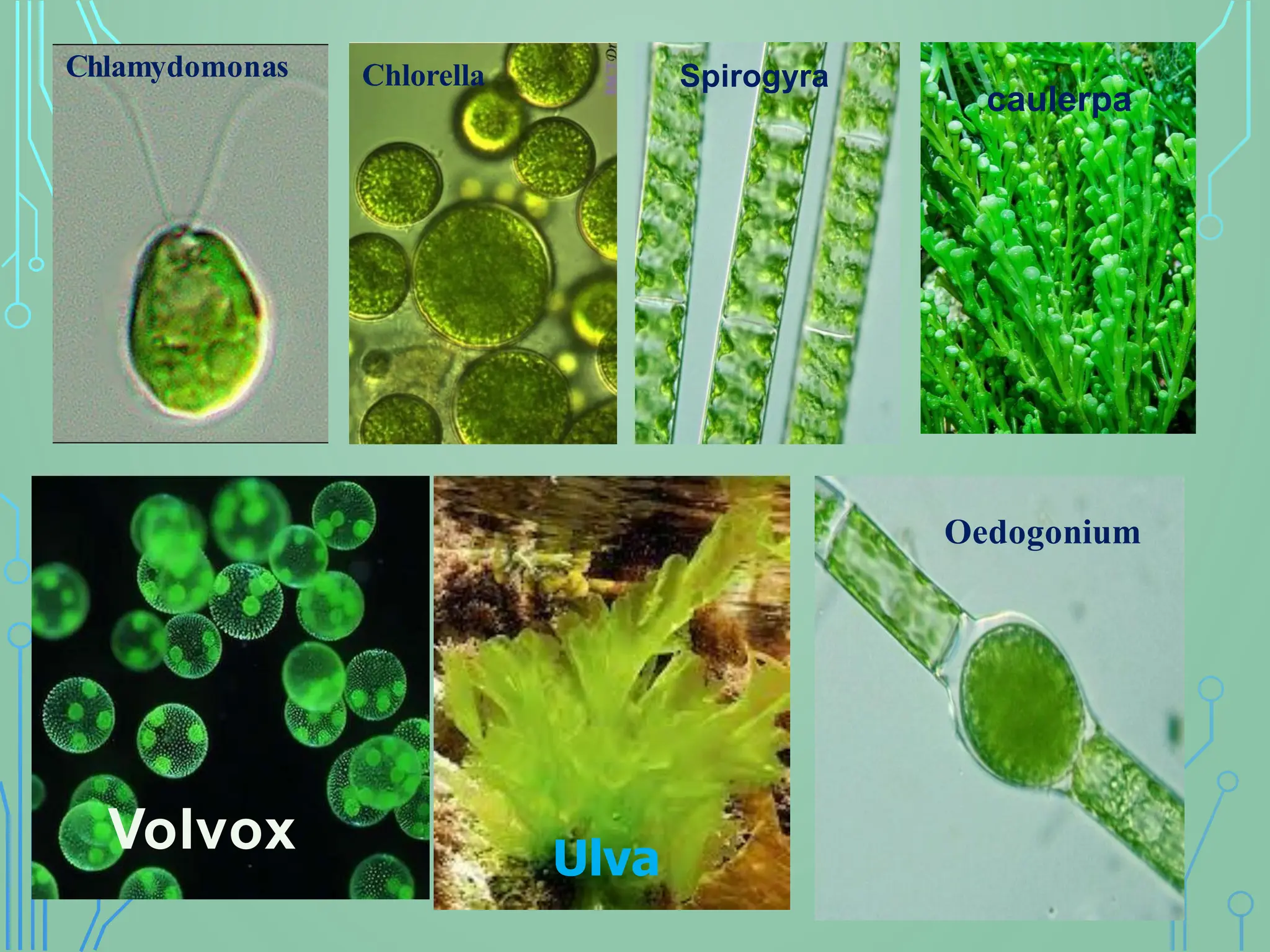
Chlamydomonas
Volvox
Chlorella
Ulva
Oedogonium
Spirogyra
caulerpa
CLASS 2. XANTHOPHYCEAE
(YELLOW GREEN ALGAE):
Mostlyunicellular, most advanced forms have asimple
filamentous habit,principal pigments are chlorophyll a
and e, β-carotene and xanthophyll’s
Reserve food mostly fat, sexual reproduction rare and
isogamous
Cell wall frequently consists of two overlapping halves,
constituents are pectin and silica, sometimes cellulose,
the motile cells with two unequal flagella at the anterior,
one tinsel and the other whiplash type, most abundant in
fresh water, a few are marine.
TRIBONIMA
Botrydium
Halosphaera
Chlorobotrys
CLASS 3. CHRYSOPHYCEAE (GOLDEN ALGAE):
Mostly unicellular,colonial and filamentous forms
Principal pigments are chlorophyll a, P-carotene and
xanthophyll’s,
storage product fat
sexual reproduction rare, specialized resting cells
known as cysts produced endogenously
flagellated forms haveeither one flagellum tinsel type or
when two one tinsel and one whiplash type, cell wall
consists of pectin and silica, fresh water and marine.
Chromulina
SYNURA
Class 4.-
Bacillariophyceae(Diatoms):
• All unicellular or colonial,
• principal pigments are chlorophyll aand c,
• β-carotene and xanthophyll’s
• storage product in the form of fat or volutins
• sexual reproduction is of widespread
occurrence byauxospore formation
• cell wall of pectin and silica,silicified cell wall
• precise nature of motile bodies not known
FRAGILAR
IA
cyclotella
Navicula
Pinnularia
CLASS 5. CRYPTOPHYCEAE:
⚫Unicellular flagellated forms,
⚫Principal pigment nature not definitely
known, except the phycobilins,
⚫Reserve food aform of starch
⚫Cell wall of cellulose
⚫T
wo unequal flagella
⚫Sexual reproduction rare andisogamous
⚫1: Cryptomonas. 2: Chroomonas 3: Rhodomonas
CLASS 6. DINOPHYCEAE:
⚫Manyof them are with motile
unicelled structure
⚫Principal pigments are chlorophyll aand
c,
β-carotene and xanthophyll’s
⚫Reserve food starch or fat
⚫Sexual reproduction rare and isogamous.
Dinophysis
NOCTIL
UCA
T
etradinium Porocentrum
CLASS 7.
CHLOROMONADINEAE:
⚫Unicellular
⚫Chromatophore bright green with excess of xanthophyll’s,
⚫Reserve food is fat,
⚫Motile cells are biflagellate
⚫Onlyfreshwater. Vacuolaria
Class 8. Euglenineae:
⚫Simple unicellular or colonial
motile organisms
⚫Pigments chlorophyll aand b, (β-
carotenes, xanthophyll
⚫Reserve food apolysaccharide
paramylon, related to starch, and fats
⚫Sexual reproduction not proved definitely
⚫No cell wall, motility byflagella,usually
one or sometimes more, tinsel type.
EUGLE
NA
Peranima
CLASS 9. PHAEOPHYCEAE
(BROWN ALGAE):
⚫Structurally the most complex algae, simple filaments to
massive plant bodies.
⚫Pigments include chlorophyll aand c, β-carotene and
xanthophyll’s
⚫Stored food in the form of laminarin (polysaccharide) and
mannitol form of alcohol
⚫Cell wall constitution algin, fucoidin and cellulose
⚫Sexual reproduction ranges from isogamyto oogamy
,
⚫Twounequal flagella attached laterally, one tinsel and the
other whiplash type
⚫Most of the species are marine.
LAMINARI
A
Laminaria
sargassum
CLASS 10. RHODOPHYCEAE
(RED ALGAE):
⚫Most forms multicellular (complex)
⚫Pigmentcontents are chlorophyll aandd, α- andβ-
carotene and xanthophyll’s,phycobilins-r-phycoerythrin
and r-phycocyanin
⚫Reserve food in the form of floridean starch
⚫Cell wall constitution polygalactose sulphate esters and
cellulose, motile cells at any stage of the life history are
unknown
⚫Sexual reproduction advanced oogamous type, mostly
marine, afew are fresh water.
CLASS 11.CYANOPHYCEAE/MYXOPHYCEAE
(BLUE-GREEN ALGAE):
⚫Simple unicellular, colonial or multicellular bodies
⚫Lacking nuclear,mitochondrial and chloroplast
double membranes
⚫Cell wall composed of pectin or cellulose
⚫Most forms are embedded in mucilaginousor
gelatinoussheaths
⚫Pigments not in organized bodiesas in other cases
⚫Principal pigments are chlorophyll-a, β-carotene,
xanthophyll’s and phycobilins,c-phycoerythrin and c-
phycocyanin
⚫Reserve food in the form of cyanophycean
or myxophycean starch
⚫No motile cell has been observed at anystage
⚫Reproduction of the bacterial type
⚫‘False’branching and special types of cells called
‘heterocyst’are characteristic features in many,
⚫Most diverse in distribution, from pole to
pole, almost everywhere, ubiquitous.
v
Anabaena
Nostoc
THANK
YOU

Classification of Algae E-Content Prepared By Dr. Neeraj Kumar Tiwari .pdf

  • 1.
    CLASSIFICATION OF ALGAE Dr. Neeraj KumarTiwari Assistant Professor MGTT College Dausa (Raj)
  • 2.
    FRITSCH’S CLASSIFICATION OFALGAE: ⚫F .E. Fritsch (1935, 1945) in his book “The Structure and Reproduction of the Algae” proposed asystemofclassification of algae. ⚫He treated algae giving rank of division anddivided it into 11 classes. ⚫ His classification of algae is mainlybased upon characters of pigments,flagella and reserve food material.
  • 3.
    ⚫Eleven classes proposedby Fritsch are as follows: ⚫1. Chlorophyceae 2. Xanthophyceae ⚫ 3. Chrysophyceae ⚫ 4. Bacillariophyceae ⚫ 5. Cryptophyceae ⚫ 6. Dinophyceae ⚫ 7. Chloromonadineae ⚫ 8. Euglenineae ⚫ 9. Phaeophyceae ⚫ 10. Rhodophyceae ⚫ 11. Myxophyceae.
  • 4.
    CLASS 1. CHLOROPHYCEAE(GREEN ALGAE): ⚫Unicellular, colonial or multicellular green plants, generally with simple structure, principal pigments are chlorophyll aandb, carotenes andxanthophyll’sasin higher plants,contained in plastids. ⚫Food storage products are mostly starch and sometimes frequently aggregates around the pyrenoids.Reproduction is byasexual and sexual means. ⚫Zoospores biflagellate or quadriflagellate flagella anterior isokontae, whiplash type, cell wall of cellulose and pectin, fresh water or marine.
  • 5.
  • 6.
    CLASS 2. XANTHOPHYCEAE (YELLOWGREEN ALGAE): Mostlyunicellular, most advanced forms have asimple filamentous habit,principal pigments are chlorophyll a and e, β-carotene and xanthophyll’s Reserve food mostly fat, sexual reproduction rare and isogamous Cell wall frequently consists of two overlapping halves, constituents are pectin and silica, sometimes cellulose, the motile cells with two unequal flagella at the anterior, one tinsel and the other whiplash type, most abundant in fresh water, a few are marine.
  • 7.
  • 8.
    CLASS 3. CHRYSOPHYCEAE(GOLDEN ALGAE): Mostly unicellular,colonial and filamentous forms Principal pigments are chlorophyll a, P-carotene and xanthophyll’s, storage product fat sexual reproduction rare, specialized resting cells known as cysts produced endogenously flagellated forms haveeither one flagellum tinsel type or when two one tinsel and one whiplash type, cell wall consists of pectin and silica, fresh water and marine.
  • 9.
  • 10.
    Class 4.- Bacillariophyceae(Diatoms): • Allunicellular or colonial, • principal pigments are chlorophyll aand c, • β-carotene and xanthophyll’s • storage product in the form of fat or volutins • sexual reproduction is of widespread occurrence byauxospore formation • cell wall of pectin and silica,silicified cell wall • precise nature of motile bodies not known
  • 11.
  • 12.
    CLASS 5. CRYPTOPHYCEAE: ⚫Unicellularflagellated forms, ⚫Principal pigment nature not definitely known, except the phycobilins, ⚫Reserve food aform of starch ⚫Cell wall of cellulose ⚫T wo unequal flagella ⚫Sexual reproduction rare andisogamous
  • 13.
    ⚫1: Cryptomonas. 2:Chroomonas 3: Rhodomonas
  • 14.
    CLASS 6. DINOPHYCEAE: ⚫Manyofthem are with motile unicelled structure ⚫Principal pigments are chlorophyll aand c, β-carotene and xanthophyll’s ⚫Reserve food starch or fat ⚫Sexual reproduction rare and isogamous.
  • 15.
  • 16.
    CLASS 7. CHLOROMONADINEAE: ⚫Unicellular ⚫Chromatophore brightgreen with excess of xanthophyll’s, ⚫Reserve food is fat, ⚫Motile cells are biflagellate ⚫Onlyfreshwater. Vacuolaria
  • 17.
    Class 8. Euglenineae: ⚫Simpleunicellular or colonial motile organisms ⚫Pigments chlorophyll aand b, (β- carotenes, xanthophyll ⚫Reserve food apolysaccharide paramylon, related to starch, and fats ⚫Sexual reproduction not proved definitely ⚫No cell wall, motility byflagella,usually one or sometimes more, tinsel type.
  • 18.
  • 19.
    CLASS 9. PHAEOPHYCEAE (BROWNALGAE): ⚫Structurally the most complex algae, simple filaments to massive plant bodies. ⚫Pigments include chlorophyll aand c, β-carotene and xanthophyll’s ⚫Stored food in the form of laminarin (polysaccharide) and mannitol form of alcohol ⚫Cell wall constitution algin, fucoidin and cellulose ⚫Sexual reproduction ranges from isogamyto oogamy , ⚫Twounequal flagella attached laterally, one tinsel and the other whiplash type ⚫Most of the species are marine.
  • 20.
  • 21.
    CLASS 10. RHODOPHYCEAE (REDALGAE): ⚫Most forms multicellular (complex) ⚫Pigmentcontents are chlorophyll aandd, α- andβ- carotene and xanthophyll’s,phycobilins-r-phycoerythrin and r-phycocyanin ⚫Reserve food in the form of floridean starch ⚫Cell wall constitution polygalactose sulphate esters and cellulose, motile cells at any stage of the life history are unknown ⚫Sexual reproduction advanced oogamous type, mostly marine, afew are fresh water.
  • 23.
    CLASS 11.CYANOPHYCEAE/MYXOPHYCEAE (BLUE-GREEN ALGAE): ⚫Simpleunicellular, colonial or multicellular bodies ⚫Lacking nuclear,mitochondrial and chloroplast double membranes ⚫Cell wall composed of pectin or cellulose ⚫Most forms are embedded in mucilaginousor gelatinoussheaths ⚫Pigments not in organized bodiesas in other cases ⚫Principal pigments are chlorophyll-a, β-carotene, xanthophyll’s and phycobilins,c-phycoerythrin and c- phycocyanin
  • 24.
    ⚫Reserve food inthe form of cyanophycean or myxophycean starch ⚫No motile cell has been observed at anystage ⚫Reproduction of the bacterial type ⚫‘False’branching and special types of cells called ‘heterocyst’are characteristic features in many, ⚫Most diverse in distribution, from pole to pole, almost everywhere, ubiquitous.
  • 25.
  • 26.