Kingdom Protista
The Catchall
Kingdom
Algae
Characteristics of Algae
Autotrophic
Not plants – why?
Often contain pyrenoids
Structure of Algae
 Thallus or body
 Unicellular or multicellular
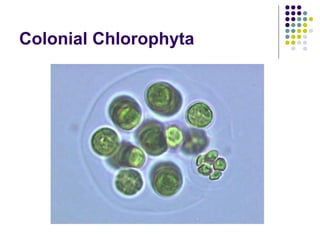
 Colonial: Volvoz
 Filamentous: Spirogyra
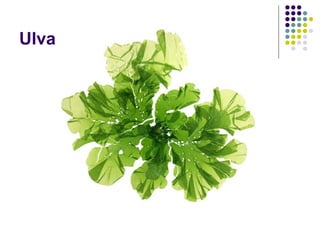
 Multicellular: Ulva
 Asexual and sexual reproduction
Phylums
 Phylum Chlorophyta
 Phylum Phaeophyta
 Phylum Rhodophyta
 Phylum Bacillariophyta
 Phylum Dinoflagellata
 Phylum Chrysophyta
 Phyla Euglenohyta
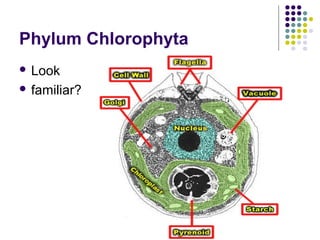
Phylum Chlorophyta
 Look
 familiar?
Continued…
 Green algae
 Many different forms
 Gave rise to land plants – why?
 Choroplasts that contain a and b cholorphyll
 Have carotenoids
 Cell walls of cellulose
Ulva
Colonial Chlorophyta
Phylum Phaeophyta
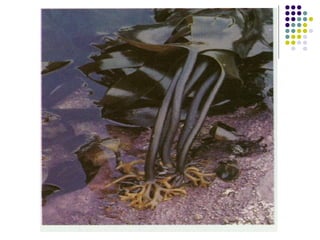
 Brown algae
 Marine
 Seaweed and kelps
 Cooler areas of ocean
 Fucoxanthin pigment
 Store food as laminarin
 ALL multicellular
 Stemlike stipe
 Leaflike region called blade
Phylum Rhodophyta
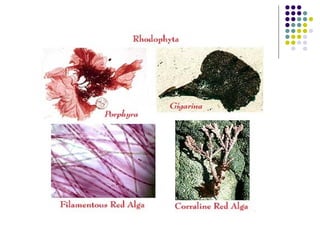
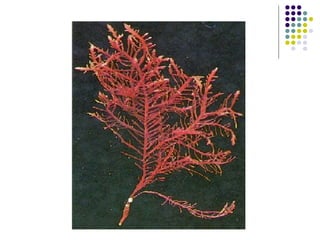
 Red algae but colors vary
 Marine seaweeds
 Smaller than brown algae and live in deeper
waters
 Phycobilins – pigment for absorbing light
 Some coated with polysaccharide
carageenan – cosmetics, gel capsules,
cheeses
 Agar – extracted from cell walls of red algae
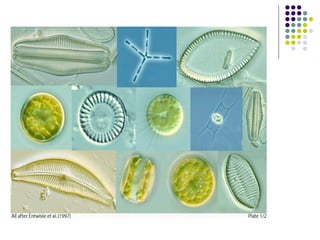
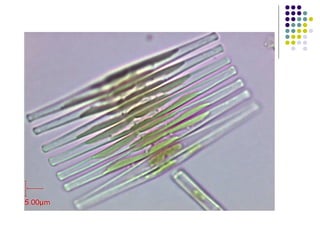
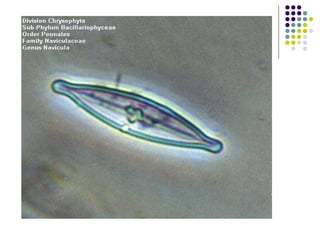
Phylum Bacillariophyta
 Diatoms
 Shells fit together like a box with a lid
 Centric and pennate
 Main component of phytoplankton
 Diatomaceous earth
Phylum Dinoflagellata
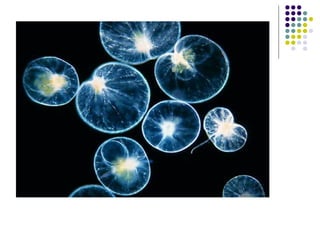
 Dinoflagellates
 Small, unicellular
 Most photosynthetic
 Some bioluminescent
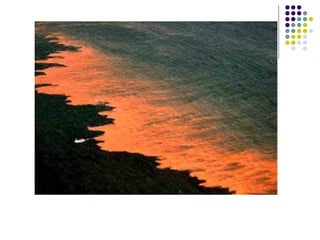
 Red tide a problem
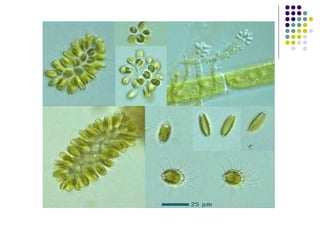
Phylum Chrysophyta
 Golden algae
 Most fresh water
 Form cysts
 2 flagella
 Carotenoids give color
 Important for formation of petroleum deposits
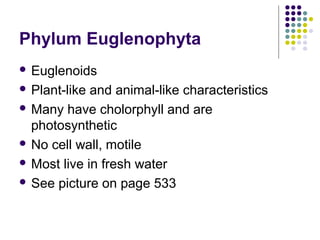
Phylum Euglenophyta
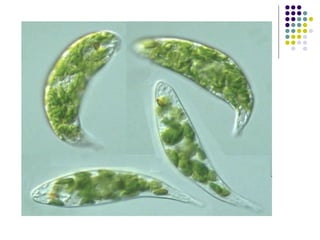
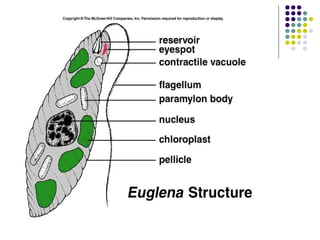
 Euglenoids
 Plant-like and animal-like characteristics
 Many have cholorphyll and are
photosynthetic
 No cell wall, motile
 Most live in fresh water
 See picture on page 533
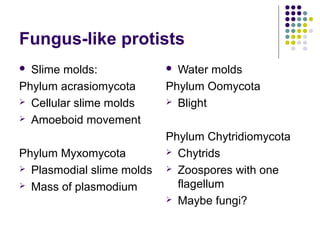
Fungus-like protists
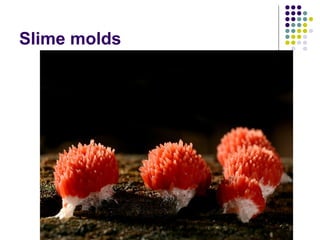
 Slime molds:
Phylum acrasiomycota
 Cellular slime molds
 Amoeboid movement
Phylum Myxomycota
 Plasmodial slime molds
 Mass of plasmodium
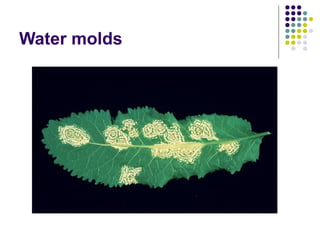
 Water molds
Phylum Oomycota
 Blight
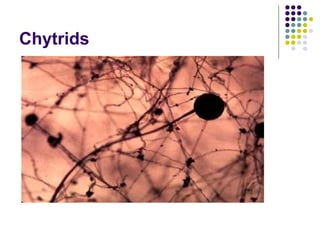
Phylum Chytridiomycota
 Chytrids
 Zoospores with one
flagellum
 Maybe fungi?
Slime molds
Water molds
Chytrids
The END….
This powerpoint was kindly donated to
www.worldofteaching.com
http://www.worldofteaching.com is home to over a
thousand powerpoints submitted by teachers. This is a
completely free site and requires no registration. Please
visit and I hope it will help in your teaching.

Protista part 2 algae