Co-Constructing Digital Pedagogies:
Leveraging Learning Assistant and
TechTA Support
Shannon Rathod, CU-Boulder & Brad Hinson, CU-Denver
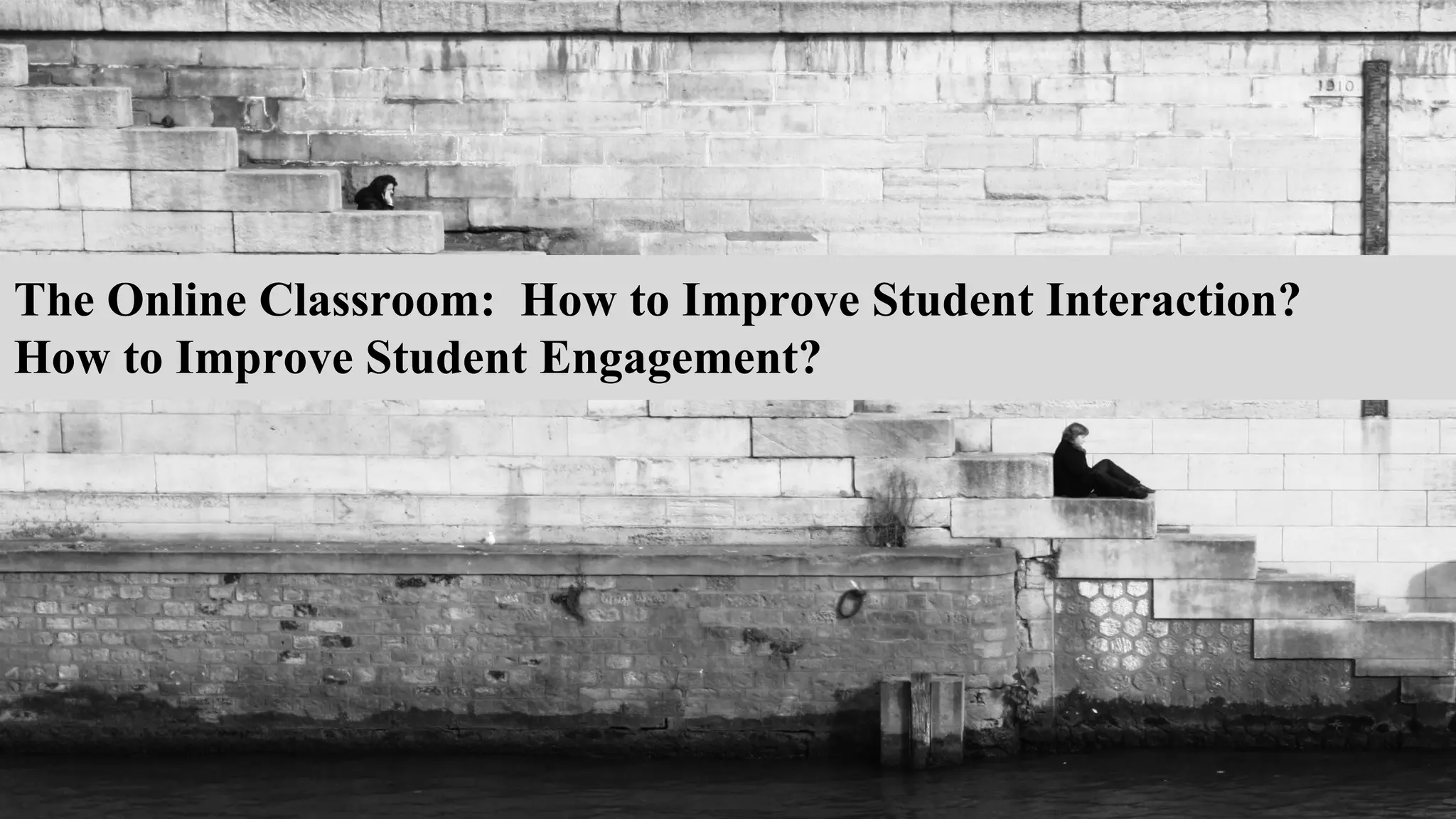
The Online Classroom: How to Improve Student Interaction?
How to Improve Student Engagement?
Student Retention and Engagement:
From the Beginning of the Course
“Effective communication
occurs not only during the
course, but also before it
begins.”
(Clapper, 2012)
“Develop orientation materials
that introduce students to online
expectations and provide points
of contact before courses
begin.”
(Betts & Lanza-Gladney, 2010)
“Too often, the sense of
community is not established
right at the beginning of the
course because of a lack of
social presence by the
facilitator.”
(Poll, Widen, & Weller, 2014)
“Recommendation: All advisors should meet individually or
in small groups with first year student within two weeks
of the start of the semester. Sooner is better!”
(“Twelve Best Practices for Student Engagement and
Retention,” 2012)
Yet too often this need for immediate engagement can result in
individual instructors attempting to rein in and control all aspects
of communication.
“Curriculum […] is constructed and negotiated in real time by the
contributions of those engaged in the learning process.”
-Dave Cormier, “Rhizomatic Education: Community as Curriculum”
How to provide students with a more foundational and lasting voice in
the course conversation?
How to provide students with a more foundational and lasting voice in
the course conversation?
Hire a Learning Assistant or TechTA!
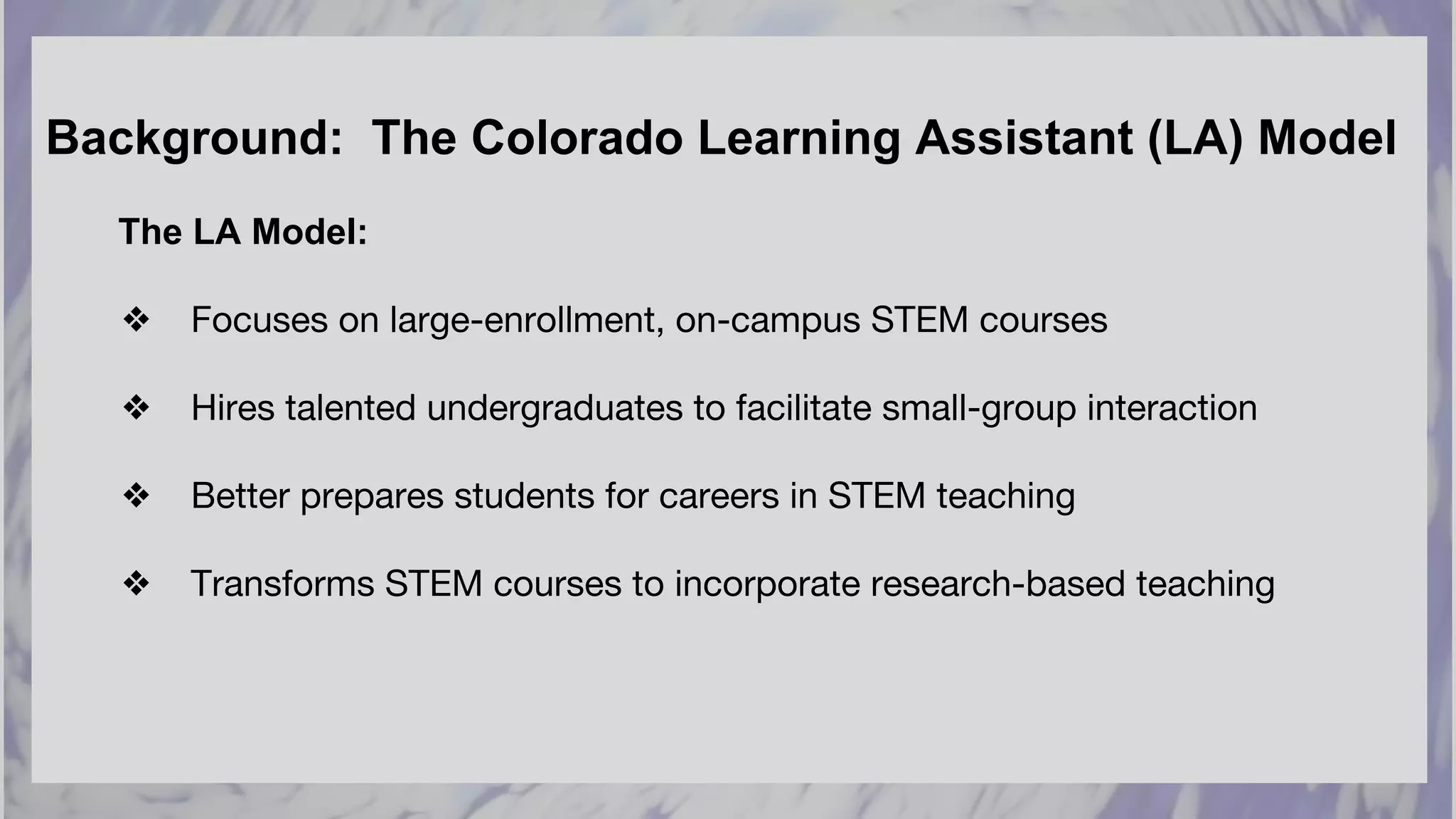
Background: The Colorado Learning Assistant (LA) Model
The LA Model:
❖ Focuses on large-enrollment, on-campus STEM courses
❖ Hires talented undergraduates to facilitate small-group interaction
❖ Better prepares students for careers in STEM teaching
❖ Transforms STEM courses to incorporate research-based teaching
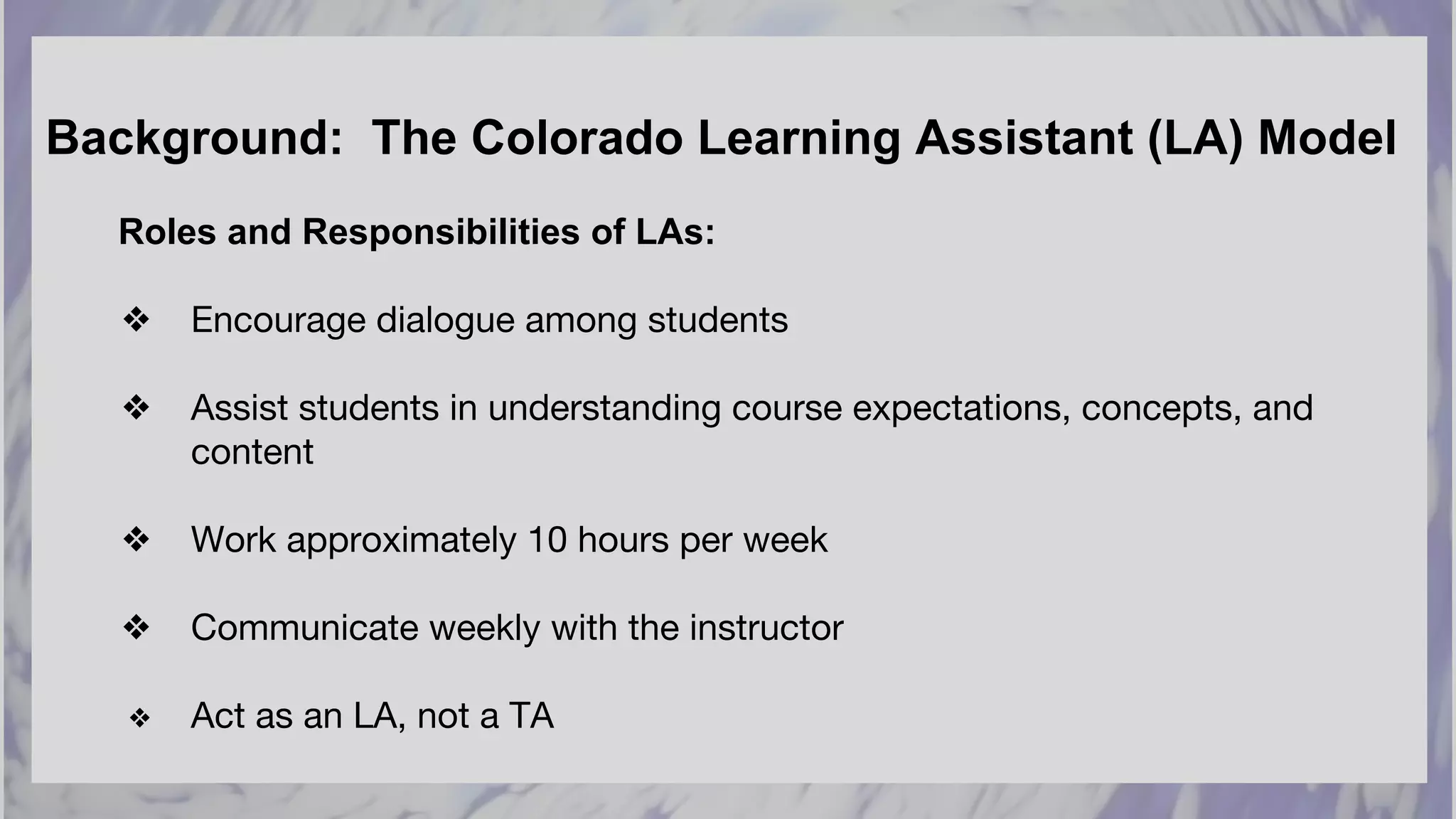
Background: The Colorado Learning Assistant (LA) Model
Roles and Responsibilities of LAs:
❖ Encourage dialogue among students
❖ Assist students in understanding course expectations, concepts, and
content
❖ Work approximately 10 hours per week
❖ Communicate weekly with the instructor
❖ Act as an LA, not a TA
Benefits of LAs
❖ Students have increased understanding of content working with LAs
(Otero, Pollock, & Finkelstein, 2010)
❖ Peer discussion improves student performance
(Smith et al., 2009)
❖ Students respond more actively when peers moderate discussions
(Seo, 2007)
❖ Increased communication and interaction positively impacts student performance in learning
(Davies & Graff, 2005)
The Online Learning Assistant Program
Based on the success of the original program, University of
Colorado at Boulder’s Independent Learning Program has
instituted LAs for its online courses.
In working with an LA, online Instructors:
❖ Redesign their courses
❖ Create alternative spaces for student interaction
❖ Emphasize collaboration
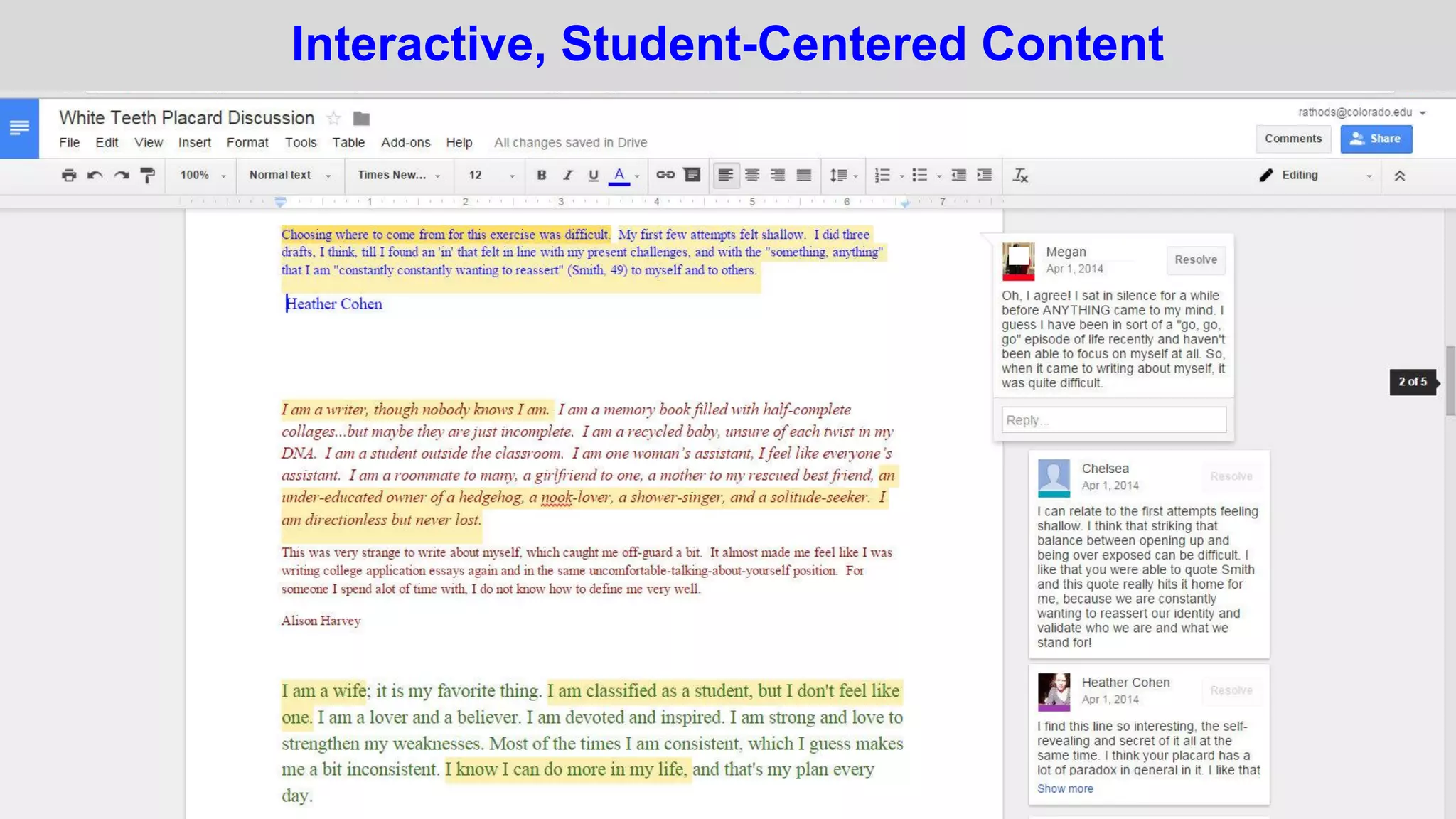
❖ Champion interactive, student-centered content
The Online Learning Assistant Program:
Beyond the Classroom
The Online Learning Assistant Program
In working with an LA, online Instructors:
❖ Redesign their courses
❖ Create alternative spaces for student interaction
❖ Emphasize collaboration
❖ Champion interactive, student-centered content
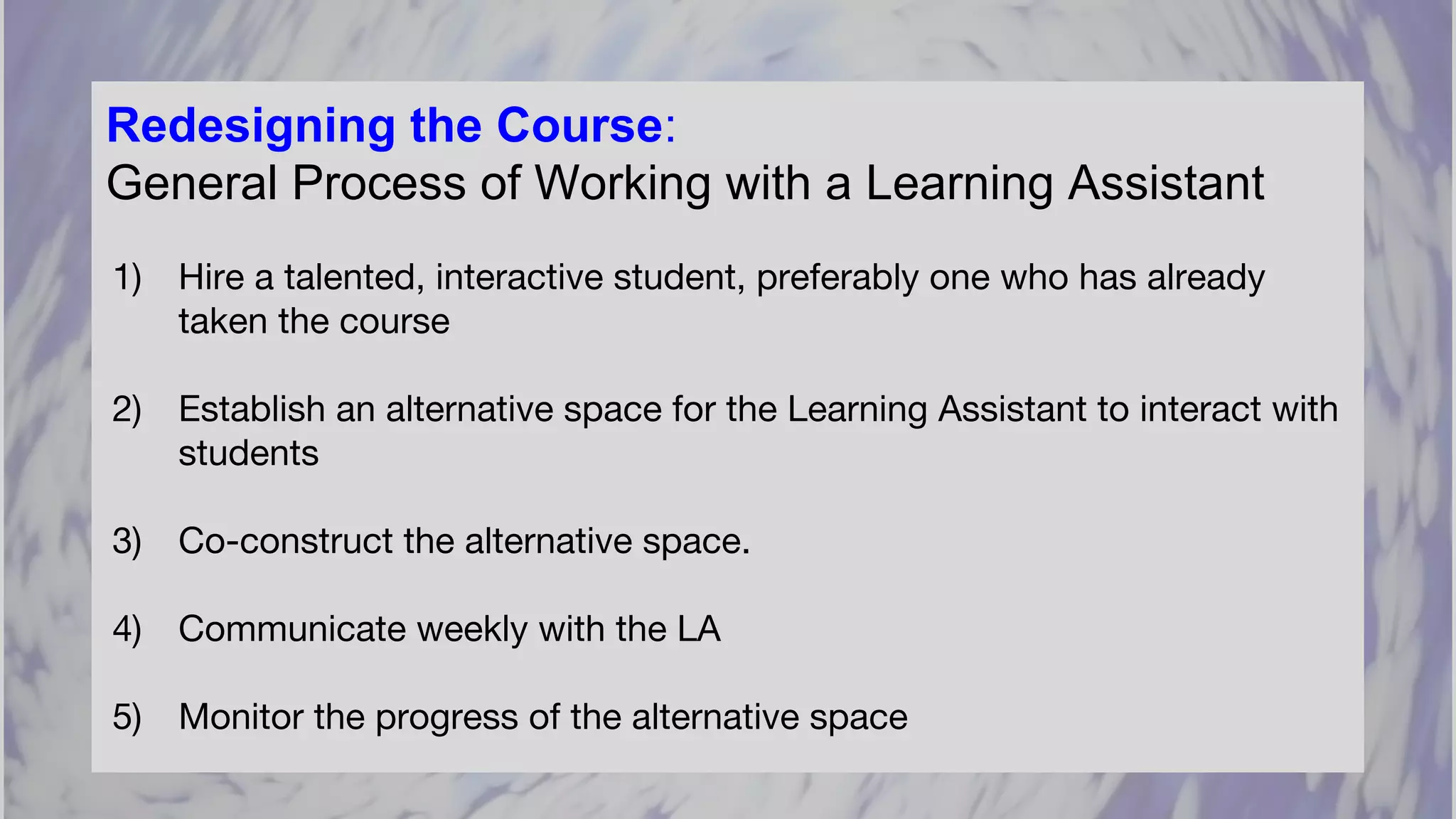
Redesigning the Course:
General Process of Working with a Learning Assistant
1) Hire a talented, interactive student, preferably one who has already
taken the course
2) Establish an alternative space for the Learning Assistant to interact with
students
3) Co-construct the alternative space.
4) Communicate weekly with the LA
5) Monitor the progress of the alternative space
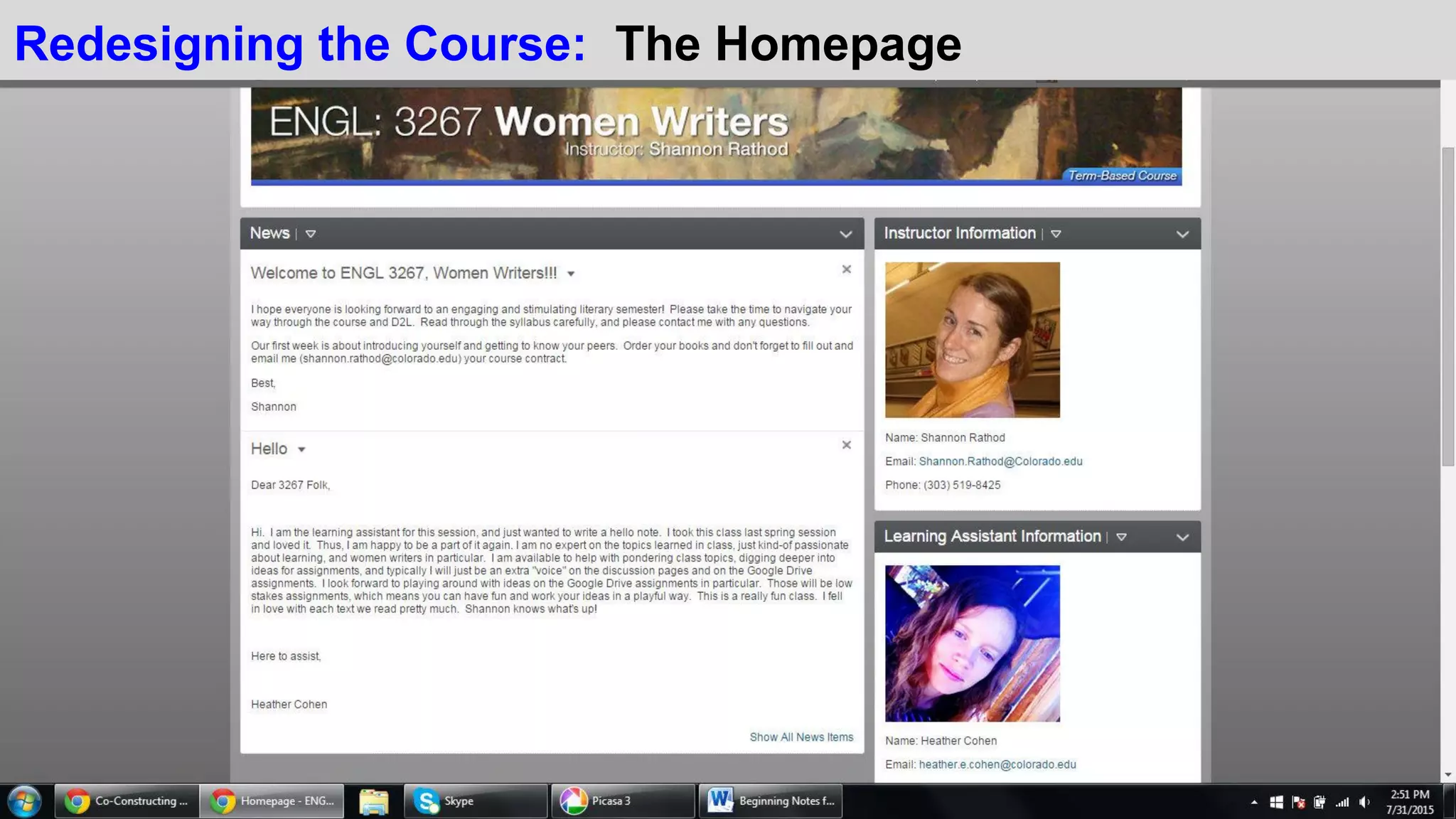
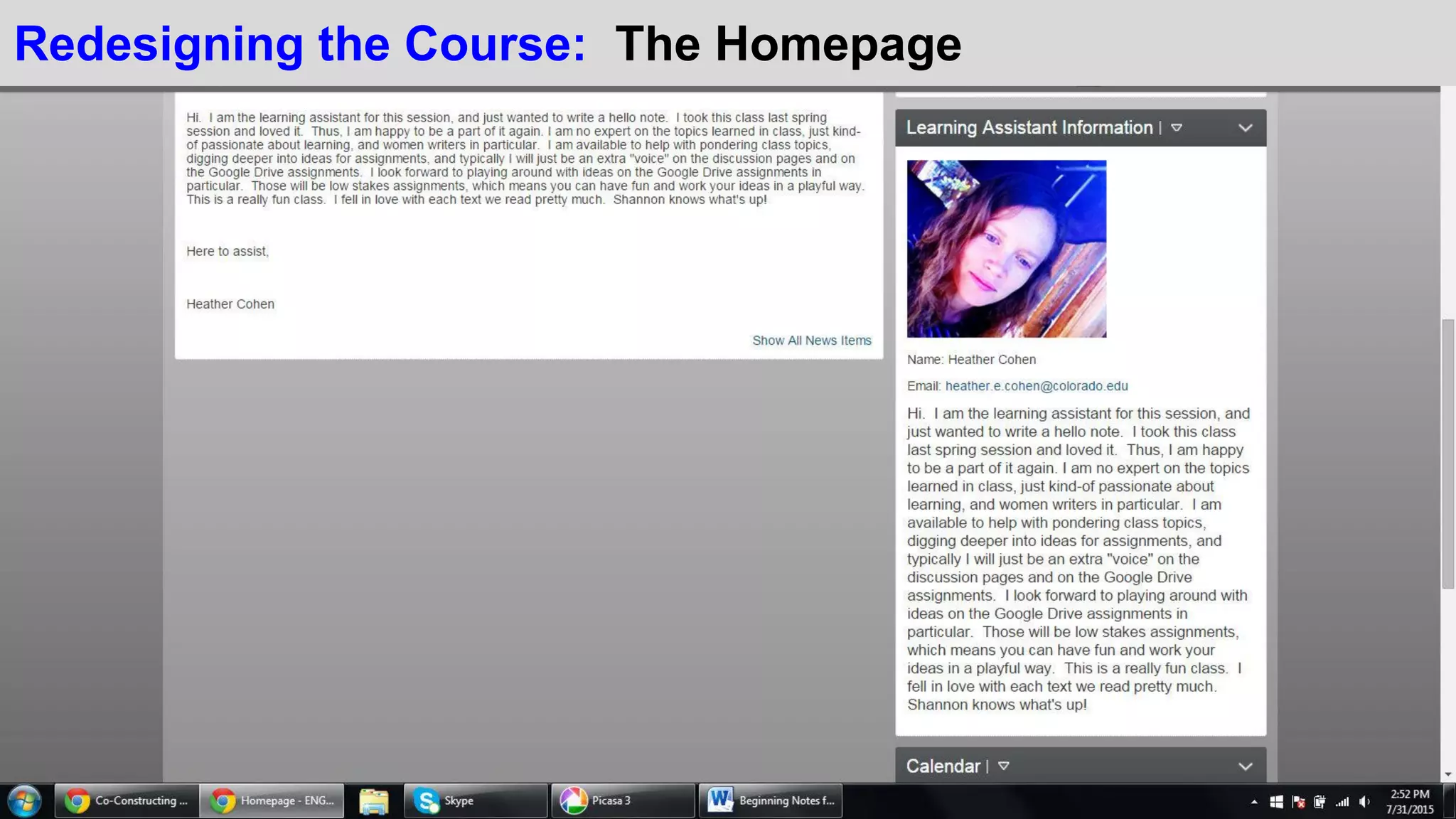
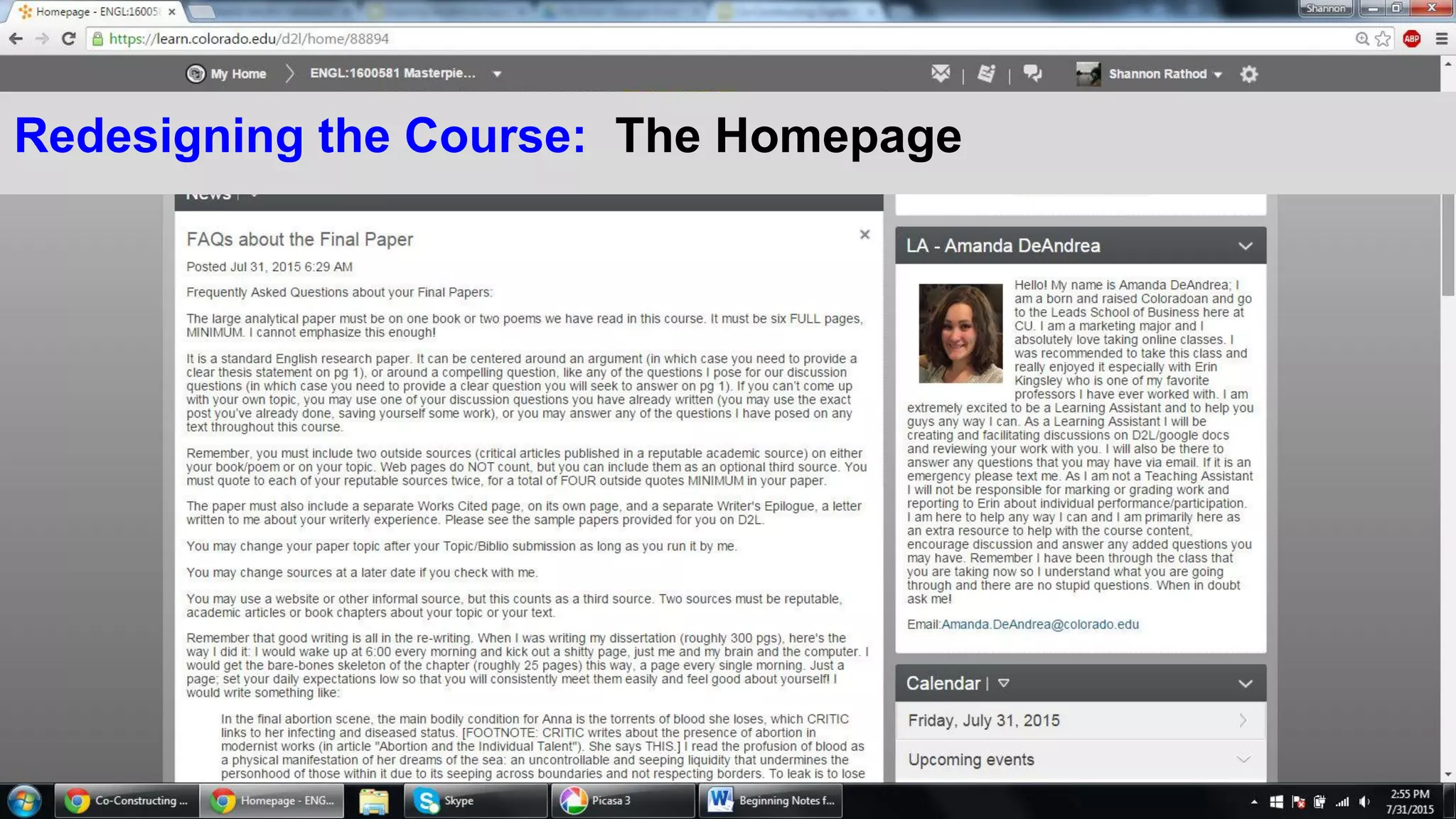
Redesigning the Course: The Homepage
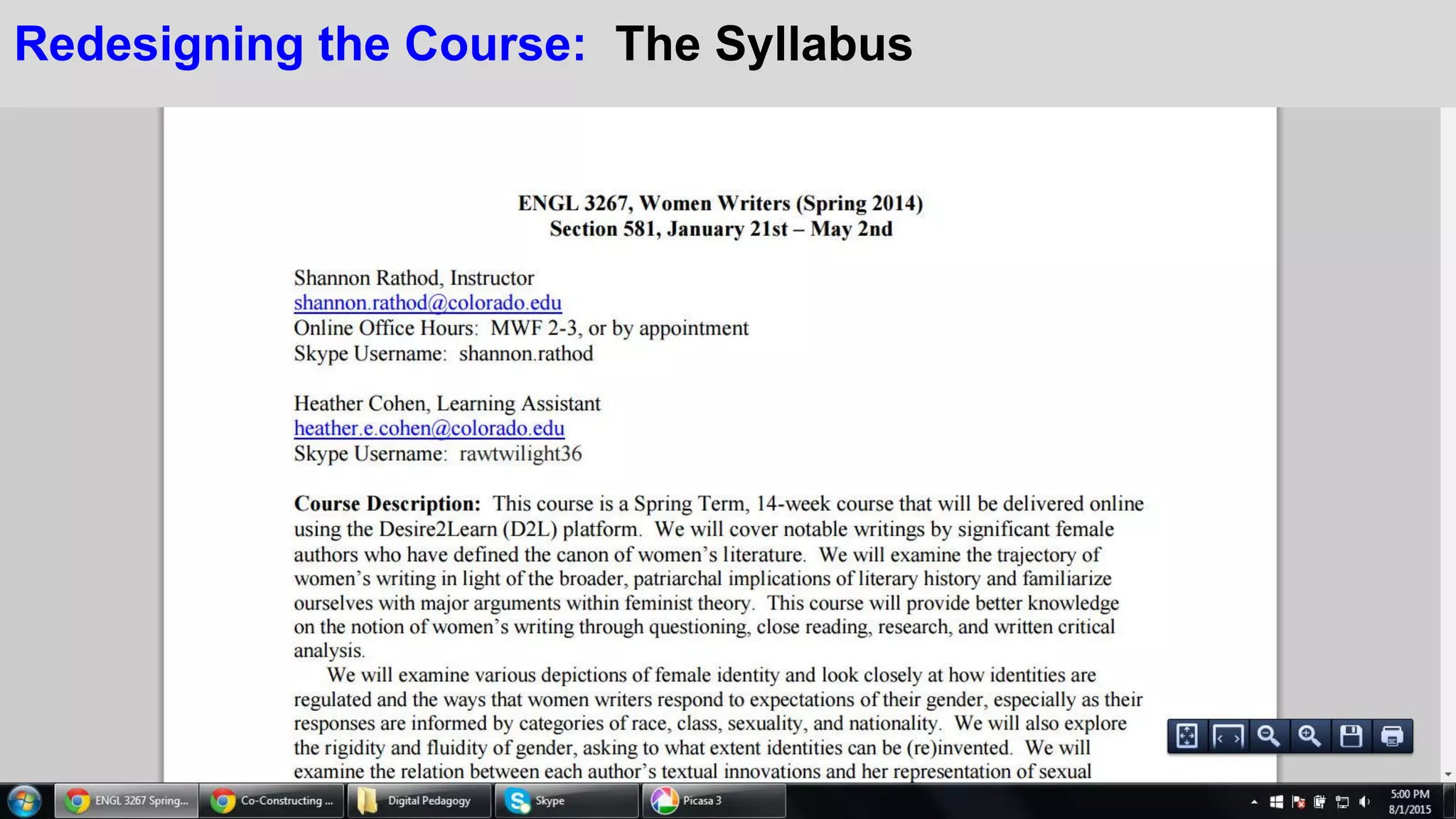
Redesigning the Course: The Syllabus
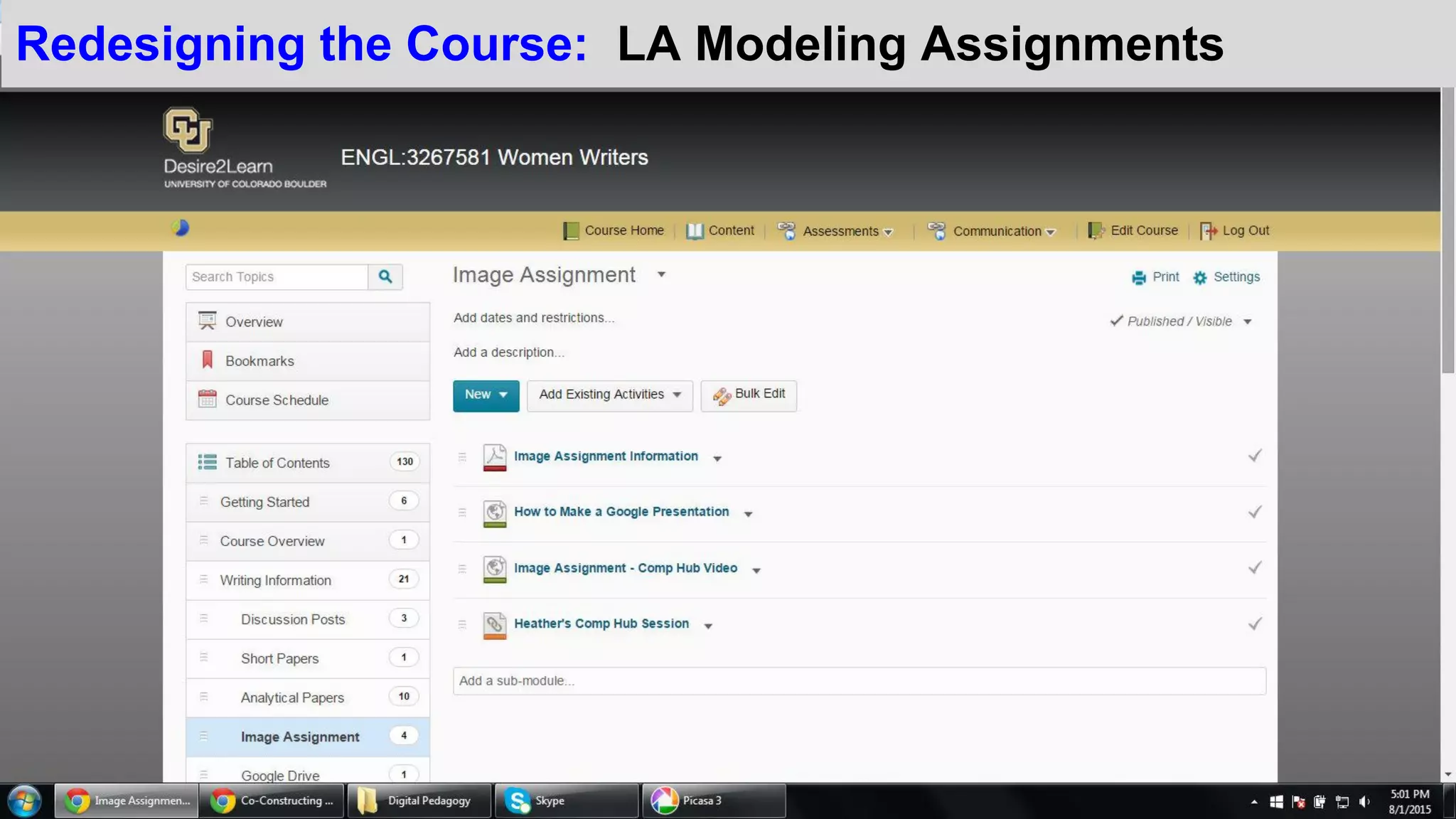
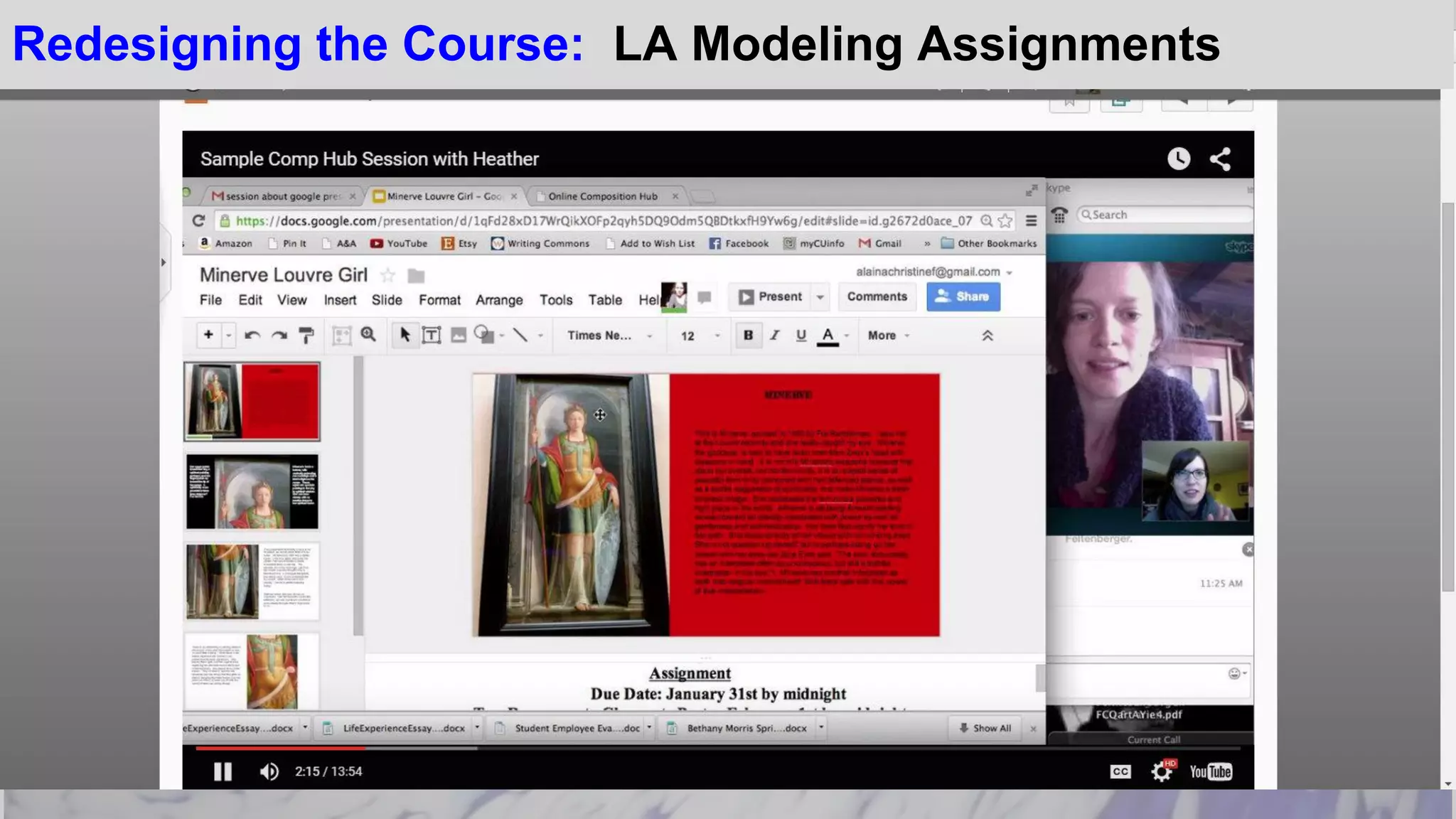
Redesigning the Course: LA Modeling Assignments
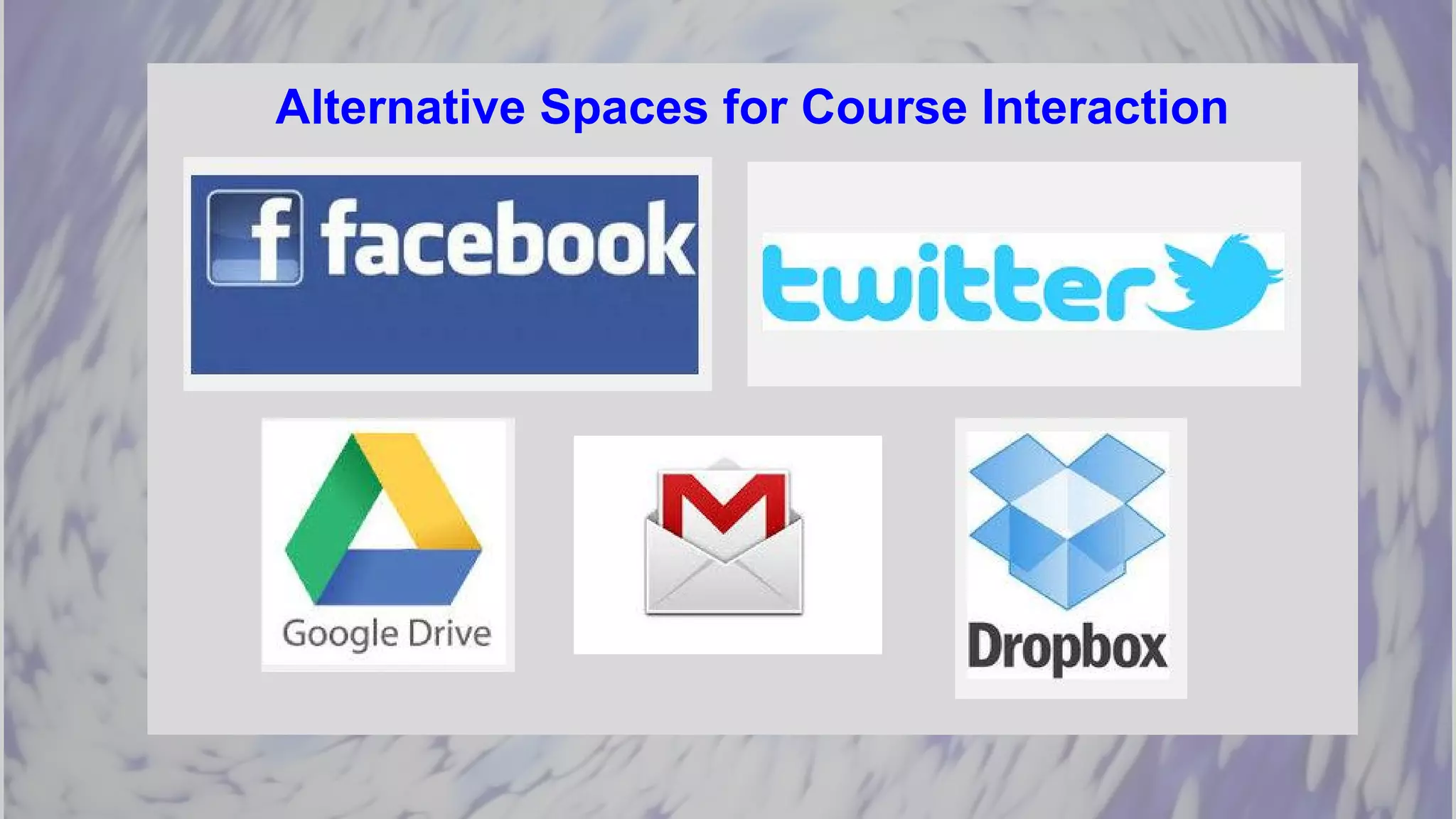
Alternative Spaces for Course Interaction
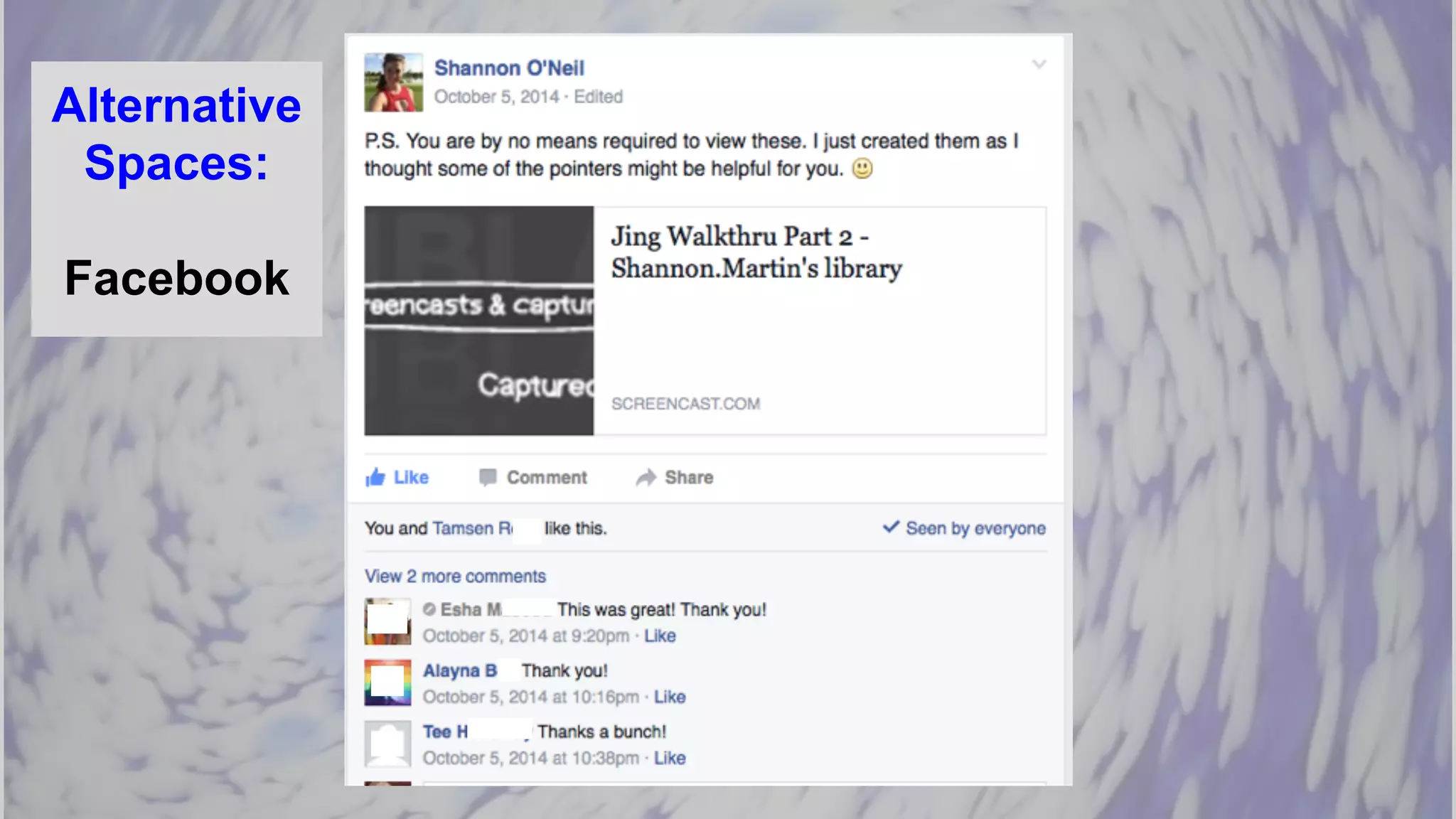
Alternative
Spaces:
Facebook
Alternative
Spaces:
Facebook
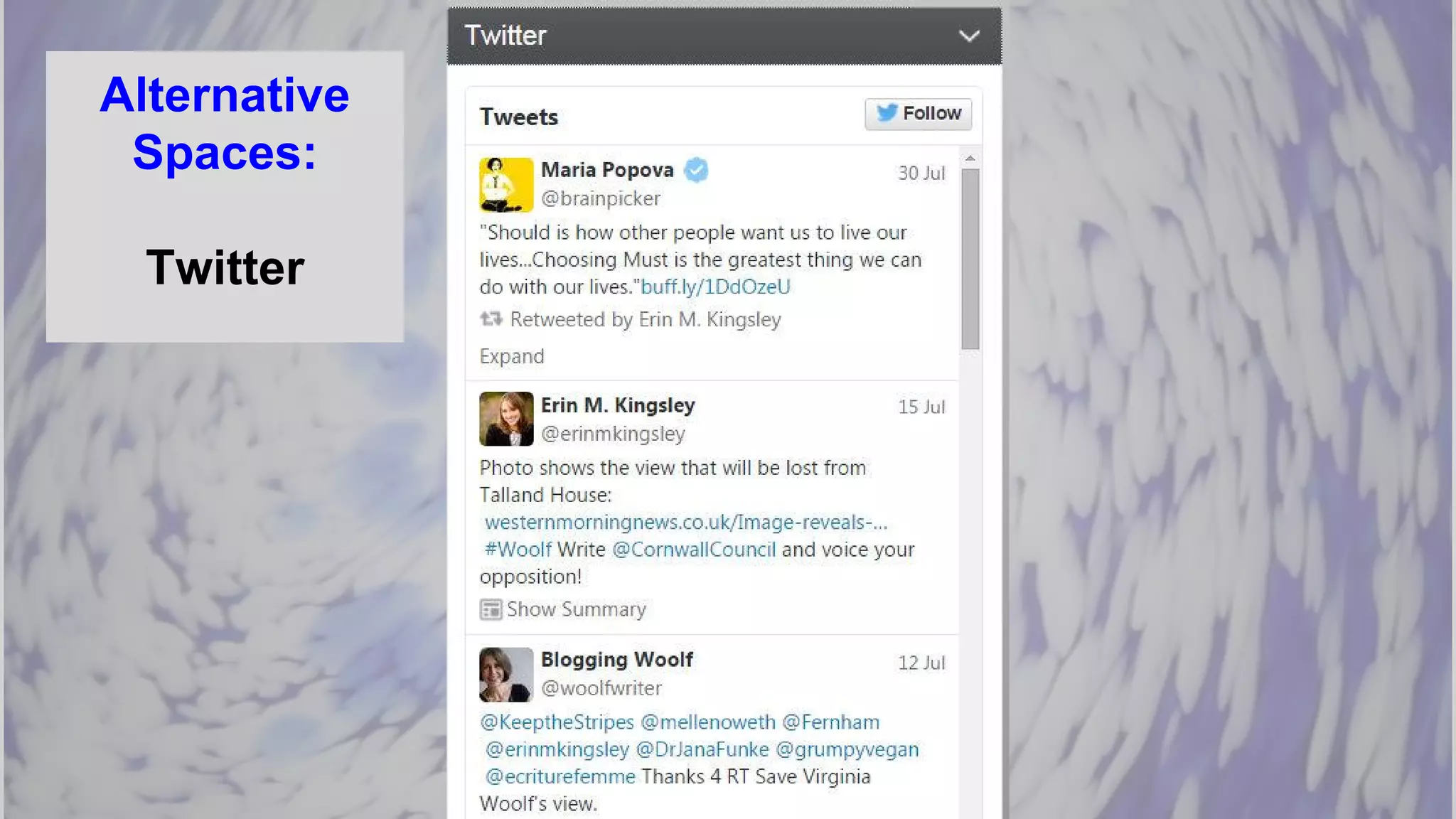
Alternative
Spaces:
Twitter
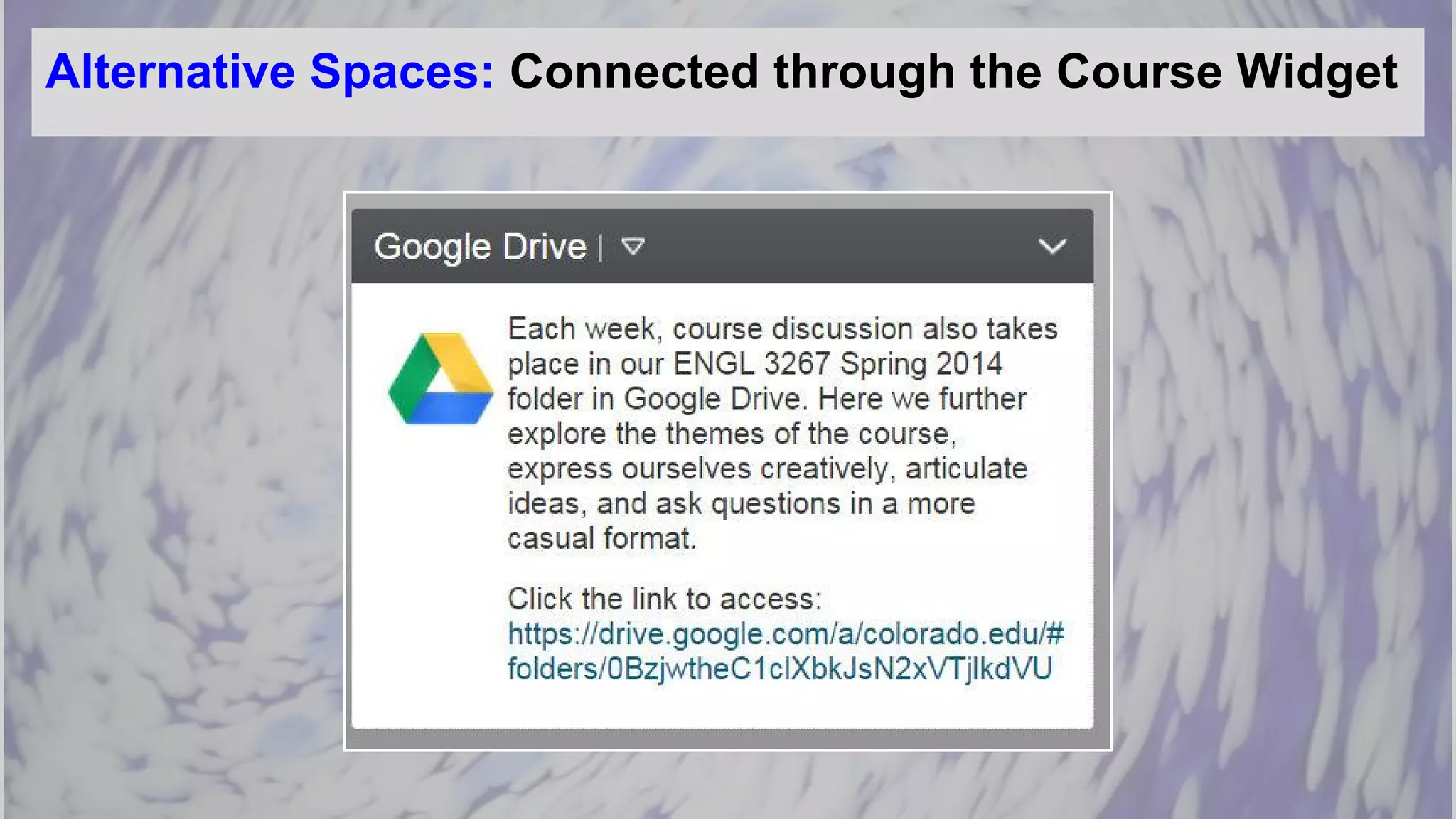
Alternative Spaces: Connected through the Course Widget
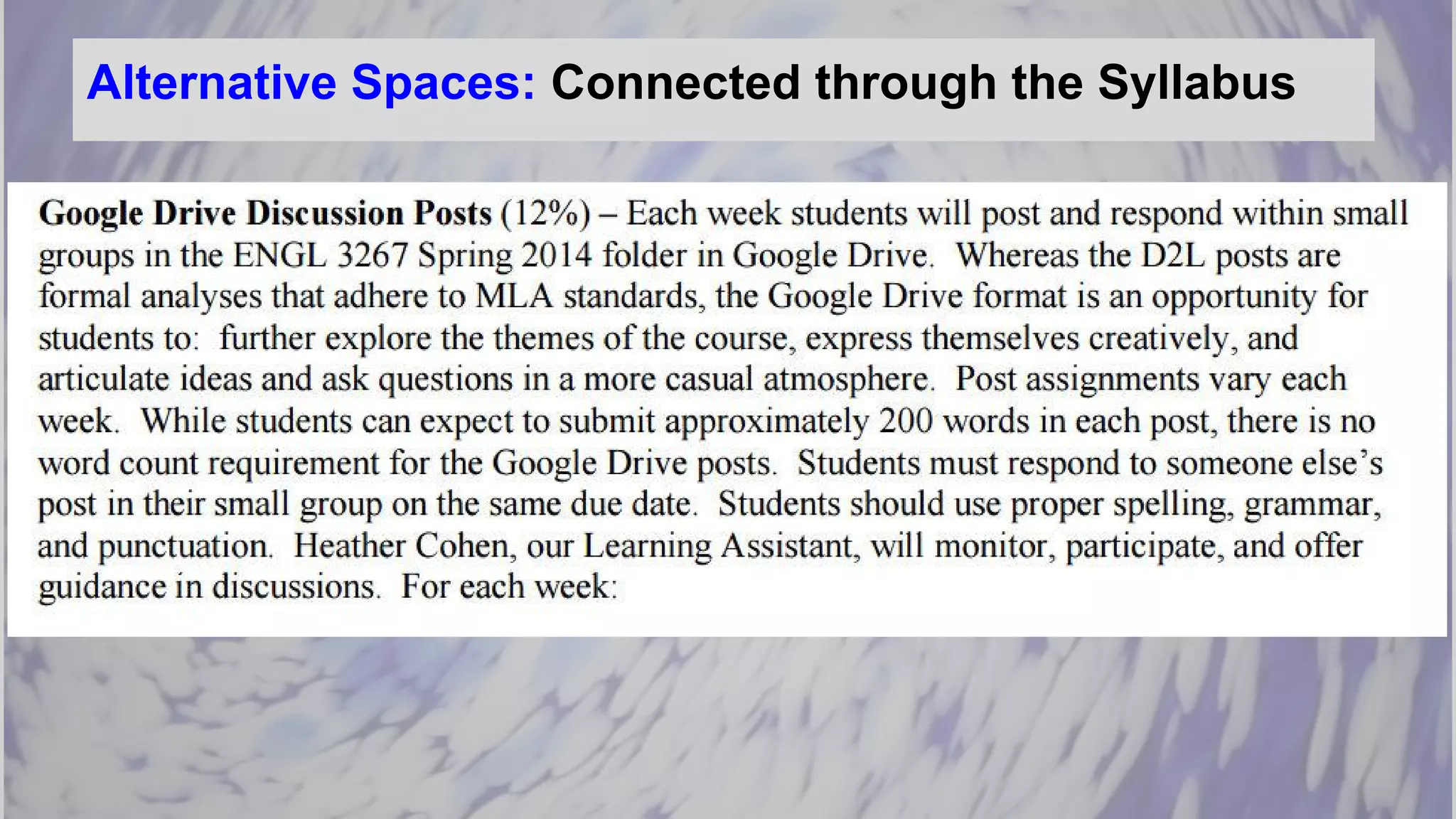
Alternative Spaces: Connected through the Syllabus
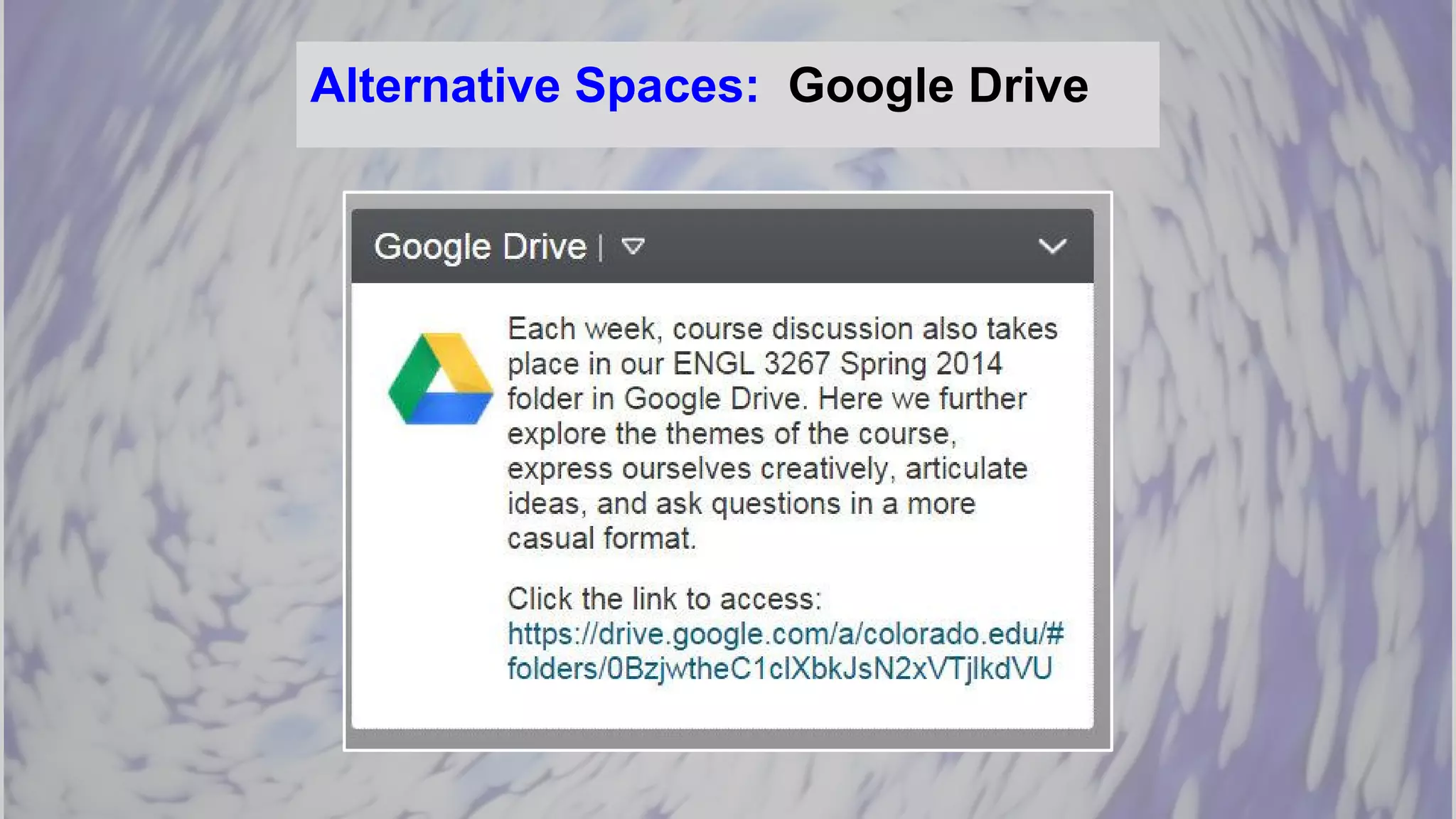
Alternative Spaces: Google Drive
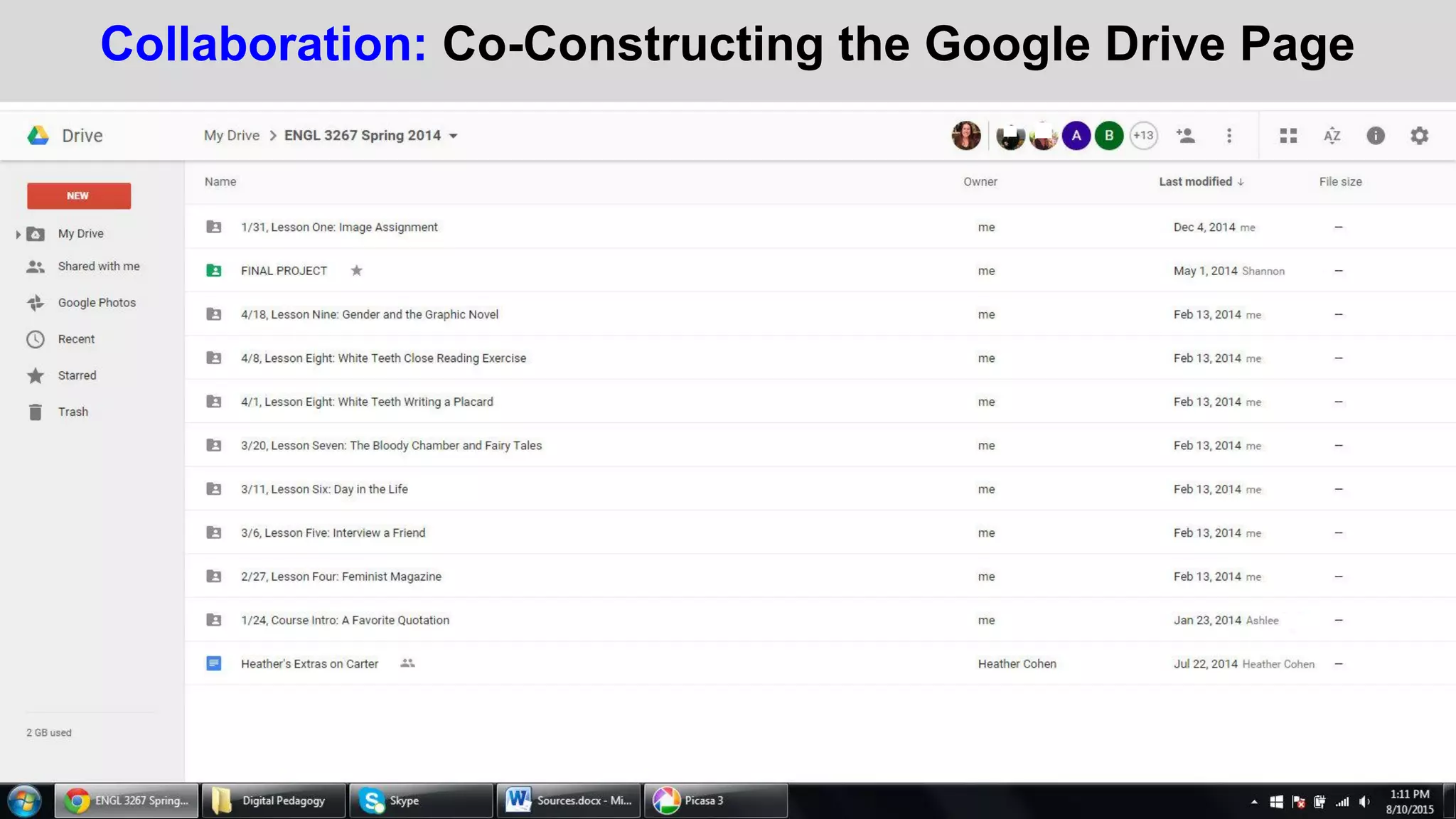
Collaboration: Co-Constructing the Google Drive Page
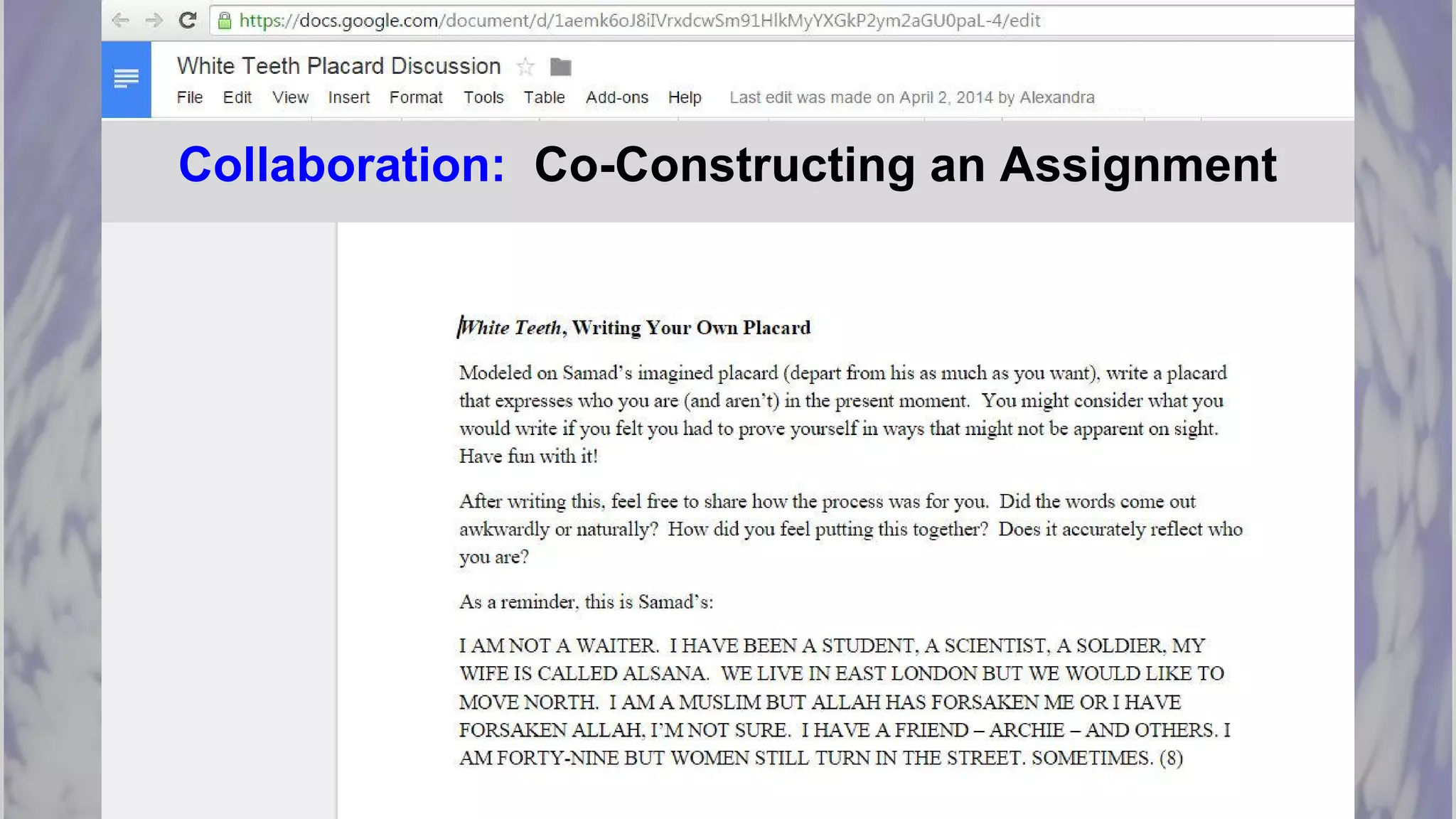
Collaboration: Co-Constructing an Assignment
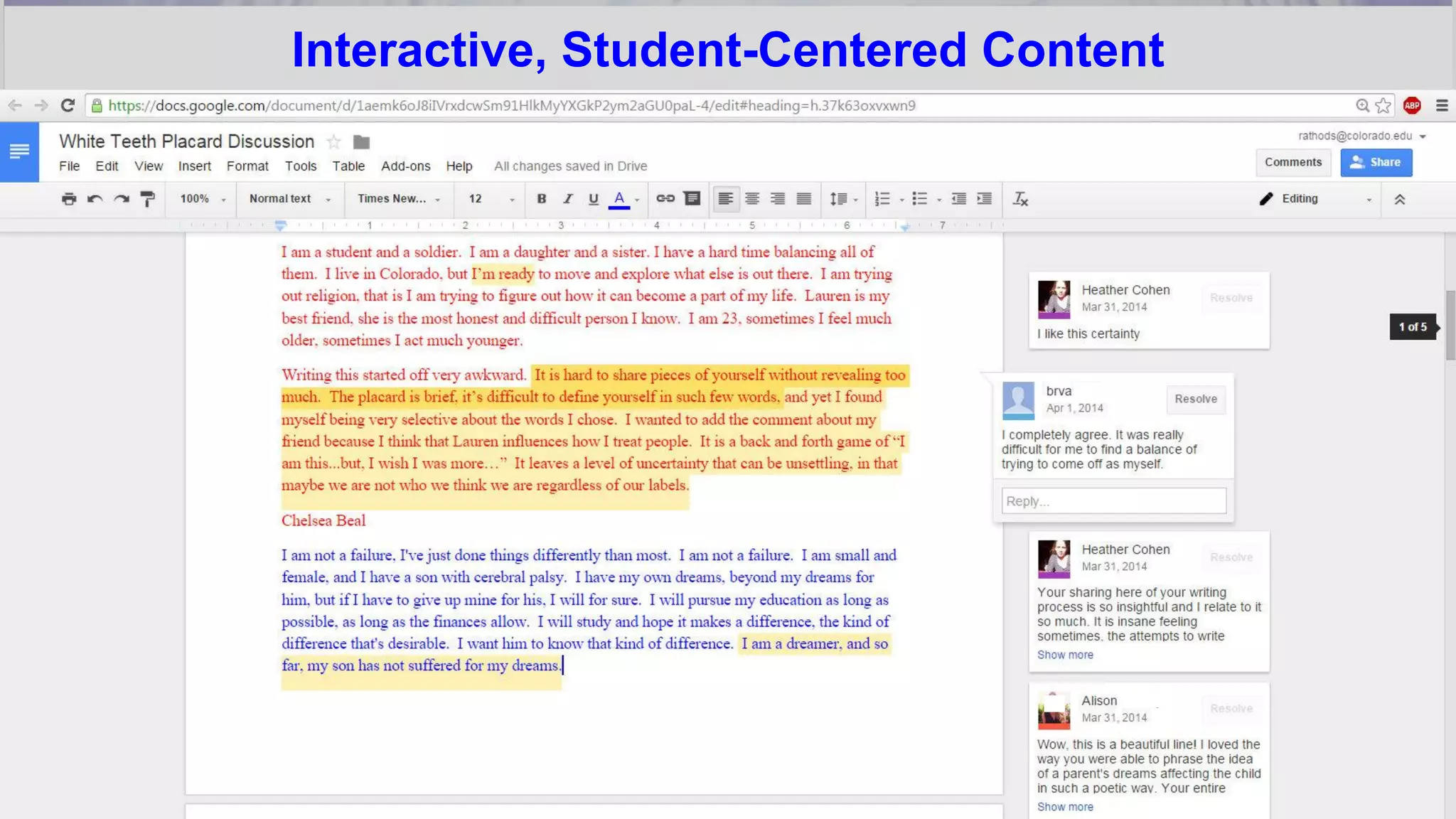
Interactive, Student-Centered Content
Positive Feedback from Online Learning Assistants
❖ “The best thing
about being a
learning assistant is
being able to
witness all the
behind the scene
workings of a
class.”
❖ “I personally have gained
some confidence in my
conversation/response
skills, at least online,
which hopefully will pay
off in grad school teaching
if I do that.”
Moving Forward with Feedback from LAs
❖ “I think the only bad
thing when it comes
to the students is that
they may find it a
waste of time to ask
for my help when
they can just as easily
send an email to the
professor.”
❖ “Early in the semester
students are eager
and respond to me in
that D2L site more,
over time their
enthusiasm fades
and I get no
responses in D2L, but
Drive is still very
interactive.”
Moving Forward with Feedback from Students
❖ “It really varies
class to class
and depends on
the course and
professor.”
❖ “I haven't really been
able to interact very
often but will find
myself doing so more
soon.”
❖ “She is great!
She responds to
everything and is
very insightful.”
❖ “The most useful aspect is having
somebody that is kind of half-
student, half-teacher. Somebody
to connect with while also
progressing us academically.”
Recommendations
❖ Allow LAs to
cultivate their
voices and their
own
relationships
with students
❖ Create a
methodology to
train and educate
LAs concurrent to
their work, such
as a credit
pedagogy course.
❖ Organize and
reflect on LA
and student
feedback each
semester
References
Betts, K. & Lanza-Gladney, M. (2010). “Academic Advising: Strategies to Increase Student
Engagement and Retention by Personalizing the Online Education Experience.” NACADA: The
Global Community for Academic Advising.
Clapper T. (2012). “Retention In Online Courses: Surviving the First Week.” evolllution.com
Cormier, D. (2008). “Rhizomatic Education: Community as Curriculum.” davecormier.com
Davies, J. & Graff, M. (2005). “Performance in e-learning: online participation and student
grades.” British Journal of Educational Technology Volume 36 Issue 4, 657-663.
Otero, V., Pollock, S., & Finkelstein, N. (2010). “A physics department’s role in preparing physics
teachers: The Colorado learning assistant model.” Am. J. Phys. 78 (11). aapt.org/ajp
Poll, K., Widen, J., & Weller, S. (2014). “Six Instructional Best Practices for Online Engagement
and Retention.” Journal of Online Doctoral Education.
Seo, K. (2007). “Utilizing peer moderating in online discussions: Addressing the controversy
between teacher moderation and nonmoderation.” American Journal of Distance Education 21
(1), 21-36.
References, continued.
Smith, M., Wood, W., Adams, W., Knight, J., Guild, N., & Su, T. (2009). “Why Peer Discussion
Improves Student Performance on In-Class Concept Questions.” Science Vol. 323.
“Twelve Best Practices for Student Engagement and Retention.” (2012). Mansfield University.
Images
Dooley, K. “Chihuly 2”
ebayink, “Tablet use 2”
Foco, E. “Stairs”
Schplook. “Korean High School Classroom”
Velasquez, J. “c9e42240”
TechTAs
in the SEHD
A TechTA is actually a Graduate Assistant recruited from the
SEHD Instructional Learning Technologies (ILT) program.
● They are paid on a semester basis - not hourly.
● They partner with faculty one-to-one, course-by-course.
● They are like a “personal trainer” for online faculty.
● They are instructional-designers on retainer.
● They take on projects large and small.
mostly, what we do...
Extreme Makeover: Online Course Edition
One-to-One Faculty Training
Course Templates
Canvas Hacks
mostly, where we work…
● Our Sandbox
● Our Themes
○ Co-Construction of Learning
○ Personal Learning Networks (PLN)
○ Building a Basecamp
○ Browser Based Instruction
○ Digital Media/Storytelling
● Our Gallery
challenges & opportunities
● Operational Rules, Protocols
● CU Online / Canvas
● Demand
● Diversity of Needs/Styles/Abilities/Cooperation
challenges & opportunities
● Operational Rules, Protocols
● CU Online / Canvas
● Demand
● Diversity of Needs/Styles/Abilities/Cooperation
Flexibility is key
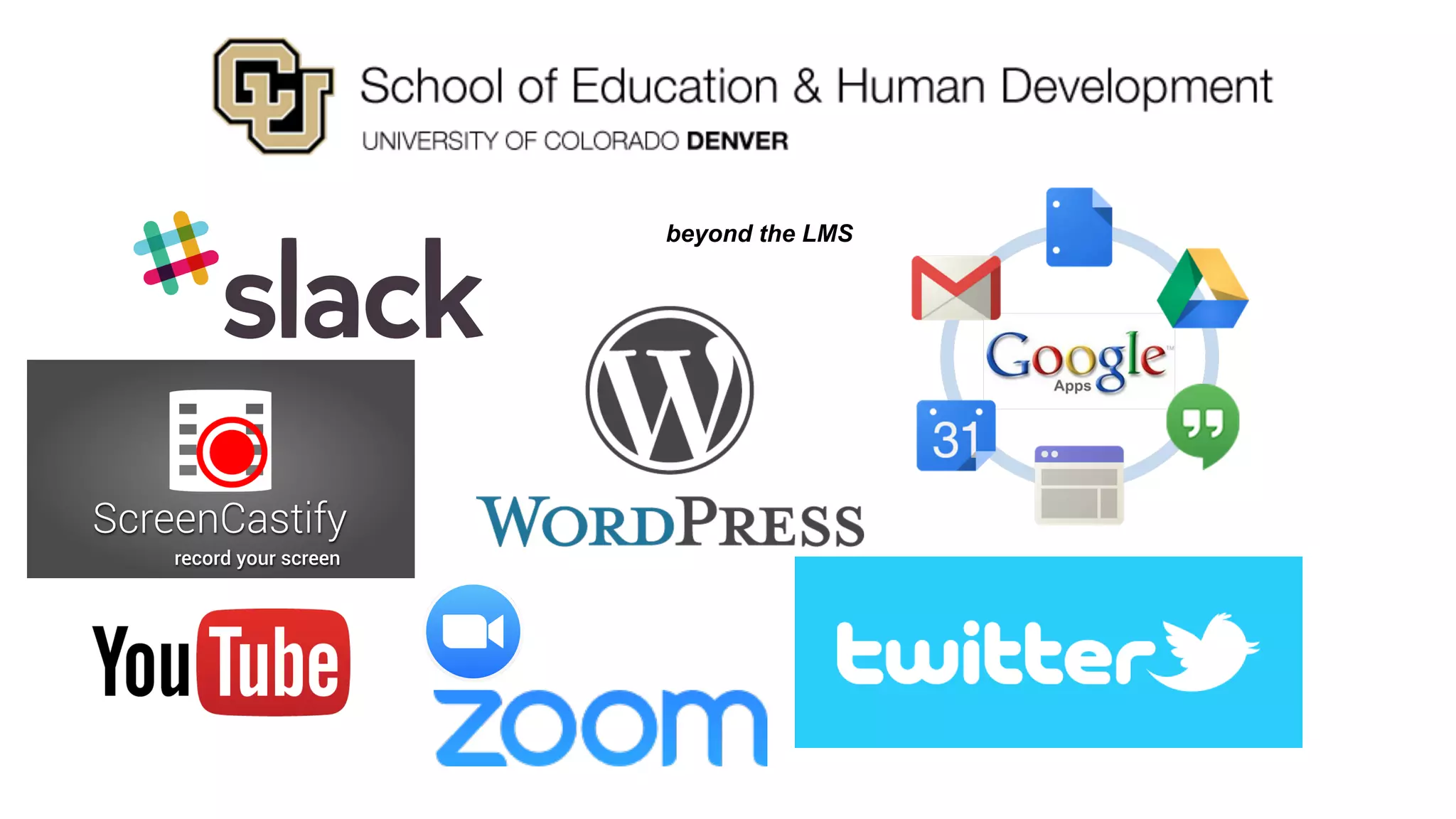
beyond the LMS
challenges & opportunities
● We reinvent ourselves every semester
● We reinvent strategies with every faculty member,
every course
● We use guidelines; not rules; not protocols
● We work as a team - crowdsource ideas and
techniques
● Adaptability + experimentation = impact
Flexibility is key

Co-Constructing Digital Pedagogies

  • 1.
    Co-Constructing Digital Pedagogies: LeveragingLearning Assistant and TechTA Support Shannon Rathod, CU-Boulder & Brad Hinson, CU-Denver
  • 2.
    The Online Classroom:How to Improve Student Interaction? How to Improve Student Engagement?
  • 3.
    Student Retention andEngagement: From the Beginning of the Course “Effective communication occurs not only during the course, but also before it begins.” (Clapper, 2012) “Develop orientation materials that introduce students to online expectations and provide points of contact before courses begin.” (Betts & Lanza-Gladney, 2010) “Too often, the sense of community is not established right at the beginning of the course because of a lack of social presence by the facilitator.” (Poll, Widen, & Weller, 2014) “Recommendation: All advisors should meet individually or in small groups with first year student within two weeks of the start of the semester. Sooner is better!” (“Twelve Best Practices for Student Engagement and Retention,” 2012)
  • 4.
    Yet too oftenthis need for immediate engagement can result in individual instructors attempting to rein in and control all aspects of communication.
  • 5.
    “Curriculum […] isconstructed and negotiated in real time by the contributions of those engaged in the learning process.” -Dave Cormier, “Rhizomatic Education: Community as Curriculum”
  • 6.
    How to providestudents with a more foundational and lasting voice in the course conversation?
  • 7.
    How to providestudents with a more foundational and lasting voice in the course conversation? Hire a Learning Assistant or TechTA!
  • 8.
    Background: The ColoradoLearning Assistant (LA) Model The LA Model: ❖ Focuses on large-enrollment, on-campus STEM courses ❖ Hires talented undergraduates to facilitate small-group interaction ❖ Better prepares students for careers in STEM teaching ❖ Transforms STEM courses to incorporate research-based teaching
  • 9.
    Background: The ColoradoLearning Assistant (LA) Model Roles and Responsibilities of LAs: ❖ Encourage dialogue among students ❖ Assist students in understanding course expectations, concepts, and content ❖ Work approximately 10 hours per week ❖ Communicate weekly with the instructor ❖ Act as an LA, not a TA
  • 10.
    Benefits of LAs ❖Students have increased understanding of content working with LAs (Otero, Pollock, & Finkelstein, 2010) ❖ Peer discussion improves student performance (Smith et al., 2009) ❖ Students respond more actively when peers moderate discussions (Seo, 2007) ❖ Increased communication and interaction positively impacts student performance in learning (Davies & Graff, 2005)
  • 11.
    The Online LearningAssistant Program Based on the success of the original program, University of Colorado at Boulder’s Independent Learning Program has instituted LAs for its online courses. In working with an LA, online Instructors: ❖ Redesign their courses ❖ Create alternative spaces for student interaction ❖ Emphasize collaboration ❖ Champion interactive, student-centered content
  • 12.
    The Online LearningAssistant Program: Beyond the Classroom
  • 13.
    The Online LearningAssistant Program In working with an LA, online Instructors: ❖ Redesign their courses ❖ Create alternative spaces for student interaction ❖ Emphasize collaboration ❖ Champion interactive, student-centered content
  • 14.
    Redesigning the Course: GeneralProcess of Working with a Learning Assistant 1) Hire a talented, interactive student, preferably one who has already taken the course 2) Establish an alternative space for the Learning Assistant to interact with students 3) Co-construct the alternative space. 4) Communicate weekly with the LA 5) Monitor the progress of the alternative space
  • 15.
  • 16.
  • 17.
  • 18.
  • 19.
    Redesigning the Course:LA Modeling Assignments
  • 20.
    Redesigning the Course:LA Modeling Assignments
  • 21.
    Alternative Spaces forCourse Interaction
  • 22.
  • 23.
  • 24.
  • 25.
    Alternative Spaces: Connectedthrough the Course Widget
  • 26.
    Alternative Spaces: Connectedthrough the Syllabus
  • 27.
  • 28.
  • 29.
  • 30.
  • 31.
  • 32.
    Positive Feedback fromOnline Learning Assistants ❖ “The best thing about being a learning assistant is being able to witness all the behind the scene workings of a class.” ❖ “I personally have gained some confidence in my conversation/response skills, at least online, which hopefully will pay off in grad school teaching if I do that.”
  • 33.
    Moving Forward withFeedback from LAs ❖ “I think the only bad thing when it comes to the students is that they may find it a waste of time to ask for my help when they can just as easily send an email to the professor.” ❖ “Early in the semester students are eager and respond to me in that D2L site more, over time their enthusiasm fades and I get no responses in D2L, but Drive is still very interactive.”
  • 34.
    Moving Forward withFeedback from Students ❖ “It really varies class to class and depends on the course and professor.” ❖ “I haven't really been able to interact very often but will find myself doing so more soon.” ❖ “She is great! She responds to everything and is very insightful.” ❖ “The most useful aspect is having somebody that is kind of half- student, half-teacher. Somebody to connect with while also progressing us academically.”
  • 35.
    Recommendations ❖ Allow LAsto cultivate their voices and their own relationships with students ❖ Create a methodology to train and educate LAs concurrent to their work, such as a credit pedagogy course. ❖ Organize and reflect on LA and student feedback each semester
  • 36.
    References Betts, K. &Lanza-Gladney, M. (2010). “Academic Advising: Strategies to Increase Student Engagement and Retention by Personalizing the Online Education Experience.” NACADA: The Global Community for Academic Advising. Clapper T. (2012). “Retention In Online Courses: Surviving the First Week.” evolllution.com Cormier, D. (2008). “Rhizomatic Education: Community as Curriculum.” davecormier.com Davies, J. & Graff, M. (2005). “Performance in e-learning: online participation and student grades.” British Journal of Educational Technology Volume 36 Issue 4, 657-663. Otero, V., Pollock, S., & Finkelstein, N. (2010). “A physics department’s role in preparing physics teachers: The Colorado learning assistant model.” Am. J. Phys. 78 (11). aapt.org/ajp Poll, K., Widen, J., & Weller, S. (2014). “Six Instructional Best Practices for Online Engagement and Retention.” Journal of Online Doctoral Education. Seo, K. (2007). “Utilizing peer moderating in online discussions: Addressing the controversy between teacher moderation and nonmoderation.” American Journal of Distance Education 21 (1), 21-36.
  • 37.
    References, continued. Smith, M.,Wood, W., Adams, W., Knight, J., Guild, N., & Su, T. (2009). “Why Peer Discussion Improves Student Performance on In-Class Concept Questions.” Science Vol. 323. “Twelve Best Practices for Student Engagement and Retention.” (2012). Mansfield University. Images Dooley, K. “Chihuly 2” ebayink, “Tablet use 2” Foco, E. “Stairs” Schplook. “Korean High School Classroom” Velasquez, J. “c9e42240”
  • 38.
  • 39.
    A TechTA isactually a Graduate Assistant recruited from the SEHD Instructional Learning Technologies (ILT) program. ● They are paid on a semester basis - not hourly. ● They partner with faculty one-to-one, course-by-course. ● They are like a “personal trainer” for online faculty. ● They are instructional-designers on retainer. ● They take on projects large and small.
  • 40.
    mostly, what wedo... Extreme Makeover: Online Course Edition One-to-One Faculty Training Course Templates Canvas Hacks mostly, where we work… ● Our Sandbox ● Our Themes ○ Co-Construction of Learning ○ Personal Learning Networks (PLN) ○ Building a Basecamp ○ Browser Based Instruction ○ Digital Media/Storytelling ● Our Gallery
  • 41.
    challenges & opportunities ●Operational Rules, Protocols ● CU Online / Canvas ● Demand ● Diversity of Needs/Styles/Abilities/Cooperation
  • 42.
    challenges & opportunities ●Operational Rules, Protocols ● CU Online / Canvas ● Demand ● Diversity of Needs/Styles/Abilities/Cooperation Flexibility is key
  • 43.
  • 44.
    challenges & opportunities ●We reinvent ourselves every semester ● We reinvent strategies with every faculty member, every course ● We use guidelines; not rules; not protocols ● We work as a team - crowdsource ideas and techniques ● Adaptability + experimentation = impact Flexibility is key