Teaching international students:	effective learning support for all		Jude Carroll 					‘Teaching International Students’ projectOxford Brookes University
What is the Teaching International Students project?Run by the Higher Education AcademyFunded through 2 year projectTIS Team: Janette Ryan, Jude Carroll, Fiona Hyland (ESCalate), Inna Pomerina (Economics), Melodee Beals (History, Classics & Archeology) , Simon Steiner (Engineering) , Malcolm Todd (C-SAP), Ali Dickens (LLAS), Andrea Frank (CEBE), Caprice Lantz (Psychology), Richard Atfield (BMAF), Adam Child & Katherine Lagar, HEA
Some  UK numbers … ‘international students’UK: 15% and rising (22.9% increase 2010 UUK)12% of first degree students66% of full-time taught postgraduates; 50% of full-time research degree students (43% of all research postgraduates) “This is no longer a ‘minority’ issue…..”Is this true here?
Not just rising numbers …..Much more diverse previous experiences as learners…from vetting and selecting to mass higher educationNew reasons for leavingNew reasons for comingNew goals and motivationsFor UK HEIs:  new reasons?
Link between numbers & your experiences? Local proportions vary  [by region, discipline, level, nationality, …]Cohort characteristics vary		Overall percentages		‘Blocks’ of one nationality / language group		Percentage of ‘home students’Length of stay / study.  Top-up? Enrolled [‘our students’] or exchange?  On line / distance? Generalisations about ‘international students’ …. are they helpful?
A few hard truths?Aim for “good teaching” or ‘work-arounds’? No easy answersLoads of shared good practice / evidence-based approaches  … much of it overlookedNOT addressing issues does not lead to neutral results“adapt”“accommodate”“adjust”Who needs to change?
Approaches to managing academic cultural diversityDenial ‘I teach.  It’s up to them to learn.’		‘I teach Chemistry.  Oxygen is the same everywhere’		‘I didn’t admit this student who can’t speak English …’‘Repair’‘You fix them and then I’ll teach them’			‘These students can’t…..  They don’t ….. They are not motivated….’Students must adapt‘These students came for a British education’			‘We do a two week conversion course before they start….’			‘All our assessments now come with detailed briefs’			‘Here are six workshops on academic writing’Teachers accommodate and adjust their practice.   But….…‘bottom line’ non-negotiable			… must be sustainable, efficient
My guesses:  …your students are becoming more diverse [in language and culture].  You will have mixed reactions to this diversity.…all your students will need to adapt to their new educational setting.  Some will have significantly more adjustment to make.  …you will need to change (or have already changed) how you teach and what you teach and probably, how you think about teaching …. to accommodate cultural and linguistic diversity.….  you and probably your colleagues will have a range of reactions (not all positive) to teaching international students.
Big issues for international students?LanguageTransition, new academic cultural assumptions and expectations; 	standards‘New game, new rules’Engagement and participation‘Support’ and guidance [formal, informal, academic, pastoral, economic, human…..]Application and utility of UK awards
Suggestions: teachers managing cultural/language diversity1.  Accept & learn about academiccultural difference2.  Support students’ transition & skill development – 		Start early and keep going.  Teach English.3.  Use teaching methods that encourage participation and 		collaboration4.  Create a globally-relevant curriculum5.  Anticipate and manage predictable problems(expectations, integration, group work, plagiarism, etc)
You probably already manage these issues   … choose one example of your actions & share itStudents’ previous learning contexts and expectations being different from a ‘typical’ NI student’s.   What do you do?Students’ language development needing particular attention at the beginning.  How do you help?Students finding it very hard to participate by speaking and interacting without encouragement.  How do you encourage them?Producing graduates for a globally interconnected and diverse world.  When and how?Students not easily mixing and seeking out interaction with those they see as ‘different’.  Your reaction?
How the Teaching International Students project sets out to help
Foregrounding academic cultural differences and advocating ‘meta-awareness’artefacts  …..  how you greet people, what you eat, what you call peoplecultural norms  …. how you resolve an argument	 how formal you are with strangers,	 how loudly you speak, 	how close you stand……  	what makes ‘a convincing argument’.  shared, deeply-held beliefs about how things should be….. The same is true for teaching and learning…… but we are less likely to expect the differences or to know about them.
Same words, different artefacts 			different norms 			different beliefsReadingWritingCritical‘my own work’TeacherLearning‘Good work’ExaminationHelpDeadline9:00
I tell my students, ‘Call me Jude’.When students ask, I help with study-based issues.I select the issues but the students must find their own answersI want students to discuss, argue, solve problems. What’s their conclusion? .. their argument?I want students  to read around, to choose good bits from reading, from lectures, labs….and to weave them together to make an answer.  Their answer …. not the answerI call my teacher Dr. xxxA good teacher notices I need help and offers it.  A good teacher tells me good answers to good questions.To learn, I must listen to the teacher.  Really listen.I read the textbook many many many times.  Exam questions and answers are from the textbook.
The important point:  from ‘essentialist’ to self-aware and transparent  ……Students base their actions and expectations on their previous academic cultural experiences. [‘I expected the UK to be the same….’]You notice surprises and differences as students act upon their assumptions…. As they ask questions, speak, work together, act on your instructions, try and learn….. [‘Cultural bumps’]You learn what your expectations and assumptions are by noting the differences.Then you tell your students explicitly some of those expectations and assumptions.  ‘Tell them the rules’
What builds a shared understanding of YOUR academic assumptions?Don’t focus on the artefact[i.e. What teachers are called , ‘Call me Jude’]Specify and describe the normative behaviour (‘the rule’) [‘Teachers and students call each other by first names except when ….’][Maybe] discuss the underpinning belief [‘Here, first names can make communication easier and more open but does not mean being friends.’]*Telling students the belief does not mean they will adopt the belief – just that they might understand it better.*If following the norm requires specific skills, then telling is not enough.
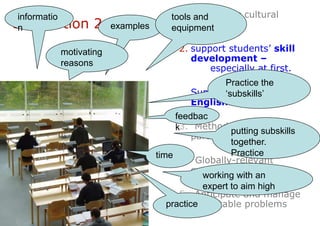
tools and equipmentSuggestion 2:information…academic cultural differencesupport students’ skill development – 	especially at first.	Support students’ English.3.  Methods to encourage participation4.  Globally-relevant curriculum5.  Anticipate and manage predictable problemsexamplesmotivating reasonsPractice the ‘subskills’feedbackputting subskills together.  Practicetimeworking with an expert to aim highfeedbackpractice
2.  Skill developmentMany new skills   [reading, note making, writing, locating sources, analysis, technical skills, time management…..]Early diagnostics  [Student:  ‘How am I doing?]Design in practice and feedbackCannot be left to individual teachers:  Programme-level planningStart early (but not induction).  Keep going ….
‘….. programme focus’ :‘We don’t have a programme, just a collection of courses’Yet ….  everything we know about improving quality and engaging students in their learning relies on having a focus at the level of the PROGRAMME.Radical idea:  we could use the needs of international students to develop and encourage a programme approach.
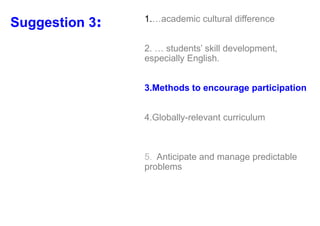
Suggestion 3:  …academic cultural difference … students’ skill development, especially English.Methods to encourage participationGlobally-relevant curriculum5.  Anticipate and manage predictable problems
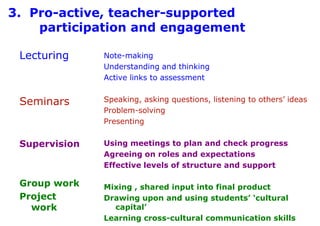
3.  Pro-active, teacher-supported 			participation and engagementLecturing SeminarsSupervisionGroup workProject workProject groups which pull students together.  Note-makingUnderstanding and thinkingActive links to assessmentSpeaking, asking questions, listening to others’ ideasProblem-solvingPresentingUsing meetings to plan and check progressAgreeing on roles and expectationsEffective levels of structure and supportMixing , shared input into final productDrawing upon and using students’ ‘cultural capital’Learning cross-cultural communication skills
The Teaching International Students Project
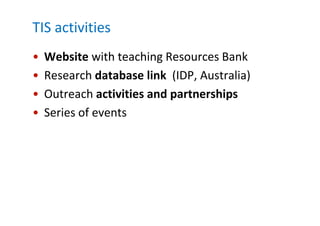
TIS activitiesWebsite with teaching Resources BankResearch database link  (IDP, Australia)Outreach activities and partnershipsSeries of events
Getting involvedContact internationalisation@heacademy.ac.ukVia website: www.heacademy.ac.uk/internationalstudents
Suggestion 4:  …academic cultural difference … students’ skill development, especially English.3.  …. encourage participation by all4.  Globally-relevant curriculum5.  Anticipate and manage trouble
4.  Globally-relevant curriculumDifferent for each programmeNot just content!Teach and assess cross cultural skillsPromote student integrationOpportunities?	- Introduction activities		- Problems for students to solve		- Reading lists		- Guest speakers		- Research areas		- Library resources
5.  Manage predictable problemsDifference is hard.  Expect it!Group work is hard.  Manage it.Plagiarism is predictable and understandable.  Work with that.Students do not integrate spontaneously.  Choreograph it.  Encourage it.  Even assess it?Conflict is inevitable.  Develop strategies and help the students develop strategies to manage conflict.It may be your most precious contribution to their future and the global future we all share.
Final wordAll students find university newMost find it new and hardMany find it new and hard and strangeSome find it new and hard and strange and all wrong, really wrongMost succeed.  Teach for inclusion and the students will succeed with more ease and less pain …. and so will you.

Jude carroll seminar

  • 1.
    Teaching international students: effectivelearning support for all Jude Carroll ‘Teaching International Students’ projectOxford Brookes University
  • 2.
    What is theTeaching International Students project?Run by the Higher Education AcademyFunded through 2 year projectTIS Team: Janette Ryan, Jude Carroll, Fiona Hyland (ESCalate), Inna Pomerina (Economics), Melodee Beals (History, Classics & Archeology) , Simon Steiner (Engineering) , Malcolm Todd (C-SAP), Ali Dickens (LLAS), Andrea Frank (CEBE), Caprice Lantz (Psychology), Richard Atfield (BMAF), Adam Child & Katherine Lagar, HEA
  • 3.
    Some UKnumbers … ‘international students’UK: 15% and rising (22.9% increase 2010 UUK)12% of first degree students66% of full-time taught postgraduates; 50% of full-time research degree students (43% of all research postgraduates) “This is no longer a ‘minority’ issue…..”Is this true here?
  • 4.
    Not just risingnumbers …..Much more diverse previous experiences as learners…from vetting and selecting to mass higher educationNew reasons for leavingNew reasons for comingNew goals and motivationsFor UK HEIs: new reasons?
  • 6.
    Link between numbers& your experiences? Local proportions vary [by region, discipline, level, nationality, …]Cohort characteristics vary Overall percentages ‘Blocks’ of one nationality / language group Percentage of ‘home students’Length of stay / study. Top-up? Enrolled [‘our students’] or exchange? On line / distance? Generalisations about ‘international students’ …. are they helpful?
  • 7.
    A few hardtruths?Aim for “good teaching” or ‘work-arounds’? No easy answersLoads of shared good practice / evidence-based approaches … much of it overlookedNOT addressing issues does not lead to neutral results“adapt”“accommodate”“adjust”Who needs to change?
  • 8.
    Approaches to managingacademic cultural diversityDenial ‘I teach. It’s up to them to learn.’ ‘I teach Chemistry. Oxygen is the same everywhere’ ‘I didn’t admit this student who can’t speak English …’‘Repair’‘You fix them and then I’ll teach them’ ‘These students can’t….. They don’t ….. They are not motivated….’Students must adapt‘These students came for a British education’ ‘We do a two week conversion course before they start….’ ‘All our assessments now come with detailed briefs’ ‘Here are six workshops on academic writing’Teachers accommodate and adjust their practice. But….…‘bottom line’ non-negotiable … must be sustainable, efficient
  • 9.
    My guesses: …your students are becoming more diverse [in language and culture]. You will have mixed reactions to this diversity.…all your students will need to adapt to their new educational setting. Some will have significantly more adjustment to make. …you will need to change (or have already changed) how you teach and what you teach and probably, how you think about teaching …. to accommodate cultural and linguistic diversity.…. you and probably your colleagues will have a range of reactions (not all positive) to teaching international students.
  • 10.
    Big issues forinternational students?LanguageTransition, new academic cultural assumptions and expectations; standards‘New game, new rules’Engagement and participation‘Support’ and guidance [formal, informal, academic, pastoral, economic, human…..]Application and utility of UK awards
  • 11.
    Suggestions: teachers managingcultural/language diversity1. Accept & learn about academiccultural difference2. Support students’ transition & skill development – Start early and keep going. Teach English.3. Use teaching methods that encourage participation and collaboration4. Create a globally-relevant curriculum5. Anticipate and manage predictable problems(expectations, integration, group work, plagiarism, etc)
  • 12.
    You probably alreadymanage these issues … choose one example of your actions & share itStudents’ previous learning contexts and expectations being different from a ‘typical’ NI student’s. What do you do?Students’ language development needing particular attention at the beginning. How do you help?Students finding it very hard to participate by speaking and interacting without encouragement. How do you encourage them?Producing graduates for a globally interconnected and diverse world. When and how?Students not easily mixing and seeking out interaction with those they see as ‘different’. Your reaction?
  • 13.
    How the TeachingInternational Students project sets out to help
  • 14.
    Foregrounding academic culturaldifferences and advocating ‘meta-awareness’artefacts ….. how you greet people, what you eat, what you call peoplecultural norms …. how you resolve an argument how formal you are with strangers, how loudly you speak, how close you stand…… what makes ‘a convincing argument’. shared, deeply-held beliefs about how things should be….. The same is true for teaching and learning…… but we are less likely to expect the differences or to know about them.
  • 15.
    Same words, differentartefacts different norms different beliefsReadingWritingCritical‘my own work’TeacherLearning‘Good work’ExaminationHelpDeadline9:00
  • 16.
    I tell mystudents, ‘Call me Jude’.When students ask, I help with study-based issues.I select the issues but the students must find their own answersI want students to discuss, argue, solve problems. What’s their conclusion? .. their argument?I want students to read around, to choose good bits from reading, from lectures, labs….and to weave them together to make an answer. Their answer …. not the answerI call my teacher Dr. xxxA good teacher notices I need help and offers it. A good teacher tells me good answers to good questions.To learn, I must listen to the teacher. Really listen.I read the textbook many many many times. Exam questions and answers are from the textbook.
  • 17.
    The important point: from ‘essentialist’ to self-aware and transparent ……Students base their actions and expectations on their previous academic cultural experiences. [‘I expected the UK to be the same….’]You notice surprises and differences as students act upon their assumptions…. As they ask questions, speak, work together, act on your instructions, try and learn….. [‘Cultural bumps’]You learn what your expectations and assumptions are by noting the differences.Then you tell your students explicitly some of those expectations and assumptions. ‘Tell them the rules’
  • 18.
    What builds ashared understanding of YOUR academic assumptions?Don’t focus on the artefact[i.e. What teachers are called , ‘Call me Jude’]Specify and describe the normative behaviour (‘the rule’) [‘Teachers and students call each other by first names except when ….’][Maybe] discuss the underpinning belief [‘Here, first names can make communication easier and more open but does not mean being friends.’]*Telling students the belief does not mean they will adopt the belief – just that they might understand it better.*If following the norm requires specific skills, then telling is not enough.
  • 19.
    tools and equipmentSuggestion2:information…academic cultural differencesupport students’ skill development – especially at first. Support students’ English.3. Methods to encourage participation4. Globally-relevant curriculum5. Anticipate and manage predictable problemsexamplesmotivating reasonsPractice the ‘subskills’feedbackputting subskills together. Practicetimeworking with an expert to aim highfeedbackpractice
  • 20.
    2. SkilldevelopmentMany new skills [reading, note making, writing, locating sources, analysis, technical skills, time management…..]Early diagnostics [Student: ‘How am I doing?]Design in practice and feedbackCannot be left to individual teachers: Programme-level planningStart early (but not induction). Keep going ….
  • 21.
    ‘….. programme focus’:‘We don’t have a programme, just a collection of courses’Yet …. everything we know about improving quality and engaging students in their learning relies on having a focus at the level of the PROGRAMME.Radical idea: we could use the needs of international students to develop and encourage a programme approach.
  • 22.
    Suggestion 3: …academic cultural difference … students’ skill development, especially English.Methods to encourage participationGlobally-relevant curriculum5. Anticipate and manage predictable problems
  • 23.
    3. Pro-active,teacher-supported participation and engagementLecturing SeminarsSupervisionGroup workProject workProject groups which pull students together. Note-makingUnderstanding and thinkingActive links to assessmentSpeaking, asking questions, listening to others’ ideasProblem-solvingPresentingUsing meetings to plan and check progressAgreeing on roles and expectationsEffective levels of structure and supportMixing , shared input into final productDrawing upon and using students’ ‘cultural capital’Learning cross-cultural communication skills
  • 24.
  • 25.
    TIS activitiesWebsite withteaching Resources BankResearch database link (IDP, Australia)Outreach activities and partnershipsSeries of events
  • 31.
    Getting involvedContact internationalisation@heacademy.ac.ukViawebsite: www.heacademy.ac.uk/internationalstudents
  • 32.
    Suggestion 4: …academic cultural difference … students’ skill development, especially English.3. …. encourage participation by all4. Globally-relevant curriculum5. Anticipate and manage trouble
  • 33.
    4. Globally-relevantcurriculumDifferent for each programmeNot just content!Teach and assess cross cultural skillsPromote student integrationOpportunities? - Introduction activities - Problems for students to solve - Reading lists - Guest speakers - Research areas - Library resources
  • 34.
    5. Managepredictable problemsDifference is hard. Expect it!Group work is hard. Manage it.Plagiarism is predictable and understandable. Work with that.Students do not integrate spontaneously. Choreograph it. Encourage it. Even assess it?Conflict is inevitable. Develop strategies and help the students develop strategies to manage conflict.It may be your most precious contribution to their future and the global future we all share.
  • 35.
    Final wordAll studentsfind university newMost find it new and hardMany find it new and hard and strangeSome find it new and hard and strange and all wrong, really wrongMost succeed. Teach for inclusion and the students will succeed with more ease and less pain …. and so will you.