What do we know about successfully harnessing student voice in schools? Cass Unit Seminar   DCSF, Sanctuary Buildings, Great Smith Street, London October 23rd, 2007 2.00pm – 4.00pm Professor Michael Fielding Institute of Education, University of London Dr Bethan Morgan Teaching Associate Faculty of Education, University of Cambridge
Presentation Structure Section 1:  Overview: Michael Fielding Section 2: Findings from the TLRP Network and Related Projects: Donald McIntyre & Bethan Morgan Section 3 The Way  Forward: all presenters
Recent Contexts Changing view of childhood UN Convention on  Rights of the Child  1989 School improvement  OfSTED Inspection framework Citizenship + Healthy Schools Consumerism  Children’s Commissioner  Work of  Professor Jean Rudduck 19-21 C  educational   imaginary  (David Hargreaves)‏ Factory    personalised education for all Segregated roles    overlapping roles Producer led    user led
Immediate Contexts Government Legalisation / Initiatives / Research Every Child Matters Personalised Learning: The East Sussex Project ‘ Real Decision Making? School Councils in Action’ ‘ Working Together: Giving children and young people a say’ NGOs / Foundations Esm é e Fairbairn / Carnegie YPI Academic Research + Publications ESRC TLRP  ‘Consulting Pupils about T&L’ ESRC Seminars  ‘Engaging Critically with PV’ Cumulative work  of e.g. Fielding, McIntyre, Rudduck, Thomson Journal Special Issues   e.g.   Discourse, Educational Action Research, Forum, Improving Schools, International Journal for Leadership in Education + 2007  International Handbook  (Thiessen + Cook-Sather)
Personalised Learning   Charles Leadbeater   ‘ The foundation of a personalised education system would be to encourage children, from an early age and across all backgrounds, to become  more involved in making decisions about what they would like to learn and how .’ Choice :  users as consumers  within  institutions, not just between them e.g. how you learn, what you learn, how you are assessed Voice :  users as citizens and co-designers of services e.g.  Students as Researchers Professionals  as  advisers, advocates, solution assemblers, brokers
Requests for evidence of impact of consultation on pupil achievement ... ‘ These  [requests] cannot be responsibly met before we are sure that schools understand the rationale for developing pupil voice and are implementing it in reasonable ways’ [i.e. not just quick fix surveys in the last few seconds of the lesson]   ‘ There is evidence of the  potential  of consultation to strengthen pupils’ commitment to learning , but not the kind of proof i.e. a direct cause and effect link – that government has wanted: it is clear that  successful implementation depends very much on the culture of the classroom and school  and that the approach to consultation and its impact are, therefore, likely to show  considerable variation across schools .’ ‘ Nevertheless, in settings where consultation is thoughtfully developed the signs are encouraging .’ Chapter 13  Rudduck & McIntyre (2007 forthcoming)
Range of Student Voice Activities Peer support    Buddying systems     Peer tutoring    Peer teaching      Circle time Organisational change structures    School councils     Student governors    Students on appointment panels     School Improvement Plans  e.g.  draw-and-write    Healthy Schools    OfSTED    ECM Engagement with T & L    Lead-learners     Classroom observation    AfL     Student co-researchers    student-led learning walks  ‘ Students-as-researchers’    Dept development plans    Evaluating work units    Classroom consultation
5 perspectives on education Exposes + challenges deep assumptions. Offers alternatives, often rooted in radical traditions Challenges the system to Transcend it Radical Different slant on existing assumptions, often inspired by new developments in business Unsettles the system to Renew it Renewal Adjustments to existing  system in the light of feedback Champions the system to Embed it Reaffirm Rejection of the market + return to holistic emphasis  Unsettles the system to Retrieve it Restorative Return to ‘proven’ methods + arrangements perceived to  promote social mobility Unsettles the system to Correct it Corrective
Student Involvement Typology(1)‏ Pupil / student attitude surveys Samples of pupil / student work Individual performance data Pupils / Students as Data Source Appointment panels Team agenda + pupil perceptions AfL lead learners Pupils / Students as Active Respondents Joint review of rewards system CPGS ‘History Dudettes’ Developing independent learning Pupils / Students as Co-Enquirers Low level bullying Is playground buddying system working? What Makes a Good Lesson? Pupils / Students as   Knowledge Creators Staff + pupil / student Learning Walks Develop unit /department research lesson Co-plan Maths Lesson Pupils / Students + Adults as Co-authors Joint Enquiry School Unit / Team Classroom
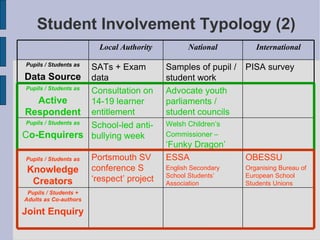
Student Involvement Typology (2)‏ PISA survey Samples of pupil / student work SATs + Exam data Pupils / Students as Data Source Advocate youth parliaments / student councils Consultation on 14-19 learner entitlement Pupils / Students as Active Respondent Welsh Children’s Commissioner –  ‘Funky Dragon’ School-led anti-bullying week Pupils / Students as C o-Enquirers OBESSU Organising Bureau of European School Students Unions ESSA English Secondary School Students’ Association Portsmouth SV conference  ‘respect’ project Pupils / Students as  Knowledge Creators Pupils / Students + Adults as Co-authors Joint Enquiry International National Local Authority
Student / pupil voice &  Students Develop capacity to  reflect on learning     greater  control over how you learn + how to improve it Respected,  listened to + taken seriously     positive sense of self Views  make a difference  to how things are done in school + classroom     change agentry New capacity to take on  roles + responsibilities Sense of  belonging  - more positive membership of class + school See  teachers differently
Student / pupil voice &  Teachers Being  positively surprised  by students    more open perception of young people’s capabilities and attitudes Experiencing + enjoying a  different way of working  with students     renewed sense of excitement  in teaching Positive agenda for improvement     insights that help their professional development  Seeing positive changes  as a result of student voice engagement
Student / pupil voice & Schools A practical  agenda for change  that teachers +  pupils can identify with Better  engagement with school  and  school learning  (students + staff)‏ Enhanced  mutual respect, trust  +  recognition  between pupils and teachers Improved  teaching  +  learning Developing a  distinct ethos  and  identity for the school Developing the school as a  learning organisation / community
Ongoing challenges (1)  Current context - teacher tensions Conflict between responsiveness to pupils and the nationally imposed agenda Pressures of time + curriculum coverage Lack of institutional support  Beyond pockets of isolated practice (role of LA + national + international networks)‏ Consumerism or democratic agency?  e.g.  “You’re no good, no bullet points, too much thinking, not thick enough files”
Ongoing challenges (2)  Using  students? Refusing the role of ‘quality assurance donkeys’ Ventriloquising predictable outcomes / teacher approved ideas ‘ Beating up’ teachers? National context over time … Class, race, gender, inclusion Ability grouping +labelling (inc. institutional)‏
Taking ‘student voice’ seriously (1)‏ Purposes + Values Why  is this work being  encouraged / resisted ? In  whose interests ? How does it connect with  policy contexts ? Power + Control Who is allowed to  speak ? About  what ? Who gets  heard ? By  whom ? Who is  listening ?  Why ? Capacities + Attitudes How are the  appropriate skills  developed? How do people  regard / care for each other ? Are they  taking it seriously ? Do some people feel  threatened ?
Taking ‘student voice’ seriously (2)‏ Systems + structures Appropriate  systems and structures ? Public /communal , as well as smaller, more intimate  spaces  to  make meaning  of recommendations and  decide what should be done ? Action + Responsibilities What actually  happens ? Who  decides? Who   has  responsibility for embedding  the change? How do we  hold  ourselves / each other  to account ? How is the change  monitored  and  evaluated ? By  whom ?
Section 2 Findings from the TLRP Network and Related Projects Professor Donald McIntyre & Dr Bethan Morgan
Strategies for Classroom Consultation The seductive attractiveness of ‘informal’ or ‘embedded’    consultation Developing the conditions for trusting dialogue Economy and power Direct consultation, indirect consultation, or pupils as      researchers  The importance of focusing on the particular The danger of working with selected pupils Guiding principles
What kinds of teachers and teaching do pupils want? Research studies reveal a very high degree of consensus across pupils, irrespective of age-group, previous success in school, subject or research study: the centrality of teacher-pupil relationships humanity, fairness, consistency respect and sensitivity positive attitude and enthusiasm
What kinds of teachers and teaching do pupils want? Four central and consistent characteristics of pupils’ preferred teaching approaches: meaningful learning, making connections avoiding tedium togetherness a measure of autonomy
What do pupils say about their own teachers? Pupils take consultation very seriously They tend to accentuate the positive They are also ready to identify unhelpful practices They suggest modifications, use contrasts, and suggest    constructive alternatives
What do pupils say about the social conditions for their classroom learning? ‘ A cacophony of competing voices’*: Sharp contrast between the  consensus  about preferred teaching approaches and the strong  differences  in classroom experiences, even in the same classrooms – differentiation and polarisation The destructive impact of ability labelling and social    class differentiation Gender differences Peer-group relations Lack of control *  Arnot & Reay (2004)
What do pupils say  about being consulted? The great potential of pupil consultation The central importance of teachers’ authentic engagement Thoughts on different methods of consultation The contribution of consultation to learning: teaching practices that really help learning greater enjoyment leading to better learning improved teacher-pupil relationships
Teachers’ responses  to what pupils say Why have teachers not consulted pupils previously? Teachers impressed by seriousness, insightfulness and constructive nature of pupil comments Teacher criteria in assessing pupil comments: educational effectiveness validity practicality representativeness
Teachers’ responses  to what pupils say Teachers found little difficulty in identifying a package of pupil ideas that they could use In practice, teachers varied: in attitudes  in their practical situations in their confidence and expertise The most powerful constraint seems to be perceived conflict between: responsiveness to pupils  and  the nationally imposed agenda
The potential impact of consultation on pupils and teachers Pupils: Changed attitudes to school and to learning Changed perceptions of teachers Stronger sense of school and class membership Developing capacity to reflect on learning New capacity to take on new roles and responsibilities Positive impact on sense of self
The potential impact of consultation on pupils and teachers Teachers: More open perception of young people’s capabilities and attitudes Readiness to change thinking Renewed sense of excitement in teaching Practical agenda for improvement Teacher - pupil relationships: Enhanced mutual respect, trust and recognition
Reservations, anxieties and constraints From the teacher perspective: Pressures of time and curriculum coverage Lack of institutional support Varied views of the pupils being taught Concerns about possible criticism Balancing individual and group perspectives From the pupil perspective: Uncertainty about the acceptability of criticising teachers Believing that consultation is for all pupils
Conditions for Developing Classroom Consultation Conditions in the classroom:  trust, respect, recognition Conditions in the school:  An explicit policy commitment within the School Advocacy by institutional leader Enabling structures and practices A school culture that values and listens to all staff A culture of enquiry among teachers A tradition of pupil involvement in decisions
Section 3 Ways Forward . . .
Positive developments (1)‏ Evidence of  reciprocal benefits to students  +  staff  at classroom / team / dept / school levels Emerging  synergy of national policies  across departments and sectors driven by: (a)  public service reform   (b) need to  engage wide range of young people  in political + social renewal Broadly  positive response of professionals , though  concerns  about  other antagonistic aspects of policy  (test + performance culture, time demands, curriculum pressure )‏
Positive developments (2)‏ Building momentum  across the country with certain areas developing significant expertise A number of  universities involved  in high quality ‘development & research’ work with schools, LAs and government organisations NGOs, Foundations  and  NFP  organisations supporting a range of work Fledgling evidence of  radical, prefigurative work against the grain     ‘practical conscience of democratic way of life’
Creative Renewal and Radical Change within the same educational system Creative renewal    SSAT  work on Student Voice ‘ Inspiring schools’  network Radical change     future practice now e.g.  Centre for Radical State Education, London Institute Current practice   e.g.    The Wroxham School, Potters Bar, Hertfordshire    Bishops Park College, Clacton, Essex Rich legacy of our radical state traditions   e.g.     Alex Bloom - St George-in-the-East, Stepney, London    Teddy O’Neill - Prestolee Elementary School, Stoneclough Key role of HEI  e.g.   Universities of Birmingham, Cambridge, East Anglia, Leicester, London, Manchester, Nottingham, and Sussex + Manchester Metropolitan and Open Universities
Support + sustainability Classrooms + Departments Classrooms Support & Sustainability through Staff (including TAs) pairing / mutual support + observation network within dept and / or within the school Support from T&L / SV post-holder Department / Team / Unit Departmental commitment through e.g. space at Dept meetings / dept publicity + bulletins / internal cover arrangements Depts encouraged + resourced centrally
Support + sustainability School SLT member with SV responsibility SV embedded at multiple levels and sites of formal and informal learning SV systemically integrated into ongoing development and review processes Advocacy + modelling by school leaders School culture that values + listens to all staff Culture of enquiry / research amongst teachers
Support + sustainability Local Authority + Networks LA development plan Involvement of advisers who can make connections with other agendas + priorities AST for SV + ‘link teachers’ in schools Emergent structures + cultures Good admin + communication infrastructure Co-constructed SV strategy + capacity-building approach Link to research base + external practice Explicit synergy + inclusive coherence
Support + sustainability National policy Replace  debilitating performance pressure  with  enabling, inclusive accountability  e.g. Bishops Park College, Clacton ‘Research Forum’ model Begin to encourage more  emergent models of curriculum Teacher voices - treat  teachers as agents , not just objects, of public service reform Value and support the role of  prefigurative practice  (future practice now)‏
Future research (1)  Classroom practice + student voice: teaching realities, teacher capacities Building on earlier, small scale research (e.g. McIntyre & Pedder, Arnot & Reay)‏ How do teachers  incorporate, sustain and make effective use of high-quality organic approaches to SV in their own classrooms ? Teachers need to listen to all pupils. How do these approaches address issues of  social class, gender, race  and  inclusion ?
Future research (2)   Leadership, SV and the systemic revisioning + renewal of schools Working with a range of volunteer Senior Leadership Teams  What is the nature and development of  high quality systemic support for SV  that operates organically at multiple levels in diverse contexts?
Future research (3)   External support for student voice Given the increasing importance of schools’  external networks  and  support systems  in  developing and sustaining creative approaches  to education What can we learn from successful LA  practice ( e.g.  Bedfordshire, Portsmouth)‏ University  engagement ( e.g.  Cambridge, Sussex)‏ Voluntary sector  ( e.g.  SCUK)‏ that will  enable SV to be embedded and sustained  in regional + national networks?
Future research (4)   Future practice now Researching past and current examples of  prefigurative practice ,  i.e.   highly creative practice significantly ahead of their time What can be learned from these inevitably small number of instances about  different ways of working the  role and effect  of such  exemplars on mainstream educational practice ?
Selected References Arnot, M., McIntyre, D., Pedder, D. & Reay, D. (2004)  Consultation in the classroom: Developing dialogue about teaching and learning,  (Cambridge, Pearson). Fielding, M. (2004) ‘New Wave’ student voice and the renewal of civic society  London Review of Education  Vol.2 No.3 pp 197-217. Morgan, B. (2007)  Consulting Pupils about Classroom Teaching and Learning: policy, practice and response in one school.  Unpublished PhD dissertation, University of Cambridge. Rudduck, J. & McIntyre, D. (2007 forthcoming)  Improving Learning through Consulting Pupils.  London: Routledge.
Contact Details Professor Michael Fielding [email_address] Dr Bethan Morgan [email_address]

Pupil Voice 1

  • 1.
    What do weknow about successfully harnessing student voice in schools? Cass Unit Seminar DCSF, Sanctuary Buildings, Great Smith Street, London October 23rd, 2007 2.00pm – 4.00pm Professor Michael Fielding Institute of Education, University of London Dr Bethan Morgan Teaching Associate Faculty of Education, University of Cambridge
  • 2.
    Presentation Structure Section1: Overview: Michael Fielding Section 2: Findings from the TLRP Network and Related Projects: Donald McIntyre & Bethan Morgan Section 3 The Way Forward: all presenters
  • 3.
    Recent Contexts Changingview of childhood UN Convention on Rights of the Child 1989 School improvement OfSTED Inspection framework Citizenship + Healthy Schools Consumerism Children’s Commissioner Work of Professor Jean Rudduck 19-21 C educational imaginary (David Hargreaves)‏ Factory  personalised education for all Segregated roles  overlapping roles Producer led  user led
  • 4.
    Immediate Contexts GovernmentLegalisation / Initiatives / Research Every Child Matters Personalised Learning: The East Sussex Project ‘ Real Decision Making? School Councils in Action’ ‘ Working Together: Giving children and young people a say’ NGOs / Foundations Esm é e Fairbairn / Carnegie YPI Academic Research + Publications ESRC TLRP ‘Consulting Pupils about T&L’ ESRC Seminars ‘Engaging Critically with PV’ Cumulative work of e.g. Fielding, McIntyre, Rudduck, Thomson Journal Special Issues e.g. Discourse, Educational Action Research, Forum, Improving Schools, International Journal for Leadership in Education + 2007 International Handbook (Thiessen + Cook-Sather)
  • 5.
    Personalised Learning Charles Leadbeater ‘ The foundation of a personalised education system would be to encourage children, from an early age and across all backgrounds, to become more involved in making decisions about what they would like to learn and how .’ Choice : users as consumers within institutions, not just between them e.g. how you learn, what you learn, how you are assessed Voice : users as citizens and co-designers of services e.g. Students as Researchers Professionals as advisers, advocates, solution assemblers, brokers
  • 6.
    Requests for evidenceof impact of consultation on pupil achievement ... ‘ These [requests] cannot be responsibly met before we are sure that schools understand the rationale for developing pupil voice and are implementing it in reasonable ways’ [i.e. not just quick fix surveys in the last few seconds of the lesson] ‘ There is evidence of the potential of consultation to strengthen pupils’ commitment to learning , but not the kind of proof i.e. a direct cause and effect link – that government has wanted: it is clear that successful implementation depends very much on the culture of the classroom and school and that the approach to consultation and its impact are, therefore, likely to show considerable variation across schools .’ ‘ Nevertheless, in settings where consultation is thoughtfully developed the signs are encouraging .’ Chapter 13 Rudduck & McIntyre (2007 forthcoming)
  • 7.
    Range of StudentVoice Activities Peer support  Buddying systems  Peer tutoring  Peer teaching  Circle time Organisational change structures  School councils  Student governors  Students on appointment panels  School Improvement Plans e.g. draw-and-write  Healthy Schools  OfSTED  ECM Engagement with T & L  Lead-learners  Classroom observation  AfL  Student co-researchers  student-led learning walks  ‘ Students-as-researchers’  Dept development plans  Evaluating work units  Classroom consultation
  • 8.
    5 perspectives oneducation Exposes + challenges deep assumptions. Offers alternatives, often rooted in radical traditions Challenges the system to Transcend it Radical Different slant on existing assumptions, often inspired by new developments in business Unsettles the system to Renew it Renewal Adjustments to existing system in the light of feedback Champions the system to Embed it Reaffirm Rejection of the market + return to holistic emphasis Unsettles the system to Retrieve it Restorative Return to ‘proven’ methods + arrangements perceived to promote social mobility Unsettles the system to Correct it Corrective
  • 9.
    Student Involvement Typology(1)‏Pupil / student attitude surveys Samples of pupil / student work Individual performance data Pupils / Students as Data Source Appointment panels Team agenda + pupil perceptions AfL lead learners Pupils / Students as Active Respondents Joint review of rewards system CPGS ‘History Dudettes’ Developing independent learning Pupils / Students as Co-Enquirers Low level bullying Is playground buddying system working? What Makes a Good Lesson? Pupils / Students as Knowledge Creators Staff + pupil / student Learning Walks Develop unit /department research lesson Co-plan Maths Lesson Pupils / Students + Adults as Co-authors Joint Enquiry School Unit / Team Classroom
  • 10.
    Student Involvement Typology(2)‏ PISA survey Samples of pupil / student work SATs + Exam data Pupils / Students as Data Source Advocate youth parliaments / student councils Consultation on 14-19 learner entitlement Pupils / Students as Active Respondent Welsh Children’s Commissioner – ‘Funky Dragon’ School-led anti-bullying week Pupils / Students as C o-Enquirers OBESSU Organising Bureau of European School Students Unions ESSA English Secondary School Students’ Association Portsmouth SV conference  ‘respect’ project Pupils / Students as Knowledge Creators Pupils / Students + Adults as Co-authors Joint Enquiry International National Local Authority
  • 11.
    Student / pupilvoice & Students Develop capacity to reflect on learning  greater control over how you learn + how to improve it Respected, listened to + taken seriously  positive sense of self Views make a difference to how things are done in school + classroom  change agentry New capacity to take on roles + responsibilities Sense of belonging - more positive membership of class + school See teachers differently
  • 12.
    Student / pupilvoice & Teachers Being positively surprised by students  more open perception of young people’s capabilities and attitudes Experiencing + enjoying a different way of working with students  renewed sense of excitement in teaching Positive agenda for improvement  insights that help their professional development Seeing positive changes as a result of student voice engagement
  • 13.
    Student / pupilvoice & Schools A practical agenda for change that teachers + pupils can identify with Better engagement with school and school learning (students + staff)‏ Enhanced mutual respect, trust + recognition between pupils and teachers Improved teaching + learning Developing a distinct ethos and identity for the school Developing the school as a learning organisation / community
  • 14.
    Ongoing challenges (1) Current context - teacher tensions Conflict between responsiveness to pupils and the nationally imposed agenda Pressures of time + curriculum coverage Lack of institutional support Beyond pockets of isolated practice (role of LA + national + international networks)‏ Consumerism or democratic agency? e.g. “You’re no good, no bullet points, too much thinking, not thick enough files”
  • 15.
    Ongoing challenges (2) Using students? Refusing the role of ‘quality assurance donkeys’ Ventriloquising predictable outcomes / teacher approved ideas ‘ Beating up’ teachers? National context over time … Class, race, gender, inclusion Ability grouping +labelling (inc. institutional)‏
  • 16.
    Taking ‘student voice’seriously (1)‏ Purposes + Values Why is this work being encouraged / resisted ? In whose interests ? How does it connect with policy contexts ? Power + Control Who is allowed to speak ? About what ? Who gets heard ? By whom ? Who is listening ? Why ? Capacities + Attitudes How are the appropriate skills developed? How do people regard / care for each other ? Are they taking it seriously ? Do some people feel threatened ?
  • 17.
    Taking ‘student voice’seriously (2)‏ Systems + structures Appropriate systems and structures ? Public /communal , as well as smaller, more intimate spaces to make meaning of recommendations and decide what should be done ? Action + Responsibilities What actually happens ? Who decides? Who has responsibility for embedding the change? How do we hold ourselves / each other to account ? How is the change monitored and evaluated ? By whom ?
  • 18.
    Section 2 Findingsfrom the TLRP Network and Related Projects Professor Donald McIntyre & Dr Bethan Morgan
  • 19.
    Strategies for ClassroomConsultation The seductive attractiveness of ‘informal’ or ‘embedded’ consultation Developing the conditions for trusting dialogue Economy and power Direct consultation, indirect consultation, or pupils as researchers The importance of focusing on the particular The danger of working with selected pupils Guiding principles
  • 20.
    What kinds ofteachers and teaching do pupils want? Research studies reveal a very high degree of consensus across pupils, irrespective of age-group, previous success in school, subject or research study: the centrality of teacher-pupil relationships humanity, fairness, consistency respect and sensitivity positive attitude and enthusiasm
  • 21.
    What kinds ofteachers and teaching do pupils want? Four central and consistent characteristics of pupils’ preferred teaching approaches: meaningful learning, making connections avoiding tedium togetherness a measure of autonomy
  • 22.
    What do pupilssay about their own teachers? Pupils take consultation very seriously They tend to accentuate the positive They are also ready to identify unhelpful practices They suggest modifications, use contrasts, and suggest constructive alternatives
  • 23.
    What do pupilssay about the social conditions for their classroom learning? ‘ A cacophony of competing voices’*: Sharp contrast between the consensus about preferred teaching approaches and the strong differences in classroom experiences, even in the same classrooms – differentiation and polarisation The destructive impact of ability labelling and social class differentiation Gender differences Peer-group relations Lack of control * Arnot & Reay (2004)
  • 24.
    What do pupilssay about being consulted? The great potential of pupil consultation The central importance of teachers’ authentic engagement Thoughts on different methods of consultation The contribution of consultation to learning: teaching practices that really help learning greater enjoyment leading to better learning improved teacher-pupil relationships
  • 25.
    Teachers’ responses to what pupils say Why have teachers not consulted pupils previously? Teachers impressed by seriousness, insightfulness and constructive nature of pupil comments Teacher criteria in assessing pupil comments: educational effectiveness validity practicality representativeness
  • 26.
    Teachers’ responses to what pupils say Teachers found little difficulty in identifying a package of pupil ideas that they could use In practice, teachers varied: in attitudes in their practical situations in their confidence and expertise The most powerful constraint seems to be perceived conflict between: responsiveness to pupils and the nationally imposed agenda
  • 27.
    The potential impactof consultation on pupils and teachers Pupils: Changed attitudes to school and to learning Changed perceptions of teachers Stronger sense of school and class membership Developing capacity to reflect on learning New capacity to take on new roles and responsibilities Positive impact on sense of self
  • 28.
    The potential impactof consultation on pupils and teachers Teachers: More open perception of young people’s capabilities and attitudes Readiness to change thinking Renewed sense of excitement in teaching Practical agenda for improvement Teacher - pupil relationships: Enhanced mutual respect, trust and recognition
  • 29.
    Reservations, anxieties andconstraints From the teacher perspective: Pressures of time and curriculum coverage Lack of institutional support Varied views of the pupils being taught Concerns about possible criticism Balancing individual and group perspectives From the pupil perspective: Uncertainty about the acceptability of criticising teachers Believing that consultation is for all pupils
  • 30.
    Conditions for DevelopingClassroom Consultation Conditions in the classroom: trust, respect, recognition Conditions in the school: An explicit policy commitment within the School Advocacy by institutional leader Enabling structures and practices A school culture that values and listens to all staff A culture of enquiry among teachers A tradition of pupil involvement in decisions
  • 31.
    Section 3 WaysForward . . .
  • 32.
    Positive developments (1)‏Evidence of reciprocal benefits to students + staff at classroom / team / dept / school levels Emerging synergy of national policies across departments and sectors driven by: (a) public service reform (b) need to engage wide range of young people in political + social renewal Broadly positive response of professionals , though concerns about other antagonistic aspects of policy (test + performance culture, time demands, curriculum pressure )‏
  • 33.
    Positive developments (2)‏Building momentum across the country with certain areas developing significant expertise A number of universities involved in high quality ‘development & research’ work with schools, LAs and government organisations NGOs, Foundations and NFP organisations supporting a range of work Fledgling evidence of radical, prefigurative work against the grain  ‘practical conscience of democratic way of life’
  • 34.
    Creative Renewal andRadical Change within the same educational system Creative renewal  SSAT work on Student Voice ‘ Inspiring schools’ network Radical change  future practice now e.g. Centre for Radical State Education, London Institute Current practice e.g.  The Wroxham School, Potters Bar, Hertfordshire  Bishops Park College, Clacton, Essex Rich legacy of our radical state traditions e.g.  Alex Bloom - St George-in-the-East, Stepney, London  Teddy O’Neill - Prestolee Elementary School, Stoneclough Key role of HEI e.g. Universities of Birmingham, Cambridge, East Anglia, Leicester, London, Manchester, Nottingham, and Sussex + Manchester Metropolitan and Open Universities
  • 35.
    Support + sustainabilityClassrooms + Departments Classrooms Support & Sustainability through Staff (including TAs) pairing / mutual support + observation network within dept and / or within the school Support from T&L / SV post-holder Department / Team / Unit Departmental commitment through e.g. space at Dept meetings / dept publicity + bulletins / internal cover arrangements Depts encouraged + resourced centrally
  • 36.
    Support + sustainabilitySchool SLT member with SV responsibility SV embedded at multiple levels and sites of formal and informal learning SV systemically integrated into ongoing development and review processes Advocacy + modelling by school leaders School culture that values + listens to all staff Culture of enquiry / research amongst teachers
  • 37.
    Support + sustainabilityLocal Authority + Networks LA development plan Involvement of advisers who can make connections with other agendas + priorities AST for SV + ‘link teachers’ in schools Emergent structures + cultures Good admin + communication infrastructure Co-constructed SV strategy + capacity-building approach Link to research base + external practice Explicit synergy + inclusive coherence
  • 38.
    Support + sustainabilityNational policy Replace debilitating performance pressure with enabling, inclusive accountability e.g. Bishops Park College, Clacton ‘Research Forum’ model Begin to encourage more emergent models of curriculum Teacher voices - treat teachers as agents , not just objects, of public service reform Value and support the role of prefigurative practice (future practice now)‏
  • 39.
    Future research (1) Classroom practice + student voice: teaching realities, teacher capacities Building on earlier, small scale research (e.g. McIntyre & Pedder, Arnot & Reay)‏ How do teachers incorporate, sustain and make effective use of high-quality organic approaches to SV in their own classrooms ? Teachers need to listen to all pupils. How do these approaches address issues of social class, gender, race and inclusion ?
  • 40.
    Future research (2) Leadership, SV and the systemic revisioning + renewal of schools Working with a range of volunteer Senior Leadership Teams What is the nature and development of high quality systemic support for SV that operates organically at multiple levels in diverse contexts?
  • 41.
    Future research (3) External support for student voice Given the increasing importance of schools’ external networks and support systems in developing and sustaining creative approaches to education What can we learn from successful LA practice ( e.g. Bedfordshire, Portsmouth)‏ University engagement ( e.g. Cambridge, Sussex)‏ Voluntary sector ( e.g. SCUK)‏ that will enable SV to be embedded and sustained in regional + national networks?
  • 42.
    Future research (4) Future practice now Researching past and current examples of prefigurative practice , i.e. highly creative practice significantly ahead of their time What can be learned from these inevitably small number of instances about different ways of working the role and effect of such exemplars on mainstream educational practice ?
  • 43.
    Selected References Arnot,M., McIntyre, D., Pedder, D. & Reay, D. (2004) Consultation in the classroom: Developing dialogue about teaching and learning, (Cambridge, Pearson). Fielding, M. (2004) ‘New Wave’ student voice and the renewal of civic society London Review of Education Vol.2 No.3 pp 197-217. Morgan, B. (2007) Consulting Pupils about Classroom Teaching and Learning: policy, practice and response in one school. Unpublished PhD dissertation, University of Cambridge. Rudduck, J. & McIntyre, D. (2007 forthcoming) Improving Learning through Consulting Pupils. London: Routledge.
  • 44.
    Contact Details ProfessorMichael Fielding [email_address] Dr Bethan Morgan [email_address]