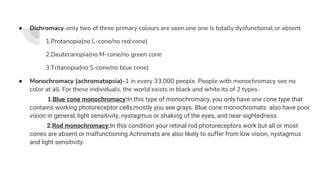
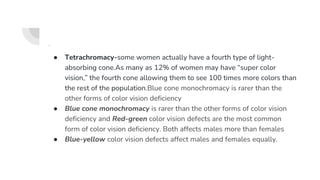
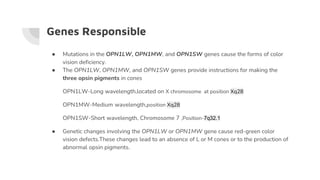
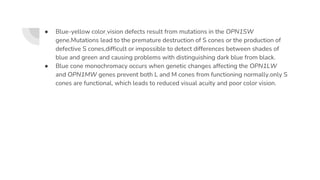
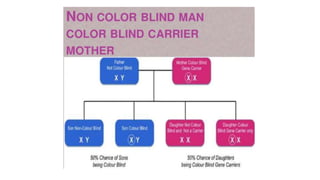
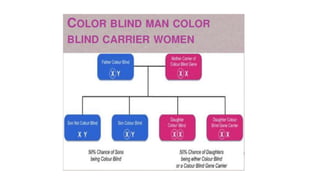
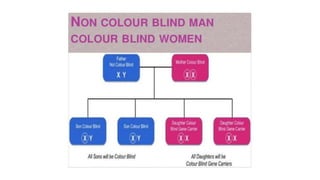
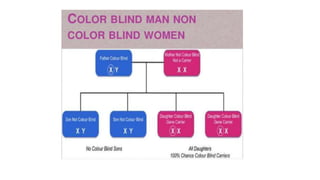
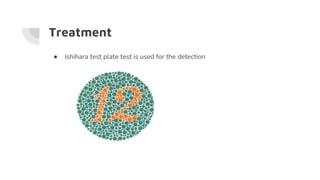
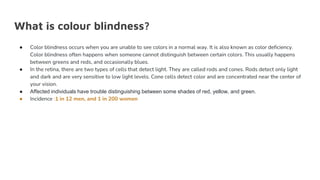
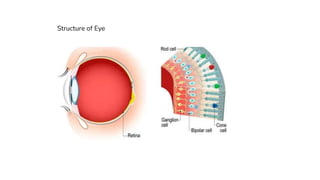
Color blindness, also known as color deficiency, occurs when someone has trouble distinguishing between certain colors, most commonly reds and greens. It is caused by mutations in genes responsible for the three types of cone cells in the retina that detect color. The most common types are red-green color blindness, which affects males more than females, and blue-yellow color blindness, which affects males and females equally. Color blindness can be inherited through X-linked recessive or autosomal dominant patterns or developed due to age, illness, chemicals, or eye trauma. It is detected using Ishihara color plate tests and in some cases treated with color filters.

![● There are three types of cones-
1.L cones-sense long wavelength (red light)
2. M cones-sense medium wavelength (green light)
3. S cones-sense shorter wavelength (blue light)
● Individuals who have all three types of cones working at full capacity are called
trichromats.Likewise, normal vision can be referred to as trichromacy.
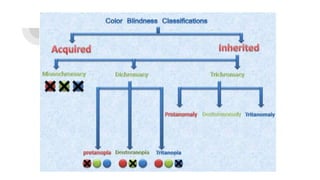
● Anomalous trichromacy-one colour is seen weakly
1.Protanomaly( L cone defect)- Red weak
2.Deuteranomaly (M cone defect)- Green weak [common]
3.Tritanomaly( S-cone defect)-Blue weak [rare]
Classification](https://image.slidesharecdn.com/colorblindness-220218055306/85/Color-blindness-5-320.jpg)