Philippine Ethnic Musical Instruments
Aerophoneis any musical instrument which produces sound primarily by causing a body of air to vibratewithout the use of strings or membranesand without the vibration of the instrument itself adding considerably to the sound.
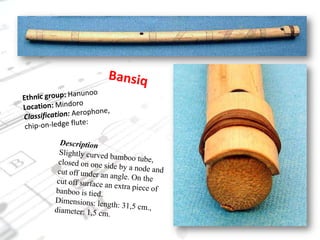
BansiqEthnic group: HanunooLocation: MindoroClassification:Aerophone, chip-on-ledge flute:DescriptionSlightly curved bamboo tube, closed on one side by a node and cut off under an angle. On the cut off surface an extra piece of banboo is tied.Dimensions: length: 31,5 cm., diameter: 1,5 cm.
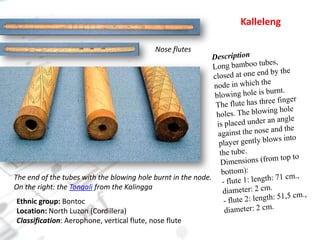
KallelengNose flutesDescriptionLong bamboo tubes, closed at one end by the node in which the blowing hole is burnt. The flute has three finger holes. The blowing hole is placed under an angle against the nose and the player gently blows into the tube.Dimensions (from top to bottom):- flute 1: length: 71 cm., diameter: 2 cm.- flute 2: length: 51,5 cm., diameter: 2 cm.The end of the tubes with the blowing hole burnt in the node.On the right: the Tongali from the KalinggaEthnic group: BontocLocation: North Luzon (Cordillera)Classification: Aerophone, vertical flute, nose flute
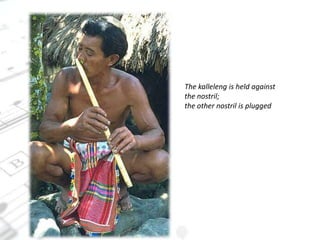
The kalleleng is held against the nostril;the other nostril is plugged
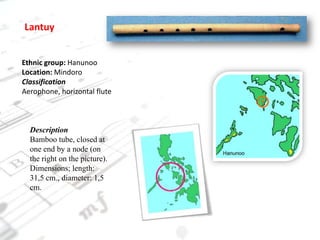
LantuyEthnic group: HanunooLocation: MindoroClassificationAerophone, horizontal fluteDescriptionBamboo tube, closed at one end by a node (on the right on the picture).Dimensions; length: 31,5 cm., diameter: 1,5 cm.
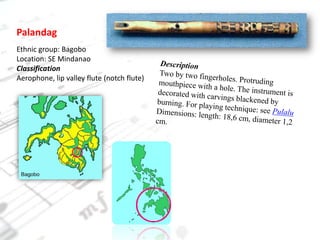
PalandagEthnic group: BagoboLocation: SE MindanaoClassificationAerophone, lip valley flute (notch flute)DescriptionTwo by two fingerholes. Protruding mouthpiece with a hole. The instrument is decorated with carvings blackened by burning. For playing technique: see PulaluDimensions: length: 18,6 cm, diameter 1,2 cm.
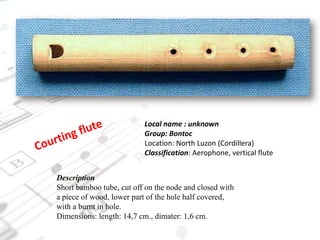
Local name : unknownGroup: BontocLocation: North Luzon (Cordillera)Classification: Aerophone, vertical fluteCourting fluteDescriptionShort bamboo tube, cut off on the node and closed with a piece of wood, lower part of the hole half covered, with a burnt in hole.Dimensions: length: 14,7 cm., dimater: 1,6 cm.
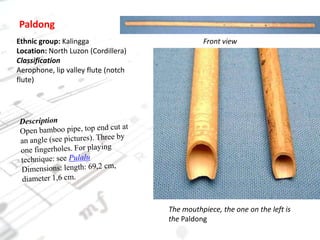
PaldongFront viewEthnic group: KalinggaLocation: North Luzon (Cordillera)ClassificationAerophone, lip valley flute (notch flute)DescriptionOpen bamboo pipe, top end cut at an angle (see pictures). Three by one fingerholes. For playing technique: see PulaluDimensions: length: 69,2 cm, diameter 1,6 cm.The mouthpiece, the one on the left is the Paldong
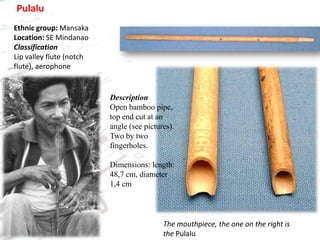
PulaluEthnic group: MansakaLocation: SE MindanaoClassificationLip valley flute (notch flute), aerophoneDescriptionOpen bamboo pipe, top end cut at an angle (see pictures). Two by two fingerholes.Dimensions: length: 48,7 cm, diameter 1,4 cmThe mouthpiece, the one on the right is the Pulalu
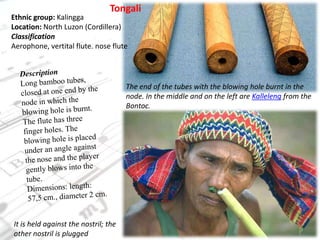
TongaliEthnic group: KalinggaLocation: North Luzon (Cordillera)ClassificationAerophone, vertital flute. nose fluteDescriptionLong bamboo tubes, closed at one end by the node in which the blowing hole is burnt. The flute has three finger holes. The blowing hole is placed under an angle against the nose and the player gently blows into the tube.Dimensions: length: 57,5 cm., diameter 2 cm.The end of the tubes with the blowing hole burnt in the node. In the middle and on the left are Kalleleng from the Bontoc.It is held against the nostril; the other nostril is plugged
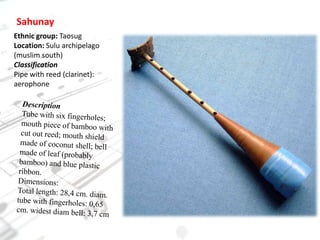
SahunayEthnic group: TaosugLocation: Sulu archipelago (muslim south)ClassificationPipe with reed (clarinet): aerophoneDescriptionTube with six fingerholes; mouth piece of bamboo with cut out reed; mouth shield made of coconut shell; bell made of leaf (probably bamboo) and blue plastic ribbon.Dimensions:Total length: 28,4 cm. diam. tube with fingerholes: 0,65 cm. widest diam bell: 3,7 cm
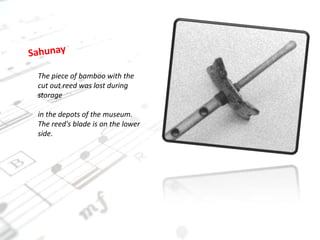
SahunayThe piece of bamboo with the cut out reed was lost during storagein the depots of the museum. The reed's blade is on the lower side.
ChordophoneA chordophone is any musical instrument which makes sound by way of a vibrating string or strings stretched between two points
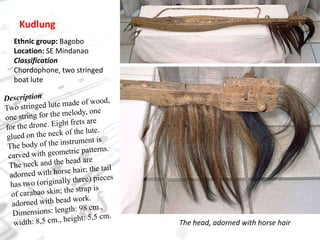
KudlungEthnic group: BagoboLocation: SE MindanaoClassificationChordophone, two stringed boat luteDescriptionTwo stringed lute made of wood, one string for the melody, one for the drone. Eight frets are glued on the neck of the lute. The body of the instrument is carved with geometric patterns. The neck and the head are adorned with horse hair; the tail has two (originally three) pieces of carabao skin; the strap is adorned with bead work.Dimensions: length: 98 cm., width: 8,5 cm., height: 5,5 cm.The head, adorned with horse hair
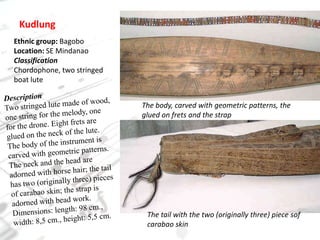
KudlungEthnic group: BagoboLocation: SE MindanaoClassificationChordophone, two stringed boat luteDescriptionTwo stringed lute made of wood, one string for the melody, one for the drone. Eight frets are glued on the neck of the lute. The body of the instrument is carved with geometric patterns. The neck and the head are adorned with horse hair; the tail has two (originally three) pieces of carabao skin; the strap is adorned with bead work.Dimensions: length: 98 cm., width: 8,5 cm., height: 5,5 cm.The body, carved with geometric patterns, the glued on frets and the strapThe tail with the two (originally three) piece sofcarabao skin
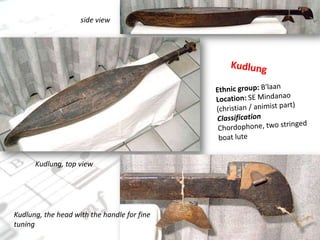
side viewKudlungEthnic group: B'laanLocation: SE Mindanao (christian / animist part)ClassificationChordophone, two stringed boat luteKudlung, top viewKudlung, the head with the handle for fine tuning
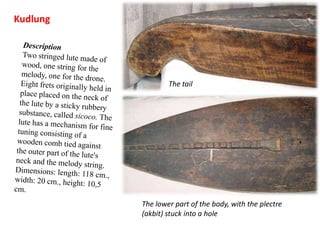
KudlungDescriptionTwo stringed lute made of wood, one string for the melody, one for the drone. Eight frets originally held in place placed on the neck of the lute by a sticky rubbery substance, called sicoco. The lute has a mechanism for fine tuning consisting of a wooden comb tied against the outer part of the lute's neck and the melody string.Dimensions: length: 118 cm., width: 20 cm., height: 10,5 cm.The tailThe lower part of the body, with the plectre (akbit) stuck into a hole
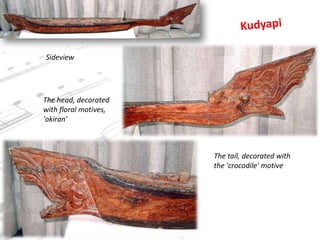
KudyapiSideviewThe head, decorated with floral motives, 'okiran'The tail, decorated with the 'crocodile' motive
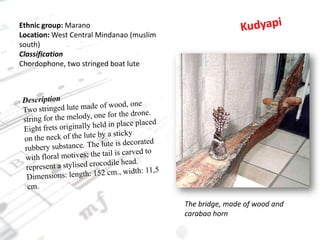
KudyapiEthnic group: MaranoLocation: West Central Mindanao (muslim south)ClassificationChordophone, two stringed boat luteDescriptionTwo stringed lute made of wood, one string for the melody, one for the drone. Eight frets originally held in place placed on the neck of the lute by a sticky rubbery substance. The lute is decorated with floral motives; the tail is carved to represent a stylised crocodile head.Dimensions: length: 152 cm., width: 11,5 cm.The bridge, made of wood and carabao horn
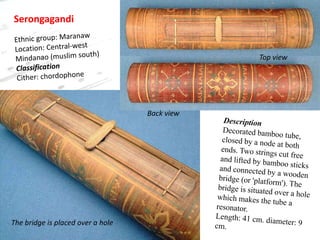
SerongagandiEthnic group: MaranawLocation: Central-west Mindanao (muslim south)ClassificationCither: chordophoneTop view Back viewDescriptionDecorated bamboo tube, closed by a node at both ends. Two strings cut free and lifted by bamboo sticks and connected by a wooden bridge (or 'platform'). The bridge is situated over a hole which makes the tube a resonator.Length: 41 cm. diameter: 9 cm.The bridge is placed over a hole
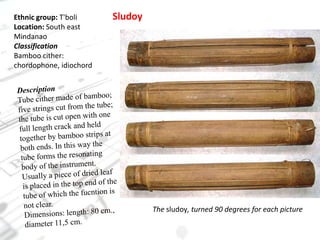
SludoyEthnic group: T'boliLocation: South east MindanaoClassificationBamboo cither: chordophone, idiochordDescriptionTube cither made of bamboo; five strings cut from the tube; the tube is cut open with one full length crack and held together by bamboo strips at both ends. In this way the tube forms the resonating body of the instrument. Usually a piece of dried leaf is placed in the top end of the tube of which the fucntion is not clear.Dimensions: length: 80 cm., diameter 11,5 cm.The sludoy, turned 90 degrees for each picture
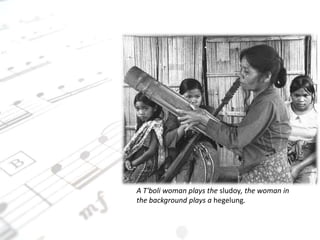
A T'boli woman plays the sludoy, the woman in the background plays a hegelung.
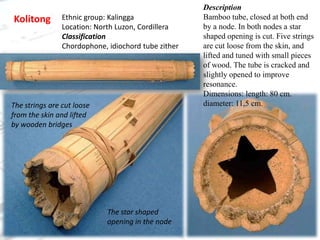
DescriptionBamboo tube, closed at both end by a node. In both nodes a star shaped opening is cut. Five strings are cut loose from the skin, and lifted and tuned with small pieces of wood. The tube is cracked and slightly opened to improve resonance.Dimensions: length: 80 cm. diameter: 11,5 cm.KolitongEthnic group: KalinggaLocation: North Luzon, CordilleraClassificationChordophone, idiochord tube zitherThe strings are cut loose from the skin and lifted by wooden bridgesThe star shaped opening in the node
IdiophoneAn idiophone is any musical instrument which creates sound primarily by way of the instrument's vibrating, without the use of strings or membranesMost percussion instruments which are not drums are idiophones.
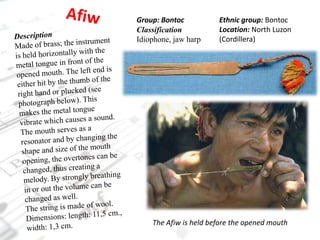
AfiwGroup: BontocClassificationIdiophone, jaw harpEthnic group: BontocLocation: North Luzon (Cordillera)DescriptionMade of brass; the instrument is held horizontally with the metal tongue in front of the opened mouth. The left end is either hit by the thumb of the right hand or plucked (see photograph below). This makes the metal tongue vibrate which causes a sound. The mouth serves as a resonator and by changing the shape and size of the mouth opening, the overtones can be changed, thus creating a melody. By strongly breathing in or out the volume can be changed as well.The string is made of wool.Dimensions: length: 11,5 cm., width: 1,3 cm.The Afiw is held before the opened mouth
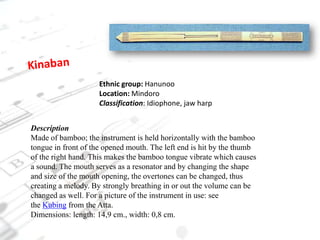
KinabanEthnic group: HanunooLocation: MindoroClassification: Idiophone, jaw harpDescriptionMade of bamboo; the instrument is held horizontally with the bamboo tongue in front of the opened mouth. The left end is hit by the thumb of the right hand. This makes the bamboo tongue vibrate which causes a sound. The mouth serves as a resonator and by changing the shape and size of the mouth opening, the overtones can be changed, thus creating a melody. By strongly breathing in or out the volume can be changed as well. For a picture of the instrument in use: see the Kubing from the Atta.Dimensions: length: 14,9 cm., width: 0,8 cm.
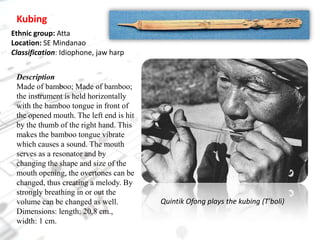
KubingEthnic group: AttaLocation: SE MindanaoClassification: Idiophone, jaw harpDescriptionMade of bamboo; Made of bamboo; the instrument is held horizontally with the bamboo tongue in front of the opened mouth. The left end is hit by the thumb of the right hand. This makes the bamboo tongue vibrate which causes a sound. The mouth serves as a resonator and by changing the shape and size of the mouth opening, the overtones can be changed, thus creating a melody. By strongly breathing in or out the volume can be changed as well.Dimensions: length: 20,8 cm., width: 1 cm.QuintikOfong plays the kubing (T'boli)
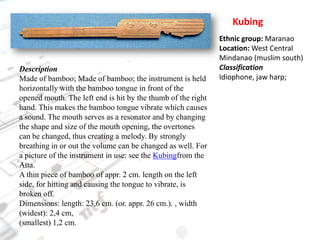
KubingEthnic group: MaranaoLocation: West Central Mindanao (muslim south)ClassificationIdiophone, jaw harp;DescriptionMade of bamboo; Made of bamboo; the instrument is held horizontally with the bamboo tongue in front of the opened mouth. The left end is hit by the thumb of the right hand. This makes the bamboo tongue vibrate which causes a sound. The mouth serves as a resonator and by changing the shape and size of the mouth opening, the overtones can be changed, thus creating a melody. By strongly breathing in or out the volume can be changed as well. For a picture of the instrument in use: see the Kubingfrom the Atta.A thin piece of bamboo of appr. 2 cm. length on the left side, for hitting and causing the tongue to vibrate, is broken off.Dimensions: length: 23,6 cm. (or. appr. 26 cm.). , width (widest): 2,4 cm,(smallest) 1,2 cm.
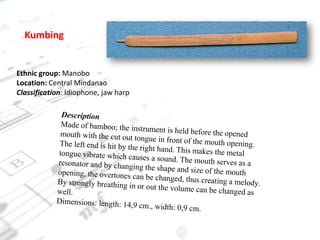
KumbingEthnic group: ManoboLocation: Central MindanaoClassification: Idiophone, jaw harpDescriptionMade of bamboo; the instrument is held before the opened mouth with the cut out tongue in front of the mouth opening. The left end is hit by the right hand. This makes the metal tongue vibrate which causes a sound. The mouth serves as a resonator and by changing the shape and size of the mouth opening, the overtones can be changed, thus creating a melody. By strongly breathing in or out the volume can be changed as well.Dimensions: length: 14,9 cm., width: 0,9 cm.
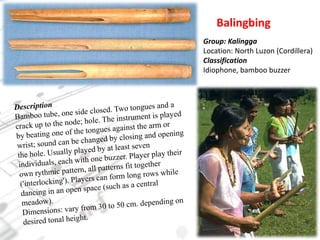
BalingbingGroup: KalinggaLocation: North Luzon (Cordillera)ClassificationIdiophone, bamboo buzzerDescriptionBamboo tube, one side closed. Two tongues and a crack up to the node; hole. The instrument is played by beating one of the tongues against the arm or wrist; sound can be changed by closing and opening the hole. Usually played by at least seven individuals, each with one buzzer. Player play their own rythmic pattern, all patterns fit together ('interlocking'). Players can form long rows while dancing in an open space (such as a central meadow).Dimensions: vary from 30 to 50 cm. depending on desired tonal height.
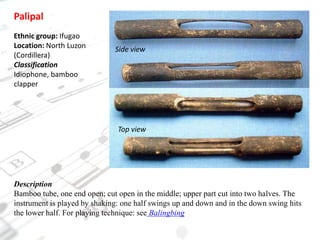
PalipalEthnic group: IfugaoLocation: North Luzon (Cordillera)ClassificationIdiophone, bamboo clapperSide viewTop viewDescriptionBamboo tube, one end open; cut open in the middle; upper part cut into two halves. The instrument is played by shaking: one half swings up and down and in the down swing hits the lower half. For playing technique: see Balingbing
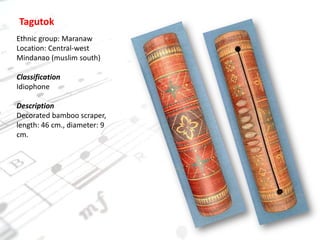
TagutokEthnic group: MaranawLocation: Central-west Mindanao (muslim south)ClassificationIdiophoneDescriptionDecorated bamboo scraper, length: 46 cm., diameter: 9 cm.
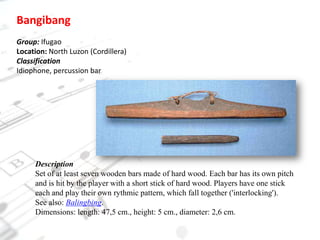
BangibangGroup:IfugaoLocation: North Luzon (Cordillera)ClassificationIdiophone, percussion barDescriptionSet of at least seven wooden bars made of hard wood. Each bar has its own pitch and is hit by the player with a short stick of hard wood. Players have one stick each and play their own rythmic pattern, which fall together ('interlocking').See also: Balingbing.Dimensions: length: 47,5 cm., height: 5 cm., diameter: 2,6 cm.
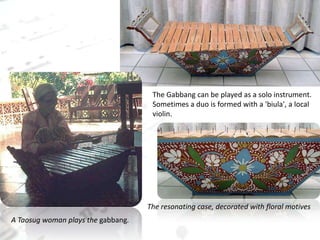
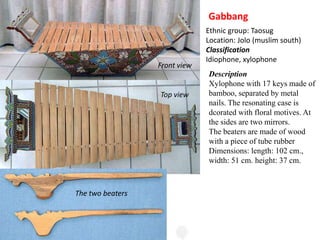
GabbangEthnic group: TaosugLocation: Jolo (muslim south)ClassificationIdiophone, xylophoneFront viewDescriptionXylophone with 17 keys made of bamboo, separated by metal nails. The resonating case is dcorated with floral motives. At the sides are two mirrors.The beaters are made of wood with a piece of tube rubberDimensions: length: 102 cm., width: 51 cm. height: 37 cm.Top viewThe two beaters
The Gabbang can be played as a solo instrument. Sometimes a duo is formed with a 'biula', a local violin.The resonating case, decorated with floral motivesA Taosug woman plays the gabbang.
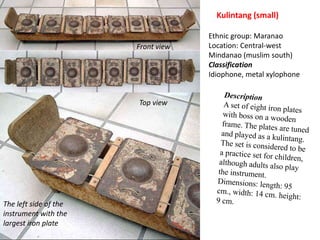
Kulintang (small)Ethnic group: MaranaoLocation: Central-west Mindanao (muslim south)ClassificationIdiophone, metal xylophoneFront viewDescriptionA set of eight iron plates with boss on a wooden frame. The plates are tuned and played as a kulintang. The set is considered to be a practice set for children, although adults also play the instrument.Dimensions: length: 95 cm., width: 14 cm. height: 9 cm.Top viewThe left side of the instrument with the largest iron plate
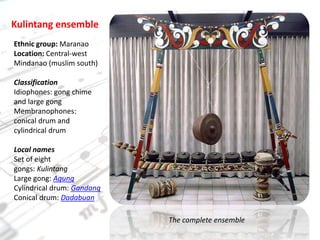
Kulintang ensembleEthnic group: MaranaoLocation: Central-west Mindanao (muslim south)ClassificationIdiophones: gong chime and large gongMembranophones: conical drum and cylindrical drumLocal namesSet of eight gongs: KulintangLarge gong: AgungCylindrical drum: GandangConical drum: DadabuanThe complete ensemble
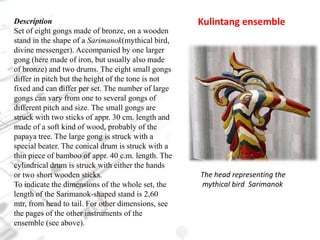
DescriptionSet of eight gongs made of bronze, on a wooden stand in the shape of a Sarimanok(mythical bird, divine messenger). Accompanied by one larger gong (here made of iron, but usually also made of bronze) and two drums. The eight small gongs differ in pitch but the height of the tone is not fixed and can differ per set. The number of large gongs can vary from one to several gongs of different pitch and size. The small gongs are struck with two sticks of appr. 30 cm. length and made of a soft kind of wood, probably of the papaya tree. The large gong is struck with a special beater. The conical drum is struck with a thin piece of bamboo of appr. 40 c.m. length. The cylindrical drum is struck with either the hands or two short wooden sticks.To indicate the dimensions of the whole set, the length of the Sarimanok-shaped stand is 2,60 mtr, from head to tail. For other dimensions, see the pages of the other instruments of the ensemble (see above).Kulintang ensembleThe head representing the         mythical bird  Sarimanok
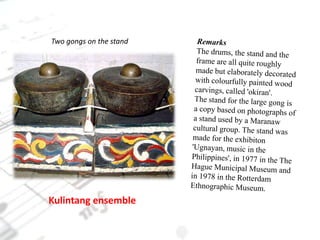
Two gongs on the standRemarksThe drums, the stand and the frame are all quite roughly made but elaborately decorated with colourfully painted wood carvings, called 'okiran'.The stand for the large gong is a copy based on photographs of a stand used by a Maranaw cultural group. The stand was made for the exhibiton 'Ugnayan, music in the Philippines', in 1977 in the The Hague Municipal Museum and in 1978 in the Rotterdam Ethnographic Museum.Kulintang ensemble
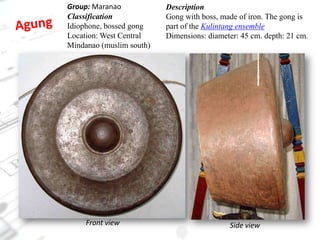
Group: MaranaoClassificationIdiophone, bossed gongLocation: West Central Mindanao (muslim south)DescriptionGong with boss, made of iron. The gong is part of the Kulintang ensembleDimensions: diameter: 45 cm. depth: 21 cm.AgungFront viewSide view
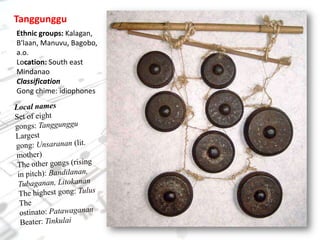
TanggungguEthnic groups: Kalagan, B'laan, Manuvu, Bagobo, a.o.Location: South east MindanaoClassificationGong chime: idiophonesLocal namesSet of eight gongs: TanggungguLargest gong: Unsaranan (lit. mother)The other gongs (rising in pitch): Bandilanan, Tubaganan, LitokananThe highest gong: TulusThe ostinato: PatawagananBeater: Tinkulai
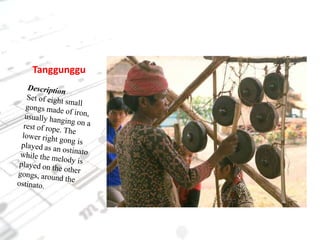
TanggungguDescriptionSet of eight small gongs made of iron, usually hanging on a rest of rope. The lower right gong is played as an ostinato while the melody is played on the other gongs, around the ostinato.
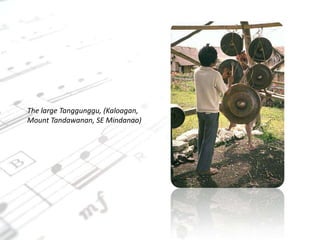
The large Tanggunggu, (Kaloagan,Mount Tandawanan, SE Mindanao)
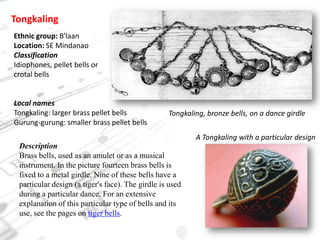
TongkalingEthnic group: B'laanLocation: SE MindanaoClassificationIdiophones, pellet bells or crotal bellsLocal namesTongkaling: larger brass pellet bellsGurung-gurung: smaller brass pellet bellsTongkaling, bronze bells, on a dance girdleA Tongkaling with a particular designDescriptionBrass bells, used as an amulet or as a musical instrument. In the picture fourteen brass bells is fixed to a metal girdle. Nine of these bells have a particular design (a tiger's face). The girdle is used during a particular dance. For an extensive explanation of this particular type of bells and its use, see the pages on tiger bells.
MembranophoneA membranophone is any musical instrument which produces sound primarily by way of a vibrating stretched membrane.Most membranophones are drums
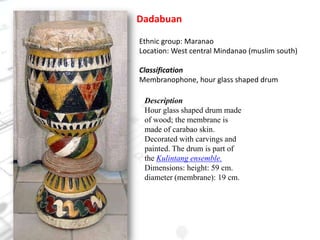
DadabuanEthnic group: MaranaoLocation: West central Mindanao (muslim south)ClassificationMembranophone, hour glass shaped drumDescriptionHour glass shaped drum made of wood; the membrane is made of carabao skin. Decorated with carvings and painted. The drum is part of the Kulintang ensemble.Dimensions: height: 59 cm. diameter (membrane): 19 cm.
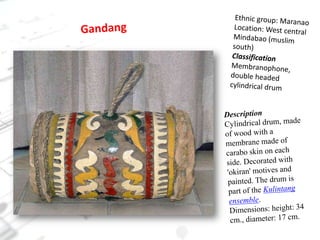
Ethnic group: MaranaoLocation: West central Mindabao (muslim south)ClassificationMembranophone, double headed cylindrical drumGandangDescriptionCylindrical drum, made of wood with a membrane made of carabo skin on each side. Decorated with 'okiran' motives and painted. The drum is part of the Kulintang ensemble.Dimensions: height: 34 cm., diameter: 17 cm.
Prepared by: JC de EgurrolaSource: Kipas Gallery: Home of traditional art and musicUrl: http://www.kipas.nl/

Philippine Ethnic Musical Instruments

  • 1.
  • 2.
    Aerophoneis any musicalinstrument which produces sound primarily by causing a body of air to vibratewithout the use of strings or membranesand without the vibration of the instrument itself adding considerably to the sound.
  • 3.
    BansiqEthnic group: HanunooLocation:MindoroClassification:Aerophone, chip-on-ledge flute:DescriptionSlightly curved bamboo tube, closed on one side by a node and cut off under an angle. On the cut off surface an extra piece of banboo is tied.Dimensions: length: 31,5 cm., diameter: 1,5 cm.
  • 4.
    KallelengNose flutesDescriptionLong bambootubes, closed at one end by the node in which the blowing hole is burnt. The flute has three finger holes. The blowing hole is placed under an angle against the nose and the player gently blows into the tube.Dimensions (from top to bottom):- flute 1: length: 71 cm., diameter: 2 cm.- flute 2: length: 51,5 cm., diameter: 2 cm.The end of the tubes with the blowing hole burnt in the node.On the right: the Tongali from the KalinggaEthnic group: BontocLocation: North Luzon (Cordillera)Classification: Aerophone, vertical flute, nose flute
  • 5.
    The kalleleng isheld against the nostril;the other nostril is plugged
  • 6.
    LantuyEthnic group: HanunooLocation:MindoroClassificationAerophone, horizontal fluteDescriptionBamboo tube, closed at one end by a node (on the right on the picture).Dimensions; length: 31,5 cm., diameter: 1,5 cm.
  • 7.
    PalandagEthnic group: BagoboLocation:SE MindanaoClassificationAerophone, lip valley flute (notch flute)DescriptionTwo by two fingerholes. Protruding mouthpiece with a hole. The instrument is decorated with carvings blackened by burning. For playing technique: see PulaluDimensions: length: 18,6 cm, diameter 1,2 cm.
  • 8.
    Local name :unknownGroup: BontocLocation: North Luzon (Cordillera)Classification: Aerophone, vertical fluteCourting fluteDescriptionShort bamboo tube, cut off on the node and closed with a piece of wood, lower part of the hole half covered, with a burnt in hole.Dimensions: length: 14,7 cm., dimater: 1,6 cm.
  • 9.
    PaldongFront viewEthnic group:KalinggaLocation: North Luzon (Cordillera)ClassificationAerophone, lip valley flute (notch flute)DescriptionOpen bamboo pipe, top end cut at an angle (see pictures). Three by one fingerholes. For playing technique: see PulaluDimensions: length: 69,2 cm, diameter 1,6 cm.The mouthpiece, the one on the left is the Paldong
  • 10.
    PulaluEthnic group: MansakaLocation:SE MindanaoClassificationLip valley flute (notch flute), aerophoneDescriptionOpen bamboo pipe, top end cut at an angle (see pictures). Two by two fingerholes.Dimensions: length: 48,7 cm, diameter 1,4 cmThe mouthpiece, the one on the right is the Pulalu
  • 11.
    TongaliEthnic group: KalinggaLocation:North Luzon (Cordillera)ClassificationAerophone, vertital flute. nose fluteDescriptionLong bamboo tubes, closed at one end by the node in which the blowing hole is burnt. The flute has three finger holes. The blowing hole is placed under an angle against the nose and the player gently blows into the tube.Dimensions: length: 57,5 cm., diameter 2 cm.The end of the tubes with the blowing hole burnt in the node. In the middle and on the left are Kalleleng from the Bontoc.It is held against the nostril; the other nostril is plugged
  • 12.
    SahunayEthnic group: TaosugLocation:Sulu archipelago (muslim south)ClassificationPipe with reed (clarinet): aerophoneDescriptionTube with six fingerholes; mouth piece of bamboo with cut out reed; mouth shield made of coconut shell; bell made of leaf (probably bamboo) and blue plastic ribbon.Dimensions:Total length: 28,4 cm. diam. tube with fingerholes: 0,65 cm. widest diam bell: 3,7 cm
  • 13.
    SahunayThe piece ofbamboo with the cut out reed was lost during storagein the depots of the museum. The reed's blade is on the lower side.
  • 14.
    ChordophoneA chordophone isany musical instrument which makes sound by way of a vibrating string or strings stretched between two points
  • 15.
    KudlungEthnic group: BagoboLocation:SE MindanaoClassificationChordophone, two stringed boat luteDescriptionTwo stringed lute made of wood, one string for the melody, one for the drone. Eight frets are glued on the neck of the lute. The body of the instrument is carved with geometric patterns. The neck and the head are adorned with horse hair; the tail has two (originally three) pieces of carabao skin; the strap is adorned with bead work.Dimensions: length: 98 cm., width: 8,5 cm., height: 5,5 cm.The head, adorned with horse hair
  • 16.
    KudlungEthnic group: BagoboLocation:SE MindanaoClassificationChordophone, two stringed boat luteDescriptionTwo stringed lute made of wood, one string for the melody, one for the drone. Eight frets are glued on the neck of the lute. The body of the instrument is carved with geometric patterns. The neck and the head are adorned with horse hair; the tail has two (originally three) pieces of carabao skin; the strap is adorned with bead work.Dimensions: length: 98 cm., width: 8,5 cm., height: 5,5 cm.The body, carved with geometric patterns, the glued on frets and the strapThe tail with the two (originally three) piece sofcarabao skin
  • 17.
    side viewKudlungEthnic group:B'laanLocation: SE Mindanao (christian / animist part)ClassificationChordophone, two stringed boat luteKudlung, top viewKudlung, the head with the handle for fine tuning
  • 18.
    KudlungDescriptionTwo stringed lutemade of wood, one string for the melody, one for the drone. Eight frets originally held in place placed on the neck of the lute by a sticky rubbery substance, called sicoco. The lute has a mechanism for fine tuning consisting of a wooden comb tied against the outer part of the lute's neck and the melody string.Dimensions: length: 118 cm., width: 20 cm., height: 10,5 cm.The tailThe lower part of the body, with the plectre (akbit) stuck into a hole
  • 19.
    KudyapiSideviewThe head, decoratedwith floral motives, 'okiran'The tail, decorated with the 'crocodile' motive
  • 20.
    KudyapiEthnic group: MaranoLocation:West Central Mindanao (muslim south)ClassificationChordophone, two stringed boat luteDescriptionTwo stringed lute made of wood, one string for the melody, one for the drone. Eight frets originally held in place placed on the neck of the lute by a sticky rubbery substance. The lute is decorated with floral motives; the tail is carved to represent a stylised crocodile head.Dimensions: length: 152 cm., width: 11,5 cm.The bridge, made of wood and carabao horn
  • 21.
    SerongagandiEthnic group: MaranawLocation: Central-westMindanao (muslim south)ClassificationCither: chordophoneTop view Back viewDescriptionDecorated bamboo tube, closed by a node at both ends. Two strings cut free and lifted by bamboo sticks and connected by a wooden bridge (or 'platform'). The bridge is situated over a hole which makes the tube a resonator.Length: 41 cm. diameter: 9 cm.The bridge is placed over a hole
  • 22.
    SludoyEthnic group: T'boliLocation:South east MindanaoClassificationBamboo cither: chordophone, idiochordDescriptionTube cither made of bamboo; five strings cut from the tube; the tube is cut open with one full length crack and held together by bamboo strips at both ends. In this way the tube forms the resonating body of the instrument. Usually a piece of dried leaf is placed in the top end of the tube of which the fucntion is not clear.Dimensions: length: 80 cm., diameter 11,5 cm.The sludoy, turned 90 degrees for each picture
  • 23.
    A T'boli womanplays the sludoy, the woman in the background plays a hegelung.
  • 24.
    DescriptionBamboo tube, closedat both end by a node. In both nodes a star shaped opening is cut. Five strings are cut loose from the skin, and lifted and tuned with small pieces of wood. The tube is cracked and slightly opened to improve resonance.Dimensions: length: 80 cm. diameter: 11,5 cm.KolitongEthnic group: KalinggaLocation: North Luzon, CordilleraClassificationChordophone, idiochord tube zitherThe strings are cut loose from the skin and lifted by wooden bridgesThe star shaped opening in the node
  • 25.
    IdiophoneAn idiophone isany musical instrument which creates sound primarily by way of the instrument's vibrating, without the use of strings or membranesMost percussion instruments which are not drums are idiophones.
  • 26.
    AfiwGroup: BontocClassificationIdiophone, jawharpEthnic group: BontocLocation: North Luzon (Cordillera)DescriptionMade of brass; the instrument is held horizontally with the metal tongue in front of the opened mouth. The left end is either hit by the thumb of the right hand or plucked (see photograph below). This makes the metal tongue vibrate which causes a sound. The mouth serves as a resonator and by changing the shape and size of the mouth opening, the overtones can be changed, thus creating a melody. By strongly breathing in or out the volume can be changed as well.The string is made of wool.Dimensions: length: 11,5 cm., width: 1,3 cm.The Afiw is held before the opened mouth
  • 27.
    KinabanEthnic group: HanunooLocation:MindoroClassification: Idiophone, jaw harpDescriptionMade of bamboo; the instrument is held horizontally with the bamboo tongue in front of the opened mouth. The left end is hit by the thumb of the right hand. This makes the bamboo tongue vibrate which causes a sound. The mouth serves as a resonator and by changing the shape and size of the mouth opening, the overtones can be changed, thus creating a melody. By strongly breathing in or out the volume can be changed as well. For a picture of the instrument in use: see the Kubing from the Atta.Dimensions: length: 14,9 cm., width: 0,8 cm.
  • 28.
    KubingEthnic group: AttaLocation:SE MindanaoClassification: Idiophone, jaw harpDescriptionMade of bamboo; Made of bamboo; the instrument is held horizontally with the bamboo tongue in front of the opened mouth. The left end is hit by the thumb of the right hand. This makes the bamboo tongue vibrate which causes a sound. The mouth serves as a resonator and by changing the shape and size of the mouth opening, the overtones can be changed, thus creating a melody. By strongly breathing in or out the volume can be changed as well.Dimensions: length: 20,8 cm., width: 1 cm.QuintikOfong plays the kubing (T'boli)
  • 29.
    KubingEthnic group: MaranaoLocation:West Central Mindanao (muslim south)ClassificationIdiophone, jaw harp;DescriptionMade of bamboo; Made of bamboo; the instrument is held horizontally with the bamboo tongue in front of the opened mouth. The left end is hit by the thumb of the right hand. This makes the bamboo tongue vibrate which causes a sound. The mouth serves as a resonator and by changing the shape and size of the mouth opening, the overtones can be changed, thus creating a melody. By strongly breathing in or out the volume can be changed as well. For a picture of the instrument in use: see the Kubingfrom the Atta.A thin piece of bamboo of appr. 2 cm. length on the left side, for hitting and causing the tongue to vibrate, is broken off.Dimensions: length: 23,6 cm. (or. appr. 26 cm.). , width (widest): 2,4 cm,(smallest) 1,2 cm.
  • 30.
    KumbingEthnic group: ManoboLocation:Central MindanaoClassification: Idiophone, jaw harpDescriptionMade of bamboo; the instrument is held before the opened mouth with the cut out tongue in front of the mouth opening. The left end is hit by the right hand. This makes the metal tongue vibrate which causes a sound. The mouth serves as a resonator and by changing the shape and size of the mouth opening, the overtones can be changed, thus creating a melody. By strongly breathing in or out the volume can be changed as well.Dimensions: length: 14,9 cm., width: 0,9 cm.
  • 31.
    BalingbingGroup: KalinggaLocation: NorthLuzon (Cordillera)ClassificationIdiophone, bamboo buzzerDescriptionBamboo tube, one side closed. Two tongues and a crack up to the node; hole. The instrument is played by beating one of the tongues against the arm or wrist; sound can be changed by closing and opening the hole. Usually played by at least seven individuals, each with one buzzer. Player play their own rythmic pattern, all patterns fit together ('interlocking'). Players can form long rows while dancing in an open space (such as a central meadow).Dimensions: vary from 30 to 50 cm. depending on desired tonal height.
  • 32.
    PalipalEthnic group: IfugaoLocation:North Luzon (Cordillera)ClassificationIdiophone, bamboo clapperSide viewTop viewDescriptionBamboo tube, one end open; cut open in the middle; upper part cut into two halves. The instrument is played by shaking: one half swings up and down and in the down swing hits the lower half. For playing technique: see Balingbing
  • 33.
    TagutokEthnic group: MaranawLocation: Central-westMindanao (muslim south)ClassificationIdiophoneDescriptionDecorated bamboo scraper, length: 46 cm., diameter: 9 cm.
  • 34.
    BangibangGroup:IfugaoLocation: North Luzon(Cordillera)ClassificationIdiophone, percussion barDescriptionSet of at least seven wooden bars made of hard wood. Each bar has its own pitch and is hit by the player with a short stick of hard wood. Players have one stick each and play their own rythmic pattern, which fall together ('interlocking').See also: Balingbing.Dimensions: length: 47,5 cm., height: 5 cm., diameter: 2,6 cm.
  • 35.
    GabbangEthnic group: TaosugLocation:Jolo (muslim south)ClassificationIdiophone, xylophoneFront viewDescriptionXylophone with 17 keys made of bamboo, separated by metal nails. The resonating case is dcorated with floral motives. At the sides are two mirrors.The beaters are made of wood with a piece of tube rubberDimensions: length: 102 cm., width: 51 cm. height: 37 cm.Top viewThe two beaters
  • 36.
    The Gabbang canbe played as a solo instrument. Sometimes a duo is formed with a 'biula', a local violin.The resonating case, decorated with floral motivesA Taosug woman plays the gabbang.
  • 37.
    Kulintang (small)Ethnic group:MaranaoLocation: Central-west Mindanao (muslim south)ClassificationIdiophone, metal xylophoneFront viewDescriptionA set of eight iron plates with boss on a wooden frame. The plates are tuned and played as a kulintang. The set is considered to be a practice set for children, although adults also play the instrument.Dimensions: length: 95 cm., width: 14 cm. height: 9 cm.Top viewThe left side of the instrument with the largest iron plate
  • 38.
    Kulintang ensembleEthnic group:MaranaoLocation: Central-west Mindanao (muslim south)ClassificationIdiophones: gong chime and large gongMembranophones: conical drum and cylindrical drumLocal namesSet of eight gongs: KulintangLarge gong: AgungCylindrical drum: GandangConical drum: DadabuanThe complete ensemble
  • 39.
    DescriptionSet of eightgongs made of bronze, on a wooden stand in the shape of a Sarimanok(mythical bird, divine messenger). Accompanied by one larger gong (here made of iron, but usually also made of bronze) and two drums. The eight small gongs differ in pitch but the height of the tone is not fixed and can differ per set. The number of large gongs can vary from one to several gongs of different pitch and size. The small gongs are struck with two sticks of appr. 30 cm. length and made of a soft kind of wood, probably of the papaya tree. The large gong is struck with a special beater. The conical drum is struck with a thin piece of bamboo of appr. 40 c.m. length. The cylindrical drum is struck with either the hands or two short wooden sticks.To indicate the dimensions of the whole set, the length of the Sarimanok-shaped stand is 2,60 mtr, from head to tail. For other dimensions, see the pages of the other instruments of the ensemble (see above).Kulintang ensembleThe head representing the mythical bird Sarimanok
  • 40.
    Two gongs onthe standRemarksThe drums, the stand and the frame are all quite roughly made but elaborately decorated with colourfully painted wood carvings, called 'okiran'.The stand for the large gong is a copy based on photographs of a stand used by a Maranaw cultural group. The stand was made for the exhibiton 'Ugnayan, music in the Philippines', in 1977 in the The Hague Municipal Museum and in 1978 in the Rotterdam Ethnographic Museum.Kulintang ensemble
  • 41.
    Group: MaranaoClassificationIdiophone, bossedgongLocation: West Central Mindanao (muslim south)DescriptionGong with boss, made of iron. The gong is part of the Kulintang ensembleDimensions: diameter: 45 cm. depth: 21 cm.AgungFront viewSide view
  • 42.
    TanggungguEthnic groups: Kalagan,B'laan, Manuvu, Bagobo, a.o.Location: South east MindanaoClassificationGong chime: idiophonesLocal namesSet of eight gongs: TanggungguLargest gong: Unsaranan (lit. mother)The other gongs (rising in pitch): Bandilanan, Tubaganan, LitokananThe highest gong: TulusThe ostinato: PatawagananBeater: Tinkulai
  • 43.
    TanggungguDescriptionSet of eightsmall gongs made of iron, usually hanging on a rest of rope. The lower right gong is played as an ostinato while the melody is played on the other gongs, around the ostinato.
  • 44.
    The large Tanggunggu,(Kaloagan,Mount Tandawanan, SE Mindanao)
  • 45.
    TongkalingEthnic group: B'laanLocation:SE MindanaoClassificationIdiophones, pellet bells or crotal bellsLocal namesTongkaling: larger brass pellet bellsGurung-gurung: smaller brass pellet bellsTongkaling, bronze bells, on a dance girdleA Tongkaling with a particular designDescriptionBrass bells, used as an amulet or as a musical instrument. In the picture fourteen brass bells is fixed to a metal girdle. Nine of these bells have a particular design (a tiger's face). The girdle is used during a particular dance. For an extensive explanation of this particular type of bells and its use, see the pages on tiger bells.
  • 46.
    MembranophoneA membranophone isany musical instrument which produces sound primarily by way of a vibrating stretched membrane.Most membranophones are drums
  • 47.
    DadabuanEthnic group: MaranaoLocation:West central Mindanao (muslim south)ClassificationMembranophone, hour glass shaped drumDescriptionHour glass shaped drum made of wood; the membrane is made of carabao skin. Decorated with carvings and painted. The drum is part of the Kulintang ensemble.Dimensions: height: 59 cm. diameter (membrane): 19 cm.
  • 48.
    Ethnic group: MaranaoLocation:West central Mindabao (muslim south)ClassificationMembranophone, double headed cylindrical drumGandangDescriptionCylindrical drum, made of wood with a membrane made of carabo skin on each side. Decorated with 'okiran' motives and painted. The drum is part of the Kulintang ensemble.Dimensions: height: 34 cm., diameter: 17 cm.
  • 49.
    Prepared by: JCde EgurrolaSource: Kipas Gallery: Home of traditional art and musicUrl: http://www.kipas.nl/