Written TestReport
Prepared by: Jeel Christine C. de Egurrola
written report of a standardized test
The type of report depends on:
 purpose of the testing
 who willreceive the test report
• Psychometric assessment reports address the profile of
individuals.
• These profiles examine and discuss in an objective manner the
attributes of the individual in terms of their ability, aptitude and
approach to work. Individuals’ preferred style of managing their
interpersonal relations at work, including the level and
implications of their compatibility or incompatibility with specific
individuals is examined within psychometric assessment reports
also.
• Profiles can show the unique strengths, limitations and potential
for development within different individuals, and contrast these
factors between individuals, thereby helping to inform an
employer’s selection and development decisions.
• Name, address, date of birth/chronological age, date of
examination, race, sex, grade/school, parents or guardians,
examiner
Demographic
information
•Problem indicated by the client; person(s) referring client; relevant
educational, social, and medical information; family information and
history; previous testing results; other personal information
Reason for referral and
relevant background
information
• During initial intake, during testing, in non-testing
situations, in classroom or work settings
Behavioral observations
of the client
• Tests given: total, scale and subscale scores: range and spread
of scores; basal and ceiling age levels; test items passed or
failed
Test results
• Strengths and weaknesses, factors affecting
performance, diagnostic interpretationsDiagnostic impressions
• Specific answers to referral questions, predictions,
cautions, suggestionsRecommendations
• Brief integrated statement of statement findingsSummary
Factors to be considered
in writinga report
• Focus ofthe report
– Test-oriented (concentrating on the objective test results, items,
scales, technical aspects of the examinee’s performance)
– Examinee-oriented (characteristics)
• What test/stouse
– Background of the examinee should cite supporting evidence of
diagnostic impressions
– With consistent evidence from a number of sources, the
examiner can be more sure of the interpretations and
conclusions.
– “everything observed from the initial encounter to the
termination of the contact with the examinee constitute data
for analysis” (Sattler, 1982)
Overuseof jargon
Focus ontestresults
rather thanthe
individual
Downplayof test
results
Poor organizationof
thereport
Failure of the examiner
to takea position
Poor written
communication skills
Commonproblems in
psychological/psychometric
reportwriting (Katz, 1985)
Content
Interpretation
Examiner attitude and orientation
Communication
Science and the profession
Major Categories of problems in writing
psychological reports
(Tallent, 1983)
• Communicate clearly the result
• Include the purposes of the testing, decisions
that gave rise to the testing, behavioral
descriptions, & sources of information
• Clearly identify opinions/professional
judgments
• DO NOT INCLUDE hearsay, unverified
opinions, generalized statements, or
potentially harmful/damaging information
Writing the report
General guidelines forgood
report writing (Katz, 1985)
• Write the report the day of testing at least within 24
hours of seeing the client
• Remember the basics
– (date, demographics, behavioral observations, test
categories, diagnostic suggestions, recommendation,
summary)
• Proper organization of report
• How long the report should be
– Aim for clarity and accuracy but keep brevity
• Report findings clearly and accurately using
straightforward statement
Patterns in organizing
psychometric reports (Klupfer, 1960)
• Utilizing a personality/psychometric theory as
frame of reference
Theory-oriented
report
• Focuses on test information, explain in detail
how interpretations were derived
Test-oriented
report
• Focuses on the question asked in referral
Problem-oriented
report
• Focuses on the examinee rather than sources
of information
person-centered
report
• Focuses on the assets and strengths of the
individual coping with life’s demands
Ego-Psychological
report
Technical Aspects to be considered
in writingpsychometric reports
• Familiarization with the Publication Manual of
the American Psychological Association, 6th
ed. (2010) – chapter 3
– Style of writing, punctuations, spelling,
capitalization, italics, abbreviations, footnotes,
references (APA format)
• Refer to the suggested Psychometric report
format of the publisher of the test you are
using
• Be specific and concrete
• Avoid ambiguous sentences
– WRONG: “Mary lacks mechanical aptitude.”
– RIGHT: “Mary is unable to use the screwdriver or
put washers on the bolt.”
– WRONG: “John is an introvert.”
– RIGHT: “John likes to be with people and be the
center of attention. He talks and laughs loudly and
makes sure he introduces himself to everyone in
the room.”
Language
• Present factual test data directly and
accurately, basing interpretations and
recommendations on reliable and valid data
• DO NOT overgeneralize from limited test
information
– WRONG: “The examinee is tall for his age and may
feel a deficit in his affiliation need.” (a subject may
have a low score on the affiliation scale, but is not
necessarily a result of his being tall for his age.)
• Informational statements should be precise
Language
• Are there real advantages to computerized
interpretation of tests?
• Will these interpretative reports reach the hands of
inexperienced or unqualified individuals who will
respond to the halo effect of objectivity projected by
computerized report?
• Will publishers and developers of computerized
interpretative programs reveal decision rules? (i.e.,
classification of assessment standards) for professional
review?
• Will computer reviews be sufficiently validated?
Four Major Concernsin
Computer-Generated Reports (Matarazzo, 1983)
1. Do the sentences convey the intended information?
2. Is the information presented in an objective manner?
3. Are statements clear and precise?
4. Are recommendations based on reliable and sufficient data?
5. Are data factual?
6. Were client records and files reviewed?
7. Are the test results valid and reliable indicator of client behavior and performance?
8. Are inferences and generalizations based on factual supporting data?
9. Have factors (previous test results, anecdotal records; behavioral observations; parent,
spouse, teacher, or peer reports and observations; medical history; grades; work history;
and educational attainment) been considered in the synthesis, analysis, and evaluation
of current test information?
10. Is the case overstated? Are irrelevant statements eliminated?
11. Is the report organized into logical parts with smooth transition from part to part and
paragraph to paragraph?
12. Are technical details, technical vocabulary, and fancy words minimized terms defined and
translated into a common-sense vocabulary
13. Are sources of information documents
Revising and Editing the Report
Advantages of Computerized Test Interpretations
(Klupfer, 1960)
1. Accuracy of scoring and retrieval of norms from
complex norm tables
2. Time saved by counselors, HR practitioners and
clinicians
3. Ability of computer to follow complex decisions
rules in a fraction of a
4. Ability to show moderating effects on test
interpretation
5. Ability to complete elaborate profile and
statistical analysis
Types of Computer Generated Programs (Roid &
Gorsuch)
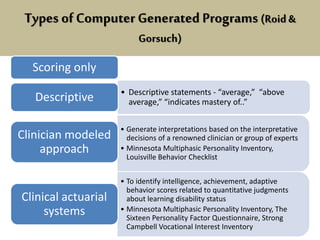
Scoring only
• Descriptive statements - “average,” “above
average,” “indicates mastery of..”Descriptive
• Generate interpretations based on the interpretative
decisions of a renowned clinician or group of experts
• Minnesota Multiphasic Personality Inventory,
Louisville Behavior Checklist
Clinician modeled
approach
• To identify intelligence, achievement, adaptive
behavior scores related to quantitative judgments
about learning disability status
• Minnesota Multiphasic Personality Inventory, The
Sixteen Personality Factor Questionnaire, Strong
Campbell Vocational Interest Inventory
Clinical actuarial
systems

Written Test Report

  • 1.
    Written TestReport Prepared by:Jeel Christine C. de Egurrola
  • 2.
    written report ofa standardized test The type of report depends on:  purpose of the testing  who willreceive the test report
  • 3.
    • Psychometric assessmentreports address the profile of individuals. • These profiles examine and discuss in an objective manner the attributes of the individual in terms of their ability, aptitude and approach to work. Individuals’ preferred style of managing their interpersonal relations at work, including the level and implications of their compatibility or incompatibility with specific individuals is examined within psychometric assessment reports also. • Profiles can show the unique strengths, limitations and potential for development within different individuals, and contrast these factors between individuals, thereby helping to inform an employer’s selection and development decisions.
  • 4.
    • Name, address,date of birth/chronological age, date of examination, race, sex, grade/school, parents or guardians, examiner Demographic information •Problem indicated by the client; person(s) referring client; relevant educational, social, and medical information; family information and history; previous testing results; other personal information Reason for referral and relevant background information • During initial intake, during testing, in non-testing situations, in classroom or work settings Behavioral observations of the client • Tests given: total, scale and subscale scores: range and spread of scores; basal and ceiling age levels; test items passed or failed Test results • Strengths and weaknesses, factors affecting performance, diagnostic interpretationsDiagnostic impressions • Specific answers to referral questions, predictions, cautions, suggestionsRecommendations • Brief integrated statement of statement findingsSummary
  • 5.
    Factors to beconsidered in writinga report • Focus ofthe report – Test-oriented (concentrating on the objective test results, items, scales, technical aspects of the examinee’s performance) – Examinee-oriented (characteristics) • What test/stouse – Background of the examinee should cite supporting evidence of diagnostic impressions – With consistent evidence from a number of sources, the examiner can be more sure of the interpretations and conclusions. – “everything observed from the initial encounter to the termination of the contact with the examinee constitute data for analysis” (Sattler, 1982)
  • 6.
    Overuseof jargon Focus ontestresults ratherthanthe individual Downplayof test results Poor organizationof thereport Failure of the examiner to takea position Poor written communication skills Commonproblems in psychological/psychometric reportwriting (Katz, 1985)
  • 7.
    Content Interpretation Examiner attitude andorientation Communication Science and the profession Major Categories of problems in writing psychological reports (Tallent, 1983)
  • 8.
    • Communicate clearlythe result • Include the purposes of the testing, decisions that gave rise to the testing, behavioral descriptions, & sources of information • Clearly identify opinions/professional judgments • DO NOT INCLUDE hearsay, unverified opinions, generalized statements, or potentially harmful/damaging information Writing the report
  • 9.
    General guidelines forgood reportwriting (Katz, 1985) • Write the report the day of testing at least within 24 hours of seeing the client • Remember the basics – (date, demographics, behavioral observations, test categories, diagnostic suggestions, recommendation, summary) • Proper organization of report • How long the report should be – Aim for clarity and accuracy but keep brevity • Report findings clearly and accurately using straightforward statement
  • 10.
    Patterns in organizing psychometricreports (Klupfer, 1960) • Utilizing a personality/psychometric theory as frame of reference Theory-oriented report • Focuses on test information, explain in detail how interpretations were derived Test-oriented report • Focuses on the question asked in referral Problem-oriented report • Focuses on the examinee rather than sources of information person-centered report • Focuses on the assets and strengths of the individual coping with life’s demands Ego-Psychological report
  • 11.
    Technical Aspects tobe considered in writingpsychometric reports • Familiarization with the Publication Manual of the American Psychological Association, 6th ed. (2010) – chapter 3 – Style of writing, punctuations, spelling, capitalization, italics, abbreviations, footnotes, references (APA format) • Refer to the suggested Psychometric report format of the publisher of the test you are using
  • 12.
    • Be specificand concrete • Avoid ambiguous sentences – WRONG: “Mary lacks mechanical aptitude.” – RIGHT: “Mary is unable to use the screwdriver or put washers on the bolt.” – WRONG: “John is an introvert.” – RIGHT: “John likes to be with people and be the center of attention. He talks and laughs loudly and makes sure he introduces himself to everyone in the room.” Language
  • 13.
    • Present factualtest data directly and accurately, basing interpretations and recommendations on reliable and valid data • DO NOT overgeneralize from limited test information – WRONG: “The examinee is tall for his age and may feel a deficit in his affiliation need.” (a subject may have a low score on the affiliation scale, but is not necessarily a result of his being tall for his age.) • Informational statements should be precise Language
  • 14.
    • Are therereal advantages to computerized interpretation of tests? • Will these interpretative reports reach the hands of inexperienced or unqualified individuals who will respond to the halo effect of objectivity projected by computerized report? • Will publishers and developers of computerized interpretative programs reveal decision rules? (i.e., classification of assessment standards) for professional review? • Will computer reviews be sufficiently validated? Four Major Concernsin Computer-Generated Reports (Matarazzo, 1983)
  • 15.
    1. Do thesentences convey the intended information? 2. Is the information presented in an objective manner? 3. Are statements clear and precise? 4. Are recommendations based on reliable and sufficient data? 5. Are data factual? 6. Were client records and files reviewed? 7. Are the test results valid and reliable indicator of client behavior and performance? 8. Are inferences and generalizations based on factual supporting data? 9. Have factors (previous test results, anecdotal records; behavioral observations; parent, spouse, teacher, or peer reports and observations; medical history; grades; work history; and educational attainment) been considered in the synthesis, analysis, and evaluation of current test information? 10. Is the case overstated? Are irrelevant statements eliminated? 11. Is the report organized into logical parts with smooth transition from part to part and paragraph to paragraph? 12. Are technical details, technical vocabulary, and fancy words minimized terms defined and translated into a common-sense vocabulary 13. Are sources of information documents Revising and Editing the Report
  • 16.
    Advantages of ComputerizedTest Interpretations (Klupfer, 1960) 1. Accuracy of scoring and retrieval of norms from complex norm tables 2. Time saved by counselors, HR practitioners and clinicians 3. Ability of computer to follow complex decisions rules in a fraction of a 4. Ability to show moderating effects on test interpretation 5. Ability to complete elaborate profile and statistical analysis
  • 17.
    Types of ComputerGenerated Programs (Roid & Gorsuch) Scoring only • Descriptive statements - “average,” “above average,” “indicates mastery of..”Descriptive • Generate interpretations based on the interpretative decisions of a renowned clinician or group of experts • Minnesota Multiphasic Personality Inventory, Louisville Behavior Checklist Clinician modeled approach • To identify intelligence, achievement, adaptive behavior scores related to quantitative judgments about learning disability status • Minnesota Multiphasic Personality Inventory, The Sixteen Personality Factor Questionnaire, Strong Campbell Vocational Interest Inventory Clinical actuarial systems