The Developmental Test of Visual-Motor Integration(Beery VMI)
Beery VMIIs a developmental sequence of geometric forms to be copied with paper and pencilIt is designed to assess the extent to which individuals can integrate their visual and motor abilities (eye-hand coordination)
To help identify, through early screening, children who may need special assistance, to obtain needed services to them, to test the effectiveness of educational and other intervention and to advance researchBeery VMIIs virtually culture freeUses geometric forms
Because children from different background often have widely varying degrees of experience with alphabets and numbersBeery VMIFrom amoebas to humans and from infants toadults, successful development is characterized byincreasing articulation of the parts with wholes.An operating assumption that is based on Sherrington’s work in biology and the work of others in various fields, including the social sciencesBeery VMIFrom amoebas to humans and from infants toadults, successful development is characterized byincreasing articulation of the parts with wholes.Ideally, a test of visual-motor integration will help some children move forward toward more fully integrating all of their physical, intellectual, emotional, and spiritual parts with the whole of their selves and othersFrom amoebas to humans, the nervous system seems to have progressed toward improved interaction among sensory and expressive modalitiesIn adult humans, sensory and expressive modalities are usually well connected and coordinated, or integratedVisual-motor may be the first sensory-response integration to developKephart emphasized the importance of integration
He noted children have well developed visual and motor skills but be unable to integrate the two.
Vereeken reported that, to copy form with a pencil, a child must first be visually aware of the location and direction.
This awareness is made possible through voluntary eye movementChildren can scribble vertical, horizontal, and circular lines before being able to imitateScribbling requires little or no eye-hand coordination
Imitation is probably achieved before direct copying of these same forms
In imitation, eye movements are rehearsed while the task is being demonstrated
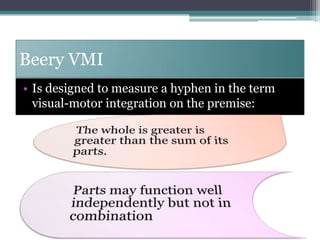
Beery VMIIs designed to measure a hyphen in the term visual-motor integration on the premise:
The End.Prepared by: Jeel Christine de Egurrolajeelchristine@i.ph

Beery VMI

  • 1.
    The Developmental Testof Visual-Motor Integration(Beery VMI)
  • 2.
    Beery VMIIs adevelopmental sequence of geometric forms to be copied with paper and pencilIt is designed to assess the extent to which individuals can integrate their visual and motor abilities (eye-hand coordination)
  • 3.
    To help identify,through early screening, children who may need special assistance, to obtain needed services to them, to test the effectiveness of educational and other intervention and to advance researchBeery VMIIs virtually culture freeUses geometric forms
  • 4.
    Because children fromdifferent background often have widely varying degrees of experience with alphabets and numbersBeery VMIFrom amoebas to humans and from infants toadults, successful development is characterized byincreasing articulation of the parts with wholes.An operating assumption that is based on Sherrington’s work in biology and the work of others in various fields, including the social sciencesBeery VMIFrom amoebas to humans and from infants toadults, successful development is characterized byincreasing articulation of the parts with wholes.Ideally, a test of visual-motor integration will help some children move forward toward more fully integrating all of their physical, intellectual, emotional, and spiritual parts with the whole of their selves and othersFrom amoebas to humans, the nervous system seems to have progressed toward improved interaction among sensory and expressive modalitiesIn adult humans, sensory and expressive modalities are usually well connected and coordinated, or integratedVisual-motor may be the first sensory-response integration to developKephart emphasized the importance of integration
  • 5.
    He noted childrenhave well developed visual and motor skills but be unable to integrate the two.
  • 6.
    Vereeken reported that,to copy form with a pencil, a child must first be visually aware of the location and direction.
  • 7.
    This awareness ismade possible through voluntary eye movementChildren can scribble vertical, horizontal, and circular lines before being able to imitateScribbling requires little or no eye-hand coordination
  • 8.
    Imitation is probablyachieved before direct copying of these same forms
  • 9.
    In imitation, eyemovements are rehearsed while the task is being demonstrated
  • 10.
    Beery VMIIs designedto measure a hyphen in the term visual-motor integration on the premise:
  • 11.
    The End.Prepared by:Jeel Christine de Egurrolajeelchristine@i.ph