PROGRAMMING CRASH COURSE
KEDS BIODESIGNS
WEEK : III
CLASS : 9
SESSION : MACHINE LEARNING
CLASSIFICATION
IMPLEMENTING SVM IN PYTHON
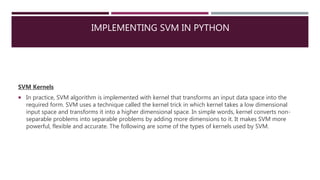
SVM Kernels
 In practice, SVM algorithm is implemented with kernel that transforms an input data space into the
required form. SVM uses a technique called the kernel trick in which kernel takes a low dimensional
input space and transforms it into a higher dimensional space. In simple words, kernel converts non-
separable problems into separable problems by adding more dimensions to it. It makes SVM more
powerful, flexible and accurate. The following are some of the types of kernels used by SVM.
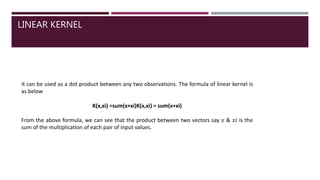
LINEAR KERNEL
It can be used as a dot product between any two observations. The formula of linear kernel is
as below
K(x,xi) =sum(x∗xi)K(x,xi) = sum(x∗xi)
From the above formula, we can see that the product between two vectors say 𝑥 & 𝑥𝑖 is the
sum of the multiplication of each pair of input values.
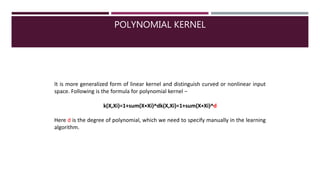
POLYNOMIAL KERNEL
It is more generalized form of linear kernel and distinguish curved or nonlinear input
space. Following is the formula for polynomial kernel −
k(X,Xi)=1+sum(X∗Xi)^dk(X,Xi)=1+sum(X∗Xi)^d
Here d is the degree of polynomial, which we need to specify manually in the learning
algorithm.
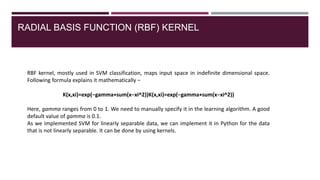
RADIAL BASIS FUNCTION (RBF) KERNEL
RBF kernel, mostly used in SVM classification, maps input space in indefinite dimensional space.
Following formula explains it mathematically −
K(x,xi)=exp(−gamma∗sum(x−xi^2))K(x,xi)=exp(−gamma∗sum(x−xi^2))
Here, gamma ranges from 0 to 1. We need to manually specify it in the learning algorithm. A good
default value of gamma is 0.1.
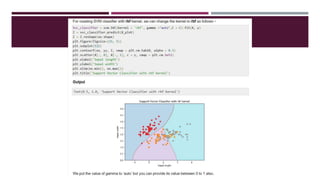
As we implemented SVM for linearly separable data, we can implement it in Python for the data
that is not linearly separable. It can be done by using kernels.
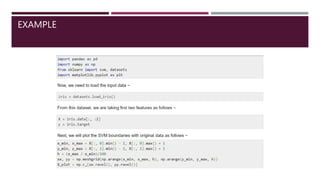
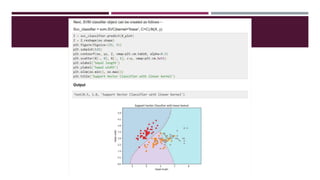
EXAMPLE
PROS AND CONS OF SVM CLASSIFIERS
Pros of SVM classifiers
 SVM classifiers offers great accuracy and work well with high dimensional space. SVM classifiers basically
use a subset of training points hence in result uses very less memory.
Cons of SVM classifiers
 They have high training time hence in practice not suitable for large datasets. Another disadvantage is
that SVM classifiers do not work well with overlapping classes.

Machine learning session 9

  • 1.
    PROGRAMMING CRASH COURSE KEDSBIODESIGNS WEEK : III CLASS : 9 SESSION : MACHINE LEARNING CLASSIFICATION
  • 2.
    IMPLEMENTING SVM INPYTHON SVM Kernels  In practice, SVM algorithm is implemented with kernel that transforms an input data space into the required form. SVM uses a technique called the kernel trick in which kernel takes a low dimensional input space and transforms it into a higher dimensional space. In simple words, kernel converts non- separable problems into separable problems by adding more dimensions to it. It makes SVM more powerful, flexible and accurate. The following are some of the types of kernels used by SVM.
  • 3.
    LINEAR KERNEL It canbe used as a dot product between any two observations. The formula of linear kernel is as below K(x,xi) =sum(x∗xi)K(x,xi) = sum(x∗xi) From the above formula, we can see that the product between two vectors say 𝑥 & 𝑥𝑖 is the sum of the multiplication of each pair of input values.
  • 4.
    POLYNOMIAL KERNEL It ismore generalized form of linear kernel and distinguish curved or nonlinear input space. Following is the formula for polynomial kernel − k(X,Xi)=1+sum(X∗Xi)^dk(X,Xi)=1+sum(X∗Xi)^d Here d is the degree of polynomial, which we need to specify manually in the learning algorithm.
  • 5.
    RADIAL BASIS FUNCTION(RBF) KERNEL RBF kernel, mostly used in SVM classification, maps input space in indefinite dimensional space. Following formula explains it mathematically − K(x,xi)=exp(−gamma∗sum(x−xi^2))K(x,xi)=exp(−gamma∗sum(x−xi^2)) Here, gamma ranges from 0 to 1. We need to manually specify it in the learning algorithm. A good default value of gamma is 0.1. As we implemented SVM for linearly separable data, we can implement it in Python for the data that is not linearly separable. It can be done by using kernels.
  • 6.
  • 9.
    PROS AND CONSOF SVM CLASSIFIERS Pros of SVM classifiers  SVM classifiers offers great accuracy and work well with high dimensional space. SVM classifiers basically use a subset of training points hence in result uses very less memory. Cons of SVM classifiers  They have high training time hence in practice not suitable for large datasets. Another disadvantage is that SVM classifiers do not work well with overlapping classes.