RECURSION Lecture 2.4
Prepared by: Mian Saeed Akbar
Recursion
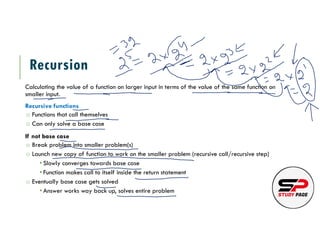
Calculating the value of a function on larger input in terms of the value of the same function on
smaller input.
Recursive functions
o Functions that call themselves
o Can only solve a base case
If not base case
o Break problem into smaller problem(s)
o Launch new copy of function to work on the smaller problem (recursive call/recursive step)
• Slowly converges towards base case
• Function makes call to itself inside the return statement
o Eventually base case gets solved
• Answer works way back up, solves entire problem
Recursion
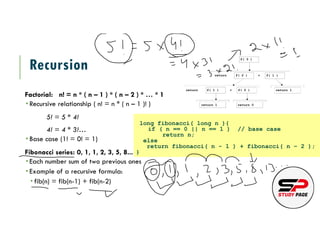
Factorial: n! = n * ( n – 1 ) * ( n – 2 ) * … * 1
 Recursive relationship ( n! = n * ( n – 1 )! )
5! = 5 * 4!
4! = 4 * 3!…
 Base case (1! = 0! = 1)
Fibonacci series: 0, 1, 1, 2, 3, 5, 8...
 Each number sum of two previous ones
 Example of a recursive formula:
 fib(n) = fib(n-1) + fib(n-2)
long fibonacci( long n ){
if ( n == 0 || n == 1 ) // base case
return n;
else
return fibonacci( n - 1 ) + fibonacci( n – 2 );
}
f( 3 )
f( 1 )
f( 2 )
f( 1 ) f( 0 ) return 1
return 1 return 0
return +
+
return
Recursion vs. Iteration
Repetition
 Iteration: explicit loop
 Recursion: repeated function calls
Termination
 Iteration: loop condition fails
 Recursion: base case recognized
Both can have infinite loops
Balance between performance (iteration) and good software engineering (recursion)
Thank you
Please subscribe my channel for more videos
and courses

Lecture 2.4 Recursion.pdf

  • 1.
    RECURSION Lecture 2.4 Preparedby: Mian Saeed Akbar
  • 2.
    Recursion Calculating the valueof a function on larger input in terms of the value of the same function on smaller input. Recursive functions o Functions that call themselves o Can only solve a base case If not base case o Break problem into smaller problem(s) o Launch new copy of function to work on the smaller problem (recursive call/recursive step) • Slowly converges towards base case • Function makes call to itself inside the return statement o Eventually base case gets solved • Answer works way back up, solves entire problem
  • 3.
    Recursion Factorial: n! =n * ( n – 1 ) * ( n – 2 ) * … * 1  Recursive relationship ( n! = n * ( n – 1 )! ) 5! = 5 * 4! 4! = 4 * 3!…  Base case (1! = 0! = 1) Fibonacci series: 0, 1, 1, 2, 3, 5, 8...  Each number sum of two previous ones  Example of a recursive formula:  fib(n) = fib(n-1) + fib(n-2) long fibonacci( long n ){ if ( n == 0 || n == 1 ) // base case return n; else return fibonacci( n - 1 ) + fibonacci( n – 2 ); } f( 3 ) f( 1 ) f( 2 ) f( 1 ) f( 0 ) return 1 return 1 return 0 return + + return
  • 4.
    Recursion vs. Iteration Repetition Iteration: explicit loop  Recursion: repeated function calls Termination  Iteration: loop condition fails  Recursion: base case recognized Both can have infinite loops Balance between performance (iteration) and good software engineering (recursion)
  • 5.
    Thank you Please subscribemy channel for more videos and courses