1
Recursion
(With applications to Searching and Sorting)
•Definition of a Recursion
•Simple Examples of Recursion
•Conditions for Recursion to Work
•How Recursion Works Internally
•Binary Search
•Merge Sort
2
Definition of Recursion
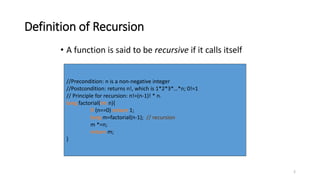
• A function is said to be recursive if it calls itself
//Precondition: n is a non-negative integer
//Postcondition: returns n!, which is 1*2*3*…*n; 0!=1
// Principle for recursion: n!=(n-1)! * n.
long factorial(int n){
if (n==0) return 1;
long m=factorial(n-1); // recursion
m *=n;
return m;
}
3
One Example of Recursion: Investment
Accounts
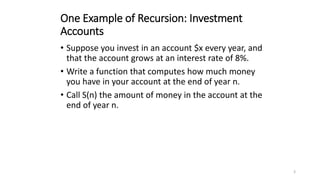
• Suppose you invest in an account $x every year, and
that the account grows at an interest rate of 8%.
• Write a function that computes how much money
you have in your account at the end of year n.
• Call S(n) the amount of money in the account at the
end of year n.
4
Investment Example (contd.)
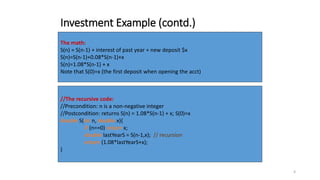
The math:
S(n) = S(n-1) + interest of past year + new deposit $x
S(n)=S(n-1)+0.08*S(n-1)+x
S(n)=1.08*S(n-1) + x
Note that S(0)=x (the first deposit when opening the acct)
//The recursive code:
//Precondition: n is a non-negative integer
//Postcondition: returns S(n) = 1.08*S(n-1) + x; S(0)=x
double S(int n, double x){
if (n==0) return x;
double lastYearS = S(n-1,x); // recursion
return (1.08*lastYearS+x);
}
5
Another Recursion Example: Finding the Minimum
in an Array
// Precondition: the input is a a double array x[ ] of at least end
// elements. start and end are nonnegative integer indexes
// marking the portion of x[ ] over which to find the minimum.
// end >= start;
// Postcondition: returns the smallest value in x[ ].
// Recursion principle: if you we have the minimum of the 1st
// half of x and the minimum of the 2nd half of x, then the
// global minimum is the smaller of those two minimums
double min(double x[ ], int start, int end){
// …. On the next slide
}
6
The Minimum Example (Contd.)
double min(double x[ ], int start, int end){
assert(end >= start && start >=0);
if (end == start) // one number to minimize over
return x[start];
int mid=(start+end)/2; // mid-point index
double min1=min(x, start, mid); // 1st recursive call
double min2=min(x, mid+1, end); // 2nd recursive call
if (min1 <= min2)
return min1;
else
return min2;
}
7
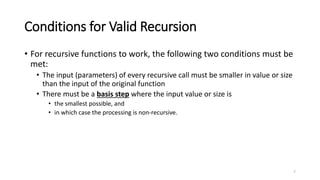
Conditions for Valid Recursion
• For recursive functions to work, the following two conditions must be
met:
• The input (parameters) of every recursive call must be smaller in value or size
than the input of the original function
• There must be a basis step where the input value or size is
• the smallest possible, and
• in which case the processing is non-recursive.
8
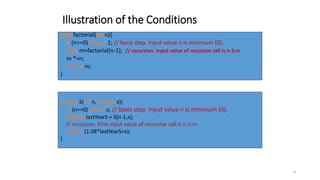
Illustration of the Conditions
long factorial(int n){
if (n==0) return 1; // basis step. Input value n is minimum (0).
long m=factorial(n-1); // recursion. Input value of recursive call is n-1<n
m *=n;
return m;
}
double S(int n, double x){
if (n==0) return x; // basis step. Input value n is minimum (0).
double lastYearS = S(n-1,x);
// recursion. First-input value of recursive call is n-1<n
return (1.08*lastYearS+x);
}
9
Illustration of the Conditions (Contd.)
double min(double x[ ], int start, int end){
assert(end >= start && start >=0);
if (end == start) // Basis step. Input size is minimum = 1.
return x[start]; // No recursion
int mid=(start+end)/2; // mid-point index
double min1=min(x, start, mid); // 1st recursive call
double min2=min(x, mid+1, end); // 2nd recursive call
// In both recursive calls, the input size is half the original, and so less.
if (min1 <= min2)
return min1;
else
return min2;
}
10
How Recursion Works Internally
• It is illustrated in class on the factorial function and
the min function
11
How to Think Recursively
• When coding, do not concern yourself how
recursion is unfolding during execution
• Rather, think of yourself as a boss, and treat each
recursive call as an order to one of your trusted
subordinates to do something.
• As a boss, you need not worry how the
subordinate does their work. Instead, take the
outcome of their work
• Finally, take the outcome of the subordinate’s
work, and use it to compute by yourself the final
result.
12
Illustration of Recursive Thinking
double min(double x[ ], int start, int end){
assert(end >= start && start >=0);
if (end == start) // Basis step.
return x[start]; // The boss does the basis step
int mid=(start+end)/2; // mid-point index
double min1=min(x, start, mid); // subordinate produces min1
double min2=min(x, mid+1, end); // subordinate produces min2
// The two recursive calls are the work of “subordinates”. Don’t
// worry how the subordinates do their work.
if (min1 <= min2)
return min1;
else
return min2;
}
13
Binary Search
• Input:
• A sorted array X[ ] of size n
• A value b to be searched for in X[ ]
• Output:
• If b is found, the index k where X[k]=b
• If b is not found, return -1
• Definition: An X[ ] is said to be sorted if:
X[0] ≤ X[1] ≤ X[2] ≤ … ≤ X[n-1]
14
Binary Search: Method
• The method is recursive:
• Compare b with the middle value X[mid]
• If b = X[mid], return mid
• If b < X[mid], then b can only be in the left half of
X[ ], because X[ ] is sorted. So call the function
recursively on the left half.
• If b > X[mid], then b can only be in the right half of
X[ ], because X[ ] is sorted. So call the function
recursively on the right half.
15
Illustration of Binary search
• X[12]:
• Search for b=12
• mid = (0+11)/2 = 5. Compare b with X[5]: 12<20.
• So search in left half X[0..4]
• mid = (0+4)/2 = 2. Compare b with X[2]: 12 > 7.
• So search right half X[3..4]
• mid = (3+4)/2 = 3.Compare b with X[3]: b=X[3]=12.
• Return 3.
0 3
15 20 25 27 35 40 47 601 5 7 12
1 42 65 87 109 11
0 3
15 20 25 27 35 40 47 601 5 7 12
1 42 65 87 109 11
0 3
15 20 25 27 35 40 47 601 5 7 12
1 42 65 87 109 11
16
The Recursive Code of Binary Search
int binarySearch(double b, double X[], int left, int right){
if (left == right)
if (b==X[left]) return left;
else return -1;
int mid = (left+right)/2;
if (b==X[mid]) return mid;
if (b < X[mid]) return binarySearch (b, X, left, mid-1);
if (b > X[mid]) return binarySearch(b, X, mid+1, right);
}
17
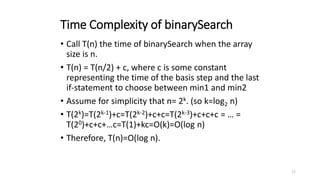
Time Complexity of binarySearch
• Call T(n) the time of binarySearch when the array
size is n.
• T(n) = T(n/2) + c, where c is some constant
representing the time of the basis step and the last
if-statement to choose between min1 and min2
• Assume for simplicity that n= 2k. (so k=log2 n)
• T(2k)=T(2k-1)+c=T(2k-2)+c+c=T(2k-3)+c+c+c = … =
T(20)+c+c+…c=T(1)+kc=O(k)=O(log n)
• Therefore, T(n)=O(log n).
18
MergeSort
• The general problem of sorting is to take as input
an unordered array X[ ], and give as output the
same set of data but sorted in increasing order
• Example:
• Input: 3 5 2 7 10 8 20 15 14 3 -1 2 -5
• Output: -5 -1 2 2 3 3 5 7 8 10 14 15 20
• We are interested in developing an algorithm that
does the sorting
19
MergeSort: Recursive Sorting
A recursive sorting function works as follows:
1. Make a recursive call to the sorting function to sort
the first half of the input array
2. Make another recursive call to sort the 2nd half of the
input array
3. Finally, merge the two sorted halves into a single
fully sorted array
20
How to Merge Two Sorted Arrays
• Say Y[ ] and Z[ ] are two sorted arrays to be
merged into a single sorted array
• Call the first element of an array the head
• While both arrays Y and Z are non-empty, repeat
the following steps:
• Compare the two heads of Y and Z
• Remove the smaller head and put it next in the output
• Now either Y or Z is empty. Move the non-empty
array to the end of output, and stop.
• The output is now fully sorted.
21
Illustration of Merging
• (In class)
22
Code for Merge
Time: Since each element of X1 and X2 and X are touched once, the time is
proportional to the sum of the sizes of X1 and X2.
void merge(double X1[ ], int left1, int right1, //merge X1[left1..right1]
doubleX2[ ], int left2, int right2, // and X2[left2..right2]
doubleX, int left) { // to X[left…]
int i1 = left1; int i2=left2; int i= left; // heads of X1, X2, X.
while (i1 <= right1 && i2 <= right2)
if (X1[i1] <= X2[i2]) {X[i]=X1[i1]; i1++; i++;}
else {X[i]=X2[i2]; i2++; i++;}
if (i1<right1) // copy leftovers of X1 to the end of X
while (i1<= right1) {X[i]=X1[i1]; i1++; i++;}
if (i2<right2) // copy leftovers of X2 to the end of X
while (i2<= right2) {X[i]=X2[i2]; i2++; i++;}
}
23
Code for MergeSort
• Time T(n) = 2T(n/2) + cn, where cn is time for merge, and n is size of X.
• This implies: T(n) = O(n log n).
void mergeSort(double X[ ], doubleY[ ], int left, int right){
if (left==right) {Y[left] = X[left]; return;}
int mid = (left+right)/2;
double Z[right+1];
// next, sort left half of X and put the result in left half of Z
mergeSort(X,Z,left,mid);
// next, sort right half of X and put the result in right half of Z
mergeSort(X,Z,mid+1,right);
// next, merge the two halves of Z and put result in Y
merge(Z,left,mid, Z,mid+1,right, Y,left);
}
24
Illustration of mergeSort
• (In class)
25
Additional Things for YOU to Do
• Modify binarySearch so that even if the item b is
not found, the function returns the index k where
X[k] < b<X[k+1].
• Write a function that inserts a new element b into
an already sorted array, assuming the array has
additional room for a new element. Hint: use
binarySearch as modified above to find where b
should be inserted, then shift the right portion of
the array by one position to the right, and then
insert the element.
26
More Things You can Do
• Write a function (called partition) that takes as input an
unsorted array X to do the following:
• Let b=the first element of X
• Move the data around inside X so that at the end b lands in some
position k where X[i] ≤ b for all i < k, and X[i] > b for all i > k.
• Hint: Have an empty array Y of same size as X. Scan the
array X; for each element X[i], if X[i] ≤ b, insert X[i] in the
left end of Y, but if X[i]>b, insert X[i] in the right end of Y. At
the end, you can copy Y onto X.
• Use partition to develop another recursive sorting
algorithm: 1. call partition; 2. call recursively on X[0..k-1]; 3.
call recursively on X[k+1..n-1].

Recursion

  • 1.
    1 Recursion (With applications toSearching and Sorting) •Definition of a Recursion •Simple Examples of Recursion •Conditions for Recursion to Work •How Recursion Works Internally •Binary Search •Merge Sort
  • 2.
    2 Definition of Recursion •A function is said to be recursive if it calls itself //Precondition: n is a non-negative integer //Postcondition: returns n!, which is 1*2*3*…*n; 0!=1 // Principle for recursion: n!=(n-1)! * n. long factorial(int n){ if (n==0) return 1; long m=factorial(n-1); // recursion m *=n; return m; }
  • 3.
    3 One Example ofRecursion: Investment Accounts • Suppose you invest in an account $x every year, and that the account grows at an interest rate of 8%. • Write a function that computes how much money you have in your account at the end of year n. • Call S(n) the amount of money in the account at the end of year n.
  • 4.
    4 Investment Example (contd.) Themath: S(n) = S(n-1) + interest of past year + new deposit $x S(n)=S(n-1)+0.08*S(n-1)+x S(n)=1.08*S(n-1) + x Note that S(0)=x (the first deposit when opening the acct) //The recursive code: //Precondition: n is a non-negative integer //Postcondition: returns S(n) = 1.08*S(n-1) + x; S(0)=x double S(int n, double x){ if (n==0) return x; double lastYearS = S(n-1,x); // recursion return (1.08*lastYearS+x); }
  • 5.
    5 Another Recursion Example:Finding the Minimum in an Array // Precondition: the input is a a double array x[ ] of at least end // elements. start and end are nonnegative integer indexes // marking the portion of x[ ] over which to find the minimum. // end >= start; // Postcondition: returns the smallest value in x[ ]. // Recursion principle: if you we have the minimum of the 1st // half of x and the minimum of the 2nd half of x, then the // global minimum is the smaller of those two minimums double min(double x[ ], int start, int end){ // …. On the next slide }
  • 6.
    6 The Minimum Example(Contd.) double min(double x[ ], int start, int end){ assert(end >= start && start >=0); if (end == start) // one number to minimize over return x[start]; int mid=(start+end)/2; // mid-point index double min1=min(x, start, mid); // 1st recursive call double min2=min(x, mid+1, end); // 2nd recursive call if (min1 <= min2) return min1; else return min2; }
  • 7.
    7 Conditions for ValidRecursion • For recursive functions to work, the following two conditions must be met: • The input (parameters) of every recursive call must be smaller in value or size than the input of the original function • There must be a basis step where the input value or size is • the smallest possible, and • in which case the processing is non-recursive.
  • 8.
    8 Illustration of theConditions long factorial(int n){ if (n==0) return 1; // basis step. Input value n is minimum (0). long m=factorial(n-1); // recursion. Input value of recursive call is n-1<n m *=n; return m; } double S(int n, double x){ if (n==0) return x; // basis step. Input value n is minimum (0). double lastYearS = S(n-1,x); // recursion. First-input value of recursive call is n-1<n return (1.08*lastYearS+x); }
  • 9.
    9 Illustration of theConditions (Contd.) double min(double x[ ], int start, int end){ assert(end >= start && start >=0); if (end == start) // Basis step. Input size is minimum = 1. return x[start]; // No recursion int mid=(start+end)/2; // mid-point index double min1=min(x, start, mid); // 1st recursive call double min2=min(x, mid+1, end); // 2nd recursive call // In both recursive calls, the input size is half the original, and so less. if (min1 <= min2) return min1; else return min2; }
  • 10.
    10 How Recursion WorksInternally • It is illustrated in class on the factorial function and the min function
  • 11.
    11 How to ThinkRecursively • When coding, do not concern yourself how recursion is unfolding during execution • Rather, think of yourself as a boss, and treat each recursive call as an order to one of your trusted subordinates to do something. • As a boss, you need not worry how the subordinate does their work. Instead, take the outcome of their work • Finally, take the outcome of the subordinate’s work, and use it to compute by yourself the final result.
  • 12.
    12 Illustration of RecursiveThinking double min(double x[ ], int start, int end){ assert(end >= start && start >=0); if (end == start) // Basis step. return x[start]; // The boss does the basis step int mid=(start+end)/2; // mid-point index double min1=min(x, start, mid); // subordinate produces min1 double min2=min(x, mid+1, end); // subordinate produces min2 // The two recursive calls are the work of “subordinates”. Don’t // worry how the subordinates do their work. if (min1 <= min2) return min1; else return min2; }
  • 13.
    13 Binary Search • Input: •A sorted array X[ ] of size n • A value b to be searched for in X[ ] • Output: • If b is found, the index k where X[k]=b • If b is not found, return -1 • Definition: An X[ ] is said to be sorted if: X[0] ≤ X[1] ≤ X[2] ≤ … ≤ X[n-1]
  • 14.
    14 Binary Search: Method •The method is recursive: • Compare b with the middle value X[mid] • If b = X[mid], return mid • If b < X[mid], then b can only be in the left half of X[ ], because X[ ] is sorted. So call the function recursively on the left half. • If b > X[mid], then b can only be in the right half of X[ ], because X[ ] is sorted. So call the function recursively on the right half.
  • 15.
    15 Illustration of Binarysearch • X[12]: • Search for b=12 • mid = (0+11)/2 = 5. Compare b with X[5]: 12<20. • So search in left half X[0..4] • mid = (0+4)/2 = 2. Compare b with X[2]: 12 > 7. • So search right half X[3..4] • mid = (3+4)/2 = 3.Compare b with X[3]: b=X[3]=12. • Return 3. 0 3 15 20 25 27 35 40 47 601 5 7 12 1 42 65 87 109 11 0 3 15 20 25 27 35 40 47 601 5 7 12 1 42 65 87 109 11 0 3 15 20 25 27 35 40 47 601 5 7 12 1 42 65 87 109 11
  • 16.
    16 The Recursive Codeof Binary Search int binarySearch(double b, double X[], int left, int right){ if (left == right) if (b==X[left]) return left; else return -1; int mid = (left+right)/2; if (b==X[mid]) return mid; if (b < X[mid]) return binarySearch (b, X, left, mid-1); if (b > X[mid]) return binarySearch(b, X, mid+1, right); }
  • 17.
    17 Time Complexity ofbinarySearch • Call T(n) the time of binarySearch when the array size is n. • T(n) = T(n/2) + c, where c is some constant representing the time of the basis step and the last if-statement to choose between min1 and min2 • Assume for simplicity that n= 2k. (so k=log2 n) • T(2k)=T(2k-1)+c=T(2k-2)+c+c=T(2k-3)+c+c+c = … = T(20)+c+c+…c=T(1)+kc=O(k)=O(log n) • Therefore, T(n)=O(log n).
  • 18.
    18 MergeSort • The generalproblem of sorting is to take as input an unordered array X[ ], and give as output the same set of data but sorted in increasing order • Example: • Input: 3 5 2 7 10 8 20 15 14 3 -1 2 -5 • Output: -5 -1 2 2 3 3 5 7 8 10 14 15 20 • We are interested in developing an algorithm that does the sorting
  • 19.
    19 MergeSort: Recursive Sorting Arecursive sorting function works as follows: 1. Make a recursive call to the sorting function to sort the first half of the input array 2. Make another recursive call to sort the 2nd half of the input array 3. Finally, merge the two sorted halves into a single fully sorted array
  • 20.
    20 How to MergeTwo Sorted Arrays • Say Y[ ] and Z[ ] are two sorted arrays to be merged into a single sorted array • Call the first element of an array the head • While both arrays Y and Z are non-empty, repeat the following steps: • Compare the two heads of Y and Z • Remove the smaller head and put it next in the output • Now either Y or Z is empty. Move the non-empty array to the end of output, and stop. • The output is now fully sorted.
  • 21.
  • 22.
    22 Code for Merge Time:Since each element of X1 and X2 and X are touched once, the time is proportional to the sum of the sizes of X1 and X2. void merge(double X1[ ], int left1, int right1, //merge X1[left1..right1] doubleX2[ ], int left2, int right2, // and X2[left2..right2] doubleX, int left) { // to X[left…] int i1 = left1; int i2=left2; int i= left; // heads of X1, X2, X. while (i1 <= right1 && i2 <= right2) if (X1[i1] <= X2[i2]) {X[i]=X1[i1]; i1++; i++;} else {X[i]=X2[i2]; i2++; i++;} if (i1<right1) // copy leftovers of X1 to the end of X while (i1<= right1) {X[i]=X1[i1]; i1++; i++;} if (i2<right2) // copy leftovers of X2 to the end of X while (i2<= right2) {X[i]=X2[i2]; i2++; i++;} }
  • 23.
    23 Code for MergeSort •Time T(n) = 2T(n/2) + cn, where cn is time for merge, and n is size of X. • This implies: T(n) = O(n log n). void mergeSort(double X[ ], doubleY[ ], int left, int right){ if (left==right) {Y[left] = X[left]; return;} int mid = (left+right)/2; double Z[right+1]; // next, sort left half of X and put the result in left half of Z mergeSort(X,Z,left,mid); // next, sort right half of X and put the result in right half of Z mergeSort(X,Z,mid+1,right); // next, merge the two halves of Z and put result in Y merge(Z,left,mid, Z,mid+1,right, Y,left); }
  • 24.
  • 25.
    25 Additional Things forYOU to Do • Modify binarySearch so that even if the item b is not found, the function returns the index k where X[k] < b<X[k+1]. • Write a function that inserts a new element b into an already sorted array, assuming the array has additional room for a new element. Hint: use binarySearch as modified above to find where b should be inserted, then shift the right portion of the array by one position to the right, and then insert the element.
  • 26.
    26 More Things Youcan Do • Write a function (called partition) that takes as input an unsorted array X to do the following: • Let b=the first element of X • Move the data around inside X so that at the end b lands in some position k where X[i] ≤ b for all i < k, and X[i] > b for all i > k. • Hint: Have an empty array Y of same size as X. Scan the array X; for each element X[i], if X[i] ≤ b, insert X[i] in the left end of Y, but if X[i]>b, insert X[i] in the right end of Y. At the end, you can copy Y onto X. • Use partition to develop another recursive sorting algorithm: 1. call partition; 2. call recursively on X[0..k-1]; 3. call recursively on X[k+1..n-1].