Chapter Seven FINANCIAL STATEMENT ANALYSIS
Outline Users of financial statement The importance of financial statement analysis Types of analysis: Percentage Analysis: Vertical Horizontal Ratio Analysis Liquidity Profitability Efficiency Solvency
Users of financial statement Managers Investors / Shareholders Potential Investors Creditors Regulatory Agencies Inland Revenue Consumers
The importance of financial statement analysis Helps interested users in making economic decisions: Provide the trend of the business for a certain period of time. Provide comparability among companies in the same industry. Helps in forecasting the business’s future performance
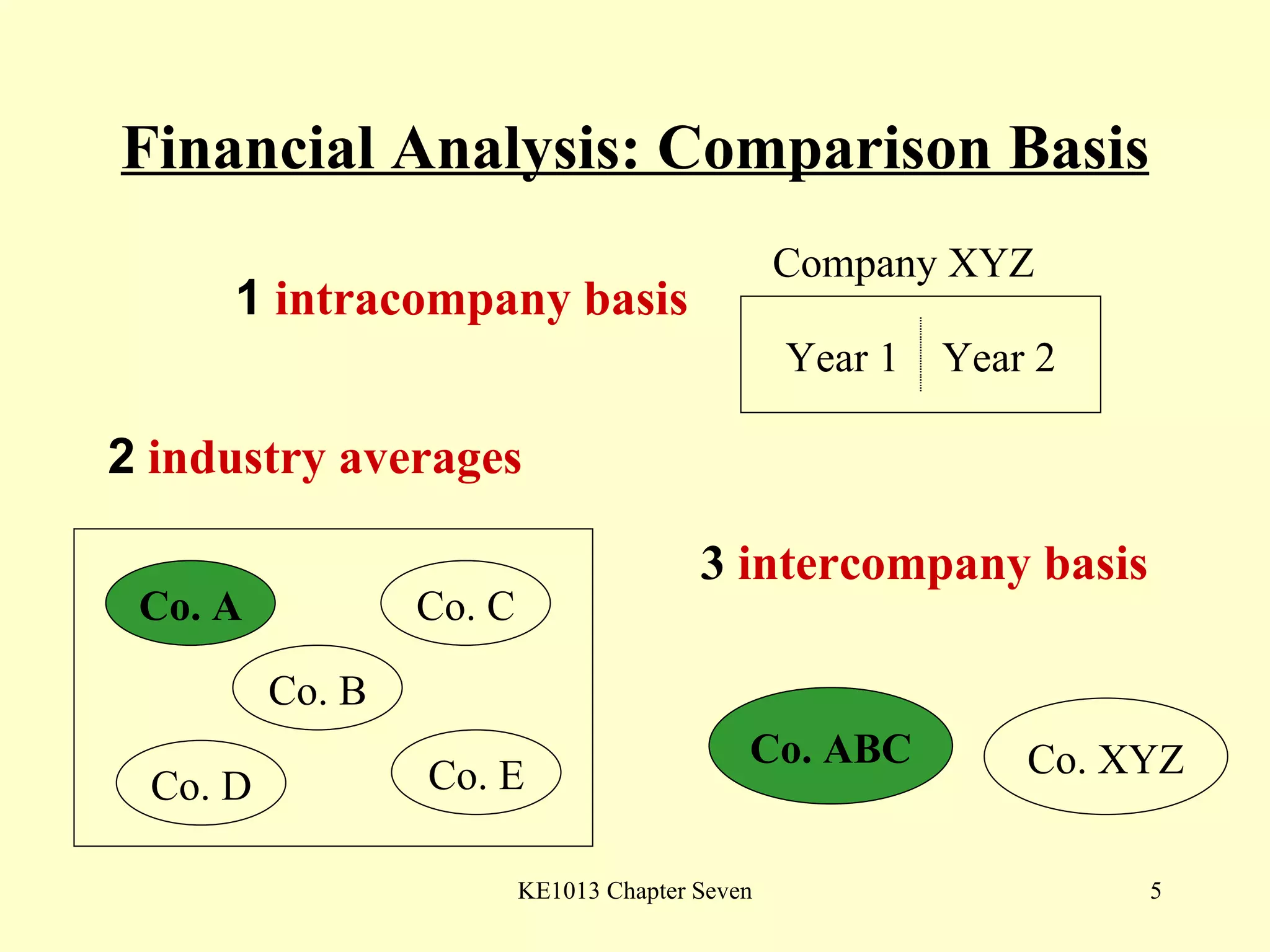
Financial Analysis: Comparison Basis 1  intracompany basis 2   industry averages Year 1  Year 2 Company XYZ Co. A Co. B Co. D Co. E Co. C Co. ABC Co. XYZ 3  intercompany basis
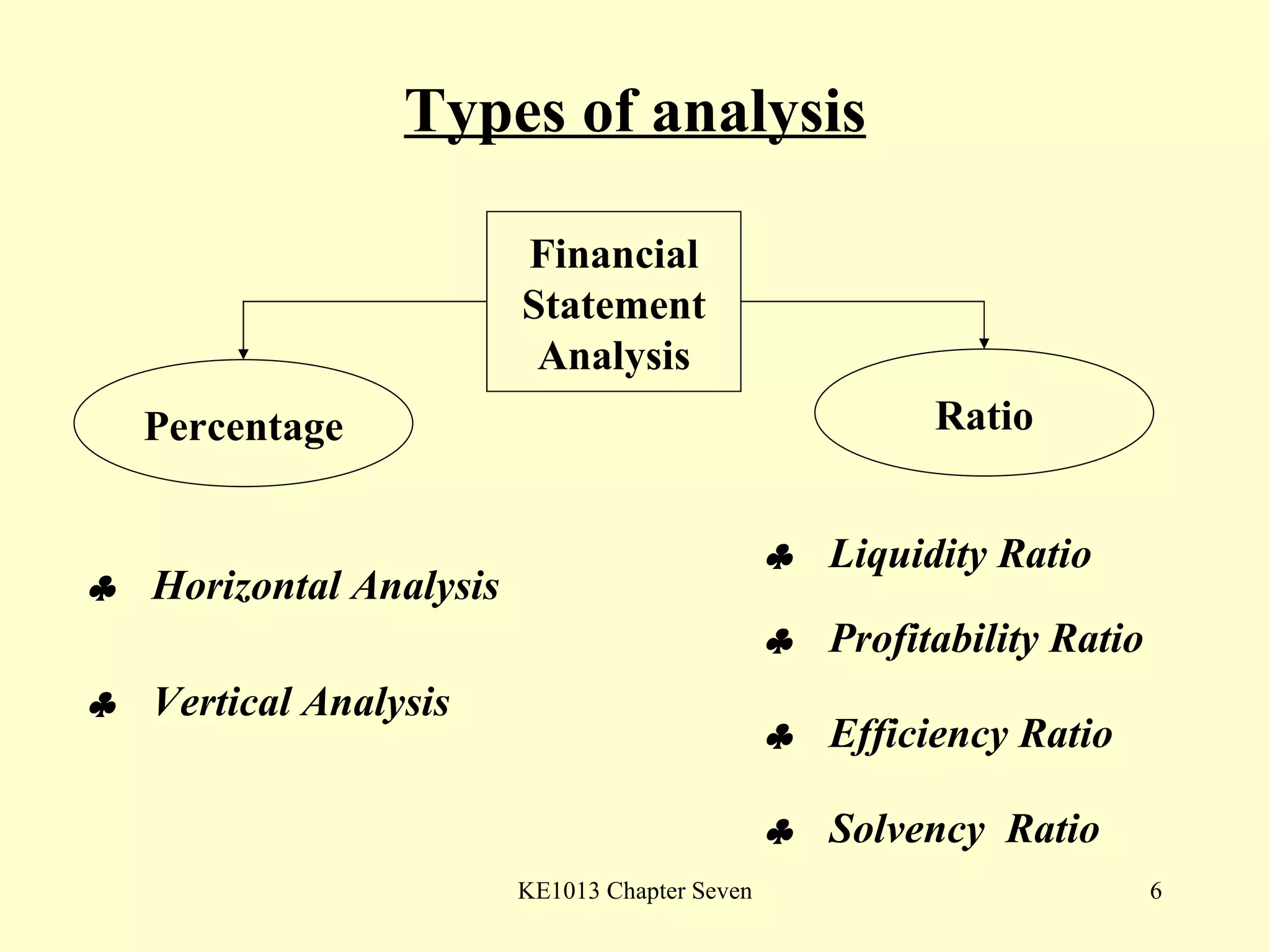
Types of analysis Financial Statement Analysis Percentage Ratio    Horizontal Analysis    Vertical Analysis    Liquidity Ratio    Profitability Ratio    Efficiency Ratio    Solvency  Ratio
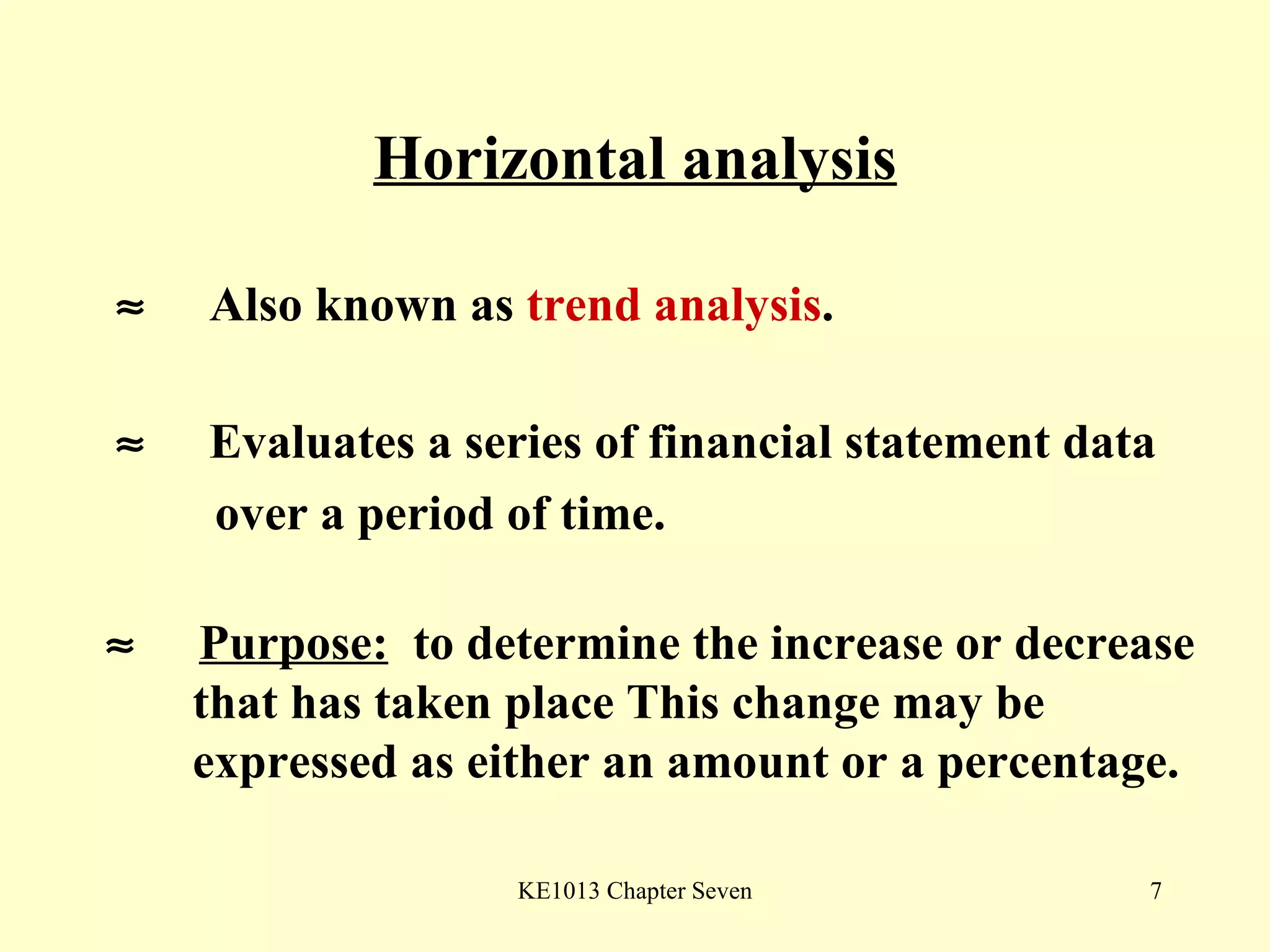
Horizontal analysis    Also known as  trend analysis .    Evaluates a series of financial statement data over a period of time.    Purpose:   to determine the increase or decrease  that has taken place This change may be  expressed as either an amount or a percentage.
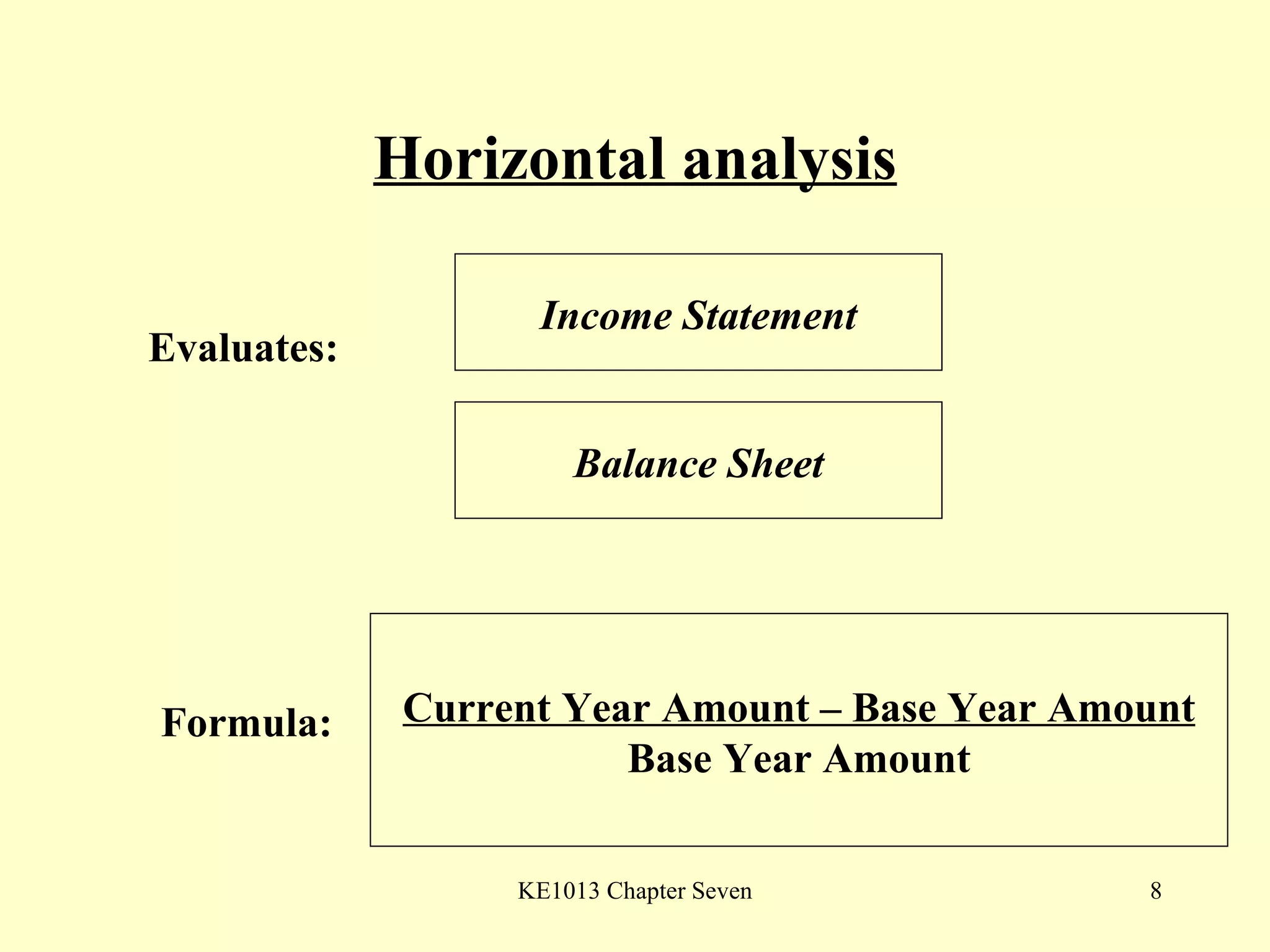
Horizontal analysis Evaluates: Income Statement Balance Sheet Formula: Current Year Amount – Base Year Amount Base Year Amount
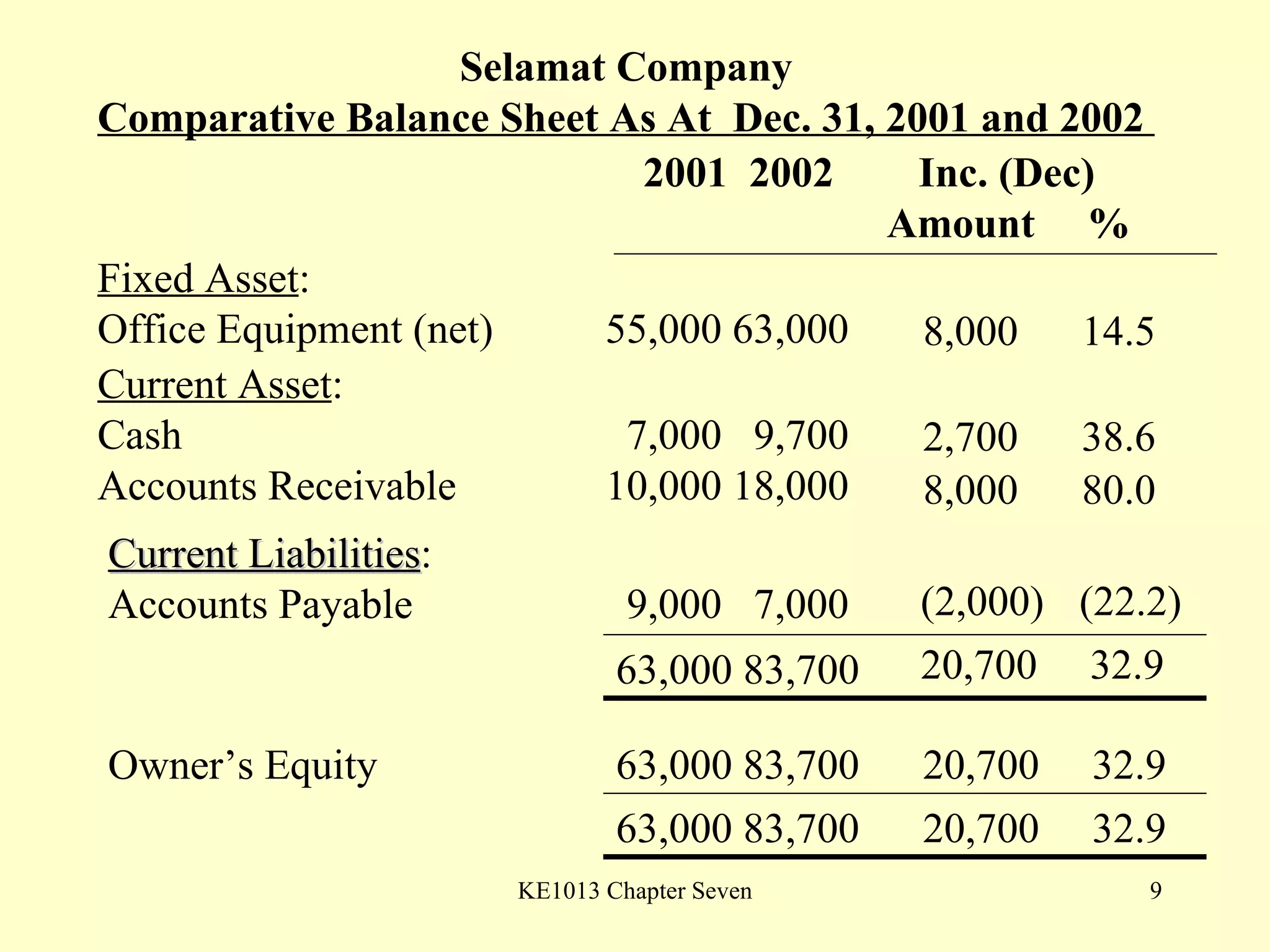
Selamat Company Comparative Balance Sheet As At  Dec. 31, 2001 and 2002  Fixed Asset : Office Equipment (net) 55,000 63,000 Current Asset : Cash   7,000   9,700 Accounts Receivable 10,000 18,000 Current Liabilities : Accounts Payable  9,000  7,000 2001  2002  Inc. (Dec)   Amount  % 63,000 83,700 Owner’s Equity 63,000 83,700 63,000 83,700 8,000   14.5 2,700   38.6 8,000   80.0 (2,000)   (22.2) 20,700   32.9 20,700   32.9 20,700   32.9
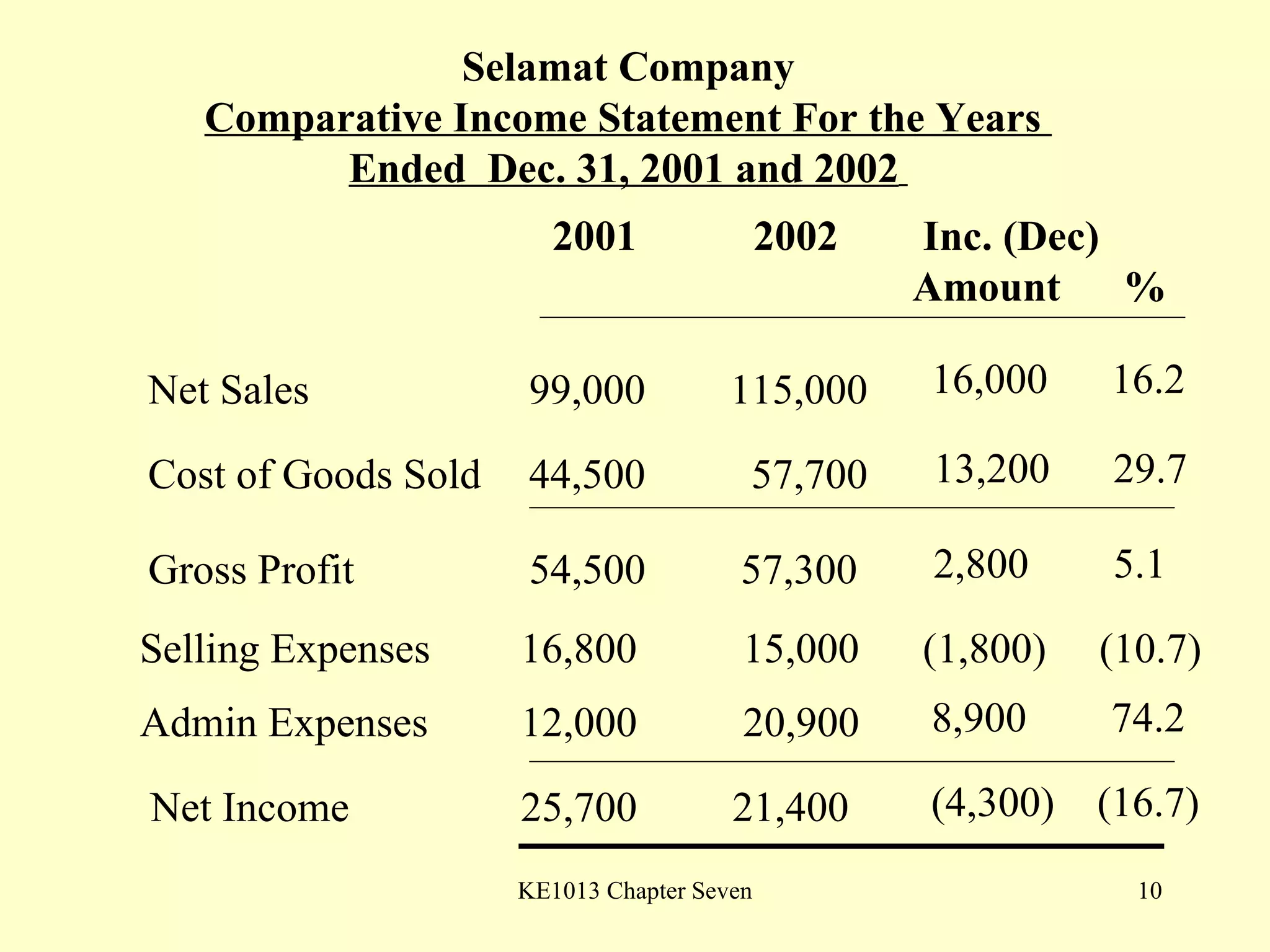
Selamat Company Comparative Income Statement For the Years  Ended  Dec. 31, 2001 and 2002   2001   2002  Inc. (Dec)     Amount  % Net Sales 99,000   115,000 Cost of Goods Sold 44,500   57,700 Gross Profit 54,500   57,300 Selling Expenses 16,800   15,000 Admin Expenses 12,000   20,900  Net Income   25,700  21,400  16,000   16.2 13,200  29.7 2,800   5.1 (1,800)  (10.7) 8,900   74.2 (4,300)  (16.7)
Vertical Analysis    Evaluates financial statement data  expressing  each item in a financial statement as a percent of a base amount.    Vertical analysis enables you to compare companies of different sizes.
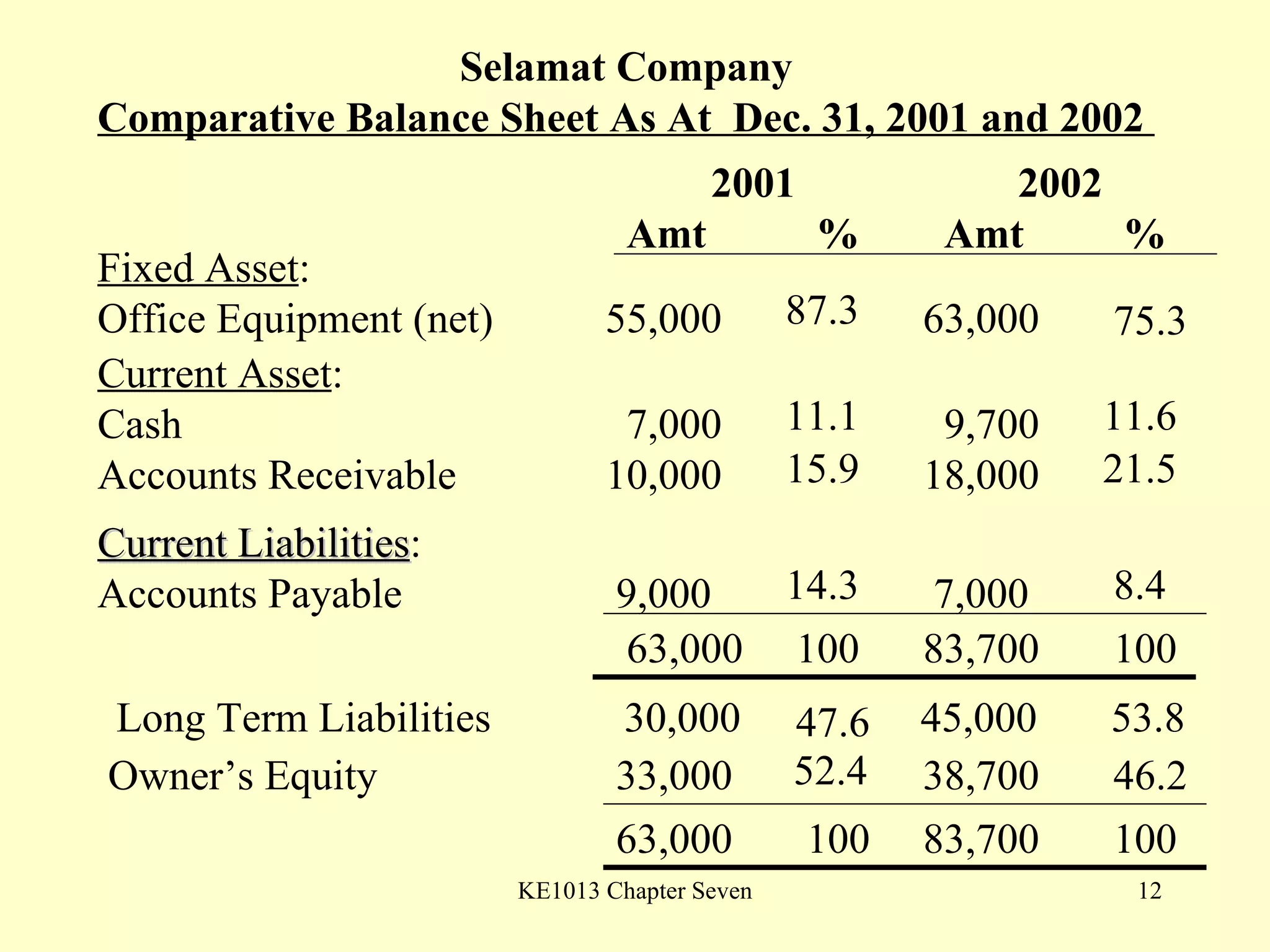
Selamat Company Comparative Balance Sheet As At  Dec. 31, 2001 and 2002  Fixed Asset : Office Equipment (net) 55,000   63,000 Current Asset : Cash   7,000     9,700 Accounts Receivable 10,000   18,000 Current Liabilities : Accounts Payable  9,000     7,000 63,000   83,700 Owner’s Equity 33,000   38,700 63,000   83,700   2001    2002 Amt % Amt   % Long Term Liabilities 30,000   45,000 100 87.3 11.1 15.9 14.3 100 100 100 47.6 52.4 75.3 11.6 21.5 8.4 53.8 46.2
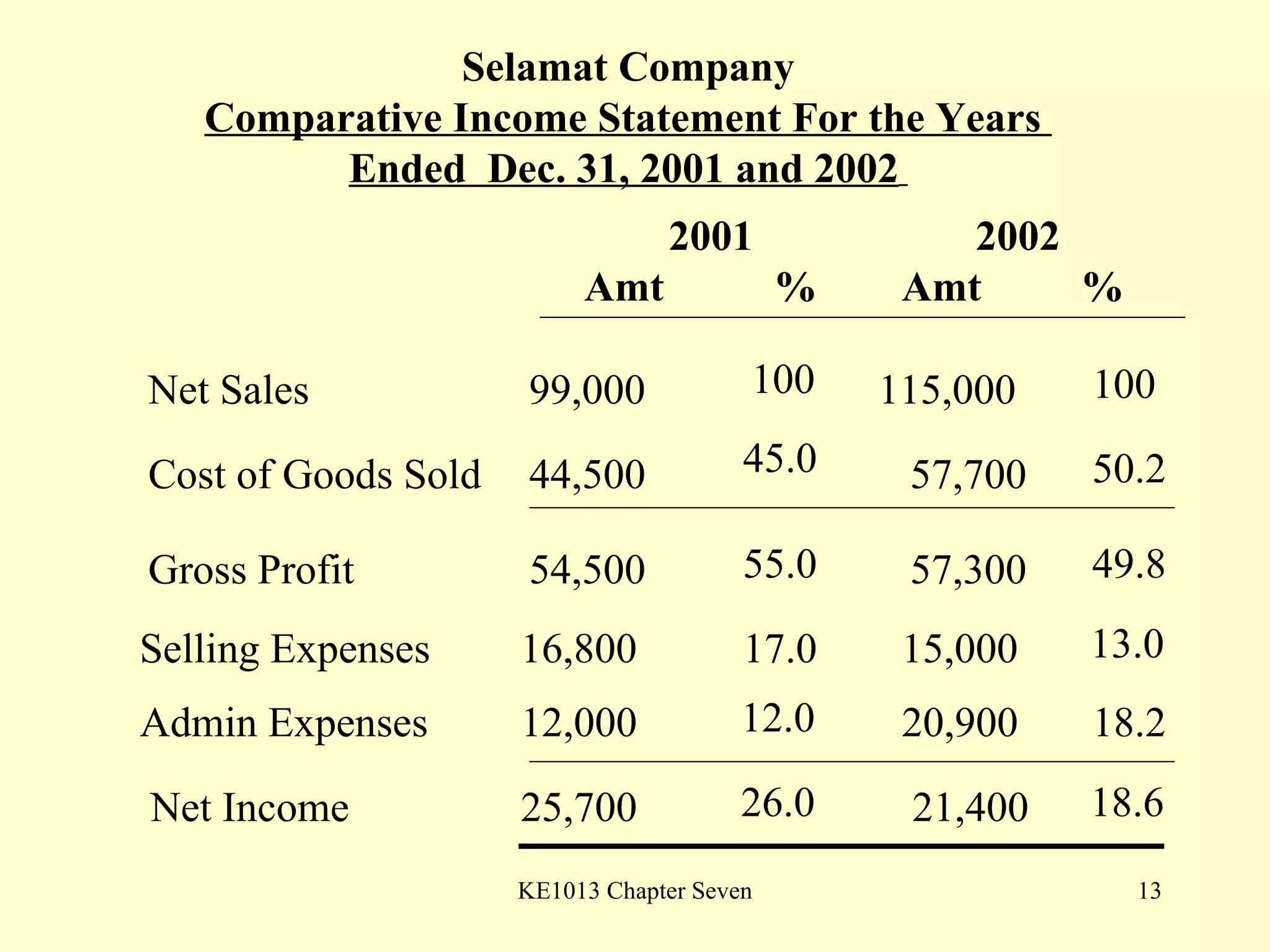
Selamat Company Comparative Income Statement For the Years  Ended  Dec. 31, 2001 and 2002     2001    2002 Amt % Amt   % Net Sales 99,000     115,000 Cost of Goods Sold 44,500   57,700 Gross Profit 54,500   57,300 Selling Expenses 16,800   15,000 Admin Expenses 12,000   20,900  Net Income   25,700  21,400  100 100 45.0 55.0 17.0 12.0 26.0 50.2 49.8 13.0 18.2 18.6
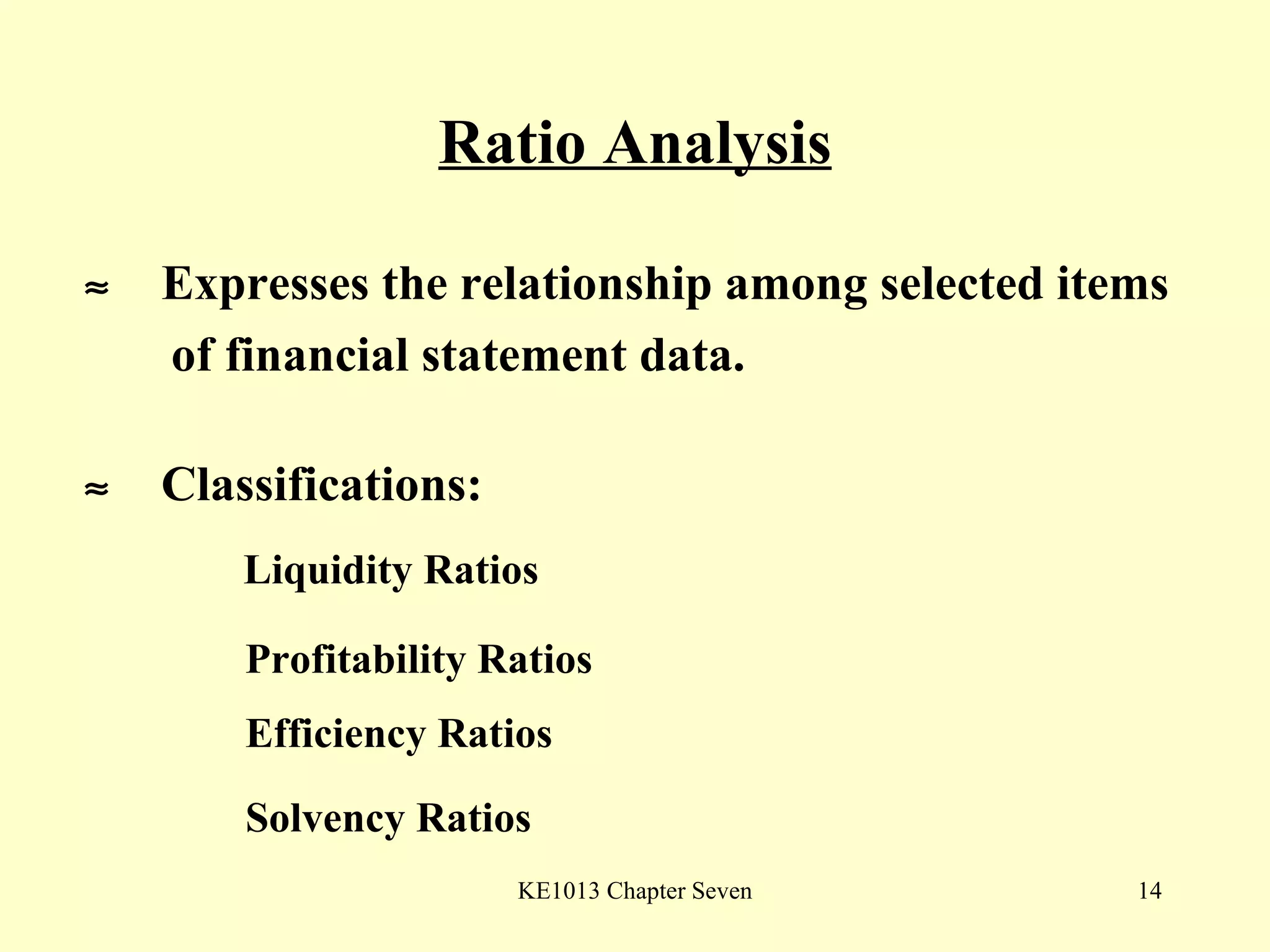
Ratio Analysis    Expresses the relationship among selected items of financial statement data.    Classifications: Liquidity Ratios Profitability Ratios Efficiency Ratios Solvency Ratios
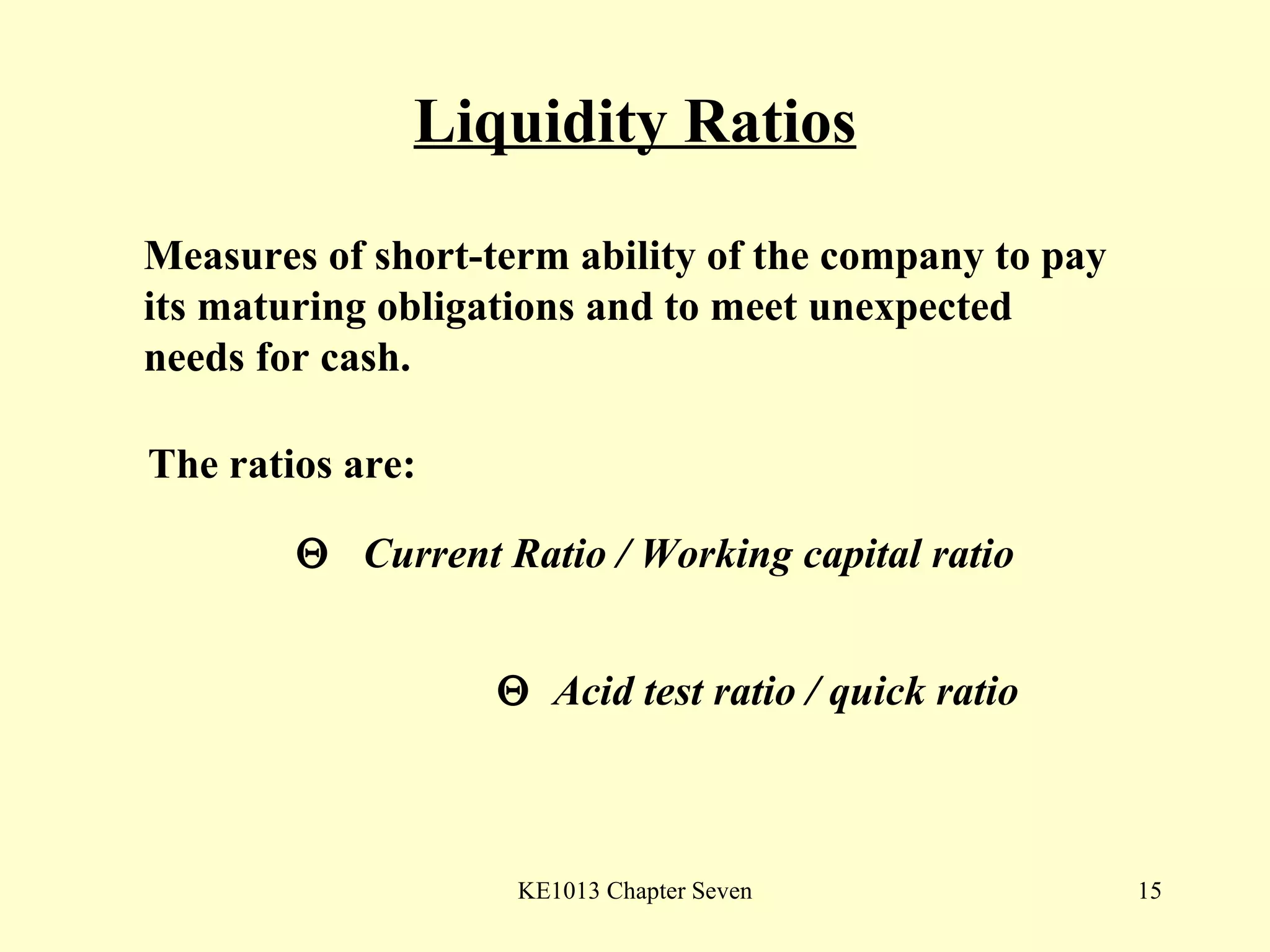
Liquidity Ratios The ratios are:    Current Ratio / Working capital ratio    Acid test ratio / quick ratio  Measures of short-term ability of the company to pay its maturing obligations and to meet unexpected needs for cash.
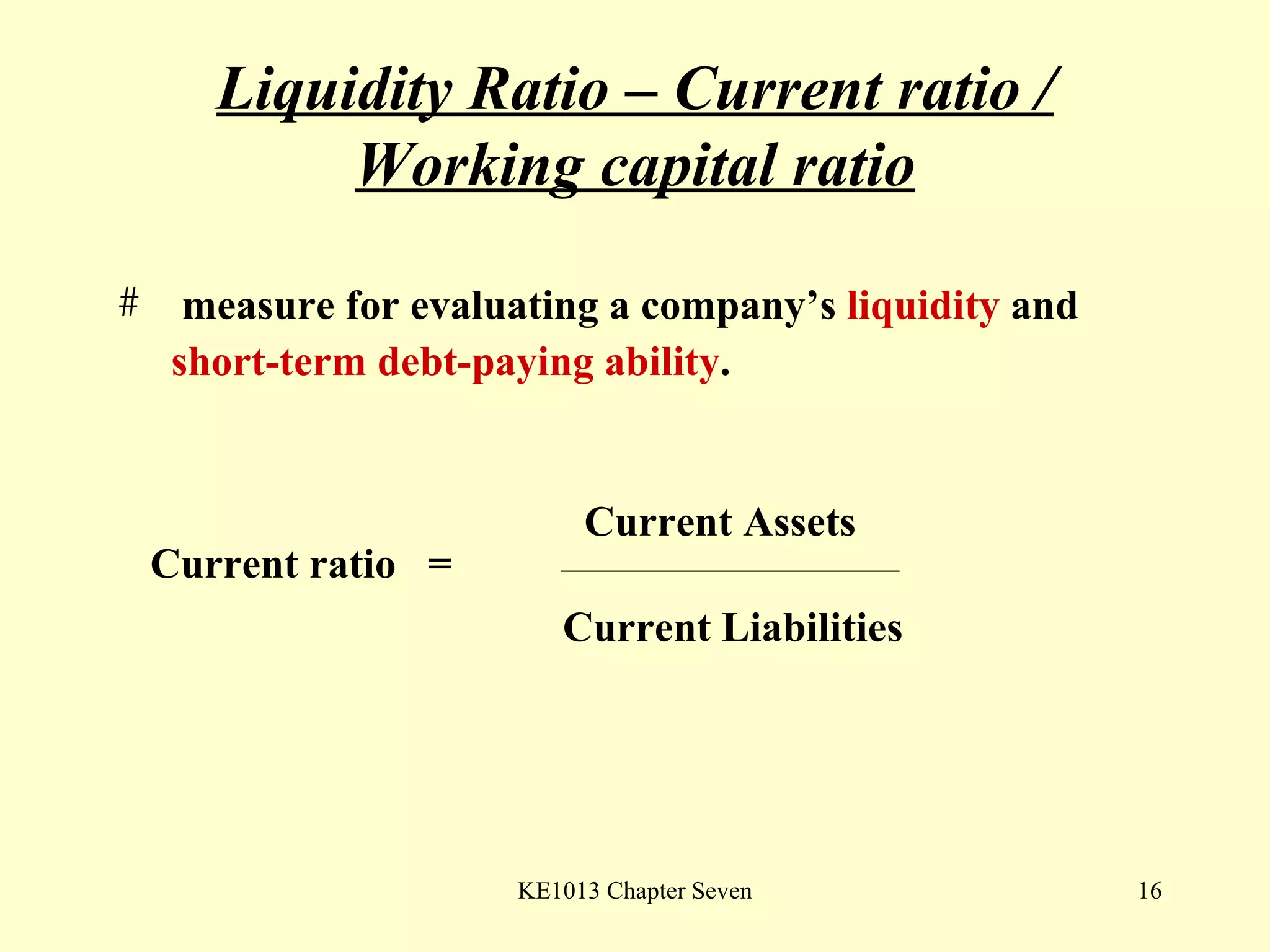
Liquidity Ratio – Current ratio / Working capital ratio measure for evaluating a company’s  liquidity  and  short-term debt-paying ability .  Current ratio  =  Current Assets Current Liabilities
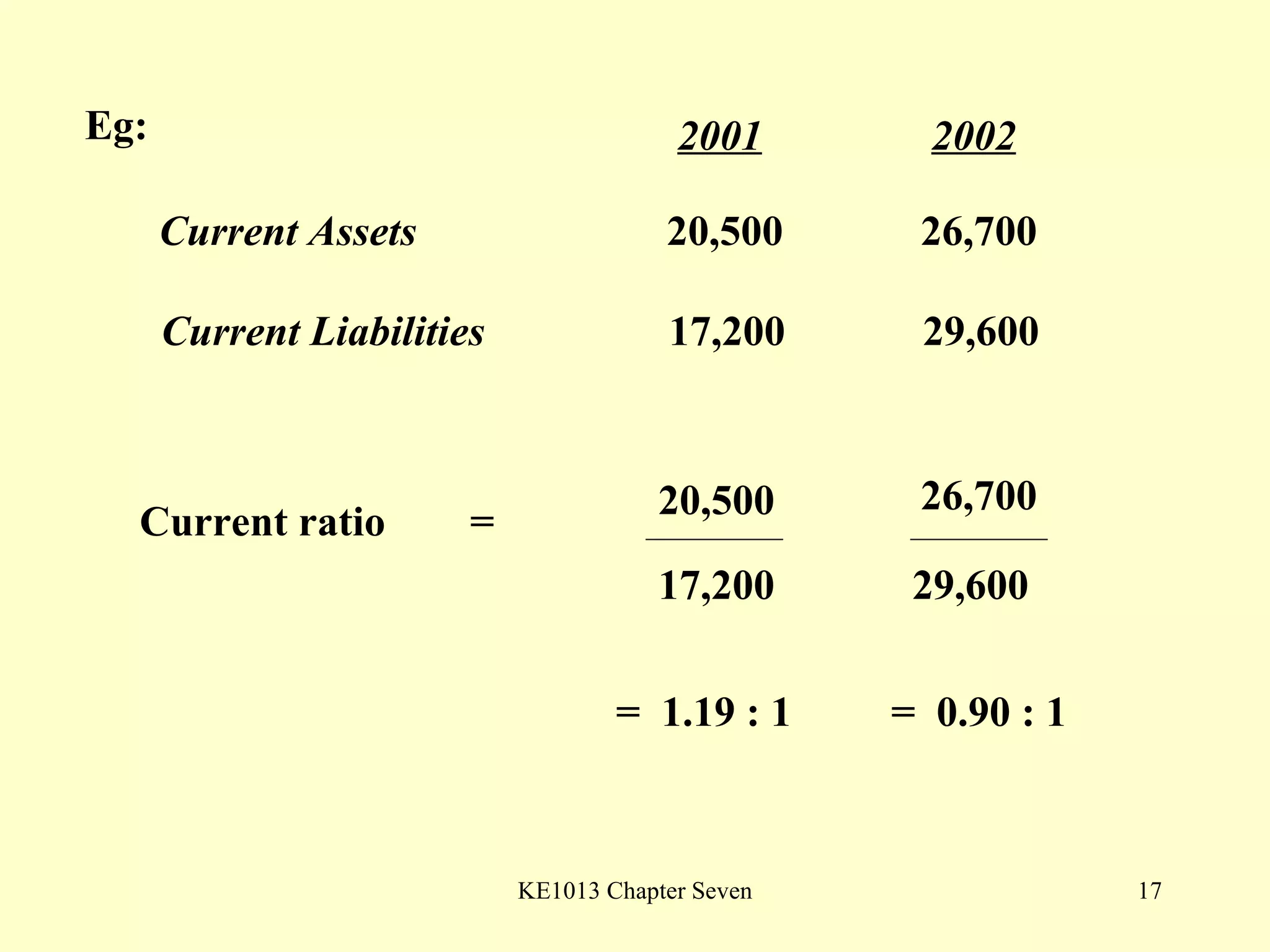
Eg: Current Assets 20,500 26,700 Current Liabilities 17,200 29,600 2001 2002 Current ratio  =  20,500 17,200 26,700 29,600 =  1.19 : 1 =  0.90 : 1
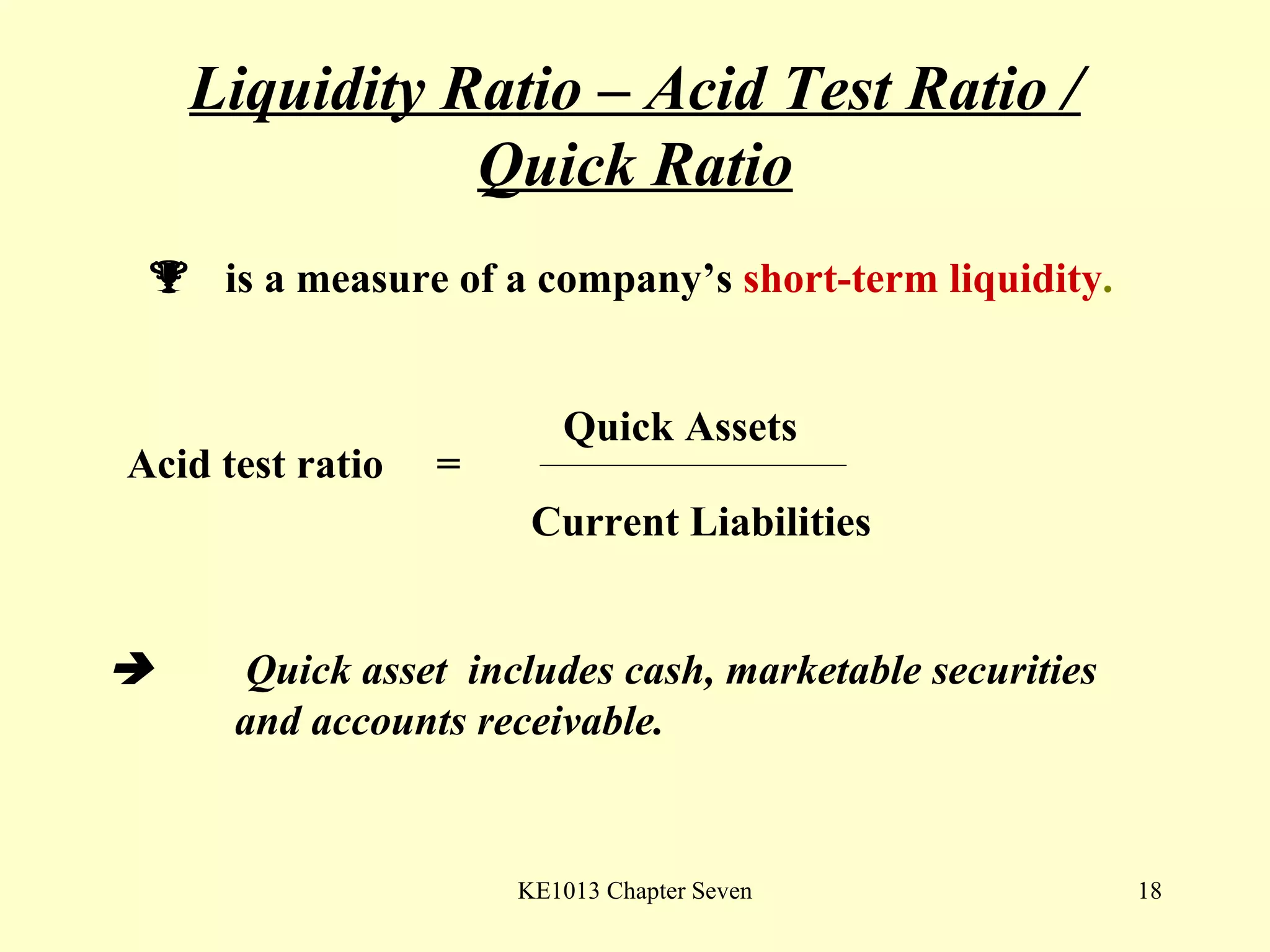
Liquidity Ratio – Acid Test Ratio / Quick Ratio    is a measure of a company’s  short-term liquidity . Acid test ratio  =  Quick Assets Current Liabilities      Quick asset  includes cash, marketable securities  and accounts receivable.
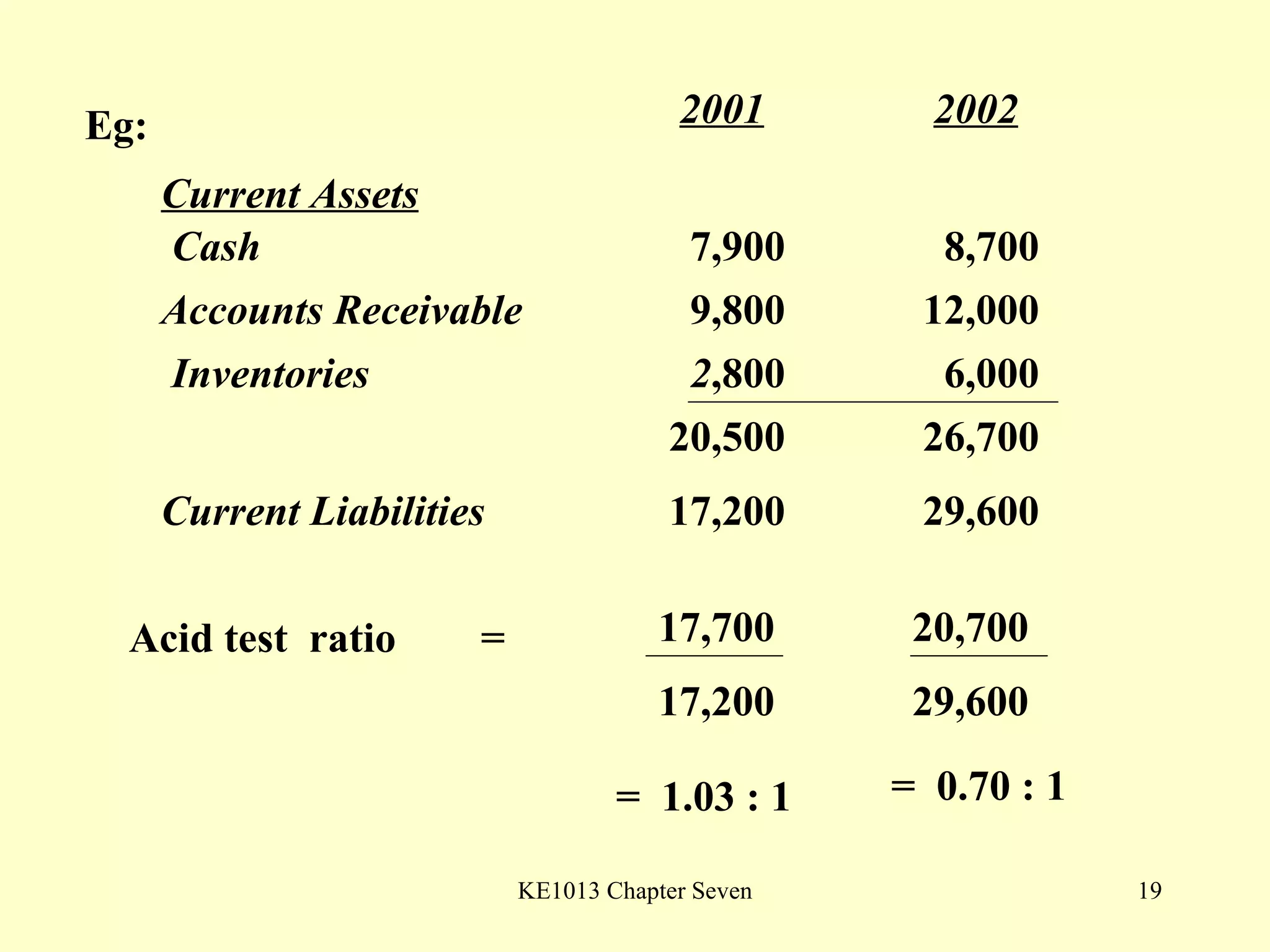
Eg: Current Assets Current Liabilities 17,200 29,600 2001 2002 Acid test  ratio  =  17,700 17,200 20,700 29,600 =  1.03 : 1 =  0.70 : 1 Cash   7,900  8,700 Accounts Receivable   9,800 12,000 Inventories  2 ,800  6,000 20,500 26,700
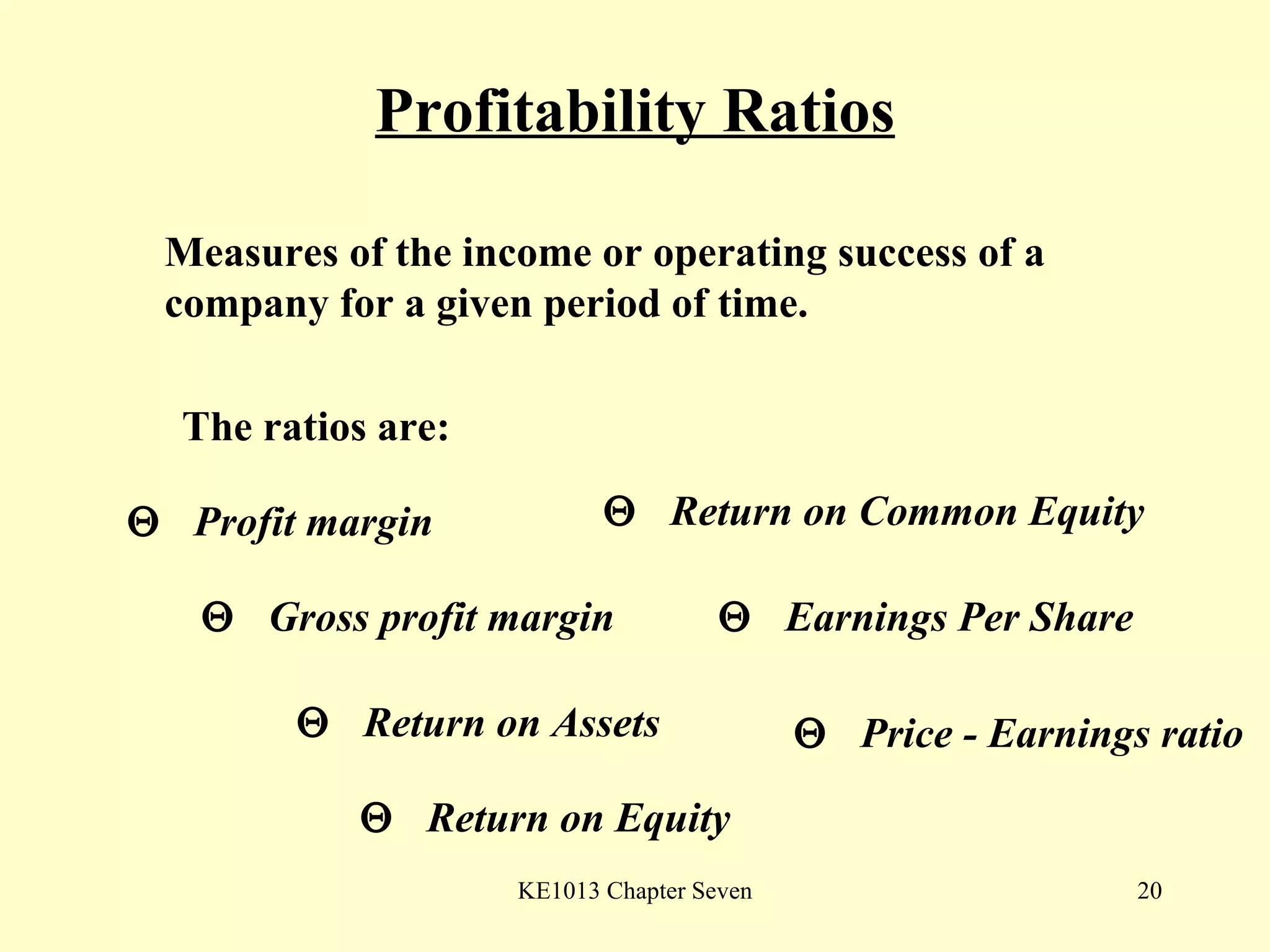
Profitability Ratios The ratios are:    Profit margin    Gross profit margin    Return on Assets     Return on Equity    Return on Common Equity    Earnings Per Share    Price - Earnings ratio Measures of the income or operating success of a company for a given period of time.
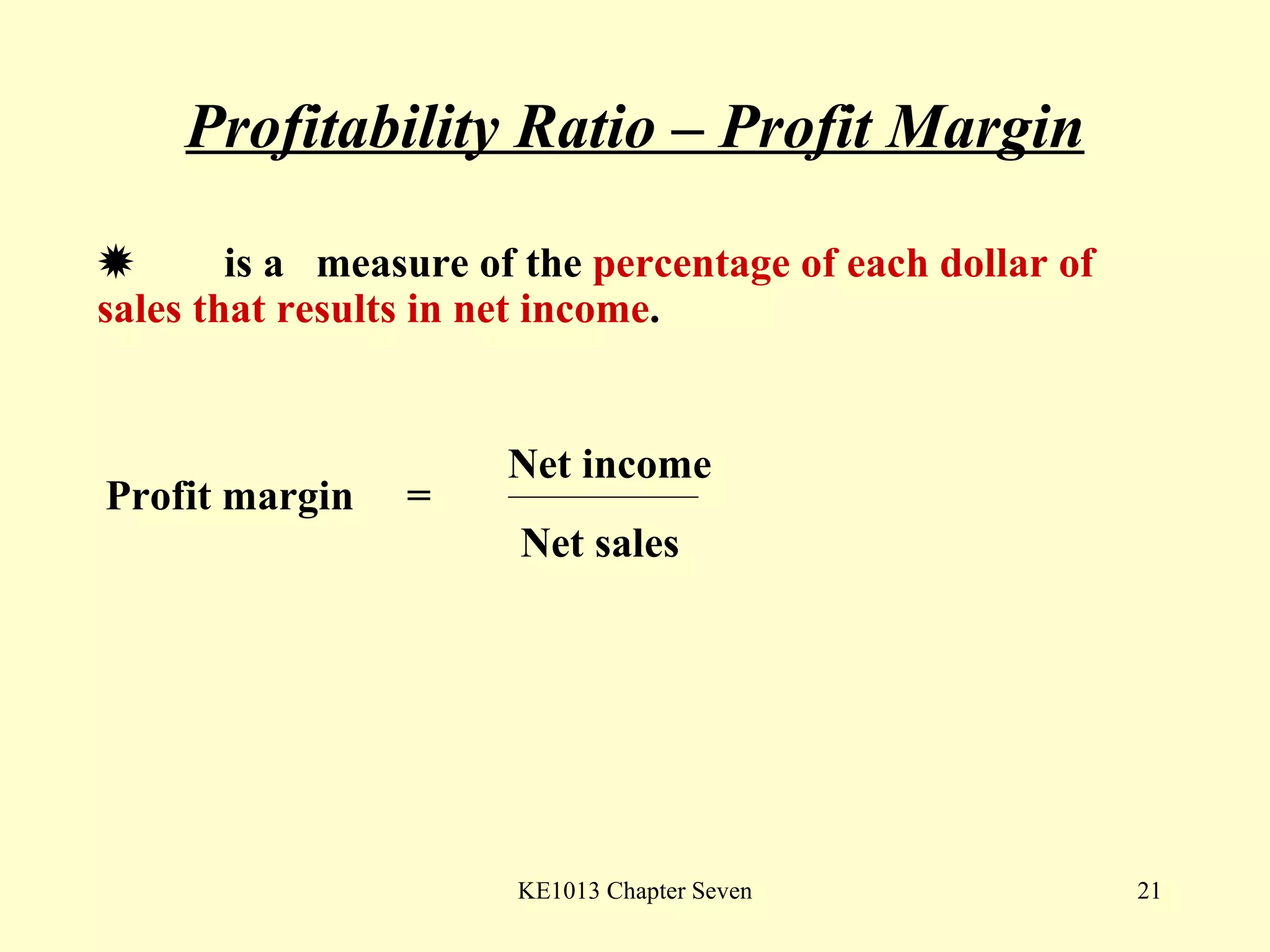
Profitability Ratio – Profit Margin  is a  measure of the  percentage of each dollar of  sales that results in net income .  Profit margin  =  Net income Net sales
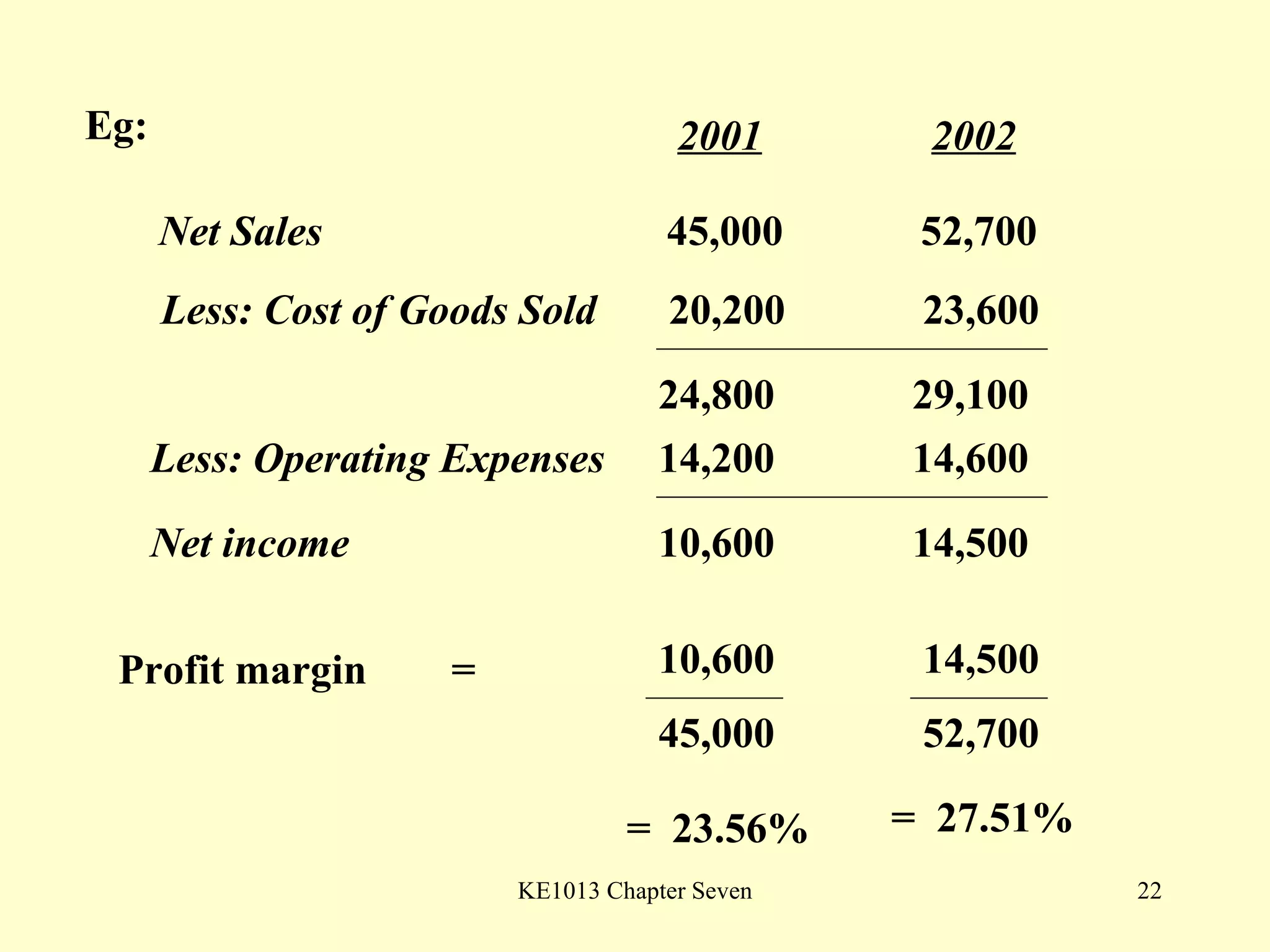
Eg: Net Sales 45,000 52,700 Less: Cost of Goods Sold 20,200 23,600 2001 2002 Profit margin  =  10,600 45,000 14,500 52,700 =  23.56% =  27.51% 24,800 29,100 Less: Operating Expenses 14,200 14,600 Net income 10,600 14,500
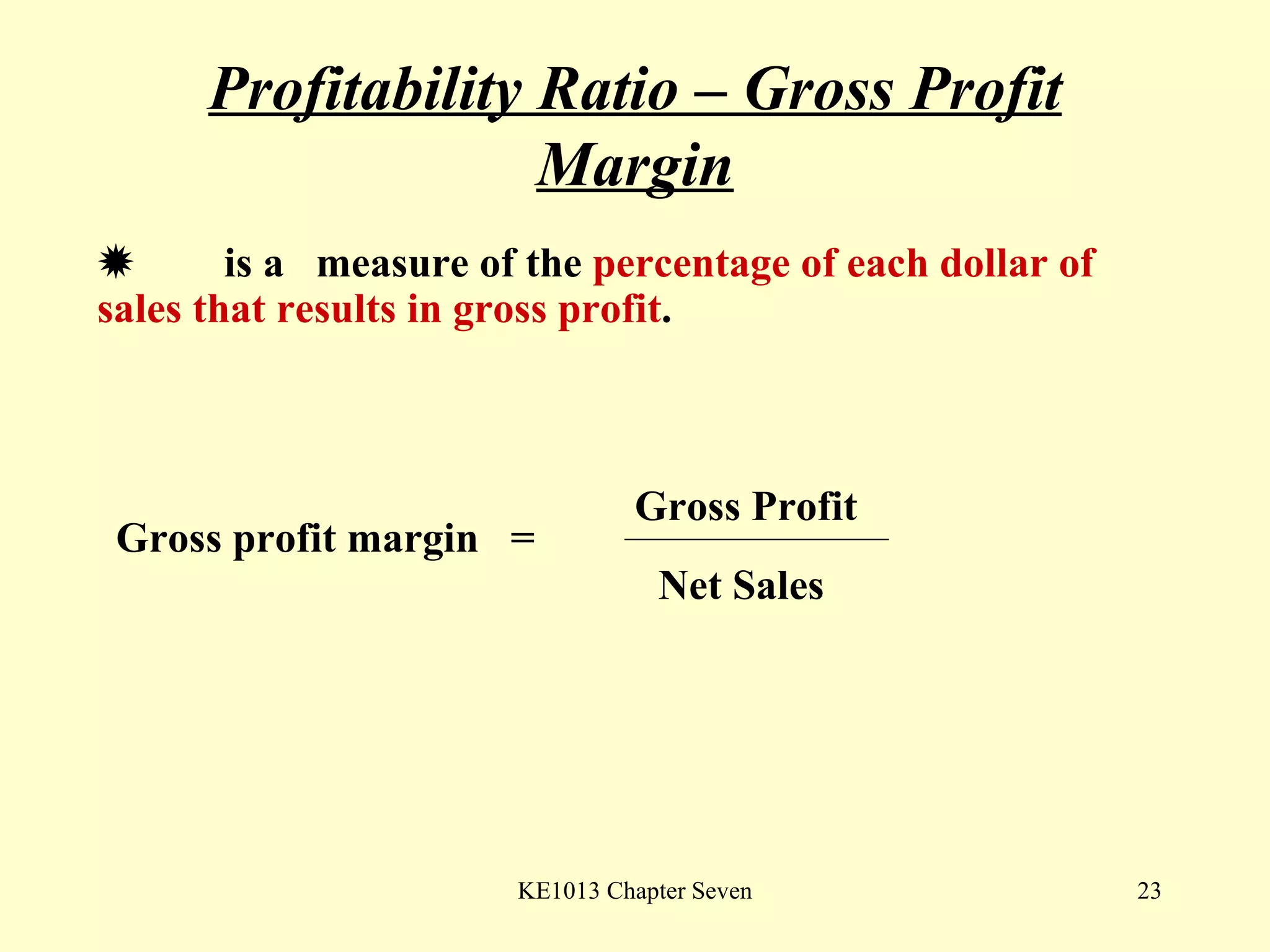
Profitability Ratio – Gross Profit Margin  is a  measure of the  percentage of each dollar of  sales that results in gross profit .  Gross profit margin  =  Gross Profit Net Sales
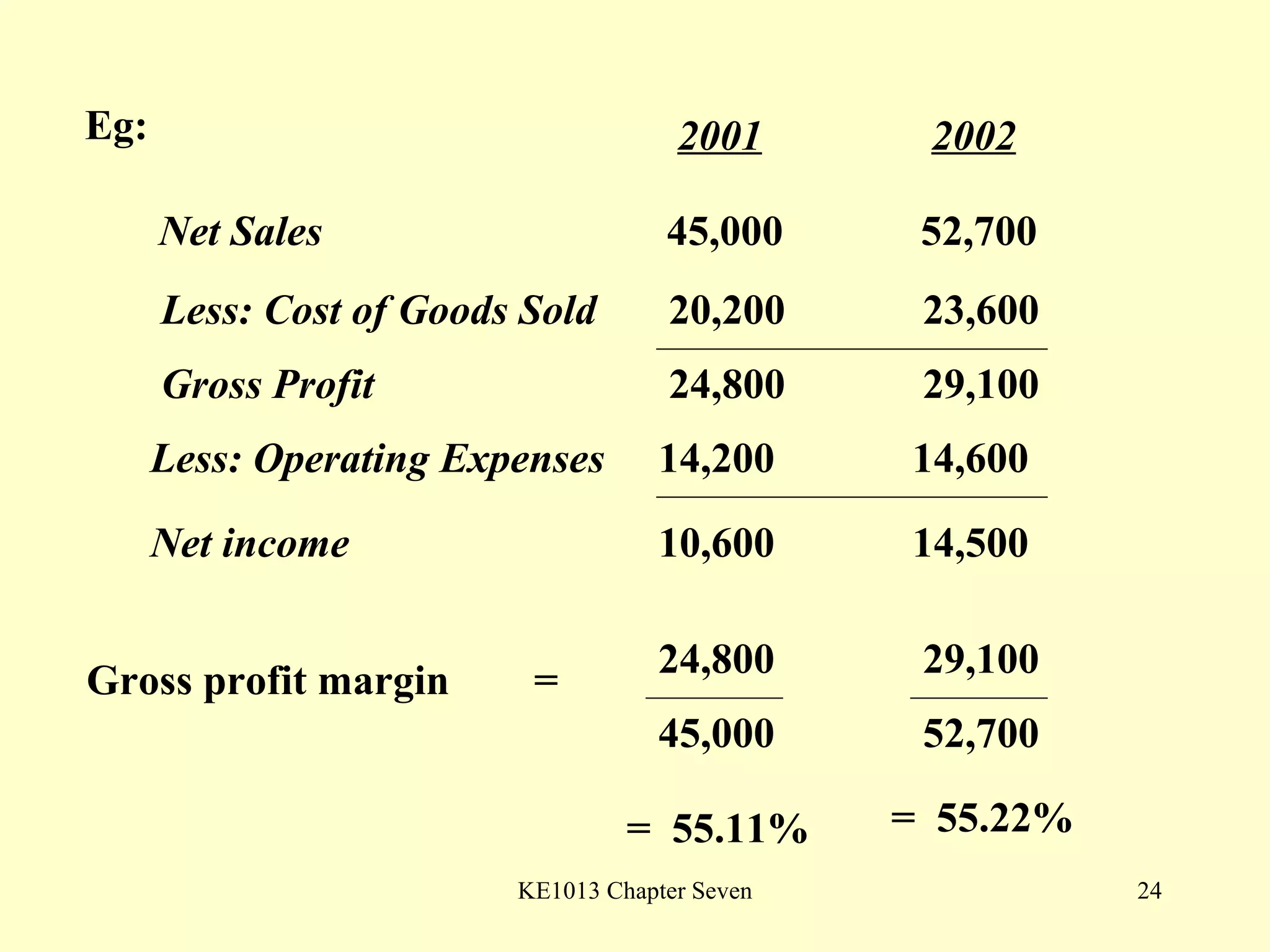
Eg: Net Sales 45,000 52,700 Less: Cost of Goods Sold 20,200 23,600 2001 2002 Gross profit margin  =  24,800 45,000 29,100 52,700 =  55.11% =  55.22% Gross Profit 24,800 29,100 Less: Operating Expenses 14,200 14,600 Net income 10,600 14,500
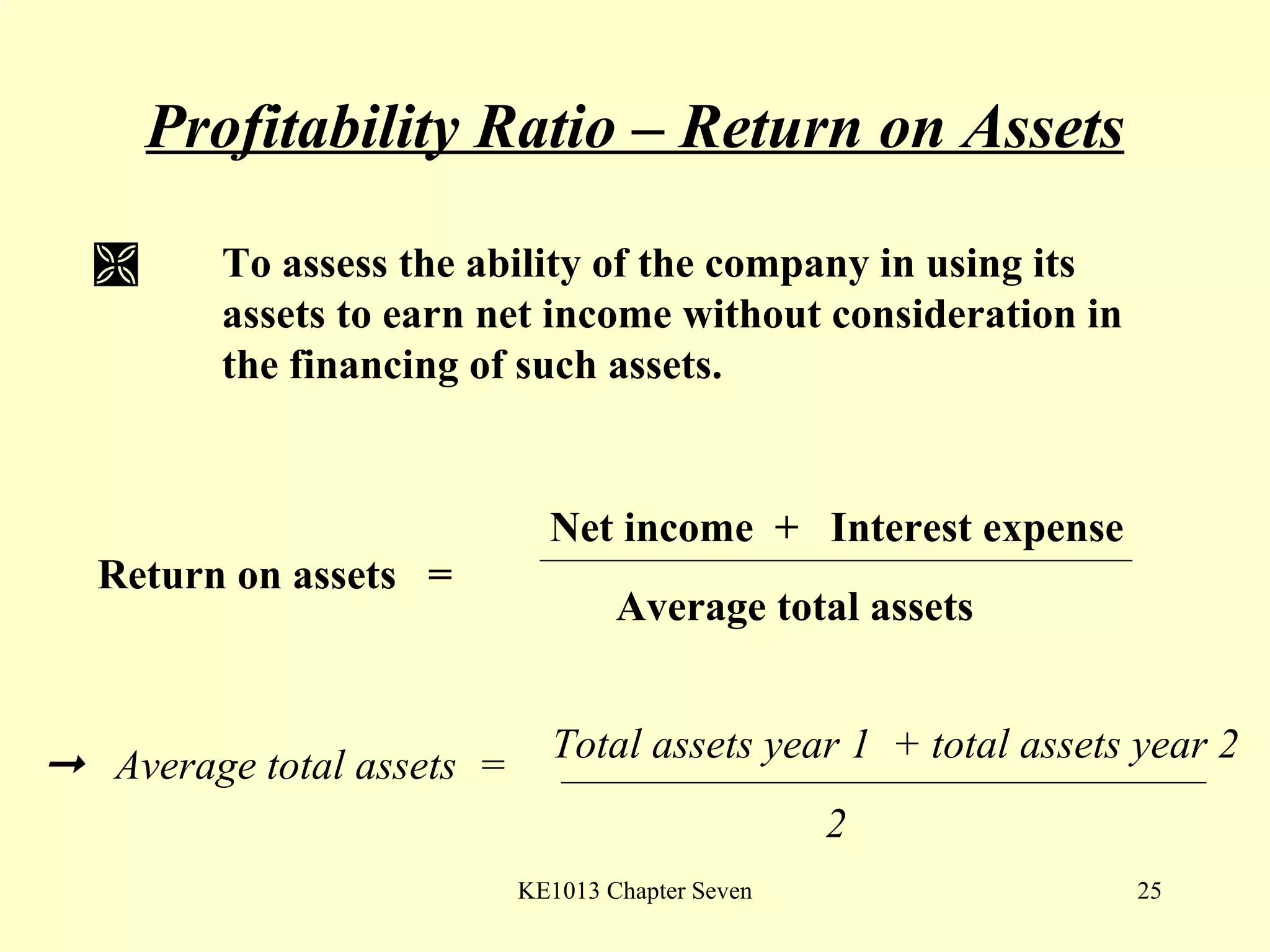
Profitability Ratio – Return on Assets    To assess the ability of the company in using its  assets to earn net income without consideration in  the financing of such assets. Return on assets  =  Net income  +  Interest expense Average total assets    Average total assets  =  Total assets year 1  + total assets year 2 2
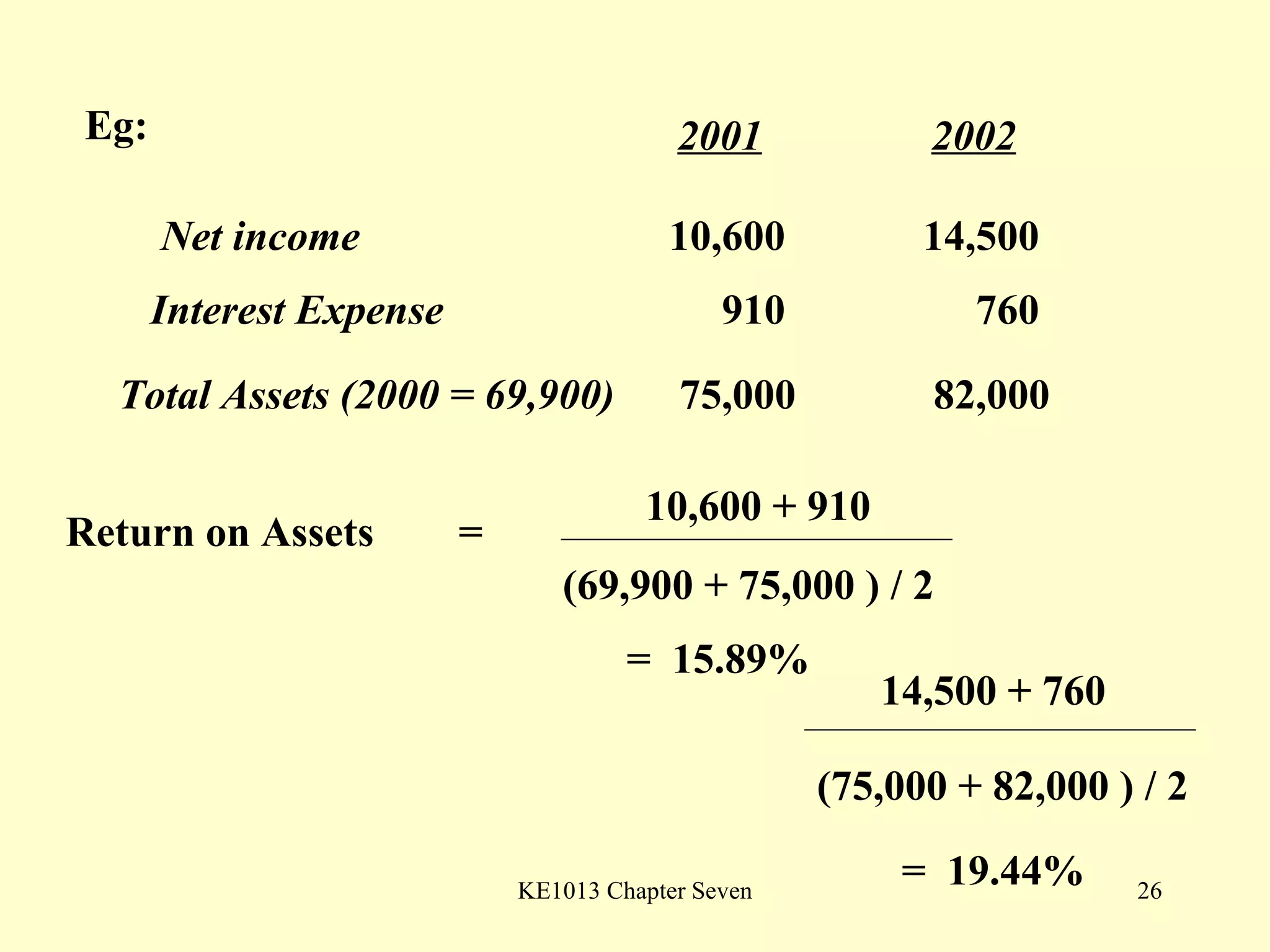
Eg: 2001 2002 Return on Assets  =  =  15.89% Net income 10,600 14,500 Interest Expense   910   760 Total Assets (2000 = 69,900)   75,000   82,000 10,600 + 910 (69,900 + 75,000 ) / 2 14,500 + 760 (75,000 + 82,000 ) / 2 =  19.44%
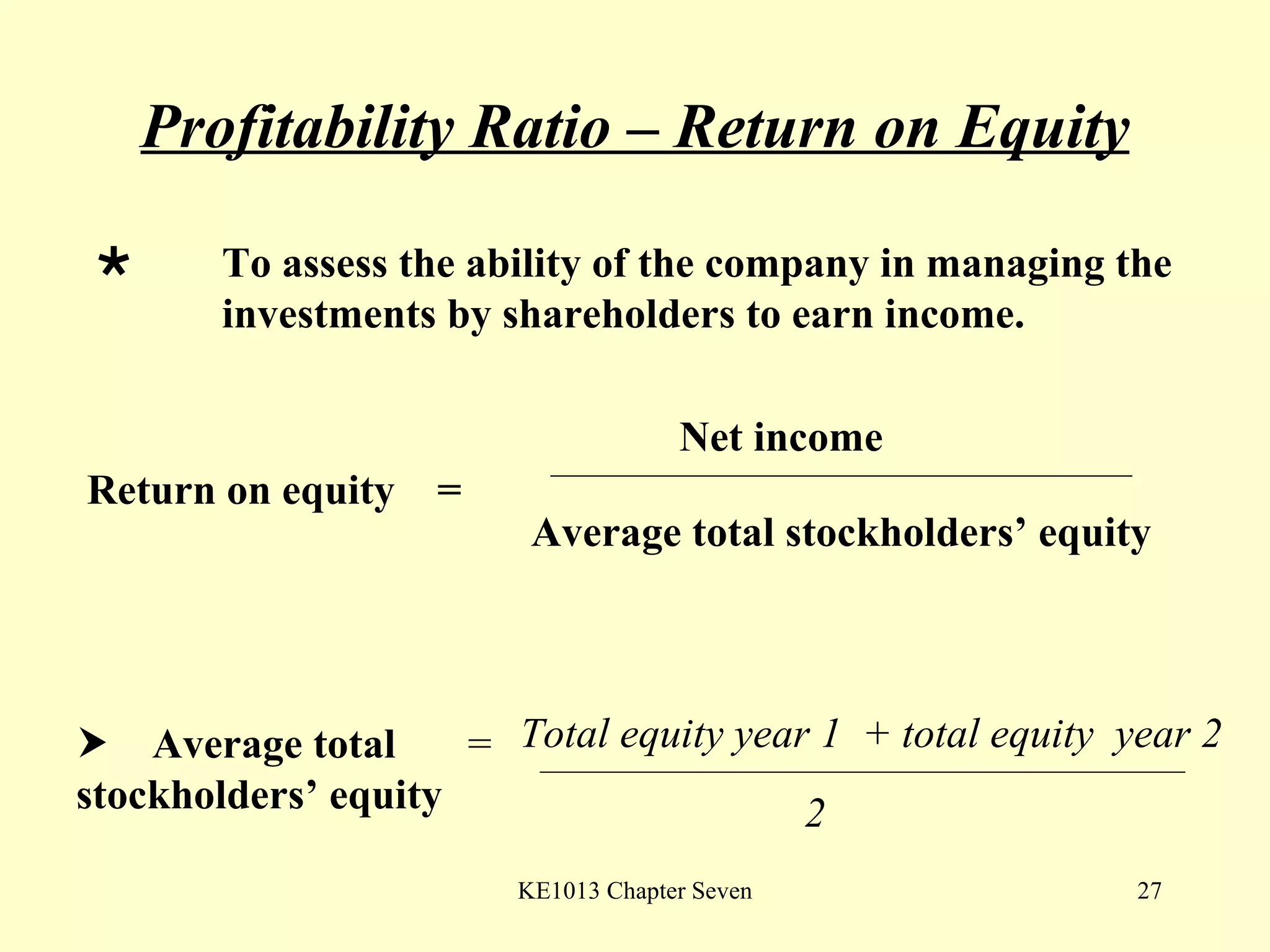
Profitability Ratio – Return on Equity  To assess the ability of the company in managing the  investments by shareholders to earn income. Return on equity  =  Net income Average total stockholders’ equity    Average total stockholders’ equity = Total equity year 1  + total equity  year 2 2
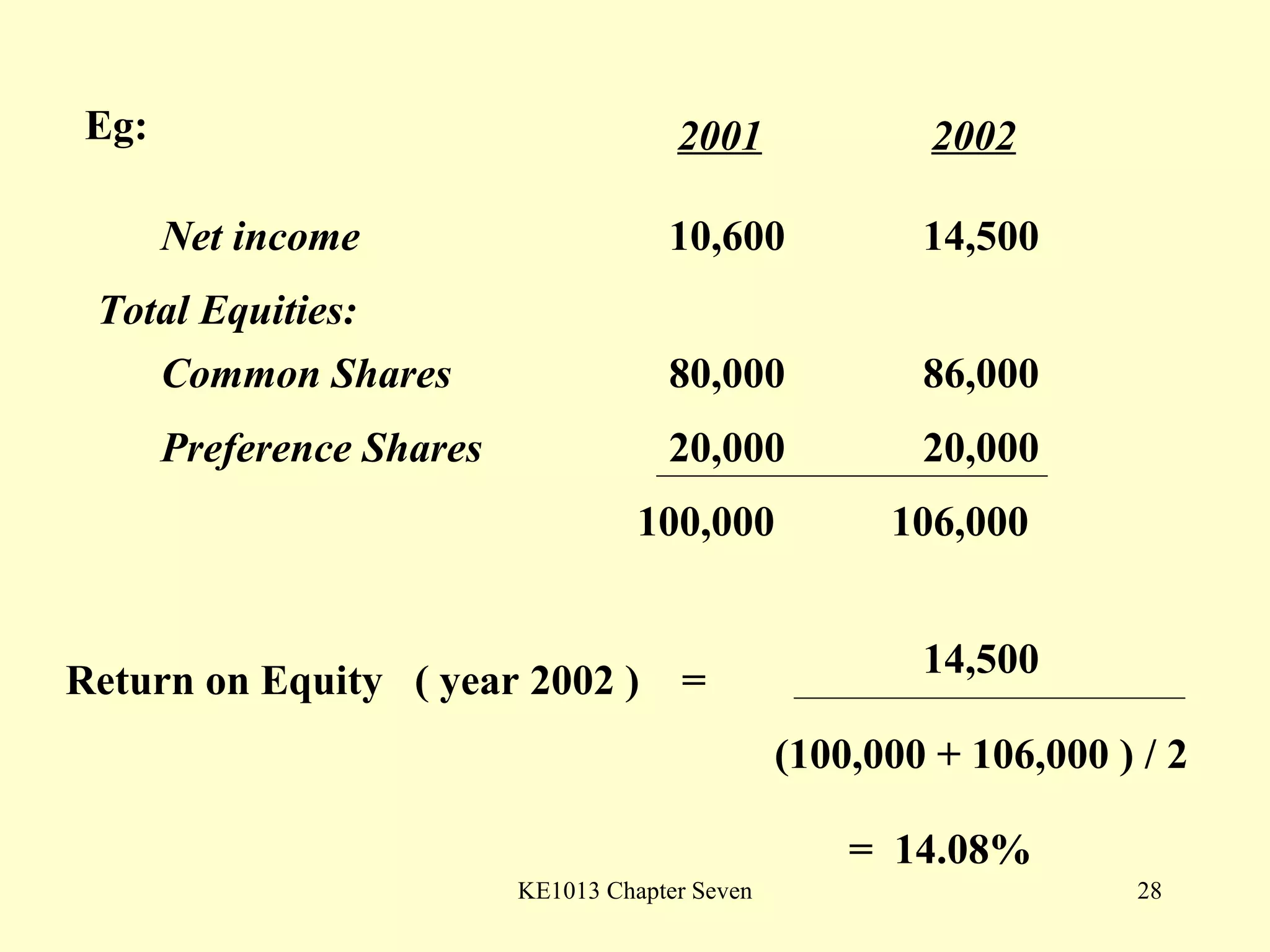
Eg: 2001 2002 Return on Equity  ( year 2002 )  =  Net income 10,600 14,500 Total Equities: 14,500 (100,000 + 106,000 ) / 2 =  14.08% Common Shares 80,000 86,000 Preference Shares 20,000 20,000 100,000 106,000
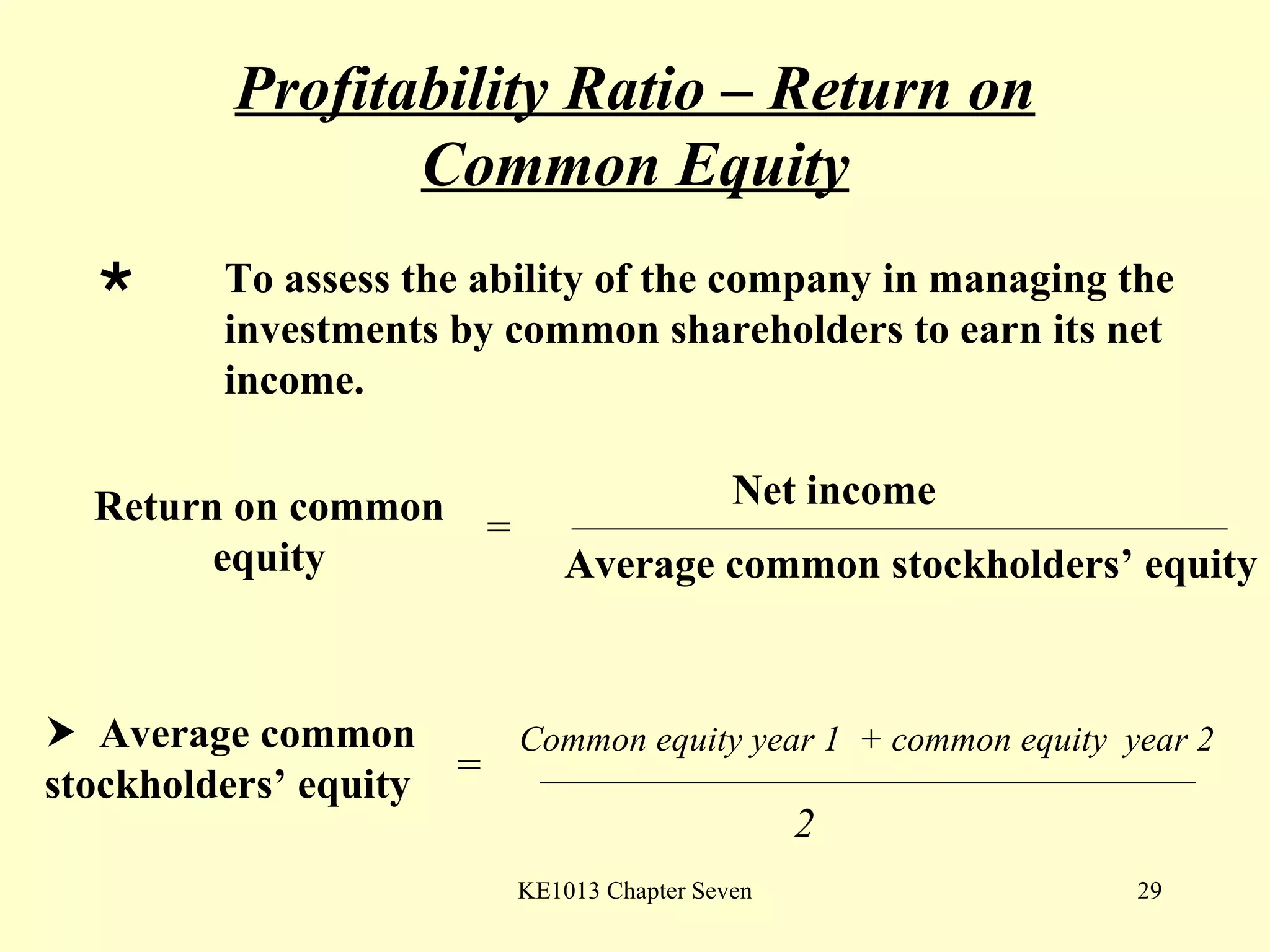
Profitability Ratio – Return on Common Equity  To assess the ability of the company in managing the  investments by common shareholders to earn its net  income. Return on common equity = Net income Average common stockholders’ equity    Average common stockholders’ equity = Common equity year 1  + common equity  year 2 2
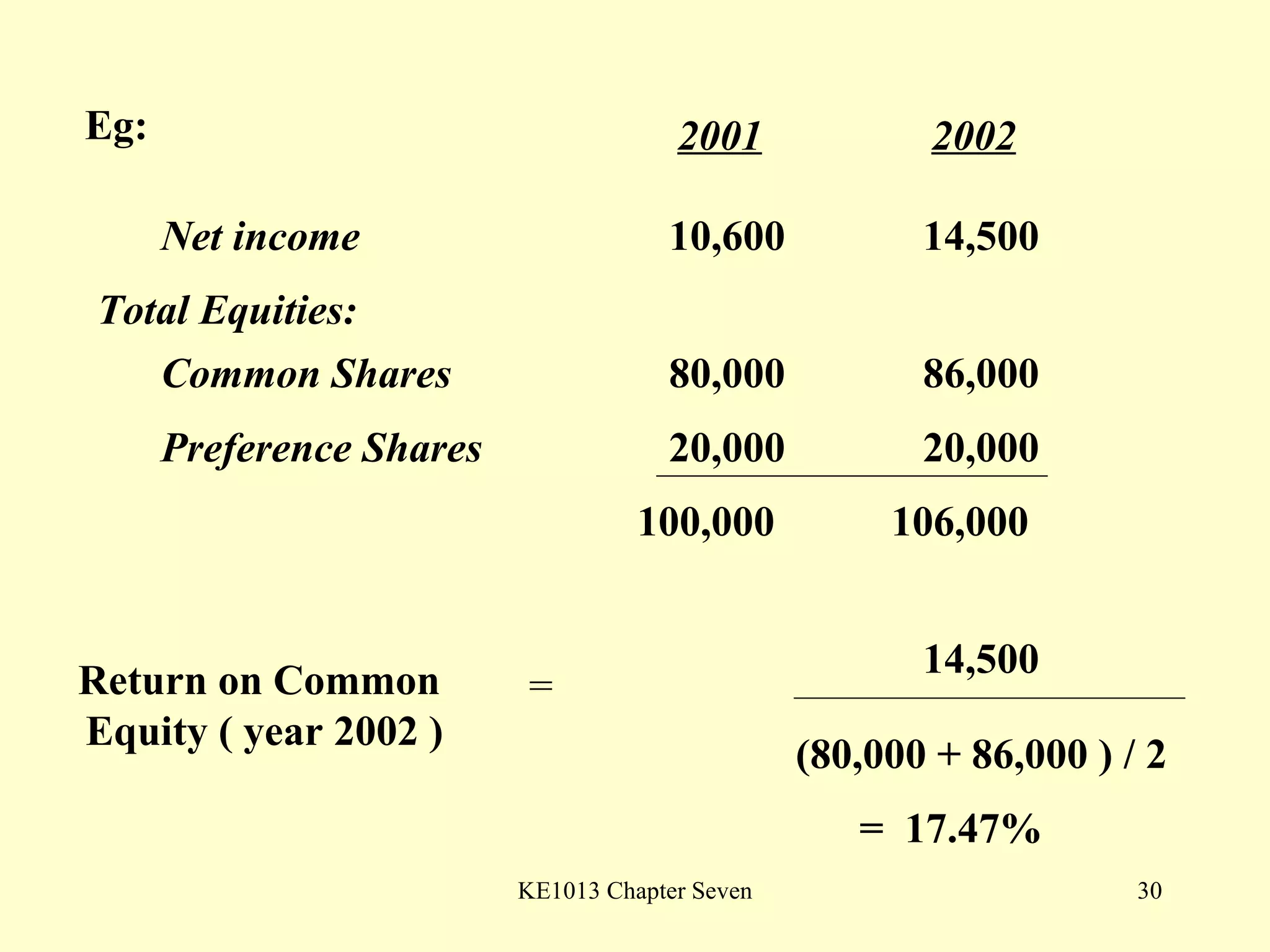
Eg: 2001 2002 Return on Common  Equity ( year 2002 ) Net income 10,600 14,500 Total Equities: 14,500 (80,000 + 86,000 ) / 2 =  17.47% Common Shares 80,000 86,000 Preference Shares 20,000 20,000 100,000 106,000 =
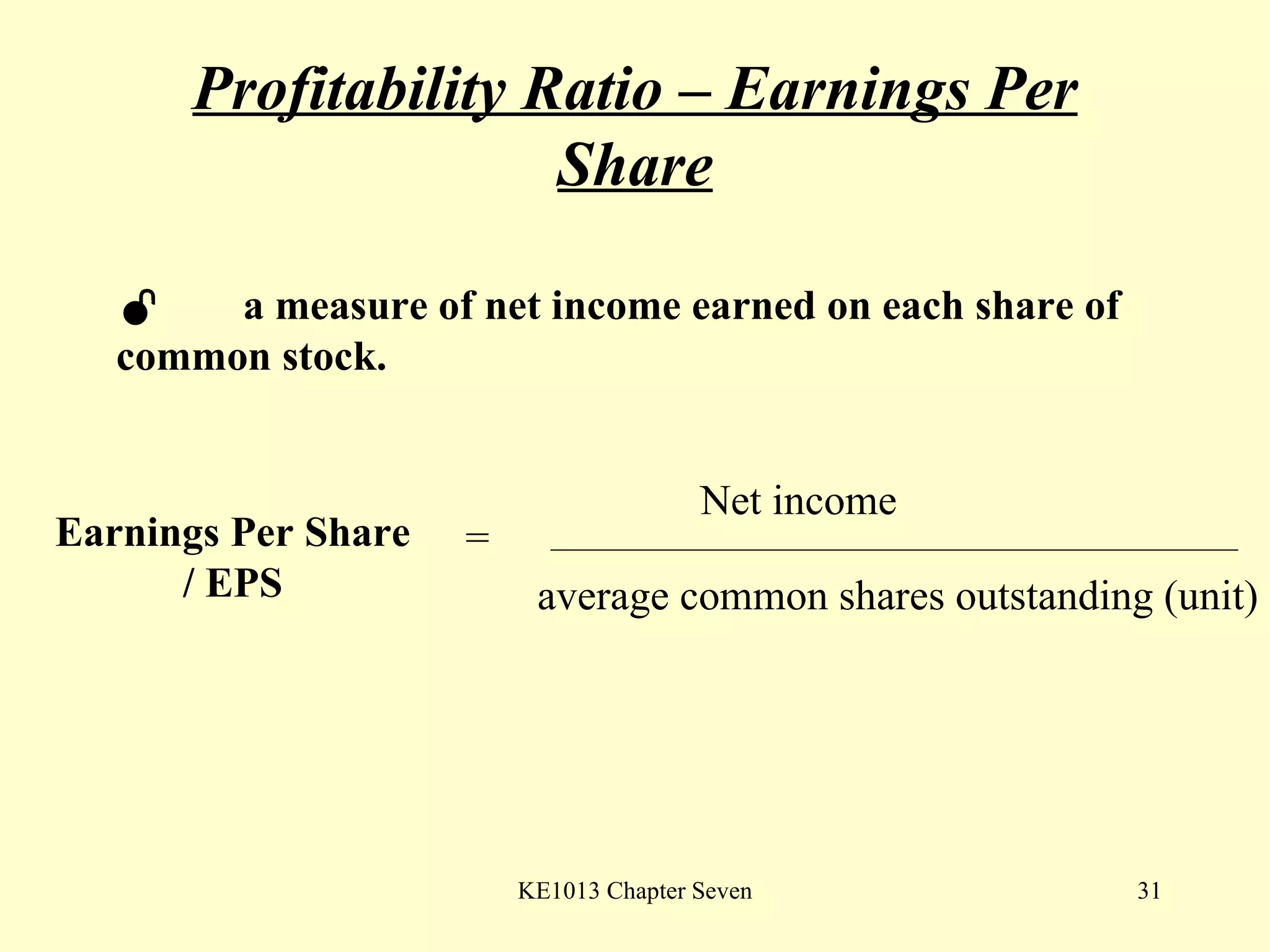
Profitability Ratio – Earnings Per Share  a measure of net income earned on each share of  common stock.  Earnings Per Share / EPS Net income average common shares outstanding (unit) =
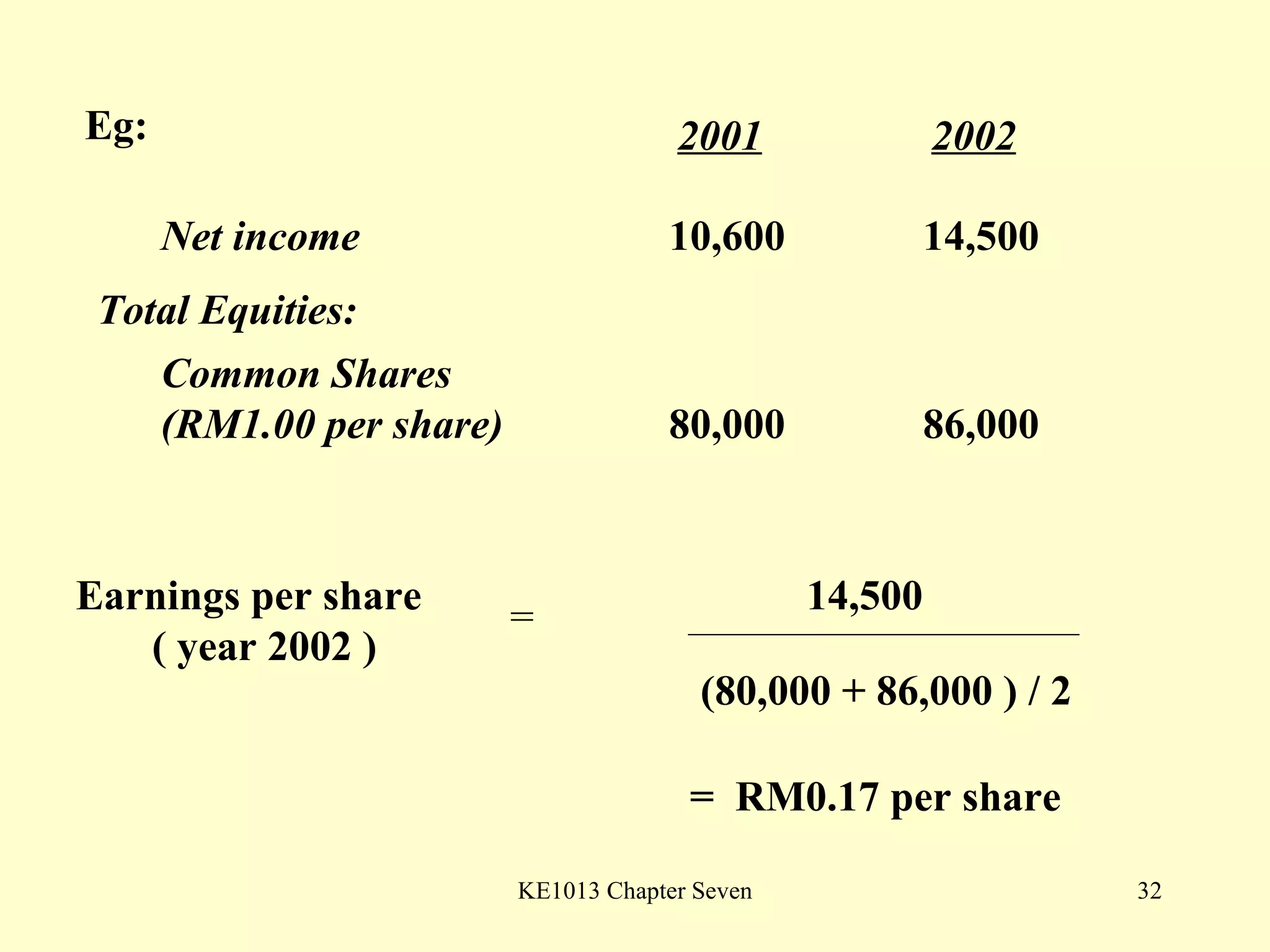
Eg: 2001 2002 Earnings per share  ( year 2002 ) Net income 10,600 14,500 Total Equities: 14,500 (80,000 + 86,000 ) / 2 =  RM0.17 per share Common Shares (RM1.00 per share) 80,000 86,000 =
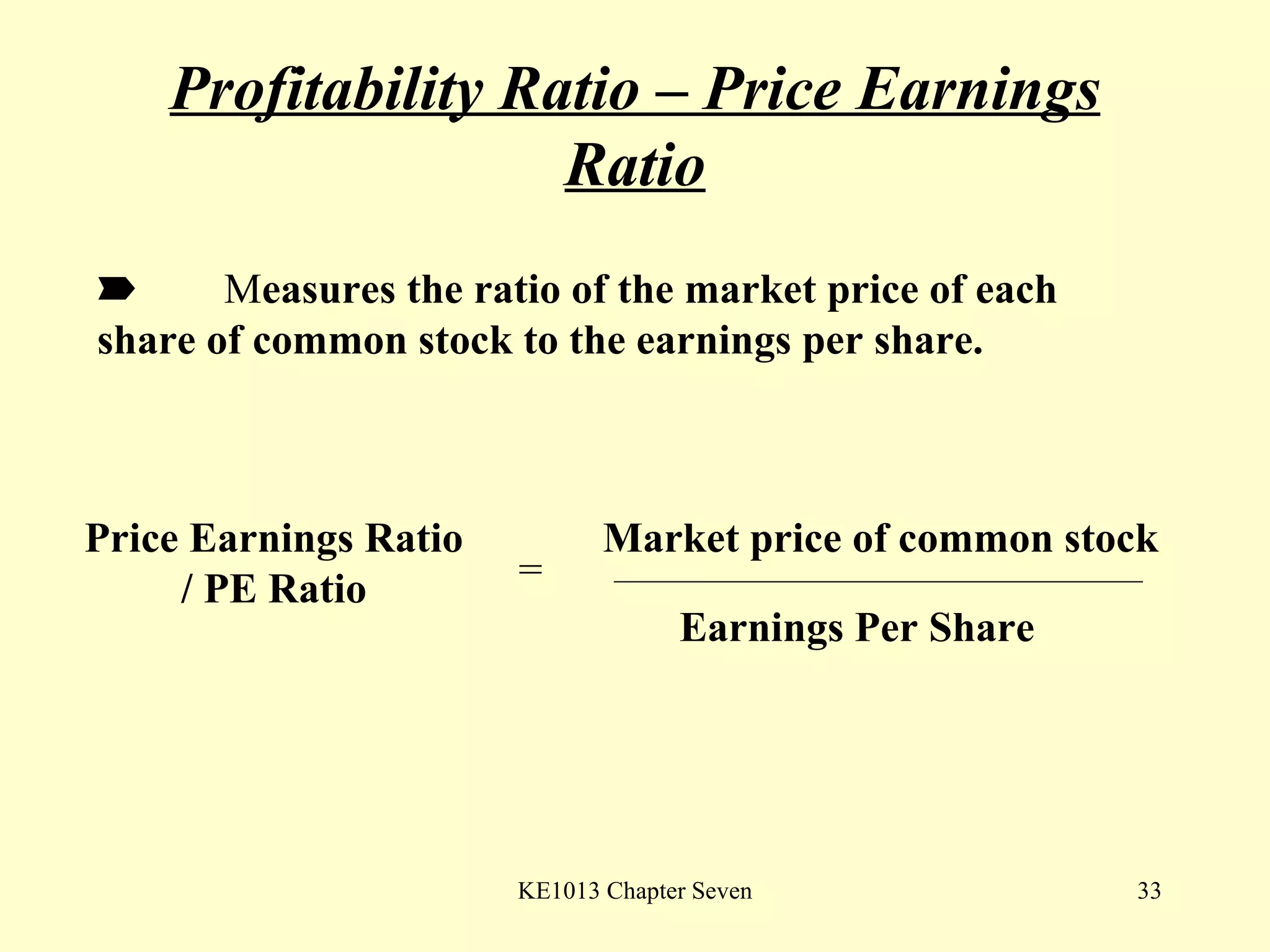
Profitability Ratio – Price Earnings Ratio  M easures the ratio of the market price of each  share of common stock to the earnings per share.  Price Earnings Ratio / PE Ratio = Market price of common stock Earnings Per Share
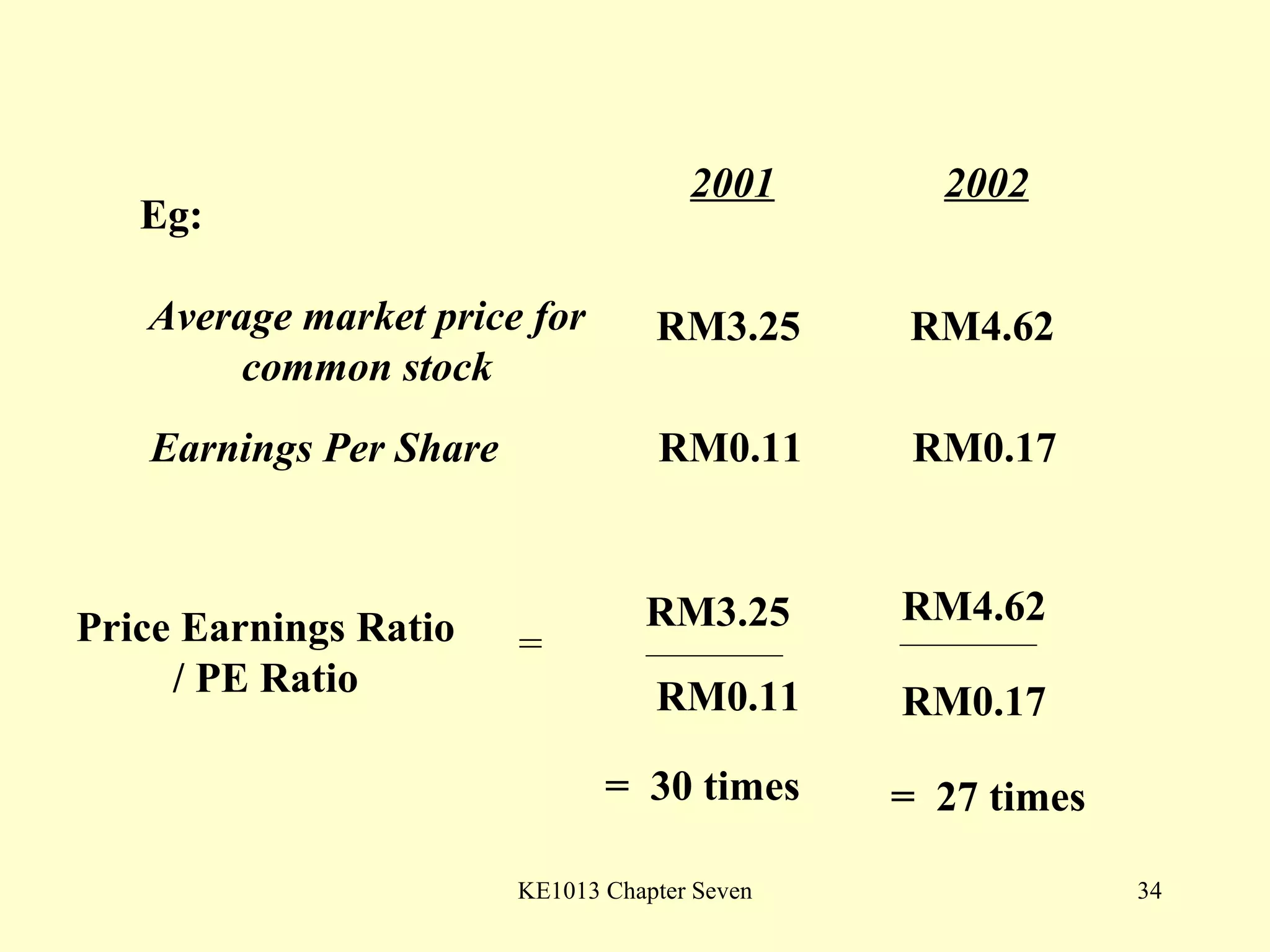
Eg: 2001 2002 Average market price for common stock RM3.25 RM4.62 Earnings Per Share RM0.11 RM0.17 Price Earnings Ratio / PE Ratio = RM3.25 RM4.62 RM0.11 RM0.17 =  30 times =  27 times
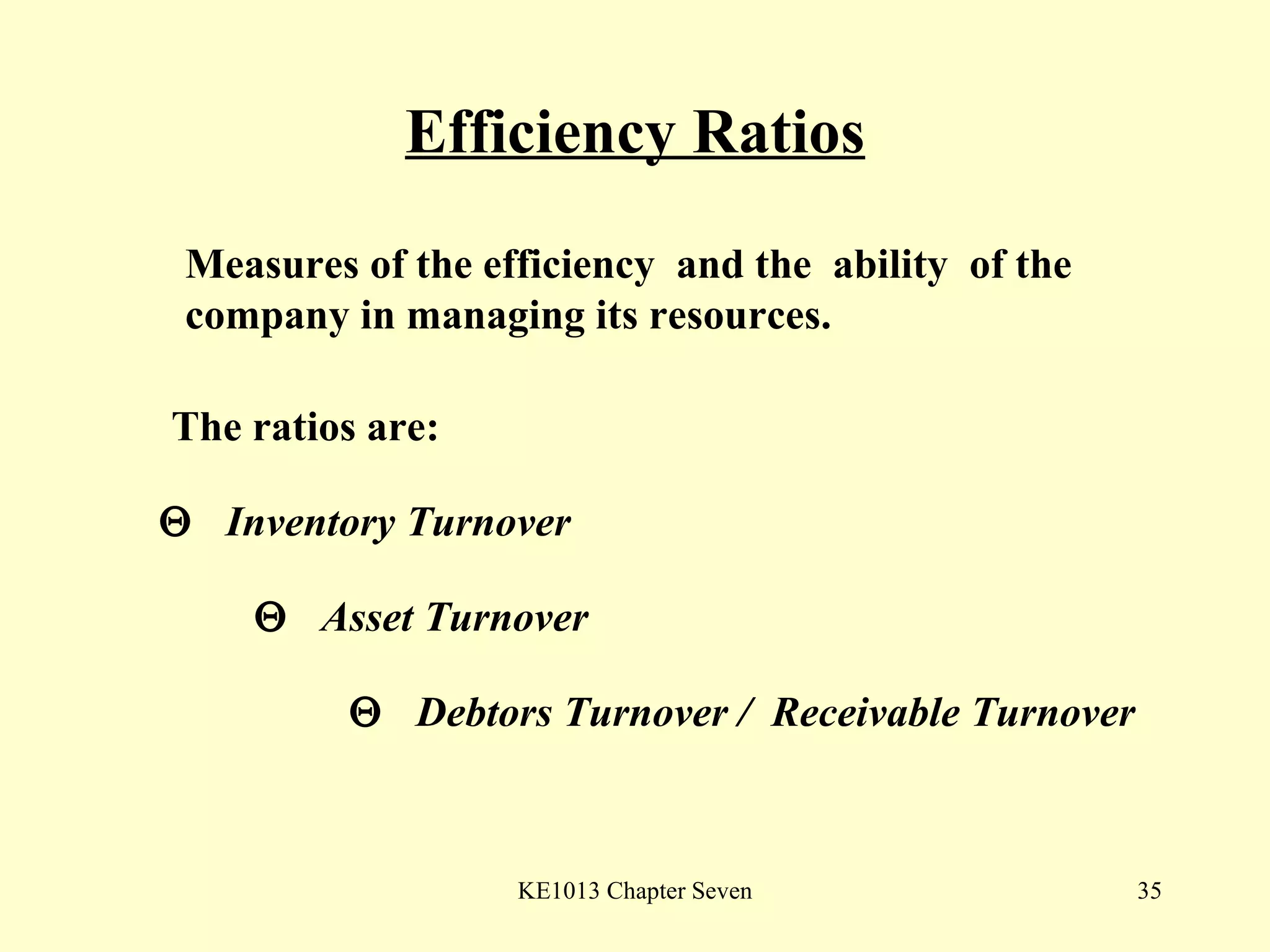
Efficiency Ratios The ratios are:    Inventory Turnover    Asset Turnover    Debtors Turnover /  Receivable Turnover Measures of the efficiency  and the  ability  of the company in managing its resources.
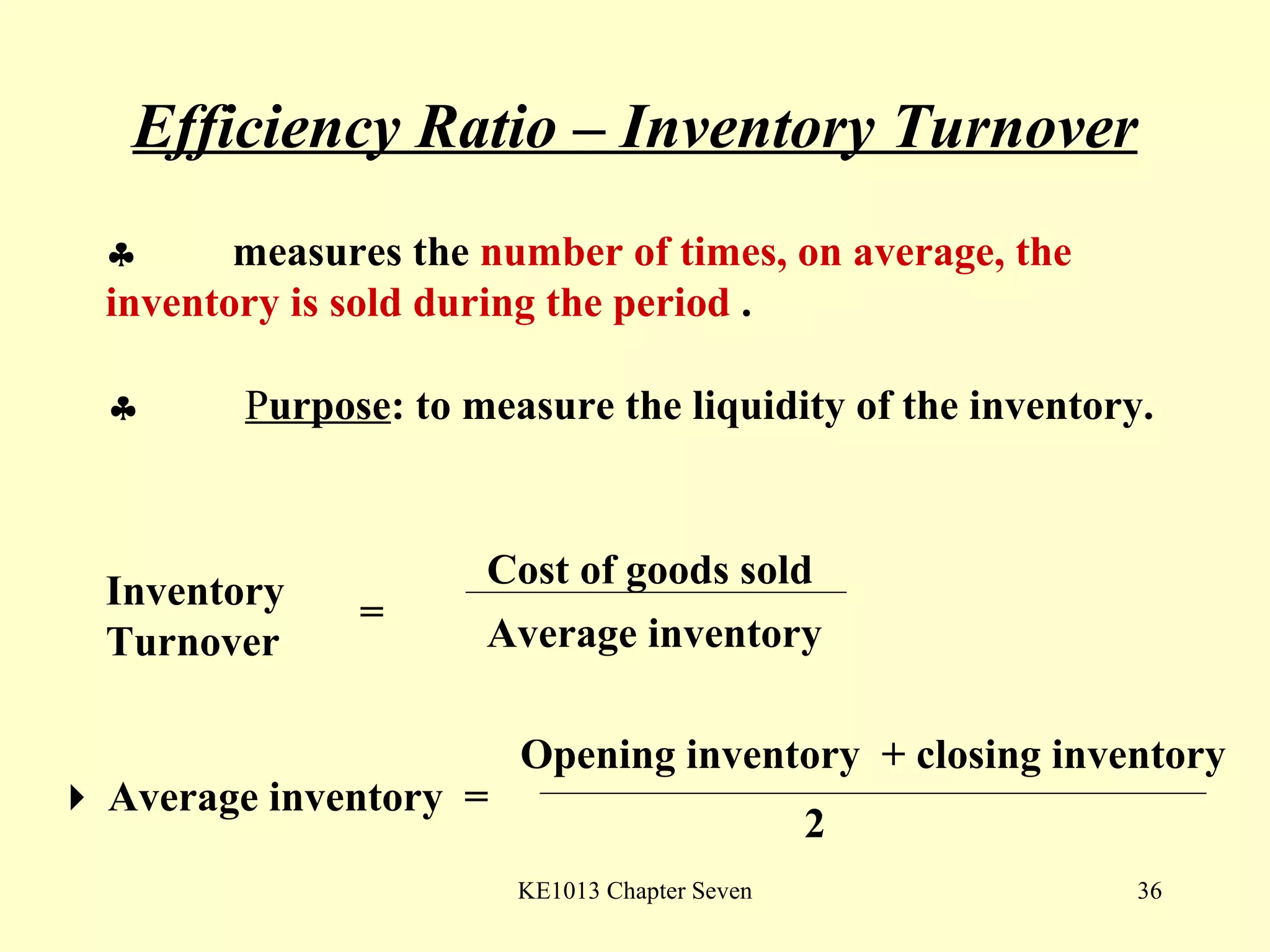
Efficiency Ratio – Inventory Turnover  measures the  number of times, on average, the  inventory is sold during the period  .     P urpose : to measure the liquidity of the inventory.  Inventory Turnover = Cost of goods sold Average inventory    Average inventory  = Opening inventory  + closing inventory 2
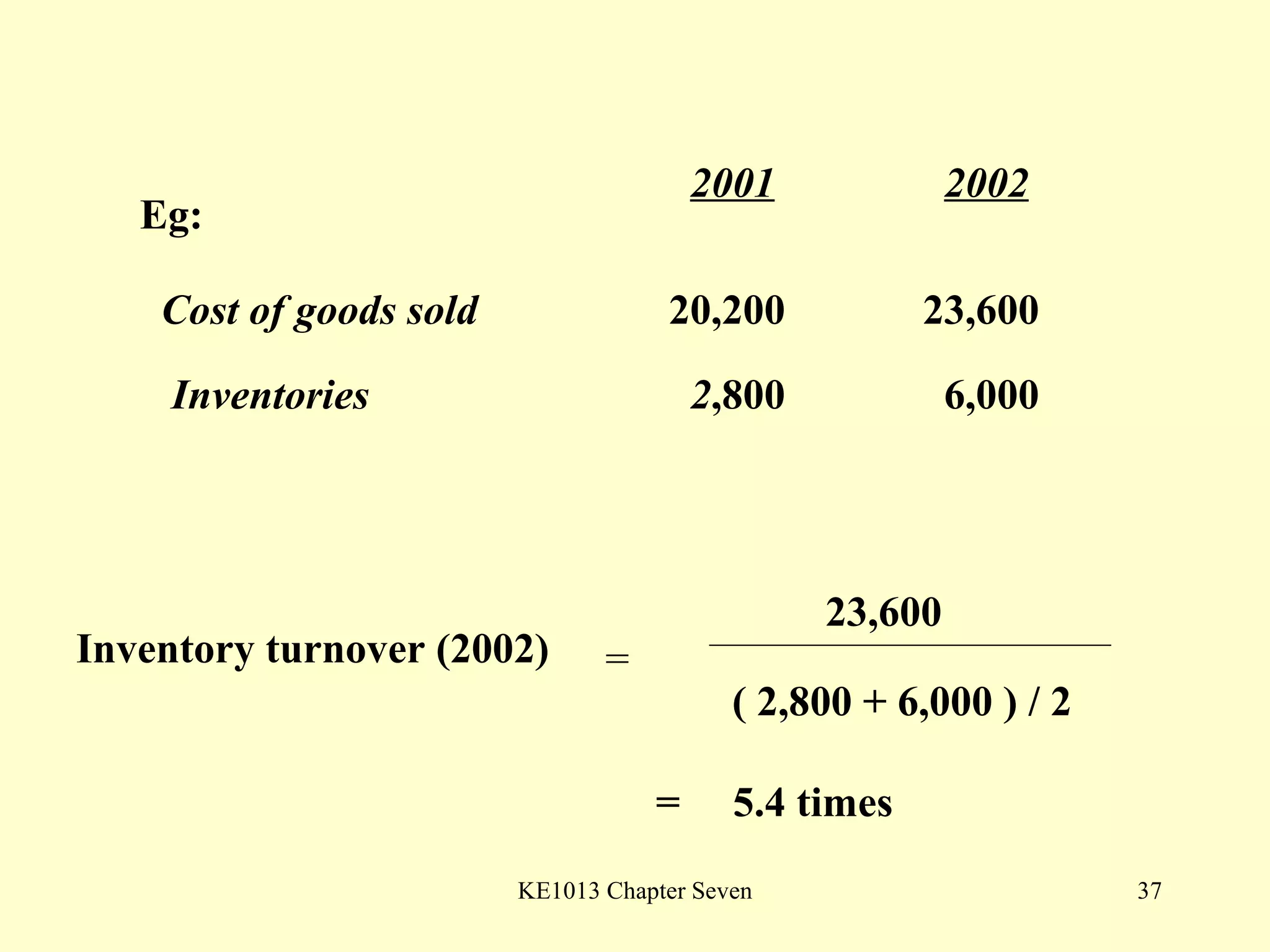
Eg: 2001 2002 = Cost of goods sold 20,200 23,600 Inventories  2 ,800  6,000 Inventory turnover (2002) 23,600 ( 2,800 + 6,000 ) / 2 =  5.4 times
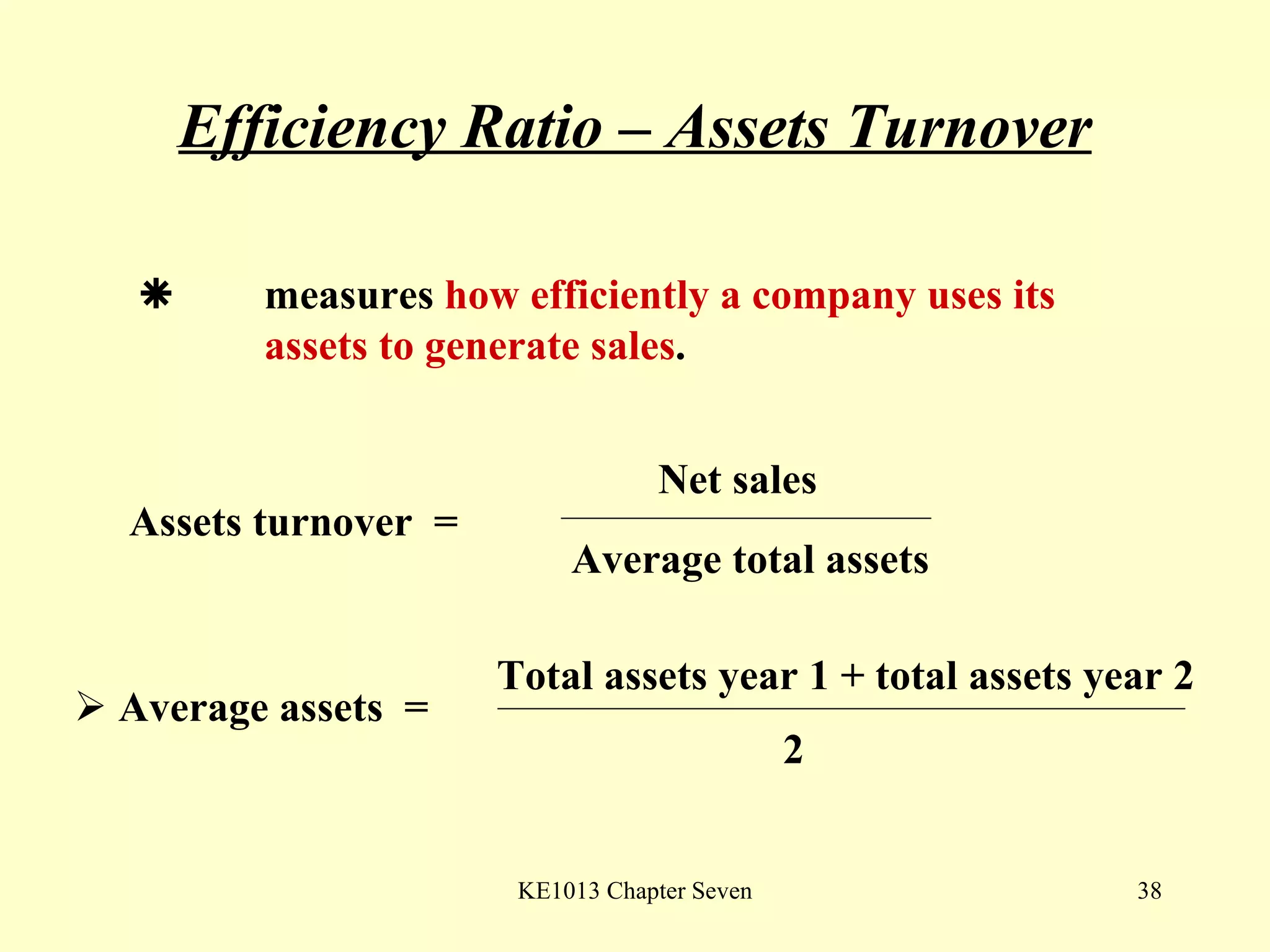
Efficiency Ratio – Assets Turnover  measures  how efficiently a company uses its  assets to generate sales .  Assets turnover  = Net sales Average total assets    Average assets  = Total assets year 1 + total assets year 2 2
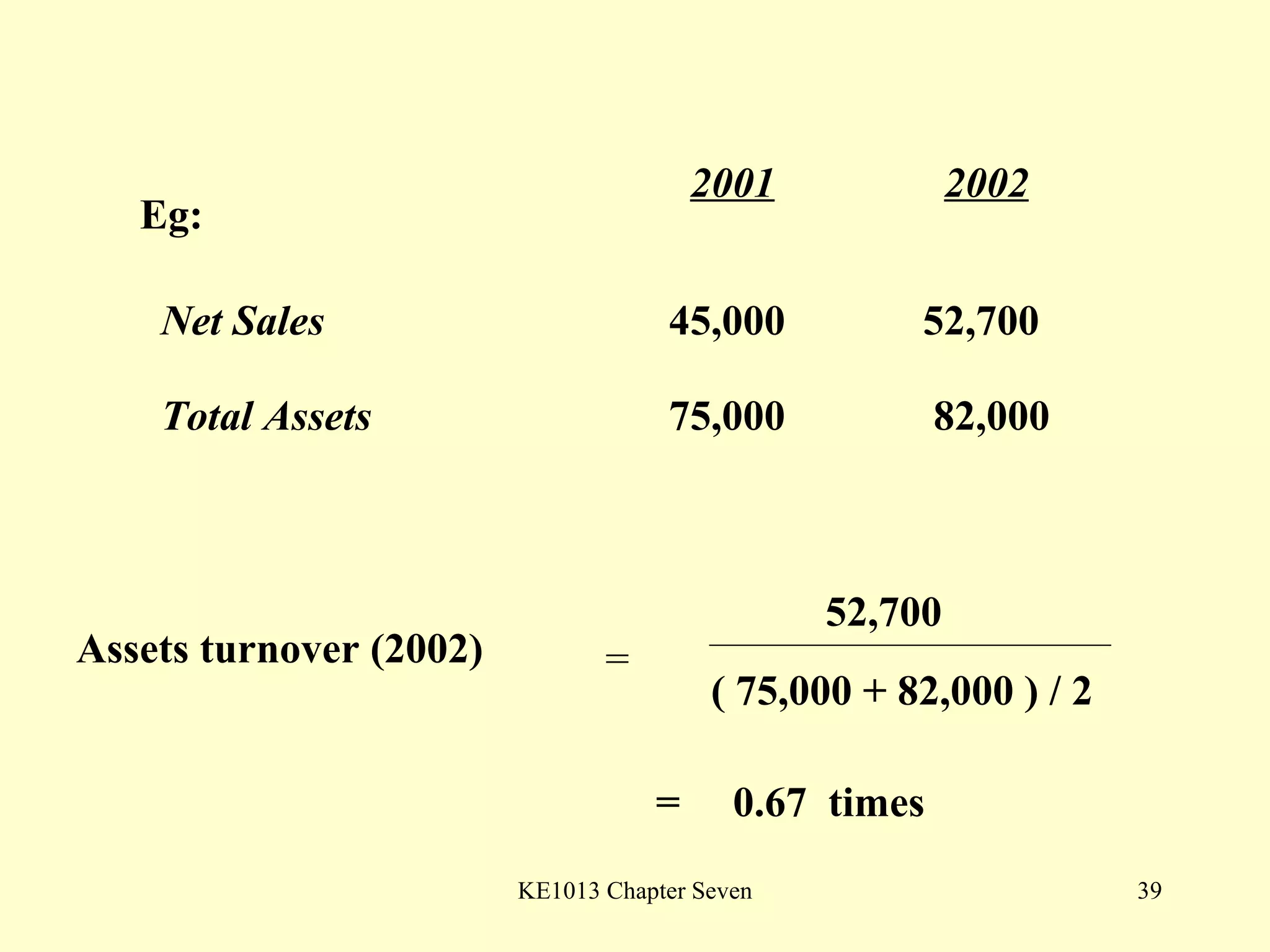
Eg: 2001 2002 = Assets turnover (2002) 52,700 ( 75,000 + 82,000 ) / 2 =  0.67  times Net Sales 45,000 52,700 Total Assets    75,000    82,000
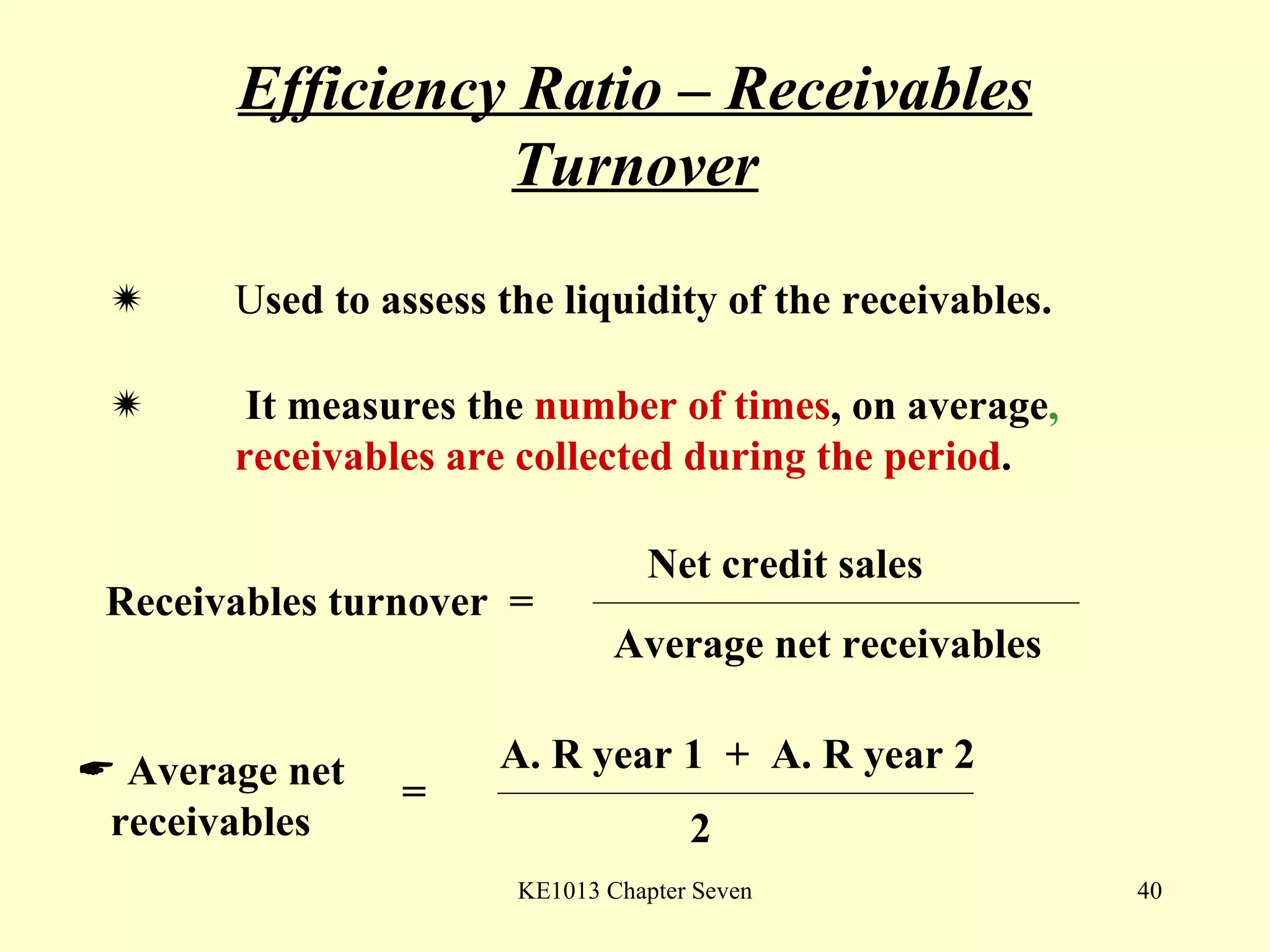
Efficiency Ratio – Receivables Turnover  U sed to assess the liquidity of the receivables.     It measures the  number of times ,   on average ,  receivables are collected during the period .  Receivables turnover  = Net credit sales Average net receivables    Average net receivables = A. R year 1  +  A. R year 2 2
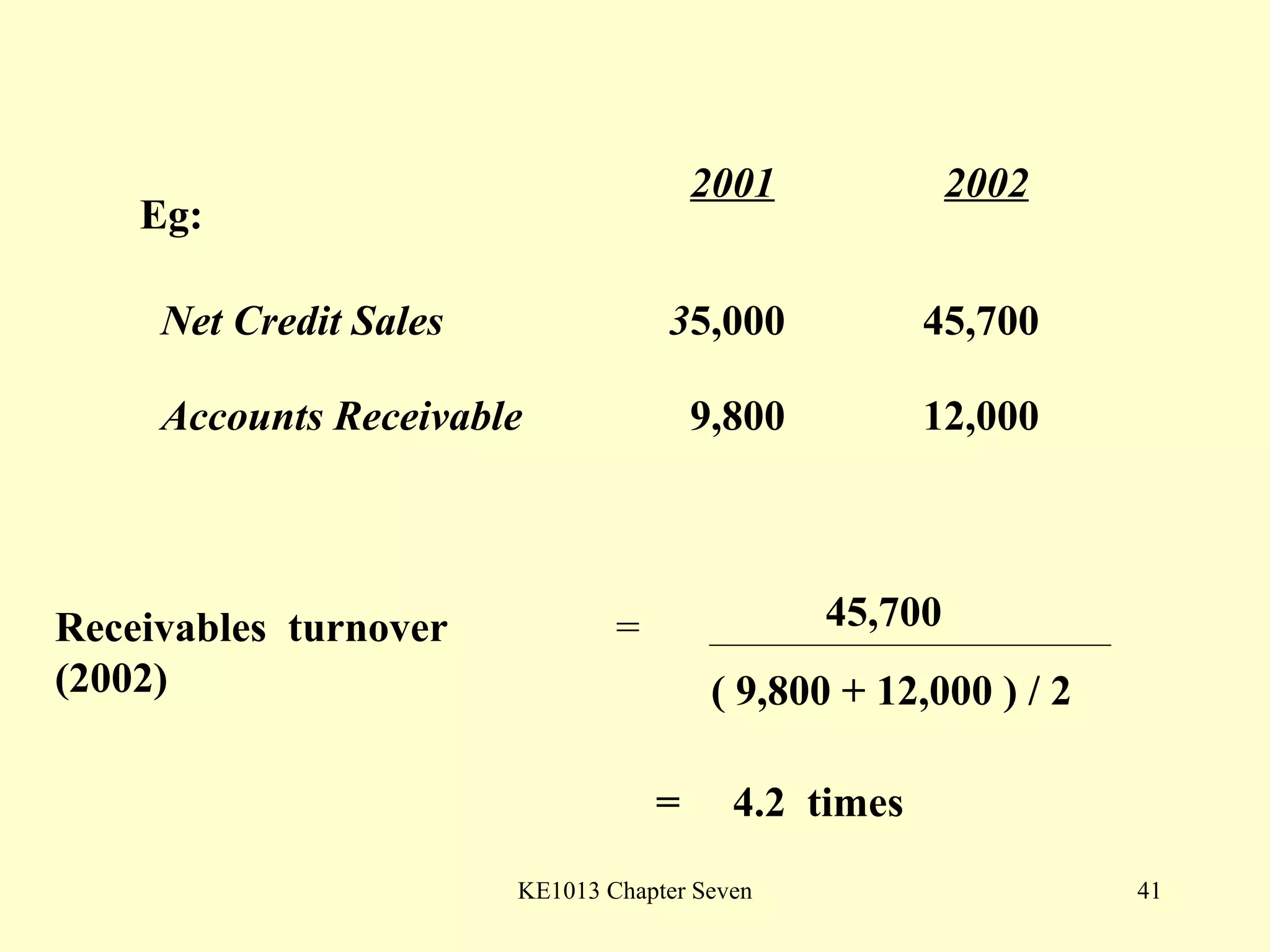
Eg: 2001 2002 = Receivables  turnover (2002) 45,700 ( 9,800 + 12,000 ) / 2 =  4.2  times Net Credit Sales 3 5,000 45,700 Accounts Receivable   9,800 12,000
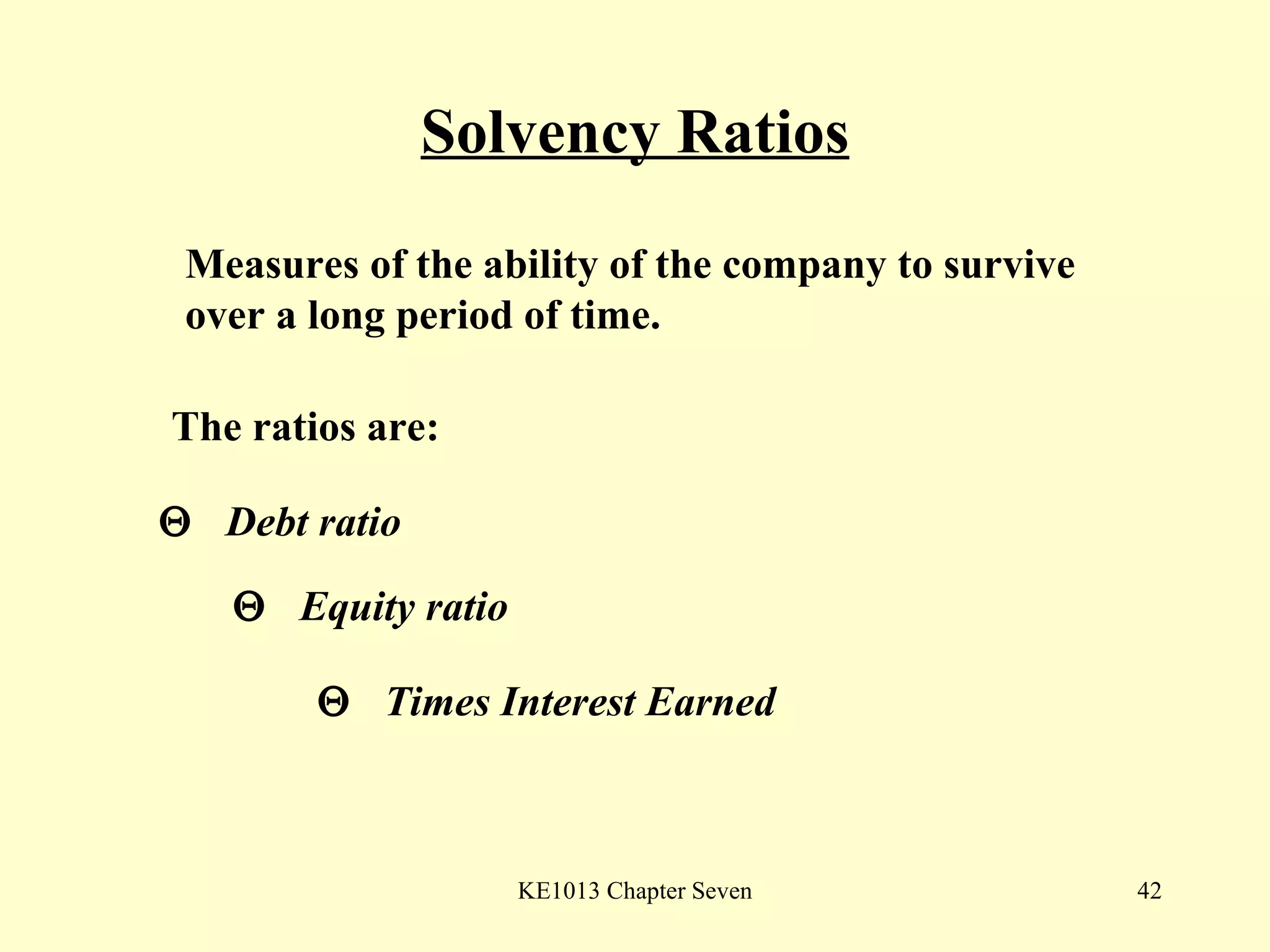
Solvency Ratios The ratios are:    Debt ratio     Equity ratio     Times Interest Earned  Measures of the ability of the company to survive over a long period of time.
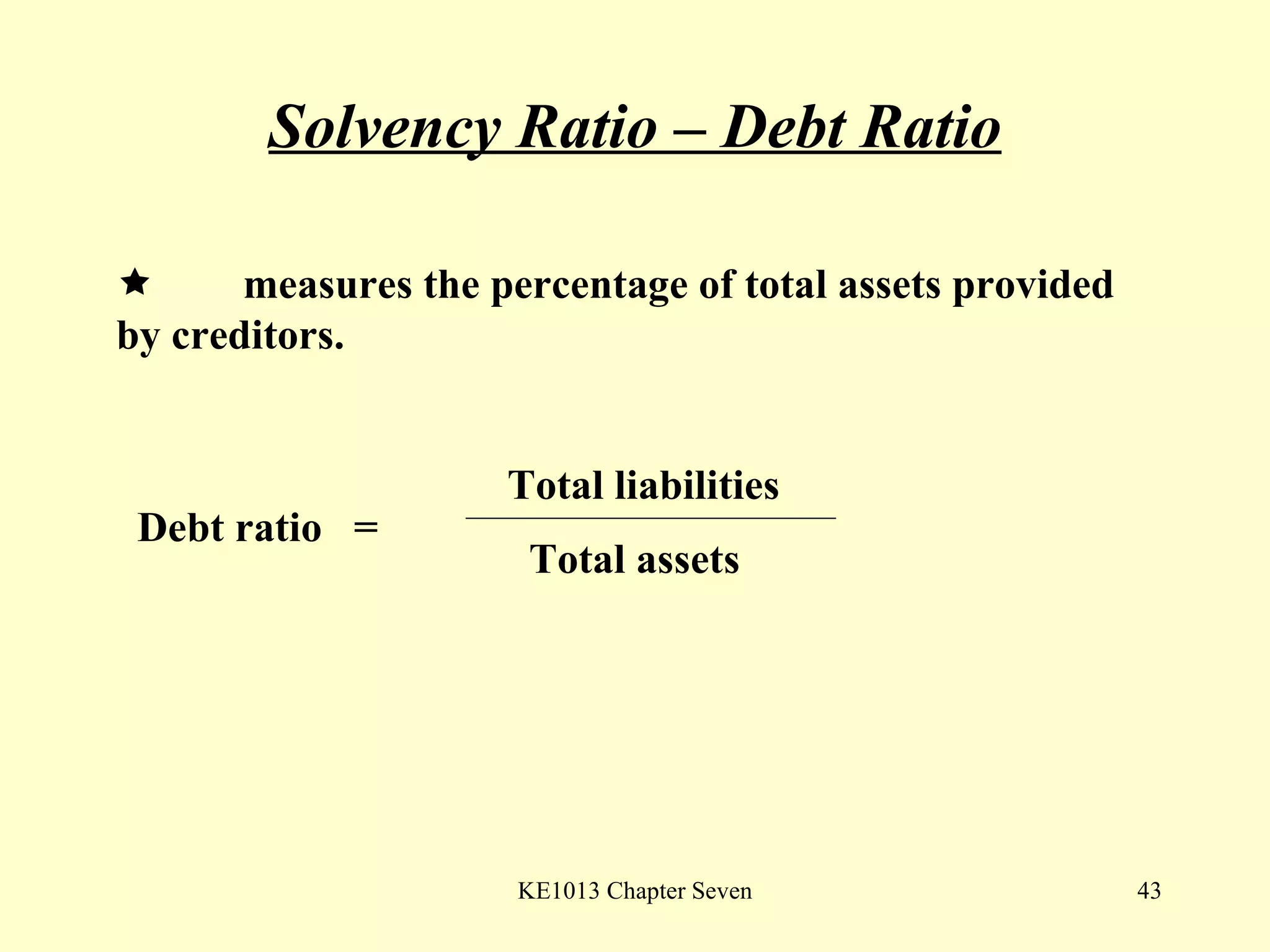
Solvency Ratio – Debt Ratio  measures the percentage of total assets provided  by creditors.  Debt ratio  = Total liabilities Total assets
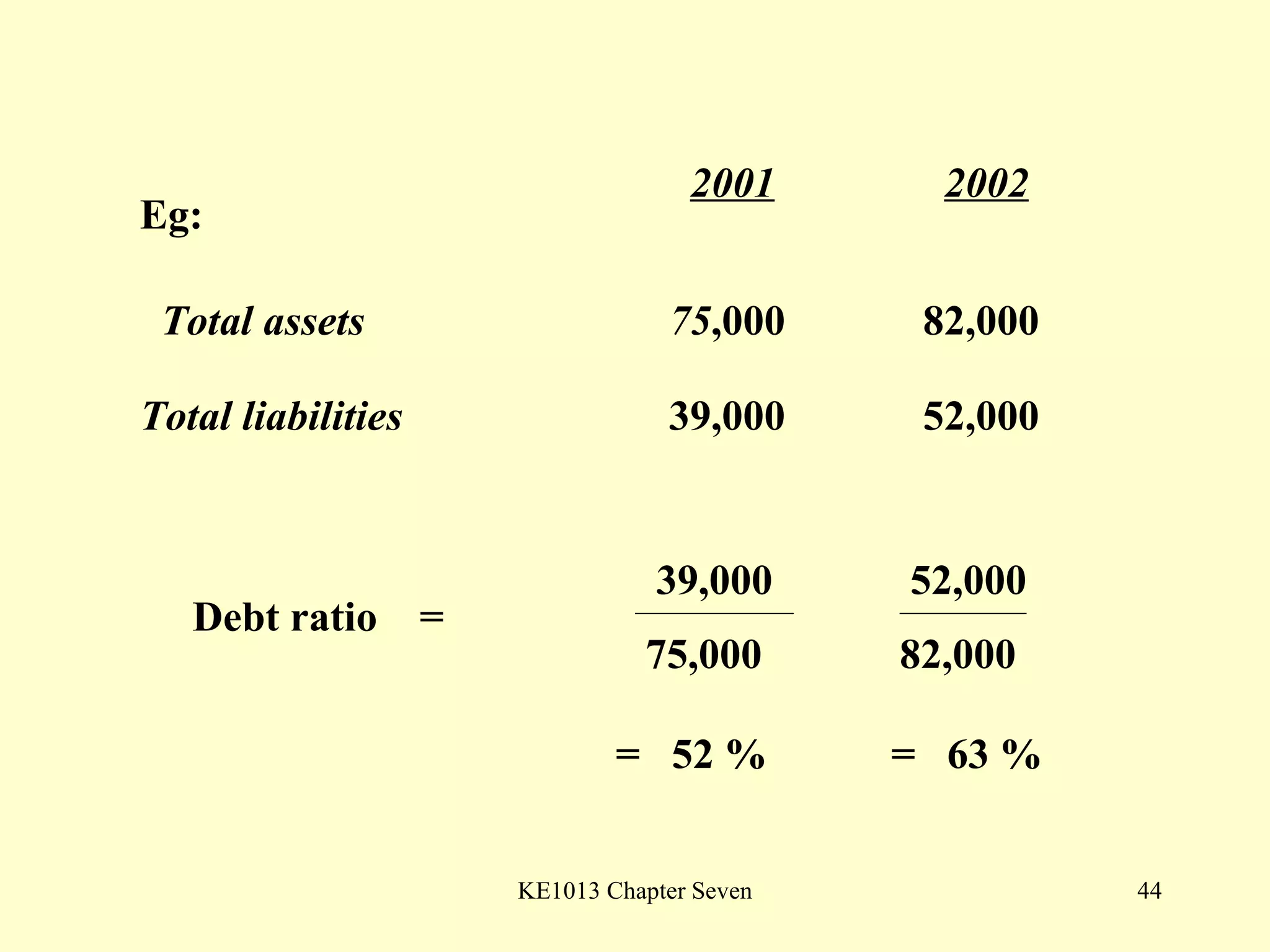
Eg: 2001 2002 Total assets 75 ,000 82,000 Total liabilities   39,000   52,000 Debt ratio  = 39,000 75,000 =  52 % 52,000 82,000 =  63 %
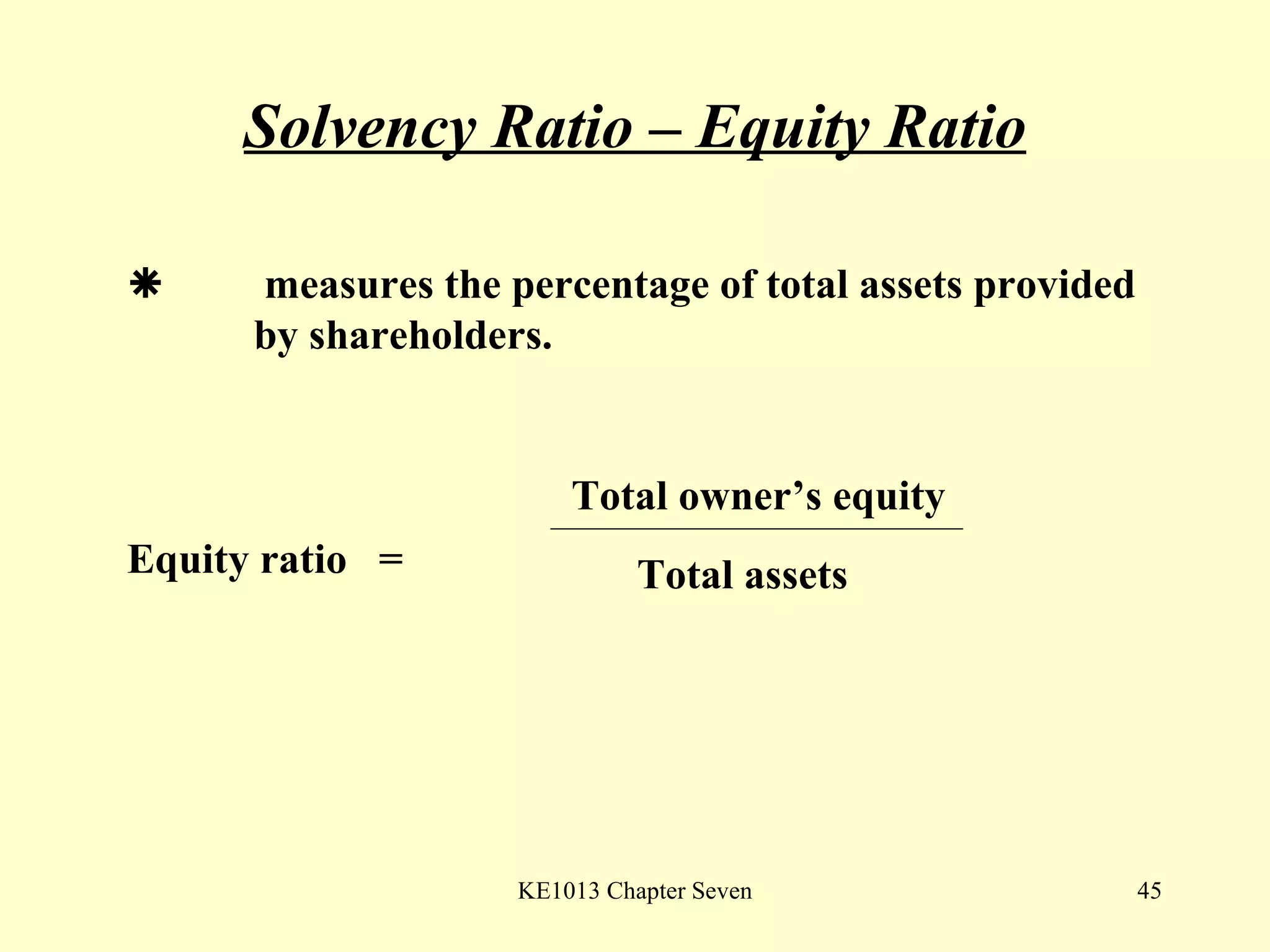
Solvency Ratio – Equity Ratio    measures the percentage of total assets provided  by shareholders.  Equity ratio  =  Total owner’s equity Total assets
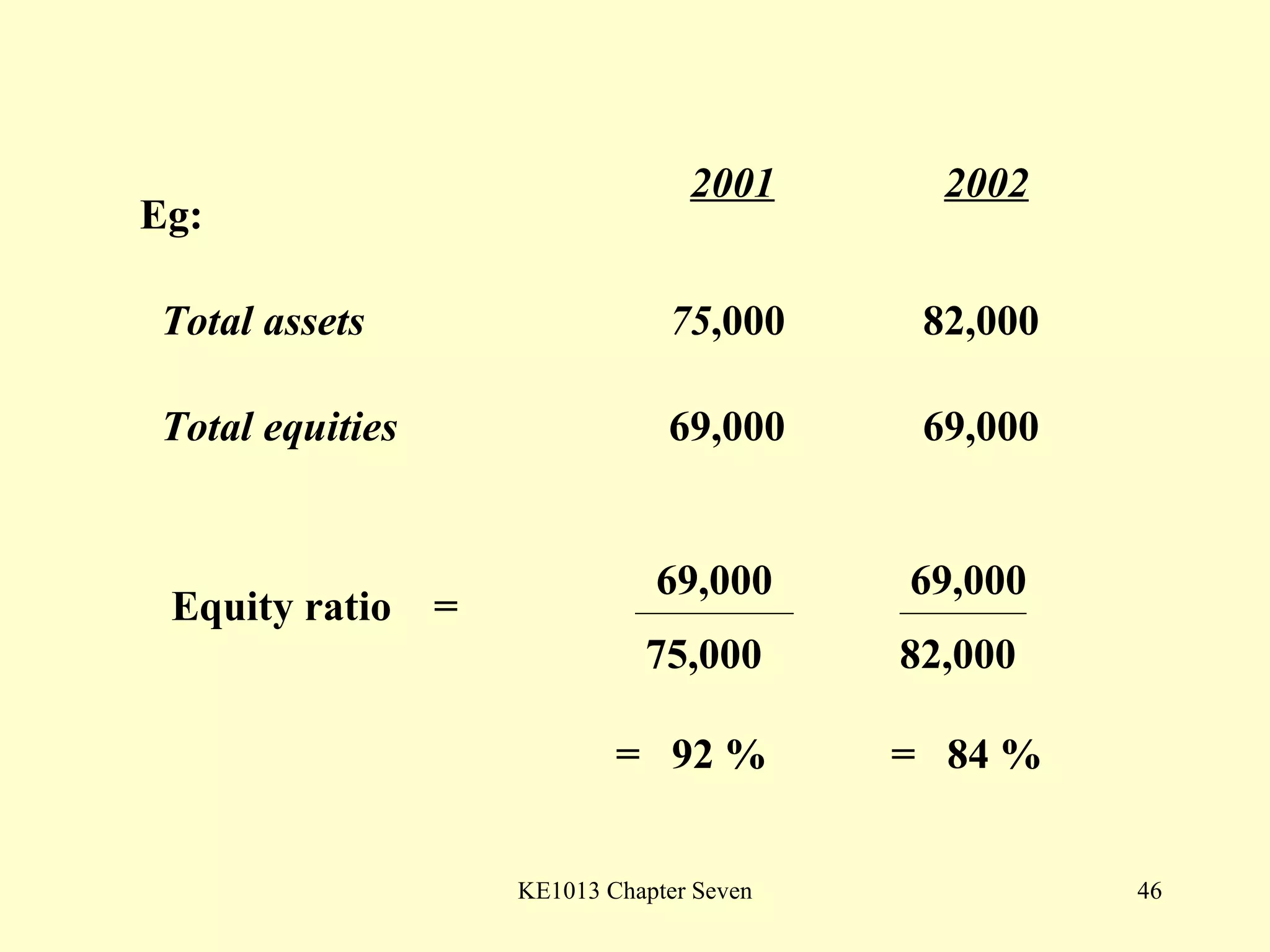
Eg: 2001 2002 Total assets 75 ,000 82,000 Equity ratio  = 69,000 75,000 =  92 % 69,000 82,000 =  84 % Total equities 69,000 69,000
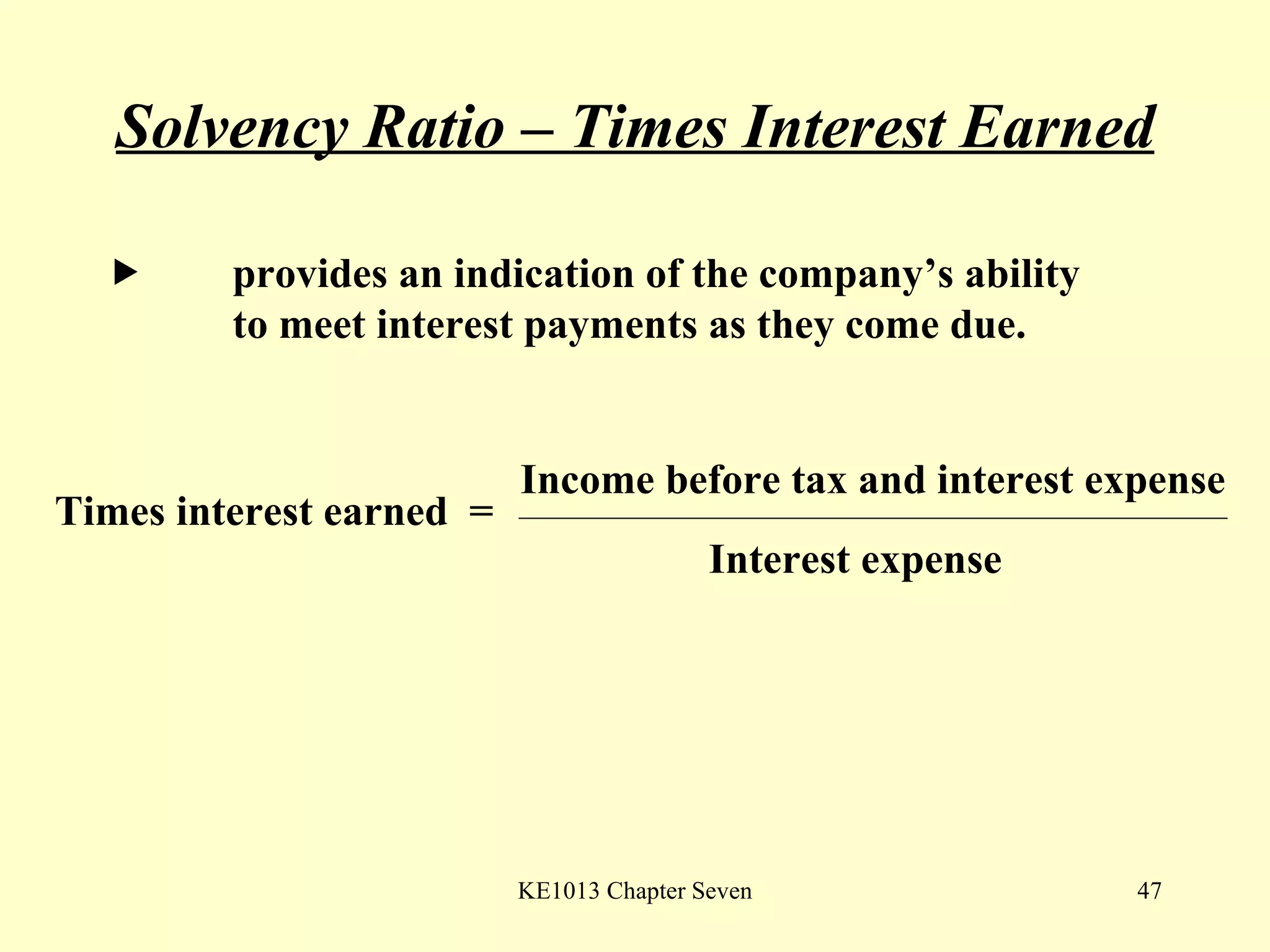
Solvency Ratio – Times Interest Earned  provides an indication of the company’s ability  to meet interest payments as they come due.  Times interest earned  =  Income before tax and interest expense Interest expense
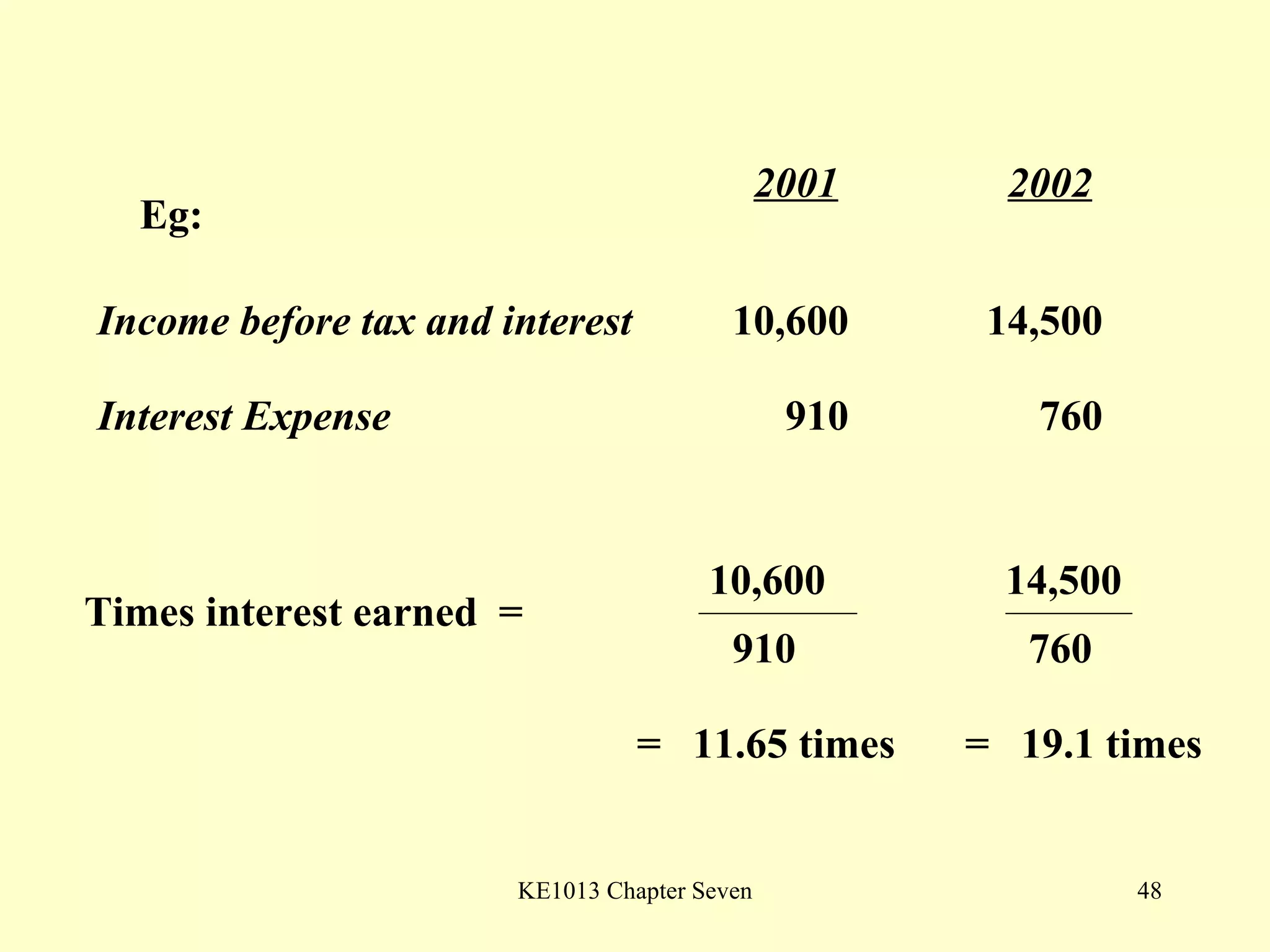
Eg: 2001 2002 Income before tax and interest 10,600 14,500 =  11.65 times Interest Expense     910   760 Times interest earned  = 10,600 910 14,500 760 =  19.1 times
Thank you

Akaun Chapter 7

  • 1.
    Chapter Seven FINANCIALSTATEMENT ANALYSIS
  • 2.
    Outline Users offinancial statement The importance of financial statement analysis Types of analysis: Percentage Analysis: Vertical Horizontal Ratio Analysis Liquidity Profitability Efficiency Solvency
  • 3.
    Users of financialstatement Managers Investors / Shareholders Potential Investors Creditors Regulatory Agencies Inland Revenue Consumers
  • 4.
    The importance offinancial statement analysis Helps interested users in making economic decisions: Provide the trend of the business for a certain period of time. Provide comparability among companies in the same industry. Helps in forecasting the business’s future performance
  • 5.
    Financial Analysis: ComparisonBasis 1 intracompany basis 2 industry averages Year 1 Year 2 Company XYZ Co. A Co. B Co. D Co. E Co. C Co. ABC Co. XYZ 3 intercompany basis
  • 6.
    Types of analysisFinancial Statement Analysis Percentage Ratio  Horizontal Analysis  Vertical Analysis  Liquidity Ratio  Profitability Ratio  Efficiency Ratio  Solvency Ratio
  • 7.
    Horizontal analysis  Also known as trend analysis .  Evaluates a series of financial statement data over a period of time.  Purpose: to determine the increase or decrease that has taken place This change may be expressed as either an amount or a percentage.
  • 8.
    Horizontal analysis Evaluates:Income Statement Balance Sheet Formula: Current Year Amount – Base Year Amount Base Year Amount
  • 9.
    Selamat Company ComparativeBalance Sheet As At Dec. 31, 2001 and 2002 Fixed Asset : Office Equipment (net) 55,000 63,000 Current Asset : Cash 7,000 9,700 Accounts Receivable 10,000 18,000 Current Liabilities : Accounts Payable 9,000 7,000 2001 2002 Inc. (Dec) Amount % 63,000 83,700 Owner’s Equity 63,000 83,700 63,000 83,700 8,000 14.5 2,700 38.6 8,000 80.0 (2,000) (22.2) 20,700 32.9 20,700 32.9 20,700 32.9
  • 10.
    Selamat Company ComparativeIncome Statement For the Years Ended Dec. 31, 2001 and 2002 2001 2002 Inc. (Dec) Amount % Net Sales 99,000 115,000 Cost of Goods Sold 44,500 57,700 Gross Profit 54,500 57,300 Selling Expenses 16,800 15,000 Admin Expenses 12,000 20,900 Net Income 25,700 21,400 16,000 16.2 13,200 29.7 2,800 5.1 (1,800) (10.7) 8,900 74.2 (4,300) (16.7)
  • 11.
    Vertical Analysis  Evaluates financial statement data expressing each item in a financial statement as a percent of a base amount.  Vertical analysis enables you to compare companies of different sizes.
  • 12.
    Selamat Company ComparativeBalance Sheet As At Dec. 31, 2001 and 2002 Fixed Asset : Office Equipment (net) 55,000 63,000 Current Asset : Cash 7,000 9,700 Accounts Receivable 10,000 18,000 Current Liabilities : Accounts Payable 9,000 7,000 63,000 83,700 Owner’s Equity 33,000 38,700 63,000 83,700 2001 2002 Amt % Amt % Long Term Liabilities 30,000 45,000 100 87.3 11.1 15.9 14.3 100 100 100 47.6 52.4 75.3 11.6 21.5 8.4 53.8 46.2
  • 13.
    Selamat Company ComparativeIncome Statement For the Years Ended Dec. 31, 2001 and 2002 2001 2002 Amt % Amt % Net Sales 99,000 115,000 Cost of Goods Sold 44,500 57,700 Gross Profit 54,500 57,300 Selling Expenses 16,800 15,000 Admin Expenses 12,000 20,900 Net Income 25,700 21,400 100 100 45.0 55.0 17.0 12.0 26.0 50.2 49.8 13.0 18.2 18.6
  • 14.
    Ratio Analysis  Expresses the relationship among selected items of financial statement data.  Classifications: Liquidity Ratios Profitability Ratios Efficiency Ratios Solvency Ratios
  • 15.
    Liquidity Ratios Theratios are:  Current Ratio / Working capital ratio  Acid test ratio / quick ratio Measures of short-term ability of the company to pay its maturing obligations and to meet unexpected needs for cash.
  • 16.
    Liquidity Ratio –Current ratio / Working capital ratio measure for evaluating a company’s liquidity and short-term debt-paying ability . Current ratio = Current Assets Current Liabilities
  • 17.
    Eg: Current Assets20,500 26,700 Current Liabilities 17,200 29,600 2001 2002 Current ratio = 20,500 17,200 26,700 29,600 = 1.19 : 1 = 0.90 : 1
  • 18.
    Liquidity Ratio –Acid Test Ratio / Quick Ratio  is a measure of a company’s short-term liquidity . Acid test ratio = Quick Assets Current Liabilities  Quick asset includes cash, marketable securities and accounts receivable.
  • 19.
    Eg: Current AssetsCurrent Liabilities 17,200 29,600 2001 2002 Acid test ratio = 17,700 17,200 20,700 29,600 = 1.03 : 1 = 0.70 : 1 Cash 7,900 8,700 Accounts Receivable 9,800 12,000 Inventories 2 ,800 6,000 20,500 26,700
  • 20.
    Profitability Ratios Theratios are:  Profit margin  Gross profit margin  Return on Assets  Return on Equity  Return on Common Equity  Earnings Per Share  Price - Earnings ratio Measures of the income or operating success of a company for a given period of time.
  • 21.
    Profitability Ratio –Profit Margin  is a measure of the percentage of each dollar of sales that results in net income . Profit margin = Net income Net sales
  • 22.
    Eg: Net Sales45,000 52,700 Less: Cost of Goods Sold 20,200 23,600 2001 2002 Profit margin = 10,600 45,000 14,500 52,700 = 23.56% = 27.51% 24,800 29,100 Less: Operating Expenses 14,200 14,600 Net income 10,600 14,500
  • 23.
    Profitability Ratio –Gross Profit Margin  is a measure of the percentage of each dollar of sales that results in gross profit . Gross profit margin = Gross Profit Net Sales
  • 24.
    Eg: Net Sales45,000 52,700 Less: Cost of Goods Sold 20,200 23,600 2001 2002 Gross profit margin = 24,800 45,000 29,100 52,700 = 55.11% = 55.22% Gross Profit 24,800 29,100 Less: Operating Expenses 14,200 14,600 Net income 10,600 14,500
  • 25.
    Profitability Ratio –Return on Assets  To assess the ability of the company in using its assets to earn net income without consideration in the financing of such assets. Return on assets = Net income + Interest expense Average total assets  Average total assets = Total assets year 1 + total assets year 2 2
  • 26.
    Eg: 2001 2002Return on Assets = = 15.89% Net income 10,600 14,500 Interest Expense 910 760 Total Assets (2000 = 69,900) 75,000 82,000 10,600 + 910 (69,900 + 75,000 ) / 2 14,500 + 760 (75,000 + 82,000 ) / 2 = 19.44%
  • 27.
    Profitability Ratio –Return on Equity  To assess the ability of the company in managing the investments by shareholders to earn income. Return on equity = Net income Average total stockholders’ equity  Average total stockholders’ equity = Total equity year 1 + total equity year 2 2
  • 28.
    Eg: 2001 2002Return on Equity ( year 2002 ) = Net income 10,600 14,500 Total Equities: 14,500 (100,000 + 106,000 ) / 2 = 14.08% Common Shares 80,000 86,000 Preference Shares 20,000 20,000 100,000 106,000
  • 29.
    Profitability Ratio –Return on Common Equity  To assess the ability of the company in managing the investments by common shareholders to earn its net income. Return on common equity = Net income Average common stockholders’ equity  Average common stockholders’ equity = Common equity year 1 + common equity year 2 2
  • 30.
    Eg: 2001 2002Return on Common Equity ( year 2002 ) Net income 10,600 14,500 Total Equities: 14,500 (80,000 + 86,000 ) / 2 = 17.47% Common Shares 80,000 86,000 Preference Shares 20,000 20,000 100,000 106,000 =
  • 31.
    Profitability Ratio –Earnings Per Share  a measure of net income earned on each share of common stock. Earnings Per Share / EPS Net income average common shares outstanding (unit) =
  • 32.
    Eg: 2001 2002Earnings per share ( year 2002 ) Net income 10,600 14,500 Total Equities: 14,500 (80,000 + 86,000 ) / 2 = RM0.17 per share Common Shares (RM1.00 per share) 80,000 86,000 =
  • 33.
    Profitability Ratio –Price Earnings Ratio  M easures the ratio of the market price of each share of common stock to the earnings per share. Price Earnings Ratio / PE Ratio = Market price of common stock Earnings Per Share
  • 34.
    Eg: 2001 2002Average market price for common stock RM3.25 RM4.62 Earnings Per Share RM0.11 RM0.17 Price Earnings Ratio / PE Ratio = RM3.25 RM4.62 RM0.11 RM0.17 = 30 times = 27 times
  • 35.
    Efficiency Ratios Theratios are:  Inventory Turnover  Asset Turnover  Debtors Turnover / Receivable Turnover Measures of the efficiency and the ability of the company in managing its resources.
  • 36.
    Efficiency Ratio –Inventory Turnover  measures the number of times, on average, the inventory is sold during the period .  P urpose : to measure the liquidity of the inventory. Inventory Turnover = Cost of goods sold Average inventory  Average inventory = Opening inventory + closing inventory 2
  • 37.
    Eg: 2001 2002= Cost of goods sold 20,200 23,600 Inventories 2 ,800 6,000 Inventory turnover (2002) 23,600 ( 2,800 + 6,000 ) / 2 = 5.4 times
  • 38.
    Efficiency Ratio –Assets Turnover  measures how efficiently a company uses its assets to generate sales . Assets turnover = Net sales Average total assets  Average assets = Total assets year 1 + total assets year 2 2
  • 39.
    Eg: 2001 2002= Assets turnover (2002) 52,700 ( 75,000 + 82,000 ) / 2 = 0.67 times Net Sales 45,000 52,700 Total Assets 75,000 82,000
  • 40.
    Efficiency Ratio –Receivables Turnover  U sed to assess the liquidity of the receivables.  It measures the number of times , on average , receivables are collected during the period . Receivables turnover = Net credit sales Average net receivables  Average net receivables = A. R year 1 + A. R year 2 2
  • 41.
    Eg: 2001 2002= Receivables turnover (2002) 45,700 ( 9,800 + 12,000 ) / 2 = 4.2 times Net Credit Sales 3 5,000 45,700 Accounts Receivable 9,800 12,000
  • 42.
    Solvency Ratios Theratios are:  Debt ratio  Equity ratio  Times Interest Earned Measures of the ability of the company to survive over a long period of time.
  • 43.
    Solvency Ratio –Debt Ratio  measures the percentage of total assets provided by creditors. Debt ratio = Total liabilities Total assets
  • 44.
    Eg: 2001 2002Total assets 75 ,000 82,000 Total liabilities 39,000 52,000 Debt ratio = 39,000 75,000 = 52 % 52,000 82,000 = 63 %
  • 45.
    Solvency Ratio –Equity Ratio  measures the percentage of total assets provided by shareholders. Equity ratio = Total owner’s equity Total assets
  • 46.
    Eg: 2001 2002Total assets 75 ,000 82,000 Equity ratio = 69,000 75,000 = 92 % 69,000 82,000 = 84 % Total equities 69,000 69,000
  • 47.
    Solvency Ratio –Times Interest Earned  provides an indication of the company’s ability to meet interest payments as they come due. Times interest earned = Income before tax and interest expense Interest expense
  • 48.
    Eg: 2001 2002Income before tax and interest 10,600 14,500 = 11.65 times Interest Expense 910 760 Times interest earned = 10,600 910 14,500 760 = 19.1 times
  • 49.