
Chapter - 4 Risk and Return: An Overview of Capital Market Theory
Chapter Objectives Discuss the concepts of average and expected rates of return. Define and measure risk for individual assets. Show the steps in the calculation of standard deviation and variance of returns. Explain the concept of normal distribution and the importance of standard deviation. Compute historical average return of securities and market premium. Determine the relationship between risk and return. Highlight the difference between relevant and irrelevant risks. Rakesh Kumar Singh
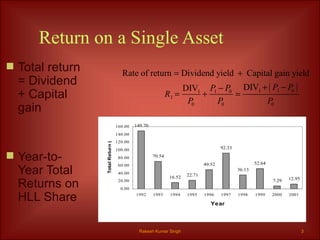
Return on a Single Asset   Total return = Dividend + Capital gain Year-to-Year Total Returns on HLL Share   Rakesh Kumar Singh
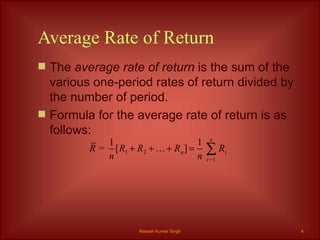
Average Rate of Return The  average rate of return  is the sum of the various one-period rates of return divided by the number of period . Formula for the average rate of return is as follows : Rakesh Kumar Singh
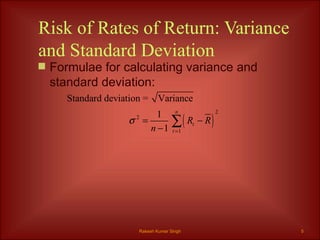
Risk of Rates of Return: Variance and Standard Deviation Formulae for calculating variance and standard deviation: Rakesh Kumar Singh
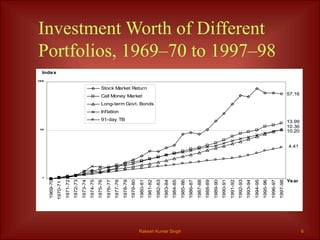
Investment Worth of Different Portfolios, 1969–70 to 1997–98 Rakesh Kumar Singh
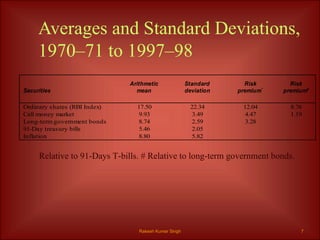
Averages and Standard Deviations, 1970–71 to 1997–98 Rakesh Kumar Singh Relative to 91-Days T-bills. # Relative to long-term government bonds.
Expected Return : Incorporating Probabilities in Estimates The  expected rate of return  [ E  ( R )] is the sum of the product of each outcome (return) and its associated probability: Rakesh Kumar Singh
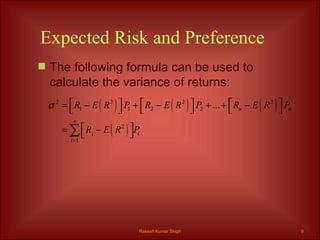
Expected Risk and Preference The following formula can be used to calculate the variance of returns: Rakesh Kumar Singh
Expected Risk and Preference A  risk-averse  investor will choose among investments with the equal rates of return, the investment with lowest standard deviation. Similarly, if investments have equal risk (standard deviations), the investor would prefer the one with higher return.  A  risk-neutral  investor does not consider risk, and would always prefer investments with higher returns.  A  risk-seeking  investor likes investments with higher risk irrespective of the rates of return. In reality, most (if not all) investors are risk-averse.   Rakesh Kumar Singh
Normal Distribution  Normal distribution is an important concept in statistics and finance. In explaining the risk-return relationship, we assume that returns are normally distributed.  Normal distribution is a  population-based, theoretical distribution . Rakesh Kumar Singh

Financial Management chapter-4

  • 1.
    Chapter - 4Risk and Return: An Overview of Capital Market Theory
  • 2.
    Chapter Objectives Discussthe concepts of average and expected rates of return. Define and measure risk for individual assets. Show the steps in the calculation of standard deviation and variance of returns. Explain the concept of normal distribution and the importance of standard deviation. Compute historical average return of securities and market premium. Determine the relationship between risk and return. Highlight the difference between relevant and irrelevant risks. Rakesh Kumar Singh
  • 3.
    Return on aSingle Asset Total return = Dividend + Capital gain Year-to-Year Total Returns on HLL Share Rakesh Kumar Singh
  • 4.
    Average Rate ofReturn The average rate of return is the sum of the various one-period rates of return divided by the number of period . Formula for the average rate of return is as follows : Rakesh Kumar Singh
  • 5.
    Risk of Ratesof Return: Variance and Standard Deviation Formulae for calculating variance and standard deviation: Rakesh Kumar Singh
  • 6.
    Investment Worth ofDifferent Portfolios, 1969–70 to 1997–98 Rakesh Kumar Singh
  • 7.
    Averages and StandardDeviations, 1970–71 to 1997–98 Rakesh Kumar Singh Relative to 91-Days T-bills. # Relative to long-term government bonds.
  • 8.
    Expected Return :Incorporating Probabilities in Estimates The expected rate of return [ E ( R )] is the sum of the product of each outcome (return) and its associated probability: Rakesh Kumar Singh
  • 9.
    Expected Risk andPreference The following formula can be used to calculate the variance of returns: Rakesh Kumar Singh
  • 10.
    Expected Risk andPreference A risk-averse investor will choose among investments with the equal rates of return, the investment with lowest standard deviation. Similarly, if investments have equal risk (standard deviations), the investor would prefer the one with higher return. A risk-neutral investor does not consider risk, and would always prefer investments with higher returns. A risk-seeking investor likes investments with higher risk irrespective of the rates of return. In reality, most (if not all) investors are risk-averse. Rakesh Kumar Singh
  • 11.
    Normal Distribution Normal distribution is an important concept in statistics and finance. In explaining the risk-return relationship, we assume that returns are normally distributed. Normal distribution is a population-based, theoretical distribution . Rakesh Kumar Singh