1
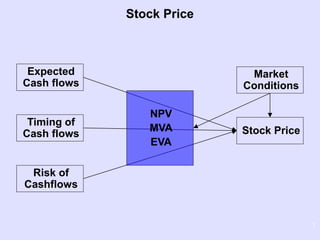
Stock Price
Risk of
Cashflows
Timing of
Cash flows
Expected
Cash flows
Stock Price
Market
Conditions
NPV
MVA
EVA
2
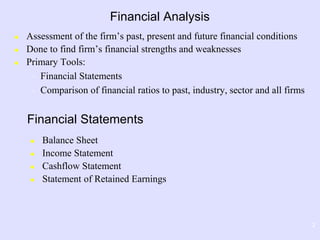
Financial Analysis
 Assessment of the firm’s past, present and future financial conditions
 Done to find firm’s financial strengths and weaknesses
 Primary Tools:
– Financial Statements
– Comparison of financial ratios to past, industry, sector and all firms
Financial Statements
 Balance Sheet
 Income Statement
 Cashflow Statement
 Statement of Retained Earnings
3
Sources of Data
 Annual reports
– Via mail, SEC or company websites
 Published collections of data
– e.g., Dun and Bradstreet or Robert Morris
 Investment sites on the web
– Examples
 http://moneycentral.msn.com/investor
 http://www.marketguide.com
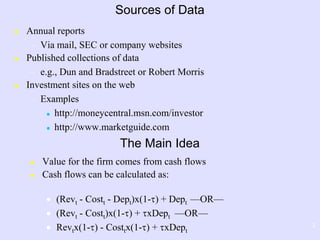
The Main Idea
 Value for the firm comes from cash flows
 Cash flows can be calculated as:
 (Revt - Costt - Dept)x(1-t) + Dept —OR—
 (Revt - Costt)x(1-t) + txDept —OR—
 Revtx(1-t) - Costtx(1-t) + txDept
4
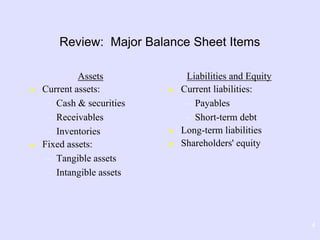
Review: Major Balance Sheet Items
Assets
 Current assets:
– Cash & securities
– Receivables
– Inventories
 Fixed assets:
– Tangible assets
– Intangible assets
Liabilities and Equity
 Current liabilities:
– Payables
– Short-term debt
 Long-term liabilities
 Shareholders' equity
5
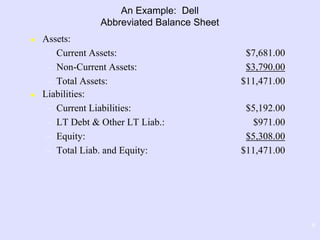
An Example: Dell
Abbreviated Balance Sheet
 Assets:
– Current Assets: $7,681.00
– Non-Current Assets: $3,790.00
– Total Assets: $11,471.00
 Liabilities:
– Current Liabilities: $5,192.00
– LT Debt & Other LT Liab.: $971.00
– Equity: $5,308.00
– Total Liab. and Equity: $11,471.00
6
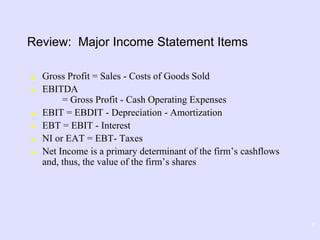
Review: Major Income Statement Items
 Gross Profit = Sales - Costs of Goods Sold
 EBITDA
= Gross Profit - Cash Operating Expenses
 EBIT = EBDIT - Depreciation - Amortization
 EBT = EBIT - Interest
 NI or EAT = EBT- Taxes
 Net Income is a primary determinant of the firm’s cashflows
and, thus, the value of the firm’s shares
7
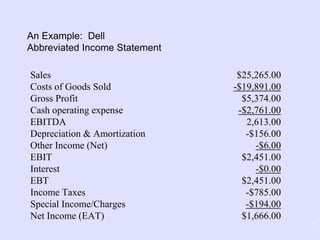
An Example: Dell
Abbreviated Income Statement
Sales $25,265.00
Costs of Goods Sold -$19,891.00
Gross Profit $5,374.00
Cash operating expense -$2,761.00
EBITDA 2,613.00
Depreciation & Amortization -$156.00
Other Income (Net) -$6.00
EBIT $2,451.00
Interest -$0.00
EBT $2,451.00
Income Taxes -$785.00
Special Income/Charges -$194.00
Net Income (EAT) $1,666.00
8
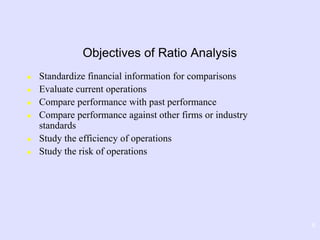
Objectives of Ratio Analysis
 Standardize financial information for comparisons
 Evaluate current operations
 Compare performance with past performance
 Compare performance against other firms or industry
standards
 Study the efficiency of operations
 Study the risk of operations
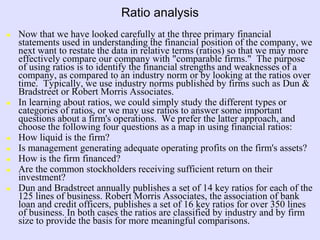
Ratio analysis
 Now that we have looked carefully at the three primary financial
statements used in understanding the financial position of the company, we
next want to restate the data in relative terms (ratios) so that we may more
effectively compare our company with "comparable firms." The purpose
of using ratios is to identify the financial strengths and weaknesses of a
company, as compared to an industry norm or by looking at the ratios over
time. Typically, we use industry norms published by firms such as Dun &
Bradstreet or Robert Morris Associates.
 In learning about ratios, we could simply study the different types or
categories of ratios, or we may use ratios to answer some important
questions about a firm's operations. We prefer the latter approach, and
choose the following four questions as a map in using financial ratios:
 How liquid is the firm?
 Is management generating adequate operating profits on the firm's assets?
 How is the firm financed?
 Are the common stockholders receiving sufficient return on their
investment?
 Dun and Bradstreet annually publishes a set of 14 key ratios for each of the
125 lines of business. Robert Morris Associates, the association of bank
loan and credit officers, publishes a set of 16 key ratios for over 350 lines
of business. In both cases the ratios are classified by industry and by firm
size to provide the basis for more meaningful comparisons.
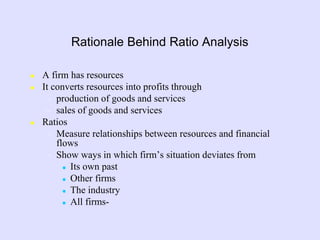
Rationale Behind Ratio Analysis
 A firm has resources
 It converts resources into profits through
– production of goods and services
– sales of goods and services
 Ratios
– Measure relationships between resources and financial
flows
– Show ways in which firm’s situation deviates from
 Its own past
 Other firms
 The industry
 All firms-
11
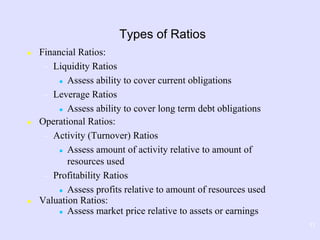
Types of Ratios
 Financial Ratios:
– Liquidity Ratios
 Assess ability to cover current obligations
– Leverage Ratios
 Assess ability to cover long term debt obligations
 Operational Ratios:
– Activity (Turnover) Ratios
 Assess amount of activity relative to amount of
resources used
– Profitability Ratios
 Assess profits relative to amount of resources used
 Valuation Ratios:
 Assess market price relative to assets or earnings
12
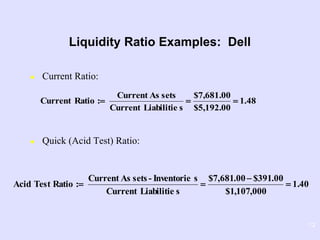
 Current Ratio:
 Quick (Acid Test) Ratio:
Liquidity Ratio Examples: Dell
48.1
5,192.00$
7,681.00$
sLiabilitieCurrent
setsCurrent As
:RatioCurrent 
1.40
000,107,1$
00.391$00.681,7$
sLiabilitieCurrent
sInventorie-setsCurrent As
:RatioTestAcid 


13
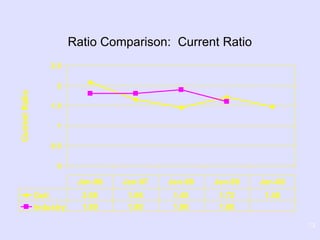
Ratio Comparison: Current Ratio
0
0.5
1
1.5
2
2.5
CurrentRatio
Dell 2.08 1.66 1.45 1.72 1.48
Industry 1.80 1.80 1.90 1.60
Jan-96 Jan-97 Jan-98 Jan-99 Jan-00
14
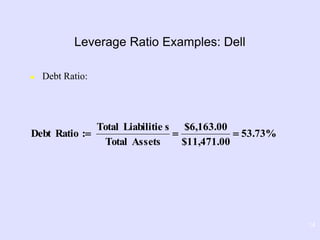
 Debt Ratio:
Leverage Ratio Examples: Dell
53.73%
11,471.00$
6,163.00$
AssetsTotal
sLiabilitieTotal
:RatioDebt 
15
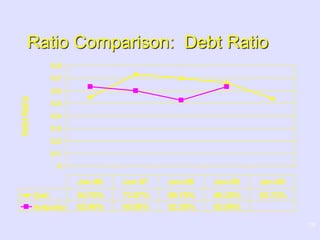
Ratio Comparison: Debt Ratio
0
0.1
0.2
0.3
0.4
0.5
0.6
0.7
0.8
DebtRatio
Dell 54.70% 73.07% 69.70% 66.25% 53.73%
Industry 62.96% 60.00% 52.38% 62.96%
Jan-96 Jan-97 Jan-98 Jan-99 Jan-00
16
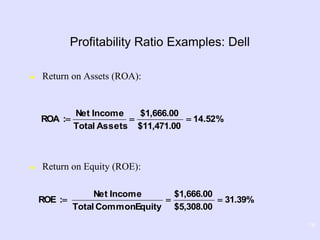
 Return on Assets (ROA):
 Return on Equity (ROE):
Profitability Ratio Examples: Dell
%52.41
11,471.00$
1,666.00$
AssetsTotal
IncomeNet
:ROA 
31.39%
5,308.00$
1,666.00$
EquityCommonTotal
IncomeNet
:ROE 
17
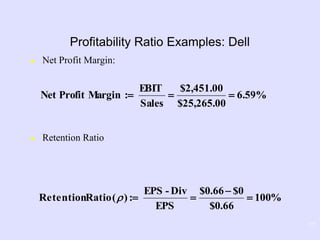
Profitability Ratio Examples: Dell
 Net Profit Margin:
 Retention Ratio
%001
66.0$
0$66.0$
EPS
Div-EPS
:)(RatioRetention 


6.59%
25,265.00$
2,451.00$
Sales
EBIT
:MarginProfitNet 
18
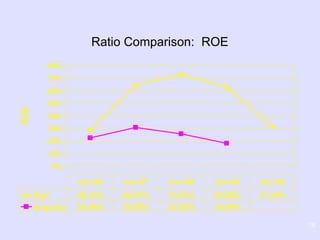
0%
10%
20%
30%
40%
50%
60%
70%
80%
ROE
Dell 28.13% 64.27% 73.01% 62.90% 31.39%
Industry 22.30% 30.60% 25.50% 18.00%
Jan-96 Jan-97 Jan-98 Jan-99 Jan-00
Ratio Comparison: ROE
19
0%
5%
10%
15%
20%
25%
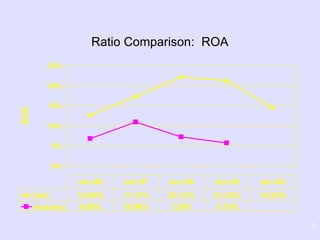
ROA
Dell 12.66% 17.31% 22.12% 21.23% 14.52%
Industry 6.80% 10.90% 7.20% 5.70%
Jan-96 Jan-97 Jan-98 Jan-99 Jan-00
Ratio Comparison: ROA
20
0%
1%
2%
3%
4%
5%
6%
7%
8%
9%
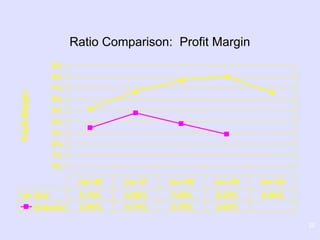
ProfitMargin
Dell 5.14% 6.68% 7.66% 8.00% 6.59%
Industry 3.40% 4.74% 3.79% 2.85%
Jan-96 Jan-97 Jan-98 Jan-99 Jan-00
Ratio Comparison: Profit Margin
21
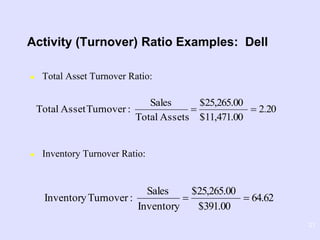
 Total Asset Turnover Ratio:
 Inventory Turnover Ratio:
Activity (Turnover) Ratio Examples: Dell
202
11,471.00$
25,265.00$
AssetsTotal
Sales
:TurnoverAssetTotal .
64.62
391.00$
25,265.00$
Inventory
Sales
:TurnoverInventory 
22
0%
50%
100%
150%
200%
250%
300%
350%
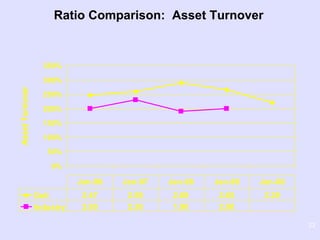
AssetTurnover
Dell 2.47 2.59 2.89 2.65 2.20
Industry 2.00 2.30 1.90 2.00
Jan-96 Jan-97 Jan-98 Jan-99 Jan-00
Ratio Comparison: Asset Turnover
23
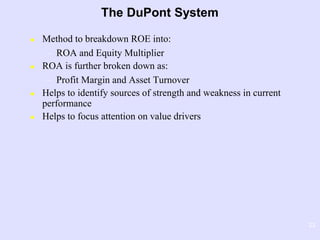
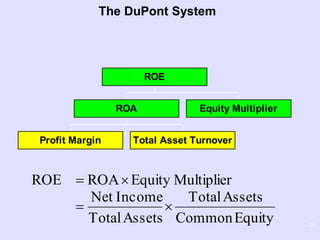
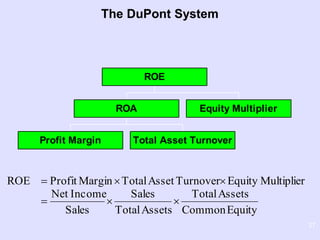
The DuPont System
 Method to breakdown ROE into:
– ROA and Equity Multiplier
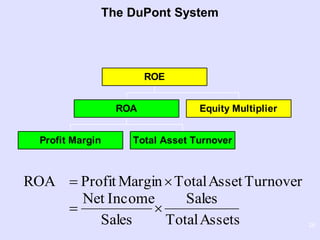
 ROA is further broken down as:
– Profit Margin and Asset Turnover
 Helps to identify sources of strength and weakness in current
performance
 Helps to focus attention on value drivers
24
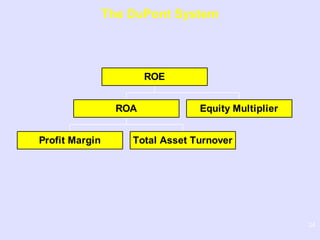
The DuPont System
Profit Margin Total Asset Turnover
ROA Equity Multiplier
ROE
25
The DuPont System
Profit Margin Total Asset Turnover
ROA Equity Multiplier
ROE
EquityCommon
AssetsTotal
AssetsTotal
IncomeNet
MultiplierEquityROAROE


26
The DuPont System
Profit Margin Total Asset Turnover
ROA Equity Multiplier
ROE
AssetsTotal
Sales
Sales
IncomeNet
TurnoverAssetTotalMarginProfitROA


27
The DuPont System
Profit Margin Total Asset Turnover
ROA Equity Multiplier
ROE
EquityCommon
AssetsTotal
AssetsTotal
Sales
Sales
IncomeNet
MultiplierEquityTurnoverAssetTotalMarginProfitROE


28
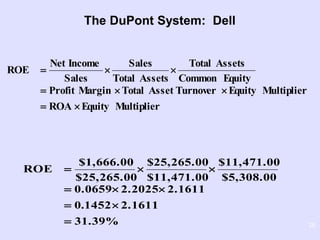
The DuPont System: Dell
MultiplierEquityROA
MultiplierEquityTurnoverAssetTotalMarginProfit
EquityCommon
AssetsTotal
AssetsTotal
Sales
Sales
IncomeNet
ROE



31.39%
2.16111452.0
2.16112.20250.0659
$5,308.00
$11,471.00
$11,471.00
$25,265.00
$25,265.00
$1,666.00
ROE




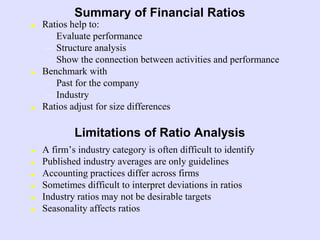
Summary of Financial Ratios
 Ratios help to:
– Evaluate performance
– Structure analysis
– Show the connection between activities and performance
 Benchmark with
– Past for the company
– Industry
 Ratios adjust for size differences
Limitations of Ratio Analysis
 A firm’s industry category is often difficult to identify
 Published industry averages are only guidelines
 Accounting practices differ across firms
 Sometimes difficult to interpret deviations in ratios
 Industry ratios may not be desirable targets
 Seasonality affects ratios
30
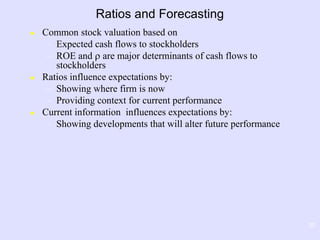
Ratios and Forecasting
 Common stock valuation based on
– Expected cash flows to stockholders
– ROE and  are major determinants of cash flows to
stockholders
 Ratios influence expectations by:
– Showing where firm is now
– Providing context for current performance
 Current information influences expectations by:
– Showing developments that will alter future performance

Financial statements

  • 1.
    1 Stock Price Risk of Cashflows Timingof Cash flows Expected Cash flows Stock Price Market Conditions NPV MVA EVA
  • 2.
    2 Financial Analysis  Assessmentof the firm’s past, present and future financial conditions  Done to find firm’s financial strengths and weaknesses  Primary Tools: – Financial Statements – Comparison of financial ratios to past, industry, sector and all firms Financial Statements  Balance Sheet  Income Statement  Cashflow Statement  Statement of Retained Earnings
  • 3.
    3 Sources of Data Annual reports – Via mail, SEC or company websites  Published collections of data – e.g., Dun and Bradstreet or Robert Morris  Investment sites on the web – Examples  http://moneycentral.msn.com/investor  http://www.marketguide.com The Main Idea  Value for the firm comes from cash flows  Cash flows can be calculated as:  (Revt - Costt - Dept)x(1-t) + Dept —OR—  (Revt - Costt)x(1-t) + txDept —OR—  Revtx(1-t) - Costtx(1-t) + txDept
  • 4.
    4 Review: Major BalanceSheet Items Assets  Current assets: – Cash & securities – Receivables – Inventories  Fixed assets: – Tangible assets – Intangible assets Liabilities and Equity  Current liabilities: – Payables – Short-term debt  Long-term liabilities  Shareholders' equity
  • 5.
    5 An Example: Dell AbbreviatedBalance Sheet  Assets: – Current Assets: $7,681.00 – Non-Current Assets: $3,790.00 – Total Assets: $11,471.00  Liabilities: – Current Liabilities: $5,192.00 – LT Debt & Other LT Liab.: $971.00 – Equity: $5,308.00 – Total Liab. and Equity: $11,471.00
  • 6.
    6 Review: Major IncomeStatement Items  Gross Profit = Sales - Costs of Goods Sold  EBITDA = Gross Profit - Cash Operating Expenses  EBIT = EBDIT - Depreciation - Amortization  EBT = EBIT - Interest  NI or EAT = EBT- Taxes  Net Income is a primary determinant of the firm’s cashflows and, thus, the value of the firm’s shares
  • 7.
    7 An Example: Dell AbbreviatedIncome Statement Sales $25,265.00 Costs of Goods Sold -$19,891.00 Gross Profit $5,374.00 Cash operating expense -$2,761.00 EBITDA 2,613.00 Depreciation & Amortization -$156.00 Other Income (Net) -$6.00 EBIT $2,451.00 Interest -$0.00 EBT $2,451.00 Income Taxes -$785.00 Special Income/Charges -$194.00 Net Income (EAT) $1,666.00
  • 8.
    8 Objectives of RatioAnalysis  Standardize financial information for comparisons  Evaluate current operations  Compare performance with past performance  Compare performance against other firms or industry standards  Study the efficiency of operations  Study the risk of operations
  • 9.
    Ratio analysis  Nowthat we have looked carefully at the three primary financial statements used in understanding the financial position of the company, we next want to restate the data in relative terms (ratios) so that we may more effectively compare our company with "comparable firms." The purpose of using ratios is to identify the financial strengths and weaknesses of a company, as compared to an industry norm or by looking at the ratios over time. Typically, we use industry norms published by firms such as Dun & Bradstreet or Robert Morris Associates.  In learning about ratios, we could simply study the different types or categories of ratios, or we may use ratios to answer some important questions about a firm's operations. We prefer the latter approach, and choose the following four questions as a map in using financial ratios:  How liquid is the firm?  Is management generating adequate operating profits on the firm's assets?  How is the firm financed?  Are the common stockholders receiving sufficient return on their investment?  Dun and Bradstreet annually publishes a set of 14 key ratios for each of the 125 lines of business. Robert Morris Associates, the association of bank loan and credit officers, publishes a set of 16 key ratios for over 350 lines of business. In both cases the ratios are classified by industry and by firm size to provide the basis for more meaningful comparisons.
  • 10.
    Rationale Behind RatioAnalysis  A firm has resources  It converts resources into profits through – production of goods and services – sales of goods and services  Ratios – Measure relationships between resources and financial flows – Show ways in which firm’s situation deviates from  Its own past  Other firms  The industry  All firms-
  • 11.
    11 Types of Ratios Financial Ratios: – Liquidity Ratios  Assess ability to cover current obligations – Leverage Ratios  Assess ability to cover long term debt obligations  Operational Ratios: – Activity (Turnover) Ratios  Assess amount of activity relative to amount of resources used – Profitability Ratios  Assess profits relative to amount of resources used  Valuation Ratios:  Assess market price relative to assets or earnings
  • 12.
    12  Current Ratio: Quick (Acid Test) Ratio: Liquidity Ratio Examples: Dell 48.1 5,192.00$ 7,681.00$ sLiabilitieCurrent setsCurrent As :RatioCurrent  1.40 000,107,1$ 00.391$00.681,7$ sLiabilitieCurrent sInventorie-setsCurrent As :RatioTestAcid   
  • 13.
    13 Ratio Comparison: CurrentRatio 0 0.5 1 1.5 2 2.5 CurrentRatio Dell 2.08 1.66 1.45 1.72 1.48 Industry 1.80 1.80 1.90 1.60 Jan-96 Jan-97 Jan-98 Jan-99 Jan-00
  • 14.
    14  Debt Ratio: LeverageRatio Examples: Dell 53.73% 11,471.00$ 6,163.00$ AssetsTotal sLiabilitieTotal :RatioDebt 
  • 15.
    15 Ratio Comparison: DebtRatio 0 0.1 0.2 0.3 0.4 0.5 0.6 0.7 0.8 DebtRatio Dell 54.70% 73.07% 69.70% 66.25% 53.73% Industry 62.96% 60.00% 52.38% 62.96% Jan-96 Jan-97 Jan-98 Jan-99 Jan-00
  • 16.
    16  Return onAssets (ROA):  Return on Equity (ROE): Profitability Ratio Examples: Dell %52.41 11,471.00$ 1,666.00$ AssetsTotal IncomeNet :ROA  31.39% 5,308.00$ 1,666.00$ EquityCommonTotal IncomeNet :ROE 
  • 17.
    17 Profitability Ratio Examples:Dell  Net Profit Margin:  Retention Ratio %001 66.0$ 0$66.0$ EPS Div-EPS :)(RatioRetention    6.59% 25,265.00$ 2,451.00$ Sales EBIT :MarginProfitNet 
  • 18.
    18 0% 10% 20% 30% 40% 50% 60% 70% 80% ROE Dell 28.13% 64.27%73.01% 62.90% 31.39% Industry 22.30% 30.60% 25.50% 18.00% Jan-96 Jan-97 Jan-98 Jan-99 Jan-00 Ratio Comparison: ROE
  • 19.
    19 0% 5% 10% 15% 20% 25% ROA Dell 12.66% 17.31%22.12% 21.23% 14.52% Industry 6.80% 10.90% 7.20% 5.70% Jan-96 Jan-97 Jan-98 Jan-99 Jan-00 Ratio Comparison: ROA
  • 20.
    20 0% 1% 2% 3% 4% 5% 6% 7% 8% 9% ProfitMargin Dell 5.14% 6.68%7.66% 8.00% 6.59% Industry 3.40% 4.74% 3.79% 2.85% Jan-96 Jan-97 Jan-98 Jan-99 Jan-00 Ratio Comparison: Profit Margin
  • 21.
    21  Total AssetTurnover Ratio:  Inventory Turnover Ratio: Activity (Turnover) Ratio Examples: Dell 202 11,471.00$ 25,265.00$ AssetsTotal Sales :TurnoverAssetTotal . 64.62 391.00$ 25,265.00$ Inventory Sales :TurnoverInventory 
  • 22.
    22 0% 50% 100% 150% 200% 250% 300% 350% AssetTurnover Dell 2.47 2.592.89 2.65 2.20 Industry 2.00 2.30 1.90 2.00 Jan-96 Jan-97 Jan-98 Jan-99 Jan-00 Ratio Comparison: Asset Turnover
  • 23.
    23 The DuPont System Method to breakdown ROE into: – ROA and Equity Multiplier  ROA is further broken down as: – Profit Margin and Asset Turnover  Helps to identify sources of strength and weakness in current performance  Helps to focus attention on value drivers
  • 24.
    24 The DuPont System ProfitMargin Total Asset Turnover ROA Equity Multiplier ROE
  • 25.
    25 The DuPont System ProfitMargin Total Asset Turnover ROA Equity Multiplier ROE EquityCommon AssetsTotal AssetsTotal IncomeNet MultiplierEquityROAROE  
  • 26.
    26 The DuPont System ProfitMargin Total Asset Turnover ROA Equity Multiplier ROE AssetsTotal Sales Sales IncomeNet TurnoverAssetTotalMarginProfitROA  
  • 27.
    27 The DuPont System ProfitMargin Total Asset Turnover ROA Equity Multiplier ROE EquityCommon AssetsTotal AssetsTotal Sales Sales IncomeNet MultiplierEquityTurnoverAssetTotalMarginProfitROE  
  • 28.
    28 The DuPont System:Dell MultiplierEquityROA MultiplierEquityTurnoverAssetTotalMarginProfit EquityCommon AssetsTotal AssetsTotal Sales Sales IncomeNet ROE    31.39% 2.16111452.0 2.16112.20250.0659 $5,308.00 $11,471.00 $11,471.00 $25,265.00 $25,265.00 $1,666.00 ROE    
  • 29.
    Summary of FinancialRatios  Ratios help to: – Evaluate performance – Structure analysis – Show the connection between activities and performance  Benchmark with – Past for the company – Industry  Ratios adjust for size differences Limitations of Ratio Analysis  A firm’s industry category is often difficult to identify  Published industry averages are only guidelines  Accounting practices differ across firms  Sometimes difficult to interpret deviations in ratios  Industry ratios may not be desirable targets  Seasonality affects ratios
  • 30.
    30 Ratios and Forecasting Common stock valuation based on – Expected cash flows to stockholders – ROE and  are major determinants of cash flows to stockholders  Ratios influence expectations by: – Showing where firm is now – Providing context for current performance  Current information influences expectations by: – Showing developments that will alter future performance

Editor's Notes