2
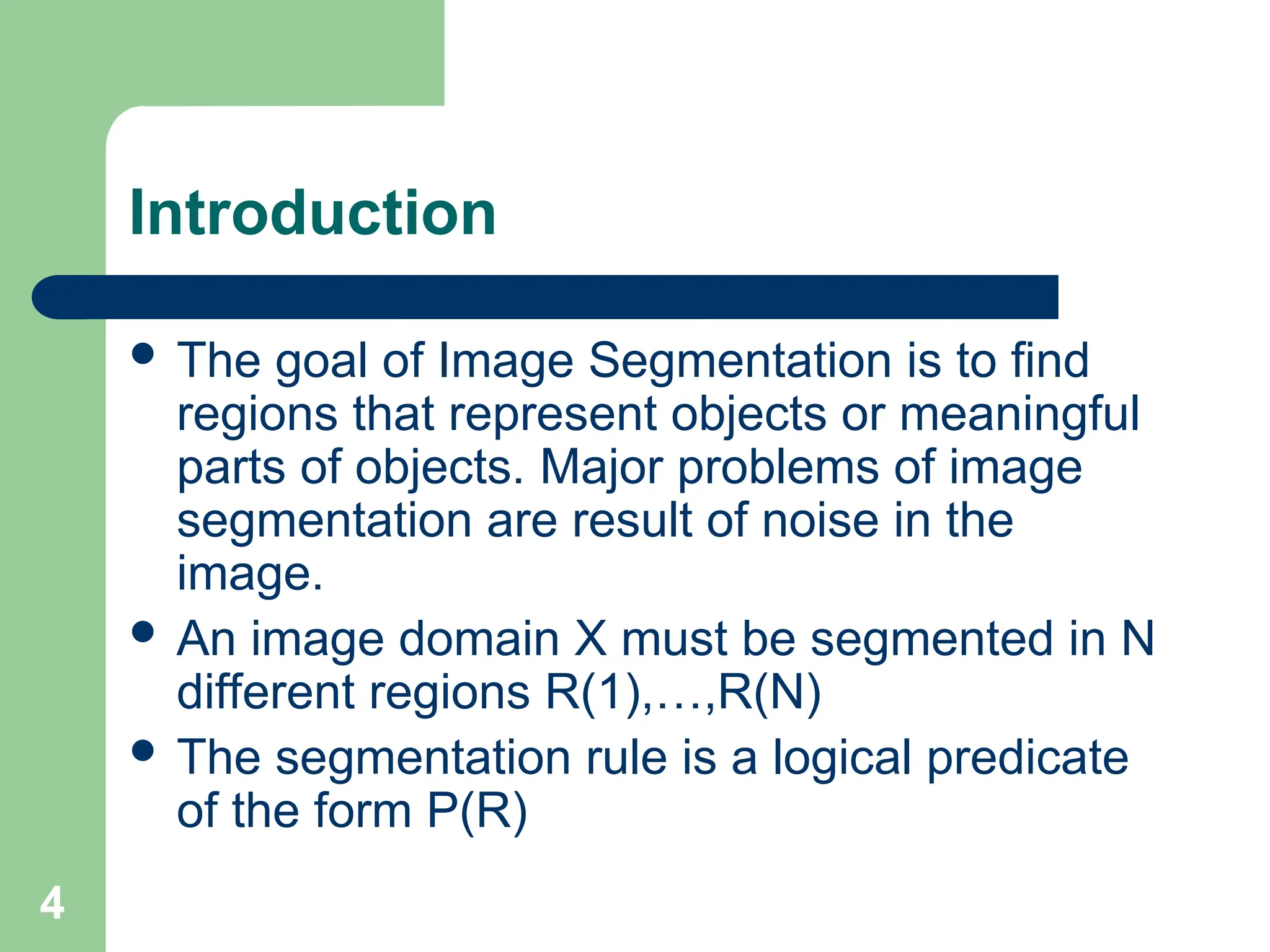
Approaches to ImageSegmentation
Histogram Thresholding
Clustering in the color space
Region Growing and Shrinking
(focus of this lecture)
3.
3
Introduction
The shape ofan object can be described in
terms of:
Its boundary – requires image edge detection
The region it occupies – requires image
segmentation in homogeneous regions,
Image regions generally have homogeneous
characteristics (e.g. intensity, texture)
4.
4
Introduction
The goalof Image Segmentation is to find
regions that represent objects or meaningful
parts of objects. Major problems of image
segmentation are result of noise in the
image.
An image domain X must be segmented in N
different regions R(1),…,R(N)
The segmentation rule is a logical predicate
of the form P(R)
5.
5
Introduction
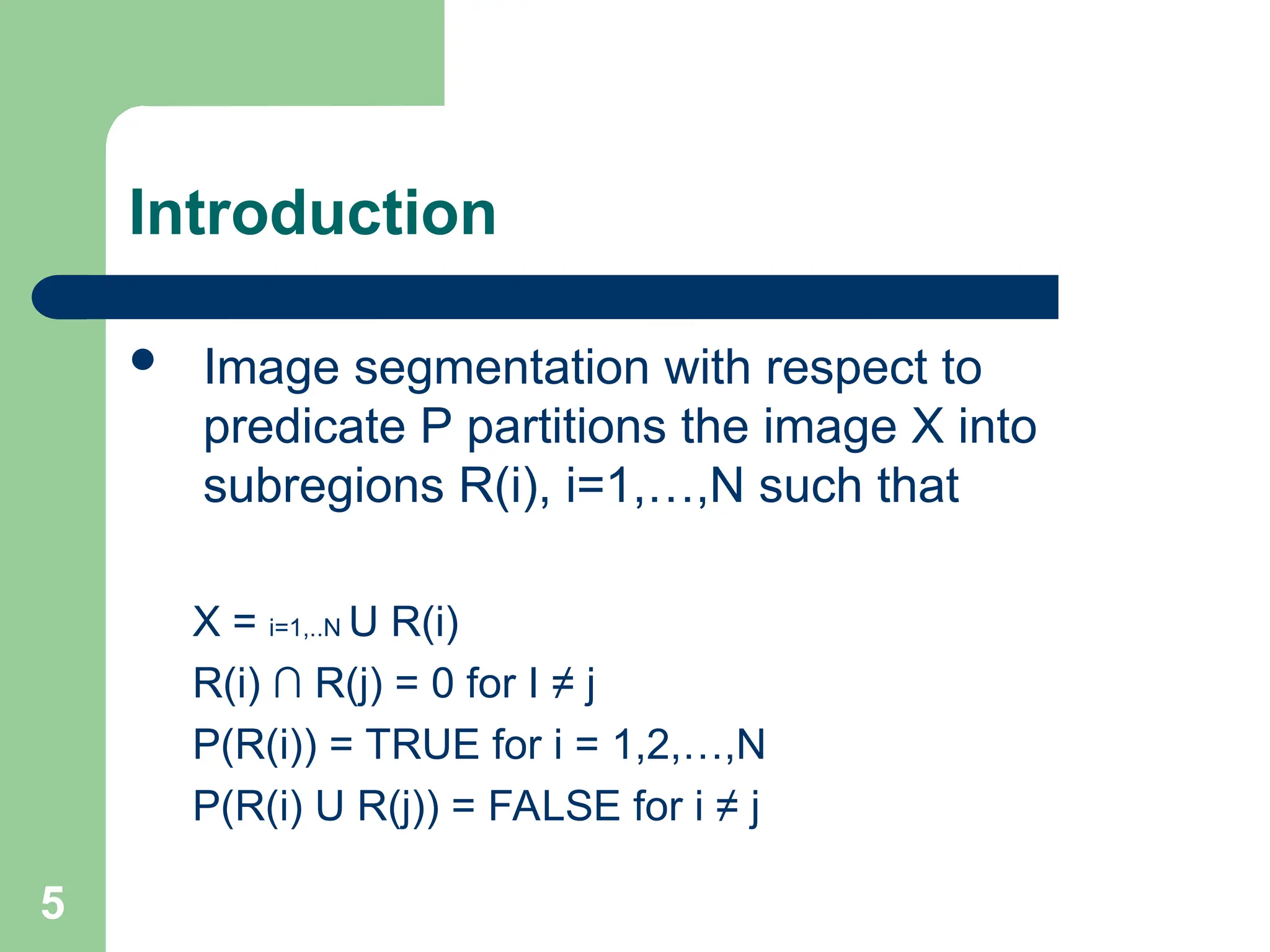
Image segmentationwith respect to
predicate P partitions the image X into
subregions R(i), i=1,…,N such that
X = i=1,..N U R(i)
R(i) ∩ R(j) = 0 for I ≠ j
P(R(i)) = TRUE for i = 1,2,…,N
P(R(i) U R(j)) = FALSE for i ≠ j
6.
6
Introduction
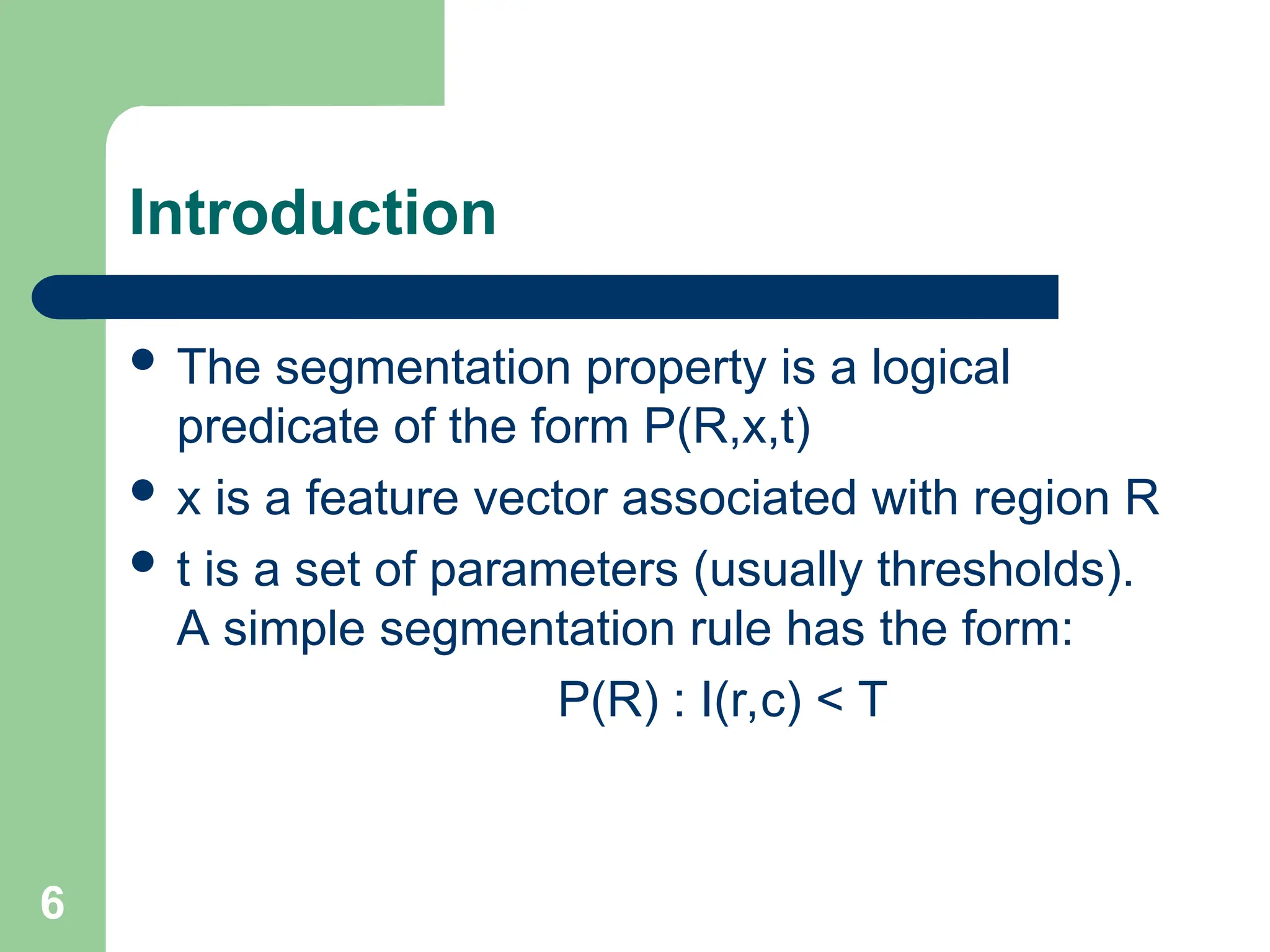
The segmentationproperty is a logical
predicate of the form P(R,x,t)
x is a feature vector associated with region R
t is a set of parameters (usually thresholds).
A simple segmentation rule has the form:
P(R) : I(r,c) < T
7.
7
Introduction
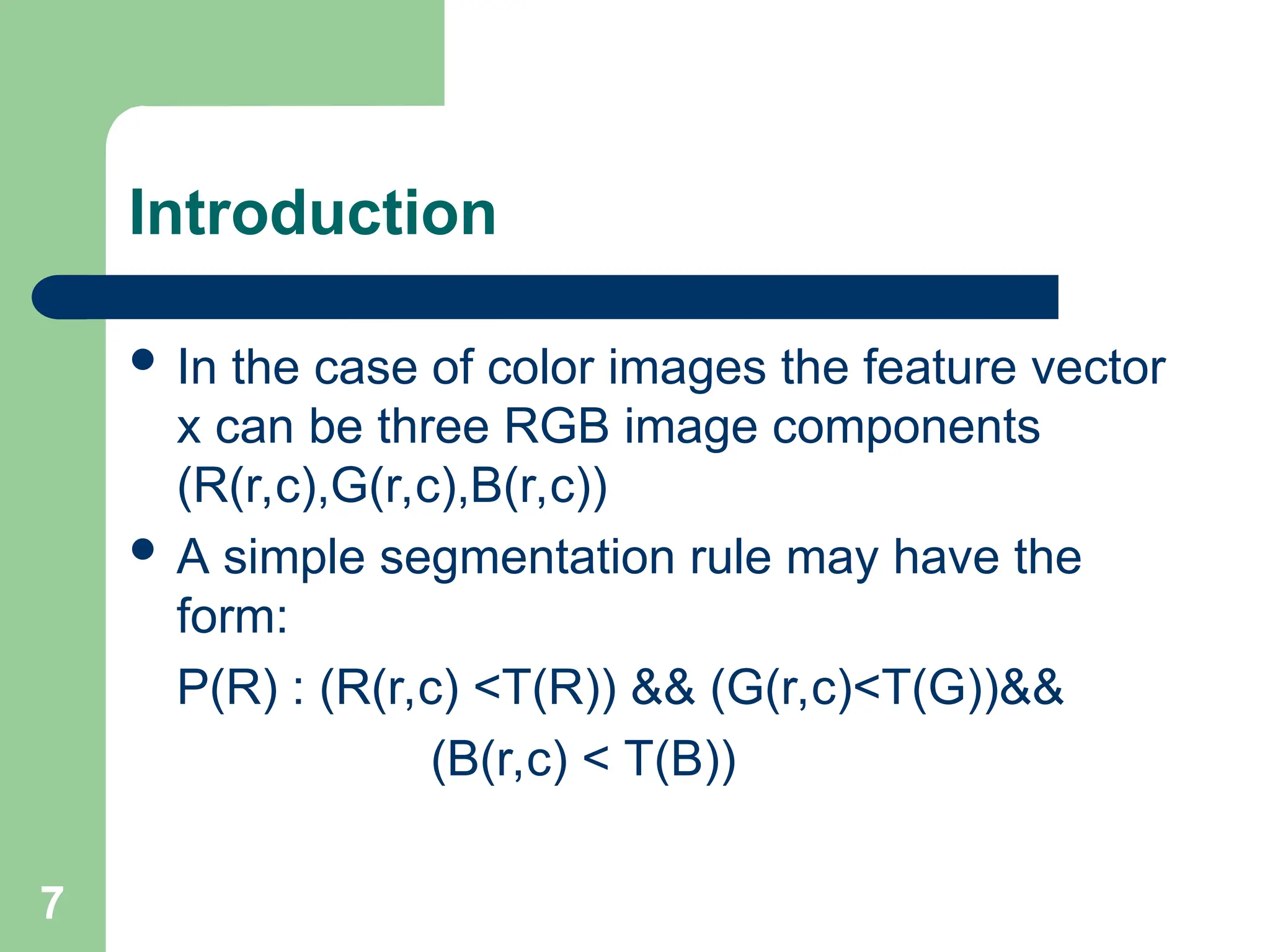
In thecase of color images the feature vector
x can be three RGB image components
(R(r,c),G(r,c),B(r,c))
A simple segmentation rule may have the
form:
P(R) : (R(r,c) <T(R)) && (G(r,c)<T(G))&&
(B(r,c) < T(B))
8.
8
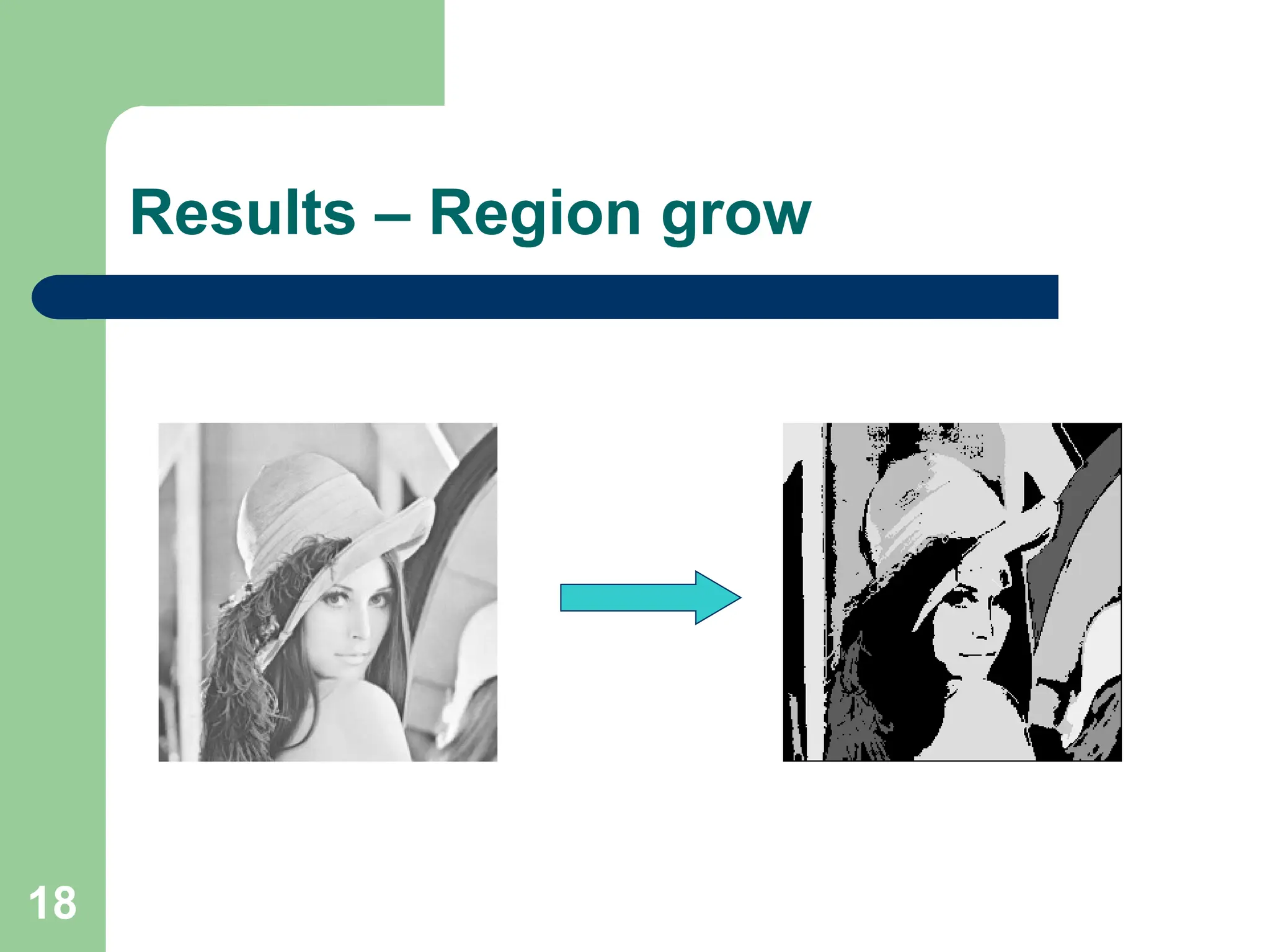
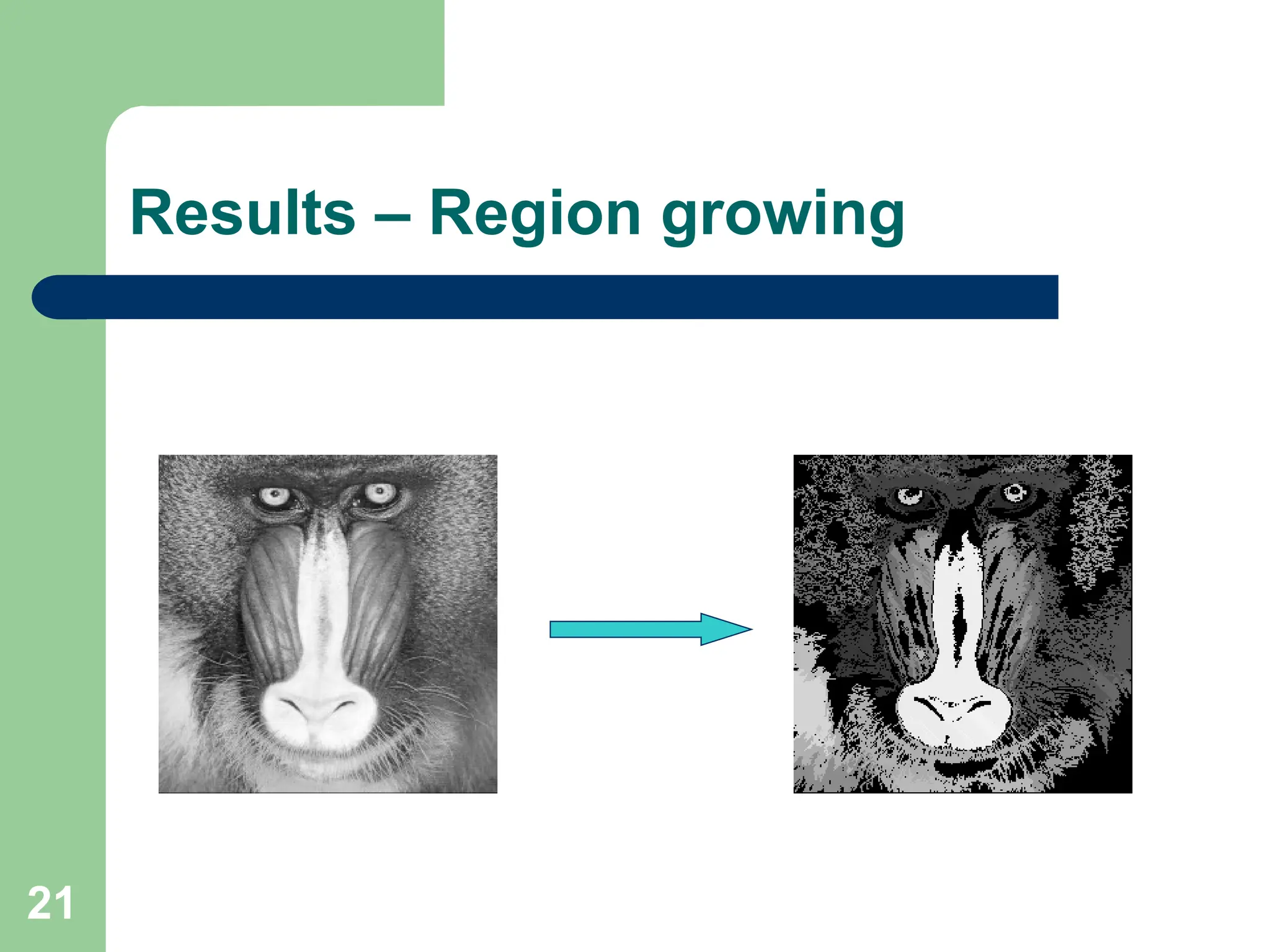
Region Growing
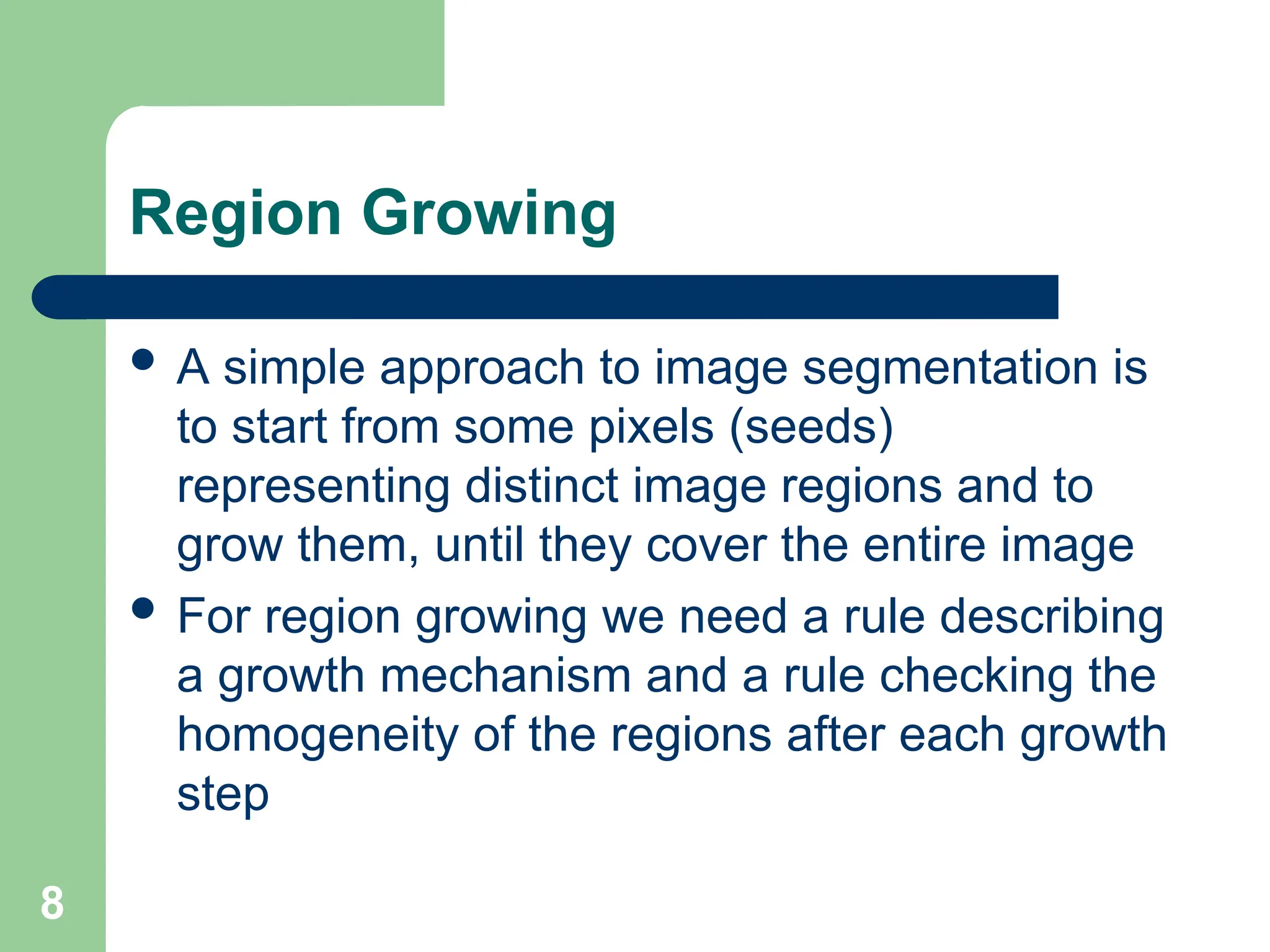
Asimple approach to image segmentation is
to start from some pixels (seeds)
representing distinct image regions and to
grow them, until they cover the entire image
For region growing we need a rule describing
a growth mechanism and a rule checking the
homogeneity of the regions after each growth
step
9.
9
Region Growing
Thegrowth mechanism – at each stage k
and for each region Ri(k), i = 1,…,N, we
check if there are unclassified pixels in the 8-
neighbourhood of each pixel of the region
border
Before assigning such a pixel x to a region
Ri(k),we check if the region homogeneity:
P(Ri(k) U {x}) = TRUE , is valid
10.
10
Region Growing
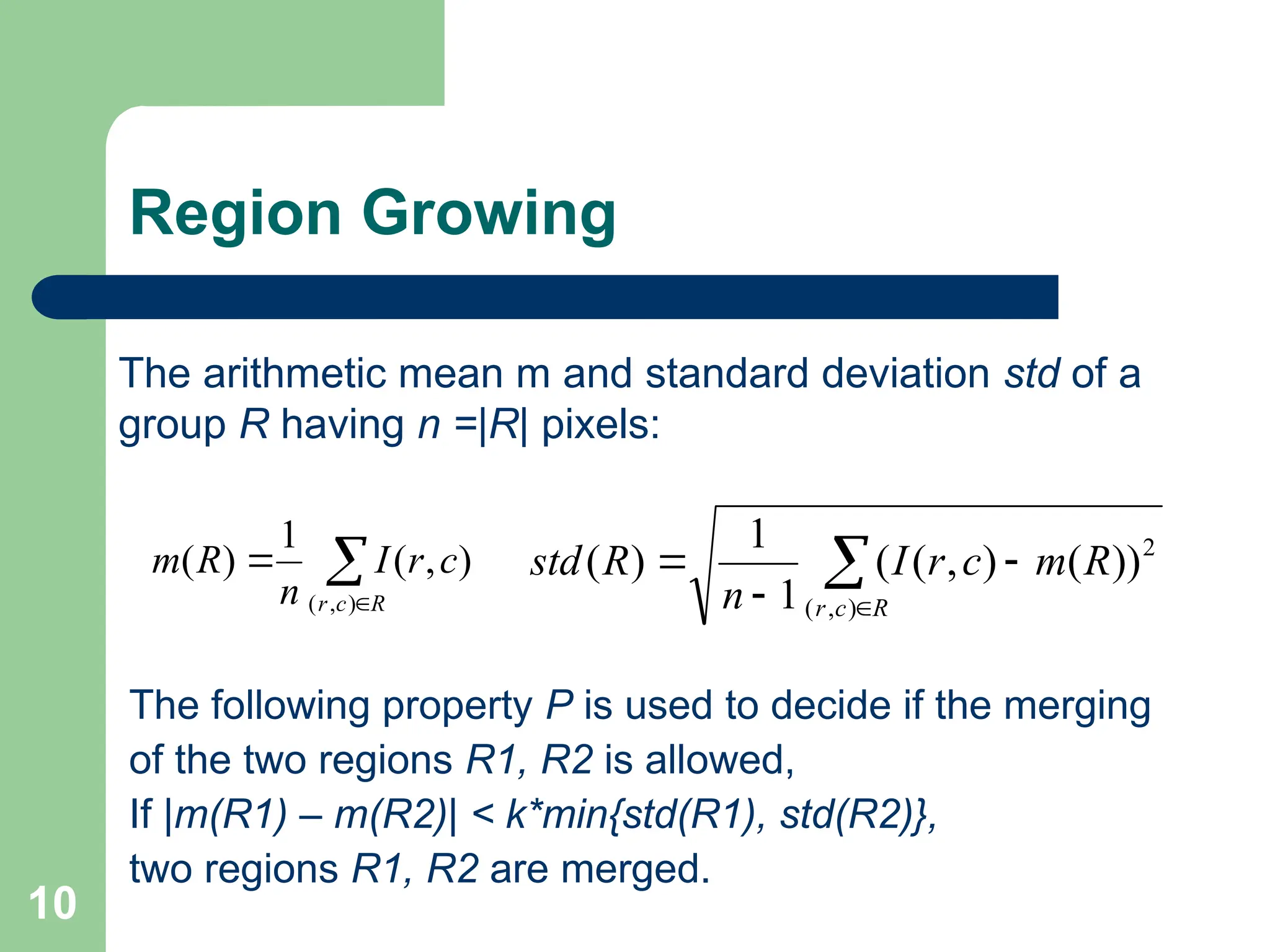
The followingproperty P is used to decide if the merging
of the two regions R1, R2 is allowed,
If |m(R1) – m(R2)| < k*min{std(R1), std(R2)},
two regions R1, R2 are merged.
R
c
r
c
r
I
n
R
m
)
,
(
)
,
(
1
)
(
The arithmetic mean m and standard deviation std of a
group R having n =|R| pixels:
R
c
r
R
m
c
r
I
n
R
std
)
,
(
2
))
(
)
,
(
(
1
1
)
(
11.
11
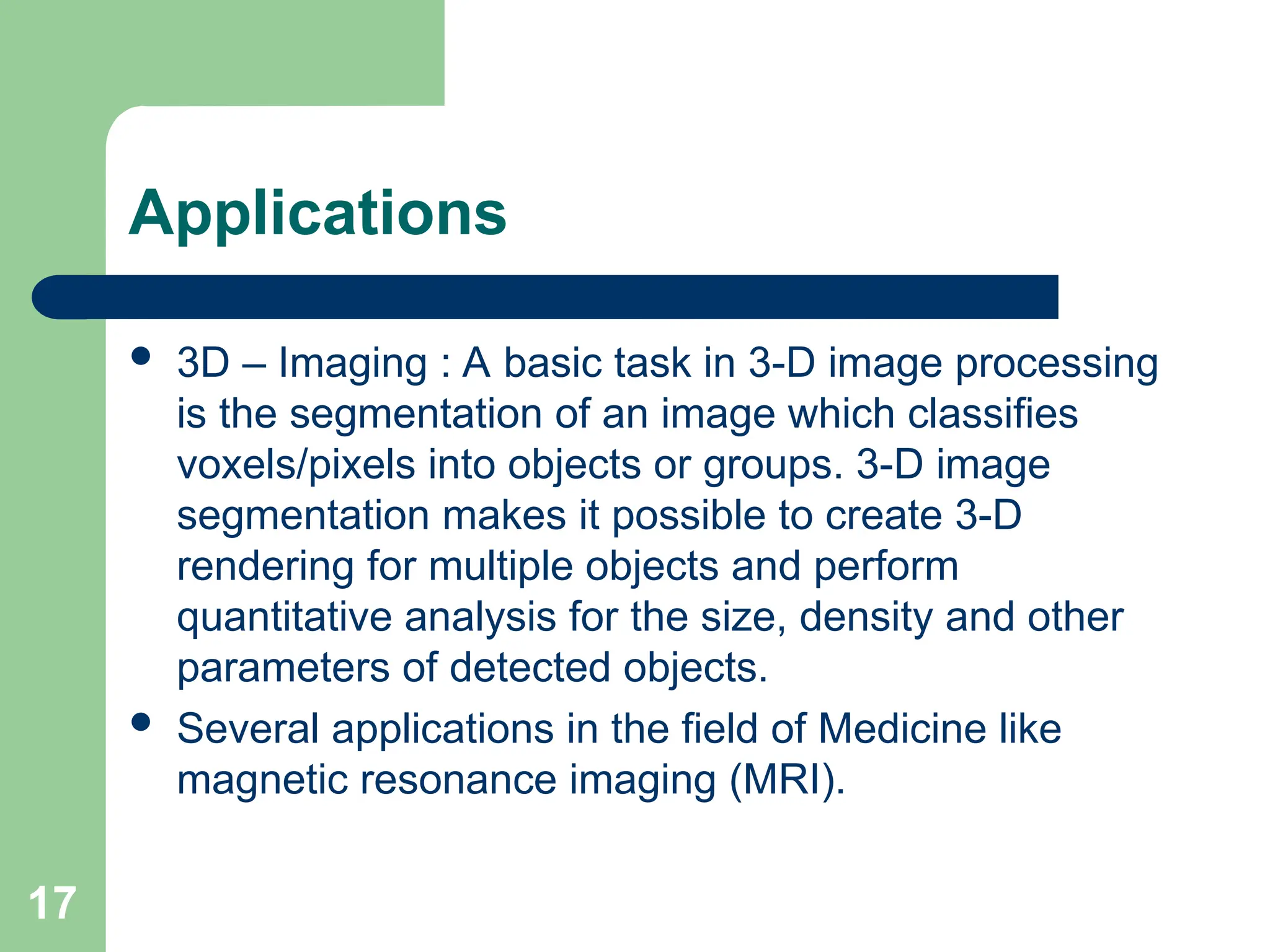
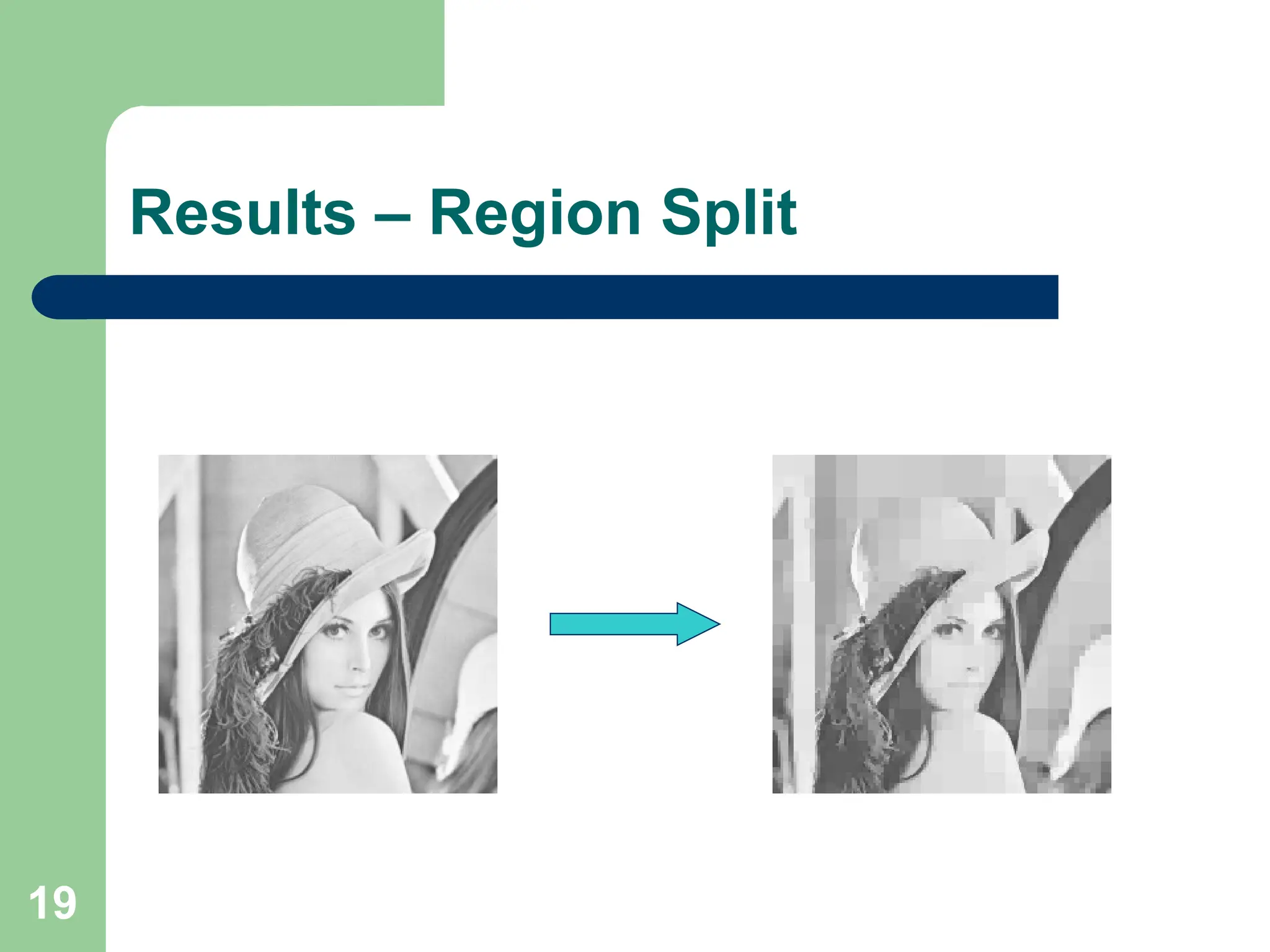
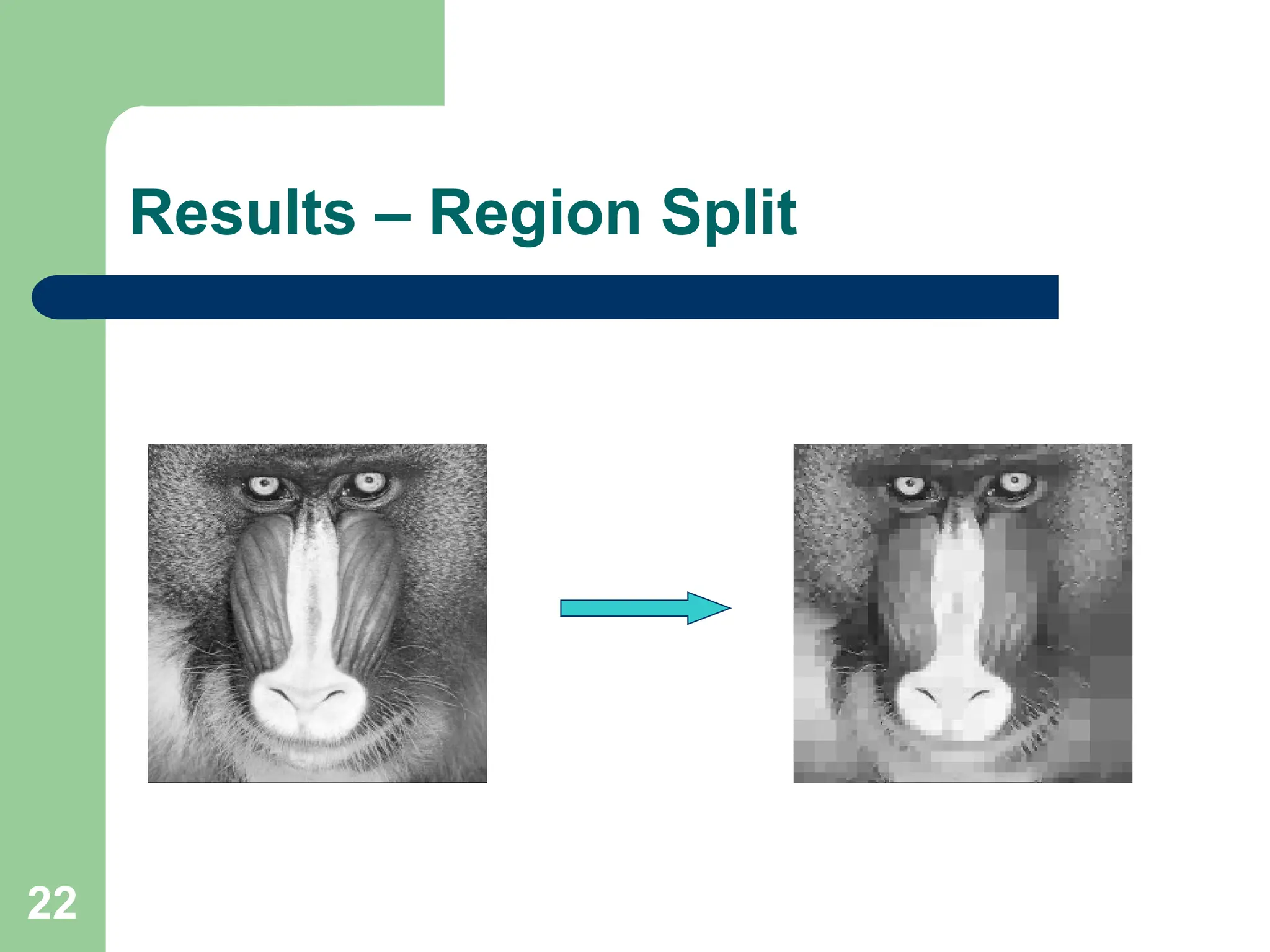
Split
The oppositeapproach to region growing is region
splitting.
It is a top-down approach and it starts with the
assumption that the entire image is homogeneous
If this is not true, the image is split into four sub
images
This splitting procedure is repeated recursively until
we split the image into homogeneous regions
12.
12
Split
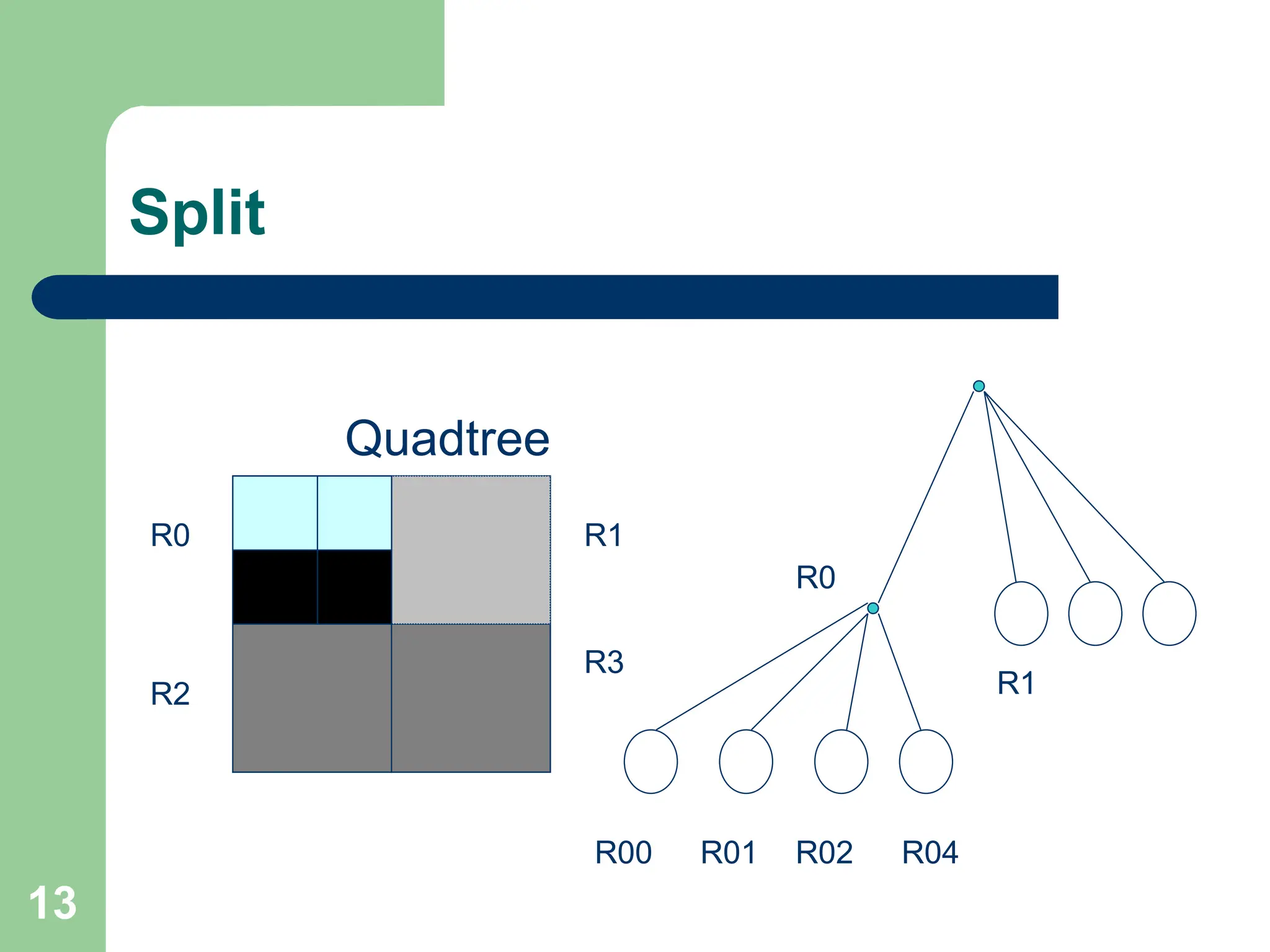
If theoriginal image is square N x N, having
dimensions that are powers of 2(N = 2n):
All regions produced but the splitting algorithm are
squares having dimensions M x M , where M is a
power of 2 as well.
Since the procedure is recursive, it produces an
image representation that can be described by a tree
whose nodes have four sons each
Such a tree is called a Quadtree.
14
Split
Splitting techniquesdisadvantage, they
create regions that may be adjacent and
homogeneous, but not merged.
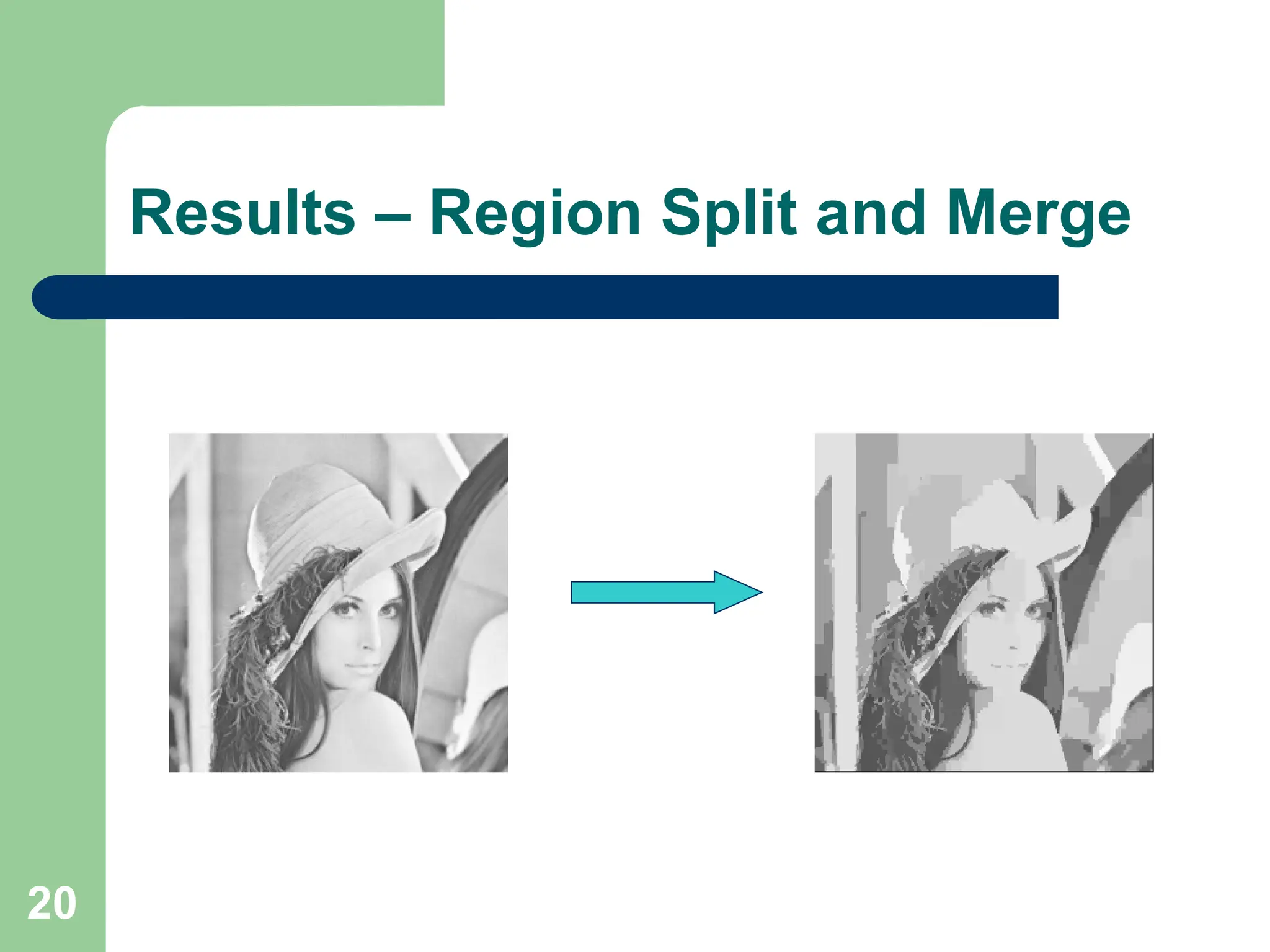
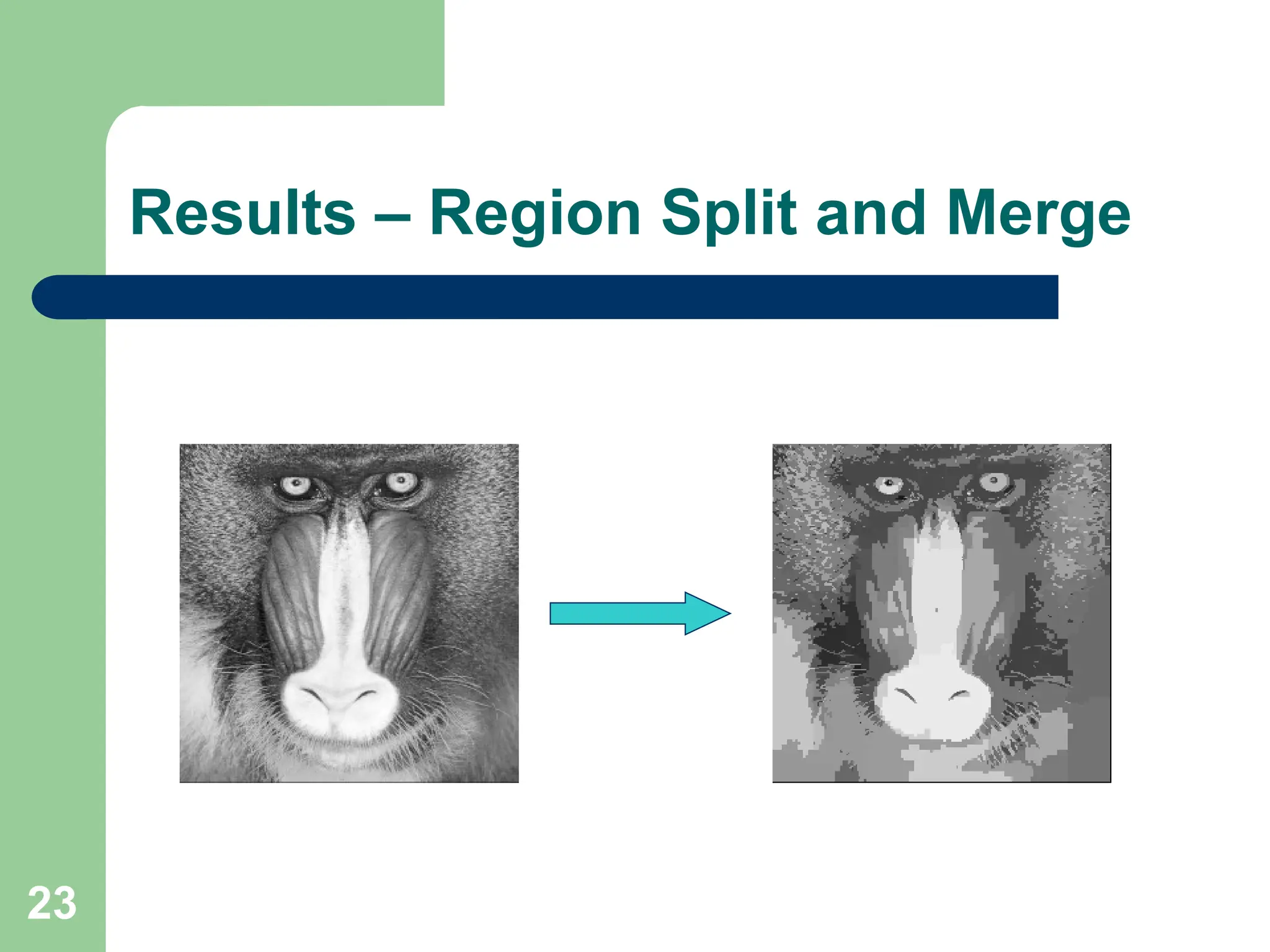
Split and Merge method is an iterative
algorithm that includes both splitting and
merging at each iteration:
15.
15
Split / Merge
If a region R is inhomogeneous
(P(R)= False) then is split into four sub
regions
If two adjacent regions Ri,Rj are
homogeneous (P(Ri U Rj) = TRUE), they are
merged
The algorithm stops when no further splitting
or merging is possible
16.
16
Split / Merge
The split and merge algorithm produces
more compact regions than the pure splitting
algorithm
17.
17
Applications
3D –Imaging : A basic task in 3-D image processing
is the segmentation of an image which classifies
voxels/pixels into objects or groups. 3-D image
segmentation makes it possible to create 3-D
rendering for multiple objects and perform
quantitative analysis for the size, density and other
parameters of detected objects.
Several applications in the field of Medicine like
magnetic resonance imaging (MRI).
24
References
“Digital ImageProcessing” – Algorithms and
Application , A multimedia approach.
by Ioannis Pitas
Computer Vision and Image Processing: A
Practical Approach
CVIP Tools software