Web 2.0: Changing the learning landscape Presented by Anne Bartlett-Bragg UTS & Digital Dialogues
Topics to explore: What is Web 2.0? Social software Mash-ups What does it enable? How will it influence our practice?
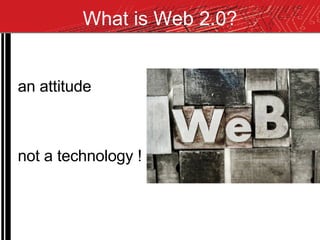
What is Web 2.0? an attitude  not a technology  !
What is Web 2.0? rapid, low cost approach to development browser-based from static isolated information silos to sources of content and interaction characterised by open communication, decentralisation of authority, freedom to share, and “the market as a conversation”
What is Web 2.0? Video clip available from YouTube: http://www.youtube.com/watch?v=6gmP4nk0EOE
What is social software? 1. How many people have a blog?  Personal?  Professional?  2. How many people use Flickr? 3. How many people use Delicious? 4. How many people use a wiki? 5. How many people subscribe to podcasts? 6. How many people use an aggregator? 7. How many people mash-up? 8. How many people can describe what RSS does? (in plain English!)
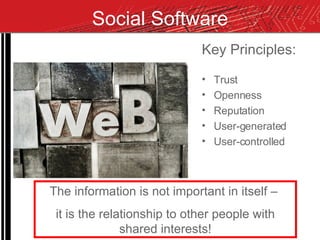
Social Software Key Principles: Trust Openness Reputation User-generated User-controlled The information is not important in itself –  it is the relationship to other people with shared interests!
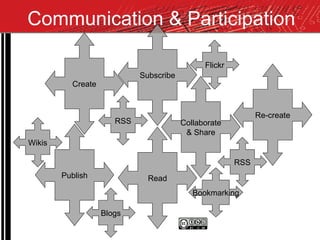
What does it enable? Learners can now create, publish, distribute, subscribe, read and re-create content. Learners are now producers and creators of learning NOT just consumers. Learning can be collaborative. Learning can be personalised. Learning can be informal. Learning is participatory. Learners are empowered. Learners are engaged.
Communication & Participation Flickr Bookmarking Subscribe Collaborate & Share Publish Create Read Re-create Blogs Wikis RSS RSS
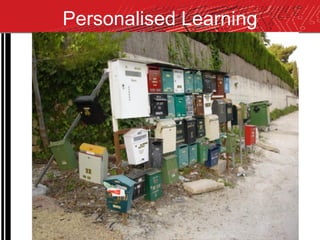
Personalised Learning
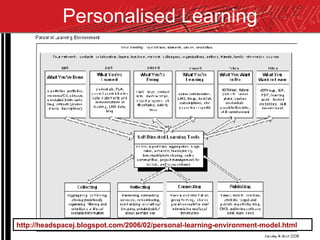
Personalised Learning http://headspacej.blogspot.com/2006/02/personal-learning-environment-model.html
Role of the Educator? Trusted source in a social learning network Guiding and advising Facilitating establishment of networks Empowering  Supporting personal landscape development
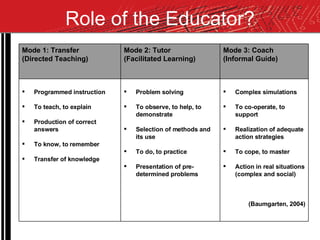
Role of the Educator? Complex simulations To co-operate, to support Realization of adequate action strategies To cope, to master Action in real situations (complex and social) (Baumgarten, 2004) Problem solving To observe, to help, to demonstrate Selection of methods and its use To do, to practice Presentation of pre-determined problems Programmed instruction To teach, to explain Production of correct answers To know, to remember Transfer of knowledge Mode 3: Coach (Informal Guide) Mode 2: Tutor (Facilitated Learning) Mode 1: Transfer (Directed Teaching)
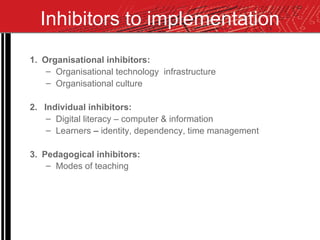
Inhibitors to implementation 1. Organisational inhibitors: Organisational technology  infrastructure Organisational culture 2.  Individual inhibitors:  Digital literacy – computer & information Learners  –  identity, dependency, time management 3.  Pedagogical inhibitors: Modes of teaching
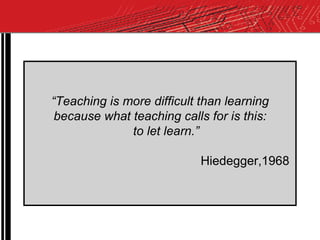
“ Teaching is more difficult than learning  because what teaching calls for is this:  to let learn.” Hiedegger,1968
 
Further Resources Slideshare http://www.slideshare.net/AnneBB Wetpaint wiki - join up! http://elearning2.wetpaint.com ABBs blog http://digitaldialogues.blogs.com/learning_technologies/ Ning community? http://www.ning.com Delicious http://del.icio.us/AnneBB Flickr http://www.flickr.com/AnneBB

AITD Web2.0: Changing the learning landscape Sep07

  • 1.
    Web 2.0: Changingthe learning landscape Presented by Anne Bartlett-Bragg UTS & Digital Dialogues
  • 2.
    Topics to explore:What is Web 2.0? Social software Mash-ups What does it enable? How will it influence our practice?
  • 3.
    What is Web2.0? an attitude not a technology !
  • 4.
    What is Web2.0? rapid, low cost approach to development browser-based from static isolated information silos to sources of content and interaction characterised by open communication, decentralisation of authority, freedom to share, and “the market as a conversation”
  • 5.
    What is Web2.0? Video clip available from YouTube: http://www.youtube.com/watch?v=6gmP4nk0EOE
  • 6.
    What is socialsoftware? 1. How many people have a blog? Personal? Professional? 2. How many people use Flickr? 3. How many people use Delicious? 4. How many people use a wiki? 5. How many people subscribe to podcasts? 6. How many people use an aggregator? 7. How many people mash-up? 8. How many people can describe what RSS does? (in plain English!)
  • 7.
    Social Software KeyPrinciples: Trust Openness Reputation User-generated User-controlled The information is not important in itself – it is the relationship to other people with shared interests!
  • 8.
    What does itenable? Learners can now create, publish, distribute, subscribe, read and re-create content. Learners are now producers and creators of learning NOT just consumers. Learning can be collaborative. Learning can be personalised. Learning can be informal. Learning is participatory. Learners are empowered. Learners are engaged.
  • 9.
    Communication & ParticipationFlickr Bookmarking Subscribe Collaborate & Share Publish Create Read Re-create Blogs Wikis RSS RSS
  • 10.
  • 11.
  • 12.
    Role of theEducator? Trusted source in a social learning network Guiding and advising Facilitating establishment of networks Empowering Supporting personal landscape development
  • 13.
    Role of theEducator? Complex simulations To co-operate, to support Realization of adequate action strategies To cope, to master Action in real situations (complex and social) (Baumgarten, 2004) Problem solving To observe, to help, to demonstrate Selection of methods and its use To do, to practice Presentation of pre-determined problems Programmed instruction To teach, to explain Production of correct answers To know, to remember Transfer of knowledge Mode 3: Coach (Informal Guide) Mode 2: Tutor (Facilitated Learning) Mode 1: Transfer (Directed Teaching)
  • 14.
    Inhibitors to implementation1. Organisational inhibitors: Organisational technology infrastructure Organisational culture 2. Individual inhibitors: Digital literacy – computer & information Learners – identity, dependency, time management 3. Pedagogical inhibitors: Modes of teaching
  • 15.
    “ Teaching ismore difficult than learning because what teaching calls for is this: to let learn.” Hiedegger,1968
  • 16.
  • 17.
    Further Resources Slidesharehttp://www.slideshare.net/AnneBB Wetpaint wiki - join up! http://elearning2.wetpaint.com ABBs blog http://digitaldialogues.blogs.com/learning_technologies/ Ning community? http://www.ning.com Delicious http://del.icio.us/AnneBB Flickr http://www.flickr.com/AnneBB