16 | APRIL 2015 | TRAINING & DEVELOPMENT WWW.AITD.COM.AU
TRAINING & DEVELOPMENT | APRIL 2015 | 17WWW.AITD.COM.AU
G
azing into crystal balls is not one of
my specialities – however intriguing
it may seem, it is not likely to provide
clear directions or guidance for
future workplace trends. How do we
distinguish between fad and sustainable
strategy? How do we consider where
learning opportunities may exist within
that trend?
The alternative to crystal balls can be
found in the approach used by urban
and software designers; a process called
Pattern Language (a term coined by
Christopher Alexander1
). Patterns guide
our designs by helping us understand
how people and their environment
interact – the way we choose to do
things. If we apply this process to
evaluating emerging workplace trends,
it can assist identification of common
behaviours across a range of conditions,
but also uncover overarching themes
- or mega-patterns – that provide
us with a broader perspective than
simply focusing on a device (like a
smartphone).
Enter the new normal: widely adopted
patterns of behaviour that is now
impacting the way we work and the way
we approach learning.
The following collection of mega-
patterns is not in a particular hierarchical
order - they are not weighted against any
priorities or reported impact. They have
been selected based on conversations
with practitioners and an extensive
review of research studies and analyst
reports produced during 2014 to identify
the mega-patterns shaping our current
and future workplaces.
Mega-pattern: The changing
nature of work and its
relationship with learning
It would be hard to deny there’s been
a substantial shift in the nature of
work - whether that is influenced
by technology, changing processes,
shifting workforce dynamics or external
market or environmental forces. The
impact extends beyond how we go
about work, to the consequences that
are being directly experienced by
traditional approaches to training and
how we perceive the role of learning in
organisations.
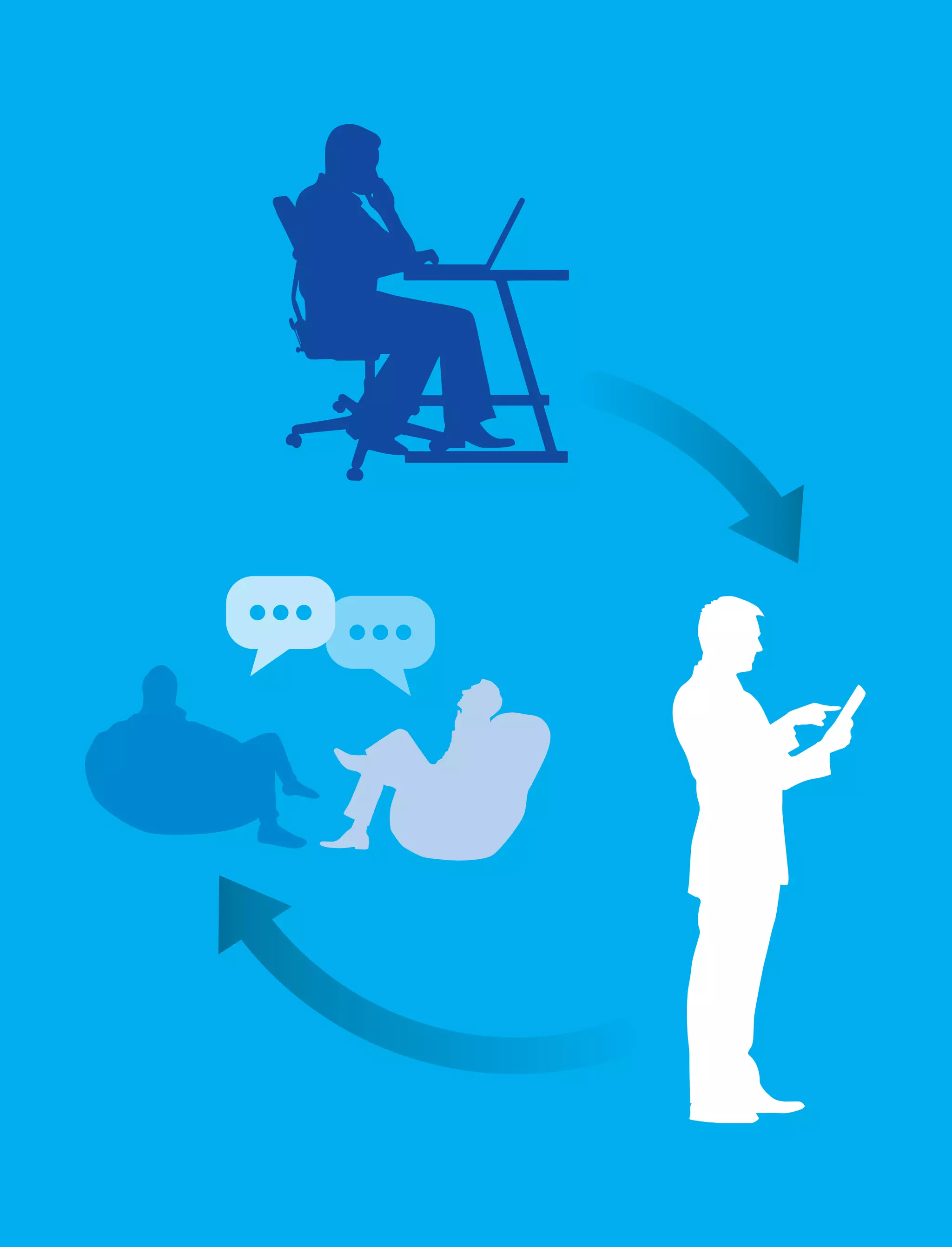
Office design
We have seen the redesign of physical
office spaces towards open style, activity-
based work approaches. These new
designs create innovative spaces that
enable people to select their appropriate
workspace to complete differing types
of activities. From private, quiet spaces
to collaborative, open spaces. But where
is learning occurring? From an interior
architect’s perspective - they continue to
build classrooms, albeit with technology
embedded.
Changing roles and
organisational structures
As learning in the workplace shifts - so
too do the relationships within the
organisational domains. There is a
recurring pattern globally represented
by an adjustment to role classifications.
Re-structured departments that include
HR, L&D, Knowledge Management and
extending to relationships with Internal
Communications are creating a broader
perspective on the value of informal
learning and just-in-time information.
Multi-generational workforce
By 2020 we will have five generations in
the workplace. The dynamics of this are
contentious. How do we accommodate
such purportedly different value sets
and approaches to work and learning?
The focus is shifting away from
division of age-based approaches
towards strategies to unite and embrace
the differences. This is supported by a
study from Steelcase2
that found the
ONLY difference was a tendency of Gen
Ys to use headphones in the workplace!
Why then are we trying to deliver
different types of training products
when the research is indicating people
would prefer to learn together?
This mega-pattern highlights a
disconnect between work, informal
learning and traditional delivery
of content. A mindset that is being
THENEW
NORMAL:
EMERGING
TRENDSIN2015
BYANNEBARTLETT-BRAGG
18 | APRIL 2015 | TRAINING & DEVELOPMENT WWW.AITD.COM.AU
reinforced by learning only occurring
and being valued when delivered in
classrooms (physical or virtual).
Flexible ways of working are not being
supported by flexible ways of learning!
Mega-pattern: The impact
of technology on work and
learning
Whether or not you believe technology
is the instigator of disruption in modern
workplaces, it cannot be avoided
when discussing new practices and
innovation. This mega-pattern exists at
the intersection of people and the digital
workplace. It encompasses the new
devices from smartphones to wearables,
new software enabling activities from
basic collaboration and networking to
deep analytics that shape new products
and innovative business models.
While most organisations have
focused on the “shiny” aspects of digital
transformation, such as customer
experience with social media,
many have neglected the potential
opportunities to integrate learning
approaches into their enterprise social
networks. Beyond the boundaries of
the LMS, learning in the workplace is
happening enabled by digital contexts.
How the effectiveness of integrating
learning into these landscapes is being
impacted by the patterns below:
Digital literacy
The cost of digital illiteracy is difficult
to measure. Consider the impact of
people unable to navigate or search
software and quickly locate important
information. Think of the limitations
experienced by members of a project
team expected to openly share their
knowledge online with people they have
never met. How do people participate
in online activities if they are unfamiliar
with the mechanics of creating or
uploading content? What aspects of
organisational culture impact online
behaviour?
In line with visual literacy topics
covered in this issue of Training and
Development - learning practitioners
have a critical role that will facilitate
the effectiveness of digital literacy and
sustainable adoption of technology
across the business. Failing to address
this may result in a further disconnect
between learning and the digital
workplace.
Mobile - everything!
If you are not planning to integrate
mobile into your learning strategies -
STOP- think again. In 2013 the number
of mobile devices had surpassed
the number of people on the planet!
This pattern has transitioned from
trend to an expectation that access to
most aspects of work be available by
whichever device someone chooses to
use. An unavoidable pattern that makes
responsive design and other methods of
mobile integration an essential learning
approach.
Wearable devices
Wearable devices are maturing.
Integration into established areas of
work are being reflected in high-end
immersive experiences with augmented
reality headsets to simple quantifiable
actions such as wellness programs
integrating fitness trackers. The
opportunities for learning are extensive
but will require experimentation and
adaptability to leverage these.
This mega-pattern is arguably the
most disruptive. However, we must
ensure our efforts to integrate learning
and technologies are not replicating
out-dated models of learning by simply
re-packaging existing content into new
devices and software.
It’s not about the technology; it’s about
how people are using it.
Mega-pattern: The changing
nature of learning in
organisations
The increasing complexities described
in the previous mega-patterns have a
direct impact on the nature of learning in
organisations. The current approach that
silos learning into unrelated systems and
locations, such as a LMS or a classroom,
creates a further distance between
learning and work.
This mega-pattern is most effectively
represented in a study of the modern
learner3
who wants to be untethered
from fixed learning locations and
structured approaches. They want to be
connected and collaborate with peers
and managers. And they want access
to information and learning that falls
outside of traditional training programs.
A 2014 white paper4
described a
future state ecosystem where multi-
faceted learning and performance
options enhanced effectiveness by
connecting people, while supporting
them through a broad range of content
options, processes and technologies.
As with the blending of roles and
departments mentioned above, the
ecosystem facilitates the merging of
knowledge management, formal and
informal learning, collaborative work, HR
and talent management, performance
support while emphasising flexibility
and adaptability across a number of
organisational systems rather than a
single, isolated LMS approach.
Instructional design is
superseded by design thinking
approaches
Watch as design practices become
an expectation across the business,
consequently influencing the design
of learning approaches. The business
expects L&D to keep up with these
trends and new approaches.
Learner-centred design will adopt
the use of authentic persona - not
standardised learner demographics that
over generalise how people learn but
genuine representations of real people,
in situ developing a deep understanding
and empathy for learners needs and
motivation.
Learning Analytics
Big data analytics or the Age of
Algorithms is empowering organisations
to more deeply examine patterns of
behaviour. Companies are already
applying data analytics to HR and talent
TRAINING & DEVELOPMENT | APRIL 2015 | 19WWW.AITD.COM.AU
acquisition but there’s limited examples
of learning analytics being leveraged
to provide adaptive learning contexts.
Measurements that will broaden
common data points like counting
course enrolments and completions
into predictive and adaptive analytics
that will guide interventions and new
approaches to performance issues are
set to become the new normal.
MOOCs
Some analysts announced the downfall
of MOOCs as an organisational learning
strategy early in 2014. However, as the
hype cycle matures the integration
of MOOCs is re-emerging as a realistic
offering for professional development.
It will be worthwhile to pay attention to
new, specialised approaches to MOOC
offerings and how re-designed delivery
options are being targeted as alternatives
to traditional eLearning courses.
Gamification matures
Results from early gamified learning
initiatives have provided insight into
what worked well and what wasn’t
effective. Strategies intended to motivate
participation like leaderboards and an
overuse of badges have pushed a reward
system similar to Pavlov’s dogs and dis-
engaged learners!
We are seeing experienced designers
embed elements of game mechanics
into their initiatives by using meaningful
rewards or recognition for performance.
Meanwhile, designers of serious games
and simulations are leveraging new tools
in cost effective ways to further extend
their learner engagement.
Social learning
The acknowledgement of social
learning as a relevant approach in
the current workplace context has
almost become ubiquitous. As this
approach flourishes, it will be essential
to revisit the underpinning theoretical
perspectives. These will inform methods
to incorporate technologies and create
activities beyond discussion forums that
empowers learners to deal with complex
work and learning environments.
A closing pattern: think like a
start up
If you were going to create a new internal
business unit that offered learning
opportunities to the organisation –
what would that look like? How would
you create an Amazon-like catalogue
that based personalised learning
recommendations on previous
experiences? Could you design an Uber
style mobile app that disrupts current
distribution of content models? Perhaps
a customised dashboard like Fitbit
that provided feedback to individuals
on their performance and learning
achievements against their goals.
How would you design engagement
to enhance the effectiveness of the
workplace? How would disrupt
the current model of learning and
development?
What will become the new normal?
Which of these trends will become
mainstream practice and which will
quietly slip into a passing phase, is
challenging to predict. What we are
compelled to address is the need for re-
shaping the current nature of learning in
organisations.
Simply providing training is no longer
good enough. Delivery methods must be
adapted to current workplace changes,
integration of how we work and learn
must become more agile and responsive.
Learning must no longer be
considered an isolated task. It must
become a valued activity discretely
embedded into our everyday practices,
where open knowledge sharing,
collaboration and guided development
are the new normal.
Dr Anne Bartlett-Bragg is the Managing
Director of the Ripple Effect Group in
the Asia-Pacific region and a sessional
lecturer of organisational learning
subjects at the University of Technology
Sydney. Anne can be found on Twitter as
@AnneBB.
Anne is a keynote speaker at the AITD
National Conference on 13-14 May 2015.
Further Reading
1
	Pattern Language: Towns, Buildings,
Construction by Christopher Alexander, Sara
Ishikawa, Murray Silverstein, 1977, Oxford
University Press
2
	Steelcase, 360 Magazine, What workers want.
3
	 Meet the modern learner, 2014, Bersin by
Deloitte.
4
	The eLearning Guild, 2014, Learning and
Performance Ecosystems: Current State and
Challenges.
The focus is shifting away from division of age-based approaches
towards strategies to unite and embrace the differences.

The New Normal: emerging trends in 2015

  • 1.
    16 | APRIL2015 | TRAINING & DEVELOPMENT WWW.AITD.COM.AU
  • 2.
    TRAINING & DEVELOPMENT| APRIL 2015 | 17WWW.AITD.COM.AU G azing into crystal balls is not one of my specialities – however intriguing it may seem, it is not likely to provide clear directions or guidance for future workplace trends. How do we distinguish between fad and sustainable strategy? How do we consider where learning opportunities may exist within that trend? The alternative to crystal balls can be found in the approach used by urban and software designers; a process called Pattern Language (a term coined by Christopher Alexander1 ). Patterns guide our designs by helping us understand how people and their environment interact – the way we choose to do things. If we apply this process to evaluating emerging workplace trends, it can assist identification of common behaviours across a range of conditions, but also uncover overarching themes - or mega-patterns – that provide us with a broader perspective than simply focusing on a device (like a smartphone). Enter the new normal: widely adopted patterns of behaviour that is now impacting the way we work and the way we approach learning. The following collection of mega- patterns is not in a particular hierarchical order - they are not weighted against any priorities or reported impact. They have been selected based on conversations with practitioners and an extensive review of research studies and analyst reports produced during 2014 to identify the mega-patterns shaping our current and future workplaces. Mega-pattern: The changing nature of work and its relationship with learning It would be hard to deny there’s been a substantial shift in the nature of work - whether that is influenced by technology, changing processes, shifting workforce dynamics or external market or environmental forces. The impact extends beyond how we go about work, to the consequences that are being directly experienced by traditional approaches to training and how we perceive the role of learning in organisations. Office design We have seen the redesign of physical office spaces towards open style, activity- based work approaches. These new designs create innovative spaces that enable people to select their appropriate workspace to complete differing types of activities. From private, quiet spaces to collaborative, open spaces. But where is learning occurring? From an interior architect’s perspective - they continue to build classrooms, albeit with technology embedded. Changing roles and organisational structures As learning in the workplace shifts - so too do the relationships within the organisational domains. There is a recurring pattern globally represented by an adjustment to role classifications. Re-structured departments that include HR, L&D, Knowledge Management and extending to relationships with Internal Communications are creating a broader perspective on the value of informal learning and just-in-time information. Multi-generational workforce By 2020 we will have five generations in the workplace. The dynamics of this are contentious. How do we accommodate such purportedly different value sets and approaches to work and learning? The focus is shifting away from division of age-based approaches towards strategies to unite and embrace the differences. This is supported by a study from Steelcase2 that found the ONLY difference was a tendency of Gen Ys to use headphones in the workplace! Why then are we trying to deliver different types of training products when the research is indicating people would prefer to learn together? This mega-pattern highlights a disconnect between work, informal learning and traditional delivery of content. A mindset that is being THENEW NORMAL: EMERGING TRENDSIN2015 BYANNEBARTLETT-BRAGG
  • 3.
    18 | APRIL2015 | TRAINING & DEVELOPMENT WWW.AITD.COM.AU reinforced by learning only occurring and being valued when delivered in classrooms (physical or virtual). Flexible ways of working are not being supported by flexible ways of learning! Mega-pattern: The impact of technology on work and learning Whether or not you believe technology is the instigator of disruption in modern workplaces, it cannot be avoided when discussing new practices and innovation. This mega-pattern exists at the intersection of people and the digital workplace. It encompasses the new devices from smartphones to wearables, new software enabling activities from basic collaboration and networking to deep analytics that shape new products and innovative business models. While most organisations have focused on the “shiny” aspects of digital transformation, such as customer experience with social media, many have neglected the potential opportunities to integrate learning approaches into their enterprise social networks. Beyond the boundaries of the LMS, learning in the workplace is happening enabled by digital contexts. How the effectiveness of integrating learning into these landscapes is being impacted by the patterns below: Digital literacy The cost of digital illiteracy is difficult to measure. Consider the impact of people unable to navigate or search software and quickly locate important information. Think of the limitations experienced by members of a project team expected to openly share their knowledge online with people they have never met. How do people participate in online activities if they are unfamiliar with the mechanics of creating or uploading content? What aspects of organisational culture impact online behaviour? In line with visual literacy topics covered in this issue of Training and Development - learning practitioners have a critical role that will facilitate the effectiveness of digital literacy and sustainable adoption of technology across the business. Failing to address this may result in a further disconnect between learning and the digital workplace. Mobile - everything! If you are not planning to integrate mobile into your learning strategies - STOP- think again. In 2013 the number of mobile devices had surpassed the number of people on the planet! This pattern has transitioned from trend to an expectation that access to most aspects of work be available by whichever device someone chooses to use. An unavoidable pattern that makes responsive design and other methods of mobile integration an essential learning approach. Wearable devices Wearable devices are maturing. Integration into established areas of work are being reflected in high-end immersive experiences with augmented reality headsets to simple quantifiable actions such as wellness programs integrating fitness trackers. The opportunities for learning are extensive but will require experimentation and adaptability to leverage these. This mega-pattern is arguably the most disruptive. However, we must ensure our efforts to integrate learning and technologies are not replicating out-dated models of learning by simply re-packaging existing content into new devices and software. It’s not about the technology; it’s about how people are using it. Mega-pattern: The changing nature of learning in organisations The increasing complexities described in the previous mega-patterns have a direct impact on the nature of learning in organisations. The current approach that silos learning into unrelated systems and locations, such as a LMS or a classroom, creates a further distance between learning and work. This mega-pattern is most effectively represented in a study of the modern learner3 who wants to be untethered from fixed learning locations and structured approaches. They want to be connected and collaborate with peers and managers. And they want access to information and learning that falls outside of traditional training programs. A 2014 white paper4 described a future state ecosystem where multi- faceted learning and performance options enhanced effectiveness by connecting people, while supporting them through a broad range of content options, processes and technologies. As with the blending of roles and departments mentioned above, the ecosystem facilitates the merging of knowledge management, formal and informal learning, collaborative work, HR and talent management, performance support while emphasising flexibility and adaptability across a number of organisational systems rather than a single, isolated LMS approach. Instructional design is superseded by design thinking approaches Watch as design practices become an expectation across the business, consequently influencing the design of learning approaches. The business expects L&D to keep up with these trends and new approaches. Learner-centred design will adopt the use of authentic persona - not standardised learner demographics that over generalise how people learn but genuine representations of real people, in situ developing a deep understanding and empathy for learners needs and motivation. Learning Analytics Big data analytics or the Age of Algorithms is empowering organisations to more deeply examine patterns of behaviour. Companies are already applying data analytics to HR and talent
  • 4.
    TRAINING & DEVELOPMENT| APRIL 2015 | 19WWW.AITD.COM.AU acquisition but there’s limited examples of learning analytics being leveraged to provide adaptive learning contexts. Measurements that will broaden common data points like counting course enrolments and completions into predictive and adaptive analytics that will guide interventions and new approaches to performance issues are set to become the new normal. MOOCs Some analysts announced the downfall of MOOCs as an organisational learning strategy early in 2014. However, as the hype cycle matures the integration of MOOCs is re-emerging as a realistic offering for professional development. It will be worthwhile to pay attention to new, specialised approaches to MOOC offerings and how re-designed delivery options are being targeted as alternatives to traditional eLearning courses. Gamification matures Results from early gamified learning initiatives have provided insight into what worked well and what wasn’t effective. Strategies intended to motivate participation like leaderboards and an overuse of badges have pushed a reward system similar to Pavlov’s dogs and dis- engaged learners! We are seeing experienced designers embed elements of game mechanics into their initiatives by using meaningful rewards or recognition for performance. Meanwhile, designers of serious games and simulations are leveraging new tools in cost effective ways to further extend their learner engagement. Social learning The acknowledgement of social learning as a relevant approach in the current workplace context has almost become ubiquitous. As this approach flourishes, it will be essential to revisit the underpinning theoretical perspectives. These will inform methods to incorporate technologies and create activities beyond discussion forums that empowers learners to deal with complex work and learning environments. A closing pattern: think like a start up If you were going to create a new internal business unit that offered learning opportunities to the organisation – what would that look like? How would you create an Amazon-like catalogue that based personalised learning recommendations on previous experiences? Could you design an Uber style mobile app that disrupts current distribution of content models? Perhaps a customised dashboard like Fitbit that provided feedback to individuals on their performance and learning achievements against their goals. How would you design engagement to enhance the effectiveness of the workplace? How would disrupt the current model of learning and development? What will become the new normal? Which of these trends will become mainstream practice and which will quietly slip into a passing phase, is challenging to predict. What we are compelled to address is the need for re- shaping the current nature of learning in organisations. Simply providing training is no longer good enough. Delivery methods must be adapted to current workplace changes, integration of how we work and learn must become more agile and responsive. Learning must no longer be considered an isolated task. It must become a valued activity discretely embedded into our everyday practices, where open knowledge sharing, collaboration and guided development are the new normal. Dr Anne Bartlett-Bragg is the Managing Director of the Ripple Effect Group in the Asia-Pacific region and a sessional lecturer of organisational learning subjects at the University of Technology Sydney. Anne can be found on Twitter as @AnneBB. Anne is a keynote speaker at the AITD National Conference on 13-14 May 2015. Further Reading 1 Pattern Language: Towns, Buildings, Construction by Christopher Alexander, Sara Ishikawa, Murray Silverstein, 1977, Oxford University Press 2 Steelcase, 360 Magazine, What workers want. 3 Meet the modern learner, 2014, Bersin by Deloitte. 4 The eLearning Guild, 2014, Learning and Performance Ecosystems: Current State and Challenges. The focus is shifting away from division of age-based approaches towards strategies to unite and embrace the differences.