LD COLLEGE OF ENGINEERING
SUBJECT :- Harbour & Airport Engineering
TOPIC :- Airport Elements
Prepared By :- Makwana Tulsi
AIRPORT ELEMENTS
 Runway, Stopway and Clearway.
 Approach zone and its obstructions.
 Land use around airport.
 Land use around heliports.
 Taxiways.
 Aprons.
 Terminal area.
 Hangar.
Airport Elements
2
RUNWAY, STOPWAY AND CLEARWAY
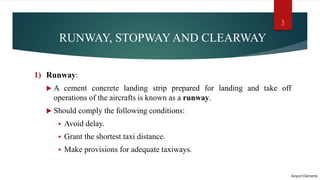
1) Runway:
 A cement concrete landing strip prepared for landing and take off
operations of the aircrafts is known as a runway.
 Should comply the following conditions:
 Avoid delay.
 Grant the shortest taxi distance.
 Make provisions for adequate taxiways.
Airport Elements
3
Continued…
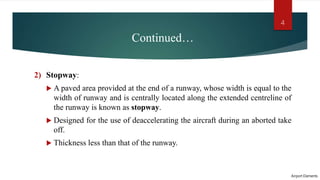
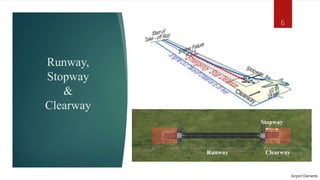
2) Stopway:
 A paved area provided at the end of a runway, whose width is equal to the
width of runway and is centrally located along the extended centreline of
the runway is known as stopway.
 Designed for the use of deaccelerating the aircraft during an aborted take
off.
 Thickness less than that of the runway.
Airport Elements
4
Continued…
3) Clearway:
 An area beyond the end of runway, centrally located along the extended
centreline of the runway and not less than 150m in width is known as
clearway.
 Provided as an precautionary measure against engine failure.
 Clearway length < 0.5(TOD - LOD)
TOD = Take off distance
LOD = Lift off distance
Airport Elements
5
Runway,
Stopway
&
Clearway
Airport Elements
6
Runway Clearway
Stopway
APPROACH ZONES AND ITS OBSTRUCTIONS
 Approach zone:
 Zoning of flight approach areas is known as approach zones.
 Protects the flight paths also controls the development of property within
approach zones.
 Zoning laws also provide protection against the pollution sources.
 Controls the property and prevents the growth tall structures and trees.
Airport Elements
7
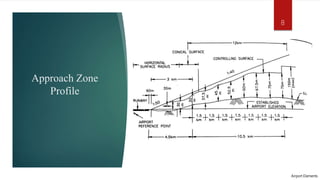
Approach Zone
Profile
Airport Elements
8
Continued…
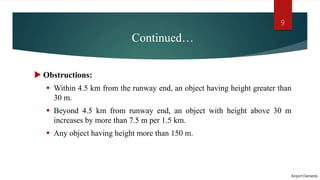
 Obstructions:
 Within 4.5 km from the runway end, an object having height greater than
30 m.
 Beyond 4.5 km from runway end, an object with height above 30 m
increases by more than 7.5 m per 1.5 km.
 Any object having height more than 150 m.
Airport Elements
9
LANDUSE AROUND AIRPORT
 Land is divided as:
a. Cultivated and non-cultivated land.
 Agriculture permitted as long as they don’t attract the birds.
 Forest and ponds near the airport not good.
b. Municipal and transport utilities.
 Power lines beyond certain height nor permitted.
Airport Elements
10
Continued…
c. Residential, commercial, industrial and recreation area.
 Residential areas within 5 km of airport and particularly along the
approach and climbout surfaces are undesirable.
 Commercial or industrial use causing electronic distortions of the
Instrument Landing System (ILS) should not be provided in approach
areas.
 Delicate instruments affected by vibrations should be avoided.
 Electric plants, gas and oil facilities are not recommended.
 Public gathering places are undesirable.
Airport Elements
11
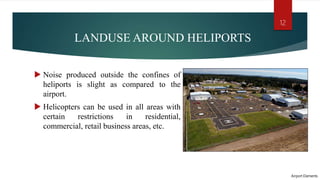
LANDUSE AROUND HELIPORTS
 Noise produced outside the confines of
heliports is slight as compared to the
airport.
 Helicopters can be used in all areas with
certain restrictions in residential,
commercial, retail business areas, etc.
Airport Elements
12
TAXIWAY
 The main function of taxiways is to provide access from the runway to
terminal area, service hangers and back.
 One way taxiways are provided on airports with heavy traffic.
 To avoid congestion a runway should have ample number of exit ways.
 Crossing with runway should be avoided as far as possible.
Airport Elements
13
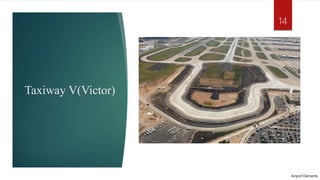
Taxiway V(Victor)
Airport Elements
14
APRON
 Indicates a definite area of the airport to accommodate aircrafts for loading
and unloading of cargo and passengers, parking, refuelling, servicing, etc.
 Usually paved.
 Located generally in front of the terminal building or adjacent to hangers.
 The aprons used for loading and unloading of cargo and passengers is called
loading and unloading aprons.
Airport Elements
15
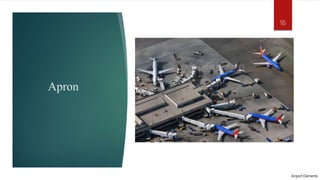
Apron
Airport Elements
16
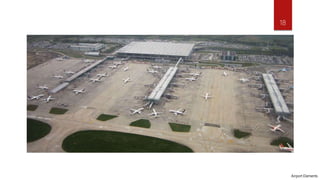
TERMINAL AREA
 Portion of airport other than landing area.
 Includes:
 Terminal building.
 Facilities for loading and unloading the passengers, cargo, mail, etc.
 Aprons.
 Vehicle parking area.
 Cargo storage buildings.
Airport Elements
17
Airport Elements
18
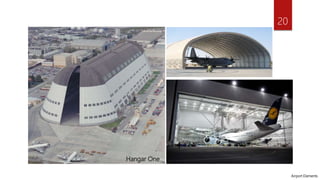
HANGAR
 A hangar is a closed building structure to hold aircraft, spacecraft or
helicopters, etc. in protective storage.
 Hangars are used for protection from the weather, direct sunlight.
 Also used for maintenance, repair, manufacture, assembly, etc.
 The size depends on the size of aircraft, size varies from ‘S’ to ‘XXL’.
 ‘XXL’ is build for the largest aircraft ‘Airbus 380’, ‘Boeing 747’ and ‘the
Antonov’.
Airport Elements
19
Airport Elements
20
Hangar One
“
”
I always Wonder why Birds chose to
stay in the same place when they
can fly anywhere on the earth, THEN
I ask Myself the same question!
HARUN YAHYA
THANK YOU

Airport elements.

  • 1.
    LD COLLEGE OFENGINEERING SUBJECT :- Harbour & Airport Engineering TOPIC :- Airport Elements Prepared By :- Makwana Tulsi
  • 2.
    AIRPORT ELEMENTS  Runway,Stopway and Clearway.  Approach zone and its obstructions.  Land use around airport.  Land use around heliports.  Taxiways.  Aprons.  Terminal area.  Hangar. Airport Elements 2
  • 3.
    RUNWAY, STOPWAY ANDCLEARWAY 1) Runway:  A cement concrete landing strip prepared for landing and take off operations of the aircrafts is known as a runway.  Should comply the following conditions:  Avoid delay.  Grant the shortest taxi distance.  Make provisions for adequate taxiways. Airport Elements 3
  • 4.
    Continued… 2) Stopway:  Apaved area provided at the end of a runway, whose width is equal to the width of runway and is centrally located along the extended centreline of the runway is known as stopway.  Designed for the use of deaccelerating the aircraft during an aborted take off.  Thickness less than that of the runway. Airport Elements 4
  • 5.
    Continued… 3) Clearway:  Anarea beyond the end of runway, centrally located along the extended centreline of the runway and not less than 150m in width is known as clearway.  Provided as an precautionary measure against engine failure.  Clearway length < 0.5(TOD - LOD) TOD = Take off distance LOD = Lift off distance Airport Elements 5
  • 6.
  • 7.
    APPROACH ZONES ANDITS OBSTRUCTIONS  Approach zone:  Zoning of flight approach areas is known as approach zones.  Protects the flight paths also controls the development of property within approach zones.  Zoning laws also provide protection against the pollution sources.  Controls the property and prevents the growth tall structures and trees. Airport Elements 7
  • 8.
  • 9.
    Continued…  Obstructions:  Within4.5 km from the runway end, an object having height greater than 30 m.  Beyond 4.5 km from runway end, an object with height above 30 m increases by more than 7.5 m per 1.5 km.  Any object having height more than 150 m. Airport Elements 9
  • 10.
    LANDUSE AROUND AIRPORT Land is divided as: a. Cultivated and non-cultivated land.  Agriculture permitted as long as they don’t attract the birds.  Forest and ponds near the airport not good. b. Municipal and transport utilities.  Power lines beyond certain height nor permitted. Airport Elements 10
  • 11.
    Continued… c. Residential, commercial,industrial and recreation area.  Residential areas within 5 km of airport and particularly along the approach and climbout surfaces are undesirable.  Commercial or industrial use causing electronic distortions of the Instrument Landing System (ILS) should not be provided in approach areas.  Delicate instruments affected by vibrations should be avoided.  Electric plants, gas and oil facilities are not recommended.  Public gathering places are undesirable. Airport Elements 11
  • 12.
    LANDUSE AROUND HELIPORTS Noise produced outside the confines of heliports is slight as compared to the airport.  Helicopters can be used in all areas with certain restrictions in residential, commercial, retail business areas, etc. Airport Elements 12
  • 13.
    TAXIWAY  The mainfunction of taxiways is to provide access from the runway to terminal area, service hangers and back.  One way taxiways are provided on airports with heavy traffic.  To avoid congestion a runway should have ample number of exit ways.  Crossing with runway should be avoided as far as possible. Airport Elements 13
  • 14.
  • 15.
    APRON  Indicates adefinite area of the airport to accommodate aircrafts for loading and unloading of cargo and passengers, parking, refuelling, servicing, etc.  Usually paved.  Located generally in front of the terminal building or adjacent to hangers.  The aprons used for loading and unloading of cargo and passengers is called loading and unloading aprons. Airport Elements 15
  • 16.
  • 17.
    TERMINAL AREA  Portionof airport other than landing area.  Includes:  Terminal building.  Facilities for loading and unloading the passengers, cargo, mail, etc.  Aprons.  Vehicle parking area.  Cargo storage buildings. Airport Elements 17
  • 18.
  • 19.
    HANGAR  A hangaris a closed building structure to hold aircraft, spacecraft or helicopters, etc. in protective storage.  Hangars are used for protection from the weather, direct sunlight.  Also used for maintenance, repair, manufacture, assembly, etc.  The size depends on the size of aircraft, size varies from ‘S’ to ‘XXL’.  ‘XXL’ is build for the largest aircraft ‘Airbus 380’, ‘Boeing 747’ and ‘the Antonov’. Airport Elements 19
  • 20.
  • 21.
    “ ” I always Wonderwhy Birds chose to stay in the same place when they can fly anywhere on the earth, THEN I ask Myself the same question! HARUN YAHYA THANK YOU