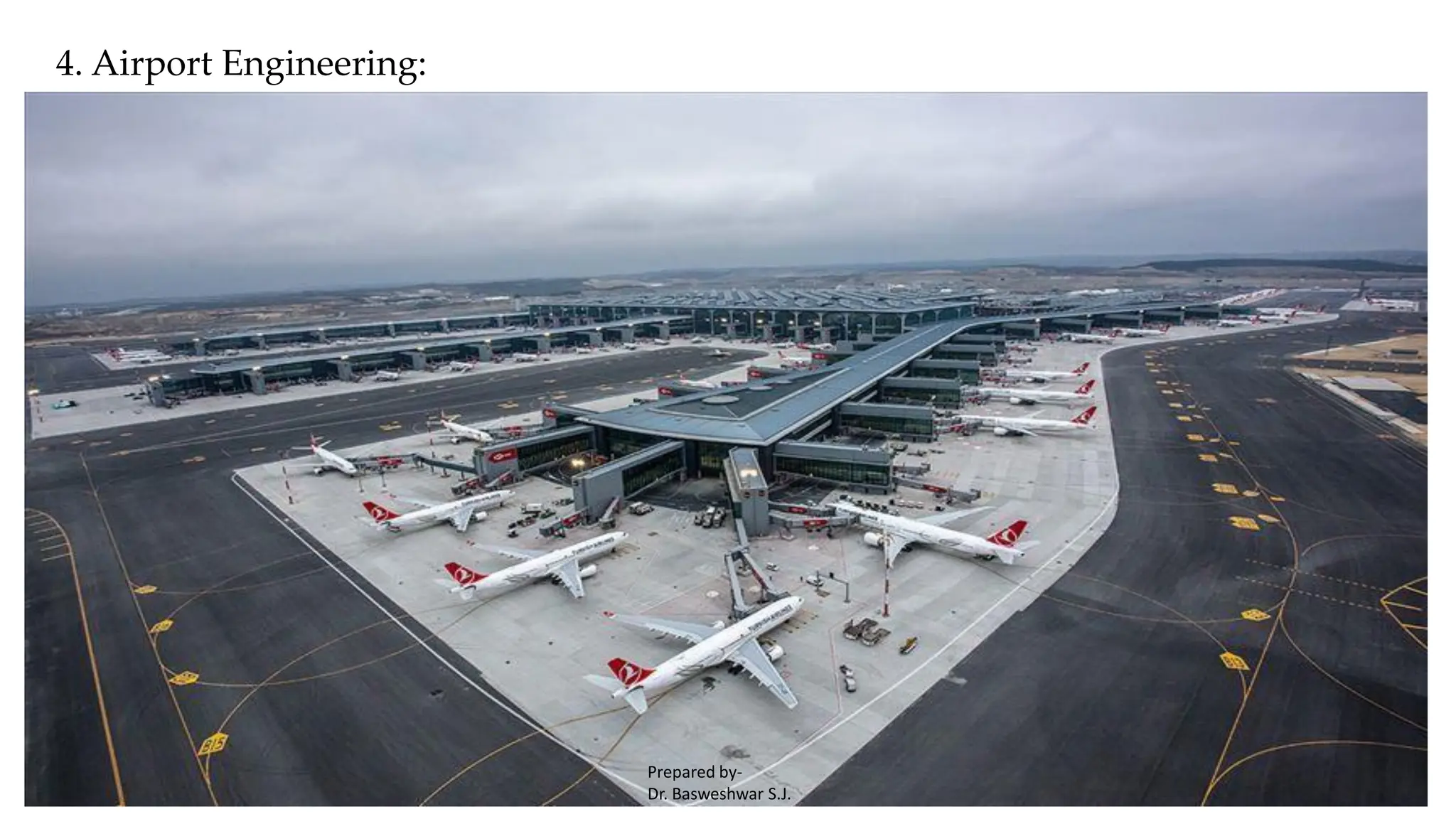
4. Airport Engineering:
Prepared by-
Dr. Basweshwar S.J.
Prepared by-
Dr. Basweshwar S.J.
6.2 Airport Engineering:
• The planning, design, construction, and operation and maintenance of facilities providing for the
landing and takeoff, loading and unloading, servicing, maintenance, and storage of aircraft.
• A terminal facility used for aircraft takeoff and landing, and including facilities for handling passengers
and cargo and for servicing aircraft.
• Facilities at airports are generally described as either airside, which commences at the secured boundary
between terminal and apron and extends to the runway and to facilities beyond, such as navigational or
remote air-traffic-control emplacements; or landside, which includes the terminal, cargo-processing, and
land-vehicle approach facilities.
• Airport design provides for convenient passenger access, efficient aircraft operations, and conveyance of
cargo and support materials.
• Airports provide facilities for changing transportation modes, such as people transferring from cars and
buses to aircraft, cargo transferring from shipping containers to trucks, or regional aircraft supplying
passengers and cargo for intercontinental aircraft.
Prepared by-
Dr. Basweshwar S.J.
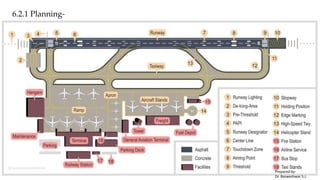
6.2.1 Planning-
Prepared by-
Dr. Basweshwar S.J.
6.2.1 Planning-
It involves planning, designing, and construction of terminals, runways, and other ancillary facilities for
airlines to operate.
Developing an airport requires huge amount of capital and anticipation of future growth of airlines and
passengers.
AAI is responsible for the development of airports in India.
Airport Designing
• Airport projects are involved with many considerations and issues hence they are highly collaborative.
• Designing of airport is taken up by architectural firms.
• The architects work in collaboration with civil engineers to come up with the Airport Layout Plans.
• The experts come up with master plans which is referred to for further developments.
Prepared by-
Dr. Basweshwar S.J.
6.2.1 Planning-
To plan an airport, the AAI is concerned for three approvals −
Technical Approvals
• Review and approve Airport Layout Plan (ALP).
• Review and acceptance of forecast.
• Airspace and procedure changes.
• Land acquisition.
Financial Approvals
• Funding for the airport is approved once the project gets clearance for safety, security, capacity, and airport access
systems.
Environmental Approvals
• Review and assess environmental issues.
• Find out solutions to address the environmental problems.
Airport planning is vital to understand problems and potential environmental issues.
Out of the reactive and proactive planning methods, an appropriate planning method is selected depending upon the
requirement.
Prepared by-
Dr. Basweshwar S.J.
6.2.2 Airport Surveys, Site Selection-
It includes the development of the land to build the terminals and
base, and building the infrastructure for the ancillary facilities.
All the infrastructural development is done in accordance with the
International Civil Aviation Org. standards.
The following criteria need to be considered while planning and
designing a terminal −
• Passenger flow and traffic peaking.
• Minimum walking distance.
• Level of service for passengers and sophistication.
• Performance standards.
• Area for Retailers: Duty free shops, food joints, and spas.
• Area for Facility points such as Restrooms, ATM machines, and
kiosks.
• Easy access to retail area and facility points.
• Compatibility of facilities with aircraft characteristics.
• Ability to handle changes in technology and automation.
• Expandability for future growth.
• Area and processing time for checking-in, immigration/customs
clearance, baggage security screening, and baggage delivery.
Factors
• Regional plan
• Airport use
• Proximity to other airports
• Ground accessibility
• Topography
• Obstructions
• Visibility
• Wind
• Noise Nuisance
• Grading, drainage and soil
characteristics
• Future development
• Availability of utilities from town
• Economic considerations
Prepared by-
Dr. Basweshwar S.J.
6.2.2 Airport Surveys, Site Selection-
Airport − Terminal Configurations
The following configurations are adapted while designing the airport terminals −
Layout Airport
Standard
Linear
Detroit Metropolitan (DTW)
Curvilinear Munich (MUC)
Pier Amsterdam (AMS), Chitose Airport Japan (CTS),
Los Angeles (LAX).
Concourse Atlanta International Airport (ATL), Al Maktoum
International Airport Dubai (DWC), O’Hare
International Airport Chicago (ORD)
Star Pier Geneva Airport Switzerland (GVA), Orlando
International Airport, Florida (MCO).
Prepared by-
Dr. Basweshwar S.J.
6.2.3 Zoning Laws-
• When the final selection of the airport site is decided, then suitable zoning laws are to be made and are to
be implemented. Hence zoning laws becomes a key part of an airport master plan.
• For the purpose of the proper functioning of the airport, the zoning laws plays a vital role.
• The airports consists of the types of zoning:-
• Land use Zoning:-
• The land use zoning comes under the part of development
• Land use zoning is classified into two parts
• (a) Closely or remotely related to the aviation
• (b) Related to non-aviation uses
• Height zoning
• Height zoning is also termed as hazard zoning. Height zoning is mainly used to protect the approaches to the
airport from the obstruction of any object.
• Certain rules and regulars are made to the heights of structures on land surrounding the airport.
Prepared by-
Dr. Basweshwar S.J.
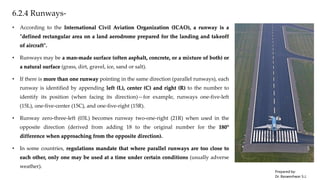
6.2.4 Runways-
• According to the International Civil Aviation Organization (ICAO), a runway is a
"defined rectangular area on a land aerodrome prepared for the landing and takeoff
of aircraft".
• Runways may be a man-made surface (often asphalt, concrete, or a mixture of both) or
a natural surface (grass, dirt, gravel, ice, sand or salt).
• If there is more than one runway pointing in the same direction (parallel runways), each
runway is identified by appending left (L), center (C) and right (R) to the number to
identify its position (when facing its direction)—for example, runways one-five-left
(15L), one-five-center (15C), and one-five-right (15R).
• Runway zero-three-left (03L) becomes runway two-one-right (21R) when used in the
opposite direction (derived from adding 18 to the original number for the 180°
difference when approaching from the opposite direction).
• In some countries, regulations mandate that where parallel runways are too close to
each other, only one may be used at a time under certain conditions (usually adverse
weather).
Prepared by-
Dr. Basweshwar S.J.
6.2.5 Geometric Design-
• Airport classification
• ICAO
• Code Number & Code Letter
• Reference Field Length + Wing Span & Wheel Track
FAA
• Approach Category & Airplane Design Group
• Approach Speed + Wing Span
• Dimensions of runway, taxiway(s) and apron(s)
• Separations
Prepared by-
Dr. Basweshwar S.J.
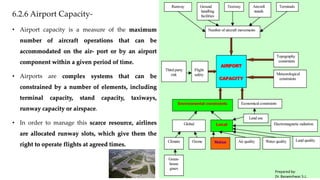
6.2.6 Airport Capacity-
• Airport capacity is a measure of the maximum
number of aircraft operations that can be
accommodated on the air- port or by an airport
component within a given period of time.
• Airports are complex systems that can be
constrained by a number of elements, including
terminal capacity, stand capacity, taxiways,
runway capacity or airspace.
• In order to manage this scarce resource, airlines
are allocated runway slots, which give them the
right to operate flights at agreed times.
Prepared by-
Dr. Basweshwar S.J.
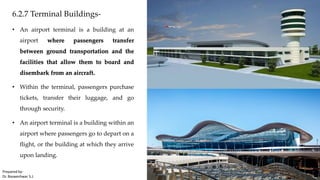
6.2.7 Terminal Buildings-
• An airport terminal is a building at an
airport where passengers transfer
between ground transportation and the
facilities that allow them to board and
disembark from an aircraft.
• Within the terminal, passengers purchase
tickets, transfer their luggage, and go
through security.
• An airport terminal is a building within an
airport where passengers go to depart on a
flight, or the building at which they arrive
upon landing.
Prepared by-
Dr. Basweshwar S.J.
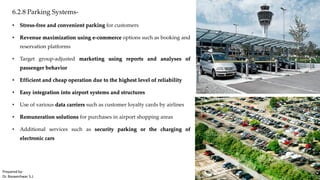
6.2.8 Parking Systems-
• Stress-free and convenient parking for customers
• Revenue maximization using e-commerce options such as booking and
reservation platforms
• Target group-adjusted marketing using reports and analyses of
passenger behavior
• Efficient and cheap operation due to the highest level of reliability
• Easy integration into airport systems and structures
• Use of various data carriers such as customer loyalty cards by airlines
• Remuneration solutions for purchases in airport shopping areas
• Additional services such as security parking or the charging of
electronic cars
Prepared by-
Dr. Basweshwar S.J.
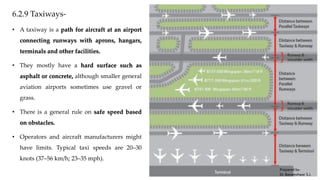
6.2.9 Taxiways-
• A taxiway is a path for aircraft at an airport
connecting runways with aprons, hangars,
terminals and other facilities.
• They mostly have a hard surface such as
asphalt or concrete, although smaller general
aviation airports sometimes use gravel or
grass.
• There is a general rule on safe speed based
on obstacles.
• Operators and aircraft manufacturers might
have limits. Typical taxi speeds are 20–30
knots (37–56 km/h; 23–35 mph).
Prepared by-
Dr. Basweshwar S.J.
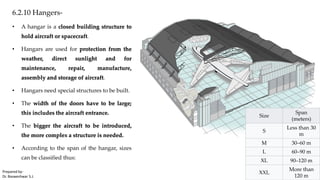
6.2.10 Hangers-
• A hangar is a closed building structure to
hold aircraft or spacecraft.
• Hangars are used for protection from the
weather, direct sunlight and for
maintenance, repair, manufacture,
assembly and storage of aircraft.
• Hangars need special structures to be built.
• The width of the doors have to be large;
this includes the aircraft entrance.
• The bigger the aircraft to be introduced,
the more complex a structure is needed.
• According to the span of the hangar, sizes
can be classified thus:
Size
Span
(meters)
S
Less than 30
m
M 30–60 m
L 60–90 m
XL 90–120 m
XXL
More than
120 m
Prepared by-
Dr. Basweshwar S.J.
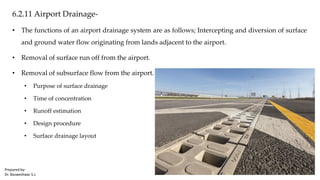
6.2.11 Airport Drainage-
• The functions of an airport drainage system are as follows; Intercepting and diversion of surface
and ground water flow originating from lands adjacent to the airport.
• Removal of surface run off from the airport.
• Removal of subsurface flow from the airport.
• Purpose of surface drainage
• Time of concentration
• Runoff estimation
• Design procedure
• Surface drainage layout
Prepared by-
Dr. Basweshwar S.J.
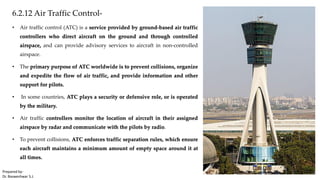
6.2.12 Air Traffic Control-
• Air traffic control (ATC) is a service provided by ground-based air traffic
controllers who direct aircraft on the ground and through controlled
airspace, and can provide advisory services to aircraft in non-controlled
airspace.
• The primary purpose of ATC worldwide is to prevent collisions, organize
and expedite the flow of air traffic, and provide information and other
support for pilots.
• In some countries, ATC plays a security or defensive role, or is operated
by the military.
• Air traffic controllers monitor the location of aircraft in their assigned
airspace by radar and communicate with the pilots by radio.
• To prevent collisions, ATC enforces traffic separation rules, which ensure
each aircraft maintains a minimum amount of empty space around it at
all times.
Prepared by-
Dr. Basweshwar S.J.
6.2.13 Airport Lighting-
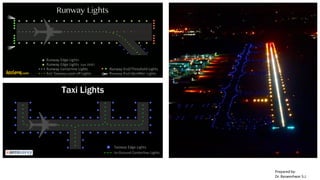
• Many airports have lighting that help guide planes using the runways and taxiways at night or in rain or
fog.
• On runways, green lights indicate the beginning of the runway for landing, while red lights indicate the
end of the runway.
• Runway edge lighting consists of white lights spaced out on both sides of the runway, indicating the
edges.
• Some airports have more complicated lighting on the runways including lights that run down the centerline
of the runway and lights that help indicate the approach (an approach lighting system, or ALS).
• Low-traffic airports may use pilot-controlled lighting to save electricity and staffing costs.
• Along taxiways, blue lights indicate the taxiway's edge, and some airports have embedded green lights
that indicate the centerline.
Prepared by-
Dr. Basweshwar S.J.
Prepared by-
Dr. Basweshwar S.J.

MODULE 4 AIRPORT ENGINEERING, INFRASTRUCTURE ENGINEERING

  • 1.
    4. Airport Engineering: Preparedby- Dr. Basweshwar S.J.
  • 2.
  • 3.
    6.2 Airport Engineering: •The planning, design, construction, and operation and maintenance of facilities providing for the landing and takeoff, loading and unloading, servicing, maintenance, and storage of aircraft. • A terminal facility used for aircraft takeoff and landing, and including facilities for handling passengers and cargo and for servicing aircraft. • Facilities at airports are generally described as either airside, which commences at the secured boundary between terminal and apron and extends to the runway and to facilities beyond, such as navigational or remote air-traffic-control emplacements; or landside, which includes the terminal, cargo-processing, and land-vehicle approach facilities. • Airport design provides for convenient passenger access, efficient aircraft operations, and conveyance of cargo and support materials. • Airports provide facilities for changing transportation modes, such as people transferring from cars and buses to aircraft, cargo transferring from shipping containers to trucks, or regional aircraft supplying passengers and cargo for intercontinental aircraft. Prepared by- Dr. Basweshwar S.J.
  • 4.
  • 5.
    6.2.1 Planning- It involvesplanning, designing, and construction of terminals, runways, and other ancillary facilities for airlines to operate. Developing an airport requires huge amount of capital and anticipation of future growth of airlines and passengers. AAI is responsible for the development of airports in India. Airport Designing • Airport projects are involved with many considerations and issues hence they are highly collaborative. • Designing of airport is taken up by architectural firms. • The architects work in collaboration with civil engineers to come up with the Airport Layout Plans. • The experts come up with master plans which is referred to for further developments. Prepared by- Dr. Basweshwar S.J.
  • 6.
    6.2.1 Planning- To planan airport, the AAI is concerned for three approvals − Technical Approvals • Review and approve Airport Layout Plan (ALP). • Review and acceptance of forecast. • Airspace and procedure changes. • Land acquisition. Financial Approvals • Funding for the airport is approved once the project gets clearance for safety, security, capacity, and airport access systems. Environmental Approvals • Review and assess environmental issues. • Find out solutions to address the environmental problems. Airport planning is vital to understand problems and potential environmental issues. Out of the reactive and proactive planning methods, an appropriate planning method is selected depending upon the requirement. Prepared by- Dr. Basweshwar S.J.
  • 7.
    6.2.2 Airport Surveys,Site Selection- It includes the development of the land to build the terminals and base, and building the infrastructure for the ancillary facilities. All the infrastructural development is done in accordance with the International Civil Aviation Org. standards. The following criteria need to be considered while planning and designing a terminal − • Passenger flow and traffic peaking. • Minimum walking distance. • Level of service for passengers and sophistication. • Performance standards. • Area for Retailers: Duty free shops, food joints, and spas. • Area for Facility points such as Restrooms, ATM machines, and kiosks. • Easy access to retail area and facility points. • Compatibility of facilities with aircraft characteristics. • Ability to handle changes in technology and automation. • Expandability for future growth. • Area and processing time for checking-in, immigration/customs clearance, baggage security screening, and baggage delivery. Factors • Regional plan • Airport use • Proximity to other airports • Ground accessibility • Topography • Obstructions • Visibility • Wind • Noise Nuisance • Grading, drainage and soil characteristics • Future development • Availability of utilities from town • Economic considerations Prepared by- Dr. Basweshwar S.J.
  • 8.
    6.2.2 Airport Surveys,Site Selection- Airport − Terminal Configurations The following configurations are adapted while designing the airport terminals − Layout Airport Standard Linear Detroit Metropolitan (DTW) Curvilinear Munich (MUC) Pier Amsterdam (AMS), Chitose Airport Japan (CTS), Los Angeles (LAX). Concourse Atlanta International Airport (ATL), Al Maktoum International Airport Dubai (DWC), O’Hare International Airport Chicago (ORD) Star Pier Geneva Airport Switzerland (GVA), Orlando International Airport, Florida (MCO). Prepared by- Dr. Basweshwar S.J.
  • 9.
    6.2.3 Zoning Laws- •When the final selection of the airport site is decided, then suitable zoning laws are to be made and are to be implemented. Hence zoning laws becomes a key part of an airport master plan. • For the purpose of the proper functioning of the airport, the zoning laws plays a vital role. • The airports consists of the types of zoning:- • Land use Zoning:- • The land use zoning comes under the part of development • Land use zoning is classified into two parts • (a) Closely or remotely related to the aviation • (b) Related to non-aviation uses • Height zoning • Height zoning is also termed as hazard zoning. Height zoning is mainly used to protect the approaches to the airport from the obstruction of any object. • Certain rules and regulars are made to the heights of structures on land surrounding the airport. Prepared by- Dr. Basweshwar S.J.
  • 10.
    6.2.4 Runways- • Accordingto the International Civil Aviation Organization (ICAO), a runway is a "defined rectangular area on a land aerodrome prepared for the landing and takeoff of aircraft". • Runways may be a man-made surface (often asphalt, concrete, or a mixture of both) or a natural surface (grass, dirt, gravel, ice, sand or salt). • If there is more than one runway pointing in the same direction (parallel runways), each runway is identified by appending left (L), center (C) and right (R) to the number to identify its position (when facing its direction)—for example, runways one-five-left (15L), one-five-center (15C), and one-five-right (15R). • Runway zero-three-left (03L) becomes runway two-one-right (21R) when used in the opposite direction (derived from adding 18 to the original number for the 180° difference when approaching from the opposite direction). • In some countries, regulations mandate that where parallel runways are too close to each other, only one may be used at a time under certain conditions (usually adverse weather). Prepared by- Dr. Basweshwar S.J.
  • 11.
    6.2.5 Geometric Design- •Airport classification • ICAO • Code Number & Code Letter • Reference Field Length + Wing Span & Wheel Track FAA • Approach Category & Airplane Design Group • Approach Speed + Wing Span • Dimensions of runway, taxiway(s) and apron(s) • Separations Prepared by- Dr. Basweshwar S.J.
  • 12.
    6.2.6 Airport Capacity- •Airport capacity is a measure of the maximum number of aircraft operations that can be accommodated on the air- port or by an airport component within a given period of time. • Airports are complex systems that can be constrained by a number of elements, including terminal capacity, stand capacity, taxiways, runway capacity or airspace. • In order to manage this scarce resource, airlines are allocated runway slots, which give them the right to operate flights at agreed times. Prepared by- Dr. Basweshwar S.J.
  • 13.
    6.2.7 Terminal Buildings- •An airport terminal is a building at an airport where passengers transfer between ground transportation and the facilities that allow them to board and disembark from an aircraft. • Within the terminal, passengers purchase tickets, transfer their luggage, and go through security. • An airport terminal is a building within an airport where passengers go to depart on a flight, or the building at which they arrive upon landing. Prepared by- Dr. Basweshwar S.J.
  • 14.
    6.2.8 Parking Systems- •Stress-free and convenient parking for customers • Revenue maximization using e-commerce options such as booking and reservation platforms • Target group-adjusted marketing using reports and analyses of passenger behavior • Efficient and cheap operation due to the highest level of reliability • Easy integration into airport systems and structures • Use of various data carriers such as customer loyalty cards by airlines • Remuneration solutions for purchases in airport shopping areas • Additional services such as security parking or the charging of electronic cars Prepared by- Dr. Basweshwar S.J.
  • 15.
    6.2.9 Taxiways- • Ataxiway is a path for aircraft at an airport connecting runways with aprons, hangars, terminals and other facilities. • They mostly have a hard surface such as asphalt or concrete, although smaller general aviation airports sometimes use gravel or grass. • There is a general rule on safe speed based on obstacles. • Operators and aircraft manufacturers might have limits. Typical taxi speeds are 20–30 knots (37–56 km/h; 23–35 mph). Prepared by- Dr. Basweshwar S.J.
  • 16.
    6.2.10 Hangers- • Ahangar is a closed building structure to hold aircraft or spacecraft. • Hangars are used for protection from the weather, direct sunlight and for maintenance, repair, manufacture, assembly and storage of aircraft. • Hangars need special structures to be built. • The width of the doors have to be large; this includes the aircraft entrance. • The bigger the aircraft to be introduced, the more complex a structure is needed. • According to the span of the hangar, sizes can be classified thus: Size Span (meters) S Less than 30 m M 30–60 m L 60–90 m XL 90–120 m XXL More than 120 m Prepared by- Dr. Basweshwar S.J.
  • 17.
    6.2.11 Airport Drainage- •The functions of an airport drainage system are as follows; Intercepting and diversion of surface and ground water flow originating from lands adjacent to the airport. • Removal of surface run off from the airport. • Removal of subsurface flow from the airport. • Purpose of surface drainage • Time of concentration • Runoff estimation • Design procedure • Surface drainage layout Prepared by- Dr. Basweshwar S.J.
  • 18.
    6.2.12 Air TrafficControl- • Air traffic control (ATC) is a service provided by ground-based air traffic controllers who direct aircraft on the ground and through controlled airspace, and can provide advisory services to aircraft in non-controlled airspace. • The primary purpose of ATC worldwide is to prevent collisions, organize and expedite the flow of air traffic, and provide information and other support for pilots. • In some countries, ATC plays a security or defensive role, or is operated by the military. • Air traffic controllers monitor the location of aircraft in their assigned airspace by radar and communicate with the pilots by radio. • To prevent collisions, ATC enforces traffic separation rules, which ensure each aircraft maintains a minimum amount of empty space around it at all times. Prepared by- Dr. Basweshwar S.J.
  • 19.
    6.2.13 Airport Lighting- •Many airports have lighting that help guide planes using the runways and taxiways at night or in rain or fog. • On runways, green lights indicate the beginning of the runway for landing, while red lights indicate the end of the runway. • Runway edge lighting consists of white lights spaced out on both sides of the runway, indicating the edges. • Some airports have more complicated lighting on the runways including lights that run down the centerline of the runway and lights that help indicate the approach (an approach lighting system, or ALS). • Low-traffic airports may use pilot-controlled lighting to save electricity and staffing costs. • Along taxiways, blue lights indicate the taxiway's edge, and some airports have embedded green lights that indicate the centerline. Prepared by- Dr. Basweshwar S.J.
  • 20.