Presented By: Lindsay Green
A Flight Plan In 10
Steps
 Introduction
 Ten steps for flight plan
 Take-off and landing runways
 Route
 Altitudes
 The weather
 Weight
 Speed
 Fuel quantities
 Alternative aerodromes
 Taxi times
 Alternative routes
 Contact Us
Table Of Content
Introduction
 A flight plan contains all the information needed to get an aircraft
from A to B. And that is a lot of information!
 A “flight planner” is given the departure and arrival times and then
has to work out the most efficient flight plan, taking a range of
factors into account.
 Once a flight plan containing all the information has been drawn up,
it can be passed on to air traffic control and the required quantity of
fuel can be ordered.
 The pilots receive the entire flight plan on their iPad, so that they
can optimally prepare and execute the flight
Ten steps for flight plan
 Take-off and landing runways
 Route
 Altitudes
 The weather
 Weight
 Speed
 Fuel quantities
 Alternative aerodromes
 Taxi times
 Alternative routes
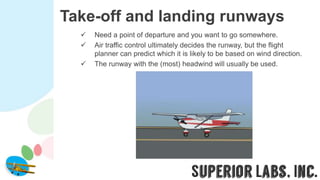
Take-off and landing runways
 Need a point of departure and you want to go somewhere.
 Air traffic control ultimately decides the runway, but the flight
planner can predict which it is likely to be based on wind direction.
 The runway with the (most) headwind will usually be used.
Route
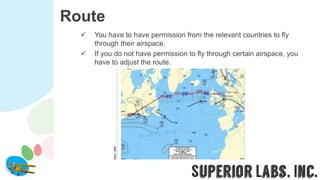
 You have to have permission from the relevant countries to fly
through their airspace.
 If you do not have permission to fly through certain airspace, you
have to adjust the route.
Altitudes
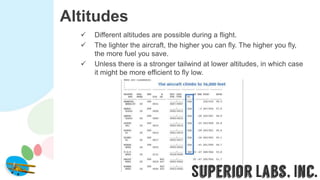
 Different altitudes are possible during a flight.
 The lighter the aircraft, the higher you can fly. The higher you fly,
the more fuel you save.
 Unless there is a stronger tailwind at lower altitudes, in which case
it might be more efficient to fly low.
The weather
 The wind is a very important factor for take-off, landing and the
altitudes you fly in between.
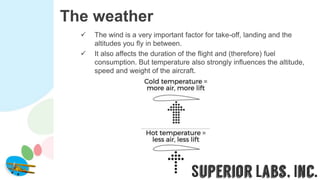
 It also affects the duration of the flight and (therefore) fuel
consumption. But temperature also strongly influences the altitude,
speed and weight of the aircraft.
Weight
 How heavy will it be with the expected number of passengers on
board, plus crew, cargo, catering, water, fuel and so on?
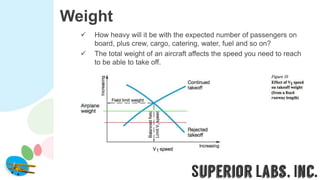
 The total weight of an aircraft affects the speed you need to reach
to be able to take off.
Speed
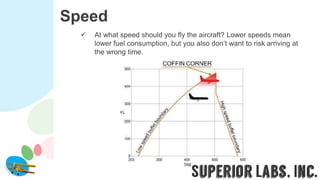
 At what speed should you fly the aircraft? Lower speeds mean
lower fuel consumption, but you also don’t want to risk arriving at
the wrong time.
Fuel quantities
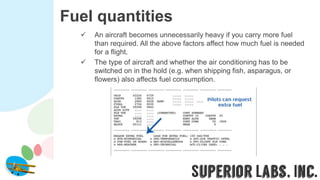
 An aircraft becomes unnecessarily heavy if you carry more fuel
than required. All the above factors affect how much fuel is needed
for a flight.
 The type of aircraft and whether the air conditioning has to be
switched on in the hold (e.g. when shipping fish, asparagus, or
flowers) also affects fuel consumption.
Alternative aerodromes
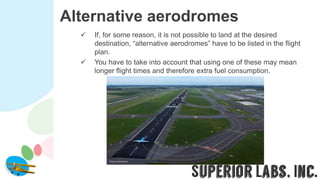
 If, for some reason, it is not possible to land at the desired
destination, “alternative aerodromes” have to be listed in the flight
plan.
 You have to take into account that using one of these may mean
longer flight times and therefore extra fuel consumption.
Taxi times & Alternative routes
 Taxi times are increased by de-icing operations or using the runway
furthest from the terminal.
 Other routes may have more favorable wind conditions, which
make it possible to reach a destination on less fuel.
 Conclusion:
 Once a flight plan containing all this information has been drawn up,
it can be passed on to air traffic control and the required quantity of
fuel can be ordered.
 The pilots receive the entire flight plan on their iPad, so that they
can optimally prepare and execute the flight.
 Superior Labs Inc
 Address: 5783 Central Ave
 Hot Springs, AR 71913
 Phone: 501-525-6688
 Fax: 501-525-7733
 Email: superiorlabsinc@gmail.com
 Website: http://www.superiorlabsinc.com
 Resource: https://goo.gl/QjQHRF
Contact Us
A flight plan in 10 steps

A flight plan in 10 steps

  • 1.
    Presented By: LindsayGreen A Flight Plan In 10 Steps
  • 2.
     Introduction  Tensteps for flight plan  Take-off and landing runways  Route  Altitudes  The weather  Weight  Speed  Fuel quantities  Alternative aerodromes  Taxi times  Alternative routes  Contact Us Table Of Content
  • 3.
    Introduction  A flightplan contains all the information needed to get an aircraft from A to B. And that is a lot of information!  A “flight planner” is given the departure and arrival times and then has to work out the most efficient flight plan, taking a range of factors into account.  Once a flight plan containing all the information has been drawn up, it can be passed on to air traffic control and the required quantity of fuel can be ordered.  The pilots receive the entire flight plan on their iPad, so that they can optimally prepare and execute the flight
  • 4.
    Ten steps forflight plan  Take-off and landing runways  Route  Altitudes  The weather  Weight  Speed  Fuel quantities  Alternative aerodromes  Taxi times  Alternative routes
  • 5.
    Take-off and landingrunways  Need a point of departure and you want to go somewhere.  Air traffic control ultimately decides the runway, but the flight planner can predict which it is likely to be based on wind direction.  The runway with the (most) headwind will usually be used.
  • 6.
    Route  You haveto have permission from the relevant countries to fly through their airspace.  If you do not have permission to fly through certain airspace, you have to adjust the route.
  • 7.
    Altitudes  Different altitudesare possible during a flight.  The lighter the aircraft, the higher you can fly. The higher you fly, the more fuel you save.  Unless there is a stronger tailwind at lower altitudes, in which case it might be more efficient to fly low.
  • 8.
    The weather  Thewind is a very important factor for take-off, landing and the altitudes you fly in between.  It also affects the duration of the flight and (therefore) fuel consumption. But temperature also strongly influences the altitude, speed and weight of the aircraft.
  • 9.
    Weight  How heavywill it be with the expected number of passengers on board, plus crew, cargo, catering, water, fuel and so on?  The total weight of an aircraft affects the speed you need to reach to be able to take off.
  • 10.
    Speed  At whatspeed should you fly the aircraft? Lower speeds mean lower fuel consumption, but you also don’t want to risk arriving at the wrong time.
  • 11.
    Fuel quantities  Anaircraft becomes unnecessarily heavy if you carry more fuel than required. All the above factors affect how much fuel is needed for a flight.  The type of aircraft and whether the air conditioning has to be switched on in the hold (e.g. when shipping fish, asparagus, or flowers) also affects fuel consumption.
  • 12.
    Alternative aerodromes  If,for some reason, it is not possible to land at the desired destination, “alternative aerodromes” have to be listed in the flight plan.  You have to take into account that using one of these may mean longer flight times and therefore extra fuel consumption.
  • 13.
    Taxi times &Alternative routes  Taxi times are increased by de-icing operations or using the runway furthest from the terminal.  Other routes may have more favorable wind conditions, which make it possible to reach a destination on less fuel.  Conclusion:  Once a flight plan containing all this information has been drawn up, it can be passed on to air traffic control and the required quantity of fuel can be ordered.  The pilots receive the entire flight plan on their iPad, so that they can optimally prepare and execute the flight.
  • 14.
     Superior LabsInc  Address: 5783 Central Ave  Hot Springs, AR 71913  Phone: 501-525-6688  Fax: 501-525-7733  Email: superiorlabsinc@gmail.com  Website: http://www.superiorlabsinc.com  Resource: https://goo.gl/QjQHRF Contact Us