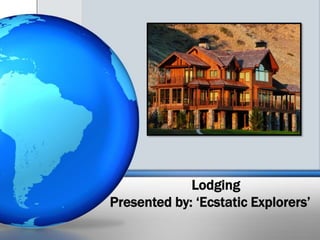
Lodging
Presented by: ‘Ecstatic Explorers’
Hotel Business
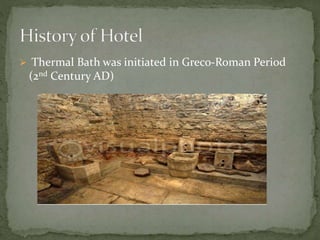
 Thermal Bath was initiated in Greco-Roman Period
(2nd Century AD)
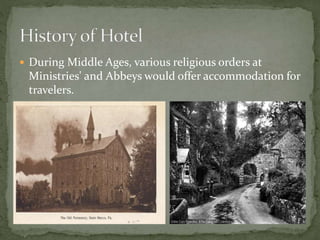
 During Middle Ages, various religious orders at
Ministries' and Abbeys would offer accommodation for
travelers.
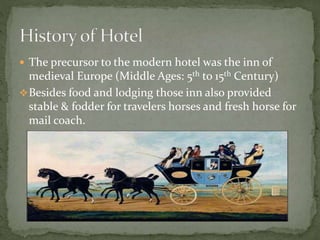
 The precursor to the modern hotel was the inn of
medieval Europe (Middle Ages: 5th to 15th Century)
Besides food and lodging those inn also provided
stable & fodder for travelers horses and fresh horse for
mail coach.
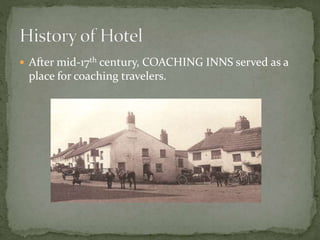
 After mid-17th century, COACHING INNS served as a
place for coaching travelers.
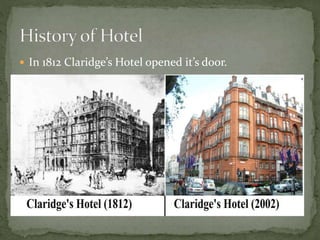
 In 1812 Claridge’s Hotel opened it’s door.
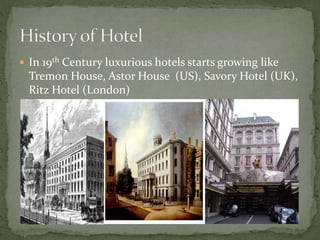
 In 19th Century luxurious hotels starts growing like
Tremon House, Astor House (US), Savory Hotel (UK),
Ritz Hotel (London)
21st Century Perspective
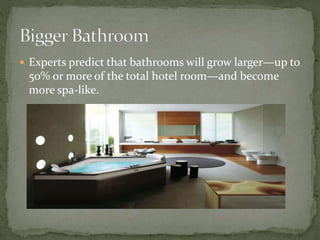
 Experts predict that bathrooms will grow larger—up to
50% or more of the total hotel room—and become
more spa-like.
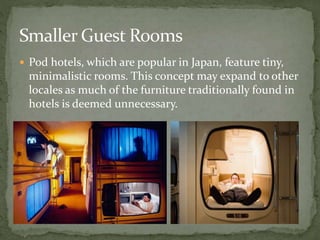
 Pod hotels, which are popular in Japan, feature tiny,
minimalistic rooms. This concept may expand to other
locales as much of the furniture traditionally found in
hotels is deemed unnecessary.
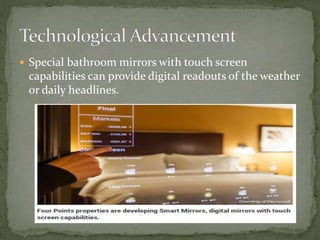
 Special bathroom mirrors with touch screen
capabilities can provide digital readouts of the weather
or daily headlines.
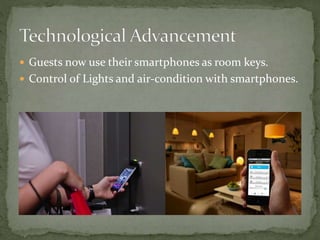
 Guests now use their smartphones as room keys.
 Control of Lights and air-condition with smartphones.
 Share moments, food photos etc. on Social Media
 Infinity pools, rooftop bars and unique ‘selfie spaces’
will become increasingly important.
 Many hotel guests express a desire for organic, locally-
sourced food.
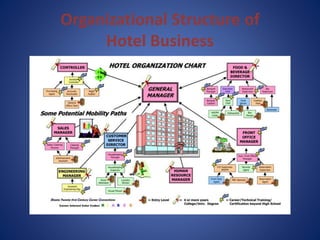
Organizational Structure of
Hotel Business
Organizational Structure of
Hotel Business
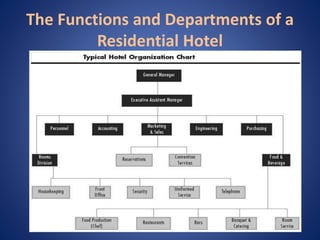
• A hierarchy with one or two executives overseeing the entire
operation
• Three Types of Groups:
1. Functional Groups: It includes Housekeeping, Food and
Beverage Services, Concierge and Front Desk Services.
2. Administrative Groups: It includes Sales and Marketing,
Accounting and Human resources.
3. Other Services related to Hotel Maintenance: It includes
Engineering, Security, Grounds keeping and General
maintenance.
4. Each functional group is overseen and directed by a
Supervisor, who reports to the General Manager
The Functions and Departments of a
Residential Hotel
1. Room Division
• The rooms division comprises departments and personnel
essential to providing the lodging services guests expect during
a hotel stay. In most of the hotels the room division generates
more revenue than all other divisions combined
• Six important departments of Room Division:
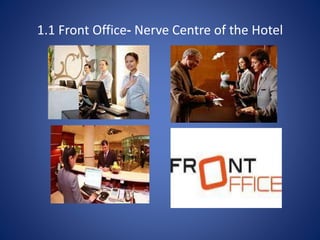
1.1 Front Office- Nerve Centre of the Hotel
1.2 Reservations
1.3 Telecommunications
1.4 Housekeeping- Professional Quality Cleaning with a personal
Touch
1.5 Uniformed Services
1.6 The Concierge- Always at your service
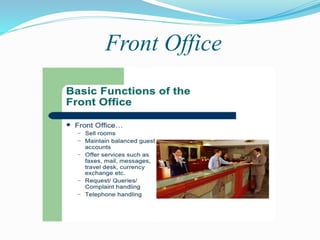
1.1 Front Office- Nerve Centre of the Hotel
1.2 Reservations
 The reservation department is responsible for receiving and
processing reservation requests for the future overnight
accommodations.
 The purpose is to accommodate guest requests in a manner
that maximizes hotel occupancy and room revenue.
 Reservation employees need to keep informing of the room
availability to ensure the sales department representatives
know how many rooms are available in the reservation system
on a given day.
1.3 Telecommunication
 Maintains a complex communications network similar to that
of any large company.
 May also be called as a private branch exchange or PBX.
 Place wake-up calls, answer questions about the hotel,
monitor automated systems (such as door alarms and fire
alarms) and coordinate emergency communications.
1.4 Housekeeping- Professional Quality Cleaning with
a personal Touch
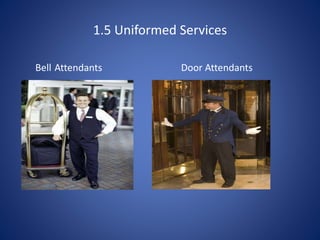
1.5 Uniformed Services
Bell Attendants Door Attendants
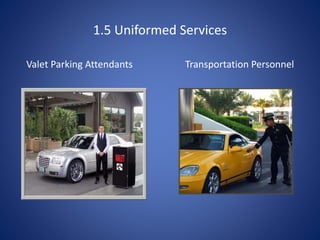
1.5 Uniformed Services
Valet Parking Attendants Transportation Personnel
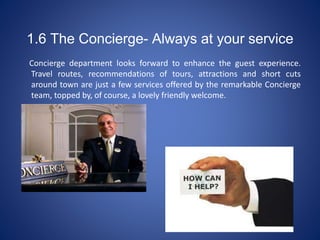
1.6 The Concierge- Always at your service
Concierge department looks forward to enhance the guest experience.
Travel routes, recommendations of tours, attractions and short cuts
around town are just a few services offered by the remarkable Concierge
team, topped by, of course, a lovely friendly welcome.
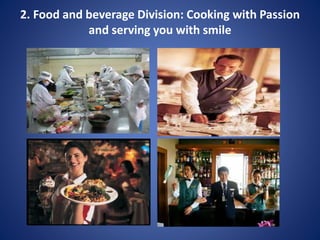
2. Food and beverage Division: Cooking with Passion
and serving you with smile
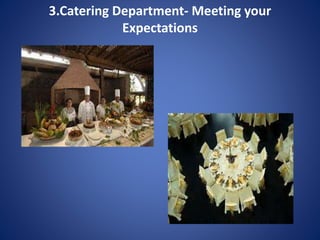
3.Catering Department- Meeting your
Expectations
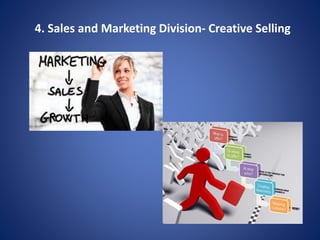
4. Sales and Marketing Division- Creative Selling
5. Accounting Division- Working with Numbers
• Accounting activities include paying outstanding invoices,
distributing unpaid statements, collecting amounts owed,
processing payroll, accumulating operating data, and
compiling financial reports.
• They also provide the hotel with relevant financial data and
forecasts which are used for daily decision making
6. Engineering and Maintenance Division- To the
Rescue!
• Repairs and regular preventive maintenance are required
around the hotel.
• It is responsible for maintaining the property’s structure and
grounds, as well as its electrical and mechanical equipment.
• They may also be charged with swimming pool sanitation,
parking lot cleanliness and fountain operations.
• The front office department efficiently exchanges information
with a representative of the engineering and maintenance
division to ensure guest satisfaction.
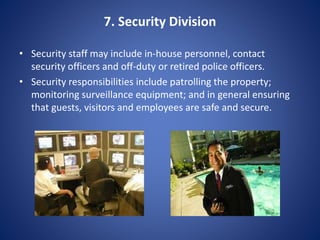
7. Security Division
• Security staff may include in-house personnel, contact
security officers and off-duty or retired police officers.
• Security responsibilities include patrolling the property;
monitoring surveillance equipment; and in general ensuring
that guests, visitors and employees are safe and secure.
8. Human Resources Division
The functions of the human resource division include:
 Employment (including external recruiting and internal
reassignment),
 Training, employee relations (including quality assurance),
 Compensation, benefits, administrations (including
employee policies),
 Labour relations and safety.
9. Other Divisions
 Many hotels staff a variety of other divisions to serve their
guests. The range of possibilities reflects the diversity of
hotels.
• Retail outlets
• Recreation
• Casino
10. Executive Team- The Pack Leaders!
• The Executive Team plays a decisive role in the hotel
operations as the final decision-maker.
• The team is comprised of the department Heads and is led by
the Director of Operations, and the General Manager.
• The team ensures the smooth running of the hotel
operations, each member responsible for the management of
its own department
Ways to Classify Hotels
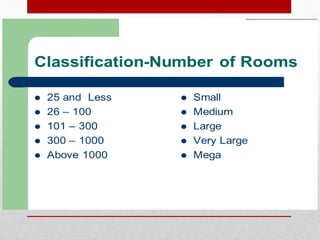
• Size - or Number of rooms
• Target Markets (Location)
• Ownership
• Types of services offered
Target Market (Location)
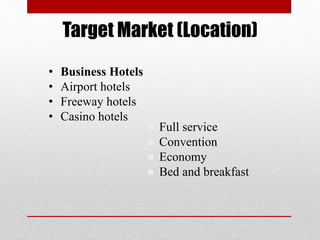
• Business Hotels
• Airport hotels
• Freeway hotels
• Casino hotels
 Full service
 Convention
 Economy
 Bed and breakfast
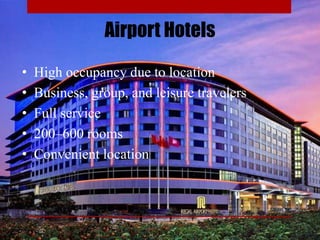
Airport Hotels
• High occupancy due to location
• Business, group, and leisure travelers
• Full service
• 200–600 rooms
• Convenient location
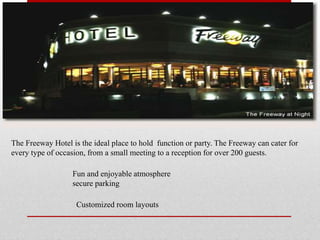
The Freeway Hotel is the ideal place to hold function or party. The Freeway can cater for
every type of occasion, from a small meeting to a reception for over 200 guests.
Fun and enjoyable atmosphere
secure parking
Customized room layouts
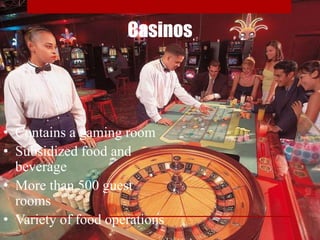
Casinos
• Contains a gaming room
• Subsidized food and
beverage
• More than 500 guest
rooms
• Variety of food operations
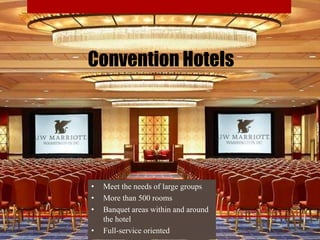
Convention Hotels
• Meet the needs of large groups
• More than 500 rooms
• Banquet areas within and around
the hotel
• Full-service oriented
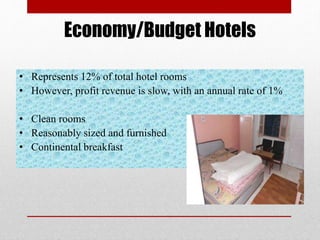
Economy/Budget Hotels
• Represents 12% of total hotel rooms
• However, profit revenue is slow, with an annual rate of 1%
• Clean rooms
• Reasonably sized and furnished
• Continental breakfast
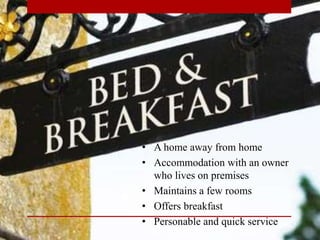
• A home away from home
• Accommodation with an owner
who lives on premises
• Maintains a few rooms
• Offers breakfast
• Personable and quick service
Vacation Ownership
 Fastest-growing segment of travel industry
 Time share:
 Purchaser uses for a specific period of time each
year
 Vacation club:
 Purchase points that entitle purchaser to use of
facility
 Not real estate based
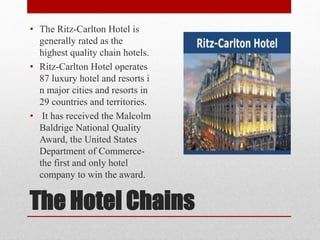
The Hotel Chains
• The Ritz-Carlton Hotel is
generally rated as the
highest quality chain hotels.
• Ritz-Carlton Hotel operates
87 luxury hotel and resorts i
n major cities and resorts in
29 countries and territories.
• It has received the Malcolm
Baldrige National Quality
Award, the United States
Department of Commerce-
the first and only hotel
company to win the award.
The Most Unusual Hotels
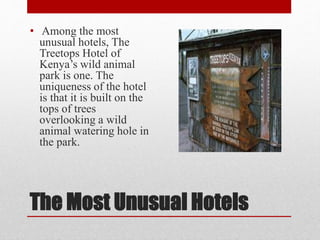
• Among the most
unusual hotels, The
Treetops Hotel of
Kenya’s wild animal
park is one. The
uniqueness of the hotel
is that it is built on the
tops of trees
overlooking a wild
animal watering hole in
the park.
The Most Unusual Hotels
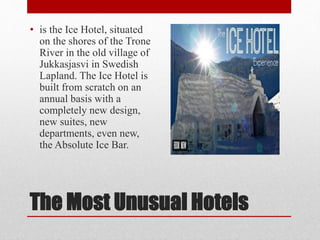
• is the Ice Hotel, situated
on the shores of the Trone
River in the old village of
Jukkasjasvi in Swedish
Lapland. The Ice Hotel is
built from scratch on an
annual basis with a
completely new design,
new suites, new
departments, even new,
the Absolute Ice Bar.
The Most Unusual Hotels
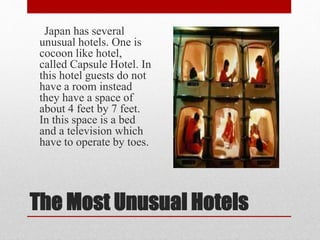
Japan has several
unusual hotels. One is
cocoon like hotel,
called Capsule Hotel. In
this hotel guests do not
have a room instead
they have a space of
about 4 feet by 7 feet.
In this space is a bed
and a television which
have to operate by toes.
Trends in Hotel Development
• Capacity control
• Safety and security
• Technology
• New Management
• Globalization
• Rapid growth in
vacation ownership
• An increase in the
number of spas and
the treatments offered
Chapter 2
Room Division
INTRODUCTION to ROOMS DIVISION
 The Rooms Division is the heart of the hotel.
 It is the main business of the hotel and the main
source of revenue.
 Rooms can contribute 70 percent or more to overall
revenue and even more to profit.
 The center of activity in the Rooms Division is the
Front Office.
Management Structure
 Management structure differs among larger, midscale, and
smaller properties.
 Someone must be responsible for each of the key result
areas that make the operation successful. For example, a
small property may not have a director of human
resources, but each department head will have general
day-to-day operating responsibilities for the human
resources function.
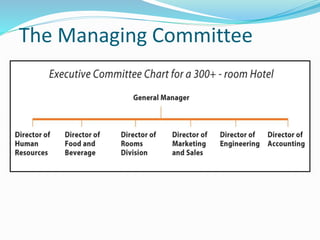
The Managing Committee
 The Executive Committee is comprised of key managers
of the hotel. Typical members would be directors of the
following departments: human resources, food and
beverage, rooms division, marketing and sales,
engineering, and accounting.
 Executive Committee meetings usually last 1 to 2 hours,
once a week. Typical topics of discussion will focus on
occupancy %, Total Quality Management, forecasts, guest
and employee satisfaction, training, etc.
The Managing Committee
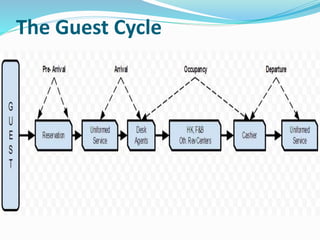
The Guest Cycle
The Departments – Rooms Division
 The rooms division director is held responsible by the
GM for the efficient and effective leadership and
operation of all the rooms division departments.
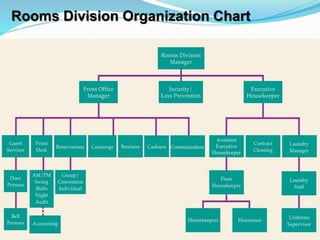
 The Rooms Division is comprised of the front office,
reservations, housekeeping, concierge, guest service,
security, and communications.
Rooms Division Organization Chart
Front Office
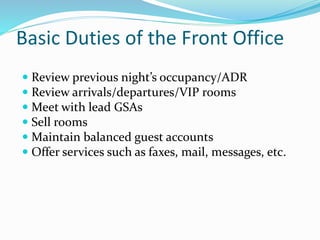
Basic Duties of the Front Office
 Review previous night’s occupancy/ADR
 Review arrivals/departures/VIP rooms
 Meet with lead GSAs
 Sell rooms
 Maintain balanced guest accounts
 Offer services such as faxes, mail, messages, etc.
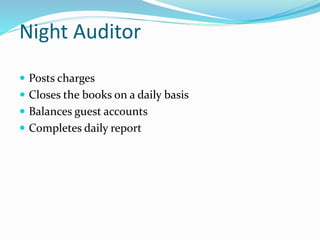
Night Auditor
 Posts charges
 Closes the books on a daily basis
 Balances guest accounts
 Completes daily report
Night Audit Process in Simple Terms
 Add yesterday’s closing balance of accounts owed
by guests
 Less payments received today against accounts
 Plus all charges made today to guests’ account
 Equals day’s closing balance of accounts owed by
guest
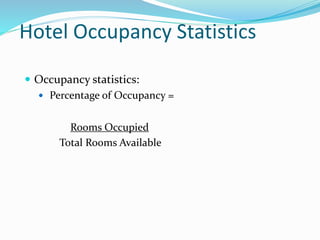
Hotel Occupancy Statistics
 Occupancy statistics:
 Percentage of Occupancy =
Rooms Occupied
Total Rooms Available
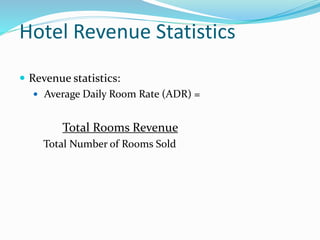
Hotel Revenue Statistics
 Revenue statistics:
 Average Daily Room Rate (ADR) =
Total Rooms Revenue
Total Number of Rooms Sold
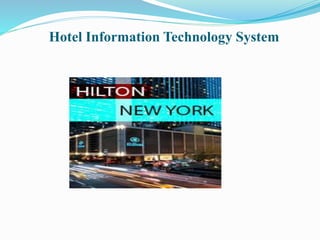
Hotel Information Technology System
Property Management System
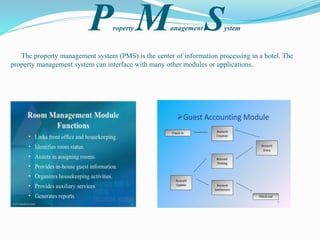
The property management system (PMS) is the center of information processing in a hotel. The
property management system can interface with many other modules or applications.
Energy Management Systems
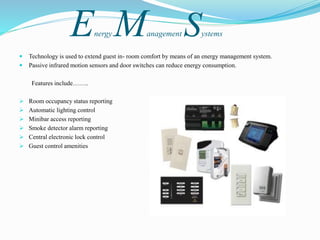
 Technology is used to extend guest in- room comfort by means of an energy management system.
 Passive infrared motion sensors and door switches can reduce energy consumption.
Features include……..
 Room occupancy status reporting
 Automatic lighting control
 Minibar access reporting
 Smoke detector alarm reporting
 Central electronic lock control
 Guest control amenities
Call Accounting Systems
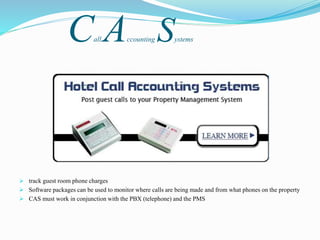
 track guest room phone charges
 Software packages can be used to monitor where calls are being made and from what phones on the property
 CAS must work in conjunction with the PBX (telephone) and the PMS
Guest Reservation Systems
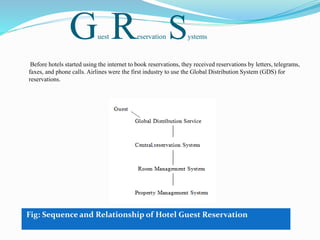
Before hotels started using the internet to book reservations, they received reservations by letters, telegrams,
faxes, and phone calls. Airlines were the first industry to use the Global Distribution System (GDS) for
reservations.
Fig: Sequence and Relationship of Hotel Guest Reservation
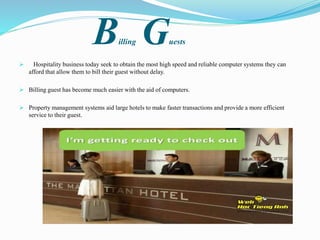
Billing Guests
 Hospitality business today seek to obtain the most high speed and reliable computer systems they can
afford that allow them to bill their guest without delay.
 Billing guest has become much easier with the aid of computers.
 Property management systems aid large hotels to make faster transactions and provide a more efficient
service to their guest.
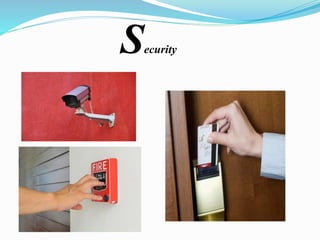
Security
Security
Each business in the hospitality industry offers
some sort of security for their guests and
employees.
• surveillance systems in which cameras
• the property to monitor the grounds & help
ensure guest safety
Guest comfort and
convenience
 Dining
 Television
 Telephones
 Internet connections
 Minibars and hygiene products.
Revenue management
 The yield management program will
monitor the demand and supply and
recommend
 The number and type of rooms to sell for
any given day and the price for which to sell
each to sell each room.
Reservation
 Central Reservation Systems
 Confirmed Reservation
 Guaranteed reservation
Housekeeping
 The largest department in terms of the
number of people employed is
housekeeping. Due to hard work and
comparatively low pay, employee turnover is
very high in this essential department.
 The modern laundry operates computerized
washing/during machines and large process.
Security
A comprehensive security plan must include
the following elements:
 Security officer
 Equipment
 Safety procedures
 Identification procedures
Chapter-3
Food and Beverage Operations
Food and Beverage Department (F&B)
Food and Beverage Department (F&B) is
responsible for-
 maintaining high quality of food and service,
 food costing
 managing restaurants, bars, etc.
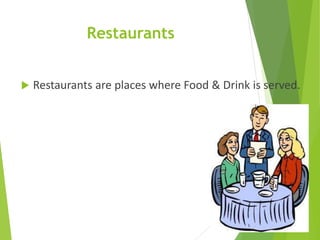
Restaurants
 Restaurants are places where Food & Drink is served.
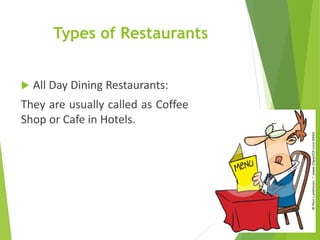
Types of Restaurants
 All Day Dining Restaurants:
They are usually called as Coffee
Shop or Cafe in Hotels.
Types of Restaurants
 Fine Dining Restaurants
are characterized by their elaborate and
exclusive menu with special emphasis on the
very high quality food they serve.
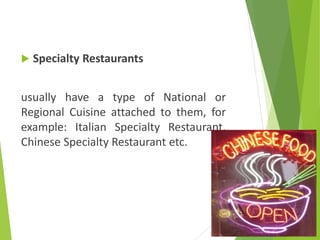
 Specialty Restaurants
usually have a type of National or
Regional Cuisine attached to them, for
example: Italian Specialty Restaurant,
Chinese Specialty Restaurant etc.
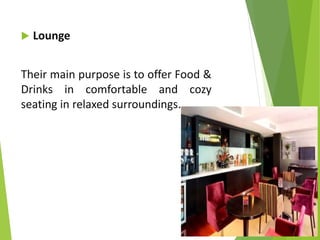
 Lounge
Their main purpose is to offer Food &
Drinks in comfortable and cozy
seating in relaxed surroundings.
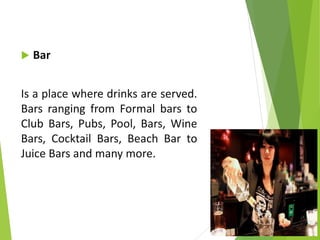
 Bar
Is a place where drinks are served.
Bars ranging from Formal bars to
Club Bars, Pubs, Pool, Bars, Wine
Bars, Cocktail Bars, Beach Bar to
Juice Bars and many more.
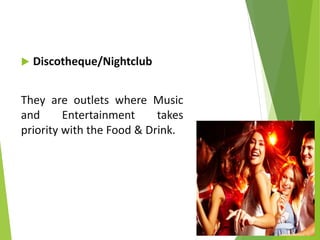
 Discotheque/Nightclub
They are outlets where Music
and Entertainment takes
priority with the Food & Drink.
 Ball Rooms
These are large Function Rooms which are
primarily used for Functions and Weddings.
 Delicatessen
Delicatessen or Deli is a place where guests
can buy fresh product ranging from Freshly
Baked Bread, Fresh Salads, Cakes, and light
and healthy drinks.
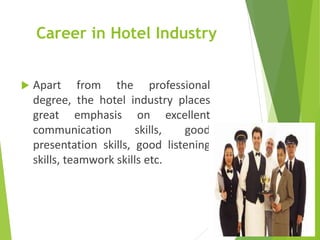
Career in Hotel Industry
 Apart from the professional
degree, the hotel industry places
great emphasis on excellent
communication skills, good
presentation skills, good listening
skills, teamwork skills etc.
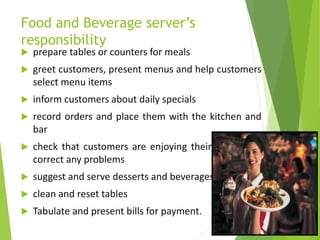
Food and Beverage server’s
responsibility
 prepare tables or counters for meals
 greet customers, present menus and help customers
select menu items
 inform customers about daily specials
 record orders and place them with the kitchen and
bar
 check that customers are enjoying their meals and
correct any problems
 suggest and serve desserts and beverages
 clean and reset tables
 Tabulate and present bills for payment.
Responsibilities of director of Food and
Beverage
 Leadership
 Identifying needs.
 Finding and keeping outstanding employees.
 Training.
 Motivation
 budgeting
 Cost control
 Finding profit from all outlet.
 Having a details working knowledge
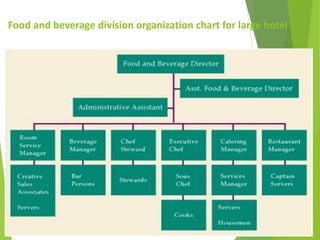
Food and beverage division organization chart for large hotel
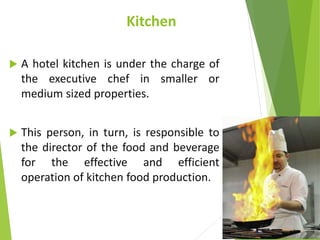
Kitchen
 A hotel kitchen is under the charge of
the executive chef in smaller or
medium sized properties.
 This person, in turn, is responsible to
the director of the food and beverage
for the effective and efficient
operation of kitchen food production.
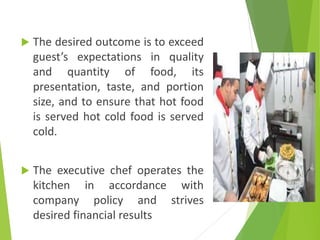
 The desired outcome is to exceed
guest’s expectations in quality
and quantity of food, its
presentation, taste, and portion
size, and to ensure that hot food
is served hot cold food is served
cold.
 The executive chef operates the
kitchen in accordance with
company policy and strives
desired financial results
Types of Chefs in Hotel Industry
 Sauce chefs: Who is responsible to prepare sauce, stews,
and sautés.
 Roast chefs: Who roasts, broils, grills, and braises meats.
 Fish chefs: Who cooks fish dishes.
 Soup chef: Who prepares all soup.
 Cold larder: Who prepares all cold foods like salads, cold hors
d’oeuvres, buffet food, and dressings.
 Banquet chef: Who prepares all kinds of banquet foods.
 Pastry chef: Who prepares all hot and cold desert items.
 Vegetable chef: Who prepares vegetables.
Food operations
 A hotel may have several restaurants or no
restaurant at all; the number and type of restaurants
varies as well.
 A major chain hotel generally has two restaurants: a
signature or upscale formal restaurant and a casual
coffee shop type of restaurant.
 These restaurants cater to both hotel guest and to
general public.
Restaurant manager are general are
generally responsible for the
following:
 Exceeding guest service expectations.
 Hiring, training and developing employees.
 Setting, maintaining quality standard.
 Marketing.
 Banquets.
 Coffee.
 In room dining, minibar or cocktail lounge.
 Presenting annual, monthly and weekly forecast and
budget for the food and beverage directors.
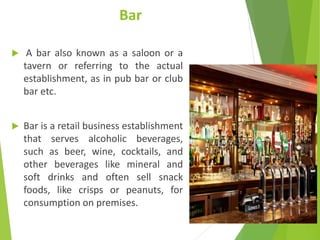
Bar
 A bar also known as a saloon or a
tavern or referring to the actual
establishment, as in pub bar or club
bar etc.
 Bar is a retail business establishment
that serves alcoholic beverages,
such as beer, wine, cocktails, and
other beverages like mineral and
soft drinks and often sell snack
foods, like crisps or peanuts, for
consumption on premises.
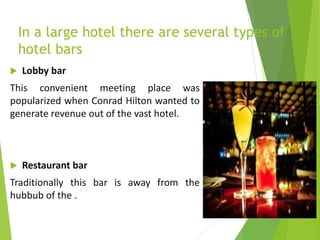
In a large hotel there are several types of
hotel bars
 Lobby bar
This convenient meeting place was
popularized when Conrad Hilton wanted to
generate revenue out of the vast hotel.
 Restaurant bar
Traditionally this bar is away from the
hubbub of the .
 Pool bars
Pool bars are popular at resort hotels where guest
can enjoy a verity of exotic cocktails poolside.
 Minibars
Minibars or honor are small, refrigerated bars in
guest room.
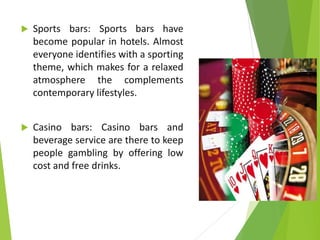
 Sports bars: Sports bars have
become popular in hotels. Almost
everyone identifies with a sporting
theme, which makes for a relaxed
atmosphere the complements
contemporary lifestyles.
 Casino bars: Casino bars and
beverage service are there to keep
people gambling by offering low
cost and free drinks.
Catering Department
Occasions for celebrations, banquets, and
catering include the following:
•State banquets, when countries leader honor
visiting royalty and head of state.
•National days.
•Embassy receptions and banquets.
•Business and association conventions and
banquets.
•Gala charity balls.
•Company dinner dances.
•Weddings.
Catering may be subdivided into-
•On –premise
•Off-premise
Director of catering
The DOC is required to have a variety of skills and
abilities as shown in the following:
•Technical purpose.
•Leadership.
The most frequent catering events in hotels
are followings.
•Meetings.
•Conventions.
•Dinners.
•Luncheons.
•Weddings.
For meetings, a variety of room setups are
available, depending on a client’s needs. The most
frequently selected meeting room setups are as
follows:
•Theater style:
Rows of chairs are placed with a centre group of chairs
and two aisles.
•Classroom style:
18-inch slim tables are used because participants need
space to take notes. It takes about three times as much
space as theater style and more time and labor to setup
•Horseshoe style:
This type of setup is frequently used when
interaction is sought among the delegates, such as
training sessions or workshops. The presenter
stands at the open ends of the horseshoe with a
black or white board, flip chart, overhead projector,
and video monitor and projector.
•Dinner style:
Dinners are usually catered at round tables of 8 or
10 persons for large parties and on boardroom
style tables for smaller numbers.
Thank You

Lodging presentation final ppt

  • 1.
  • 2.
  • 4.
     Thermal Bathwas initiated in Greco-Roman Period (2nd Century AD)
  • 5.
     During MiddleAges, various religious orders at Ministries' and Abbeys would offer accommodation for travelers.
  • 6.
     The precursorto the modern hotel was the inn of medieval Europe (Middle Ages: 5th to 15th Century) Besides food and lodging those inn also provided stable & fodder for travelers horses and fresh horse for mail coach.
  • 7.
     After mid-17thcentury, COACHING INNS served as a place for coaching travelers.
  • 8.
     In 1812Claridge’s Hotel opened it’s door.
  • 9.
     In 19thCentury luxurious hotels starts growing like Tremon House, Astor House (US), Savory Hotel (UK), Ritz Hotel (London)
  • 10.
  • 11.
     Experts predictthat bathrooms will grow larger—up to 50% or more of the total hotel room—and become more spa-like.
  • 12.
     Pod hotels,which are popular in Japan, feature tiny, minimalistic rooms. This concept may expand to other locales as much of the furniture traditionally found in hotels is deemed unnecessary.
  • 13.
     Special bathroommirrors with touch screen capabilities can provide digital readouts of the weather or daily headlines.
  • 14.
     Guests nowuse their smartphones as room keys.  Control of Lights and air-condition with smartphones.
  • 15.
     Share moments,food photos etc. on Social Media  Infinity pools, rooftop bars and unique ‘selfie spaces’ will become increasingly important.
  • 16.
     Many hotelguests express a desire for organic, locally- sourced food.
  • 17.
  • 18.
    Organizational Structure of HotelBusiness • A hierarchy with one or two executives overseeing the entire operation • Three Types of Groups: 1. Functional Groups: It includes Housekeeping, Food and Beverage Services, Concierge and Front Desk Services. 2. Administrative Groups: It includes Sales and Marketing, Accounting and Human resources. 3. Other Services related to Hotel Maintenance: It includes Engineering, Security, Grounds keeping and General maintenance. 4. Each functional group is overseen and directed by a Supervisor, who reports to the General Manager
  • 19.
    The Functions andDepartments of a Residential Hotel
  • 20.
    1. Room Division •The rooms division comprises departments and personnel essential to providing the lodging services guests expect during a hotel stay. In most of the hotels the room division generates more revenue than all other divisions combined • Six important departments of Room Division: 1.1 Front Office- Nerve Centre of the Hotel 1.2 Reservations 1.3 Telecommunications 1.4 Housekeeping- Professional Quality Cleaning with a personal Touch 1.5 Uniformed Services 1.6 The Concierge- Always at your service
  • 21.
    1.1 Front Office-Nerve Centre of the Hotel
  • 22.
    1.2 Reservations  Thereservation department is responsible for receiving and processing reservation requests for the future overnight accommodations.  The purpose is to accommodate guest requests in a manner that maximizes hotel occupancy and room revenue.  Reservation employees need to keep informing of the room availability to ensure the sales department representatives know how many rooms are available in the reservation system on a given day.
  • 23.
    1.3 Telecommunication  Maintainsa complex communications network similar to that of any large company.  May also be called as a private branch exchange or PBX.  Place wake-up calls, answer questions about the hotel, monitor automated systems (such as door alarms and fire alarms) and coordinate emergency communications.
  • 24.
    1.4 Housekeeping- ProfessionalQuality Cleaning with a personal Touch
  • 25.
    1.5 Uniformed Services BellAttendants Door Attendants
  • 26.
    1.5 Uniformed Services ValetParking Attendants Transportation Personnel
  • 27.
    1.6 The Concierge-Always at your service Concierge department looks forward to enhance the guest experience. Travel routes, recommendations of tours, attractions and short cuts around town are just a few services offered by the remarkable Concierge team, topped by, of course, a lovely friendly welcome.
  • 28.
    2. Food andbeverage Division: Cooking with Passion and serving you with smile
  • 29.
  • 30.
    4. Sales andMarketing Division- Creative Selling
  • 31.
    5. Accounting Division-Working with Numbers • Accounting activities include paying outstanding invoices, distributing unpaid statements, collecting amounts owed, processing payroll, accumulating operating data, and compiling financial reports. • They also provide the hotel with relevant financial data and forecasts which are used for daily decision making
  • 32.
    6. Engineering andMaintenance Division- To the Rescue! • Repairs and regular preventive maintenance are required around the hotel. • It is responsible for maintaining the property’s structure and grounds, as well as its electrical and mechanical equipment. • They may also be charged with swimming pool sanitation, parking lot cleanliness and fountain operations. • The front office department efficiently exchanges information with a representative of the engineering and maintenance division to ensure guest satisfaction.
  • 33.
    7. Security Division •Security staff may include in-house personnel, contact security officers and off-duty or retired police officers. • Security responsibilities include patrolling the property; monitoring surveillance equipment; and in general ensuring that guests, visitors and employees are safe and secure.
  • 34.
    8. Human ResourcesDivision The functions of the human resource division include:  Employment (including external recruiting and internal reassignment),  Training, employee relations (including quality assurance),  Compensation, benefits, administrations (including employee policies),  Labour relations and safety.
  • 35.
    9. Other Divisions Many hotels staff a variety of other divisions to serve their guests. The range of possibilities reflects the diversity of hotels. • Retail outlets • Recreation • Casino
  • 36.
    10. Executive Team-The Pack Leaders! • The Executive Team plays a decisive role in the hotel operations as the final decision-maker. • The team is comprised of the department Heads and is led by the Director of Operations, and the General Manager. • The team ensures the smooth running of the hotel operations, each member responsible for the management of its own department
  • 37.
    Ways to ClassifyHotels • Size - or Number of rooms • Target Markets (Location) • Ownership • Types of services offered
  • 39.
    Target Market (Location) •Business Hotels • Airport hotels • Freeway hotels • Casino hotels  Full service  Convention  Economy  Bed and breakfast
  • 40.
    Airport Hotels • Highoccupancy due to location • Business, group, and leisure travelers • Full service • 200–600 rooms • Convenient location
  • 41.
    The Freeway Hotelis the ideal place to hold function or party. The Freeway can cater for every type of occasion, from a small meeting to a reception for over 200 guests. Fun and enjoyable atmosphere secure parking Customized room layouts
  • 42.
    Casinos • Contains agaming room • Subsidized food and beverage • More than 500 guest rooms • Variety of food operations
  • 43.
    Convention Hotels • Meetthe needs of large groups • More than 500 rooms • Banquet areas within and around the hotel • Full-service oriented
  • 44.
    Economy/Budget Hotels • Represents12% of total hotel rooms • However, profit revenue is slow, with an annual rate of 1% • Clean rooms • Reasonably sized and furnished • Continental breakfast
  • 45.
    • A homeaway from home • Accommodation with an owner who lives on premises • Maintains a few rooms • Offers breakfast • Personable and quick service
  • 46.
    Vacation Ownership  Fastest-growingsegment of travel industry  Time share:  Purchaser uses for a specific period of time each year  Vacation club:  Purchase points that entitle purchaser to use of facility  Not real estate based
  • 47.
    The Hotel Chains •The Ritz-Carlton Hotel is generally rated as the highest quality chain hotels. • Ritz-Carlton Hotel operates 87 luxury hotel and resorts i n major cities and resorts in 29 countries and territories. • It has received the Malcolm Baldrige National Quality Award, the United States Department of Commerce- the first and only hotel company to win the award.
  • 48.
    The Most UnusualHotels • Among the most unusual hotels, The Treetops Hotel of Kenya’s wild animal park is one. The uniqueness of the hotel is that it is built on the tops of trees overlooking a wild animal watering hole in the park.
  • 49.
    The Most UnusualHotels • is the Ice Hotel, situated on the shores of the Trone River in the old village of Jukkasjasvi in Swedish Lapland. The Ice Hotel is built from scratch on an annual basis with a completely new design, new suites, new departments, even new, the Absolute Ice Bar.
  • 50.
    The Most UnusualHotels Japan has several unusual hotels. One is cocoon like hotel, called Capsule Hotel. In this hotel guests do not have a room instead they have a space of about 4 feet by 7 feet. In this space is a bed and a television which have to operate by toes.
  • 51.
    Trends in HotelDevelopment • Capacity control • Safety and security • Technology • New Management • Globalization • Rapid growth in vacation ownership • An increase in the number of spas and the treatments offered
  • 52.
  • 53.
    INTRODUCTION to ROOMSDIVISION  The Rooms Division is the heart of the hotel.  It is the main business of the hotel and the main source of revenue.  Rooms can contribute 70 percent or more to overall revenue and even more to profit.  The center of activity in the Rooms Division is the Front Office.
  • 54.
    Management Structure  Managementstructure differs among larger, midscale, and smaller properties.  Someone must be responsible for each of the key result areas that make the operation successful. For example, a small property may not have a director of human resources, but each department head will have general day-to-day operating responsibilities for the human resources function.
  • 55.
    The Managing Committee The Executive Committee is comprised of key managers of the hotel. Typical members would be directors of the following departments: human resources, food and beverage, rooms division, marketing and sales, engineering, and accounting.  Executive Committee meetings usually last 1 to 2 hours, once a week. Typical topics of discussion will focus on occupancy %, Total Quality Management, forecasts, guest and employee satisfaction, training, etc.
  • 56.
  • 57.
  • 58.
    The Departments –Rooms Division  The rooms division director is held responsible by the GM for the efficient and effective leadership and operation of all the rooms division departments.  The Rooms Division is comprised of the front office, reservations, housekeeping, concierge, guest service, security, and communications.
  • 59.
  • 60.
  • 62.
    Basic Duties ofthe Front Office  Review previous night’s occupancy/ADR  Review arrivals/departures/VIP rooms  Meet with lead GSAs  Sell rooms  Maintain balanced guest accounts  Offer services such as faxes, mail, messages, etc.
  • 63.
    Night Auditor  Postscharges  Closes the books on a daily basis  Balances guest accounts  Completes daily report
  • 64.
    Night Audit Processin Simple Terms  Add yesterday’s closing balance of accounts owed by guests  Less payments received today against accounts  Plus all charges made today to guests’ account  Equals day’s closing balance of accounts owed by guest
  • 65.
    Hotel Occupancy Statistics Occupancy statistics:  Percentage of Occupancy = Rooms Occupied Total Rooms Available
  • 66.
    Hotel Revenue Statistics Revenue statistics:  Average Daily Room Rate (ADR) = Total Rooms Revenue Total Number of Rooms Sold
  • 67.
  • 68.
    Property Management System Theproperty management system (PMS) is the center of information processing in a hotel. The property management system can interface with many other modules or applications.
  • 69.
    Energy Management Systems Technology is used to extend guest in- room comfort by means of an energy management system.  Passive infrared motion sensors and door switches can reduce energy consumption. Features include……..  Room occupancy status reporting  Automatic lighting control  Minibar access reporting  Smoke detector alarm reporting  Central electronic lock control  Guest control amenities
  • 70.
    Call Accounting Systems track guest room phone charges  Software packages can be used to monitor where calls are being made and from what phones on the property  CAS must work in conjunction with the PBX (telephone) and the PMS
  • 71.
    Guest Reservation Systems Beforehotels started using the internet to book reservations, they received reservations by letters, telegrams, faxes, and phone calls. Airlines were the first industry to use the Global Distribution System (GDS) for reservations. Fig: Sequence and Relationship of Hotel Guest Reservation
  • 72.
    Billing Guests  Hospitalitybusiness today seek to obtain the most high speed and reliable computer systems they can afford that allow them to bill their guest without delay.  Billing guest has become much easier with the aid of computers.  Property management systems aid large hotels to make faster transactions and provide a more efficient service to their guest.
  • 73.
  • 74.
    Security Each business inthe hospitality industry offers some sort of security for their guests and employees. • surveillance systems in which cameras • the property to monitor the grounds & help ensure guest safety
  • 75.
    Guest comfort and convenience Dining  Television  Telephones  Internet connections  Minibars and hygiene products.
  • 76.
    Revenue management  Theyield management program will monitor the demand and supply and recommend  The number and type of rooms to sell for any given day and the price for which to sell each to sell each room.
  • 77.
    Reservation  Central ReservationSystems  Confirmed Reservation  Guaranteed reservation
  • 78.
    Housekeeping  The largestdepartment in terms of the number of people employed is housekeeping. Due to hard work and comparatively low pay, employee turnover is very high in this essential department.  The modern laundry operates computerized washing/during machines and large process.
  • 79.
    Security A comprehensive securityplan must include the following elements:  Security officer  Equipment  Safety procedures  Identification procedures
  • 80.
  • 81.
    Food and BeverageDepartment (F&B) Food and Beverage Department (F&B) is responsible for-  maintaining high quality of food and service,  food costing  managing restaurants, bars, etc.
  • 82.
    Restaurants  Restaurants areplaces where Food & Drink is served.
  • 83.
    Types of Restaurants All Day Dining Restaurants: They are usually called as Coffee Shop or Cafe in Hotels.
  • 84.
    Types of Restaurants Fine Dining Restaurants are characterized by their elaborate and exclusive menu with special emphasis on the very high quality food they serve.
  • 85.
     Specialty Restaurants usuallyhave a type of National or Regional Cuisine attached to them, for example: Italian Specialty Restaurant, Chinese Specialty Restaurant etc.
  • 86.
     Lounge Their mainpurpose is to offer Food & Drinks in comfortable and cozy seating in relaxed surroundings.
  • 87.
     Bar Is aplace where drinks are served. Bars ranging from Formal bars to Club Bars, Pubs, Pool, Bars, Wine Bars, Cocktail Bars, Beach Bar to Juice Bars and many more.
  • 88.
     Discotheque/Nightclub They areoutlets where Music and Entertainment takes priority with the Food & Drink.
  • 89.
     Ball Rooms Theseare large Function Rooms which are primarily used for Functions and Weddings.  Delicatessen Delicatessen or Deli is a place where guests can buy fresh product ranging from Freshly Baked Bread, Fresh Salads, Cakes, and light and healthy drinks.
  • 90.
    Career in HotelIndustry  Apart from the professional degree, the hotel industry places great emphasis on excellent communication skills, good presentation skills, good listening skills, teamwork skills etc.
  • 91.
    Food and Beverageserver’s responsibility  prepare tables or counters for meals  greet customers, present menus and help customers select menu items  inform customers about daily specials  record orders and place them with the kitchen and bar  check that customers are enjoying their meals and correct any problems  suggest and serve desserts and beverages  clean and reset tables  Tabulate and present bills for payment.
  • 92.
    Responsibilities of directorof Food and Beverage  Leadership  Identifying needs.  Finding and keeping outstanding employees.  Training.  Motivation  budgeting  Cost control  Finding profit from all outlet.  Having a details working knowledge
  • 93.
    Food and beveragedivision organization chart for large hotel
  • 94.
    Kitchen  A hotelkitchen is under the charge of the executive chef in smaller or medium sized properties.  This person, in turn, is responsible to the director of the food and beverage for the effective and efficient operation of kitchen food production.
  • 95.
     The desiredoutcome is to exceed guest’s expectations in quality and quantity of food, its presentation, taste, and portion size, and to ensure that hot food is served hot cold food is served cold.  The executive chef operates the kitchen in accordance with company policy and strives desired financial results
  • 96.
    Types of Chefsin Hotel Industry  Sauce chefs: Who is responsible to prepare sauce, stews, and sautés.  Roast chefs: Who roasts, broils, grills, and braises meats.  Fish chefs: Who cooks fish dishes.  Soup chef: Who prepares all soup.
  • 97.
     Cold larder:Who prepares all cold foods like salads, cold hors d’oeuvres, buffet food, and dressings.  Banquet chef: Who prepares all kinds of banquet foods.  Pastry chef: Who prepares all hot and cold desert items.  Vegetable chef: Who prepares vegetables.
  • 98.
    Food operations  Ahotel may have several restaurants or no restaurant at all; the number and type of restaurants varies as well.  A major chain hotel generally has two restaurants: a signature or upscale formal restaurant and a casual coffee shop type of restaurant.  These restaurants cater to both hotel guest and to general public.
  • 99.
    Restaurant manager aregeneral are generally responsible for the following:  Exceeding guest service expectations.  Hiring, training and developing employees.  Setting, maintaining quality standard.  Marketing.  Banquets.  Coffee.  In room dining, minibar or cocktail lounge.  Presenting annual, monthly and weekly forecast and budget for the food and beverage directors.
  • 100.
    Bar  A baralso known as a saloon or a tavern or referring to the actual establishment, as in pub bar or club bar etc.  Bar is a retail business establishment that serves alcoholic beverages, such as beer, wine, cocktails, and other beverages like mineral and soft drinks and often sell snack foods, like crisps or peanuts, for consumption on premises.
  • 101.
    In a largehotel there are several types of hotel bars  Lobby bar This convenient meeting place was popularized when Conrad Hilton wanted to generate revenue out of the vast hotel.  Restaurant bar Traditionally this bar is away from the hubbub of the .
  • 102.
     Pool bars Poolbars are popular at resort hotels where guest can enjoy a verity of exotic cocktails poolside.  Minibars Minibars or honor are small, refrigerated bars in guest room.
  • 103.
     Sports bars:Sports bars have become popular in hotels. Almost everyone identifies with a sporting theme, which makes for a relaxed atmosphere the complements contemporary lifestyles.  Casino bars: Casino bars and beverage service are there to keep people gambling by offering low cost and free drinks.
  • 104.
    Catering Department Occasions forcelebrations, banquets, and catering include the following: •State banquets, when countries leader honor visiting royalty and head of state. •National days. •Embassy receptions and banquets.
  • 105.
    •Business and associationconventions and banquets. •Gala charity balls. •Company dinner dances. •Weddings. Catering may be subdivided into- •On –premise •Off-premise
  • 106.
    Director of catering TheDOC is required to have a variety of skills and abilities as shown in the following: •Technical purpose. •Leadership.
  • 107.
    The most frequentcatering events in hotels are followings. •Meetings. •Conventions. •Dinners. •Luncheons. •Weddings.
  • 108.
    For meetings, avariety of room setups are available, depending on a client’s needs. The most frequently selected meeting room setups are as follows: •Theater style: Rows of chairs are placed with a centre group of chairs and two aisles. •Classroom style: 18-inch slim tables are used because participants need space to take notes. It takes about three times as much space as theater style and more time and labor to setup
  • 109.
    •Horseshoe style: This typeof setup is frequently used when interaction is sought among the delegates, such as training sessions or workshops. The presenter stands at the open ends of the horseshoe with a black or white board, flip chart, overhead projector, and video monitor and projector. •Dinner style: Dinners are usually catered at round tables of 8 or 10 persons for large parties and on boardroom style tables for smaller numbers.
  • 110.