Security
Each business in the hospitality industry offers some sort of
security for their guests and employees.
• surveillance systems in which cameras
• the property to monitor the grounds & help ensure guest
safety
Guest comfort and convenience
 Dining
 Television
 Telephones
 Internet connections
 Minibars and hygiene products.
Revenue management
 The yield management program will monitor the demand
and supply and recommend
 The number and type of rooms to sell for any given day and
the price for which to sell each to sell each room.
Reservation
 Central Reservation Systems
 Confirmed Reservation
 Guaranteed reservation
Communication CBX or PBX
 In-house communication
 Guest communication
 Pagers and radios
 Voice mail, faxes, messages and emergency centre.
Housekeeping & Laundry
 The largest department in terms of the number of people
employed is housekeeping. Due to hard work and
comparatively low pay, employee turnover is very high in this
essential department.
 The modern laundry operates computerized washing/during
machines and large process.
Security
A comprehensive security plan must include the following
elements:
 Security officer
 Equipment
 Safety procedures
 Identification procedures
Chapter-6
Food and Beverage Operations
Food and Beverage Department (F&B)
Food and Beverage Department (F&B) is responsible for-
 maintaining high quality of food and service,
 food costing
 managing restaurants, bars, etc.
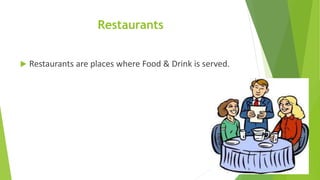
Restaurants
 Restaurants are places where Food & Drink is served.
Types of Restaurants
 All Day Dining Restaurants:
They are usually called as Coffee Shop or
Cafe in Hotels.
Types of Restaurants
 Fine Dining Restaurants
are characterized by their elaborate and exclusive menu with
special emphasis on the very high quality food they serve.
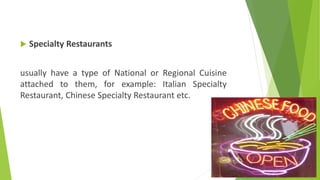
 Specialty Restaurants
usually have a type of National or Regional Cuisine
attached to them, for example: Italian Specialty
Restaurant, Chinese Specialty Restaurant etc.
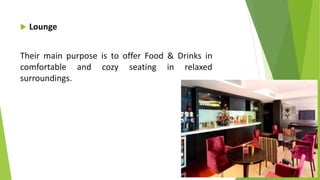
 Lounge
Their main purpose is to offer Food & Drinks in
comfortable and cozy seating in relaxed
surroundings.
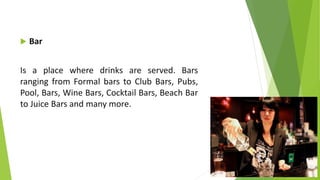
 Bar
Is a place where drinks are served. Bars
ranging from Formal bars to Club Bars, Pubs,
Pool, Bars, Wine Bars, Cocktail Bars, Beach Bar
to Juice Bars and many more.
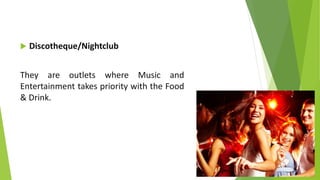
 Discotheque/Nightclub
They are outlets where Music and
Entertainment takes priority with the Food
& Drink.
 Ball Rooms
These are large Function Rooms which are primarily used for
Functions and Weddings.
 Delicatessen
Delicatessen or Deli is a place where guests can buy fresh
product ranging from Freshly Baked Bread, Fresh Salads,
Cakes, and light and healthy drinks.
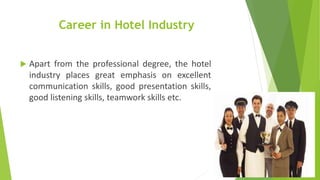
Career in Hotel Industry
 Apart from the professional degree, the hotel
industry places great emphasis on excellent
communication skills, good presentation skills,
good listening skills, teamwork skills etc.
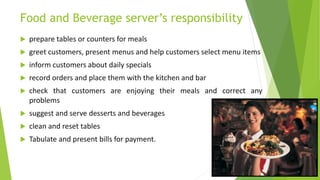
Food and Beverage server’s responsibility
 prepare tables or counters for meals
 greet customers, present menus and help customers select menu items
 inform customers about daily specials
 record orders and place them with the kitchen and bar
 check that customers are enjoying their meals and correct any
problems
 suggest and serve desserts and beverages
 clean and reset tables
 Tabulate and present bills for payment.
Responsibilities of director of Food and Beverage
 Leadership
 Identifying needs.
 Finding and keeping outstanding employees.
 Training.
 Motivation
 budgeting
 Cost control
 Finding profit from all outlet.
 Having a details working knowledge
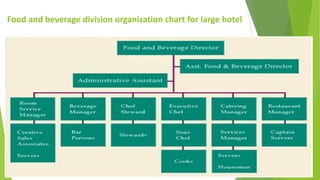
Food and beverage division organization chart for large hotel
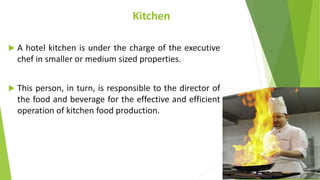
Kitchen
 A hotel kitchen is under the charge of the executive
chef in smaller or medium sized properties.
 This person, in turn, is responsible to the director of
the food and beverage for the effective and efficient
operation of kitchen food production.
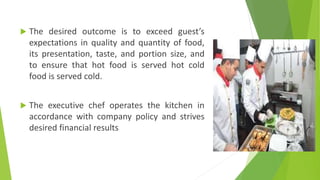
 The desired outcome is to exceed guest’s
expectations in quality and quantity of food,
its presentation, taste, and portion size, and
to ensure that hot food is served hot cold
food is served cold.
 The executive chef operates the kitchen in
accordance with company policy and strives
desired financial results
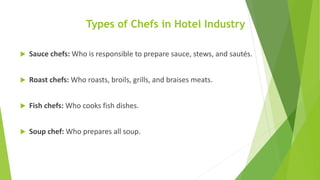
Types of Chefs in Hotel Industry
 Sauce chefs: Who is responsible to prepare sauce, stews, and sautés.
 Roast chefs: Who roasts, broils, grills, and braises meats.
 Fish chefs: Who cooks fish dishes.
 Soup chef: Who prepares all soup.
 Cold larder: Who prepares all cold foods like salads, cold hors d’oeuvres, buffet food,
and dressings.
 Banquet chef: Who prepares all kinds of banquet foods.
 Pastry chef: Who prepares all hot and cold desert items.
 Vegetable chef: Who prepares vegetables.
Food operations
 A hotel may have several restaurants or no restaurant at all; the number
and type of restaurants varies as well.
 A major chain hotel generally has two restaurants: a signature or
upscale formal restaurant and a casual coffee shop type of restaurant.
 These restaurants cater to both hotel guest and to general public.
Restaurant manager are general are
generally responsible for the following:
 Exceeding guest service expectations.
 Hiring, training and developing employees.
 Setting, maintaining quality standard.
 Marketing.
 Banquets.
 Coffee.
 In room dining, minibar or cocktail lounge.
 Presenting annual, monthly and weekly forecast and budget for the
food and beverage directors.
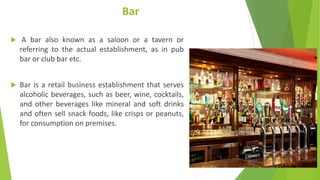
Bar
 A bar also known as a saloon or a tavern or
referring to the actual establishment, as in pub
bar or club bar etc.
 Bar is a retail business establishment that serves
alcoholic beverages, such as beer, wine, cocktails,
and other beverages like mineral and soft drinks
and often sell snack foods, like crisps or peanuts,
for consumption on premises.
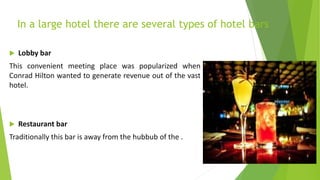
In a large hotel there are several types of hotel bars
 Lobby bar
This convenient meeting place was popularized when
Conrad Hilton wanted to generate revenue out of the vast
hotel.
 Restaurant bar
Traditionally this bar is away from the hubbub of the .
 Pool bars
Pool bars are popular at resort hotels where guest can enjoy a verity of
exotic cocktails poolside.
 Minibars
Minibars or honor are small, refrigerated bars in guest room.
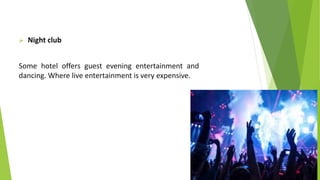
 Night club
Some hotel offers guest evening entertainment and
dancing. Where live entertainment is very expensive.
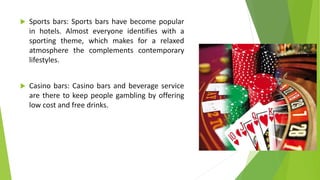
 Sports bars: Sports bars have become popular
in hotels. Almost everyone identifies with a
sporting theme, which makes for a relaxed
atmosphere the complements contemporary
lifestyles.
 Casino bars: Casino bars and beverage service
are there to keep people gambling by offering
low cost and free drinks.
Stewarding Department
The chief steward is responsible to the director of food &
beverage for the following functions:
•Cleanliness of the back of the house.
•Maintaining clean glassware, china, and cutlery for the food and
beverage outlets.
•Maintaining strict inventory control and monthly stock check.
•Maintenance of dishwashing machines.
•Inventory of chemical stock.
•Sanitation of kitchen, banquet isles, storerooms,
walk-ins/freezers, and all equipment.
•Pest control and co-ordination with
exterminating company.
•Forecasting labor and cleaning supplies.
Catering Department
Occasions for celebrations, banquets, and catering include the
following:
•State banquets, when countries leader honor visiting royalty
and head of state.
•National days.
•Embassy receptions and banquets.
•Business and association conventions and banquets.
•Gala charity balls.
•Company dinner dances.
•Weddings.
Catering may be subdivided into-
•On –premise
•Off-premise
Director of catering
The DOC is required to have a variety of skills and abilities as shown in
the following:
•Technical purpose.
•Leadership.
The most frequent catering events in hotels are followings.
•Meetings.
•Conventions.
•Dinners.
•Luncheons.
•Weddings.
For meetings, a variety of room setups are available, depending on a
client’s needs. The most frequently selected meeting room setups are
as follows:
•Theater style:
Rows of chairs are placed with a centre group of chairs and two aisles.
•Classroom style:
18-inch slim tables are used because participants need space to take
notes. It takes about three times as much space as theater style and more
time and labor to setup and breakup.
•Horseshoe style:
This type of setup is frequently used when interaction is sought
among the delegates, such as training sessions or workshops. The
presenter stands at the open ends of the horseshoe with a black or
white board, flip chart, overhead projector, and video monitor and
projector.
•Dinner style:
Dinners are usually catered at round tables of 8 or 10 persons for
large parties and on boardroom style tables for smaller numbers.
Security and f and b   final

Security and f and b final

  • 2.
    Security Each business inthe hospitality industry offers some sort of security for their guests and employees. • surveillance systems in which cameras • the property to monitor the grounds & help ensure guest safety
  • 3.
    Guest comfort andconvenience  Dining  Television  Telephones  Internet connections  Minibars and hygiene products.
  • 4.
    Revenue management  Theyield management program will monitor the demand and supply and recommend  The number and type of rooms to sell for any given day and the price for which to sell each to sell each room.
  • 5.
    Reservation  Central ReservationSystems  Confirmed Reservation  Guaranteed reservation
  • 6.
    Communication CBX orPBX  In-house communication  Guest communication  Pagers and radios  Voice mail, faxes, messages and emergency centre.
  • 7.
    Housekeeping & Laundry The largest department in terms of the number of people employed is housekeeping. Due to hard work and comparatively low pay, employee turnover is very high in this essential department.  The modern laundry operates computerized washing/during machines and large process.
  • 8.
    Security A comprehensive securityplan must include the following elements:  Security officer  Equipment  Safety procedures  Identification procedures
  • 9.
  • 10.
    Food and BeverageDepartment (F&B) Food and Beverage Department (F&B) is responsible for-  maintaining high quality of food and service,  food costing  managing restaurants, bars, etc.
  • 11.
    Restaurants  Restaurants areplaces where Food & Drink is served.
  • 12.
    Types of Restaurants All Day Dining Restaurants: They are usually called as Coffee Shop or Cafe in Hotels.
  • 13.
    Types of Restaurants Fine Dining Restaurants are characterized by their elaborate and exclusive menu with special emphasis on the very high quality food they serve.
  • 14.
     Specialty Restaurants usuallyhave a type of National or Regional Cuisine attached to them, for example: Italian Specialty Restaurant, Chinese Specialty Restaurant etc.
  • 15.
     Lounge Their mainpurpose is to offer Food & Drinks in comfortable and cozy seating in relaxed surroundings.
  • 16.
     Bar Is aplace where drinks are served. Bars ranging from Formal bars to Club Bars, Pubs, Pool, Bars, Wine Bars, Cocktail Bars, Beach Bar to Juice Bars and many more.
  • 17.
     Discotheque/Nightclub They areoutlets where Music and Entertainment takes priority with the Food & Drink.
  • 18.
     Ball Rooms Theseare large Function Rooms which are primarily used for Functions and Weddings.  Delicatessen Delicatessen or Deli is a place where guests can buy fresh product ranging from Freshly Baked Bread, Fresh Salads, Cakes, and light and healthy drinks.
  • 19.
    Career in HotelIndustry  Apart from the professional degree, the hotel industry places great emphasis on excellent communication skills, good presentation skills, good listening skills, teamwork skills etc.
  • 20.
    Food and Beverageserver’s responsibility  prepare tables or counters for meals  greet customers, present menus and help customers select menu items  inform customers about daily specials  record orders and place them with the kitchen and bar  check that customers are enjoying their meals and correct any problems  suggest and serve desserts and beverages  clean and reset tables  Tabulate and present bills for payment.
  • 21.
    Responsibilities of directorof Food and Beverage  Leadership  Identifying needs.  Finding and keeping outstanding employees.  Training.  Motivation  budgeting  Cost control  Finding profit from all outlet.  Having a details working knowledge
  • 22.
    Food and beveragedivision organization chart for large hotel
  • 23.
    Kitchen  A hotelkitchen is under the charge of the executive chef in smaller or medium sized properties.  This person, in turn, is responsible to the director of the food and beverage for the effective and efficient operation of kitchen food production.
  • 24.
     The desiredoutcome is to exceed guest’s expectations in quality and quantity of food, its presentation, taste, and portion size, and to ensure that hot food is served hot cold food is served cold.  The executive chef operates the kitchen in accordance with company policy and strives desired financial results
  • 25.
    Types of Chefsin Hotel Industry  Sauce chefs: Who is responsible to prepare sauce, stews, and sautés.  Roast chefs: Who roasts, broils, grills, and braises meats.  Fish chefs: Who cooks fish dishes.  Soup chef: Who prepares all soup.
  • 26.
     Cold larder:Who prepares all cold foods like salads, cold hors d’oeuvres, buffet food, and dressings.  Banquet chef: Who prepares all kinds of banquet foods.  Pastry chef: Who prepares all hot and cold desert items.  Vegetable chef: Who prepares vegetables.
  • 27.
    Food operations  Ahotel may have several restaurants or no restaurant at all; the number and type of restaurants varies as well.  A major chain hotel generally has two restaurants: a signature or upscale formal restaurant and a casual coffee shop type of restaurant.  These restaurants cater to both hotel guest and to general public.
  • 28.
    Restaurant manager aregeneral are generally responsible for the following:  Exceeding guest service expectations.  Hiring, training and developing employees.  Setting, maintaining quality standard.  Marketing.  Banquets.  Coffee.  In room dining, minibar or cocktail lounge.  Presenting annual, monthly and weekly forecast and budget for the food and beverage directors.
  • 29.
    Bar  A baralso known as a saloon or a tavern or referring to the actual establishment, as in pub bar or club bar etc.  Bar is a retail business establishment that serves alcoholic beverages, such as beer, wine, cocktails, and other beverages like mineral and soft drinks and often sell snack foods, like crisps or peanuts, for consumption on premises.
  • 30.
    In a largehotel there are several types of hotel bars  Lobby bar This convenient meeting place was popularized when Conrad Hilton wanted to generate revenue out of the vast hotel.  Restaurant bar Traditionally this bar is away from the hubbub of the .
  • 31.
     Pool bars Poolbars are popular at resort hotels where guest can enjoy a verity of exotic cocktails poolside.  Minibars Minibars or honor are small, refrigerated bars in guest room.
  • 32.
     Night club Somehotel offers guest evening entertainment and dancing. Where live entertainment is very expensive.
  • 33.
     Sports bars:Sports bars have become popular in hotels. Almost everyone identifies with a sporting theme, which makes for a relaxed atmosphere the complements contemporary lifestyles.  Casino bars: Casino bars and beverage service are there to keep people gambling by offering low cost and free drinks.
  • 34.
    Stewarding Department The chiefsteward is responsible to the director of food & beverage for the following functions: •Cleanliness of the back of the house. •Maintaining clean glassware, china, and cutlery for the food and beverage outlets. •Maintaining strict inventory control and monthly stock check.
  • 35.
    •Maintenance of dishwashingmachines. •Inventory of chemical stock. •Sanitation of kitchen, banquet isles, storerooms, walk-ins/freezers, and all equipment. •Pest control and co-ordination with exterminating company. •Forecasting labor and cleaning supplies.
  • 36.
    Catering Department Occasions forcelebrations, banquets, and catering include the following: •State banquets, when countries leader honor visiting royalty and head of state. •National days. •Embassy receptions and banquets.
  • 37.
    •Business and associationconventions and banquets. •Gala charity balls. •Company dinner dances. •Weddings. Catering may be subdivided into- •On –premise •Off-premise
  • 38.
    Director of catering TheDOC is required to have a variety of skills and abilities as shown in the following: •Technical purpose. •Leadership.
  • 39.
    The most frequentcatering events in hotels are followings. •Meetings. •Conventions. •Dinners. •Luncheons. •Weddings.
  • 40.
    For meetings, avariety of room setups are available, depending on a client’s needs. The most frequently selected meeting room setups are as follows: •Theater style: Rows of chairs are placed with a centre group of chairs and two aisles. •Classroom style: 18-inch slim tables are used because participants need space to take notes. It takes about three times as much space as theater style and more time and labor to setup and breakup.
  • 41.
    •Horseshoe style: This typeof setup is frequently used when interaction is sought among the delegates, such as training sessions or workshops. The presenter stands at the open ends of the horseshoe with a black or white board, flip chart, overhead projector, and video monitor and projector. •Dinner style: Dinners are usually catered at round tables of 8 or 10 persons for large parties and on boardroom style tables for smaller numbers.