The document outlines the requirements and training to obtain a private pilot airplane certificate, including:
- Minimum age, language, and medical requirements
- Required hours of ground and flight training, including solo and cross-country flights
- Maneuvers and operations to be trained by a certified flight instructor
- Knowledge examinations and practical flight test to be passed to obtain the certificate
17 years ofage Able to read, write and converse in English Obtain at least a 3 rd class medical certificate Receive and log ground training from an authorized instructor or complete a home study course Pass a knowledge test scoring 70% or better
3.
Accumulate at least40 hours of flight time At least 20 hours from an authorized flight instructor, including at least : 3 hr. cross-country 3 hr. at night including 1 cross-country flight over 100 NM total distance 10 takeoff and landings to a full stop 3 hr. instrument training 3 hr. in airplanes in preparation for the practical test within 60 days prior
4.
10 hr. soloflight time 5 hr. of solo cross country flights 1 solo cross-county of at least 150 NM total distance, with full-stop landings at a minimum of 3 points and with one segment consisting of at least a 50 NM leg between the takeoff and landing locations 3 solo takeoffs and landings to a full stop at an airport with an operating control tower.
5.
Obtain a logbooksign-off by your CFI for: Preflight preparation/procedures Airport/seaport base operations Takeoffs, landings, and go-arounds Performance maneuvers Ground reference maneuvers Navigation Slow flight and stalls Basic instrument maneuvers Emergency operations Night operations Post flight procedures Successfully complete a practical flight test with FAA
Dispatch procedures Use of checklists Certificates and Documents Location and Use Aircraft Preflight Aeronautical Decision Making and Judgment Recovery Procedures Engine Controls Flight Controls Emergency Equipment & survival gear Aircraft Servicing Fuel grades
8.
Scheduling Aircraft keycontrol procedures Aircraft and airport security/access procedures Handling of aircraft and discrepancies found during preflight including re-dispatch in a new aircraft, if appropriate
9.
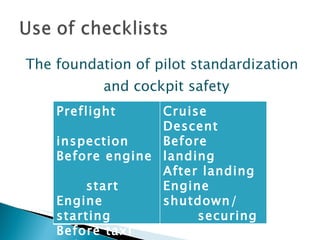
The foundation ofpilot standardization and cockpit safety Preflight inspection Before engine start Engine starting Before taxi Before takeoff After takeoff Cruise Descent Before landing After landing Engine shutdown/ securing emergency
10.
A airworthinesscertificate R registration R radio license ( not required in US ) O operation limitations – may be any combination of FAA –approved airplane Flight manual and/or pilot’s operating handbook, placards, instrument markings W weight and balance info
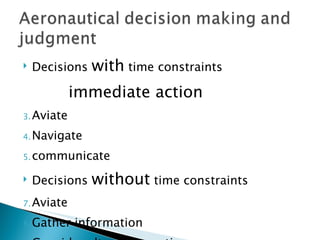
Decisions with time constraints immediate action Aviate Navigate communicate Decisions without time constraints Aviate Gather information Consider alternative action
13.
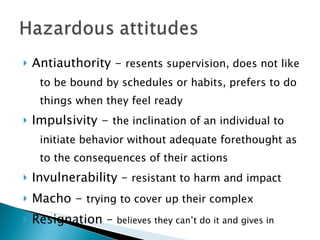
Antiauthority - resents supervision, does not like to be bound by schedules or habits, prefers to do things when they feel ready Impulsivity - the inclination of an individual to initiate behavior without adequate forethought as to the consequences of their actions Invulnerability – resistant to harm and impact Macho - trying to cover up their complex Resignation – believes they can’t do it and gives in
14.
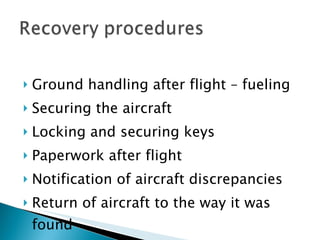
Ground handling afterflight – fueling Securing the aircraft Locking and securing keys Paperwork after flight Notification of aircraft discrepancies Return of aircraft to the way it was found
15.
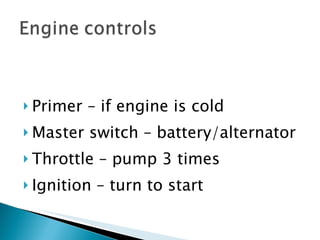
Primer – ifengine is cold Master switch – battery/alternator Throttle – pump 3 times Ignition – turn to start
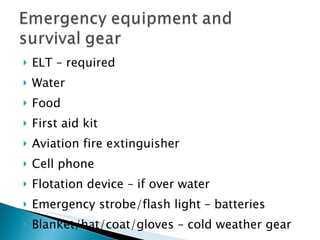
ELT – requiredWater Food First aid kit Aviation fire extinguisher Cell phone Flotation device – if over water Emergency strobe/flash light – batteries Blanket/hat/coat/gloves – cold weather gear
18.
Money or creditcard for fuel/oil Make sure you are able to self-service
19.
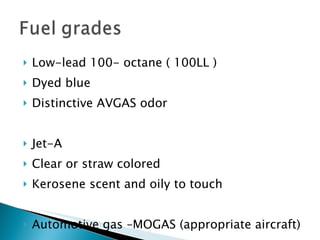
Low-lead 100- octane( 100LL ) Dyed blue Distinctive AVGAS odor Jet-A Clear or straw colored Kerosene scent and oily to touch Automotive gas –MOGAS (appropriate aircraft)
20.
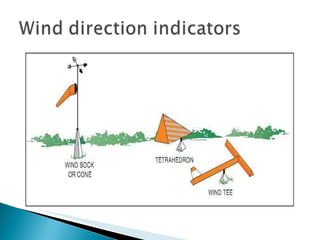
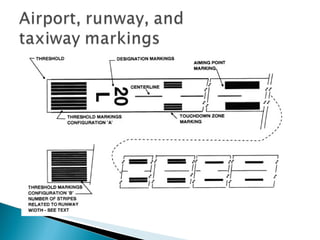
Wind Direction IndicatorsAirport, Runway, and Taxiway Signs Airport, Runway, and Taxiway Markings Airport, Runway, and Taxiway Lighting Radio Calls and Checks CTAF Obtaining Airport Advisories
21.
22.
23.
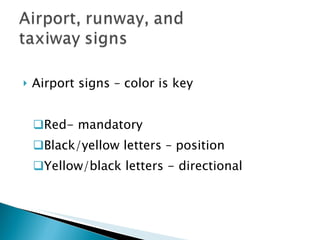
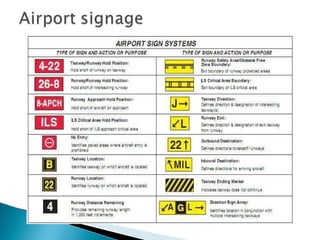
Airport signs –color is key Red- mandatory Black/yellow letters – position Yellow/black letters - directional
24.
25.
26.
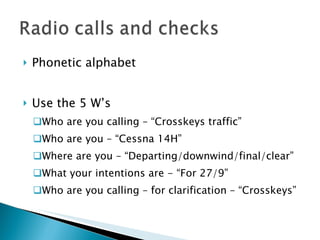
Phonetic alphabet Usethe 5 W’s Who are you calling – “Crosskeys traffic” Who are you – “Cessna 14H” Where are you – “Departing/downwind/final/clear” What your intentions are - “For 27/9” Who are you calling – for clarification – “Crosskeys”
27.
For airports withouta control tower May be a: UNICOM Multicom FSS Tower frequency (when closed) and is identified in appropriate aeronautical publications.
28.
UNICOM – a nongovernmental communications facility which may provide information at certain airports. Multicom – a mobile service not open to public Correspondence used to provide communications essential to conduct the activities being performed by or directed from private aircraft.
29.
1-800 WX-brief FSS– Air traffic facilities which provide Pilot briefings En route communication VFR search and rescue services Assist lost aircraft and aircraft in emergencies Relay ATC clearances Originate Notices to Airmen (NOTAMS) Broadcast aviation wx and NAS (National air service) information Receive and process flight plans Monitor NAVAIDs
30.
In addition, atselected locations, FSSs provide En route Flight Advisory Service (Flight watch) Flight Watch is the common name in the United States for an Enroute Flight Advisory Service (EFAS) dedicated to providing weather to and collecting it from pilots operating at lower altitudes (mostly general aviation ). Take weather observations Issue airport advisories Advise customs and immigrations of trans-boarder flights
31.
Local airport advisoryis provided by flight service stations or the military at airports not serviced by an operating control tower Provides information to arriving and departing aircraft concerning wind direction and speed, favored runway, altimeter setting, pertinent know traffic, pertinent know field conditions, airport taxi routes and traffic patters, and authorized instrument approaches. This information is advisory only – not an ATC clearance
32.
Other airport advisoriescommon at non-tower airports may be obtained over the CTAF from other aircraft in the pattern or through the UNICOM. Pilots landing at non-tower airports should monitor the CTAF at least 10-20 miles out to hear other traffic in the pattern. If unable, request an airport advisory 5-10 miles out. Check wind sock.
33.
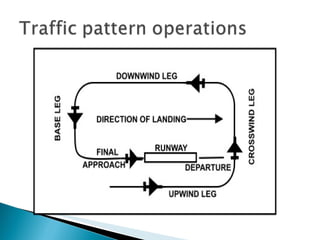
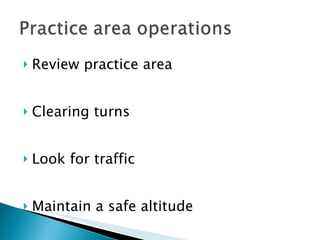
Runway Incursions Useof Aircraft Lighting during Taxi and Traffic Pattern Operations Collision avoidance Scanning for Traffic Traffic Pattern Operations Practice Area Operations
34.
Never taxi ontoany runway without first looking for landing traffic. Always monitor the CTAF and/or the appropriate ATC frequencies while operating on the surface of an airport.
35.
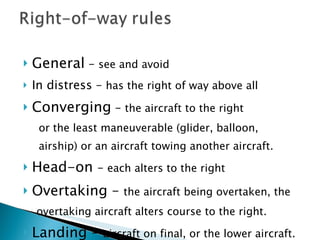
General – see and avoid In distress – has the right of way above all Converging – the aircraft to the right or the least maneuverable (glider, balloon, airship) or an aircraft towing another aircraft. Head-on – each alters to the right Overtaking – the aircraft being overtaken, the overtaking aircraft alters course to the right. Landing – aircraft on final, or the lower aircraft.
36.
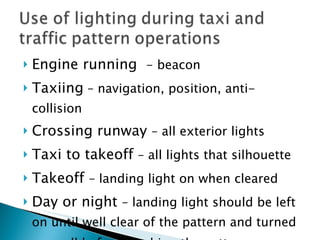
Engine running - beacon Taxiing – navigation, position, anti-collision Crossing runway – all exterior lights Taxi to takeoff – all lights that silhouette Takeoff – landing light on when cleared Day or night – landing light should be left on until well clear of the pattern and turned on well before reaching the pattern.
37.
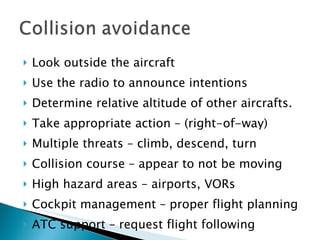
Look outside theaircraft Use the radio to announce intentions Determine relative altitude of other aircrafts. Take appropriate action – (right-of-way) Multiple threats – climb, descend, turn Collision course – appear to not be moving High hazard areas – airports, VORs Cockpit management – proper flight planning ATC support – request flight following
38.
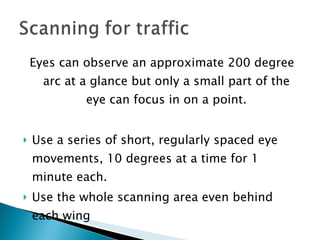
Eyes can observean approximate 200 degree arc at a glance but only a small part of the eye can focus in on a point. Use a series of short, regularly spaced eye movements, 10 degrees at a time for 1 minute each. Use the whole scanning area even behind each wing
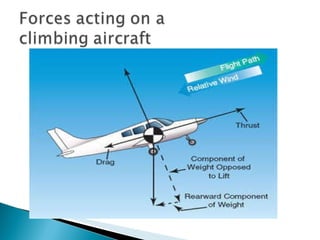
4 Forces ofFlight Angle of Attack Airframe (Components) Three Axes of Flight Forces Acting on a Climbing Aircraft Forces Acting on a Descending Aircraft Forces Acting on a Turning Aircraft Effects of Flaps Critical Angle of Attack/Stalls Spin Awareness
42.
43.
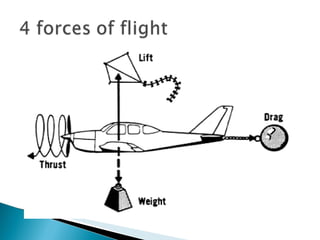
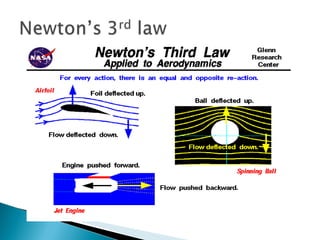
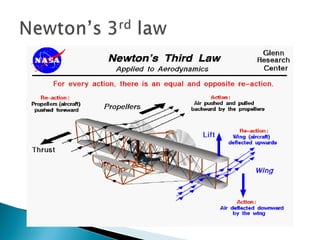
Supporting force forflight in an atmosphere Acts perpendicular to the relative wind Generated through Bernoulli’s Principle and Newton’s Law
44.
As a fluidpasses through a pipe that narrows or widens, the velocity and pressure of the fluid vary. As the pipe narrows, the fluid flows more quickly. Surprisingly, Bernoulli's Principle tells us that as the fluid flows more quickly through the narrow sections, the pressure actually decreases rather than increases! http://mitchellscience.com/bernoulli_principle_animation
45.
46.
47.
48.
49.
50.
Considered to actparallel and just about on the longitudinal axis Produced by movement of the air by propeller or the expansion of air in a turbine
51.
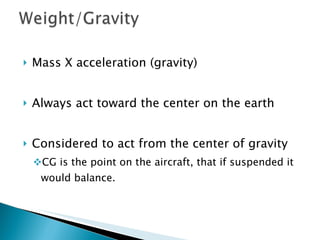
Mass X acceleration(gravity) Always act toward the center on the earth Considered to act from the center of gravity CG is the point on the aircraft, that if suspended it would balance.
52.
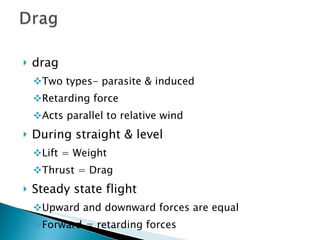
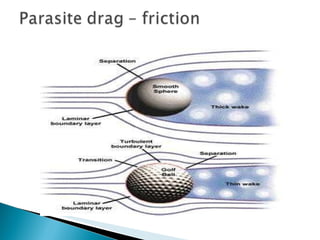
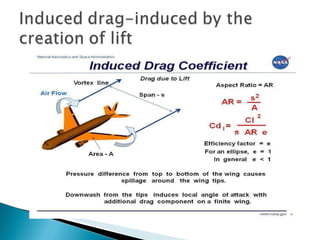
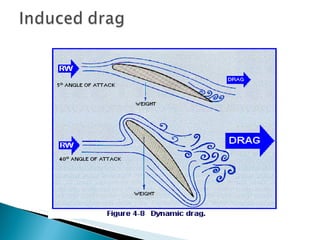
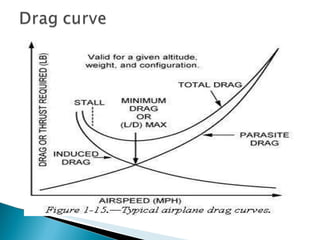
drag Two types-parasite & induced Retarding force Acts parallel to relative wind During straight & level Lift = Weight Thrust = Drag Steady state flight Upward and downward forces are equal Forward = retarding forces
53.
54.
55.
56.
57.
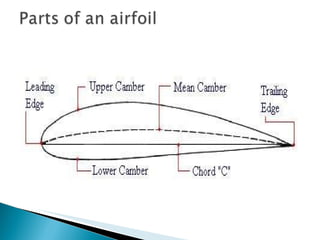
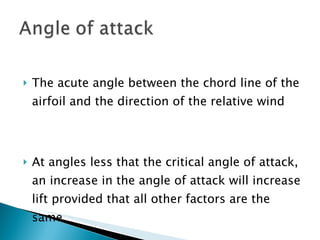
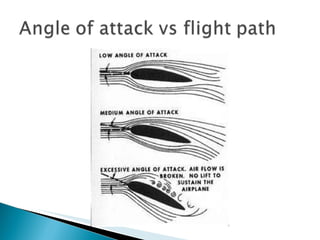
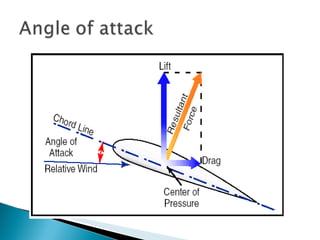
The acute anglebetween the chord line of the airfoil and the direction of the relative wind At angles less that the critical angle of attack, an increase in the angle of attack will increase lift provided that all other factors are the same
58.
59.
60.
61.
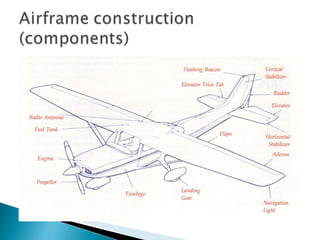
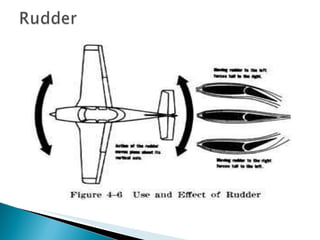
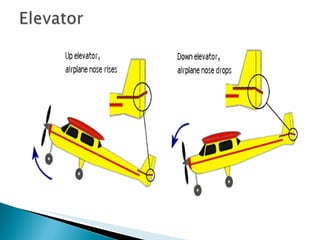
Fuselage Monocoque –skin carries all of the stress Truss – internal structure with non-load carrying skin Semi-monocoque – inside formers & stringers Wings Provides all the lift that supports aircraft in flight Empennage Vertical stabilizer – directional balance Rudder – direction of yaw Horizontal stabilizer – longitudinal balance Elevator – controls the pitch
62.
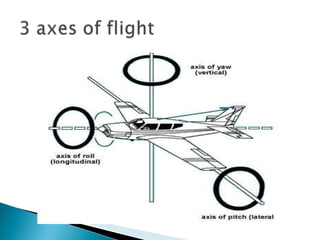
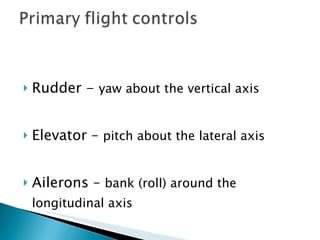
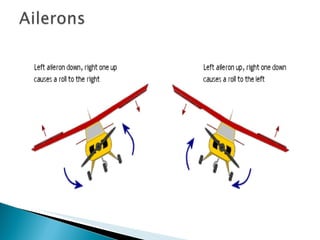
Rudder - yaw about the vertical axis Elevator – pitch about the lateral axis Ailerons – bank (roll) around the longitudinal axis
63.
64.
65.
66.
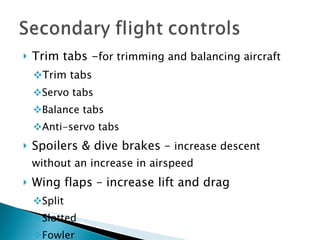
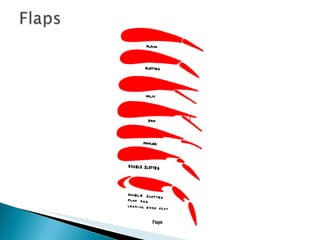
Trim tabs -for trimming and balancing aircraft Trim tabs Servo tabs Balance tabs Anti-servo tabs Spoilers & dive brakes – increase descent without an increase in airspeed Wing flaps – increase lift and drag Split Slotted Fowler
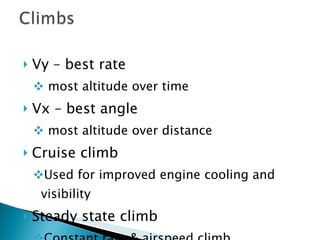
Vy – bestrate most altitude over time Vx – best angle most altitude over distance Cruise climb Used for improved engine cooling and visibility Steady state climb Constant rate & airspeed climb
71.
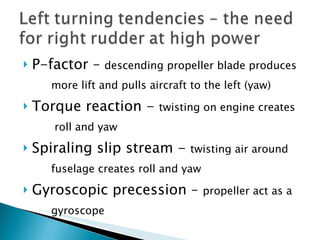
P-factor – descending propeller blade produces more lift and pulls aircraft to the left (yaw) Torque reaction - twisting on engine creates roll and yaw Spiraling slip stream - twisting air around fuselage creates roll and yaw Gyroscopic precession – propeller act as a gyroscope
72.
73.
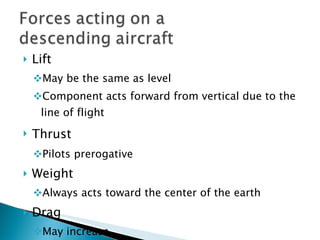
Lift May bethe same as level Component acts forward from vertical due to the line of flight Thrust Pilots prerogative Weight Always acts toward the center of the earth Drag May increase Best glide - Most distance per unit of altitude
74.
75.
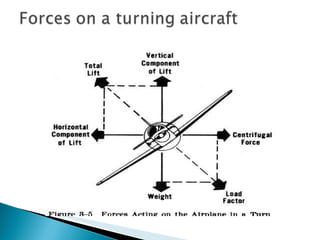
Bank the aircraftin order to change the direction of flight Rudder yaws but does not create the unbalance of forces needed to change direction Slip – tail inside Skid – tail outside Adverse yaw Raised wing creates more lift and more drag. Aircraft tries to turn opposite the turn. creates added drag
76.
77.
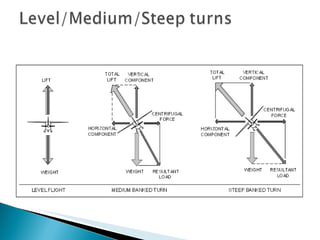
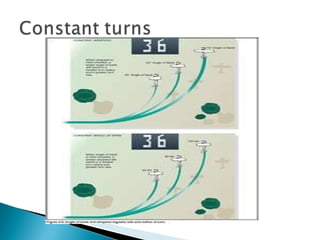
Horizontal turns Liftvector is tilted Creates an acceleration Shallow - 0 to 20 degrees of bank Medium – 20 to 45 degree of bank Steep – more than 45 degree of bank Apply coordinated aileron and rudder initially for the turn, then increase back pressure, once the turn is established pressure on controls can be relaxed
78.
79.
80.
The raised wingcreates more lift than the lowered wind. Especially in steeper turns the lift on the raised wing will continue to increase and will need aileron applied opposite the turn in order to correct.
81.
Extending the flapsincreases: Wing camber Wing area (some types) Angle of attack of the wing These changes increase lift and drag (induced and parasite Allows the pilot to make a steeper approach without increasing airspeed May provide increased lift required for certain maneuvers
82.
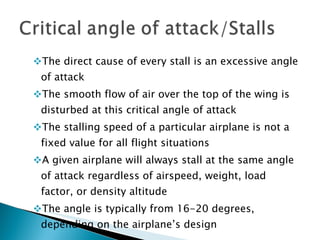
An airplane willfly as long as the wing is creating sufficient lift to counteract the load imposed on it The angle of attack at which a wing stalls regardless of airspeed, flight attitude, or weight is known as the critical angle of attack
83.
The direct causeof every stall is an excessive angle of attack The smooth flow of air over the top of the wing is disturbed at this critical angle of attack The stalling speed of a particular airplane is not a fixed value for all flight situations A given airplane will always stall at the same angle of attack regardless of airspeed, weight, load factor, or density altitude The angle is typically from 16-20 degrees, depending on the airplane’s design
84.
85.
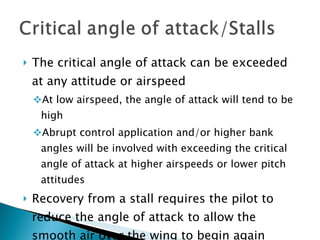
The critical angleof attack can be exceeded at any attitude or airspeed At low airspeed, the angle of attack will tend to be high Abrupt control application and/or higher bank angles will be involved with exceeding the critical angle of attack at higher airspeeds or lower pitch attitudes Recovery from a stall requires the pilot to reduce the angle of attack to allow the smooth air over the wing to begin again Considerable altitude may be lost during recovery
86.
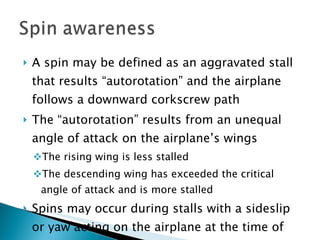
A spin maybe defined as an aggravated stall that results “autorotation” and the airplane follows a downward corkscrew path The “autorotation” results from an unequal angle of attack on the airplane’s wings The rising wing is less stalled The descending wing has exceeded the critical angle of attack and is more stalled Spins may occur during stalls with a sideslip or yaw acting on the airplane at the time of the stall
87.
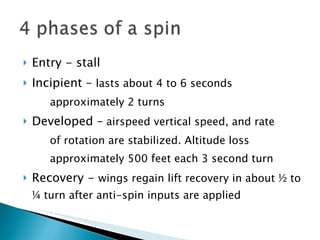
Entry - stallIncipient – lasts about 4 to 6 seconds approximately 2 turns Developed – airspeed vertical speed, and rate of rotation are stabilized. Altitude loss approximately 500 feet each 3 second turn Recovery - wings regain lift recovery in about ½ to ¼ turn after anti-spin inputs are applied
88.
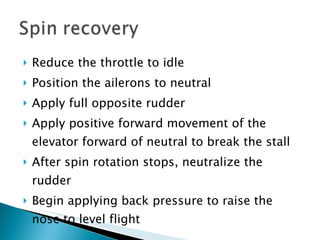
Reduce the throttleto idle Position the ailerons to neutral Apply full opposite rudder Apply positive forward movement of the elevator forward of neutral to break the stall After spin rotation stops, neutralize the rudder Begin applying back pressure to raise the nose to level flight
89.
Spin avoidance andrecovery require positive control applications Intentional spins should only be practiced within the limitations of a properly rigged airplane with a qualified instructor at an altitude allowing recovery prior to descent below 3000ft AGL
90.
Static Stability (Positive/Negative)Dynamic Stability (Positive/Negative) Dihedral Effect Ground Effect Wing Tip Vortices Wake Static Stability (Positive/Negative) Dynamic Stability (Positive/Negative) Dihedral Effect Ground Effect Wing Tip Vortices Wake Turbulence and Avoidance Load Factor and Gusts
91.
Stability -the inherent quality of an airplane to correct for conditions that may disturb it from equilibrium Controllability - the airplane’s capability to respond to a pilot’ control inputs Maneuverability - the ability of the aircraft to change direction about the three exes and withstand the forces imposed by the maneuver
92.
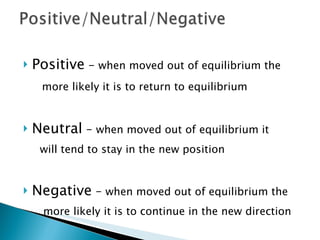
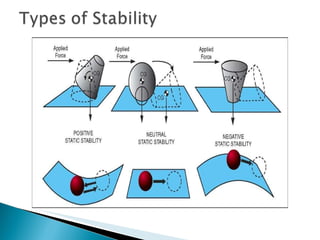
Positive – when moved out of equilibrium the more likely it is to return to equilibrium Neutral – when moved out of equilibrium it will tend to stay in the new position Negative – when moved out of equilibrium the more likely it is to continue in the new direction
93.
In inherently stableaircraft returns to it’s original position after being disturbed The location of the center of gravity (CG) determines the longitudinal stability Too much stability is detrimental to maneuverability Too little stability can be detrimental to controllability
94.
95.
Stability -the inherent quality of an airplane to correct for conditions that may disturb it from equilibrium Controllability - the airplane’s capability to respond to a pilot’ control inputs Maneuverability - the ability of the aircraft to change direction about the three exes and withstand the forces imposed by the maneuver
96.
The result overtime when reacting to a disturbance from equilibrium Dynamic stability requires positive static stability as the initial reaction An aircraft with positive dynamic stability will tend to return to equilibrium through smaller and smaller oscillations An aircraft with neutral dynamic stability will tend to continue oscillation with the same magnitude for each oscillation An aircraft with negative dynamic stability will continue oscillating with the magnitude of each oscillation increasing
97.
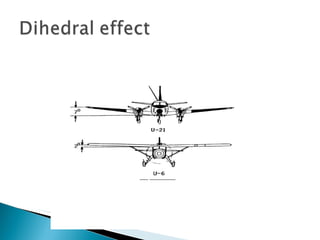
Dihedral is theangle at which the wings are slanted upward from the root to the tip Dihedral’s stabilizing effect is the result of a slight sideslip which occurs when one wing is forced down The sideslip creates a difference between the angle of attack on the upper and lower wings with the lower wing having a greater angle of attack (creating more lift) and raises the lowered wing
98.
99.
By over-controlling/correcting theaircraft the pilot disturbs the inherent stability creating oscillations that increase in magnitude until the aircraft become impossible to control
100.
The condition ofimproved performance encountered when the aircraft is near the ground (approximately a wing span) The ground changes the airflow around the wing and creates a cushion of air This reduces the upwash, downwash, and wingtip vortices Results in a reduction of induced drag