Chapter
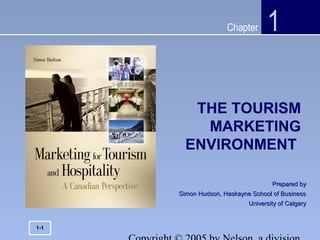
THE TOURISM
MARKETING
ENVIRONMENT
1
Prepared byPrepared by
Simon Hudson, Haskayne School of BusinessSimon Hudson, Haskayne School of Business
University of CalgaryUniversity of Calgary
1-1
Chapter
Topics
• Influence of marketing on tourism
• Services marketing models
• Tourism in Canada
• Key players in Canada’s tourism
industry
• Micro and macro-environments
1The Tourism Marketing Environment
1-2
Chapter 1
1-3
The Tourism Marketing Environment
Chapter
Four Unique Characteristics of
Services
1
1-4
The Tourism Marketing Environment
IntangibilityIntangibility
PerishabilityPerishabilityInseparabilityInseparability
HeterogeneityHeterogeneity
Chapter 1
1-5
The Tourism Marketing Environment
Chapter 1
1-6
The Tourism Marketing Environment
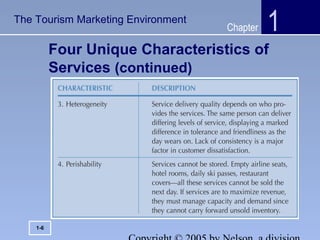
Four Unique Characteristics of
Services (continued)
Chapter
The Services Marketing Triangle
1
1-7
The Tourism Marketing Environment
Chapter
Expanded Mix for Services:
The Seven Ps
• Product
• Price
• Place
• Promotion
• People
• Process
• Physical Evidence
1
1-8
The Tourism Marketing Environment
Chapter
Tourism in Canada
• Canada is ranked as the 9th most popular
destination in the world with an international share
of 2.9%
• In 2002, Canada attracted 20 million international
overnight visitors who spent $17.8 million.
• Tourism GDP is $22.4 billion and nearly 600,000
people employed in tourism
• In 2002 Canadians made nearly 18 million overnight
trips outside Canada
1
1-9
The Tourism Marketing Environment
Chapter 1
1-10
The Tourism Marketing Environment
Chapter 1
1-11
The Tourism Marketing Environment
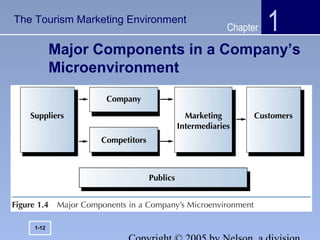
Chapter
Major Components in a Company’s
Microenvironment
1
1-12
The Tourism Marketing Environment
Chapter 1
1-13
The Tourism Marketing Environment
Major Components in a Company’s
Macroenvironment
Chapter
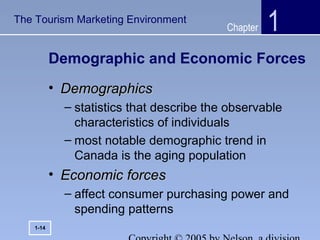
Demographic and Economic Forces
• DemographicsDemographics
– statistics that describe the observable
characteristics of individuals
– most notable demographic trend in
Canada is the aging population
• Economic forcesEconomic forces
– affect consumer purchasing power and
spending patterns
1
1-14
The Tourism Marketing Environment
Chapter
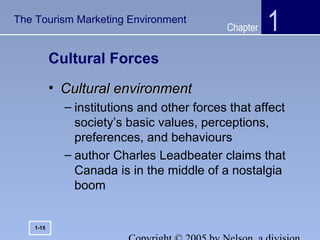
Cultural Forces
• Cultural environmentCultural environment
– institutions and other forces that affect
society’s basic values, perceptions,
preferences, and behaviours
– author Charles Leadbeater claims that
Canada is in the middle of a nostalgia
boom
1
1-15
The Tourism Marketing Environment
Chapter
Cultural Trends
• increased responsibility for those who drink & those who sell
and serve alcoholic beverages
• desire to develop individuality in order to be seen and treated
as different from others (egonomics)
• tendency to act and feel younger than one’s age (down-aging)
• urge to change one’s life to a slower but more rewarding pace
(cashing out)
• refusal to tolerate shoddy products and poor service (the
vigilant consumer)
• acceptance of the gay and lesbian community
• concerns for the environment
• increasing desire for smoke-free restaurants and hotels
• desire to regularly eat out.
1
1-16
The Tourism Marketing Environment
Chapter
Divide Into Groups
• Read the Fairmont Hotels case study
at the end of the chapter.
• Apply the eight major forces of the
macroenvironment to the Canadian
hotel industry today.
• What are the major forces shaping the
future for Fairmont?
1
1-17
The Tourism Marketing Environment

Ch 01

  • 1.
    Chapter THE TOURISM MARKETING ENVIRONMENT 1 Prepared byPreparedby Simon Hudson, Haskayne School of BusinessSimon Hudson, Haskayne School of Business University of CalgaryUniversity of Calgary 1-1
  • 2.
    Chapter Topics • Influence ofmarketing on tourism • Services marketing models • Tourism in Canada • Key players in Canada’s tourism industry • Micro and macro-environments 1The Tourism Marketing Environment 1-2
  • 3.
    Chapter 1 1-3 The TourismMarketing Environment
  • 4.
    Chapter Four Unique Characteristicsof Services 1 1-4 The Tourism Marketing Environment IntangibilityIntangibility PerishabilityPerishabilityInseparabilityInseparability HeterogeneityHeterogeneity
  • 5.
    Chapter 1 1-5 The TourismMarketing Environment
  • 6.
    Chapter 1 1-6 The TourismMarketing Environment Four Unique Characteristics of Services (continued)
  • 7.
    Chapter The Services MarketingTriangle 1 1-7 The Tourism Marketing Environment
  • 8.
    Chapter Expanded Mix forServices: The Seven Ps • Product • Price • Place • Promotion • People • Process • Physical Evidence 1 1-8 The Tourism Marketing Environment
  • 9.
    Chapter Tourism in Canada •Canada is ranked as the 9th most popular destination in the world with an international share of 2.9% • In 2002, Canada attracted 20 million international overnight visitors who spent $17.8 million. • Tourism GDP is $22.4 billion and nearly 600,000 people employed in tourism • In 2002 Canadians made nearly 18 million overnight trips outside Canada 1 1-9 The Tourism Marketing Environment
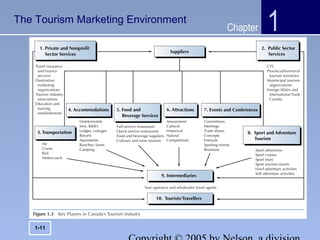
  • 10.
    Chapter 1 1-10 The TourismMarketing Environment
  • 11.
    Chapter 1 1-11 The TourismMarketing Environment
  • 12.
    Chapter Major Components ina Company’s Microenvironment 1 1-12 The Tourism Marketing Environment
  • 13.
    Chapter 1 1-13 The TourismMarketing Environment Major Components in a Company’s Macroenvironment
  • 14.
    Chapter Demographic and EconomicForces • DemographicsDemographics – statistics that describe the observable characteristics of individuals – most notable demographic trend in Canada is the aging population • Economic forcesEconomic forces – affect consumer purchasing power and spending patterns 1 1-14 The Tourism Marketing Environment
  • 15.
    Chapter Cultural Forces • CulturalenvironmentCultural environment – institutions and other forces that affect society’s basic values, perceptions, preferences, and behaviours – author Charles Leadbeater claims that Canada is in the middle of a nostalgia boom 1 1-15 The Tourism Marketing Environment
  • 16.
    Chapter Cultural Trends • increasedresponsibility for those who drink & those who sell and serve alcoholic beverages • desire to develop individuality in order to be seen and treated as different from others (egonomics) • tendency to act and feel younger than one’s age (down-aging) • urge to change one’s life to a slower but more rewarding pace (cashing out) • refusal to tolerate shoddy products and poor service (the vigilant consumer) • acceptance of the gay and lesbian community • concerns for the environment • increasing desire for smoke-free restaurants and hotels • desire to regularly eat out. 1 1-16 The Tourism Marketing Environment
  • 17.
    Chapter Divide Into Groups •Read the Fairmont Hotels case study at the end of the chapter. • Apply the eight major forces of the macroenvironment to the Canadian hotel industry today. • What are the major forces shaping the future for Fairmont? 1 1-17 The Tourism Marketing Environment