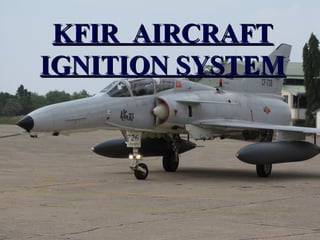
KFIR AIRCRAFTKFIR AIRCRAFT
IGNITION SYSTEMIGNITION SYSTEM
OBJECTIVE
At the end of this Lesson to make you all
aware,
a. Purpose and principle of
ignition system.
b. Construction and operation of
ignition system of kfir aircraft.
3
LESSON COVERAGELESSON COVERAGE
Introduction.
System components.
No 1 ignition unit
No 2 ignition unit
A/B ignition switch
A/B igniter plug
Speed and time delay relay
Operation
Conclusion.
Question. 33
INTRODUCTIONINTRODUCTION
The ignition system comprise three separate
circuits and 2 ignition units, one of which is a dual
purpose unit. All three circuits are independent in
operation except that the No 1 and No 2 main circuits
operate together with the actuation of a single switch.
The A/B circuit is mounted within the No 1 ignition unit
and is operated by a fuel pressure signal.
Cont…
The system incorporates two identical igniter
units and 2 igniters installed in combustion chamber.
The igniter units convert 28 V DC power from DC 1-
1 bus into high voltage pulses. Igniter unit No 1 also
supplies ignition pulses to the A/B ignition torch
through AC -2 bus
55
Cont…
IGNITION SYSTEM COMPONENTIGNITION SYSTEM COMPONENT
 No 1 ignition unit (Dual purpose)
 No 2 ignition unit
Main igniter plugs
Afterburner ignition switch
Afterburner igniter plug
Speed and time delay relay
66
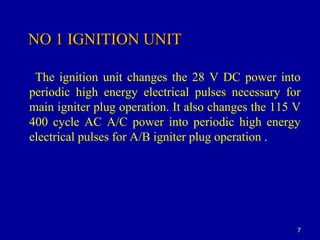
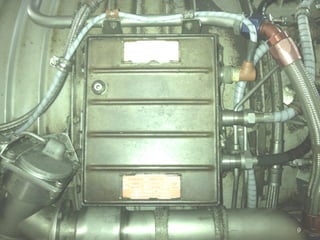
NO 1 IGNITION UNITNO 1 IGNITION UNIT
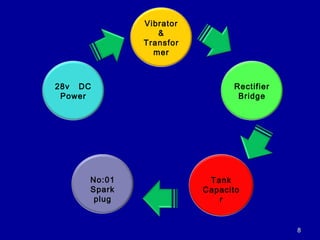
The ignition unit changes the 28 V DC power into
periodic high energy electrical pulses necessary for
main igniter plug operation. It also changes the 115 V
400 cycle AC A/C power into periodic high energy
electrical pulses for A/B igniter plug operation .
77
88
28v DC
Power
Vibrator
&
Transfor
mer
Rectifier
Bridge
Tank
Capacito
r
No:01
Spark
plug
99
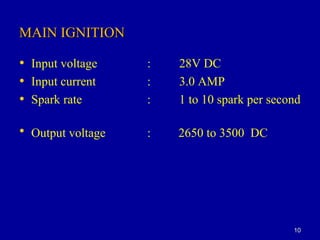
MAIN IGNITIONMAIN IGNITION
• Input voltage : 28V DC
• Input current : 3.0 AMP
• Spark rate : 1 to 10 spark per second
• Output voltage : 2650 to 3500 DC
1010
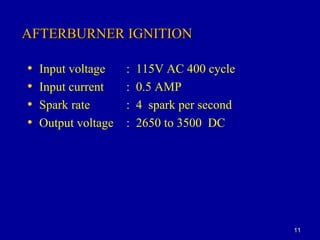
• Input voltage : 115V AC 400 cycle
• Input current : 0.5 AMP
• Spark rate : 4 spark per second
• Output voltage : 2650 to 3500 DC
AFTERBURNER IGNITIONAFTERBURNER IGNITION
1111
NO: 2 IGNITION UNITNO: 2 IGNITION UNIT
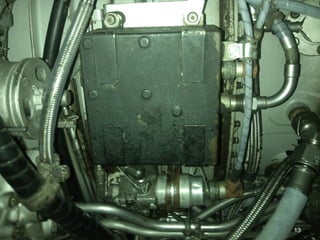
The ignition unit increases the 28 V DC aircraft
power into periodic high energy electrical pulses
necessary for ,main igniter plug operation. This unit
operates in conjunction with the main circuit of the
No 1 ignition unit.
1212
1313
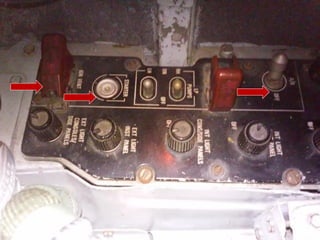
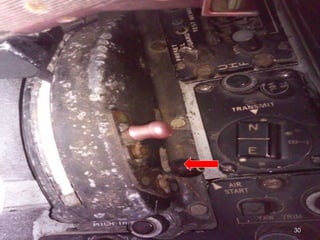
AFTER BURNER IGNITION SWITCHAFTER BURNER IGNITION SWITCH
The afterburner ignition switch permits the flowThe afterburner ignition switch permits the flow
of current from an aircraft power source to theof current from an aircraft power source to the
afterburner ignition circuit of the ignition unit duringafterburner ignition circuit of the ignition unit during
afterburner operation.afterburner operation.
1414
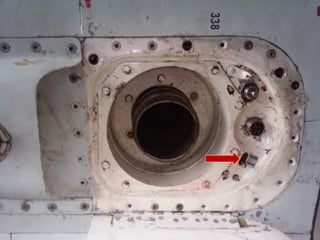
AFTERBURNER IGNITER PLUGAFTERBURNER IGNITER PLUG
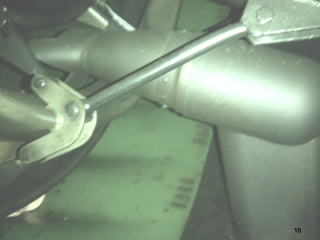
The afterburner igniter plug produces the sparkThe afterburner igniter plug produces the spark
that ignites the fuel air mixture inthat ignites the fuel air mixture in the torch igniterthe torch igniter
for afterburner operation.for afterburner operation.
1515
1616
1717
115V Ac
Power
Transfor
mer
Rectifier
Bridge
Tank
Capacito
r
AB
Spark
plug
1818
1919
2020
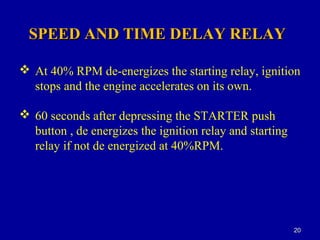
SPEED AND TIME DELAY RELAYSPEED AND TIME DELAY RELAY
 At 40% RPM de-energizes the starting relay, ignition
stops and the engine accelerates on its own.
 60 seconds after depressing the STARTER push
button , de energizes the ignition relay and starting
relay if not de energized at 40%RPM.
2121
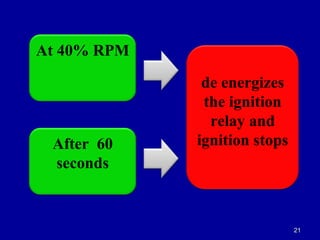
At 40% RPM
After 60
seconds
de energizes
the ignition
relay and
ignition stops
OPERATIONOPERATION
2222
2323
2424
2525
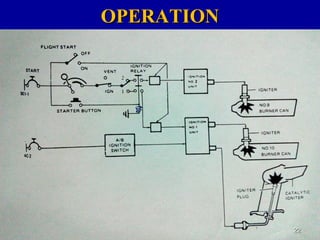
2626
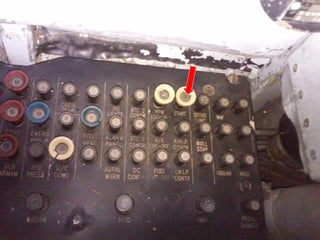
STARTING AND IGNITION SYSTEM
Once the fuel valve is open and LP pump are on
signal the ground crew to supply the air pressure for
start . when RPM is alive depress the STARTER push
button . at 10% RPM the pilot opens the throttle to idle ,
the ignition units starts to operate and fuel is supplied to
the engine . at 35% signal to the ground crew to stop air
pressure . the engine continues to accelerate and stabilizes
at 66%- 68% RPM.
OPERATION
NORMAL OPERATION
When the ignition switch is closed, 28 V DC current flows to both
main ignition units. here it is converted to AC, increased in
amplitude, and rectified to DC to charge the tank capacitor. The
tank capacitor discharges when voltage becomes high enough to
ionize the sealed gap. The discharge passes through the igniter
plug lead, a heavily insulated cable, to the igniter plug. A semi-
conducting material shunts the igniter plug electrodes. When the
voltage between the electrodes reaches approximately 1000 volt
current flows across the surface of semi-conductor and ionizes the
air gap between the electrodes, permitting the tank capacitor to
discharge completely. The periodic high-intensity sparks initiate
combustion .
2727
AFTERBERNER SYSTEMAFTERBERNER SYSTEM
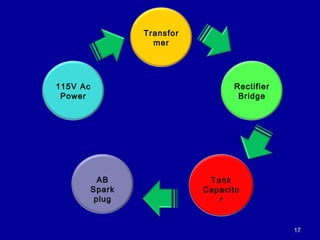
When the afterburner ignition switch contacts close, currentWhen the afterburner ignition switch contacts close, current
passes from the aircraft 115v ac power source to the afterburnerpasses from the aircraft 115v ac power source to the afterburner
ignition circuit of the no:01 ignition unit. The ignition circuitignition circuit of the no:01 ignition unit. The ignition circuit
increases the applied voltage in amplitude and rectifies it.Theincreases the applied voltage in amplitude and rectifies it.The
direct current charges a tank capacitor within the ignitiondirect current charges a tank capacitor within the ignition
subsystem. Normally a potential of 1000-1500 volts between thesubsystem. Normally a potential of 1000-1500 volts between the
igniter plug electrodes is sufficient to ionize the air gap. Theigniter plug electrodes is sufficient to ionize the air gap. The
discharge produces the spark that ignites the fuel-air mixturedischarge produces the spark that ignites the fuel-air mixture
within the torch igniter. The flame from the torch igniter thenwithin the torch igniter. The flame from the torch igniter then
ignites the fuel-air mixture within the tailpipe. The afterburnerignites the fuel-air mixture within the tailpipe. The afterburner
ignition system functions continuously during afterburnerignition system functions continuously during afterburner
operation.operation.
2828
AIR RE-IGNITIONAIR RE-IGNITION
When the engine failure occurs during flight,When the engine failure occurs during flight,
pilot desires to re-ignite the engine.when re-light switchpilot desires to re-ignite the engine.when re-light switch
put to forward position,both main igniter plugs areput to forward position,both main igniter plugs are
directly powered through the DC 1-1 bus and igniterdirectly powered through the DC 1-1 bus and igniter
plugs continuously operate until re-light switch onplugs continuously operate until re-light switch on
forward position.forward position.
2929
3030
CONCLUSIONCONCLUSION..
Introduction of ignition system.Introduction of ignition system.
Description of ignition system.Description of ignition system.
Ignition system component.Ignition system component.
Description of component.Description of component.
3131
REFERENCEREFERENCE
• Aircraft maintenance manualAircraft maintenance manual
3232
3434

Aircraft Ignaition System

  • 1.
  • 2.
    OBJECTIVE At the endof this Lesson to make you all aware, a. Purpose and principle of ignition system. b. Construction and operation of ignition system of kfir aircraft. 3
  • 3.
    LESSON COVERAGELESSON COVERAGE Introduction. Systemcomponents. No 1 ignition unit No 2 ignition unit A/B ignition switch A/B igniter plug Speed and time delay relay Operation Conclusion. Question. 33
  • 4.
    INTRODUCTIONINTRODUCTION The ignition systemcomprise three separate circuits and 2 ignition units, one of which is a dual purpose unit. All three circuits are independent in operation except that the No 1 and No 2 main circuits operate together with the actuation of a single switch. The A/B circuit is mounted within the No 1 ignition unit and is operated by a fuel pressure signal. Cont…
  • 5.
    The system incorporatestwo identical igniter units and 2 igniters installed in combustion chamber. The igniter units convert 28 V DC power from DC 1- 1 bus into high voltage pulses. Igniter unit No 1 also supplies ignition pulses to the A/B ignition torch through AC -2 bus 55 Cont…
  • 6.
    IGNITION SYSTEM COMPONENTIGNITIONSYSTEM COMPONENT  No 1 ignition unit (Dual purpose)  No 2 ignition unit Main igniter plugs Afterburner ignition switch Afterburner igniter plug Speed and time delay relay 66
  • 7.
    NO 1 IGNITIONUNITNO 1 IGNITION UNIT The ignition unit changes the 28 V DC power into periodic high energy electrical pulses necessary for main igniter plug operation. It also changes the 115 V 400 cycle AC A/C power into periodic high energy electrical pulses for A/B igniter plug operation . 77
  • 8.
  • 9.
  • 10.
    MAIN IGNITIONMAIN IGNITION •Input voltage : 28V DC • Input current : 3.0 AMP • Spark rate : 1 to 10 spark per second • Output voltage : 2650 to 3500 DC 1010
  • 11.
    • Input voltage: 115V AC 400 cycle • Input current : 0.5 AMP • Spark rate : 4 spark per second • Output voltage : 2650 to 3500 DC AFTERBURNER IGNITIONAFTERBURNER IGNITION 1111
  • 12.
    NO: 2 IGNITIONUNITNO: 2 IGNITION UNIT The ignition unit increases the 28 V DC aircraft power into periodic high energy electrical pulses necessary for ,main igniter plug operation. This unit operates in conjunction with the main circuit of the No 1 ignition unit. 1212
  • 13.
  • 14.
    AFTER BURNER IGNITIONSWITCHAFTER BURNER IGNITION SWITCH The afterburner ignition switch permits the flowThe afterburner ignition switch permits the flow of current from an aircraft power source to theof current from an aircraft power source to the afterburner ignition circuit of the ignition unit duringafterburner ignition circuit of the ignition unit during afterburner operation.afterburner operation. 1414
  • 15.
    AFTERBURNER IGNITER PLUGAFTERBURNERIGNITER PLUG The afterburner igniter plug produces the sparkThe afterburner igniter plug produces the spark that ignites the fuel air mixture inthat ignites the fuel air mixture in the torch igniterthe torch igniter for afterburner operation.for afterburner operation. 1515
  • 16.
  • 17.
  • 18.
  • 19.
  • 20.
    2020 SPEED AND TIMEDELAY RELAYSPEED AND TIME DELAY RELAY  At 40% RPM de-energizes the starting relay, ignition stops and the engine accelerates on its own.  60 seconds after depressing the STARTER push button , de energizes the ignition relay and starting relay if not de energized at 40%RPM.
  • 21.
    2121 At 40% RPM After60 seconds de energizes the ignition relay and ignition stops
  • 22.
  • 23.
  • 24.
  • 25.
  • 26.
    2626 STARTING AND IGNITIONSYSTEM Once the fuel valve is open and LP pump are on signal the ground crew to supply the air pressure for start . when RPM is alive depress the STARTER push button . at 10% RPM the pilot opens the throttle to idle , the ignition units starts to operate and fuel is supplied to the engine . at 35% signal to the ground crew to stop air pressure . the engine continues to accelerate and stabilizes at 66%- 68% RPM.
  • 27.
    OPERATION NORMAL OPERATION When theignition switch is closed, 28 V DC current flows to both main ignition units. here it is converted to AC, increased in amplitude, and rectified to DC to charge the tank capacitor. The tank capacitor discharges when voltage becomes high enough to ionize the sealed gap. The discharge passes through the igniter plug lead, a heavily insulated cable, to the igniter plug. A semi- conducting material shunts the igniter plug electrodes. When the voltage between the electrodes reaches approximately 1000 volt current flows across the surface of semi-conductor and ionizes the air gap between the electrodes, permitting the tank capacitor to discharge completely. The periodic high-intensity sparks initiate combustion . 2727
  • 28.
    AFTERBERNER SYSTEMAFTERBERNER SYSTEM Whenthe afterburner ignition switch contacts close, currentWhen the afterburner ignition switch contacts close, current passes from the aircraft 115v ac power source to the afterburnerpasses from the aircraft 115v ac power source to the afterburner ignition circuit of the no:01 ignition unit. The ignition circuitignition circuit of the no:01 ignition unit. The ignition circuit increases the applied voltage in amplitude and rectifies it.Theincreases the applied voltage in amplitude and rectifies it.The direct current charges a tank capacitor within the ignitiondirect current charges a tank capacitor within the ignition subsystem. Normally a potential of 1000-1500 volts between thesubsystem. Normally a potential of 1000-1500 volts between the igniter plug electrodes is sufficient to ionize the air gap. Theigniter plug electrodes is sufficient to ionize the air gap. The discharge produces the spark that ignites the fuel-air mixturedischarge produces the spark that ignites the fuel-air mixture within the torch igniter. The flame from the torch igniter thenwithin the torch igniter. The flame from the torch igniter then ignites the fuel-air mixture within the tailpipe. The afterburnerignites the fuel-air mixture within the tailpipe. The afterburner ignition system functions continuously during afterburnerignition system functions continuously during afterburner operation.operation. 2828
  • 29.
    AIR RE-IGNITIONAIR RE-IGNITION Whenthe engine failure occurs during flight,When the engine failure occurs during flight, pilot desires to re-ignite the engine.when re-light switchpilot desires to re-ignite the engine.when re-light switch put to forward position,both main igniter plugs areput to forward position,both main igniter plugs are directly powered through the DC 1-1 bus and igniterdirectly powered through the DC 1-1 bus and igniter plugs continuously operate until re-light switch onplugs continuously operate until re-light switch on forward position.forward position. 2929
  • 30.
  • 31.
    CONCLUSIONCONCLUSION.. Introduction of ignitionsystem.Introduction of ignition system. Description of ignition system.Description of ignition system. Ignition system component.Ignition system component. Description of component.Description of component. 3131
  • 32.
    REFERENCEREFERENCE • Aircraft maintenancemanualAircraft maintenance manual 3232
  • 34.