ARAVIND KUMAR M S (622014102001)
SANTHOSH KUMAR B (622014102325)
DEEPAKKUMAR N (622014102701)
Presented by
PAAVAI COLLEGE OF ENGINEERING
Mr.M.KATHIRESAN, M.E,
Assistant Professor
Automobile Engineering
Paavai College of Engineering
Namakkal – 636018
Under guidance of
DEPARTMENT OF AUTOMOBILE ENGINEERING
BATCH NO :05
STUDY OF LASER IGNITION SYSTEM
ABSTRACT
The increasing disadvantages of spark plug ignition system due to some causes, it is becoming
essential to find an alternative to the spark plug ignition system. spark plug ignition system is unable to
burn the fuel mixture completely inside the combustion chamber,where as the alternative to it .The laser
ignition system burns air fuel mixture completely and runs the engine for a longer time compared to
spark plug ignition system.It is help to achieving the best performance of vehicle. This project presents
the overall scenario of the working of laser ignition system which as the name suggests makes use of the
laser.In this paper, mostly considering performances of laser ignition and conventional spark ignition
systems are comparatively evaluated in terms of in-cylinder pressure variation, combustion stability, fuel
consumption, power output and exhaust emissions at similar operating conditions of the engine due to the
better outcome of this project yet to be aimed it.
Synopsis:
 Introduction
 Types of ignition
 Spark ignition
 Drawbacks of spark plug
 Remedies of problem
 Laser ignition
 Future Researches
 Advantages
 Comparison between SI & LI
 Conclusion
INDRODUCTION
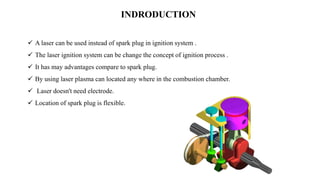
 A laser can be used instead of spark plug in ignition system .
 The laser ignition system can be change the concept of ignition process .
 It has may advantages compare to spark plug.
 By using laser plasma can located any where in the combustion chamber.
 Laser doesn't need electrode.
 Location of spark plug is flexible.
IGNITION SYSTEM
There are two type of ignitions are classified likes,
 Compression ignition
 Induced ignition
Definition
 It ‘s the power produce system.( 2 ms)
 To create a sparks/initial Energy.
 The air fuel mixtures are burn by a spark.
Types of Ignition
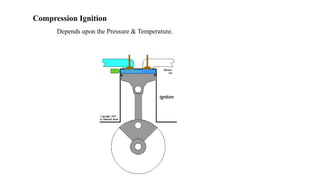
Compression Ignition
Depends upon the Pressure & Temperature.
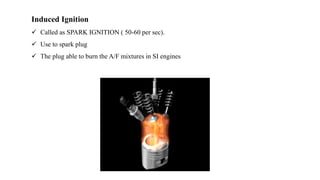
Induced Ignition
 Called as SPARK IGNITION ( 50-60 per sec).
 Use to spark plug
 The plug able to burn the A/F mixtures in SI engines
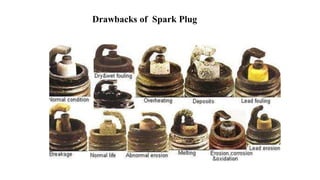
Drawbacks of Spark Plug
Remedies of Problems
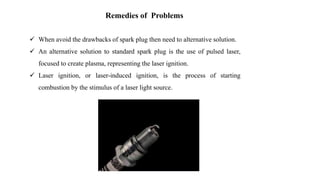
 When avoid the drawbacks of spark plug then need to alternative solution.
 An alternative solution to standard spark plug is the use of pulsed laser,
focused to create plasma, representing the laser ignition.
 Laser ignition, or laser-induced ignition, is the process of starting
combustion by the stimulus of a laser light source.
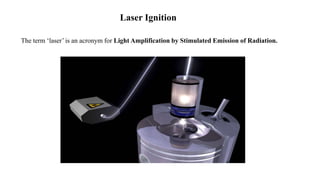
Laser Ignition
The term ‘laser’ is an acronym for Light Amplification by Stimulated Emission of Radiation.
Types of Laser
 Gas Laser
He-ne gas,co2 gas ,co gas & Ar-ion gases
 Chemical Laser
a) Hydrogen fluoride laser
b) Deuterium fluoride laser
 Excimer Laser
Semi conductor
 Solid State Laser
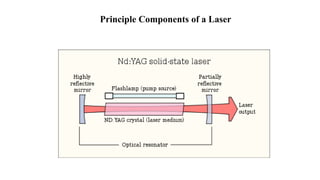
Nd:Yag laser
Types of Laser Ignition
 Thermal initiation
• No electrical breakdown
• Kinetic energy-rotational or vibrational forms
 Non-Resonant breakdown
Invisible or UV range-multi photon energy
 Resonant breakdown
• less input electron
• Direct ionization of atoms
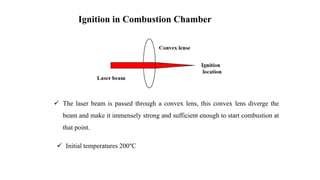
Ignition in Combustion Chamber
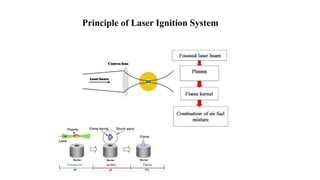
 The laser beam is passed through a convex lens, this convex lens diverge the
beam and make it immensely strong and sufficient enough to start combustion at
that point.
 Initial temperatures 200°C
Principle Components of a Laser
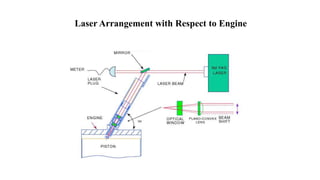
Laser Arrangement with Respect to Engine
 Power source -12 v battery.
 Optical window
a) Withstand the thermal and mechanical stresses from the engine.
b) Withstand the high laser power.
 Optic fiber wire
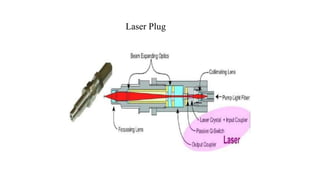
It is used to transport the laser beam from generating unit to the focusing unit.
Laser Arrangement with Respect to Engine
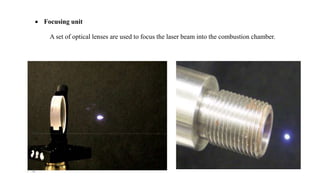
 Focusing unit
A set of optical lenses are used to focus the laser beam into the combustion chamber.
Principle of Laser Ignition System
Laser Plug
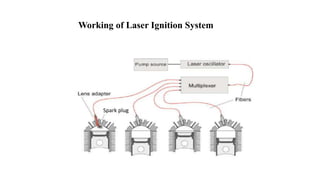
Spark plug
Working of Laser Ignition System
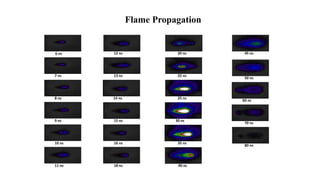
6 ns
7 ns
8 ns
9 ns
10 ns
11 ns
12 ns
13 ns
14 ns
15 ns
16 ns
18 ns
20 ns
22 ns
25 ns
30 ns
35 ns
40 ns
45 ns
50 ns
60 ns
70 ns
80 ns
Flame Propagation
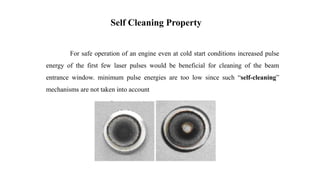
For safe operation of an engine even at cold start conditions increased pulse
energy of the first few laser pulses would be beneficial for cleaning of the beam
entrance window. minimum pulse energies are too low since such “self-cleaning”
mechanisms are not taken into account
Self Cleaning Property
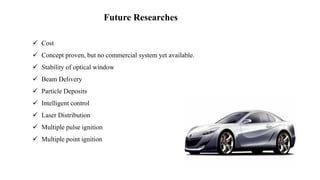
 Cost
 Concept proven, but no commercial system yet available.
 Stability of optical window
 Beam Delivery
 Particle Deposits
 Intelligent control
 Laser Distribution
 Multiple pulse ignition
 Multiple point ignition
Future Researches
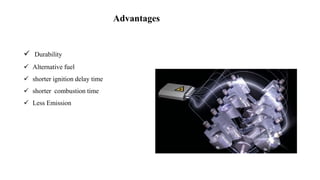
 Durability
 Alternative fuel
 shorter ignition delay time
 shorter combustion time
 Less Emission
Advantages
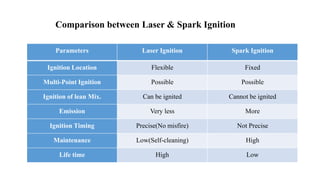
Comparison between Laser & Spark Ignition
Parameters Laser Ignition Spark Ignition
Ignition Location Flexible Fixed
Multi-Point Ignition Possible Possible
Ignition of lean Mix. Can be ignited Cannot be ignited
Emission Very less More
Ignition Timing Precise(No misfire) Not Precise
Maintenance Low(Self-cleaning) High
Life time High Low
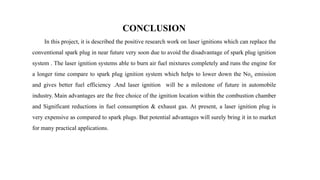
CONCLUSION
In this project, it is described the positive research work on laser ignitions which can replace the
conventional spark plug in near future very soon due to avoid the disadvantage of spark plug ignition
system . The laser ignition systems able to burn air fuel mixtures completely and runs the engine for
a longer time compare to spark plug ignition system which helps to lower down the Nox emission
and gives better fuel efficiency .And laser ignition will be a milestone of future in automobile
industry. Main advantages are the free choice of the ignition location within the combustion chamber
and Significant reductions in fuel consumption & exhaust gas. At present, a laser ignition plug is
very expensive as compared to spark plugs. But potential advantages will surely bring it in to market
for many practical applications.
REFERENCE
1) Takuma Endo & Keisuke Kuwamoto by “Comparative study of laser ignition and spark-plug
ignition in high-speed flows” Hiroshima 739-8527, Japan.
2) J. Griffiths, M.J.W. Rileyb & Borman , by “Effect of flow velocity and temperature on ignition
characteristics in laser ignition of natural gas and air mixtures” Brayford Pool, Lincoln, LN6 7TS,
United Kingdom .
3) J D Mullett , G Triantos, and S Keen by “The influence of beam energy, mode and focal length on the
control of laser ignition in an internal combustion engine” GSI Group, UK.
4) Cangsu Xu n, Donghua Fang& Jian Ma, by “A comparative study of laser ignition and spark ignition
with gasoline–air mixtures”, Zhejiang University, Hangzhou 310027.
5) Lydia Wermer a , James Hanssonb & Seong-kyun Im a ,by” Dual-pulse laser-induced spark ignition
and flame propagation of a methane diffusion jet flame” Department of Mechanical Engineering,
USA.
Thank you !

Study of Laser Ignition System(LIS).ppt

  • 1.
    ARAVIND KUMAR MS (622014102001) SANTHOSH KUMAR B (622014102325) DEEPAKKUMAR N (622014102701) Presented by PAAVAI COLLEGE OF ENGINEERING Mr.M.KATHIRESAN, M.E, Assistant Professor Automobile Engineering Paavai College of Engineering Namakkal – 636018 Under guidance of DEPARTMENT OF AUTOMOBILE ENGINEERING BATCH NO :05 STUDY OF LASER IGNITION SYSTEM
  • 2.
    ABSTRACT The increasing disadvantagesof spark plug ignition system due to some causes, it is becoming essential to find an alternative to the spark plug ignition system. spark plug ignition system is unable to burn the fuel mixture completely inside the combustion chamber,where as the alternative to it .The laser ignition system burns air fuel mixture completely and runs the engine for a longer time compared to spark plug ignition system.It is help to achieving the best performance of vehicle. This project presents the overall scenario of the working of laser ignition system which as the name suggests makes use of the laser.In this paper, mostly considering performances of laser ignition and conventional spark ignition systems are comparatively evaluated in terms of in-cylinder pressure variation, combustion stability, fuel consumption, power output and exhaust emissions at similar operating conditions of the engine due to the better outcome of this project yet to be aimed it.
  • 3.
    Synopsis:  Introduction  Typesof ignition  Spark ignition  Drawbacks of spark plug  Remedies of problem  Laser ignition  Future Researches  Advantages  Comparison between SI & LI  Conclusion
  • 4.
    INDRODUCTION  A lasercan be used instead of spark plug in ignition system .  The laser ignition system can be change the concept of ignition process .  It has may advantages compare to spark plug.  By using laser plasma can located any where in the combustion chamber.  Laser doesn't need electrode.  Location of spark plug is flexible.
  • 5.
    IGNITION SYSTEM There aretwo type of ignitions are classified likes,  Compression ignition  Induced ignition Definition  It ‘s the power produce system.( 2 ms)  To create a sparks/initial Energy.  The air fuel mixtures are burn by a spark. Types of Ignition
  • 6.
    Compression Ignition Depends uponthe Pressure & Temperature.
  • 7.
    Induced Ignition  Calledas SPARK IGNITION ( 50-60 per sec).  Use to spark plug  The plug able to burn the A/F mixtures in SI engines
  • 8.
  • 9.
    Remedies of Problems When avoid the drawbacks of spark plug then need to alternative solution.  An alternative solution to standard spark plug is the use of pulsed laser, focused to create plasma, representing the laser ignition.  Laser ignition, or laser-induced ignition, is the process of starting combustion by the stimulus of a laser light source.
  • 10.
    Laser Ignition The term‘laser’ is an acronym for Light Amplification by Stimulated Emission of Radiation.
  • 11.
    Types of Laser Gas Laser He-ne gas,co2 gas ,co gas & Ar-ion gases  Chemical Laser a) Hydrogen fluoride laser b) Deuterium fluoride laser  Excimer Laser Semi conductor  Solid State Laser Nd:Yag laser
  • 12.
    Types of LaserIgnition  Thermal initiation • No electrical breakdown • Kinetic energy-rotational or vibrational forms  Non-Resonant breakdown Invisible or UV range-multi photon energy  Resonant breakdown • less input electron • Direct ionization of atoms
  • 13.
    Ignition in CombustionChamber  The laser beam is passed through a convex lens, this convex lens diverge the beam and make it immensely strong and sufficient enough to start combustion at that point.  Initial temperatures 200°C
  • 14.
  • 15.
    Laser Arrangement withRespect to Engine
  • 16.
     Power source-12 v battery.  Optical window a) Withstand the thermal and mechanical stresses from the engine. b) Withstand the high laser power.  Optic fiber wire It is used to transport the laser beam from generating unit to the focusing unit. Laser Arrangement with Respect to Engine
  • 17.
     Focusing unit Aset of optical lenses are used to focus the laser beam into the combustion chamber.
  • 18.
    Principle of LaserIgnition System
  • 19.
  • 20.
    Spark plug Working ofLaser Ignition System
  • 21.
    6 ns 7 ns 8ns 9 ns 10 ns 11 ns 12 ns 13 ns 14 ns 15 ns 16 ns 18 ns 20 ns 22 ns 25 ns 30 ns 35 ns 40 ns 45 ns 50 ns 60 ns 70 ns 80 ns Flame Propagation
  • 22.
    For safe operationof an engine even at cold start conditions increased pulse energy of the first few laser pulses would be beneficial for cleaning of the beam entrance window. minimum pulse energies are too low since such “self-cleaning” mechanisms are not taken into account Self Cleaning Property
  • 23.
     Cost  Conceptproven, but no commercial system yet available.  Stability of optical window  Beam Delivery  Particle Deposits  Intelligent control  Laser Distribution  Multiple pulse ignition  Multiple point ignition Future Researches
  • 24.
     Durability  Alternativefuel  shorter ignition delay time  shorter combustion time  Less Emission Advantages
  • 25.
    Comparison between Laser& Spark Ignition Parameters Laser Ignition Spark Ignition Ignition Location Flexible Fixed Multi-Point Ignition Possible Possible Ignition of lean Mix. Can be ignited Cannot be ignited Emission Very less More Ignition Timing Precise(No misfire) Not Precise Maintenance Low(Self-cleaning) High Life time High Low
  • 26.
    CONCLUSION In this project,it is described the positive research work on laser ignitions which can replace the conventional spark plug in near future very soon due to avoid the disadvantage of spark plug ignition system . The laser ignition systems able to burn air fuel mixtures completely and runs the engine for a longer time compare to spark plug ignition system which helps to lower down the Nox emission and gives better fuel efficiency .And laser ignition will be a milestone of future in automobile industry. Main advantages are the free choice of the ignition location within the combustion chamber and Significant reductions in fuel consumption & exhaust gas. At present, a laser ignition plug is very expensive as compared to spark plugs. But potential advantages will surely bring it in to market for many practical applications.
  • 27.
    REFERENCE 1) Takuma Endo& Keisuke Kuwamoto by “Comparative study of laser ignition and spark-plug ignition in high-speed flows” Hiroshima 739-8527, Japan. 2) J. Griffiths, M.J.W. Rileyb & Borman , by “Effect of flow velocity and temperature on ignition characteristics in laser ignition of natural gas and air mixtures” Brayford Pool, Lincoln, LN6 7TS, United Kingdom . 3) J D Mullett , G Triantos, and S Keen by “The influence of beam energy, mode and focal length on the control of laser ignition in an internal combustion engine” GSI Group, UK. 4) Cangsu Xu n, Donghua Fang& Jian Ma, by “A comparative study of laser ignition and spark ignition with gasoline–air mixtures”, Zhejiang University, Hangzhou 310027. 5) Lydia Wermer a , James Hanssonb & Seong-kyun Im a ,by” Dual-pulse laser-induced spark ignition and flame propagation of a methane diffusion jet flame” Department of Mechanical Engineering, USA.
  • 28.