Airport Planning
L28: Aircraft Characteristics
Dr. Rajat Rastogi, Associate Professor
Lecture Outline
• Aircraft characteristics
• Influence of aircraft characteristics
7/18/2016 11:45 AM
2
Aircraft Characteristics
• Engine Type and
Propulsion
• Size of aircraft
• Aircraft weight and
wheel configuration
• Minimum Turning
Radius
• Speed
• Minimum Circling
Radius
• Capacity
• Noise
• Vortices at tail ends
• Jet Blast
• Fuel Spillage
7/18/2016 11:45 AM
3
Engine Type and Propulsion
• Propulsion Type –
• Piston engine, Jet engine (Turbo jet, Turbo propulsion or
Ram jet) or Rocket engine
• Speeds: 500 km/hr, 800 km/hr, 1280 – 2400
km/hr, 4600 km/hr respectively
• Altitudes low, low to middle and high altitudes
• Ram jet is used in missiles and rocket engine is
used for outside atmospheric operations7/18/2016 11:45 AM
4
Engine Type and Propulsion
• Specific Fuel Consumption – Fuel required to
create thrust of 1 lb
• Factors influencing:
• Weight of aircraft
• Altitude
• Speed
• Engine’s Bypass Ratio ????
7/18/2016 11:45 AM
5
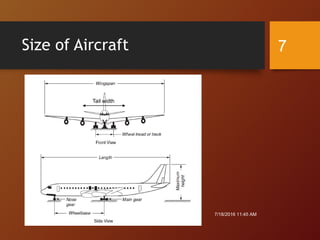
Size of Aircraft
• Basic parameters -
• Fuselage length (from nose to tail),
• Gear tread (distance between main gears),
• Height (at tail),
• Tail width,
• Wheel base (distance between nose gear
and main gear) and
• Wing span (near main gear)
7/18/2016 11:45 AM
6
Size of Aircraft
Tail width
7/18/2016 11:45 AM
7
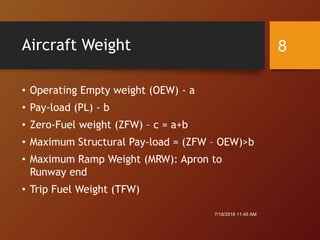
Aircraft Weight
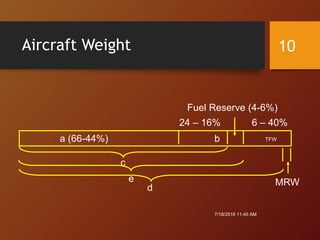
• Operating Empty weight (OEW) - a
• Pay-load (PL) - b
• Zero-Fuel weight (ZFW) – c = a+b
• Maximum Structural Pay-load = (ZFW – OEW)>b
• Maximum Ramp Weight (MRW): Apron to
Runway end
• Trip Fuel Weight (TFW)
7/18/2016 11:45 AM
8
Aircraft Weight
• Maximum Gross Take-off weight (MGTOW) - d
• Maximum Structural Take-off weight (MSTOW):
at sea level, Temp. 15oC, Standard Design
Wheel weight
• Maximum Structural landing weight (MSLW): e
Weight for which landing gear is designed
• Landing weight  MSLW
• Tae-off weight  MSTOW
7/18/2016 11:45 AM
9
Aircraft Weight
7/18/2016 11:45 AM
10
d
a (66-44%) b
24 – 16%
TFW
6 – 40%
Fuel Reserve (4-6%)
c
MRWe
Aircraft Wheel Configuration
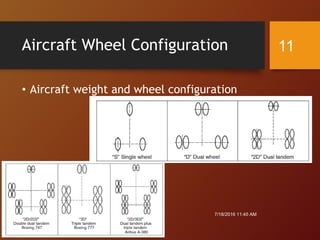
• Aircraft weight and wheel configuration
7/18/2016 11:45 AM
11
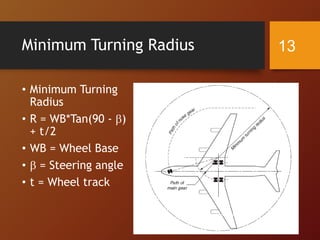
Minimum Turning Radius
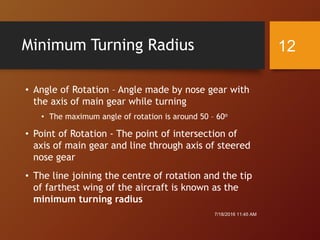
• Angle of Rotation – Angle made by nose gear with
the axis of main gear while turning
• The maximum angle of rotation is around 50 – 60o
• Point of Rotation - The point of intersection of
axis of main gear and line through axis of steered
nose gear
• The line joining the centre of rotation and the tip
of farthest wing of the aircraft is known as the
minimum turning radius
7/18/2016 11:45 AM
12
Minimum Turning Radius
• Minimum Turning
Radius
• R = WB*Tan(90 - )
+ t/2
• WB = Wheel Base
•  = Steering angle
• t = Wheel track
7/18/2016 11:45 AM
13
Minimum Circling Radius
• This is the radius in space required for the
aircraft to take a smooth turn. It depends
upon
• Type of aircraft
• Air traffic volume
• Weather condition
7/18/2016 11:45 AM
14
Speed of Aircraft
• Air Speed
• Speed of aircraft relative to the medium
(i.e. air), depending upon air density
• Indicated speed – indicated by the
instrument on board
• This is around 2 percent lower than the true
speed at each 330 m (1000ft) above sea level
7/18/2016 11:45 AM
15
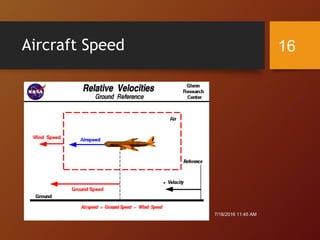
Aircraft Speed
7/18/2016 11:45 AM
16
Aircraft Speed
• Ground Speed
• Speed of aircraft relative to the ground
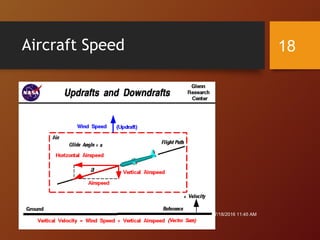
• Air speed = Ground speed (+/-) wind velocity
• Mach 1 ~ equivalent to speed of sound
• Speed of sound = 33.4 T0.5 miles per hr
• T = Temperature in degree Rankine
• 1 knot = 1 naum/h (1 nautm = 6080ft = 1.15
land mile)
7/18/2016 11:45 AM
17
Aircraft Speed
7/18/2016 11:45 AM
18
Aircraft Speed - Performance
7/18/2016 11:45 AM
19
• Do-Not Exceed speed (Vne)
• Design Maneuvering Speed (Va)
• Lift-off Speed (Vlo)
• Rotate Speed (Vr)
• Decision Speed (Vl)
• Stall Speed (Vso)
• Reference Landing Approach Speed (Vref)
• Vref = 1.3 * Vso
Aircraft Capacity
• Defined as the number of passengers and
amount of cargo it can handle
• Dependent up on
• Size and design of an aircraft
• Propulsive power of aircraft
• Speed of aircraft
7/18/2016 11:45 AM
20
Aircraft Noise
• This is a big problem in the areas where
airports are quite near to the developed areas.
• Major sources of noise are
• Engine
• Machinery (prominent during landing)
• Primary jet (prominent during take-off)
7/18/2016 11:45 AM
21
Aircraft Noise
• Disturbances are much more sever during
take-off than during landing
• Since the inception of the jet engines, the
noise has reduced due to technological
advancement
• Aircraft noise is less damaging than road
traffic noise ????
7/18/2016 11:45 AM
22
Vortices at Tail Ends
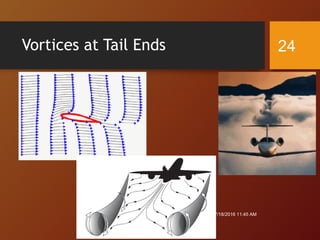
• Vortices are made up of two counter rotating
cylindrical masses extending along the flight
path
• These are formed near the tail ends of the
wings or tail end of the aircraft
• The velocity of wind in these vortices may be
very high
7/18/2016 11:45 AM
23
Vortices at Tail Ends
7/18/2016 11:45 AM
24
Aircraft Jet Blast
• This is the blast that comes out of the jet
engine at the rear of the aircraft to provide it
force for movement
• Its severity depends up on
• Height of the tail pipe from the round
• Angle of the tail pipe
• Blast fences need to be erected to control
damage
7/18/2016 11:45 AM
25
Fuel Spillage
• Spilling of fuel occurs when the engine is shut
down or is losing speed
7/18/2016 11:45 AM
26
Influencing Aircraft
Characteristics
• Engine Type and
Propulsion
• Size of aircraft
• Aircraft weight and
wheel configuration
• Minimum Turning
Radius
• Speed
• Minimum Circling
Radius
• Capacity
• Noise
• Vortices at tail ends
• Jet Blast
• Fuel Spillage
7/18/2016 11:45 AM
27
Engine Type and Propulsion
• Size of aircraft
• Speed of aircraft
• Length of runway
• Weight
• Carrying capacity
• Noise nuisance
• Circling radius
• Range
• Maintenance
facilities
• Blast pads, etc.
7/18/2016 11:45 AM
28
Size of an Aircraft
• Load carrying capacity
• Facilities like size of apron, terminal area, etc
• Wing span – taxiway width, separation
between traffic lanes, size of gate, apron size,
width of hanger gate
• Length – widening of taxiway on curves, size of
apron, hangers, aircraft capacity, width of exit
taxiway
7/18/2016 11:45 AM
29
Size of an Aircraft
7/18/2016 11:45 AM
30
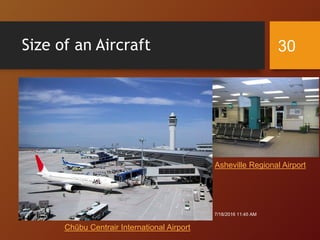
Chūbu Centrair International Airport
Asheville Regional Airport
Size of an Aircraft
7/18/2016 11:45 AM
31
Size of an Aircraft
• Height – height of hanger gate, etc.
• Tail width – size of parking and apron
• Wheel base – minimum radius of
taxiway
• Gear tread – minimum turning radius
7/18/2016 11:45 AM
32
Aircraft weight and wheel
configuration
• Thickness of runway, taxiway, apron
• Distribution of load through wheels
• 5% on nose gear and rest on landing gears
• Generation of revenue
• Turning
• Stability
7/18/2016 11:45 AM
33
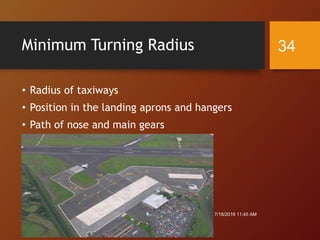
Minimum Turning Radius
• Radius of taxiways
• Position in the landing aprons and hangers
• Path of nose and main gears
7/18/2016 11:45 AM
34
Minimum Circling Radius
• Separation of two nearby airports
• Adjustment of timings of landing and take-off
aircrafts
• Airport capacity
• Zoning laws relating to height of an
obstruction (in turning zone area)
7/18/2016 11:45 AM
35
Aircraft Speed
• Reduced journey times
• Increase in frequency of operations
• Broadening of air network
7/18/2016 11:45 AM
36
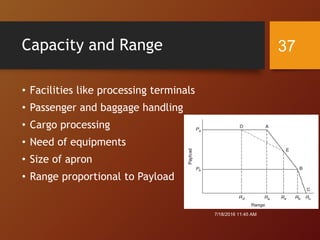
Capacity and Range
• Facilities like processing terminals
• Passenger and baggage handling
• Cargo processing
• Need of equipments
• Size of apron
• Range proportional to Payload
7/18/2016 11:45 AM
37
Noise
• Sleep disturbances, startle
• Annoyance
• Health risks, deafness, heart attack, etc
• Loss of Concentration, attentiveness
7/18/2016 11:45 AM
38
Vortices at Tail Ends
• Hazardous to the following aircraft due to tail
vortices and wing vortices
• Tangential velocities ~ weight of aircraft and
inversely proportional to speed
• More intense when near the airport
• Stresses at the joints with fuselage
• Pressure on or under the wings producing lifts
or drags
• Wake-turbulence classification of aircraft7/18/2016 11:45 AM
39
Jet Blast
• Inconvenience, discomfort or ever injury to
passengers
• Wake velocities and hot exhaust gas may harm
nearby aircraft (if directed towards it)
7/18/2016 11:45 AM
40
Fuel Spillage
• Seriously affects the bituminous pavement
• Slip of wheels
7/18/2016 11:45 AM
41
7/18/2016 11:45 AM
42
?????

aircraft characteristics

  • 1.
    Airport Planning L28: AircraftCharacteristics Dr. Rajat Rastogi, Associate Professor
  • 2.
    Lecture Outline • Aircraftcharacteristics • Influence of aircraft characteristics 7/18/2016 11:45 AM 2
  • 3.
    Aircraft Characteristics • EngineType and Propulsion • Size of aircraft • Aircraft weight and wheel configuration • Minimum Turning Radius • Speed • Minimum Circling Radius • Capacity • Noise • Vortices at tail ends • Jet Blast • Fuel Spillage 7/18/2016 11:45 AM 3
  • 4.
    Engine Type andPropulsion • Propulsion Type – • Piston engine, Jet engine (Turbo jet, Turbo propulsion or Ram jet) or Rocket engine • Speeds: 500 km/hr, 800 km/hr, 1280 – 2400 km/hr, 4600 km/hr respectively • Altitudes low, low to middle and high altitudes • Ram jet is used in missiles and rocket engine is used for outside atmospheric operations7/18/2016 11:45 AM 4
  • 5.
    Engine Type andPropulsion • Specific Fuel Consumption – Fuel required to create thrust of 1 lb • Factors influencing: • Weight of aircraft • Altitude • Speed • Engine’s Bypass Ratio ???? 7/18/2016 11:45 AM 5
  • 6.
    Size of Aircraft •Basic parameters - • Fuselage length (from nose to tail), • Gear tread (distance between main gears), • Height (at tail), • Tail width, • Wheel base (distance between nose gear and main gear) and • Wing span (near main gear) 7/18/2016 11:45 AM 6
  • 7.
    Size of Aircraft Tailwidth 7/18/2016 11:45 AM 7
  • 8.
    Aircraft Weight • OperatingEmpty weight (OEW) - a • Pay-load (PL) - b • Zero-Fuel weight (ZFW) – c = a+b • Maximum Structural Pay-load = (ZFW – OEW)>b • Maximum Ramp Weight (MRW): Apron to Runway end • Trip Fuel Weight (TFW) 7/18/2016 11:45 AM 8
  • 9.
    Aircraft Weight • MaximumGross Take-off weight (MGTOW) - d • Maximum Structural Take-off weight (MSTOW): at sea level, Temp. 15oC, Standard Design Wheel weight • Maximum Structural landing weight (MSLW): e Weight for which landing gear is designed • Landing weight  MSLW • Tae-off weight  MSTOW 7/18/2016 11:45 AM 9
  • 10.
    Aircraft Weight 7/18/2016 11:45AM 10 d a (66-44%) b 24 – 16% TFW 6 – 40% Fuel Reserve (4-6%) c MRWe
  • 11.
    Aircraft Wheel Configuration •Aircraft weight and wheel configuration 7/18/2016 11:45 AM 11
  • 12.
    Minimum Turning Radius •Angle of Rotation – Angle made by nose gear with the axis of main gear while turning • The maximum angle of rotation is around 50 – 60o • Point of Rotation - The point of intersection of axis of main gear and line through axis of steered nose gear • The line joining the centre of rotation and the tip of farthest wing of the aircraft is known as the minimum turning radius 7/18/2016 11:45 AM 12
  • 13.
    Minimum Turning Radius •Minimum Turning Radius • R = WB*Tan(90 - ) + t/2 • WB = Wheel Base •  = Steering angle • t = Wheel track 7/18/2016 11:45 AM 13
  • 14.
    Minimum Circling Radius •This is the radius in space required for the aircraft to take a smooth turn. It depends upon • Type of aircraft • Air traffic volume • Weather condition 7/18/2016 11:45 AM 14
  • 15.
    Speed of Aircraft •Air Speed • Speed of aircraft relative to the medium (i.e. air), depending upon air density • Indicated speed – indicated by the instrument on board • This is around 2 percent lower than the true speed at each 330 m (1000ft) above sea level 7/18/2016 11:45 AM 15
  • 16.
  • 17.
    Aircraft Speed • GroundSpeed • Speed of aircraft relative to the ground • Air speed = Ground speed (+/-) wind velocity • Mach 1 ~ equivalent to speed of sound • Speed of sound = 33.4 T0.5 miles per hr • T = Temperature in degree Rankine • 1 knot = 1 naum/h (1 nautm = 6080ft = 1.15 land mile) 7/18/2016 11:45 AM 17
  • 18.
  • 19.
    Aircraft Speed -Performance 7/18/2016 11:45 AM 19 • Do-Not Exceed speed (Vne) • Design Maneuvering Speed (Va) • Lift-off Speed (Vlo) • Rotate Speed (Vr) • Decision Speed (Vl) • Stall Speed (Vso) • Reference Landing Approach Speed (Vref) • Vref = 1.3 * Vso
  • 20.
    Aircraft Capacity • Definedas the number of passengers and amount of cargo it can handle • Dependent up on • Size and design of an aircraft • Propulsive power of aircraft • Speed of aircraft 7/18/2016 11:45 AM 20
  • 21.
    Aircraft Noise • Thisis a big problem in the areas where airports are quite near to the developed areas. • Major sources of noise are • Engine • Machinery (prominent during landing) • Primary jet (prominent during take-off) 7/18/2016 11:45 AM 21
  • 22.
    Aircraft Noise • Disturbancesare much more sever during take-off than during landing • Since the inception of the jet engines, the noise has reduced due to technological advancement • Aircraft noise is less damaging than road traffic noise ???? 7/18/2016 11:45 AM 22
  • 23.
    Vortices at TailEnds • Vortices are made up of two counter rotating cylindrical masses extending along the flight path • These are formed near the tail ends of the wings or tail end of the aircraft • The velocity of wind in these vortices may be very high 7/18/2016 11:45 AM 23
  • 24.
    Vortices at TailEnds 7/18/2016 11:45 AM 24
  • 25.
    Aircraft Jet Blast •This is the blast that comes out of the jet engine at the rear of the aircraft to provide it force for movement • Its severity depends up on • Height of the tail pipe from the round • Angle of the tail pipe • Blast fences need to be erected to control damage 7/18/2016 11:45 AM 25
  • 26.
    Fuel Spillage • Spillingof fuel occurs when the engine is shut down or is losing speed 7/18/2016 11:45 AM 26
  • 27.
    Influencing Aircraft Characteristics • EngineType and Propulsion • Size of aircraft • Aircraft weight and wheel configuration • Minimum Turning Radius • Speed • Minimum Circling Radius • Capacity • Noise • Vortices at tail ends • Jet Blast • Fuel Spillage 7/18/2016 11:45 AM 27
  • 28.
    Engine Type andPropulsion • Size of aircraft • Speed of aircraft • Length of runway • Weight • Carrying capacity • Noise nuisance • Circling radius • Range • Maintenance facilities • Blast pads, etc. 7/18/2016 11:45 AM 28
  • 29.
    Size of anAircraft • Load carrying capacity • Facilities like size of apron, terminal area, etc • Wing span – taxiway width, separation between traffic lanes, size of gate, apron size, width of hanger gate • Length – widening of taxiway on curves, size of apron, hangers, aircraft capacity, width of exit taxiway 7/18/2016 11:45 AM 29
  • 30.
    Size of anAircraft 7/18/2016 11:45 AM 30 Chūbu Centrair International Airport Asheville Regional Airport
  • 31.
    Size of anAircraft 7/18/2016 11:45 AM 31
  • 32.
    Size of anAircraft • Height – height of hanger gate, etc. • Tail width – size of parking and apron • Wheel base – minimum radius of taxiway • Gear tread – minimum turning radius 7/18/2016 11:45 AM 32
  • 33.
    Aircraft weight andwheel configuration • Thickness of runway, taxiway, apron • Distribution of load through wheels • 5% on nose gear and rest on landing gears • Generation of revenue • Turning • Stability 7/18/2016 11:45 AM 33
  • 34.
    Minimum Turning Radius •Radius of taxiways • Position in the landing aprons and hangers • Path of nose and main gears 7/18/2016 11:45 AM 34
  • 35.
    Minimum Circling Radius •Separation of two nearby airports • Adjustment of timings of landing and take-off aircrafts • Airport capacity • Zoning laws relating to height of an obstruction (in turning zone area) 7/18/2016 11:45 AM 35
  • 36.
    Aircraft Speed • Reducedjourney times • Increase in frequency of operations • Broadening of air network 7/18/2016 11:45 AM 36
  • 37.
    Capacity and Range •Facilities like processing terminals • Passenger and baggage handling • Cargo processing • Need of equipments • Size of apron • Range proportional to Payload 7/18/2016 11:45 AM 37
  • 38.
    Noise • Sleep disturbances,startle • Annoyance • Health risks, deafness, heart attack, etc • Loss of Concentration, attentiveness 7/18/2016 11:45 AM 38
  • 39.
    Vortices at TailEnds • Hazardous to the following aircraft due to tail vortices and wing vortices • Tangential velocities ~ weight of aircraft and inversely proportional to speed • More intense when near the airport • Stresses at the joints with fuselage • Pressure on or under the wings producing lifts or drags • Wake-turbulence classification of aircraft7/18/2016 11:45 AM 39
  • 40.
    Jet Blast • Inconvenience,discomfort or ever injury to passengers • Wake velocities and hot exhaust gas may harm nearby aircraft (if directed towards it) 7/18/2016 11:45 AM 40
  • 41.
    Fuel Spillage • Seriouslyaffects the bituminous pavement • Slip of wheels 7/18/2016 11:45 AM 41
  • 42.