College of Engineering
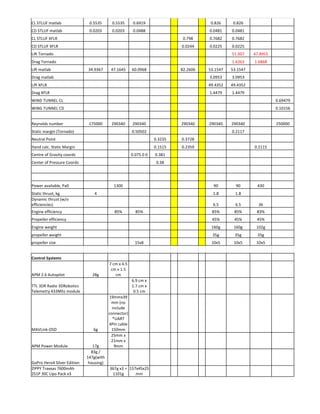
Coursework Submission Sheet
	
 Ā 
	
 Ā 
	
 Ā 
By submitting this coursework, I certify that this is all my own work.
	
 Ā 
	
 Ā 
Submission	
 Ā date	
 Ā 15/05/15	
 Ā 
	
 Ā 
	
 Ā  	
 Ā 
Student	
 Ā signature	
 Ā if	
 Ā this	
 Ā is	
 Ā a	
 Ā non-­‐electronic	
 Ā submission…………………………………………………	
 Ā 
	
 Ā 
	
 Ā 
	
 Ā 
	
 Ā 
	
 Ā 
SPLD	
 Ā Students	
 Ā 
Please tick this box if you are officially recognised by the University as an SPLD student.
	
 Ā 
	
 Ā 
	
 Ā 
	
 Ā 
	
 Ā 
	
 Ā 
	
 Ā 
Coursework Title: Final Report
Coursework number (i.e. CW1 CW2)
Module code: EGA 302
Module title: Aerospace engineering design
Submission deadline: 15/05/15
Supervisor: Dr Ben Evans
Student number: 710820
Group Name Absolute Zero
Email: 710820@swansea.ac.uk
Degree course: Meng Aerospace engineering
Contents
1 Introduction 4
2 Concept Design Process 4
2.1 Team Role Agreement . . . . . . . . . . . . . . . . . . . . . . . . . . . . . . . . . . . . . . . . . . . . 4
2.2 Mission requirements . . . . . . . . . . . . . . . . . . . . . . . . . . . . . . . . . . . . . . . . . . . . . 4
2.3 Competitor Survey . . . . . . . . . . . . . . . . . . . . . . . . . . . . . . . . . . . . . . . . . . . . . . 4
3 Regulations 8
4 Preliminary Design 8
4.1 Aerodynamics . . . . . . . . . . . . . . . . . . . . . . . . . . . . . . . . . . . . . . . . . . . . . . . . . 8
4.1.1 Aerofoil selection . . . . . . . . . . . . . . . . . . . . . . . . . . . . . . . . . . . . . . . . . . . 8
4.1.2 Aerodynamic characteristics . . . . . . . . . . . . . . . . . . . . . . . . . . . . . . . . . . . . . 9
4.1.3 Aircraft changes . . . . . . . . . . . . . . . . . . . . . . . . . . . . . . . . . . . . . . . . . . . 9
4.2 Structural Design . . . . . . . . . . . . . . . . . . . . . . . . . . . . . . . . . . . . . . . . . . . . . . . 10
4.2.1 Structural Diagram . . . . . . . . . . . . . . . . . . . . . . . . . . . . . . . . . . . . . . . . . . 10
4.3 Powertrain . . . . . . . . . . . . . . . . . . . . . . . . . . . . . . . . . . . . . . . . . . . . . . . . . . 12
4.3.1 Motor selection . . . . . . . . . . . . . . . . . . . . . . . . . . . . . . . . . . . . . . . . . . . . 12
4.3.2 Propeller selection . . . . . . . . . . . . . . . . . . . . . . . . . . . . . . . . . . . . . . . . . . 12
4.4 Material selection . . . . . . . . . . . . . . . . . . . . . . . . . . . . . . . . . . . . . . . . . . . . . . . 13
4.4.1 Aircraft changes . . . . . . . . . . . . . . . . . . . . . . . . . . . . . . . . . . . . . . . . . . . 13
4.5 Control Systems . . . . . . . . . . . . . . . . . . . . . . . . . . . . . . . . . . . . . . . . . . . . . . . 13
4.5.1 Aircraft changes . . . . . . . . . . . . . . . . . . . . . . . . . . . . . . . . . . . . . . . . . . . 14
4.6 Stability . . . . . . . . . . . . . . . . . . . . . . . . . . . . . . . . . . . . . . . . . . . . . . . . . . . . 14
4.6.1 Aircraft Changes . . . . . . . . . . . . . . . . . . . . . . . . . . . . . . . . . . . . . . . . . . . 14
4.7 Weight . . . . . . . . . . . . . . . . . . . . . . . . . . . . . . . . . . . . . . . . . . . . . . . . . . . . . 15
4.8 Aircraft Performance . . . . . . . . . . . . . . . . . . . . . . . . . . . . . . . . . . . . . . . . . . . . . 15
4.8.1 Flight envelope . . . . . . . . . . . . . . . . . . . . . . . . . . . . . . . . . . . . . . . . . . . . 15
4.8.2 Rate of Climb . . . . . . . . . . . . . . . . . . . . . . . . . . . . . . . . . . . . . . . . . . . . . 15
4.8.3 Sink Rate . . . . . . . . . . . . . . . . . . . . . . . . . . . . . . . . . . . . . . . . . . . . . . . 16
4.8.4 Range . . . . . . . . . . . . . . . . . . . . . . . . . . . . . . . . . . . . . . . . . . . . . . . . . 16
4.8.5 Take-off and Landing . . . . . . . . . . . . . . . . . . . . . . . . . . . . . . . . . . . . . . . . 16
4.8.6 Aircraft changes . . . . . . . . . . . . . . . . . . . . . . . . . . . . . . . . . . . . . . . . . . . 16
4.9 Preliminary design conclusion . . . . . . . . . . . . . . . . . . . . . . . . . . . . . . . . . . . . . . . . 16
5 Detailed Design Process 17
5.1 Aerodynamics . . . . . . . . . . . . . . . . . . . . . . . . . . . . . . . . . . . . . . . . . . . . . . . . . 17
5.1.1 Virtual Wind Tunnel . . . . . . . . . . . . . . . . . . . . . . . . . . . . . . . . . . . . . . . . . 17
5.1.2 Aircraft changes . . . . . . . . . . . . . . . . . . . . . . . . . . . . . . . . . . . . . . . . . . . 18
5.1.3 Assessment of Analysis tools . . . . . . . . . . . . . . . . . . . . . . . . . . . . . . . . . . . . 19
5.2 Structural . . . . . . . . . . . . . . . . . . . . . . . . . . . . . . . . . . . . . . . . . . . . . . . . . . . 19
5.3 Motor . . . . . . . . . . . . . . . . . . . . . . . . . . . . . . . . . . . . . . . . . . . . . . . . . . . . . 22
5.4 Material . . . . . . . . . . . . . . . . . . . . . . . . . . . . . . . . . . . . . . . . . . . . . . . . . . . . 22
5.4.1 Aircraft changes . . . . . . . . . . . . . . . . . . . . . . . . . . . . . . . . . . . . . . . . . . . 22
5.5 Control Systems . . . . . . . . . . . . . . . . . . . . . . . . . . . . . . . . . . . . . . . . . . . . . . . 23
5.6 Stability . . . . . . . . . . . . . . . . . . . . . . . . . . . . . . . . . . . . . . . . . . . . . . . . . . . . 24
5.7 Weight and Performance . . . . . . . . . . . . . . . . . . . . . . . . . . . . . . . . . . . . . . . . . . . 25
5.7.1 Gliding flight . . . . . . . . . . . . . . . . . . . . . . . . . . . . . . . . . . . . . . . . . . . . . 25
5.7.2 Turning flight . . . . . . . . . . . . . . . . . . . . . . . . . . . . . . . . . . . . . . . . . . . . . 25
5.7.3 Landing . . . . . . . . . . . . . . . . . . . . . . . . . . . . . . . . . . . . . . . . . . . . . . . . 25
5.7.4 Range and Endurance . . . . . . . . . . . . . . . . . . . . . . . . . . . . . . . . . . . . . . . . 25
5.7.5 Final design flight parameters . . . . . . . . . . . . . . . . . . . . . . . . . . . . . . . . . . . . 25
2
6 Aircraft testing 25
6.1 Structural . . . . . . . . . . . . . . . . . . . . . . . . . . . . . . . . . . . . . . . . . . . . . . . . . . . 25
6.2 Aircraft scaling . . . . . . . . . . . . . . . . . . . . . . . . . . . . . . . . . . . . . . . . . . . . . . . . 26
6.3 Stability . . . . . . . . . . . . . . . . . . . . . . . . . . . . . . . . . . . . . . . . . . . . . . . . . . . . 26
6.4 Flight Simulator . . . . . . . . . . . . . . . . . . . . . . . . . . . . . . . . . . . . . . . . . . . . . . . 27
7 Aircraft costing 28
8 Conclusion 28
9 Risk Assessment 28
10 Appendix 1 (VTS) 32
3
Design Report
Absolute Zero
University of Swansea
Abstract
A detailed design report has been carried out for the purpose of creating an Unmanned Aerial Vehicle (UAV)
for scientific research in the mapping of glacial retreats in Greenland. A comprehensive look into how and why
the aircraft looks and performs the way it does along with costings to determine the viability of creating a UAV fit
for this purpose.
1. Introduction
Unmanned aerial vehicles (UAV) are becoming more
prominent due to their versatility and abilities to com-
plete tasks that man can not always accomplish. UAVs
are no longer only used for military applications but
are starting to become viable options for scientists and
hobbyists alike. UAVs or drones are divided into two
main categories, remote controlled or autonomous. For
the purpose of this design report an autonomous drone
was chosen due to the large range required.
Glacial retreats are slowly being recognised by the
general public as a problem due to what may happen
if glaciers start to disappear from around the world.
ā€˜Glacier mass balance’ is the key to understanding glacial
retreats, this balance is the yearly addition of frozen
water to the yearly melted water determining whether
the glacier is healthy or in retreat.[1] If glaciers from
around the world were to disappear then it would leave
regions without fresh drinking water effecting animals,
wildlife and over a longer period of time sea levels.[2]
The aim of this project is to help develop a scientific
resource that allows glaciologists to map and keep record
of glacial retreats more easily and relatively quickly al-
lowing for preservation of these prehistoric glaciers.
2. Concept Design Process
2.1. Team Role Agreement
Based on individual’s strengths an agreement to
which roles each members would specialise in along with
a secondary role for support, Table 2 shows each member
and there specified subject area.
2.2. Mission requirements
As part of this design a guideline has been provided
with the minimum values required from the aircraft.
Certain values have been upgraded as it was felt the
benefits of producing an aircraft with certain capabilities
would be favourable to the mission.
Table 1: Mission requirements
Minimum desired
Take off distance 20m 20m
Range 60km 90km
Gust conditions 20 āˆ’ 30km/h 30 āˆ’ 40km/h
Cruise speed 50km/h 50km/h
Service ceiling 1000m 1000m
Payload 500g 1kg
cost £1000 under £1000
Reusability Yes Yes
Due to Greenland’s unforgiving weather and how
quickly weather fronts can form, were some of the key
factors in changing values in Table 1. Gusty conditions
are a major concern due to the mountainous regions
therefore the decision to design a more stable aircraft
was chosen. Range was increased incase areas of in-
terest arise during a mission along with an increase in
payload to lift better camera equipment or measuring
equipment. A challenge was set within the design to
create an aircraft under budget however this was not a
vital consideration in component costing.
2.3. Competitor Survey
To fully understand market needs and define a niche
in the market a competitor survey was conducted.
Table 2: Team Role Agreement
J.Jacob J.Johnson I.Milodowski D.Parish M.Rowland-jones M.Satha W.Shackley J.Tang
Specialisation Structure Materials & Propulsion Dynamics & Stability Aerodynamics Structural Weight & Performance Aerodynamics Control Systems
Secondary Role Dynamics & Stability Weight & Performance Structure Control Systems Aerodynamics Materials & Propulsion Structure Aerodynamics
4
Hirrus UAV [15]
Specifications Hirrus UAV
Weight 7kg
Max speed 130 km/h
Flight time 180 mins
Range 30km (auto pilot)
Payload 0.7kg
Service Ceiling 3 km
Aeromapper 300 [16]
Specifications Aeromapper 300
Wing span 3m
Fuselage length 1.23m
Material carbon fibre fuselage and fiberglass payload bay
Take off hand launch or launcher
Empty weight 3.6kg
Takeoff weight 5.2kg
Cruise speed 58km/h
Max speed 120km/h
Endurance 90mins
Cost £10, 200 all included
Mugin 2600 UAV [17]
Specifications Mugin 2600 UAV
Wingspan 2.6m
Weight (No Engine) 6.5kg
Max Take Off Weight 15kg
Payload 4kg
Cruise Speed 120 km/h
Flight Time ~2 Hours
Cost £700 airframe
DuraFly Zephyr V-70 [19]
Specifications Zephyr V-70
Wing span 1.53m
Fuselage length 1m
Material Expanded PolyOlefin
Take off Hand launch or
launcher
Motor EDF 500 watts
Takeoff weight 1.15kg
Specifications Skywalker X8
Wing span 2.12m
Material Expanded PolyOlefin
Take off Hand launch or launcher
Motor 400-800 watts
Takeoff weight 3.5kg
Cost £110 empty shell
Specifications UAV 3000
Wing span 3m
Fuselage length 1.5m
Material Glassfiber/ply fuselage
Take off Hand launch or launcher
Empty weight 5.2 kg
Takeoff weight Dependant on motor up to 2
kg
Cost £ 180 empty shell
	
 Ā 
UAV	
 Ā 3000	
 Ā [20]	
 Ā 
Skywalker X8 [18]
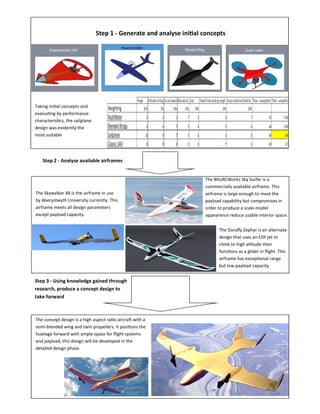
Taking initial concepts and
evaluating by performance
characteristics, the sailplane
design was evidently the
most suitable
The Skywalker X8 is the airframe in use
by Aberystwyth University currently. This
airframe meets all design parameters
except payload capacity.
Step 1 - Generate and analyse initial concepts
Step 2 - Analyse available airframes
The BlitzRCWorks Sky Surfer is a
commercially available airframe. This
airframe is large enough to meet the
payload capability but compromises in
order to produce a scale-model
appearence reduce usable interior space.
The Durafly Zephyr is an alternate
design that uses an EDF jet to
climb to high altitude then
functions as a glider in flight. This
airframe has exceptional range
but low payload capacity.
Step 3 - Using knowledge gained through
research, produce a concept design to
take forward
The concept design is a high aspect ratio aircraft with a
semi-blended wing and twin propellers. It positions the
fuselage forward with ample space for flight systems
and payload, this design will be developed in the
detailed design phase.
Figure 1: Positioning map detailing niches in the market
where this design hopes to sit
After initial research into each area multiple drones
were picked for further consideration. A quick table
detailing each aircrafts properties along with a picture
of each aircraft can be found above. From here a po-
sitioning map was created using a marketing tool that
allows users to find niches in the market. Fig1 shows
where each UAV fits in the market and where the aircraft
detailed in this reports aims to fit in.
3. Regulations
It is important to understand the regulations that
may effect the design of the UAV. Although the aircraft
will be flown in Greenland where the UAV regulations
are much more relaxed, it was important the UAV is able
to conduct missions within the UK for testing purposes.
Under the Civil Aviation Authority two key concerns
dictate the need for a permission of flight:
• Is the aircraft flying on a commercial basis (i.e
conducting ā€˜aerial work’)
• Camera or surveillance equipment fitted to the
aircraft within congested areas.
Although the aircraft will not be working on the basis
of monetary gain it will still be conducting work for an
organisation therefore a certificate will be required to fly
the aircraft. The second key parameter will however not
apply to this aircraft due to the surveillance or camera
equipment not operating in congested areas.[3]
UAVs are classified into 3 types based on overall
weight. Class 1 under 20 kg, class 2 between 20-150kg
and class 3 anything above 150kg. A certificate of Air-
worthiness is required for any UAV over the weight of
150kg, for the purpose of this project it will not be
required due to a very low weight under 10 kg.[4]
4. Preliminary Design
From detailed calculations and research, each area of
the conceptual design was looked into and accessed for
viability and purpose ultimately determining the final
aircraft at the preliminary stage.
4.1. Aerodynamics
4.1.1 Aerofoil selection
Reynolds numbers are a vital step in choosing an
aerofoil. A low reynolds number (Re) is favourable
due to low Re values experience more laminar flow and
therefore the aircraft will produce more efficient wings
generating lift.
Re =
ρV c
µ
(1)
From Equation (1) a value of Re = 250000 was found
allowing for the comparison of multiple aerofoils.
Figure 2: Comparison of multiple Aerofoils over four key
areas at the given reynolds number
The generation of the graphs in Fig.2 were produced
by Xfoil,[5] a program and analysis tool available for
aerofoil selection. The program was developed at MIT
and is only applicable if certain criteria are not met
i.e Compressible flow, Viscous Flow, etc... Based on
the low reynolds number and the values calculated by
Xfoils, the NACA 2412 was chosen due to its low drag
properties and relatively high Clmax. Initial studies into
the NACA 2412 using both Tornedo[6] and XFLR[7]
which will be discussed later on, yielded low values of
lift. Two possible options are to increase surface areas,
mainly wing span, or change the aerofoil to a higher
camber therefore generating more lift. The decision to
change to a NACA 6412 was chosen due to changing the
wing span by the amount needed would have resulted in
a difficult aircraft to launch.
8
4.1.2 Aerodynamic characteristics
To determine the aerodynamic characteristics of the
wing geometry and performance, multiple methods were
used. The advantage of using multiple methods meant
that these calculations could be made more accurate.
The following is a brief explanation of how each theoret-
ical method works.
Prandtl Lifting Line theory assumes that there is
only one horseshoe vortex for each wing segment, thus
making the wing finite. The theory predicts the distribu-
tion of lift generated along the span of the wing through
its three dimensional geometry. The strength of this
vortex reduces along the span. To ease calculations the
theory does not take into account the following; Com-
pressible flow, Viscous Flow, Swept Wings, low aspect
ratio wings and unsteady flows. The use of this theory
revolved around using different aerofoils from an aerofoil
generating software online known as airfoiltools.[8] From
this website estimations of Coefficient of lift properties
were taken from graphs which showed the characteristics
of each aerofoil. This was then introduced into the ap-
propriate equations to calculate the Coefficients of drag
and lift.
CL =
2L
ρv2S
(2)
CD = Cd0 +
C2
l
Ļ€eAR
(3)
Results from equations (2) and (3) can also be used to
determine the optimum angle of attack to fly at a given
wing geometries through the greatest CL/CD ratio.
Vortex Lattice Methods models the lifting surfaces
of a wing by assuming that the wing is an infinitely thin
sheet made of small vortices, this is influenced mainly by
the thickness of the sheet. It is an extension of Prandtls
lifting line theory however instead of the theory assuming
that there is a single vortex per wing segment a lattice
of these vortices are generated. To simplify calculations
the software makes the following assumptions; the flow
is incompressible, inviscid and non-rotational.
The lifting surfaces are assumed to be thin and the
influence of the thickness is neglected. It is also assumed
that the angle of attack and the angle of sideslip are both
negligible. Two different types of software were used to
do these calculations both with different advantages over
the other. Tornado which allows ease of design of the
wings through coordinate systems, which creates three
dimensional lifting surfaces such as the wings, horizontal
and vertical tails. However this software lacked the abil-
ity to create a fuselage and simulate how the fuselage
would interact with the lift generating surfaces. The sec-
ond was a program called XFLR5 which uses the same
interaction system as Tornado however has the ability to
create a fuselage and shows the effect this will have on
the wings and also has some very basic computational
fluid dynamics entwined into the software to produce
graphical representations of flows.
Table 3: Aerodynamics characteristics based on multiple
methods
NACA 2412 NACA 6412
Wing Span 3 2.4
Mean Geometric Chord 0.3 0.25
Reynolds number 290000 220000
Wing inclination 4 3.7
Tornado
CL 0.54 0.75
CD 0.009 0.024
XFLR
CL 0.44 0.8
CD 0.01 0.024
Finite wing method
CL 0.55 0.692
CD 0.02 0.05
Table 3 shows the two key iterations and the differ-
ence between both theories.
4.1.3 Aircraft changes
First iteration: Originally a weight estimation of 6kg
meant that the coefficients of lift and drag were calcu-
lated to produce enough lift for the aircraft to fly at
straight and level un-accelerated flight where lift is equal
to weight. Using a constant chord is often used where
low cost is important because of their ease to build and
manufacture, but they are less efficient in the outer sec-
tions of the wing. Through structural analysis the wing
span overall was not needed and could be shortened to
reduce loading factors caused by the span of the wing
and amount of material used.
Second iteration: With the estimated mass of the
aircraft still at 6kg, it was determined that changing
the aerofoil to a NACA 6412 meant that more lift could
be generated because of the increase in camber of the
aerofoil. This also allowed for partitions of the wing to
be tapered so to increase the aspect ratio of the wings
making them more structurally and aerodynamically ef-
ficient by reducing wing tip vortex strength. It was also
slightly swept back so as to increase the aerodynamic
stability. The change in aerofoil also meant that there
was now a larger CLmax available, this means that the
distance required to take off would be shortened, along
with better stall characteristics.
9
4.2. Structural Design
The design of certain features were governed by the
research from the aerodynamics, such as the wing shape
and aerofoil, and this evolved as time went on. The
main difference from the original wing concept was the
introduction of a taper ratio of 0.5 and increasing the
sweep to 10 degrees.
One of the conceptual designs for the internal struc-
ture of the wing was to produce a hollow shell with a
spar. This was produced to try and reduce weight while
remaining as strong as possible, however when trying
to optimise weight and structural integrity it was found
reducing the wall thickness of the aerofoil to reach an
optimal weight was problematic for structural loads.
It follows that a more classic ribs and spar configu-
ration has been adopted and the material selection has
increased stiffness and reduced weight. The tail geom-
etry again changed with the larger single-vertical tail.
Identical to the front wing, these were originally designed
to be a plastic shell but are now ribs and spars from
the original concept, the fuselage design has changed
substantially: removing the joined front and tail wing
construction as it increased weight too much and chang-
ing the battery choice altered the front hub. With the
shortened hub the design became structurally weaker
due to the point at which the tail of the wing cut into
the fuselage was near where the hub ended creating a
thin section of material, so a new design was looked into
with an additional aim of being more aerodynamically
suited to the flight parameters.
A high lift generating (HLG) fuselage was then de-
signed by using Mathematical optimisation technique
which then favours with more lift and low drag char-
acteristics at lower angles of attack, short landing and
take-off capabilities.[9] The main challenge in the fuse-
lage design was the space requirements and to get a
technical structure which withstands the load factors.
The largest stresses act at the joints where the wings are
connected to the fuselage, thus this area was strength-
ened with a larger wall thickness. Fillets were applied
at the sharper edges which again gives a uniform flow
of the loadings. Hence, the internal structure resists the
tensile and compressive loadings.
Fig 5 shows an overview of the aircraft design at
this stage along with placement of components. The
placement of each component was derived with the help
of control and stability to ensure a stable aircraft during
flight, see the section on stability.
4.2.1 Structural Diagram
A vital part of producing an aircraft is evaluating the
limitations. A load factor, n, can be calculated based
on equations (4) and (5). This graph shows three key
areas, the first is the stall properties of the aircraft this
is important when flying slowly. The top horizontal line
shows the structural limitations in-terms of manoeuvres,
the last line is the the vertical line where a maximum
speed is applied before structural loads become too high.
n =
q
W
S
CD0
k
(4)
n =
qπAe
W
S
[(
T
W
)max āˆ’
qCD0
W
S
] (5)
This can be depicted as a ā€˜V-n’ diagram found in
Fig. 3.
Figure 3: Structural limitations of the aircraft
10
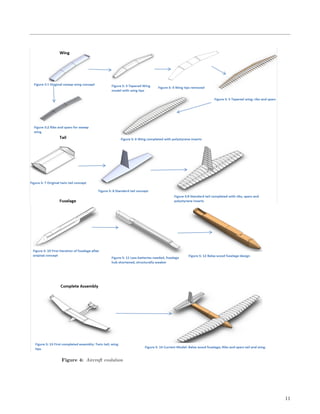
Figure 4: Aircraft evolution
11
Figure 5: Aircraft cross section along with component placing based on CG calculations
4.3. Powertrain
4.3.1 Motor selection
There are many types of engines ranging from elec-
tric propeller driven , diesel propeller driven, electric
ducted fan (EDF) and jet engines. Initially both jet
engines and electric ducted fan were ruled out due to
there lack of efficiency. EDF systems are designed to
operate at large RPM and produce large amounts of
thrust however, they are predominantly used in the RC
world as motors installed in model jet fighters reaching
large speeds and relatively low flight times, this was
decided, for the purpose of this mission inadequate. Jet
engines become very inefficient when scaled down to
the size we need, they also generally have high specific
fuel consumption compared to a small diesel or petrol
propeller driven aircraft therefore this motor was also
ruled out.
When comparing an electric motor versus a diesel or
petrol engine the main differences are in efficiency and
weight. With recent advances in brushless technology
electric motors can reach anywhere from 75%-85% effi-
ciency much higher than internal combustion engines.[10]
The weight of a petrol or diesel engine is much higher
increasing the aircrafts overall weight, not a desirable
feature. Due to the small thrust requirements produced
by weight and performance along with aerodynamics
results the choice for a mid powered electric engine was
chosen producing roughly 200 watts of power.
4.3.2 Propeller selection
There are two main aspects to all propellers, the di-
ameter of the propeller and the pitch of the blades. The
diameter of the propeller is the distance from tip to tip,
the pitch or twist of the blade is defined as the distance
the propeller would move the airplane forward in one
rotation in a perfect world. However this is impractical
as perfect conditions will almost never arise due to the
fact that propellers are never 100% efficient and this is
also considering an incompressible flow.[11] Although at
the speeds the aircraft is flying it would typically not
encounter compressibility effects it may be encountered
at the tips of the propeller.
The effects of the diameter of the propeller in general
will result in a larger amount of thrust produced by the
engine, whereas the pitch will increase the speed of the
aircraft. For example a small diameter coupled with a
large pitch will move faster through the air however only
move small amounts of air meaning it will be perfect
for small aircraft looking to move fast. A large diame-
ter propeller with a shallow pitch angle will move large
amounts of air meaning large amounts of thrust but the
shallow pitch angle means it will move through the air
more slowly.[11]
Based on Fig.6 and the more desirable shallow pitch
and larger diameter it can determined that a propeller
size of 10 Ɨ 5 is more desirable for the Greenland appli-
cation. The choice of propeller size also means that an
increase in torque benefits Take-off and Landing proper-
ties of the aircraft.
12
Figure 6: Propeller sizing guild based on engine size[12]
4.4. Material selection
The material selection was based on work completed
by the structural group along with the help of the Edu-
pack software. The structural design allowed for a maxi-
mum of 1000kg/m3
for critical components and a min of
100kg/m3
. From these values a list of possible materials
were chosen based of manufacturing routes, structural
limitations and overall viability for the aircraft. During
the detailed design phase materials will be assessed and
simulated to verify functionality. A short list of possible
materials for key component will be carried forward are:
• Nylon 6 10
• High density polystyrene
• hard wood, Spar
• Balsa wood
4.4.1 Aircraft changes
The conceptual design brought forward featured two
engines mounted on the underside of the wings. The
two engine configuration has since been dropped to a
single engine due to two main reasons, the first of which
is weight. Due to the relative lightness of the proposed
aircraft, having two very small engines produce the same
amount of thrust as having one slightly larger engine
with next to no real benefits with regards to excess
weight. The second reason is due to the effect it will
have on the range of the aircraft. Most brushless engines
will have a 75-85% efficiency therefore losses associated
with having two engines is much higher than just one
single engine. Not only do the losses in efficiency reduce
the range of the aircraft but due to each engine drawing
separate currents, the amount of energy needed for both
engines will far exceed that needed for one single engine.
Towards the end of the preliminary phase a prob-
lem was found in the design and material choice for the
fuselage therefore a complete overhaul of structure and
material choice was done which will be discussed later
on.
4.5. Control Systems
Due to the difficult nature of the mission a detailed
look into the flight controls and telemetry for the aircraft
has been conducted. The Greenland project requires an
aircraft that is autonomous and able to capture images
of the landscape it is flying through.
Multiple autopilot systems have been studied and
the AMP 2.6 board with GPS is a viable option at this
current stage. It includes 3-axis gyro, accelerometer,
magnetometer, barometer and other high performance
recording instruments that can be streamed live to the
ground station while in range or recorded while out of
range. The system also features an open source autopi-
lot systems using Invensenses 6 DoF Accelerometer and
Gyro MPU-6000.
Camera equipment is one of the most important as-
pects of design. The mission requires scientists to analyse
pictures captured from the aircraft to help map glacial
retreats. The initial design was to have two cameras, the
first facing forward and the main camera facing down
mapping the landscape. However due to the aircraft
changing from 2 engines to 1 engine, there is no longer
room for two cameras therefore one main camera will be
pointing down mapping the landscape. A GoPro hero 4
will be used as a high resolution device is needed.
Research on battery quantity and quality has been
carried out and there are clear advantages using LiPo
battery packs. Calculations have been conducted:
Batterylife =
mAh
mA
Ɨ 0.7 (6)
Based on Equation 6, where an efficiency of 70%
was used for environmental factors, and values found
by the propulsions section it was determined that two
high capacity LiPo batteries will be required for the
given flight time however three will be used for extra
range allowing for a safety factor and redundancies. The
batteries under consideration at this time is the Zippy
Traxxas 7600mAh 2S 1P 30C.
Table 14 shows the current selection of equipment
proposed for this mission along with dimensions and
weight of each component.
13
Table 4: Control Systems
component Length (mm) width (mm) Height (mm) Weight (g)
Ardupilot 2.6 70 40 10 32
Turnigy MX-353S 17g Servo x 4 38 13 27 17 Ɨ 4
Zippy Traxxas 7600mAh Battery x3 157 25 45 367 Ɨ 3
Turnigy Dual Power Unit 100 50 20 89
Turnigy Plush 60A Speed Controller 80 31 14 60
Turnigy D3536/8 1000KV motor 52 35 35 102
3DR uBlox GPS + Compass 38 38 8.5 16.8
3DR Video/OSD System Kit N/A N/A N/A 100 āˆ’ 150
Total 1594
4.5.1 Aircraft changes
Due to the amount of components to fit within the
fuselage it was required at an early stage to help re-
design the fuselage to accommodate all necessary flight
equipment. Although this can not be seen externally,
internally new compartments where created.
4.6. Stability
For an aircraft to be stable it must, after a period
of time, return to an equilibrium point in flight follow-
ing disruptive forces, such as a gust of wind or control
surface deflection. The first task with regards to the dy-
namic and static stability of the UAV was to determine
the static margin. The static margin is defined as the
distance between the centre of gravity and the neutral
point as a percentage of the mean chord. For an aircraft
to be statically stable, the centre of gravity must be
forward of the neutral point, therefore the static margin
must also be positive. Generally a margin greater than
5% [1] should provide sufficient stability.
An increase in angle of attack, α, should generate
a nose-down pitching moment, directing the aircraft
back towards equilibrium. In reverse too, a decrease
in α should generate a nose-up moment, directing the
aircraft once more towards stability.
dCM
dαα
< 0 (7)
At straight, level and steady flight the pitching moment
should be zero, as the aircraft should be in its equilib-
rium position. Therefore:
CMα(αα = 0) < 0 (8)
To calculate the static margin, this equation was used:
CMα = (h āˆ’ hn)CLα (9)
From this equation, it can be seen that the centre
of gravity must be located in front of the neutral point
in order to achieve static stability. The static margin is
noted as: h āˆ’ hn. To make the calculation of the static
margin easier, a MATLAB script was written, enabling
it to be calculated quickly during changes to the UAV
parameters.
Taking into account the configuration of the UAV
in the early design stages, the static margin was calcu-
lated to be 0.2359, 23.59%, demonstrating static sta-
bility. With the updated design, this was then revised
to 21.15%, matching also the values achieved from Tor-
nado. However, this value was deemed to be too high to
achieve sufficient manoeuvrability, and the target for a
static margin of around 15% was set, as UAV are usually
expected to have a static margin in the region of 5%
to 15%. To achieve this, the positions of the masses
within the airframe structure were shifted closer to the
neutral point. A static margin of 14.69% ended up being
calculated for the configuration detailed above. Table5
shows the change in CoG based on changes made to the
static margin.
Table 5: Centre of Gravity variation from leading ledge of
wings
Before After
X-CoG 30.7mm 108.46mm
Y-CoG 0 0
4.6.1 Aircraft Changes
The tail design for this aircraft will have a major
effect on stability of the aircraft during flight. Choosing
the correct configuration will make for a more stable
aircraft resulting in clearer pictures and therefore more
accurate aerial photography for the Greenland project.
The tail configuration carried forward from the con-
ceptual design was a twin tail plane, this design was
considered favourable at the time due to its larger surface
area and therefore increased stability during turbulent
14
winds. This has since been changed to a more classic
tail plane design for several reasons.
The first reason for changing this was due to the
extra weight that would be added to this design due
to structural reasons. Placing such a heavy weight at
the end of the horizontal stabiliser would mean that the
internal structure would outweigh that of the classic tail
design.
The second reason was due to the redundancy level
of having two rudders. This would increase drag, and
other aerodynamic problems associated with having the
second surface.
Weighing the advantages and disadvantages of the
two types of designs it was more favourable to revert the
design back to a classic tail design making for a lighter,
more efficient and simpler design.
A major change due to stability reasons was the
length of the fuselage and the positioning of the wings.
The increased length of the fuselage and moving the
wings positioning further back allows for a better static
margin, moving the centre of gravity closer to the neutral
point of the aircraft. This produced a more statically
stable aircraft.
4.7. Weight
Keeping track of weight through the design is a vital
part of producing an aircraft. A comprehensive table
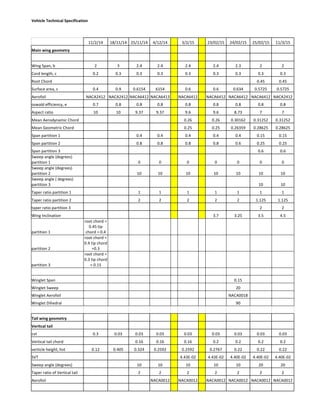
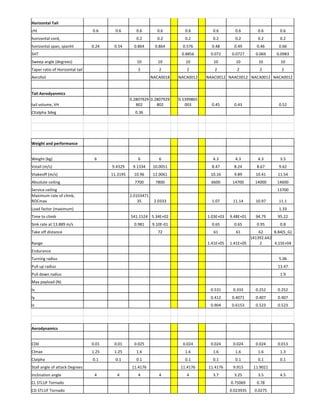
know as a Vehicle Technical Specification, VTS, was pro-
duce to keep track of all incoming data from each design
group, this can be found in Appendix 1. A small table
showing weight estimations at the start and throughout
the initial build can be found in table 6.
Table 6: Weight estimation
Weight (g)
Battery 367 Ɨ 3 = 1101
Motor 160
Propeller 35
Airframe 3000
Camera 1000
Autopilot & GPS 28
Power module 17
Telemetry module 33
Servos 17 Ɨ 4 = 68
Total 5500 (estimated 6000)
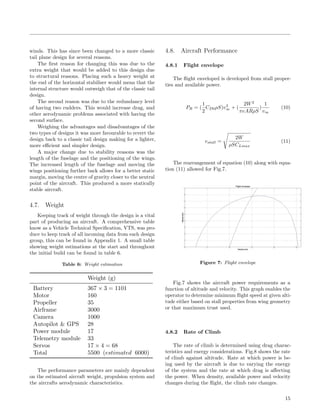
The performance parameters are mainly dependent
on the estimated aircraft weight, propulsion system and
the aircrafts aerodynamic characteristics.
4.8. Aircraft Performance
4.8.1 Flight envelope
The flight enveloped is developed from stall proper-
ties and available power.
PR = (
1
2
CD0ρS)v3
āˆž + (
2W2
Ļ€eARρS
)
1
vāˆž
(10)
vstall =
2W
ρSCLmax
(11)
The rearrangement of equation (10) along with equa-
tion (11) allowed for Fig.7.
Figure 7: Flight envelope
Fig.7 shows the aircraft power requirements as a
function of altitude and velocity. This graph enables the
operator to determine minimum flight speed at given alti-
tude either based on stall properties from wing geometry
or that maximum trust used.
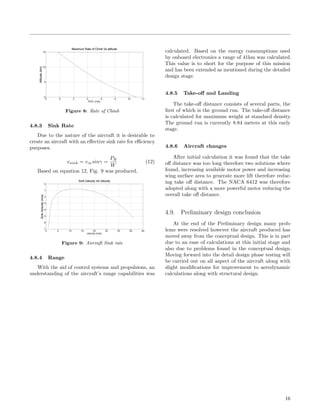
4.8.2 Rate of Climb
The rate of climb is determined using drag charac-
teristics and energy considerations. Fig.8 shows the rate
of climb against altitude. Rate at which power is be-
ing used by the aircraft is due to varying the energy
of the system and the rate at which drag is affecting
the power. When density, available power and velocity
changes during the flight, the climb rate changes.
15
Figure 8: Rate of Climb
4.8.3 Sink Rate
Due to the nature of the aircraft it is desirable to
create an aircraft with an effective sink rate for efficiency
purposes.
vsink = vāˆžsinγ =
PR
W
(12)
Based on equation 12, Fig. 9 was produced.
Figure 9: Aircraft Sink rate
4.8.4 Range
With the aid of control systems and propulsions, an
understanding of the aircraft’s range capabilities was
calculated. Based on the energy consumptions used
by onboard electronics a range of 41km was calculated.
This value is to short for the purpose of this mission
and has been extended as mentioned during the detailed
design stage.
4.8.5 Take-off and Landing
The take-off distance consists of several parts, the
first of which is the ground run. The take-off distance
is calculated for maximum weight at standard density.
The ground run is currently 8.84 meters at this early
stage.
4.8.6 Aircraft changes
After initial calculation it was found that the take
off distance was too long therefore two solutions where
found, increasing available motor power and increasing
wing surface area to generate more lift therefore reduc-
ing take off distance. The NACA 6412 was therefore
adopted along with a more powerful motor reducing the
overall take off distance.
4.9. Preliminary design conclusion
At the end of the Preliminary design many prob-
lems were resolved however the aircraft produced has
moved away from the conceptual design. This is in part
due to an ease of calculations at this initial stage and
also due to problems found in the conceptual design.
Moving forward into the detail design phase testing will
be carried out on all aspect of the aircraft along with
slight modifications for improvement to aerodynamic
calculations along with structural design.
16
5. Detailed Design Process
Moving out of the Preliminary design phase where
the aircraft’s overall characteristics have been decided
and early calculations have been conducted to ensure a
functional plane, the aircraft now moves into the detailed
design phase where parameters are refined to ensure ef-
ficiency and more desirable characteristics. During this
stage aircraft modelling followed by aircraft testing has
been accomplished to ensure an aircraft that not only
flies but handles correctly.
5.1. Aerodynamics
The aircraft wings underwent a large change in shape
for both aerodynamic and structural redundancy pur-
poses. This resulted in an overall aircraft weight reduc-
tion and more sleek aerodynamic geometry allowing for
reductions in drag, Fig.10 shows the evolution of the
aircraft wings from an aerodynamic point of view.
Figure 10: The first iteration is a simple wing, rectangular
in shape, this was then tapered at the ends in an
effort to reduce wing tip strength in the second
iteration. The last and final iteration has an
increased taper ratio along with a semi blended
wing, larger root cord, for structural reasons to
increase stiffness along with increase in lift and
aerodynamic properties.
During the detailed design stage of the project more
realistic software was adopted to verify lift and drag
properties. This was done to verify values that have
already been calculated and to fully understand the
aircraft.
5.1.1 Virtual Wind Tunnel
Virtual Wind Tunnel by Altair[13] is a Computa-
tional fluid dynamics software package designed for au-
tomotive vehicles. The key benefit of this software is
that it uses viscous flow, much more similar to the real
world. Gathering data from the virtual wind tunnel
allows for more accurate calculations for instance lift,
drag, pressure distribution and flow separation.
The Virtual Wind Tunnel works on the utilisation
of the Navier-Stoke equations. It is possible to calcu-
late the forces acting in the X, Y and Z co-ordinate
system, for the purpose of this study, lift, drag and cross
forces (usually negligible) respectively. The values found
are then normalised into values of CL and CD using
equations (2) and (3).
Generating a mesh is extremely important when
testing in the virtual wind tunnel, there are two basic
two-dimensional shapes that are used for meshing. The
benefits of using a triangle is that is it the simplest type
of mesh to create and has the ability to give a more
accurate concave or convex shapes. This is of great
importance when generating a mesh for the UAV as the
wings are in the shape of an aerofoil which is smooth,
any difficult to produce a smooth profile of the wing
which will greatly affect results.
Element size and the maximum deviation of elements
is important to create a fine mesh. The benefit of having
a finer mesh is that it will give more accurate results.
For this test the number of elements created is around
30,000. Which is more than enough for simple geometry
input, to achieve more accurate results a finer mesh
could be generated, however the finer the mesh the more
computationally heavy and time consuming it will be.
The mesh created for the virtual wind tunnel can be
found in Fig.11
Figure 11: Meshing of the aircraft for the Virtual Wind
Tunnel
17
After multiple results where found using the virtual
wind tunnel and testing commenced in the flight sim-
ulator it was noticed that the aircraft was not acting
as anticipated. After some initial research it was found
that the software uses the Spalart-Allmaras model which
was found to have some disadvantages when performing
in the boundary layer resulting in a reduced drag values.
The advantage of this model however is the computa-
tional time is much smaller than different models.
Creating a large enough area around the body of the
aircraft is important, this will result in more accurate
values based on better flow separation over the wing
and behind the UAV. The results produced will be more
accurate as the flow will have more time to converge
back to a laminar flow, as turbulent flows will affect the
change in pressure over and under the wing causing loss
in lift.
Figure 12: Computational area around the aircraft for sim-
ulations
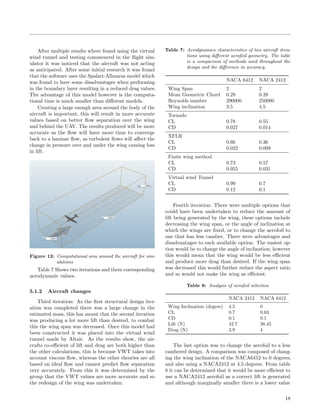
Table 7 Shows two iterations and there corresponding
aerodynamic values.
5.1.2 Aircraft changes
Third iteration: As the first structural design iter-
ation was completed there was a large change in the
estimated mass, this has meant that the second iteration
was producing a lot more lift than desired, to combat
this the wing span was decreased. Once this model had
been constructed it was placed into the virtual wind
tunnel made by Altair. As the results show, the air-
crafts co-efficient of lift and drag are both higher than
the other calculations, this is because VWT takes into
account viscous flow, whereas the other theories are all
based on ideal flow and cannot predict flow separation
very accurately. From this it was determined by the
group that the VWT values are more accurate and so
the redesign of the wing was undertaken.
Table 7: Aerodynamics characteristics of two aircraft itera-
tions using different aerofoil geometry. The table
is a comparison of methods used throughout the
design and the difference in accuracy.
NACA 6412 NACA 2412
Wing Span 2 2
Mean Geometric Chord 0.29 0.29
Reynolds number 290000 250000
Wing inclination 3.5 4.5
Tornado
CL 0.78 0.55
CD 0.027 0.014
XFLR
CL 0.66 0.36
CD 0.022 0.009
Finite wing method
CL 0.73 0.57
CD 0.055 0.031
Virtual wind Tunnel
CL 0.99 0.7
CD 0.12 0.1
Fourth iteration: There were multiple options that
could have been undertaken to reduce the amount of
lift being generated by the wing, these options include
decreasing the wing span, or the angle of inclination at
which the wings are fixed, or to change the aerofoil to
one that has less camber. There were advantages and
disadvantages to each available option. The easiest op-
tion would be to change the angle of inclination; however
this would mean that the wing would be less efficient
and produce more drag than desired. If the wing span
was decreased this would further reduce the aspect ratio
and so would not make the wing as efficient.
Table 8: Analysis of aerofoil selection
NACA 2412 NACA 6412
Wing Inclination (degree) 4.5 0
CL 0.7 0.63
CD 0.1 0.1
Lift (N) 42.7 38.45
Drag (N) 3.9 4
The last option was to change the aerofoil to a less
cambered design. A comparison was composed of chang-
ing the wing inclination of the NACA6412 to 0 degrees,
and also using a NACA2412 at 4.5 degrees. From table
8 it can be determined that it would be more efficient to
use a NACA2412 aerofoil as a correct lift is generated
and although marginally smaller there is a lower value
18
of drag.
The decision to change the aerofoil was passed on to
the structural devision along with updated values to the
vehicle technical specification to allow each section to
update values where necessary.
5.1.3 Assessment of Analysis tools
Through the course of this design multiple analysis
tools where used. During the preliminary design stage
tools such as Tornado, a Matlab script, and XFLR5 were
used. Aircraft changes were based on values found using
these packages however on further examination using
more accurate packages such as Virtual Wind Tunnel
it was noticed that initial values calculated were much
lower than needed. The software used during the prelim-
inary stage ended up forcing design changes that were
reverted back during the detailed stage due to inaccu-
rate values found. On closer examination calculations
based on previous published wind tunnel test to find CL
values proved more reliable than certain software and
correlated with the Virtual Wind Tunnel results.
5.2. Structural
Initially a hollow shell was considered for a wing using
a high strength polystyrene, this was considered through
the sweep wing and tapered wing designs, though it was
substantially heavier than anticipated (around 1.8kg)
and deemed too heavy, so ribs and spar models have
been chosen since.
Moving away from a purely polystyrene based wing
designs the adoption of balsa wood for spars and nylon
6/10 for ribs. The addition of a low density polystyrene
was considered as a potential material to hold aerofoil
form between spars allowing for better aerodynamics.
Up to the current iteration, very little has changed ex-
cept that balsa has been replaced with a stronger stiffer
wood such as bamboo.
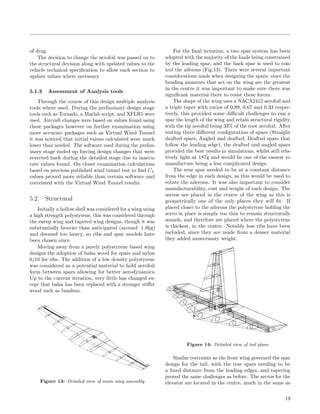
Figure 13: Detailed view of main wing assembly
For the final iteration, a two spar system has been
adopted with the majority of the loads being constrained
by the leading spar, and the back spar is used to con-
trol the ailerons (Fig.13). There were several important
considerations made when designing the spars: since the
bending moments that act on the wing are the greatest
in the centre it was important to make sure there was
significant material there to resist these forces.
The shape of the wing uses a NACA2412 aerofoil and
a triple taper with ratios of 0.89, 0.67 and 0.33 respec-
tively, this provided some difficult challenges to run a
spar the length of the wing and retain structural rigidity,
with the tip aerofoil being 33% of the root aerofoil. After
testing three different configuration of spars (Straight
drafted spars; Angled and drafted; Drafted spars that
follow the leading edge), the drafted and angled spars
provided the best results in simulations, whilst still rela-
tively light at 187g and would be one of the easiest to
manufacture being a less complicated design.
The rear spar needed to be at a constant distance
from the edge in each design, as this would be used to
rotate the ailerons. It was also important to consider
manufacturability, cost and weight of each design. The
servos are placed in the centre of the wing as this is
geometrically one of the only places they will fit. If
placed closer to the ailerons the polystyrene holding the
servo in place is simply too thin to remain structurally
sounds, and therefore are placed where the polystyrene
is thickest, in the centre. Notably less ribs have been
included, since they are made from a denser material
they added unnecessary weight.
Figure 14: Detailed view of tail plane
Similar restraints as the front wing governed the spar
design for the tail, with the rear spars needing to be
a fixed distance from the leading edges, and tapering
proved the same challenges as before. The servos for the
elevator are located in the centre, much in the same as
19
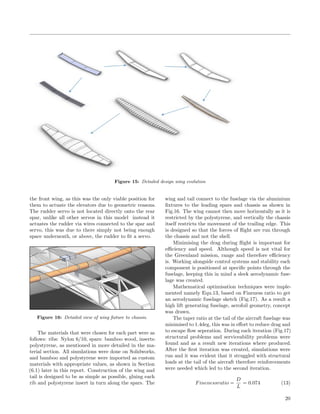
Figure 15: Detailed design wing evolution
the front wing, as this was the only viable position for
them to actuate the elevators due to geometric reasons.
The rudder servo is not located directly onto the rear
spar, unlike all other servos in this model instead it
actuates the rudder via wires connected to the spar and
servo, this was due to there simply not being enough
space underneath, or above, the rudder to fit a servo.
Figure 16: Detailed view of wing fixture to chassis.
The materials that were chosen for each part were as
follows: ribs: Nylon 6/10, spars: bamboo wood, inserts:
polystyrene, as mentioned in more detailed in the ma-
terial section. All simulations were done on Solidworks,
and bamboo and polystyrene were imported as custom
materials with appropriate values, as shown in Section
(6.1) later in this report. Construction of the wing and
tail is designed to be as simple as possible, gluing each
rib and polystyrene insert in turn along the spars. The
wing and tail connect to the fuselage via the aluminium
fixtures to the leading spars and chassis as shown in
Fig.16. The wing cannot then move horizontally as it is
restricted by the polystyrene, and vertically the chassis
itself restricts the movement of the trailing edge. This
is designed so that the forces of flight are run through
the chassis and not the shell.
Minimising the drag during flight is important for
efficiency and speed. Although speed is not vital for
the Greenland mission, range and therefore efficiency
is. Working alongside control systems and stability each
component is positioned at specific points through the
fuselage, keeping this in mind a sleek aerodynamic fuse-
lage was created.
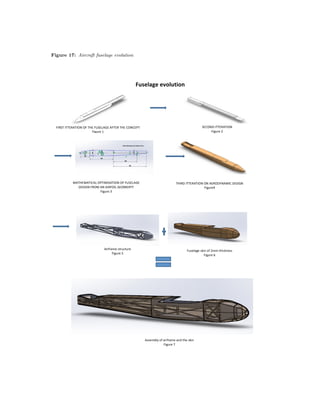
Mathematical optimisation techniques were imple-
mented namely Equ.13, based on Fineness ratio to get
an aerodynamic fuselage sketch (Fig.17). As a result a
high lift generating fuselage, aerofoil geometry, concept
was drawn.
The taper ratio at the tail of the aircraft fuselage was
minimised to 1.4deg, this was in effort to reduce drag and
to escape flow seperation. During each iteration (Fig.17)
structural problems and serviceability problems were
found and as a result new iterations where produced.
After the first iteration was created, simulations were
run and it was evident that it struggled with structural
loads at the tail of the aircraft therefore reinforcements
were needed which led to the second iteration.
Finenessratio =
D
L
= 0.074 (13)
20
Ā 
Fuselage	
 Ā evolution	
 Ā 
	
 Ā 	
 Ā 	
 Ā 	
 Ā 	
 Ā 	
 Ā 	
 Ā 	
 Ā 	
 Ā 	
 Ā 	
 Ā 	
 Ā 	
 Ā 	
 Ā 	
 Ā 	
 Ā 	
 Ā 	
 Ā 	
 Ā 	
 Ā 	
 Ā 	
 Ā 	
 Ā 	
 Ā 	
 Ā 	
 Ā 	
 Ā 	
 Ā 	
 Ā 	
 Ā 	
 Ā 	
 Ā 	
 Ā 	
 Ā 	
 Ā 	
 Ā 	
 Ā 	
 Ā 	
 Ā 	
 Ā 	
 Ā 	
 Ā 	
 Ā 	
 Ā 	
 Ā 	
 Ā 	
 Ā 	
 Ā 	
 Ā 	
 Ā 	
 Ā 	
 Ā 	
 Ā 	
 Ā 	
 Ā 	
 Ā 	
 Ā  	
 Ā 
	
 Ā 
	
 Ā 	
 Ā 	
 Ā 	
 Ā  	
 Ā 	
 Ā 	
 Ā 	
 Ā 	
 Ā 	
 Ā 	
 Ā 	
 Ā 	
 Ā 	
 Ā 	
 Ā 	
 Ā 	
 Ā 	
 Ā 	
 Ā 	
 Ā 	
 Ā 	
 Ā 	
 Ā 	
 Ā 	
 Ā 	
 Ā 	
 Ā 	
 Ā  	
 Ā 
	
 Ā 
	
 Ā 
	
 Ā 
	
 Ā 	
 Ā 	
 Ā 	
 Ā 	
 Ā  	
 Ā 	
 Ā 	
 Ā 	
 Ā 	
 Ā 	
 Ā 	
 Ā 	
 Ā 	
 Ā  	
 Ā 
	
 Ā 
	
 Ā 
	
 Ā 	
 Ā 	
 Ā 	
 Ā 	
 Ā 	
 Ā 	
 Ā 	
 Ā 	
 Ā 	
 Ā 	
 Ā 	
 Ā 	
 Ā 	
 Ā 	
 Ā 	
 Ā 	
 Ā 	
 Ā 	
 Ā 	
 Ā 	
 Ā 	
 Ā 	
 Ā 	
 Ā 	
 Ā 	
 Ā 	
 Ā 	
 Ā 
	
 Ā 
FIRST	
 Ā ITTERATION	
 Ā OF	
 Ā THE	
 Ā FUSELAGE	
 Ā AFTER	
 Ā THE	
 Ā CONCEPT	
 Ā 
Figure	
 Ā 1
SECOND	
 Ā ITTERATION	
 Ā 
Figure	
 Ā 2
MATHEMATICAL	
 Ā OPTIMISATION	
 Ā OF	
 Ā FUSELAGE	
 Ā 
DESIGN	
 Ā FROM	
 Ā AN	
 Ā AIRFOIL	
 Ā GEOMERTY	
 Ā 
Figure	
 Ā 3
THIRD	
 Ā ITTERATION	
 Ā ON	
 Ā AERODYNAMIC	
 Ā DESIGN	
 Ā 
Figure4	
 Ā 
Airframe	
 Ā structure	
 Ā 
Figure	
 Ā 5
Fuselage	
 Ā skin	
 Ā of	
 Ā 2mm	
 Ā thickness	
 Ā 
Figure	
 Ā 6
Assembly	
 Ā of	
 Ā airframe	
 Ā and	
 Ā the	
 Ā skin	
 Ā 
Figure	
 Ā 7	
 Ā 
Figure 17: Aircraft fuselage evolution
Multiple techniques were used and as a result, the
third iteration gave a better aerodynamic fuselage, both
in terms of fineness ratio and the tail taper ratio. With
the overall geometry of the fuselage determined, a model
was created ready for testing using a monocoque struc-
ture. Working with the material section it was noticed
that this design made it difficult to service components
and build in conventional managers meaning more com-
plex materials would be required resulting in a heavier
and less stiff fuselage. The fourth iteration was created
using a complete airframe design, where a tray of in-
ternal components could be placed within the airframe
for quick access and ability to swap trays for immediate
relaunch capabilities. Each iteration can be found in
Fig.17.
5.3. Motor
The Power-train in the aircraft has evolved multiple
times over the course of the design. With changes to
aerodynamic performance along with criteria set out by
weight and performance it was crucial that the correct
motor was chosen.
Based on the current drag estimates under straight
and level flight where thrust must equal drag equation
(14) was used to determine power required.
PR = Tv (14)
The value of 56 Watts is required for straight and
level flight, however this value is assuming perfect condi-
tions therefore equation (15) was used to include motor
efficiency, shaft efficiency and propeller efficiency.
PR = TvĪ·shaftĪ·motorĪ·propeller (15)
Based on equations (14) and (15) a total power of
171.5 Watts is needed during straight and level flight.
A certain amount of redundancy is required for take
off, strong winds and any other eventualities that may
occur during a flight. Table 9 shows the characteristics
of the chosen motor.
Table 9: Motor selection
Voltage 7.414.8V
RPM 1000 Kv
Max Power 430 Watts
Weight 102g
Using the current motor and Equ.(6) it has been
found that the aircraft will be able to sustain flight for
up to 1.7 hours.
The propeller, and engine type proposed during the
preliminary design is still fit for purpose therefore a 10Ɨ5
will be used along with an electric brushless motor.
5.4. Material
Edupack[?] was continuously used to determine vi-
able materials based on two key areas, weight and stiff-
ness. The two parameters are vital for wing design and
given by equations (16) and (17)
m = ALρ (16)
S =
CEA2
12L3
(17)
Equations (16) and (17) are substituted into each
other to provide a material index which can then be
applied to the Edupack software.
m = L
12L3S
C
Ɨ
ρ
E
1
2
(18)
The information in equation (18) provides important
values to achieve the stiffest and lightest material fit for
purpose, the value of ρ
E0.5 must be as small as possible.
This was applied to Fig.18 and is depicted as the
line that traverses the graph. Everything above this line
is a suitable candidate for material choice however the
higher the Young’s modulus the better. A criteria was
added so that the overall weight of the aircraft did not
rise significantly and therefore a maximum density of
2000 kg/m3
was chosen eliminating metals.
From Fig.18 the decision to use bamboo was adopted
for the main spar. This is due to the high stiffness and
relatively low density.
A light plastic film will be applied to the aircraft
and act as the skin of the UAV. This was chosen due
to its waterproof properties and the heat shrinking that
allows for exact moulding. Low density polystyrene will
be placed in-between each rib to allow for support of the
skin and ensure a perfect aerodynamic shape is kept.
5.4.1 Aircraft changes
Although the material selection has not had a major
impact on aircraft size or shape it has been a major
driving force to completely change the internal structure
of the fuselage. During the second iteration it was no-
ticed that parts were not easily accessible for repairs and
servicing (Fig.15). A larger problem was caused when it
was noticed that the fuselage would have to be manufac-
tured in a very specific way using certain materials that
where not feasible for this mission. Therefore a complete
overhaul of the internal structure of the fuselage was
22
Figure 18: Edupack material selection softare[14]
done. Working along side the structure group a new
airframe system was implemented and allowed for more
material choice and manufacturing route.
The use of 3D printing is a large topic in the world of
manufacturing, the versatility of printing broken parts
along with upgrading components is endless. Therefore
incorporating this was felt as important especially if
scientists are in remote areas, all they would require is
a 3D printer to repair components. This move to 3D
ABS plastics was only possible due to the adoption of
an airframe instead of the heavier monocoque design.
Under testing the ABS plastic was able to withstand
the forces that would be expected from flight.
5.5. Control Systems
The process to determine the sizing of ailerons, rud-
ders and elevators was undertaken by using the Aerofoil
Flap Modeller script in Matlab. It takes the two dimen-
sional curves of the aerofoil used on the UAV, changing
some figures by percentage of the aerofoil chord length
to simulate a virtual control surface at a set range of
deflection angles, calculating the changes in lift coeffi-
cient and centre of pressure from the simulated control
surface.
Figure 19: CoP change during aileron deflection
The Aerofoil Flap Modeller script has been run twice
in order to size the ailerons, rudders and elevators. Fig.19
relate to the aileron sizing; in Fig.19, it indicates that
a smaller aileron with a 20% of the chord length, has
smaller changes in centre of pressure as it deflects, while
it is still generating sufficient lift coefficient changes to
roll the aircraft. The smaller change in centre of pres-
sure is desirable because it does not cause huge changes
in drag produced at the aileron, it will give the air-
craft a benefit in terms of power consumption during
manoeuvring.
23
The same method was used to calculate elevator size
and yielded 50% length should be used for both elevator
and rudder configuration.
Two methods were used to calculate aileron size
based on the aerofoil flap modeller and the second based
on hand calculated that take into account roll rates and
banking moments.
To complete the hand calculations the following val-
ues where used, Wing span = 2m, Take-off weight =
3.5kg, Wing area = 0.5725m2, Aspect Ratio = 6.99, Ta-
per Ratio = 2, Horizontal tail planform area = 0.0983m2,
Stall Speed = 8.67m/s, and Bank angle = 10 degrees
turning in 2 seconds.
ClΓA =
2CLawτCr
Sb
[
y2
2
+
2
3
(
Ī» āˆ’ 1
b
)y3
]yo
yi
(19)
Equation (19) was used to calculate the roll moment
required for the aircraft, from this the position of the
inboard and outboard aileron should be 60% and 95%
of the wing span respectively. This gave rise to a value
of yi = 0.61m and yo = 0.95m. The difference of these
values allow for the aileron length of 0.34m and the
depth of the aileron was found to be 0.057m, Fig.20 is a
diagram of the ailerons.
Figure 20: Aileron sizing
The calculations fit with the aerofoil flap modeller
therefore these values were deemed satisfactory and
proved sufficient during flight testing.
The sizing for both elevator and rudder were done
on the same bases and yielded the Fig.21 and Fig.22
Figure 21: Rudder sizing
Figure 22: Elevator sizing
5.6. Stability
The XFLR5 program, as mentioned in section 2.1,
allows users to determine where avionics and flight in-
struments should be placed within the aircraft. Using
the measurements of the length of the fuselage that
have been provided, a model of the UAV has been cre-
ated in this software, the user is able to move different
components of the aircraft, the wings and weighted in-
struments within the fuselage. A 3D model has been
produced within the program to determine positioning
of component to enable the structural group to build
compartments for housing all the electronics. This in
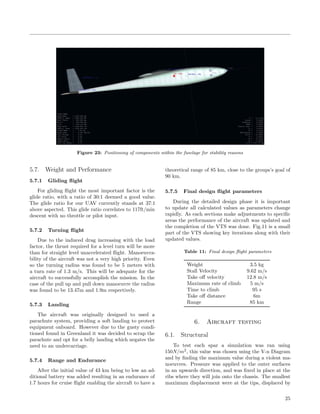
turn enabled for a more stable aircraft, Fig.23 depicts
where components should be placed for stability reasons.
Over the course of the design multiple iterations
have been created. Changes in weight, structure and
components all upset the balance of the aircraft. The
re-calculation of the static margin along with a small
shift in Cog was needed to maintain the desired 15%.
The resulting calculations produced Table 10.
Table 10: Centre of Gravity position and component posi-
tioning from nose of aircraft
Distance (m)
CoG 0.48
Battery and camera 0.34
24
Figure 23: Positioning of components within the fuselage for stability reasons
5.7. Weight and Performance
5.7.1 Gliding flight
For gliding flight the most important factor is the
glide ratio, with a ratio of 30:1 deemed a good value.
The glide ratio for our UAV currently stands at 37:1
above aspected. This glide ratio correlates to 117ft/min
descent with no throttle or pilot input.
5.7.2 Turning flight
Due to the induced drag increasing with the load
factor, the thrust required for a level turn will be more
than for straight level unaccelerated flight. Manoeuvra-
bility of the aircraft was not a very high priority. Even
so the turning radius was found to be 5 meters with
a turn rate of 1.3 m/s. This will be adequate for the
aircraft to successfully accomplish the mission. In the
case of the pull up and pull down manoeuvre the radius
was found to be 13.47m and 1.9m respectively.
5.7.3 Landing
The aircraft was originally designed to used a
parachute system, providing a soft landing to protect
equipment onboard. However due to the gusty condi-
tioned found in Greenland it was decided to scrap the
parachute and opt for a belly landing which negates the
need to an undercarriage.
5.7.4 Range and Endurance
After the initial value of 43 km being to low an ad-
ditional battery was added resulting in an endurance of
1.7 hours for cruise flight enabling the aircraft to have a
theoretical range of 85 km, close to the groups’s goal of
90 km.
5.7.5 Final design flight parameters
During the detailed design phase it is important
to update all calculated values as parameters change
rapidly. As each sections make adjustments to specific
areas the performance of the aircraft was updated and
the completion of the VTS was done. Fig.11 is a small
part of the VTS showing key iterations along with their
updated values.
Table 11: Final design flight parameters
Weight 3.5 kg
Stall Velocity 9.62 m/s
Take off velocity 12.8 m/s
Maximum rate of climb 5 m/s
Time to climb 95 s
Take off distance 6m
Range 85 km
6. Aircraft testing
6.1. Structural
To test each spar a simulation was ran using
150N/m2
, this value was chosen using the V-n Diagram
and by finding the maximum value during a violent ma-
noeuvres. Pressure was applied to the outer surfaces
in an upwards direction, and was fixed in place at the
ribs where they will join onto the chassis. The smallest
maximum displacement were at the tips, displaced by
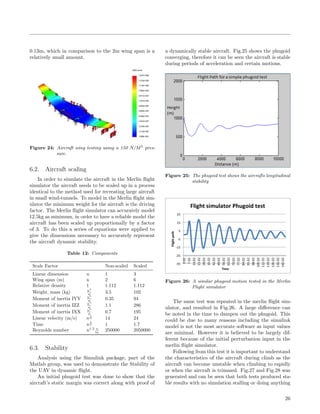
25
0.13m, which in comparison to the 2m wing span is a
relatively small amount.
Figure 24: Aircraft wing testing using a 150 N/M2
pres-
sure.
6.2. Aircraft scaling
In order to simulate the aircraft in the Merlin flight
simulator the aircraft needs to be scaled up in a process
identical to the method used for recreating large aircraft
in small wind-tunnels. To model in the Merlin flight sim-
ulator the minimum weight for the aircraft is the driving
factor. The Merlin flight simulator can accurately model
12.5kg as minimum, in order to have a reliable model the
aircraft has been scaled up proportionally by a factor
of 3. To do this a series of equations were applied to
give the dimensions necessary to accurately represent
the aircraft dynamic stability.
Table 12: Components
Scale Factor Non-scaled Scaled
Linear dimension n 1 3
Wing span (m) n 2 6
Relative density 1 1.112 1.112
Weight, mass (kg) n3
σ 3.5 102
Moment of inertia IYY n5
σ 0.35 94
Moment of inertia IZZ n5
σ 1.1 286
Moment of inertia IXX n5
σ 0.7 195
Linear velocity (m/s) n
1
2 14 24
Time n
1
2 1 1.7
Reynolds number n1.5 v
v0
250000 2050000
6.3. Stability
Analysis using the Simulink package, part of the
Matlab group, was used to demonstrate the Stability of
the UAV in dynamic flight.
An initial phugoid test was done to show that the
aircraft’s static margin was correct along with proof of
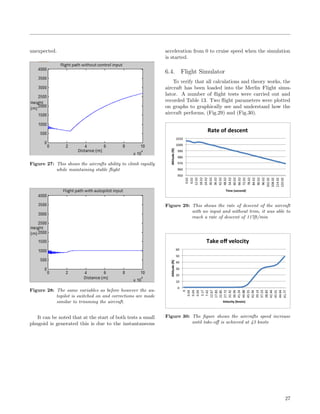
a dynamically stable aircraft. Fig.25 shows the phugoid
converging, therefore it can be seen the aircraft is stable
during periods of acceleration and certain motions.
Figure 25: The phugoid test shows the aircrafts longitudinal
stability
Figure 26: A similar phugoid motion tested in the Merlin
Flight simulator
The same test was repeated in the merlin flight sim-
ulator, and resulted in Fig.26. A large difference can
be noted in the time to dampen out the phugoid. This
could be due to many reasons including the simulink
model is not the most accurate software as input values
are minimal. However it is believed to be largely dif-
ferent because of the initial perturbation input in the
merlin flight simulator.
Following from this test it is important to understand
the characteristics of the aircraft during climb as the
aircraft can become unstable when climbing to rapidly
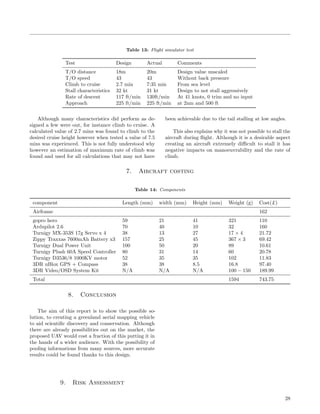
or when the aircraft is trimmed. Fig.27 and Fig.28 was
generated and can be seen that both tests produced sta-
ble results with no simulation stalling or doing anything
26
unexpected.
Figure 27: This shows the aircrafts ability to climb rapidly
while maintaining stable flight
Figure 28: The same variables as before however the au-
topilot is switched on and corrections are made
similar to trimming the aircraft.
It can be noted that at the start of both tests a small
phugoid is generated this is due to the instantaneous
acceleration from 0 to cruise speed when the simulation
is started.
6.4. Flight Simulator
To verify that all calculations and theory works, the
aircraft has been loaded into the Merlin Flight simu-
lator. A number of flight tests were carried out and
recorded Table 13. Two flight parameters were plotted
on graphs to graphically see and understand how the
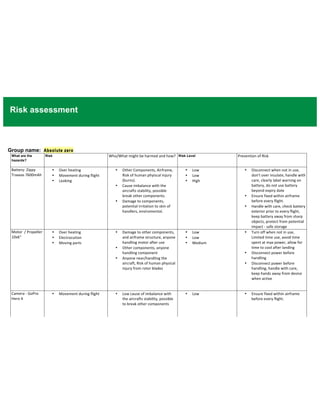
aircraft performs, (Fig.29) and (Fig.30).
Figure 29: This shows the rate of descent of the aircraft
with no input and without trim, it was able to
reach a rate of descent of 117ft/min
Figure 30: The figure shows the aircrafts speed increase
until take-off is achieved at 43 knots
27
Table 13: Flight simulator test
Test Design Actual Comments
T/O distance 18m 20m Design value unscaled
T/O speed 43 43 Without back pressure
Climb to cruise 2.7 min 7:35 min From sea level
Stall characteristics 32 kt 31 kt Design to not stall aggressively
Rate of descent 117 ft/min 130ft/min At 41 knots, 0 trim and no input
Approach 225 ft/min 225 ft/min at 2nm and 500 ft
Although many characteristics did perform as de-
signed a few were out, for instance climb to cruise. A
calculated value of 2.7 mins was found to climb to the
desired cruise height however when tested a value of 7.5
mins was experienced. This is not fully understood why
however an estimation of maximum rate of climb was
found and used for all calculations that may not have
been achievable due to the tail stalling at low angles.
This also explains why it was not possible to stall the
aircraft during flight. Although it is a desirable aspect
creating an aircraft extremely difficult to stall it has
negative impacts on manoeuvrability and the rate of
climb.
7. Aircraft costing
Table 14: Components
component Length (mm) width (mm) Height (mm) Weight (g) Cost(Ā£)
Airframe 162
gopro hero 59 21 41 321 110
Ardupilot 2.6 70 40 10 32 160
Turnigy MX-353S 17g Servo x 4 38 13 27 17 Ɨ 4 21.72
Zippy Traxxas 7600mAh Battery x3 157 25 45 367 Ɨ 3 69.42
Turnigy Dual Power Unit 100 50 20 89 10.61
Turnigy Plush 60A Speed Controller 80 31 14 60 20.78
Turnigy D3536/8 1000KV motor 52 35 35 102 11.83
3DR uBlox GPS + Compass 38 38 8.5 16.8 97.40
3DR Video/OSD System Kit N/A N/A N/A 100 āˆ’ 150 189.99
Total 1594 743.75
8. Conclusion
The aim of this report is to show the possible so-
lution, to creating a greenland aerial mapping vehicle
to aid scientific discovery and conservation. Although
there are already possibilities out on the market, the
proposed UAV would cost a fraction of this putting it in
the hands of a wider audience. With the possibility of
pooling informations from many sources, more accurate
results could be found thanks to this design.
9. Risk Assessment
28
Risk assessment
Group name: Absolute zero
What are the
hazards?
Risk Who/What	
 Ā might	
 Ā be	
 Ā harmed	
 Ā and	
 Ā how?	
 Ā  Risk Level Prevention	
 Ā of	
 Ā Risk	
 Ā 
Battery-­‐	
 Ā Zippy	
 Ā 
Traxxas	
 Ā 7600mAh	
 Ā 	
 Ā 
• Over	
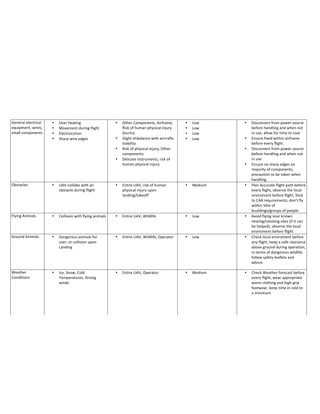
 Ā heating	
 Ā 
• Movement	
 Ā during	
 Ā flight	
 Ā 
• Leaking	
 Ā 
• Other	
 Ā Components,	
 Ā Airframe,	
 Ā 
Risk	
 Ā of	
 Ā human	
 Ā phyiscal	
 Ā injury	
 Ā 
(burns).	
 Ā 
• Cause	
 Ā imbalance	
 Ā with	
 Ā the	
 Ā 
aircrafts	
 Ā stability,	
 Ā possible	
 Ā 
break	
 Ā other	
 Ā components.	
 Ā 
• Damage	
 Ā to	
 Ā components,	
 Ā 
potential	
 Ā irritation	
 Ā to	
 Ā skin	
 Ā of	
 Ā 
handlers,	
 Ā enviromental.	
 Ā 
• Low	
 Ā 	
 Ā 
• Low	
 Ā 	
 Ā 
• High	
 Ā 
• Disconnect	
 Ā when	
 Ā not	
 Ā in	
 Ā use,	
 Ā 
don't	
 Ā over	
 Ā insulate,	
 Ā handle	
 Ā with	
 Ā 
care,	
 Ā clearly	
 Ā label	
 Ā warning	
 Ā on	
 Ā 
battery,	
 Ā do	
 Ā not	
 Ā use	
 Ā battery	
 Ā 
beyond	
 Ā expiry	
 Ā date	
 Ā 
• Ensure	
 Ā fixed	
 Ā within	
 Ā airframe	
 Ā 
before	
 Ā every	
 Ā flight.	
 Ā 
• Handle	
 Ā with	
 Ā care,	
 Ā check	
 Ā battery	
 Ā 
exterior	
 Ā prior	
 Ā to	
 Ā every	
 Ā flight,	
 Ā 
keep	
 Ā battery	
 Ā away	
 Ā from	
 Ā sharp	
 Ā 
objects,	
 Ā protect	
 Ā from	
 Ā potential	
 Ā 
impact	
 Ā -­‐	
 Ā safe	
 Ā storage	
 Ā 	
 Ā 
Motor	
 Ā 	
 Ā /	
 Ā Propeller	
 Ā 
10x6"	
 Ā 
• Over	
 Ā heating	
 Ā 
• Electrocution	
 Ā 
• Moving	
 Ā parts	
 Ā 
• Damage	
 Ā to	
 Ā other	
 Ā components,	
 Ā 
and	
 Ā airframe	
 Ā structure,	
 Ā anyone	
 Ā 
handling	
 Ā motor	
 Ā after	
 Ā use	
 Ā 	
 Ā 
• Other	
 Ā components,	
 Ā anyone	
 Ā 
handling	
 Ā component	
 Ā 
• Anyone	
 Ā near/handling	
 Ā the	
 Ā 
aircraft,	
 Ā Risk	
 Ā of	
 Ā human	
 Ā physical	
 Ā 
injury	
 Ā from	
 Ā rotor	
 Ā blades	
 Ā 
• Low	
 Ā 	
 Ā 
• Low	
 Ā 	
 Ā 
• Medium	
 Ā 
• Turn	
 Ā off	
 Ā when	
 Ā not	
 Ā in	
 Ā use,	
 Ā 
Limited	
 Ā time	
 Ā use,	
 Ā avoid	
 Ā time	
 Ā 
spent	
 Ā at	
 Ā max	
 Ā power,	
 Ā allow	
 Ā for	
 Ā 
time	
 Ā to	
 Ā cool	
 Ā after	
 Ā landing	
 Ā 
• Disconnect	
 Ā power	
 Ā before	
 Ā 
handling	
 Ā 
• Disconnect	
 Ā power	
 Ā before	
 Ā 
handling,	
 Ā handle	
 Ā with	
 Ā care,	
 Ā 
keep	
 Ā hands	
 Ā away	
 Ā from	
 Ā device	
 Ā 
when	
 Ā active	
 Ā 
Camera	
 Ā -­‐	
 Ā GoPro	
 Ā 
Hero	
 Ā 4	
 Ā 
• Movement	
 Ā during	
 Ā flight	
 Ā  • Low	
 Ā cause	
 Ā of	
 Ā imbalance	
 Ā with	
 Ā 
the	
 Ā aircrafts	
 Ā stability,	
 Ā possible	
 Ā 
to	
 Ā break	
 Ā other	
 Ā components	
 Ā 
• Low	
 Ā 	
 Ā  • Ensure	
 Ā fixed	
 Ā within	
 Ā airframe	
 Ā 
before	
 Ā every	
 Ā flight.	
 Ā 
General	
 Ā electrical	
 Ā 
equipment,	
 Ā wires,	
 Ā 
small	
 Ā components	
 Ā 	
 Ā 
• Over	
 Ā heating	
 Ā 
• Movement	
 Ā during	
 Ā flight	
 Ā 
• Electrocution	
 Ā 
• Sharp	
 Ā wire	
 Ā edges	
 Ā 
• Other	
 Ā Components,	
 Ā Airframe,	
 Ā 
Risk	
 Ā of	
 Ā human	
 Ā physical	
 Ā injury	
 Ā 
(burns)	
 Ā 
• Slight	
 Ā imbalance	
 Ā with	
 Ā aircrafts	
 Ā 
stability	
 Ā 
• Risk	
 Ā of	
 Ā physical	
 Ā injury,	
 Ā Other	
 Ā 
components	
 Ā 
• Delicate	
 Ā instruments,	
 Ā risk	
 Ā of	
 Ā 
human	
 Ā physical	
 Ā injury	
 Ā 
• Low	
 Ā 	
 Ā 
• Low	
 Ā 	
 Ā 
• Low	
 Ā 	
 Ā 
• Low	
 Ā 	
 Ā 
• Disconnect	
 Ā from	
 Ā power	
 Ā source	
 Ā 
before	
 Ā handling	
 Ā and	
 Ā when	
 Ā not	
 Ā 
in	
 Ā use,	
 Ā allow	
 Ā for	
 Ā time	
 Ā to	
 Ā cool	
 Ā 
• Ensure	
 Ā fixed	
 Ā within	
 Ā airframe	
 Ā 
before	
 Ā every	
 Ā flight.	
 Ā 
• Disconnect	
 Ā from	
 Ā power	
 Ā source	
 Ā 
before	
 Ā handling	
 Ā and	
 Ā when	
 Ā not	
 Ā 
in	
 Ā use	
 Ā 
• Ensure	
 Ā no	
 Ā sharp	
 Ā edges	
 Ā on	
 Ā 
majority	
 Ā of	
 Ā components,	
 Ā 
precaution	
 Ā to	
 Ā be	
 Ā taken	
 Ā when	
 Ā 
handling	
 Ā 
Obstacles	
 Ā  • UAV	
 Ā collides	
 Ā with	
 Ā an	
 Ā 
obstacle	
 Ā during	
 Ā flight	
 Ā 
• Entire	
 Ā UAV,	
 Ā risk	
 Ā of	
 Ā human	
 Ā 
physical	
 Ā injury	
 Ā upon	
 Ā 
landing/takeoff	
 Ā 
• Medium	
 Ā  • Plan	
 Ā Accurate	
 Ā flight	
 Ā path	
 Ā before	
 Ā 
every	
 Ā flight,	
 Ā observe	
 Ā the	
 Ā local	
 Ā 
enviroment	
 Ā before	
 Ā flight,	
 Ā Stick	
 Ā 
to	
 Ā CAA	
 Ā requirements,	
 Ā don't	
 Ā fly	
 Ā 
within	
 Ā 50m	
 Ā of	
 Ā 
buuldings/groups	
 Ā of	
 Ā people	
 Ā 
Flying	
 Ā Animals	
 Ā  • Collision	
 Ā with	
 Ā flying	
 Ā animals	
 Ā  • Entire	
 Ā UAV,	
 Ā Wildlife	
 Ā  • Low	
 Ā 	
 Ā  • Avoid	
 Ā flying	
 Ā near	
 Ā known	
 Ā 
nesting/roosting	
 Ā sites	
 Ā (if	
 Ā it	
 Ā can	
 Ā 
be	
 Ā helped),	
 Ā observe	
 Ā the	
 Ā local	
 Ā 
enviroment	
 Ā before	
 Ā flight	
 Ā 
Ground	
 Ā Animals	
 Ā 	
 Ā  • Dangerous	
 Ā animals	
 Ā for	
 Ā 
user,	
 Ā or	
 Ā collision	
 Ā upon	
 Ā 
Landing	
 Ā 
• Entire	
 Ā UAV,	
 Ā Wildlife,	
 Ā Operator	
 Ā  • Low	
 Ā 	
 Ā  • Check	
 Ā local	
 Ā enviroment	
 Ā before	
 Ā 
any	
 Ā flight,	
 Ā keep	
 Ā a	
 Ā safe	
 Ā clearance	
 Ā 
above	
 Ā ground	
 Ā during	
 Ā operation,	
 Ā 
in	
 Ā terms	
 Ā of	
 Ā dangerous	
 Ā wildlife,	
 Ā 
follow	
 Ā safety	
 Ā leaflets	
 Ā and	
 Ā 
advice	
 Ā 	
 Ā 
Weather	
 Ā 
Conditions	
 Ā 
	
 Ā 
• Ice,	
 Ā Snow,	
 Ā Cold	
 Ā 
Temperatures,	
 Ā Strong	
 Ā 
winds	
 Ā 
	
 Ā 
• Entire	
 Ā UAV,	
 Ā Operator	
 Ā 
	
 Ā 
• Medium	
 Ā 
	
 Ā 
• Check	
 Ā Weather	
 Ā forecast	
 Ā before	
 Ā 
every	
 Ā flight,	
 Ā wear	
 Ā appropriate	
 Ā 
warm	
 Ā clothing	
 Ā and	
 Ā high-­‐grip	
 Ā 
footwear,	
 Ā keep	
 Ā time	
 Ā in	
 Ā cold	
 Ā to	
 Ā 
a	
 Ā minimum	
 Ā 
	
 Ā 
Systems	
 Ā 
	
 Ā 
• Power	
 Ā failure	
 Ā during	
 Ā flight	
 Ā 
• Communication	
 Ā failure	
 Ā 
during	
 Ā flight	
 Ā 
• Control	
 Ā system	
 Ā failure	
 Ā 
during	
 Ā flight	
 Ā 
• Entire	
 Ā UAV,	
 Ā (rare	
 Ā likelihood	
 Ā of	
 Ā 
wildlife	
 Ā or	
 Ā people)	
 Ā 
• Entire	
 Ā UAV,	
 Ā (rare	
 Ā likelihood	
 Ā of	
 Ā 
wildlife	
 Ā or	
 Ā people)	
 Ā 
• Entire	
 Ā UAV,	
 Ā (rare	
 Ā likelihood	
 Ā of	
 Ā 
wildlife	
 Ā or	
 Ā people)	
 Ā 
	
 Ā 
• Medium	
 Ā 
• Medium	
 Ā 
• Medium	
 Ā 
	
 Ā 
• Routinely	
 Ā check	
 Ā equipment	
 Ā and	
 Ā 
aircraft	
 Ā before	
 Ā every	
 Ā flight,	
 Ā Do	
 Ā 
not	
 Ā operate	
 Ā near	
 Ā large	
 Ā groups	
 Ā 
of	
 Ā people	
 Ā or	
 Ā buildings	
 Ā 
• Routinely	
 Ā check	
 Ā equipment	
 Ā and	
 Ā 
aircraft	
 Ā before	
 Ā every	
 Ā flight,	
 Ā Do	
 Ā 
not	
 Ā operate	
 Ā near	
 Ā large	
 Ā groups	
 Ā 
of	
 Ā people	
 Ā or	
 Ā buildings	
 Ā 
• Routinely	
 Ā check	
 Ā equipment	
 Ā and	
 Ā 
aircraft	
 Ā before	
 Ā every	
 Ā flight,	
 Ā Do	
 Ā 
not	
 Ā operate	
 Ā near	
 Ā large	
 Ā groups	
 Ā 
of	
 Ā people	
 Ā or	
 Ā buildings	
 Ā 
	
 Ā 
References
[1] Nichols.edu. Alpine Glacier Mass
Balance [Internet]. Available from:
http://www.nichols.edu/departments/glacier/mb.htm
[2] Thomas Mlg. Worldwide glacier re-
treat. RealClimate. available at
www.realclimate.org/index.php?p=129
[3] Caa.co.uk. Do I need a Permission for an
Unmanned Aircraft (UAS) — Aircraft —
Operations and Safety [Internet]. Available
from: http://www.caa.co.uk/default.aspx?catid
=1995&pageid=16006
[4] Unmanned Aircraft System Operations In UK
Airspace Guidance, CAP 722. 6th ed. CAA, 2015.
Print.
[5] Web.mit.edu. [Internet]. 2013 Available from:
http://web.mit.edu/drela/Public/web/xfoil/
[6] Redhammer.se. Tornado, the Vortex lat-
tice method. [Internet]. Available from:
http://www.redhammer.se/tornado/
[7] Xflr5.com. XFLR5 [Internet]. 2015. Available from:
http://www.xflr5.com/xflr5.htm
[8] Airfoiltools.com. Airfoil Tools [Internet]. Available
from: http://www.airfoiltools.com/
[9] High lift generating fuselage concept http :
//www.ijetae.com/files/V olume2Issue5
[10] Quantum Devices INC. Brushless Mo-
tors vs Brush Motors, what’s the differ-
ence? [Internet]. 2010 Available from:
https://quantumdevices.wordpress.com/2010/08/27
/brushless-motors-vs-brush-motors-whats-the-
difference/
[11] Brown, M. (2014). Sizing RC Airplane Pro-
pellers. [online] Hooked on RC Airplanes. Available
at: http://www.hooked-on-rc-airplanes.com/sizing-
rc-airplane-propellers.html
[12] Carpenter. P. RC Airplane Propeller Size Guide
[Internet]. Rc-airplane-world.com. 2015. Available
from: http://www.rc-airplane-world.com/propeller-
size.html
[13] Altairhyperworks.com. HyperWorks: Open Archi-
tecture CAE solution [Internet]. 2015 Available
from: http://www.altairhyperworks.com/
[14] CES Edupack. (2014). United Kingdom: Granta.
[15] Hirrus mini UAV system [Internet]. 1st ed.
Bucharest: TeamNet International S.A;
2015 [cited 8 March 2015]. Available from:
http://www.aft.ro/bro.pdf
[16] Aeromao.com. Aeromao - Aeromapper 300 [Inter-
net]. 2015 [cited 2 March 2015]. Available from:
http : //www.aeromao.com/aeromapper300
[17] 3. Fpvflying.com. Mugin 2600 UAV FPV
platform - FPV flying [Internet]. 2015
[cited 18 March 2015]. Available from:
http://www.fpvflying.com/products/Mugin-
2600-UAV-FPV-platform.html
[18] HobbyKing Store. Skywalker X8 FPV / UAV Flying
Wing 2120mm [Internet]. 2015 [cited 12 May 2015].
Available from http://www.hobbyking.co.uk/
[19] HobbyKing Store. Durafly Zephyr V-70 High Per-
formance 70mm EDF V-Tail Glider 1533mm (PNF)
[Internet]. 2015 [cited 12 May 2015]. Available from
http://www.hobbyking.co.uk/
[20] HobbyKing Store. UAV-3000 Composite FPV/UAV
Aircraft 3000mm (ARF) (EU Warehouse) [Inter-
net]. 2015 [cited 12 March 2015]. Available from
http://www.hobbyking.co.uk/
10. Appendix 1 (VTS)
32
Vehicle	
 Ā Technical	
 Ā Specification	
 Ā 
	
 Ā 
11/2/14	
 Ā  18/11/14	
 Ā  25/11/14	
 Ā  4/12/14	
 Ā 
	
 Ā 
3/2/15	
 Ā 
	
 Ā 
23/02/15	
 Ā  24/02/15	
 Ā  25/02/15	
 Ā  11/3/15	
 Ā 
Main	
 Ā wing	
 Ā geometry	
 Ā 
	
 Ā 
	
 Ā 
Wing	
 Ā Span,	
 Ā b	
 Ā  2	
 Ā  3	
 Ā  2.4	
 Ā  2.4	
 Ā 
	
 Ā 
2.4	
 Ā  2.4	
 Ā  2.3	
 Ā  2	
 Ā  2	
 Ā 
Cord	
 Ā length,	
 Ā c	
 Ā  0.2	
 Ā  0.3	
 Ā  0.3	
 Ā  0.3	
 Ā 
	
 Ā 
0.3	
 Ā  0.3	
 Ā  0.3	
 Ā  0.3	
 Ā  0.3	
 Ā 
Root	
 Ā Chord	
 Ā 
	
 Ā 
0.45	
 Ā  0.45	
 Ā 
Surface	
 Ā area,	
 Ā s	
 Ā  0.4	
 Ā  0.9	
 Ā  0.6154	
 Ā  6154	
 Ā 
	
 Ā 
0.6	
 Ā  0.6	
 Ā  0.634	
 Ā  0.5725	
 Ā  0.5725	
 Ā 
Aerofoil	
 Ā  NACA2412	
 Ā  NACA2412	
 Ā NACA6412	
 Ā NACA6413	
 Ā 
	
 Ā 
NACA6412	
 Ā  NACA6412	
 Ā  NACA6412	
 Ā  NACA6412	
 Ā  NACA2412	
 Ā 
oswald	
 Ā efficiency,	
 Ā e	
 Ā  0.7	
 Ā  0.8	
 Ā  0.8	
 Ā  0.8	
 Ā 
	
 Ā 
0.8	
 Ā  0.8	
 Ā  0.8	
 Ā  0.8	
 Ā  0.8	
 Ā 
Aspect	
 Ā ratio	
 Ā  10	
 Ā  10	
 Ā  9.37	
 Ā  9.37	
 Ā 
	
 Ā 
9.6	
 Ā  9.6	
 Ā  8.73	
 Ā  7	
 Ā  7	
 Ā 
Mean	
 Ā Aerodynamic	
 Ā Chord	
 Ā 
	
 Ā 
0.26	
 Ā  0.26	
 Ā  0.30162	
 Ā  0.31252	
 Ā  0.31252	
 Ā 
Mean	
 Ā Geometric	
 Ā Chord	
 Ā 
	
 Ā 
0.25	
 Ā  0.25	
 Ā  0.26359	
 Ā  0.28625	
 Ā  0.28625	
 Ā 
Span	
 Ā partition	
 Ā 1	
 Ā 
	
 Ā 
0.4	
 Ā  0.4	
 Ā 
	
 Ā 
0.4	
 Ā  0.4	
 Ā  0.4	
 Ā  0.15	
 Ā  0.15	
 Ā 
Span	
 Ā partition	
 Ā 2	
 Ā 
	
 Ā 
0.8	
 Ā  0.8	
 Ā 
	
 Ā 
0.8	
 Ā  0.8	
 Ā  0.6	
 Ā  0.25	
 Ā  0.25	
 Ā 
Span	
 Ā partition	
 Ā 3	
 Ā 
	
 Ā 
0.6	
 Ā  0.6	
 Ā 
Sweep	
 Ā angle	
 Ā (degrees)	
 Ā 
partition	
 Ā 1	
 Ā 
	
 Ā 
0	
 Ā  0	
 Ā 
	
 Ā 
0	
 Ā  0	
 Ā  0	
 Ā  0	
 Ā  0	
 Ā 
Sweep	
 Ā angle	
 Ā (degrees)	
 Ā 
partition	
 Ā 2	
 Ā 
	
 Ā 
10	
 Ā  10	
 Ā 
	
 Ā 
10	
 Ā  10	
 Ā  10	
 Ā  10	
 Ā  10	
 Ā 
Sweep	
 Ā angle	
 Ā (	
 Ā degrees)	
 Ā 
partition	
 Ā 3	
 Ā 
	
 Ā 
10	
 Ā  10	
 Ā 
Taper	
 Ā ratio	
 Ā partition	
 Ā 1	
 Ā 
	
 Ā 
1	
 Ā  1	
 Ā 
	
 Ā 
1	
 Ā  1	
 Ā  1	
 Ā  1	
 Ā  1	
 Ā 
Taper	
 Ā ratio	
 Ā partition	
 Ā 2	
 Ā 
	
 Ā 
2	
 Ā  2	
 Ā 
	
 Ā 
2	
 Ā  2	
 Ā  2	
 Ā  1.125	
 Ā  1.125	
 Ā 
taper	
 Ā ratio	
 Ā partition	
 Ā 3	
 Ā 
	
 Ā 
2	
 Ā  2	
 Ā 
Wing	
 Ā Inclination	
 Ā 
	
 Ā 
3.7	
 Ā  3.25	
 Ā  3.5	
 Ā  4.5	
 Ā 
partition	
 Ā 1	
 Ā 
root	
 Ā chord	
 Ā =	
 Ā 
0.45	
 Ā tip	
 Ā 
chord	
 Ā =	
 Ā 0.4	
 Ā 
	
 Ā 
partition	
 Ā 2	
 Ā 
root	
 Ā chord	
 Ā =	
 Ā 
0.4	
 Ā tip	
 Ā chord	
 Ā 
=0.3	
 Ā 
	
 Ā 
partition	
 Ā 3	
 Ā 
root	
 Ā chord	
 Ā =	
 Ā 
0.3	
 Ā tip	
 Ā chord	
 Ā 
=	
 Ā 0.15	
 Ā 
	
 Ā 
Winglet	
 Ā Span	
 Ā 
	
 Ā 
0.15	
 Ā  	
 Ā 
Winglet	
 Ā Sweep	
 Ā 
	
 Ā 
20	
 Ā  	
 Ā 
Winglet	
 Ā Aerofoil	
 Ā 
	
 Ā 
NACA0018	
 Ā  	
 Ā 
Winglet	
 Ā Dihedral	
 Ā 
	
 Ā 
90	
 Ā  	
 Ā 
Tail	
 Ā wing	
 Ā geometry	
 Ā 
	
 Ā 
Veritcal	
 Ā tail	
 Ā 
	
 Ā 
cvt	
 Ā  0.3	
 Ā  0.03	
 Ā  0.03	
 Ā  0.03	
 Ā 
	
 Ā 
0.03	
 Ā  0.03	
 Ā  0.03	
 Ā  0.03	
 Ā  0.03	
 Ā 
Vertical	
 Ā tail	
 Ā chord	
 Ā 
	
 Ā 
0.16	
 Ā  0.16	
 Ā 
	
 Ā 
0.16	
 Ā  0.2	
 Ā  0.2	
 Ā  0.2	
 Ā  0.2	
 Ā 
verticle	
 Ā height,	
 Ā hvt	
 Ā  0.12	
 Ā  0.405	
 Ā  0.324	
 Ā  0.2592	
 Ā 
	
 Ā 
0.2592	
 Ā  0.2767	
 Ā  0.22	
 Ā  0.22	
 Ā  0.22	
 Ā 
SVT	
 Ā 
	
 Ā 
4.43E-­‐02	
 Ā  4.43E-­‐02	
 Ā  4.40E-­‐02	
 Ā  4.40E-­‐02	
 Ā  4.40E-­‐02	
 Ā 
Sweep	
 Ā angle	
 Ā (degrees)	
 Ā 
	
 Ā 
10	
 Ā  10	
 Ā 
	
 Ā 
10	
 Ā  10	
 Ā  10	
 Ā  20	
 Ā  20	
 Ā 
Taper	
 Ā ratio	
 Ā of	
 Ā Vertical	
 Ā tail	
 Ā 
	
 Ā 
2	
 Ā  2	
 Ā 
	
 Ā 
2	
 Ā  2	
 Ā  2	
 Ā  2	
 Ā  2	
 Ā 
Aerofoil	
 Ā 
	
 Ā 
NACA0012	
 Ā 
	
 Ā 
NACA0012	
 Ā  NACA0012	
 Ā  NACA0012	
 Ā  NACA0012	
 Ā  NACA0012	
 Ā 
	
 Ā 
Horizontal	
 Ā Tail	
 Ā 
	
 Ā 
cht	
 Ā  0.6	
 Ā  0.6	
 Ā  0.6	
 Ā  0.6	
 Ā 
	
 Ā 
0.6	
 Ā  0.6	
 Ā  0.6	
 Ā  0.6	
 Ā  0.6	
 Ā 
horizontal	
 Ā cord,	
 Ā 
	
 Ā 
0.2	
 Ā  0.2	
 Ā 
	
 Ā 
0.2	
 Ā  0.2	
 Ā  0.2	
 Ā  0.2	
 Ā  0.2	
 Ā 
horizontal	
 Ā span,	
 Ā spanht	
 Ā  0.24	
 Ā  0.54	
 Ā  0.864	
 Ā  0.864	
 Ā 
	
 Ā 
0.576	
 Ā  0.48	
 Ā  0.49	
 Ā  0.46	
 Ā  0.66	
 Ā 
SHT	
 Ā 
	
 Ā 
0.8856	
 Ā  0.072	
 Ā  0.0727	
 Ā  0.069	
 Ā  0.0983	
 Ā 
Sweep	
 Ā angle	
 Ā (degrees)	
 Ā 
	
 Ā 
10	
 Ā  10	
 Ā 
	
 Ā 
10	
 Ā  10	
 Ā  10	
 Ā  10	
 Ā  10	
 Ā 
Taper	
 Ā ratio	
 Ā of	
 Ā Horizontal	
 Ā tail	
 Ā 
	
 Ā 
2	
 Ā  2	
 Ā 
	
 Ā 
2	
 Ā  2	
 Ā  2	
 Ā  2	
 Ā  2	
 Ā 
Aerofoil	
 Ā 
	
 Ā 
NACA0018	
 Ā 
	
 Ā 
NACA0012	
 Ā  NAAC0012	
 Ā  NAAC0012	
 Ā  NACA0012	
 Ā  NACA0012	
 Ā 
	
 Ā 
Tail	
 Ā Aerodyanmics	
 Ā 
	
 Ā 
tail	
 Ā volume,	
 Ā VH	
 Ā 
	
 Ā 
0.2807929
802	
 Ā 
0.2807929
802	
 Ā 
	
 Ā 
0.5399865
003	
 Ā  0.45	
 Ā  0.43	
 Ā 
	
 Ā 
0.52	
 Ā 
Cltalpha	
 Ā 3deg	
 Ā 
	
 Ā 
0.36	
 Ā 
Weight	
 Ā and	
 Ā performance	
 Ā 
	
 Ā 
Weight	
 Ā (kg)	
 Ā 	
 Ā  6	
 Ā 
	
 Ā 
6	
 Ā  6	
 Ā 
	
 Ā 
4.3	
 Ā  4.3	
 Ā  4.3	
 Ā  3.5	
 Ā 
Vstall	
 Ā (m/s)	
 Ā 
	
 Ā 
9.4329	
 Ā  9.1334	
 Ā  10.0051	
 Ā 
	
 Ā 
8.47	
 Ā  8.24	
 Ā  8.67	
 Ā  9.62	
 Ā 
Vtakeoff	
 Ā (m/s)	
 Ā 
	
 Ā 
11.3195	
 Ā  10.96	
 Ā  12.0061	
 Ā 
	
 Ā 
10.16	
 Ā  9.89	
 Ā  10.41	
 Ā  11.54	
 Ā 
Absolute	
 Ā ceiling	
 Ā 
	
 Ā 
7700	
 Ā  7800	
 Ā 
	
 Ā 
6600	
 Ā  14700	
 Ā  14000	
 Ā  14600	
 Ā 
Service	
 Ā ceiling	
 Ā 	
 Ā 
	
 Ā 
13700	
 Ā 
Maximum	
 Ā rate	
 Ā of	
 Ā climb,	
 Ā 
ROCmax	
 Ā 
	
 Ā 
2.0103471
35	
 Ā  2.0333	
 Ā 
	
 Ā 
1.07	
 Ā  11.14	
 Ā  10.97	
 Ā  11.1	
 Ā 
Load	
 Ā factor	
 Ā (maximum)	
 Ā 
	
 Ā 
1.33	
 Ā 
Time	
 Ā to	
 Ā climb	
 Ā 
	
 Ā 
541.1524	
 Ā  5.34E+02	
 Ā 
	
 Ā 
1.03E+03	
 Ā  9.48E+01	
 Ā  94.79	
 Ā  95.22	
 Ā 
Sink	
 Ā rate	
 Ā at	
 Ā 13.889	
 Ā m/s	
 Ā 
	
 Ā 
0.981	
 Ā  9.10E-­‐01	
 Ā 
	
 Ā 
0.65	
 Ā  0.65	
 Ā  0.95	
 Ā  0.8	
 Ā 
Take	
 Ā off	
 Ā distance	
 Ā 
	
 Ā 
72	
 Ā 
	
 Ā 
61	
 Ā  61	
 Ā  62	
 Ā  8.84(S_G)	
 Ā 
Range	
 Ā 
	
 Ā 
1.41E+05	
 Ā  1.41E+05	
 Ā 
141392.642
2	
 Ā  4.15E+04	
 Ā 
Endurance	
 Ā 
	
 Ā 
Turning	
 Ā radius	
 Ā 
	
 Ā 
5.06	
 Ā 
Pull	
 Ā up	
 Ā radius	
 Ā 
	
 Ā 
13.47	
 Ā 
Pull	
 Ā down	
 Ā radius	
 Ā 
	
 Ā 
1.9	
 Ā 
Max	
 Ā payload	
 Ā (N)	
 Ā 
	
 Ā 
Ix	
 Ā 
	
 Ā 
0.531	
 Ā  0.333	
 Ā  0.252	
 Ā  0.252	
 Ā 
Iy	
 Ā 
	
 Ā 
0.412	
 Ā  0.4071	
 Ā  0.407	
 Ā  0.407	
 Ā 
Iz	
 Ā 
	
 Ā 
0.904	
 Ā  0.6153	
 Ā  0.523	
 Ā  0.523	
 Ā 
	
 Ā 
Aerodynamics	
 Ā 
	
 Ā 
CD0	
 Ā  0.01	
 Ā  0.01	
 Ā  0.025	
 Ā 
	
 Ā 
0.024	
 Ā  0.024	
 Ā  0.024	
 Ā  0.024	
 Ā  0.013	
 Ā 
Clmax	
 Ā  1.25	
 Ā  1.25	
 Ā  1.6	
 Ā 
	
 Ā 
1.6	
 Ā  1.6	
 Ā  1.6	
 Ā  1.6	
 Ā  1.3	
 Ā 
Clalpha	
 Ā  0.1	
 Ā  0.1	
 Ā  0.1	
 Ā 
	
 Ā 
0.1	
 Ā  0.1	
 Ā  0.1	
 Ā  0.1	
 Ā  0.1	
 Ā 
Stall	
 Ā angle	
 Ā of	
 Ā attack	
 Ā Degrees	
 Ā 
	
 Ā 
11.4176	
 Ā 
	
 Ā 
11.4176	
 Ā  11.4176	
 Ā  9.915	
 Ā  11.9021	
 Ā 
inclination	
 Ā angle	
 Ā  4	
 Ā  4	
 Ā  4	
 Ā  4	
 Ā 
	
 Ā 
4	
 Ā 
	
 Ā 
3.7	
 Ā  3.25	
 Ā  3.5	
 Ā  4.5	
 Ā 
CL	
 Ā STLUF	
 Ā Tornado	
 Ā 
	
 Ā 
0.75069	
 Ā  0.78	
 Ā 
	
 Ā 
CD	
 Ā STLUF	
 Ā Tornado	
 Ā 
	
 Ā 
0.023935	
 Ā  0.0275	
 Ā 
	
 Ā 
Ā 
CL	
 Ā STLUF	
 Ā matlab	
 Ā  0.5535	
 Ā  0.5535	
 Ā  0.6919	
 Ā 
	
 Ā  	
 Ā 
0.826	
 Ā  0.826	
 Ā 
	
 Ā  	
 Ā 
CD	
 Ā STLUF	
 Ā matlab	
 Ā  0.0203	
 Ā  0.0203	
 Ā  0.0488	
 Ā 
	
 Ā  	
 Ā 
0.0481	
 Ā  0.0481	
 Ā 
	
 Ā  	
 Ā 
CL	
 Ā STLUF	
 Ā XFLR	
 Ā 
	
 Ā  	
 Ā 
0.798	
 Ā  0.7682	
 Ā  0.7682	
 Ā 
	
 Ā  	
 Ā 
CD	
 Ā STLUF	
 Ā XFLR	
 Ā 
	
 Ā  	
 Ā 
0.0244	
 Ā  0.0225	
 Ā  0.0225	
 Ā 
	
 Ā  	
 Ā 
Lift	
 Ā Tornado	
 Ā 
	
 Ā 
51.007	
 Ā  47.8955	
 Ā 
	
 Ā 
Drag	
 Ā Tornado	
 Ā 
	
 Ā 
1.6263	
 Ā  1.6868	
 Ā 
	
 Ā 
Lift	
 Ā matlab	
 Ā  34.9367	
 Ā  47.1645	
 Ā  60.0968	
 Ā 
	
 Ā 
82.2606	
 Ā 
	
 Ā 
53.1547	
 Ā  53.1547	
 Ā 
	
 Ā  	
 Ā 
Drag	
 Ā matlab	
 Ā 
	
 Ā  	
 Ā 
3.0953	
 Ā  3.0953	
 Ā 
	
 Ā  	
 Ā 
Lift	
 Ā XFLR	
 Ā 
	
 Ā  	
 Ā 
49.4352	
 Ā  49.4352	
 Ā 
	
 Ā  	
 Ā 
Drag	
 Ā XFLR	
 Ā 
	
 Ā  	
 Ā 
1.4479	
 Ā  1.4479	
 Ā 
	
 Ā  	
 Ā 
WIND	
 Ā TUNNEL	
 Ā CL	
 Ā 
	
 Ā 
0.69479	
 Ā 
WING	
 Ā TUNNEL	
 Ā CD	
 Ā 
	
 Ā 
0.10156	
 Ā 
Reynolds	
 Ā number	
 Ā  175000	
 Ā  290340	
 Ā  290340	
 Ā 
	
 Ā 
290340	
 Ā  290340	
 Ā  290340	
 Ā 
	
 Ā 
250000	
 Ā 
Static	
 Ā margin	
 Ā (Tornado)	
 Ā 
	
 Ā 
0.50502	
 Ā 
	
 Ā 
0.2117	
 Ā 
	
 Ā 
Neutral	
 Ā Point	
 Ā 
	
 Ā 
0.3235	
 Ā 
	
 Ā 
0.3728	
 Ā 
Hand	
 Ā calc.	
 Ā Static	
 Ā Margin	
 Ā 
	
 Ā 
0.1515	
 Ā 
	
 Ā 
0.2359	
 Ā  0.2115	
 Ā 
Centre	
 Ā of	
 Ā Gravity	
 Ā coords	
 Ā 
	
 Ā 
0.075	
 Ā 0	
 Ā 0	
 Ā  0.381	
 Ā 
	
 Ā 
Center	
 Ā of	
 Ā Pressure	
 Ā Coords	
 Ā 
	
 Ā 
0.38	
 Ā 
	
 Ā 
Power	
 Ā available,	
 Ā Pa0	
 Ā 
	
 Ā 
1300	
 Ā 
	
 Ā  	
 Ā 
90	
 Ā  90	
 Ā  430	
 Ā 
Static	
 Ā thrust,	
 Ā kg	
 Ā  4	
 Ā 
	
 Ā  	
 Ā  	
 Ā 
1.8	
 Ā  1.8	
 Ā 
	
 Ā Dynamic	
 Ā thrust	
 Ā (w/o	
 Ā 
efficiencies)	
 Ā 
	
 Ā 
6.5	
 Ā  6.5	
 Ā  36	
 Ā 
Engine	
 Ā efficiency	
 Ā 
	
 Ā 
85%	
 Ā  85%	
 Ā 
	
 Ā 
85%	
 Ā  85%	
 Ā  83%	
 Ā 
Propeller	
 Ā efficiency	
 Ā 
	
 Ā  	
 Ā 
45%	
 Ā  45%	
 Ā  45%	
 Ā 
Engine	
 Ā weight	
 Ā 
	
 Ā  	
 Ā 
160g	
 Ā  160g	
 Ā  102g	
 Ā 
propeller	
 Ā weight	
 Ā 
	
 Ā  	
 Ā 
35g	
 Ā  35g	
 Ā  35g	
 Ā 
propeller	
 Ā size	
 Ā 
	
 Ā 
15x8	
 Ā  10x5	
 Ā  10x5	
 Ā  10x5	
 Ā 
Control	
 Ā Systems	
 Ā 
	
 Ā 
APM	
 Ā 2.6	
 Ā Autopilot	
 Ā  28g	
 Ā 
7	
 Ā cm	
 Ā x	
 Ā 4.5	
 Ā 
cm	
 Ā x	
 Ā 1.5	
 Ā 
cm	
 Ā 
TTL	
 Ā 3DR	
 Ā Radio	
 Ā 3DRobotics	
 Ā 
Telemetry	
 Ā 433Mhz	
 Ā module	
 Ā 
	
 Ā 
6.9	
 Ā cm	
 Ā x	
 Ā 
1.7	
 Ā cm	
 Ā x	
 Ā 
0.5	
 Ā cm	
 Ā 
MAVLink-­‐OSD	
 Ā  6g	
 Ā 
19mmx39
mm	
 Ā (no	
 Ā 
include	
 Ā 
connector)	
 Ā 
*UART	
 Ā 
4Pin	
 Ā cable	
 Ā 
150mm	
 Ā 
APM	
 Ā Power	
 Ā Module	
 Ā  17g	
 Ā 
25mm	
 Ā x	
 Ā 
21mm	
 Ā x	
 Ā 
9mm	
 Ā 
GoPro	
 Ā Hero4	
 Ā Silver	
 Ā Edition	
 Ā 
83g	
 Ā /	
 Ā 
147g(with	
 Ā 
housing)	
 Ā 
	
 Ā  	
 Ā ZIPPY	
 Ā Traxxas	
 Ā 7600mAh	
 Ā 
2S1P	
 Ā 30C	
 Ā Lipo	
 Ā Pack	
 Ā x3	
 Ā 
	
 Ā 
367g	
 Ā x3	
 Ā =	
 Ā 
1101g	
 Ā 
157x45x25
mm	
 Ā 

Final year Design Report

  • 1.
    College of Engineering CourseworkSubmission Sheet Ā  Ā  Ā  By submitting this coursework, I certify that this is all my own work. Ā  Ā  Submission Ā date Ā 15/05/15 Ā  Ā  Ā  Ā  Student Ā signature Ā if Ā this Ā is Ā a Ā non-­‐electronic Ā submission………………………………………………… Ā  Ā  Ā  Ā  Ā  Ā  SPLD Ā Students Ā  Please tick this box if you are officially recognised by the University as an SPLD student. Ā  Ā  Ā  Ā  Ā  Ā  Ā  Coursework Title: Final Report Coursework number (i.e. CW1 CW2) Module code: EGA 302 Module title: Aerospace engineering design Submission deadline: 15/05/15 Supervisor: Dr Ben Evans Student number: 710820 Group Name Absolute Zero Email: 710820@swansea.ac.uk Degree course: Meng Aerospace engineering
  • 2.
    Contents 1 Introduction 4 2Concept Design Process 4 2.1 Team Role Agreement . . . . . . . . . . . . . . . . . . . . . . . . . . . . . . . . . . . . . . . . . . . . 4 2.2 Mission requirements . . . . . . . . . . . . . . . . . . . . . . . . . . . . . . . . . . . . . . . . . . . . . 4 2.3 Competitor Survey . . . . . . . . . . . . . . . . . . . . . . . . . . . . . . . . . . . . . . . . . . . . . . 4 3 Regulations 8 4 Preliminary Design 8 4.1 Aerodynamics . . . . . . . . . . . . . . . . . . . . . . . . . . . . . . . . . . . . . . . . . . . . . . . . . 8 4.1.1 Aerofoil selection . . . . . . . . . . . . . . . . . . . . . . . . . . . . . . . . . . . . . . . . . . . 8 4.1.2 Aerodynamic characteristics . . . . . . . . . . . . . . . . . . . . . . . . . . . . . . . . . . . . . 9 4.1.3 Aircraft changes . . . . . . . . . . . . . . . . . . . . . . . . . . . . . . . . . . . . . . . . . . . 9 4.2 Structural Design . . . . . . . . . . . . . . . . . . . . . . . . . . . . . . . . . . . . . . . . . . . . . . . 10 4.2.1 Structural Diagram . . . . . . . . . . . . . . . . . . . . . . . . . . . . . . . . . . . . . . . . . . 10 4.3 Powertrain . . . . . . . . . . . . . . . . . . . . . . . . . . . . . . . . . . . . . . . . . . . . . . . . . . 12 4.3.1 Motor selection . . . . . . . . . . . . . . . . . . . . . . . . . . . . . . . . . . . . . . . . . . . . 12 4.3.2 Propeller selection . . . . . . . . . . . . . . . . . . . . . . . . . . . . . . . . . . . . . . . . . . 12 4.4 Material selection . . . . . . . . . . . . . . . . . . . . . . . . . . . . . . . . . . . . . . . . . . . . . . . 13 4.4.1 Aircraft changes . . . . . . . . . . . . . . . . . . . . . . . . . . . . . . . . . . . . . . . . . . . 13 4.5 Control Systems . . . . . . . . . . . . . . . . . . . . . . . . . . . . . . . . . . . . . . . . . . . . . . . 13 4.5.1 Aircraft changes . . . . . . . . . . . . . . . . . . . . . . . . . . . . . . . . . . . . . . . . . . . 14 4.6 Stability . . . . . . . . . . . . . . . . . . . . . . . . . . . . . . . . . . . . . . . . . . . . . . . . . . . . 14 4.6.1 Aircraft Changes . . . . . . . . . . . . . . . . . . . . . . . . . . . . . . . . . . . . . . . . . . . 14 4.7 Weight . . . . . . . . . . . . . . . . . . . . . . . . . . . . . . . . . . . . . . . . . . . . . . . . . . . . . 15 4.8 Aircraft Performance . . . . . . . . . . . . . . . . . . . . . . . . . . . . . . . . . . . . . . . . . . . . . 15 4.8.1 Flight envelope . . . . . . . . . . . . . . . . . . . . . . . . . . . . . . . . . . . . . . . . . . . . 15 4.8.2 Rate of Climb . . . . . . . . . . . . . . . . . . . . . . . . . . . . . . . . . . . . . . . . . . . . . 15 4.8.3 Sink Rate . . . . . . . . . . . . . . . . . . . . . . . . . . . . . . . . . . . . . . . . . . . . . . . 16 4.8.4 Range . . . . . . . . . . . . . . . . . . . . . . . . . . . . . . . . . . . . . . . . . . . . . . . . . 16 4.8.5 Take-off and Landing . . . . . . . . . . . . . . . . . . . . . . . . . . . . . . . . . . . . . . . . 16 4.8.6 Aircraft changes . . . . . . . . . . . . . . . . . . . . . . . . . . . . . . . . . . . . . . . . . . . 16 4.9 Preliminary design conclusion . . . . . . . . . . . . . . . . . . . . . . . . . . . . . . . . . . . . . . . . 16 5 Detailed Design Process 17 5.1 Aerodynamics . . . . . . . . . . . . . . . . . . . . . . . . . . . . . . . . . . . . . . . . . . . . . . . . . 17 5.1.1 Virtual Wind Tunnel . . . . . . . . . . . . . . . . . . . . . . . . . . . . . . . . . . . . . . . . . 17 5.1.2 Aircraft changes . . . . . . . . . . . . . . . . . . . . . . . . . . . . . . . . . . . . . . . . . . . 18 5.1.3 Assessment of Analysis tools . . . . . . . . . . . . . . . . . . . . . . . . . . . . . . . . . . . . 19 5.2 Structural . . . . . . . . . . . . . . . . . . . . . . . . . . . . . . . . . . . . . . . . . . . . . . . . . . . 19 5.3 Motor . . . . . . . . . . . . . . . . . . . . . . . . . . . . . . . . . . . . . . . . . . . . . . . . . . . . . 22 5.4 Material . . . . . . . . . . . . . . . . . . . . . . . . . . . . . . . . . . . . . . . . . . . . . . . . . . . . 22 5.4.1 Aircraft changes . . . . . . . . . . . . . . . . . . . . . . . . . . . . . . . . . . . . . . . . . . . 22 5.5 Control Systems . . . . . . . . . . . . . . . . . . . . . . . . . . . . . . . . . . . . . . . . . . . . . . . 23 5.6 Stability . . . . . . . . . . . . . . . . . . . . . . . . . . . . . . . . . . . . . . . . . . . . . . . . . . . . 24 5.7 Weight and Performance . . . . . . . . . . . . . . . . . . . . . . . . . . . . . . . . . . . . . . . . . . . 25 5.7.1 Gliding flight . . . . . . . . . . . . . . . . . . . . . . . . . . . . . . . . . . . . . . . . . . . . . 25 5.7.2 Turning flight . . . . . . . . . . . . . . . . . . . . . . . . . . . . . . . . . . . . . . . . . . . . . 25 5.7.3 Landing . . . . . . . . . . . . . . . . . . . . . . . . . . . . . . . . . . . . . . . . . . . . . . . . 25 5.7.4 Range and Endurance . . . . . . . . . . . . . . . . . . . . . . . . . . . . . . . . . . . . . . . . 25 5.7.5 Final design flight parameters . . . . . . . . . . . . . . . . . . . . . . . . . . . . . . . . . . . . 25 2
  • 3.
    6 Aircraft testing25 6.1 Structural . . . . . . . . . . . . . . . . . . . . . . . . . . . . . . . . . . . . . . . . . . . . . . . . . . . 25 6.2 Aircraft scaling . . . . . . . . . . . . . . . . . . . . . . . . . . . . . . . . . . . . . . . . . . . . . . . . 26 6.3 Stability . . . . . . . . . . . . . . . . . . . . . . . . . . . . . . . . . . . . . . . . . . . . . . . . . . . . 26 6.4 Flight Simulator . . . . . . . . . . . . . . . . . . . . . . . . . . . . . . . . . . . . . . . . . . . . . . . 27 7 Aircraft costing 28 8 Conclusion 28 9 Risk Assessment 28 10 Appendix 1 (VTS) 32 3
  • 4.
    Design Report Absolute Zero Universityof Swansea Abstract A detailed design report has been carried out for the purpose of creating an Unmanned Aerial Vehicle (UAV) for scientific research in the mapping of glacial retreats in Greenland. A comprehensive look into how and why the aircraft looks and performs the way it does along with costings to determine the viability of creating a UAV fit for this purpose. 1. Introduction Unmanned aerial vehicles (UAV) are becoming more prominent due to their versatility and abilities to com- plete tasks that man can not always accomplish. UAVs are no longer only used for military applications but are starting to become viable options for scientists and hobbyists alike. UAVs or drones are divided into two main categories, remote controlled or autonomous. For the purpose of this design report an autonomous drone was chosen due to the large range required. Glacial retreats are slowly being recognised by the general public as a problem due to what may happen if glaciers start to disappear from around the world. ā€˜Glacier mass balance’ is the key to understanding glacial retreats, this balance is the yearly addition of frozen water to the yearly melted water determining whether the glacier is healthy or in retreat.[1] If glaciers from around the world were to disappear then it would leave regions without fresh drinking water effecting animals, wildlife and over a longer period of time sea levels.[2] The aim of this project is to help develop a scientific resource that allows glaciologists to map and keep record of glacial retreats more easily and relatively quickly al- lowing for preservation of these prehistoric glaciers. 2. Concept Design Process 2.1. Team Role Agreement Based on individual’s strengths an agreement to which roles each members would specialise in along with a secondary role for support, Table 2 shows each member and there specified subject area. 2.2. Mission requirements As part of this design a guideline has been provided with the minimum values required from the aircraft. Certain values have been upgraded as it was felt the benefits of producing an aircraft with certain capabilities would be favourable to the mission. Table 1: Mission requirements Minimum desired Take off distance 20m 20m Range 60km 90km Gust conditions 20 āˆ’ 30km/h 30 āˆ’ 40km/h Cruise speed 50km/h 50km/h Service ceiling 1000m 1000m Payload 500g 1kg cost Ā£1000 under Ā£1000 Reusability Yes Yes Due to Greenland’s unforgiving weather and how quickly weather fronts can form, were some of the key factors in changing values in Table 1. Gusty conditions are a major concern due to the mountainous regions therefore the decision to design a more stable aircraft was chosen. Range was increased incase areas of in- terest arise during a mission along with an increase in payload to lift better camera equipment or measuring equipment. A challenge was set within the design to create an aircraft under budget however this was not a vital consideration in component costing. 2.3. Competitor Survey To fully understand market needs and define a niche in the market a competitor survey was conducted. Table 2: Team Role Agreement J.Jacob J.Johnson I.Milodowski D.Parish M.Rowland-jones M.Satha W.Shackley J.Tang Specialisation Structure Materials & Propulsion Dynamics & Stability Aerodynamics Structural Weight & Performance Aerodynamics Control Systems Secondary Role Dynamics & Stability Weight & Performance Structure Control Systems Aerodynamics Materials & Propulsion Structure Aerodynamics 4
  • 5.
    Hirrus UAV [15] SpecificationsHirrus UAV Weight 7kg Max speed 130 km/h Flight time 180 mins Range 30km (auto pilot) Payload 0.7kg Service Ceiling 3 km Aeromapper 300 [16] Specifications Aeromapper 300 Wing span 3m Fuselage length 1.23m Material carbon fibre fuselage and fiberglass payload bay Take off hand launch or launcher Empty weight 3.6kg Takeoff weight 5.2kg Cruise speed 58km/h Max speed 120km/h Endurance 90mins Cost £10, 200 all included
  • 6.
    Mugin 2600 UAV[17] Specifications Mugin 2600 UAV Wingspan 2.6m Weight (No Engine) 6.5kg Max Take Off Weight 15kg Payload 4kg Cruise Speed 120 km/h Flight Time ~2 Hours Cost £700 airframe DuraFly Zephyr V-70 [19] Specifications Zephyr V-70 Wing span 1.53m Fuselage length 1m Material Expanded PolyOlefin Take off Hand launch or launcher Motor EDF 500 watts Takeoff weight 1.15kg Specifications Skywalker X8 Wing span 2.12m Material Expanded PolyOlefin Take off Hand launch or launcher Motor 400-800 watts Takeoff weight 3.5kg Cost £110 empty shell Specifications UAV 3000 Wing span 3m Fuselage length 1.5m Material Glassfiber/ply fuselage Take off Hand launch or launcher Empty weight 5.2 kg Takeoff weight Dependant on motor up to 2 kg Cost £ 180 empty shell   UAV  3000  [20]   Skywalker X8 [18]
  • 7.
    Taking initial conceptsand evaluating by performance characteristics, the sailplane design was evidently the most suitable The Skywalker X8 is the airframe in use by Aberystwyth University currently. This airframe meets all design parameters except payload capacity. Step 1 - Generate and analyse initial concepts Step 2 - Analyse available airframes The BlitzRCWorks Sky Surfer is a commercially available airframe. This airframe is large enough to meet the payload capability but compromises in order to produce a scale-model appearence reduce usable interior space. The Durafly Zephyr is an alternate design that uses an EDF jet to climb to high altitude then functions as a glider in flight. This airframe has exceptional range but low payload capacity. Step 3 - Using knowledge gained through research, produce a concept design to take forward The concept design is a high aspect ratio aircraft with a semi-blended wing and twin propellers. It positions the fuselage forward with ample space for flight systems and payload, this design will be developed in the detailed design phase.
  • 8.
    Figure 1: Positioningmap detailing niches in the market where this design hopes to sit After initial research into each area multiple drones were picked for further consideration. A quick table detailing each aircrafts properties along with a picture of each aircraft can be found above. From here a po- sitioning map was created using a marketing tool that allows users to find niches in the market. Fig1 shows where each UAV fits in the market and where the aircraft detailed in this reports aims to fit in. 3. Regulations It is important to understand the regulations that may effect the design of the UAV. Although the aircraft will be flown in Greenland where the UAV regulations are much more relaxed, it was important the UAV is able to conduct missions within the UK for testing purposes. Under the Civil Aviation Authority two key concerns dictate the need for a permission of flight: • Is the aircraft flying on a commercial basis (i.e conducting ā€˜aerial work’) • Camera or surveillance equipment fitted to the aircraft within congested areas. Although the aircraft will not be working on the basis of monetary gain it will still be conducting work for an organisation therefore a certificate will be required to fly the aircraft. The second key parameter will however not apply to this aircraft due to the surveillance or camera equipment not operating in congested areas.[3] UAVs are classified into 3 types based on overall weight. Class 1 under 20 kg, class 2 between 20-150kg and class 3 anything above 150kg. A certificate of Air- worthiness is required for any UAV over the weight of 150kg, for the purpose of this project it will not be required due to a very low weight under 10 kg.[4] 4. Preliminary Design From detailed calculations and research, each area of the conceptual design was looked into and accessed for viability and purpose ultimately determining the final aircraft at the preliminary stage. 4.1. Aerodynamics 4.1.1 Aerofoil selection Reynolds numbers are a vital step in choosing an aerofoil. A low reynolds number (Re) is favourable due to low Re values experience more laminar flow and therefore the aircraft will produce more efficient wings generating lift. Re = ρV c µ (1) From Equation (1) a value of Re = 250000 was found allowing for the comparison of multiple aerofoils. Figure 2: Comparison of multiple Aerofoils over four key areas at the given reynolds number The generation of the graphs in Fig.2 were produced by Xfoil,[5] a program and analysis tool available for aerofoil selection. The program was developed at MIT and is only applicable if certain criteria are not met i.e Compressible flow, Viscous Flow, etc... Based on the low reynolds number and the values calculated by Xfoils, the NACA 2412 was chosen due to its low drag properties and relatively high Clmax. Initial studies into the NACA 2412 using both Tornedo[6] and XFLR[7] which will be discussed later on, yielded low values of lift. Two possible options are to increase surface areas, mainly wing span, or change the aerofoil to a higher camber therefore generating more lift. The decision to change to a NACA 6412 was chosen due to changing the wing span by the amount needed would have resulted in a difficult aircraft to launch. 8
  • 9.
    4.1.2 Aerodynamic characteristics Todetermine the aerodynamic characteristics of the wing geometry and performance, multiple methods were used. The advantage of using multiple methods meant that these calculations could be made more accurate. The following is a brief explanation of how each theoret- ical method works. Prandtl Lifting Line theory assumes that there is only one horseshoe vortex for each wing segment, thus making the wing finite. The theory predicts the distribu- tion of lift generated along the span of the wing through its three dimensional geometry. The strength of this vortex reduces along the span. To ease calculations the theory does not take into account the following; Com- pressible flow, Viscous Flow, Swept Wings, low aspect ratio wings and unsteady flows. The use of this theory revolved around using different aerofoils from an aerofoil generating software online known as airfoiltools.[8] From this website estimations of Coefficient of lift properties were taken from graphs which showed the characteristics of each aerofoil. This was then introduced into the ap- propriate equations to calculate the Coefficients of drag and lift. CL = 2L ρv2S (2) CD = Cd0 + C2 l Ļ€eAR (3) Results from equations (2) and (3) can also be used to determine the optimum angle of attack to fly at a given wing geometries through the greatest CL/CD ratio. Vortex Lattice Methods models the lifting surfaces of a wing by assuming that the wing is an infinitely thin sheet made of small vortices, this is influenced mainly by the thickness of the sheet. It is an extension of Prandtls lifting line theory however instead of the theory assuming that there is a single vortex per wing segment a lattice of these vortices are generated. To simplify calculations the software makes the following assumptions; the flow is incompressible, inviscid and non-rotational. The lifting surfaces are assumed to be thin and the influence of the thickness is neglected. It is also assumed that the angle of attack and the angle of sideslip are both negligible. Two different types of software were used to do these calculations both with different advantages over the other. Tornado which allows ease of design of the wings through coordinate systems, which creates three dimensional lifting surfaces such as the wings, horizontal and vertical tails. However this software lacked the abil- ity to create a fuselage and simulate how the fuselage would interact with the lift generating surfaces. The sec- ond was a program called XFLR5 which uses the same interaction system as Tornado however has the ability to create a fuselage and shows the effect this will have on the wings and also has some very basic computational fluid dynamics entwined into the software to produce graphical representations of flows. Table 3: Aerodynamics characteristics based on multiple methods NACA 2412 NACA 6412 Wing Span 3 2.4 Mean Geometric Chord 0.3 0.25 Reynolds number 290000 220000 Wing inclination 4 3.7 Tornado CL 0.54 0.75 CD 0.009 0.024 XFLR CL 0.44 0.8 CD 0.01 0.024 Finite wing method CL 0.55 0.692 CD 0.02 0.05 Table 3 shows the two key iterations and the differ- ence between both theories. 4.1.3 Aircraft changes First iteration: Originally a weight estimation of 6kg meant that the coefficients of lift and drag were calcu- lated to produce enough lift for the aircraft to fly at straight and level un-accelerated flight where lift is equal to weight. Using a constant chord is often used where low cost is important because of their ease to build and manufacture, but they are less efficient in the outer sec- tions of the wing. Through structural analysis the wing span overall was not needed and could be shortened to reduce loading factors caused by the span of the wing and amount of material used. Second iteration: With the estimated mass of the aircraft still at 6kg, it was determined that changing the aerofoil to a NACA 6412 meant that more lift could be generated because of the increase in camber of the aerofoil. This also allowed for partitions of the wing to be tapered so to increase the aspect ratio of the wings making them more structurally and aerodynamically ef- ficient by reducing wing tip vortex strength. It was also slightly swept back so as to increase the aerodynamic stability. The change in aerofoil also meant that there was now a larger CLmax available, this means that the distance required to take off would be shortened, along with better stall characteristics. 9
  • 10.
    4.2. Structural Design Thedesign of certain features were governed by the research from the aerodynamics, such as the wing shape and aerofoil, and this evolved as time went on. The main difference from the original wing concept was the introduction of a taper ratio of 0.5 and increasing the sweep to 10 degrees. One of the conceptual designs for the internal struc- ture of the wing was to produce a hollow shell with a spar. This was produced to try and reduce weight while remaining as strong as possible, however when trying to optimise weight and structural integrity it was found reducing the wall thickness of the aerofoil to reach an optimal weight was problematic for structural loads. It follows that a more classic ribs and spar configu- ration has been adopted and the material selection has increased stiffness and reduced weight. The tail geom- etry again changed with the larger single-vertical tail. Identical to the front wing, these were originally designed to be a plastic shell but are now ribs and spars from the original concept, the fuselage design has changed substantially: removing the joined front and tail wing construction as it increased weight too much and chang- ing the battery choice altered the front hub. With the shortened hub the design became structurally weaker due to the point at which the tail of the wing cut into the fuselage was near where the hub ended creating a thin section of material, so a new design was looked into with an additional aim of being more aerodynamically suited to the flight parameters. A high lift generating (HLG) fuselage was then de- signed by using Mathematical optimisation technique which then favours with more lift and low drag char- acteristics at lower angles of attack, short landing and take-off capabilities.[9] The main challenge in the fuse- lage design was the space requirements and to get a technical structure which withstands the load factors. The largest stresses act at the joints where the wings are connected to the fuselage, thus this area was strength- ened with a larger wall thickness. Fillets were applied at the sharper edges which again gives a uniform flow of the loadings. Hence, the internal structure resists the tensile and compressive loadings. Fig 5 shows an overview of the aircraft design at this stage along with placement of components. The placement of each component was derived with the help of control and stability to ensure a stable aircraft during flight, see the section on stability. 4.2.1 Structural Diagram A vital part of producing an aircraft is evaluating the limitations. A load factor, n, can be calculated based on equations (4) and (5). This graph shows three key areas, the first is the stall properties of the aircraft this is important when flying slowly. The top horizontal line shows the structural limitations in-terms of manoeuvres, the last line is the the vertical line where a maximum speed is applied before structural loads become too high. n = q W S CD0 k (4) n = qĻ€Ae W S [( T W )max āˆ’ qCD0 W S ] (5) This can be depicted as a ā€˜V-n’ diagram found in Fig. 3. Figure 3: Structural limitations of the aircraft 10
  • 11.
    Figure 4: Aircraftevolution 11
  • 12.
    Figure 5: Aircraftcross section along with component placing based on CG calculations 4.3. Powertrain 4.3.1 Motor selection There are many types of engines ranging from elec- tric propeller driven , diesel propeller driven, electric ducted fan (EDF) and jet engines. Initially both jet engines and electric ducted fan were ruled out due to there lack of efficiency. EDF systems are designed to operate at large RPM and produce large amounts of thrust however, they are predominantly used in the RC world as motors installed in model jet fighters reaching large speeds and relatively low flight times, this was decided, for the purpose of this mission inadequate. Jet engines become very inefficient when scaled down to the size we need, they also generally have high specific fuel consumption compared to a small diesel or petrol propeller driven aircraft therefore this motor was also ruled out. When comparing an electric motor versus a diesel or petrol engine the main differences are in efficiency and weight. With recent advances in brushless technology electric motors can reach anywhere from 75%-85% effi- ciency much higher than internal combustion engines.[10] The weight of a petrol or diesel engine is much higher increasing the aircrafts overall weight, not a desirable feature. Due to the small thrust requirements produced by weight and performance along with aerodynamics results the choice for a mid powered electric engine was chosen producing roughly 200 watts of power. 4.3.2 Propeller selection There are two main aspects to all propellers, the di- ameter of the propeller and the pitch of the blades. The diameter of the propeller is the distance from tip to tip, the pitch or twist of the blade is defined as the distance the propeller would move the airplane forward in one rotation in a perfect world. However this is impractical as perfect conditions will almost never arise due to the fact that propellers are never 100% efficient and this is also considering an incompressible flow.[11] Although at the speeds the aircraft is flying it would typically not encounter compressibility effects it may be encountered at the tips of the propeller. The effects of the diameter of the propeller in general will result in a larger amount of thrust produced by the engine, whereas the pitch will increase the speed of the aircraft. For example a small diameter coupled with a large pitch will move faster through the air however only move small amounts of air meaning it will be perfect for small aircraft looking to move fast. A large diame- ter propeller with a shallow pitch angle will move large amounts of air meaning large amounts of thrust but the shallow pitch angle means it will move through the air more slowly.[11] Based on Fig.6 and the more desirable shallow pitch and larger diameter it can determined that a propeller size of 10 Ɨ 5 is more desirable for the Greenland appli- cation. The choice of propeller size also means that an increase in torque benefits Take-off and Landing proper- ties of the aircraft. 12
  • 13.
    Figure 6: Propellersizing guild based on engine size[12] 4.4. Material selection The material selection was based on work completed by the structural group along with the help of the Edu- pack software. The structural design allowed for a maxi- mum of 1000kg/m3 for critical components and a min of 100kg/m3 . From these values a list of possible materials were chosen based of manufacturing routes, structural limitations and overall viability for the aircraft. During the detailed design phase materials will be assessed and simulated to verify functionality. A short list of possible materials for key component will be carried forward are: • Nylon 6 10 • High density polystyrene • hard wood, Spar • Balsa wood 4.4.1 Aircraft changes The conceptual design brought forward featured two engines mounted on the underside of the wings. The two engine configuration has since been dropped to a single engine due to two main reasons, the first of which is weight. Due to the relative lightness of the proposed aircraft, having two very small engines produce the same amount of thrust as having one slightly larger engine with next to no real benefits with regards to excess weight. The second reason is due to the effect it will have on the range of the aircraft. Most brushless engines will have a 75-85% efficiency therefore losses associated with having two engines is much higher than just one single engine. Not only do the losses in efficiency reduce the range of the aircraft but due to each engine drawing separate currents, the amount of energy needed for both engines will far exceed that needed for one single engine. Towards the end of the preliminary phase a prob- lem was found in the design and material choice for the fuselage therefore a complete overhaul of structure and material choice was done which will be discussed later on. 4.5. Control Systems Due to the difficult nature of the mission a detailed look into the flight controls and telemetry for the aircraft has been conducted. The Greenland project requires an aircraft that is autonomous and able to capture images of the landscape it is flying through. Multiple autopilot systems have been studied and the AMP 2.6 board with GPS is a viable option at this current stage. It includes 3-axis gyro, accelerometer, magnetometer, barometer and other high performance recording instruments that can be streamed live to the ground station while in range or recorded while out of range. The system also features an open source autopi- lot systems using Invensenses 6 DoF Accelerometer and Gyro MPU-6000. Camera equipment is one of the most important as- pects of design. The mission requires scientists to analyse pictures captured from the aircraft to help map glacial retreats. The initial design was to have two cameras, the first facing forward and the main camera facing down mapping the landscape. However due to the aircraft changing from 2 engines to 1 engine, there is no longer room for two cameras therefore one main camera will be pointing down mapping the landscape. A GoPro hero 4 will be used as a high resolution device is needed. Research on battery quantity and quality has been carried out and there are clear advantages using LiPo battery packs. Calculations have been conducted: Batterylife = mAh mA Ɨ 0.7 (6) Based on Equation 6, where an efficiency of 70% was used for environmental factors, and values found by the propulsions section it was determined that two high capacity LiPo batteries will be required for the given flight time however three will be used for extra range allowing for a safety factor and redundancies. The batteries under consideration at this time is the Zippy Traxxas 7600mAh 2S 1P 30C. Table 14 shows the current selection of equipment proposed for this mission along with dimensions and weight of each component. 13
  • 14.
    Table 4: ControlSystems component Length (mm) width (mm) Height (mm) Weight (g) Ardupilot 2.6 70 40 10 32 Turnigy MX-353S 17g Servo x 4 38 13 27 17 Ɨ 4 Zippy Traxxas 7600mAh Battery x3 157 25 45 367 Ɨ 3 Turnigy Dual Power Unit 100 50 20 89 Turnigy Plush 60A Speed Controller 80 31 14 60 Turnigy D3536/8 1000KV motor 52 35 35 102 3DR uBlox GPS + Compass 38 38 8.5 16.8 3DR Video/OSD System Kit N/A N/A N/A 100 āˆ’ 150 Total 1594 4.5.1 Aircraft changes Due to the amount of components to fit within the fuselage it was required at an early stage to help re- design the fuselage to accommodate all necessary flight equipment. Although this can not be seen externally, internally new compartments where created. 4.6. Stability For an aircraft to be stable it must, after a period of time, return to an equilibrium point in flight follow- ing disruptive forces, such as a gust of wind or control surface deflection. The first task with regards to the dy- namic and static stability of the UAV was to determine the static margin. The static margin is defined as the distance between the centre of gravity and the neutral point as a percentage of the mean chord. For an aircraft to be statically stable, the centre of gravity must be forward of the neutral point, therefore the static margin must also be positive. Generally a margin greater than 5% [1] should provide sufficient stability. An increase in angle of attack, α, should generate a nose-down pitching moment, directing the aircraft back towards equilibrium. In reverse too, a decrease in α should generate a nose-up moment, directing the aircraft once more towards stability. dCM dαα < 0 (7) At straight, level and steady flight the pitching moment should be zero, as the aircraft should be in its equilib- rium position. Therefore: CMα(αα = 0) < 0 (8) To calculate the static margin, this equation was used: CMα = (h āˆ’ hn)CLα (9) From this equation, it can be seen that the centre of gravity must be located in front of the neutral point in order to achieve static stability. The static margin is noted as: h āˆ’ hn. To make the calculation of the static margin easier, a MATLAB script was written, enabling it to be calculated quickly during changes to the UAV parameters. Taking into account the configuration of the UAV in the early design stages, the static margin was calcu- lated to be 0.2359, 23.59%, demonstrating static sta- bility. With the updated design, this was then revised to 21.15%, matching also the values achieved from Tor- nado. However, this value was deemed to be too high to achieve sufficient manoeuvrability, and the target for a static margin of around 15% was set, as UAV are usually expected to have a static margin in the region of 5% to 15%. To achieve this, the positions of the masses within the airframe structure were shifted closer to the neutral point. A static margin of 14.69% ended up being calculated for the configuration detailed above. Table5 shows the change in CoG based on changes made to the static margin. Table 5: Centre of Gravity variation from leading ledge of wings Before After X-CoG 30.7mm 108.46mm Y-CoG 0 0 4.6.1 Aircraft Changes The tail design for this aircraft will have a major effect on stability of the aircraft during flight. Choosing the correct configuration will make for a more stable aircraft resulting in clearer pictures and therefore more accurate aerial photography for the Greenland project. The tail configuration carried forward from the con- ceptual design was a twin tail plane, this design was considered favourable at the time due to its larger surface area and therefore increased stability during turbulent 14
  • 15.
    winds. This hassince been changed to a more classic tail plane design for several reasons. The first reason for changing this was due to the extra weight that would be added to this design due to structural reasons. Placing such a heavy weight at the end of the horizontal stabiliser would mean that the internal structure would outweigh that of the classic tail design. The second reason was due to the redundancy level of having two rudders. This would increase drag, and other aerodynamic problems associated with having the second surface. Weighing the advantages and disadvantages of the two types of designs it was more favourable to revert the design back to a classic tail design making for a lighter, more efficient and simpler design. A major change due to stability reasons was the length of the fuselage and the positioning of the wings. The increased length of the fuselage and moving the wings positioning further back allows for a better static margin, moving the centre of gravity closer to the neutral point of the aircraft. This produced a more statically stable aircraft. 4.7. Weight Keeping track of weight through the design is a vital part of producing an aircraft. A comprehensive table know as a Vehicle Technical Specification, VTS, was pro- duce to keep track of all incoming data from each design group, this can be found in Appendix 1. A small table showing weight estimations at the start and throughout the initial build can be found in table 6. Table 6: Weight estimation Weight (g) Battery 367 Ɨ 3 = 1101 Motor 160 Propeller 35 Airframe 3000 Camera 1000 Autopilot & GPS 28 Power module 17 Telemetry module 33 Servos 17 Ɨ 4 = 68 Total 5500 (estimated 6000) The performance parameters are mainly dependent on the estimated aircraft weight, propulsion system and the aircrafts aerodynamic characteristics. 4.8. Aircraft Performance 4.8.1 Flight envelope The flight enveloped is developed from stall proper- ties and available power. PR = ( 1 2 CD0ρS)v3 āˆž + ( 2W2 Ļ€eARρS ) 1 vāˆž (10) vstall = 2W ρSCLmax (11) The rearrangement of equation (10) along with equa- tion (11) allowed for Fig.7. Figure 7: Flight envelope Fig.7 shows the aircraft power requirements as a function of altitude and velocity. This graph enables the operator to determine minimum flight speed at given alti- tude either based on stall properties from wing geometry or that maximum trust used. 4.8.2 Rate of Climb The rate of climb is determined using drag charac- teristics and energy considerations. Fig.8 shows the rate of climb against altitude. Rate at which power is be- ing used by the aircraft is due to varying the energy of the system and the rate at which drag is affecting the power. When density, available power and velocity changes during the flight, the climb rate changes. 15
  • 16.
    Figure 8: Rateof Climb 4.8.3 Sink Rate Due to the nature of the aircraft it is desirable to create an aircraft with an effective sink rate for efficiency purposes. vsink = vāˆžsinγ = PR W (12) Based on equation 12, Fig. 9 was produced. Figure 9: Aircraft Sink rate 4.8.4 Range With the aid of control systems and propulsions, an understanding of the aircraft’s range capabilities was calculated. Based on the energy consumptions used by onboard electronics a range of 41km was calculated. This value is to short for the purpose of this mission and has been extended as mentioned during the detailed design stage. 4.8.5 Take-off and Landing The take-off distance consists of several parts, the first of which is the ground run. The take-off distance is calculated for maximum weight at standard density. The ground run is currently 8.84 meters at this early stage. 4.8.6 Aircraft changes After initial calculation it was found that the take off distance was too long therefore two solutions where found, increasing available motor power and increasing wing surface area to generate more lift therefore reduc- ing take off distance. The NACA 6412 was therefore adopted along with a more powerful motor reducing the overall take off distance. 4.9. Preliminary design conclusion At the end of the Preliminary design many prob- lems were resolved however the aircraft produced has moved away from the conceptual design. This is in part due to an ease of calculations at this initial stage and also due to problems found in the conceptual design. Moving forward into the detail design phase testing will be carried out on all aspect of the aircraft along with slight modifications for improvement to aerodynamic calculations along with structural design. 16
  • 17.
    5. Detailed DesignProcess Moving out of the Preliminary design phase where the aircraft’s overall characteristics have been decided and early calculations have been conducted to ensure a functional plane, the aircraft now moves into the detailed design phase where parameters are refined to ensure ef- ficiency and more desirable characteristics. During this stage aircraft modelling followed by aircraft testing has been accomplished to ensure an aircraft that not only flies but handles correctly. 5.1. Aerodynamics The aircraft wings underwent a large change in shape for both aerodynamic and structural redundancy pur- poses. This resulted in an overall aircraft weight reduc- tion and more sleek aerodynamic geometry allowing for reductions in drag, Fig.10 shows the evolution of the aircraft wings from an aerodynamic point of view. Figure 10: The first iteration is a simple wing, rectangular in shape, this was then tapered at the ends in an effort to reduce wing tip strength in the second iteration. The last and final iteration has an increased taper ratio along with a semi blended wing, larger root cord, for structural reasons to increase stiffness along with increase in lift and aerodynamic properties. During the detailed design stage of the project more realistic software was adopted to verify lift and drag properties. This was done to verify values that have already been calculated and to fully understand the aircraft. 5.1.1 Virtual Wind Tunnel Virtual Wind Tunnel by Altair[13] is a Computa- tional fluid dynamics software package designed for au- tomotive vehicles. The key benefit of this software is that it uses viscous flow, much more similar to the real world. Gathering data from the virtual wind tunnel allows for more accurate calculations for instance lift, drag, pressure distribution and flow separation. The Virtual Wind Tunnel works on the utilisation of the Navier-Stoke equations. It is possible to calcu- late the forces acting in the X, Y and Z co-ordinate system, for the purpose of this study, lift, drag and cross forces (usually negligible) respectively. The values found are then normalised into values of CL and CD using equations (2) and (3). Generating a mesh is extremely important when testing in the virtual wind tunnel, there are two basic two-dimensional shapes that are used for meshing. The benefits of using a triangle is that is it the simplest type of mesh to create and has the ability to give a more accurate concave or convex shapes. This is of great importance when generating a mesh for the UAV as the wings are in the shape of an aerofoil which is smooth, any difficult to produce a smooth profile of the wing which will greatly affect results. Element size and the maximum deviation of elements is important to create a fine mesh. The benefit of having a finer mesh is that it will give more accurate results. For this test the number of elements created is around 30,000. Which is more than enough for simple geometry input, to achieve more accurate results a finer mesh could be generated, however the finer the mesh the more computationally heavy and time consuming it will be. The mesh created for the virtual wind tunnel can be found in Fig.11 Figure 11: Meshing of the aircraft for the Virtual Wind Tunnel 17
  • 18.
    After multiple resultswhere found using the virtual wind tunnel and testing commenced in the flight sim- ulator it was noticed that the aircraft was not acting as anticipated. After some initial research it was found that the software uses the Spalart-Allmaras model which was found to have some disadvantages when performing in the boundary layer resulting in a reduced drag values. The advantage of this model however is the computa- tional time is much smaller than different models. Creating a large enough area around the body of the aircraft is important, this will result in more accurate values based on better flow separation over the wing and behind the UAV. The results produced will be more accurate as the flow will have more time to converge back to a laminar flow, as turbulent flows will affect the change in pressure over and under the wing causing loss in lift. Figure 12: Computational area around the aircraft for sim- ulations Table 7 Shows two iterations and there corresponding aerodynamic values. 5.1.2 Aircraft changes Third iteration: As the first structural design iter- ation was completed there was a large change in the estimated mass, this has meant that the second iteration was producing a lot more lift than desired, to combat this the wing span was decreased. Once this model had been constructed it was placed into the virtual wind tunnel made by Altair. As the results show, the air- crafts co-efficient of lift and drag are both higher than the other calculations, this is because VWT takes into account viscous flow, whereas the other theories are all based on ideal flow and cannot predict flow separation very accurately. From this it was determined by the group that the VWT values are more accurate and so the redesign of the wing was undertaken. Table 7: Aerodynamics characteristics of two aircraft itera- tions using different aerofoil geometry. The table is a comparison of methods used throughout the design and the difference in accuracy. NACA 6412 NACA 2412 Wing Span 2 2 Mean Geometric Chord 0.29 0.29 Reynolds number 290000 250000 Wing inclination 3.5 4.5 Tornado CL 0.78 0.55 CD 0.027 0.014 XFLR CL 0.66 0.36 CD 0.022 0.009 Finite wing method CL 0.73 0.57 CD 0.055 0.031 Virtual wind Tunnel CL 0.99 0.7 CD 0.12 0.1 Fourth iteration: There were multiple options that could have been undertaken to reduce the amount of lift being generated by the wing, these options include decreasing the wing span, or the angle of inclination at which the wings are fixed, or to change the aerofoil to one that has less camber. There were advantages and disadvantages to each available option. The easiest op- tion would be to change the angle of inclination; however this would mean that the wing would be less efficient and produce more drag than desired. If the wing span was decreased this would further reduce the aspect ratio and so would not make the wing as efficient. Table 8: Analysis of aerofoil selection NACA 2412 NACA 6412 Wing Inclination (degree) 4.5 0 CL 0.7 0.63 CD 0.1 0.1 Lift (N) 42.7 38.45 Drag (N) 3.9 4 The last option was to change the aerofoil to a less cambered design. A comparison was composed of chang- ing the wing inclination of the NACA6412 to 0 degrees, and also using a NACA2412 at 4.5 degrees. From table 8 it can be determined that it would be more efficient to use a NACA2412 aerofoil as a correct lift is generated and although marginally smaller there is a lower value 18
  • 19.
    of drag. The decisionto change the aerofoil was passed on to the structural devision along with updated values to the vehicle technical specification to allow each section to update values where necessary. 5.1.3 Assessment of Analysis tools Through the course of this design multiple analysis tools where used. During the preliminary design stage tools such as Tornado, a Matlab script, and XFLR5 were used. Aircraft changes were based on values found using these packages however on further examination using more accurate packages such as Virtual Wind Tunnel it was noticed that initial values calculated were much lower than needed. The software used during the prelim- inary stage ended up forcing design changes that were reverted back during the detailed stage due to inaccu- rate values found. On closer examination calculations based on previous published wind tunnel test to find CL values proved more reliable than certain software and correlated with the Virtual Wind Tunnel results. 5.2. Structural Initially a hollow shell was considered for a wing using a high strength polystyrene, this was considered through the sweep wing and tapered wing designs, though it was substantially heavier than anticipated (around 1.8kg) and deemed too heavy, so ribs and spar models have been chosen since. Moving away from a purely polystyrene based wing designs the adoption of balsa wood for spars and nylon 6/10 for ribs. The addition of a low density polystyrene was considered as a potential material to hold aerofoil form between spars allowing for better aerodynamics. Up to the current iteration, very little has changed ex- cept that balsa has been replaced with a stronger stiffer wood such as bamboo. Figure 13: Detailed view of main wing assembly For the final iteration, a two spar system has been adopted with the majority of the loads being constrained by the leading spar, and the back spar is used to con- trol the ailerons (Fig.13). There were several important considerations made when designing the spars: since the bending moments that act on the wing are the greatest in the centre it was important to make sure there was significant material there to resist these forces. The shape of the wing uses a NACA2412 aerofoil and a triple taper with ratios of 0.89, 0.67 and 0.33 respec- tively, this provided some difficult challenges to run a spar the length of the wing and retain structural rigidity, with the tip aerofoil being 33% of the root aerofoil. After testing three different configuration of spars (Straight drafted spars; Angled and drafted; Drafted spars that follow the leading edge), the drafted and angled spars provided the best results in simulations, whilst still rela- tively light at 187g and would be one of the easiest to manufacture being a less complicated design. The rear spar needed to be at a constant distance from the edge in each design, as this would be used to rotate the ailerons. It was also important to consider manufacturability, cost and weight of each design. The servos are placed in the centre of the wing as this is geometrically one of the only places they will fit. If placed closer to the ailerons the polystyrene holding the servo in place is simply too thin to remain structurally sounds, and therefore are placed where the polystyrene is thickest, in the centre. Notably less ribs have been included, since they are made from a denser material they added unnecessary weight. Figure 14: Detailed view of tail plane Similar restraints as the front wing governed the spar design for the tail, with the rear spars needing to be a fixed distance from the leading edges, and tapering proved the same challenges as before. The servos for the elevator are located in the centre, much in the same as 19
  • 20.
    Figure 15: Detaileddesign wing evolution the front wing, as this was the only viable position for them to actuate the elevators due to geometric reasons. The rudder servo is not located directly onto the rear spar, unlike all other servos in this model instead it actuates the rudder via wires connected to the spar and servo, this was due to there simply not being enough space underneath, or above, the rudder to fit a servo. Figure 16: Detailed view of wing fixture to chassis. The materials that were chosen for each part were as follows: ribs: Nylon 6/10, spars: bamboo wood, inserts: polystyrene, as mentioned in more detailed in the ma- terial section. All simulations were done on Solidworks, and bamboo and polystyrene were imported as custom materials with appropriate values, as shown in Section (6.1) later in this report. Construction of the wing and tail is designed to be as simple as possible, gluing each rib and polystyrene insert in turn along the spars. The wing and tail connect to the fuselage via the aluminium fixtures to the leading spars and chassis as shown in Fig.16. The wing cannot then move horizontally as it is restricted by the polystyrene, and vertically the chassis itself restricts the movement of the trailing edge. This is designed so that the forces of flight are run through the chassis and not the shell. Minimising the drag during flight is important for efficiency and speed. Although speed is not vital for the Greenland mission, range and therefore efficiency is. Working alongside control systems and stability each component is positioned at specific points through the fuselage, keeping this in mind a sleek aerodynamic fuse- lage was created. Mathematical optimisation techniques were imple- mented namely Equ.13, based on Fineness ratio to get an aerodynamic fuselage sketch (Fig.17). As a result a high lift generating fuselage, aerofoil geometry, concept was drawn. The taper ratio at the tail of the aircraft fuselage was minimised to 1.4deg, this was in effort to reduce drag and to escape flow seperation. During each iteration (Fig.17) structural problems and serviceability problems were found and as a result new iterations where produced. After the first iteration was created, simulations were run and it was evident that it struggled with structural loads at the tail of the aircraft therefore reinforcements were needed which led to the second iteration. Finenessratio = D L = 0.074 (13) 20
  • 21.
    Ā  Fuselage Ā evolution Ā  Ā  Ā  Ā  Ā  Ā  Ā  Ā  Ā  Ā  Ā  Ā  Ā  Ā  Ā  Ā  Ā  Ā  Ā  Ā  Ā  Ā  Ā  Ā  Ā  Ā  Ā  Ā  Ā  Ā  Ā  Ā  Ā  Ā  Ā  Ā  Ā  Ā  Ā  Ā  Ā  Ā  Ā  Ā  Ā  Ā  Ā  Ā  Ā  Ā  Ā  Ā  Ā  Ā  Ā  Ā  Ā  Ā  Ā  Ā  Ā  Ā  Ā  Ā  Ā  Ā  Ā  Ā  Ā  Ā  Ā  Ā  Ā  Ā  Ā  Ā  Ā  Ā  Ā  Ā  Ā  Ā  Ā  Ā  Ā  Ā  Ā  Ā  Ā  Ā  Ā  Ā  Ā  Ā  Ā  Ā  Ā  Ā  Ā  Ā  Ā  Ā  Ā  Ā  Ā  Ā  Ā  Ā  Ā  Ā  Ā  Ā  Ā  Ā  Ā  Ā  Ā  Ā  Ā  Ā  Ā  Ā  Ā  Ā  Ā  Ā  Ā  Ā  Ā  Ā  Ā  Ā  Ā  Ā  Ā  Ā  Ā  Ā  FIRST Ā ITTERATION Ā OF Ā THE Ā FUSELAGE Ā AFTER Ā THE Ā CONCEPT Ā  Figure Ā 1 SECOND Ā ITTERATION Ā  Figure Ā 2 MATHEMATICAL Ā OPTIMISATION Ā OF Ā FUSELAGE Ā  DESIGN Ā FROM Ā AN Ā AIRFOIL Ā GEOMERTY Ā  Figure Ā 3 THIRD Ā ITTERATION Ā ON Ā AERODYNAMIC Ā DESIGN Ā  Figure4 Ā  Airframe Ā structure Ā  Figure Ā 5 Fuselage Ā skin Ā of Ā 2mm Ā thickness Ā  Figure Ā 6 Assembly Ā of Ā airframe Ā and Ā the Ā skin Ā  Figure Ā 7 Ā  Figure 17: Aircraft fuselage evolution
  • 22.
    Multiple techniques wereused and as a result, the third iteration gave a better aerodynamic fuselage, both in terms of fineness ratio and the tail taper ratio. With the overall geometry of the fuselage determined, a model was created ready for testing using a monocoque struc- ture. Working with the material section it was noticed that this design made it difficult to service components and build in conventional managers meaning more com- plex materials would be required resulting in a heavier and less stiff fuselage. The fourth iteration was created using a complete airframe design, where a tray of in- ternal components could be placed within the airframe for quick access and ability to swap trays for immediate relaunch capabilities. Each iteration can be found in Fig.17. 5.3. Motor The Power-train in the aircraft has evolved multiple times over the course of the design. With changes to aerodynamic performance along with criteria set out by weight and performance it was crucial that the correct motor was chosen. Based on the current drag estimates under straight and level flight where thrust must equal drag equation (14) was used to determine power required. PR = Tv (14) The value of 56 Watts is required for straight and level flight, however this value is assuming perfect condi- tions therefore equation (15) was used to include motor efficiency, shaft efficiency and propeller efficiency. PR = TvĪ·shaftĪ·motorĪ·propeller (15) Based on equations (14) and (15) a total power of 171.5 Watts is needed during straight and level flight. A certain amount of redundancy is required for take off, strong winds and any other eventualities that may occur during a flight. Table 9 shows the characteristics of the chosen motor. Table 9: Motor selection Voltage 7.414.8V RPM 1000 Kv Max Power 430 Watts Weight 102g Using the current motor and Equ.(6) it has been found that the aircraft will be able to sustain flight for up to 1.7 hours. The propeller, and engine type proposed during the preliminary design is still fit for purpose therefore a 10Ɨ5 will be used along with an electric brushless motor. 5.4. Material Edupack[?] was continuously used to determine vi- able materials based on two key areas, weight and stiff- ness. The two parameters are vital for wing design and given by equations (16) and (17) m = ALρ (16) S = CEA2 12L3 (17) Equations (16) and (17) are substituted into each other to provide a material index which can then be applied to the Edupack software. m = L 12L3S C Ɨ ρ E 1 2 (18) The information in equation (18) provides important values to achieve the stiffest and lightest material fit for purpose, the value of ρ E0.5 must be as small as possible. This was applied to Fig.18 and is depicted as the line that traverses the graph. Everything above this line is a suitable candidate for material choice however the higher the Young’s modulus the better. A criteria was added so that the overall weight of the aircraft did not rise significantly and therefore a maximum density of 2000 kg/m3 was chosen eliminating metals. From Fig.18 the decision to use bamboo was adopted for the main spar. This is due to the high stiffness and relatively low density. A light plastic film will be applied to the aircraft and act as the skin of the UAV. This was chosen due to its waterproof properties and the heat shrinking that allows for exact moulding. Low density polystyrene will be placed in-between each rib to allow for support of the skin and ensure a perfect aerodynamic shape is kept. 5.4.1 Aircraft changes Although the material selection has not had a major impact on aircraft size or shape it has been a major driving force to completely change the internal structure of the fuselage. During the second iteration it was no- ticed that parts were not easily accessible for repairs and servicing (Fig.15). A larger problem was caused when it was noticed that the fuselage would have to be manufac- tured in a very specific way using certain materials that where not feasible for this mission. Therefore a complete overhaul of the internal structure of the fuselage was 22
  • 23.
    Figure 18: Edupackmaterial selection softare[14] done. Working along side the structure group a new airframe system was implemented and allowed for more material choice and manufacturing route. The use of 3D printing is a large topic in the world of manufacturing, the versatility of printing broken parts along with upgrading components is endless. Therefore incorporating this was felt as important especially if scientists are in remote areas, all they would require is a 3D printer to repair components. This move to 3D ABS plastics was only possible due to the adoption of an airframe instead of the heavier monocoque design. Under testing the ABS plastic was able to withstand the forces that would be expected from flight. 5.5. Control Systems The process to determine the sizing of ailerons, rud- ders and elevators was undertaken by using the Aerofoil Flap Modeller script in Matlab. It takes the two dimen- sional curves of the aerofoil used on the UAV, changing some figures by percentage of the aerofoil chord length to simulate a virtual control surface at a set range of deflection angles, calculating the changes in lift coeffi- cient and centre of pressure from the simulated control surface. Figure 19: CoP change during aileron deflection The Aerofoil Flap Modeller script has been run twice in order to size the ailerons, rudders and elevators. Fig.19 relate to the aileron sizing; in Fig.19, it indicates that a smaller aileron with a 20% of the chord length, has smaller changes in centre of pressure as it deflects, while it is still generating sufficient lift coefficient changes to roll the aircraft. The smaller change in centre of pres- sure is desirable because it does not cause huge changes in drag produced at the aileron, it will give the air- craft a benefit in terms of power consumption during manoeuvring. 23
  • 24.
    The same methodwas used to calculate elevator size and yielded 50% length should be used for both elevator and rudder configuration. Two methods were used to calculate aileron size based on the aerofoil flap modeller and the second based on hand calculated that take into account roll rates and banking moments. To complete the hand calculations the following val- ues where used, Wing span = 2m, Take-off weight = 3.5kg, Wing area = 0.5725m2, Aspect Ratio = 6.99, Ta- per Ratio = 2, Horizontal tail planform area = 0.0983m2, Stall Speed = 8.67m/s, and Bank angle = 10 degrees turning in 2 seconds. ClĪ“A = 2CLawĻ„Cr Sb [ y2 2 + 2 3 ( Ī» āˆ’ 1 b )y3 ]yo yi (19) Equation (19) was used to calculate the roll moment required for the aircraft, from this the position of the inboard and outboard aileron should be 60% and 95% of the wing span respectively. This gave rise to a value of yi = 0.61m and yo = 0.95m. The difference of these values allow for the aileron length of 0.34m and the depth of the aileron was found to be 0.057m, Fig.20 is a diagram of the ailerons. Figure 20: Aileron sizing The calculations fit with the aerofoil flap modeller therefore these values were deemed satisfactory and proved sufficient during flight testing. The sizing for both elevator and rudder were done on the same bases and yielded the Fig.21 and Fig.22 Figure 21: Rudder sizing Figure 22: Elevator sizing 5.6. Stability The XFLR5 program, as mentioned in section 2.1, allows users to determine where avionics and flight in- struments should be placed within the aircraft. Using the measurements of the length of the fuselage that have been provided, a model of the UAV has been cre- ated in this software, the user is able to move different components of the aircraft, the wings and weighted in- struments within the fuselage. A 3D model has been produced within the program to determine positioning of component to enable the structural group to build compartments for housing all the electronics. This in turn enabled for a more stable aircraft, Fig.23 depicts where components should be placed for stability reasons. Over the course of the design multiple iterations have been created. Changes in weight, structure and components all upset the balance of the aircraft. The re-calculation of the static margin along with a small shift in Cog was needed to maintain the desired 15%. The resulting calculations produced Table 10. Table 10: Centre of Gravity position and component posi- tioning from nose of aircraft Distance (m) CoG 0.48 Battery and camera 0.34 24
  • 25.
    Figure 23: Positioningof components within the fuselage for stability reasons 5.7. Weight and Performance 5.7.1 Gliding flight For gliding flight the most important factor is the glide ratio, with a ratio of 30:1 deemed a good value. The glide ratio for our UAV currently stands at 37:1 above aspected. This glide ratio correlates to 117ft/min descent with no throttle or pilot input. 5.7.2 Turning flight Due to the induced drag increasing with the load factor, the thrust required for a level turn will be more than for straight level unaccelerated flight. Manoeuvra- bility of the aircraft was not a very high priority. Even so the turning radius was found to be 5 meters with a turn rate of 1.3 m/s. This will be adequate for the aircraft to successfully accomplish the mission. In the case of the pull up and pull down manoeuvre the radius was found to be 13.47m and 1.9m respectively. 5.7.3 Landing The aircraft was originally designed to used a parachute system, providing a soft landing to protect equipment onboard. However due to the gusty condi- tioned found in Greenland it was decided to scrap the parachute and opt for a belly landing which negates the need to an undercarriage. 5.7.4 Range and Endurance After the initial value of 43 km being to low an ad- ditional battery was added resulting in an endurance of 1.7 hours for cruise flight enabling the aircraft to have a theoretical range of 85 km, close to the groups’s goal of 90 km. 5.7.5 Final design flight parameters During the detailed design phase it is important to update all calculated values as parameters change rapidly. As each sections make adjustments to specific areas the performance of the aircraft was updated and the completion of the VTS was done. Fig.11 is a small part of the VTS showing key iterations along with their updated values. Table 11: Final design flight parameters Weight 3.5 kg Stall Velocity 9.62 m/s Take off velocity 12.8 m/s Maximum rate of climb 5 m/s Time to climb 95 s Take off distance 6m Range 85 km 6. Aircraft testing 6.1. Structural To test each spar a simulation was ran using 150N/m2 , this value was chosen using the V-n Diagram and by finding the maximum value during a violent ma- noeuvres. Pressure was applied to the outer surfaces in an upwards direction, and was fixed in place at the ribs where they will join onto the chassis. The smallest maximum displacement were at the tips, displaced by 25
  • 26.
    0.13m, which incomparison to the 2m wing span is a relatively small amount. Figure 24: Aircraft wing testing using a 150 N/M2 pres- sure. 6.2. Aircraft scaling In order to simulate the aircraft in the Merlin flight simulator the aircraft needs to be scaled up in a process identical to the method used for recreating large aircraft in small wind-tunnels. To model in the Merlin flight sim- ulator the minimum weight for the aircraft is the driving factor. The Merlin flight simulator can accurately model 12.5kg as minimum, in order to have a reliable model the aircraft has been scaled up proportionally by a factor of 3. To do this a series of equations were applied to give the dimensions necessary to accurately represent the aircraft dynamic stability. Table 12: Components Scale Factor Non-scaled Scaled Linear dimension n 1 3 Wing span (m) n 2 6 Relative density 1 1.112 1.112 Weight, mass (kg) n3 σ 3.5 102 Moment of inertia IYY n5 σ 0.35 94 Moment of inertia IZZ n5 σ 1.1 286 Moment of inertia IXX n5 σ 0.7 195 Linear velocity (m/s) n 1 2 14 24 Time n 1 2 1 1.7 Reynolds number n1.5 v v0 250000 2050000 6.3. Stability Analysis using the Simulink package, part of the Matlab group, was used to demonstrate the Stability of the UAV in dynamic flight. An initial phugoid test was done to show that the aircraft’s static margin was correct along with proof of a dynamically stable aircraft. Fig.25 shows the phugoid converging, therefore it can be seen the aircraft is stable during periods of acceleration and certain motions. Figure 25: The phugoid test shows the aircrafts longitudinal stability Figure 26: A similar phugoid motion tested in the Merlin Flight simulator The same test was repeated in the merlin flight sim- ulator, and resulted in Fig.26. A large difference can be noted in the time to dampen out the phugoid. This could be due to many reasons including the simulink model is not the most accurate software as input values are minimal. However it is believed to be largely dif- ferent because of the initial perturbation input in the merlin flight simulator. Following from this test it is important to understand the characteristics of the aircraft during climb as the aircraft can become unstable when climbing to rapidly or when the aircraft is trimmed. Fig.27 and Fig.28 was generated and can be seen that both tests produced sta- ble results with no simulation stalling or doing anything 26
  • 27.
    unexpected. Figure 27: Thisshows the aircrafts ability to climb rapidly while maintaining stable flight Figure 28: The same variables as before however the au- topilot is switched on and corrections are made similar to trimming the aircraft. It can be noted that at the start of both tests a small phugoid is generated this is due to the instantaneous acceleration from 0 to cruise speed when the simulation is started. 6.4. Flight Simulator To verify that all calculations and theory works, the aircraft has been loaded into the Merlin Flight simu- lator. A number of flight tests were carried out and recorded Table 13. Two flight parameters were plotted on graphs to graphically see and understand how the aircraft performs, (Fig.29) and (Fig.30). Figure 29: This shows the rate of descent of the aircraft with no input and without trim, it was able to reach a rate of descent of 117ft/min Figure 30: The figure shows the aircrafts speed increase until take-off is achieved at 43 knots 27
  • 28.
    Table 13: Flightsimulator test Test Design Actual Comments T/O distance 18m 20m Design value unscaled T/O speed 43 43 Without back pressure Climb to cruise 2.7 min 7:35 min From sea level Stall characteristics 32 kt 31 kt Design to not stall aggressively Rate of descent 117 ft/min 130ft/min At 41 knots, 0 trim and no input Approach 225 ft/min 225 ft/min at 2nm and 500 ft Although many characteristics did perform as de- signed a few were out, for instance climb to cruise. A calculated value of 2.7 mins was found to climb to the desired cruise height however when tested a value of 7.5 mins was experienced. This is not fully understood why however an estimation of maximum rate of climb was found and used for all calculations that may not have been achievable due to the tail stalling at low angles. This also explains why it was not possible to stall the aircraft during flight. Although it is a desirable aspect creating an aircraft extremely difficult to stall it has negative impacts on manoeuvrability and the rate of climb. 7. Aircraft costing Table 14: Components component Length (mm) width (mm) Height (mm) Weight (g) Cost(Ā£) Airframe 162 gopro hero 59 21 41 321 110 Ardupilot 2.6 70 40 10 32 160 Turnigy MX-353S 17g Servo x 4 38 13 27 17 Ɨ 4 21.72 Zippy Traxxas 7600mAh Battery x3 157 25 45 367 Ɨ 3 69.42 Turnigy Dual Power Unit 100 50 20 89 10.61 Turnigy Plush 60A Speed Controller 80 31 14 60 20.78 Turnigy D3536/8 1000KV motor 52 35 35 102 11.83 3DR uBlox GPS + Compass 38 38 8.5 16.8 97.40 3DR Video/OSD System Kit N/A N/A N/A 100 āˆ’ 150 189.99 Total 1594 743.75 8. Conclusion The aim of this report is to show the possible so- lution, to creating a greenland aerial mapping vehicle to aid scientific discovery and conservation. Although there are already possibilities out on the market, the proposed UAV would cost a fraction of this putting it in the hands of a wider audience. With the possibility of pooling informations from many sources, more accurate results could be found thanks to this design. 9. Risk Assessment 28
  • 29.
    Risk assessment Group name:Absolute zero What are the hazards? Risk Who/What Ā might Ā be Ā harmed Ā and Ā how? Ā  Risk Level Prevention Ā of Ā Risk Ā  Battery-­‐ Ā Zippy Ā  Traxxas Ā 7600mAh Ā  Ā  • Over Ā heating Ā  • Movement Ā during Ā flight Ā  • Leaking Ā  • Other Ā Components, Ā Airframe, Ā  Risk Ā of Ā human Ā phyiscal Ā injury Ā  (burns). Ā  • Cause Ā imbalance Ā with Ā the Ā  aircrafts Ā stability, Ā possible Ā  break Ā other Ā components. Ā  • Damage Ā to Ā components, Ā  potential Ā irritation Ā to Ā skin Ā of Ā  handlers, Ā enviromental. Ā  • Low Ā  Ā  • Low Ā  Ā  • High Ā  • Disconnect Ā when Ā not Ā in Ā use, Ā  don't Ā over Ā insulate, Ā handle Ā with Ā  care, Ā clearly Ā label Ā warning Ā on Ā  battery, Ā do Ā not Ā use Ā battery Ā  beyond Ā expiry Ā date Ā  • Ensure Ā fixed Ā within Ā airframe Ā  before Ā every Ā flight. Ā  • Handle Ā with Ā care, Ā check Ā battery Ā  exterior Ā prior Ā to Ā every Ā flight, Ā  keep Ā battery Ā away Ā from Ā sharp Ā  objects, Ā protect Ā from Ā potential Ā  impact Ā -­‐ Ā safe Ā storage Ā  Ā  Motor Ā  Ā / Ā Propeller Ā  10x6" Ā  • Over Ā heating Ā  • Electrocution Ā  • Moving Ā parts Ā  • Damage Ā to Ā other Ā components, Ā  and Ā airframe Ā structure, Ā anyone Ā  handling Ā motor Ā after Ā use Ā  Ā  • Other Ā components, Ā anyone Ā  handling Ā component Ā  • Anyone Ā near/handling Ā the Ā  aircraft, Ā Risk Ā of Ā human Ā physical Ā  injury Ā from Ā rotor Ā blades Ā  • Low Ā  Ā  • Low Ā  Ā  • Medium Ā  • Turn Ā off Ā when Ā not Ā in Ā use, Ā  Limited Ā time Ā use, Ā avoid Ā time Ā  spent Ā at Ā max Ā power, Ā allow Ā for Ā  time Ā to Ā cool Ā after Ā landing Ā  • Disconnect Ā power Ā before Ā  handling Ā  • Disconnect Ā power Ā before Ā  handling, Ā handle Ā with Ā care, Ā  keep Ā hands Ā away Ā from Ā device Ā  when Ā active Ā  Camera Ā -­‐ Ā GoPro Ā  Hero Ā 4 Ā  • Movement Ā during Ā flight Ā  • Low Ā cause Ā of Ā imbalance Ā with Ā  the Ā aircrafts Ā stability, Ā possible Ā  to Ā break Ā other Ā components Ā  • Low Ā  Ā  • Ensure Ā fixed Ā within Ā airframe Ā  before Ā every Ā flight. Ā 
  • 30.
    General Ā electrical Ā  equipment, Ā wires, Ā  small Ā components Ā  Ā  • Over Ā heating Ā  • Movement Ā during Ā flight Ā  • Electrocution Ā  • Sharp Ā wire Ā edges Ā  • Other Ā Components, Ā Airframe, Ā  Risk Ā of Ā human Ā physical Ā injury Ā  (burns) Ā  • Slight Ā imbalance Ā with Ā aircrafts Ā  stability Ā  • Risk Ā of Ā physical Ā injury, Ā Other Ā  components Ā  • Delicate Ā instruments, Ā risk Ā of Ā  human Ā physical Ā injury Ā  • Low Ā  Ā  • Low Ā  Ā  • Low Ā  Ā  • Low Ā  Ā  • Disconnect Ā from Ā power Ā source Ā  before Ā handling Ā and Ā when Ā not Ā  in Ā use, Ā allow Ā for Ā time Ā to Ā cool Ā  • Ensure Ā fixed Ā within Ā airframe Ā  before Ā every Ā flight. Ā  • Disconnect Ā from Ā power Ā source Ā  before Ā handling Ā and Ā when Ā not Ā  in Ā use Ā  • Ensure Ā no Ā sharp Ā edges Ā on Ā  majority Ā of Ā components, Ā  precaution Ā to Ā be Ā taken Ā when Ā  handling Ā  Obstacles Ā  • UAV Ā collides Ā with Ā an Ā  obstacle Ā during Ā flight Ā  • Entire Ā UAV, Ā risk Ā of Ā human Ā  physical Ā injury Ā upon Ā  landing/takeoff Ā  • Medium Ā  • Plan Ā Accurate Ā flight Ā path Ā before Ā  every Ā flight, Ā observe Ā the Ā local Ā  enviroment Ā before Ā flight, Ā Stick Ā  to Ā CAA Ā requirements, Ā don't Ā fly Ā  within Ā 50m Ā of Ā  buuldings/groups Ā of Ā people Ā  Flying Ā Animals Ā  • Collision Ā with Ā flying Ā animals Ā  • Entire Ā UAV, Ā Wildlife Ā  • Low Ā  Ā  • Avoid Ā flying Ā near Ā known Ā  nesting/roosting Ā sites Ā (if Ā it Ā can Ā  be Ā helped), Ā observe Ā the Ā local Ā  enviroment Ā before Ā flight Ā  Ground Ā Animals Ā  Ā  • Dangerous Ā animals Ā for Ā  user, Ā or Ā collision Ā upon Ā  Landing Ā  • Entire Ā UAV, Ā Wildlife, Ā Operator Ā  • Low Ā  Ā  • Check Ā local Ā enviroment Ā before Ā  any Ā flight, Ā keep Ā a Ā safe Ā clearance Ā  above Ā ground Ā during Ā operation, Ā  in Ā terms Ā of Ā dangerous Ā wildlife, Ā  follow Ā safety Ā leaflets Ā and Ā  advice Ā  Ā  Weather Ā  Conditions Ā  Ā  • Ice, Ā Snow, Ā Cold Ā  Temperatures, Ā Strong Ā  winds Ā  Ā  • Entire Ā UAV, Ā Operator Ā  Ā  • Medium Ā  Ā  • Check Ā Weather Ā forecast Ā before Ā  every Ā flight, Ā wear Ā appropriate Ā  warm Ā clothing Ā and Ā high-­‐grip Ā  footwear, Ā keep Ā time Ā in Ā cold Ā to Ā  a Ā minimum Ā  Ā 
  • 31.
    Systems Ā  Ā  •Power Ā failure Ā during Ā flight Ā  • Communication Ā failure Ā  during Ā flight Ā  • Control Ā system Ā failure Ā  during Ā flight Ā  • Entire Ā UAV, Ā (rare Ā likelihood Ā of Ā  wildlife Ā or Ā people) Ā  • Entire Ā UAV, Ā (rare Ā likelihood Ā of Ā  wildlife Ā or Ā people) Ā  • Entire Ā UAV, Ā (rare Ā likelihood Ā of Ā  wildlife Ā or Ā people) Ā  Ā  • Medium Ā  • Medium Ā  • Medium Ā  Ā  • Routinely Ā check Ā equipment Ā and Ā  aircraft Ā before Ā every Ā flight, Ā Do Ā  not Ā operate Ā near Ā large Ā groups Ā  of Ā people Ā or Ā buildings Ā  • Routinely Ā check Ā equipment Ā and Ā  aircraft Ā before Ā every Ā flight, Ā Do Ā  not Ā operate Ā near Ā large Ā groups Ā  of Ā people Ā or Ā buildings Ā  • Routinely Ā check Ā equipment Ā and Ā  aircraft Ā before Ā every Ā flight, Ā Do Ā  not Ā operate Ā near Ā large Ā groups Ā  of Ā people Ā or Ā buildings Ā  Ā 
  • 32.
    References [1] Nichols.edu. AlpineGlacier Mass Balance [Internet]. Available from: http://www.nichols.edu/departments/glacier/mb.htm [2] Thomas Mlg. Worldwide glacier re- treat. RealClimate. available at www.realclimate.org/index.php?p=129 [3] Caa.co.uk. Do I need a Permission for an Unmanned Aircraft (UAS) — Aircraft — Operations and Safety [Internet]. Available from: http://www.caa.co.uk/default.aspx?catid =1995&pageid=16006 [4] Unmanned Aircraft System Operations In UK Airspace Guidance, CAP 722. 6th ed. CAA, 2015. Print. [5] Web.mit.edu. [Internet]. 2013 Available from: http://web.mit.edu/drela/Public/web/xfoil/ [6] Redhammer.se. Tornado, the Vortex lat- tice method. [Internet]. Available from: http://www.redhammer.se/tornado/ [7] Xflr5.com. XFLR5 [Internet]. 2015. Available from: http://www.xflr5.com/xflr5.htm [8] Airfoiltools.com. Airfoil Tools [Internet]. Available from: http://www.airfoiltools.com/ [9] High lift generating fuselage concept http : //www.ijetae.com/files/V olume2Issue5 [10] Quantum Devices INC. Brushless Mo- tors vs Brush Motors, what’s the differ- ence? [Internet]. 2010 Available from: https://quantumdevices.wordpress.com/2010/08/27 /brushless-motors-vs-brush-motors-whats-the- difference/ [11] Brown, M. (2014). Sizing RC Airplane Pro- pellers. [online] Hooked on RC Airplanes. Available at: http://www.hooked-on-rc-airplanes.com/sizing- rc-airplane-propellers.html [12] Carpenter. P. RC Airplane Propeller Size Guide [Internet]. Rc-airplane-world.com. 2015. Available from: http://www.rc-airplane-world.com/propeller- size.html [13] Altairhyperworks.com. HyperWorks: Open Archi- tecture CAE solution [Internet]. 2015 Available from: http://www.altairhyperworks.com/ [14] CES Edupack. (2014). United Kingdom: Granta. [15] Hirrus mini UAV system [Internet]. 1st ed. Bucharest: TeamNet International S.A; 2015 [cited 8 March 2015]. Available from: http://www.aft.ro/bro.pdf [16] Aeromao.com. Aeromao - Aeromapper 300 [Inter- net]. 2015 [cited 2 March 2015]. Available from: http : //www.aeromao.com/aeromapper300 [17] 3. Fpvflying.com. Mugin 2600 UAV FPV platform - FPV flying [Internet]. 2015 [cited 18 March 2015]. Available from: http://www.fpvflying.com/products/Mugin- 2600-UAV-FPV-platform.html [18] HobbyKing Store. Skywalker X8 FPV / UAV Flying Wing 2120mm [Internet]. 2015 [cited 12 May 2015]. Available from http://www.hobbyking.co.uk/ [19] HobbyKing Store. Durafly Zephyr V-70 High Per- formance 70mm EDF V-Tail Glider 1533mm (PNF) [Internet]. 2015 [cited 12 May 2015]. Available from http://www.hobbyking.co.uk/ [20] HobbyKing Store. UAV-3000 Composite FPV/UAV Aircraft 3000mm (ARF) (EU Warehouse) [Inter- net]. 2015 [cited 12 March 2015]. Available from http://www.hobbyking.co.uk/ 10. Appendix 1 (VTS) 32
  • 33.
    Vehicle Ā Technical Ā Specification Ā  Ā  11/2/14 Ā  18/11/14 Ā  25/11/14 Ā  4/12/14 Ā  Ā  3/2/15 Ā  Ā  23/02/15 Ā  24/02/15 Ā  25/02/15 Ā  11/3/15 Ā  Main Ā wing Ā geometry Ā  Ā  Ā  Wing Ā Span, Ā b Ā  2 Ā  3 Ā  2.4 Ā  2.4 Ā  Ā  2.4 Ā  2.4 Ā  2.3 Ā  2 Ā  2 Ā  Cord Ā length, Ā c Ā  0.2 Ā  0.3 Ā  0.3 Ā  0.3 Ā  Ā  0.3 Ā  0.3 Ā  0.3 Ā  0.3 Ā  0.3 Ā  Root Ā Chord Ā  Ā  0.45 Ā  0.45 Ā  Surface Ā area, Ā s Ā  0.4 Ā  0.9 Ā  0.6154 Ā  6154 Ā  Ā  0.6 Ā  0.6 Ā  0.634 Ā  0.5725 Ā  0.5725 Ā  Aerofoil Ā  NACA2412 Ā  NACA2412 Ā NACA6412 Ā NACA6413 Ā  Ā  NACA6412 Ā  NACA6412 Ā  NACA6412 Ā  NACA6412 Ā  NACA2412 Ā  oswald Ā efficiency, Ā e Ā  0.7 Ā  0.8 Ā  0.8 Ā  0.8 Ā  Ā  0.8 Ā  0.8 Ā  0.8 Ā  0.8 Ā  0.8 Ā  Aspect Ā ratio Ā  10 Ā  10 Ā  9.37 Ā  9.37 Ā  Ā  9.6 Ā  9.6 Ā  8.73 Ā  7 Ā  7 Ā  Mean Ā Aerodynamic Ā Chord Ā  Ā  0.26 Ā  0.26 Ā  0.30162 Ā  0.31252 Ā  0.31252 Ā  Mean Ā Geometric Ā Chord Ā  Ā  0.25 Ā  0.25 Ā  0.26359 Ā  0.28625 Ā  0.28625 Ā  Span Ā partition Ā 1 Ā  Ā  0.4 Ā  0.4 Ā  Ā  0.4 Ā  0.4 Ā  0.4 Ā  0.15 Ā  0.15 Ā  Span Ā partition Ā 2 Ā  Ā  0.8 Ā  0.8 Ā  Ā  0.8 Ā  0.8 Ā  0.6 Ā  0.25 Ā  0.25 Ā  Span Ā partition Ā 3 Ā  Ā  0.6 Ā  0.6 Ā  Sweep Ā angle Ā (degrees) Ā  partition Ā 1 Ā  Ā  0 Ā  0 Ā  Ā  0 Ā  0 Ā  0 Ā  0 Ā  0 Ā  Sweep Ā angle Ā (degrees) Ā  partition Ā 2 Ā  Ā  10 Ā  10 Ā  Ā  10 Ā  10 Ā  10 Ā  10 Ā  10 Ā  Sweep Ā angle Ā ( Ā degrees) Ā  partition Ā 3 Ā  Ā  10 Ā  10 Ā  Taper Ā ratio Ā partition Ā 1 Ā  Ā  1 Ā  1 Ā  Ā  1 Ā  1 Ā  1 Ā  1 Ā  1 Ā  Taper Ā ratio Ā partition Ā 2 Ā  Ā  2 Ā  2 Ā  Ā  2 Ā  2 Ā  2 Ā  1.125 Ā  1.125 Ā  taper Ā ratio Ā partition Ā 3 Ā  Ā  2 Ā  2 Ā  Wing Ā Inclination Ā  Ā  3.7 Ā  3.25 Ā  3.5 Ā  4.5 Ā  partition Ā 1 Ā  root Ā chord Ā = Ā  0.45 Ā tip Ā  chord Ā = Ā 0.4 Ā  Ā  partition Ā 2 Ā  root Ā chord Ā = Ā  0.4 Ā tip Ā chord Ā  =0.3 Ā  Ā  partition Ā 3 Ā  root Ā chord Ā = Ā  0.3 Ā tip Ā chord Ā  = Ā 0.15 Ā  Ā  Winglet Ā Span Ā  Ā  0.15 Ā  Ā  Winglet Ā Sweep Ā  Ā  20 Ā  Ā  Winglet Ā Aerofoil Ā  Ā  NACA0018 Ā  Ā  Winglet Ā Dihedral Ā  Ā  90 Ā  Ā  Tail Ā wing Ā geometry Ā  Ā  Veritcal Ā tail Ā  Ā  cvt Ā  0.3 Ā  0.03 Ā  0.03 Ā  0.03 Ā  Ā  0.03 Ā  0.03 Ā  0.03 Ā  0.03 Ā  0.03 Ā  Vertical Ā tail Ā chord Ā  Ā  0.16 Ā  0.16 Ā  Ā  0.16 Ā  0.2 Ā  0.2 Ā  0.2 Ā  0.2 Ā  verticle Ā height, Ā hvt Ā  0.12 Ā  0.405 Ā  0.324 Ā  0.2592 Ā  Ā  0.2592 Ā  0.2767 Ā  0.22 Ā  0.22 Ā  0.22 Ā  SVT Ā  Ā  4.43E-­‐02 Ā  4.43E-­‐02 Ā  4.40E-­‐02 Ā  4.40E-­‐02 Ā  4.40E-­‐02 Ā  Sweep Ā angle Ā (degrees) Ā  Ā  10 Ā  10 Ā  Ā  10 Ā  10 Ā  10 Ā  20 Ā  20 Ā  Taper Ā ratio Ā of Ā Vertical Ā tail Ā  Ā  2 Ā  2 Ā  Ā  2 Ā  2 Ā  2 Ā  2 Ā  2 Ā  Aerofoil Ā  Ā  NACA0012 Ā  Ā  NACA0012 Ā  NACA0012 Ā  NACA0012 Ā  NACA0012 Ā  NACA0012 Ā  Ā 
  • 34.
    Horizontal Ā Tail Ā  Ā  cht Ā  0.6 Ā  0.6 Ā  0.6 Ā  0.6 Ā  Ā  0.6 Ā  0.6 Ā  0.6 Ā  0.6 Ā  0.6 Ā  horizontal Ā cord, Ā  Ā  0.2 Ā  0.2 Ā  Ā  0.2 Ā  0.2 Ā  0.2 Ā  0.2 Ā  0.2 Ā  horizontal Ā span, Ā spanht Ā  0.24 Ā  0.54 Ā  0.864 Ā  0.864 Ā  Ā  0.576 Ā  0.48 Ā  0.49 Ā  0.46 Ā  0.66 Ā  SHT Ā  Ā  0.8856 Ā  0.072 Ā  0.0727 Ā  0.069 Ā  0.0983 Ā  Sweep Ā angle Ā (degrees) Ā  Ā  10 Ā  10 Ā  Ā  10 Ā  10 Ā  10 Ā  10 Ā  10 Ā  Taper Ā ratio Ā of Ā Horizontal Ā tail Ā  Ā  2 Ā  2 Ā  Ā  2 Ā  2 Ā  2 Ā  2 Ā  2 Ā  Aerofoil Ā  Ā  NACA0018 Ā  Ā  NACA0012 Ā  NAAC0012 Ā  NAAC0012 Ā  NACA0012 Ā  NACA0012 Ā  Ā  Tail Ā Aerodyanmics Ā  Ā  tail Ā volume, Ā VH Ā  Ā  0.2807929 802 Ā  0.2807929 802 Ā  Ā  0.5399865 003 Ā  0.45 Ā  0.43 Ā  Ā  0.52 Ā  Cltalpha Ā 3deg Ā  Ā  0.36 Ā  Weight Ā and Ā performance Ā  Ā  Weight Ā (kg) Ā  Ā  6 Ā  Ā  6 Ā  6 Ā  Ā  4.3 Ā  4.3 Ā  4.3 Ā  3.5 Ā  Vstall Ā (m/s) Ā  Ā  9.4329 Ā  9.1334 Ā  10.0051 Ā  Ā  8.47 Ā  8.24 Ā  8.67 Ā  9.62 Ā  Vtakeoff Ā (m/s) Ā  Ā  11.3195 Ā  10.96 Ā  12.0061 Ā  Ā  10.16 Ā  9.89 Ā  10.41 Ā  11.54 Ā  Absolute Ā ceiling Ā  Ā  7700 Ā  7800 Ā  Ā  6600 Ā  14700 Ā  14000 Ā  14600 Ā  Service Ā ceiling Ā  Ā  Ā  13700 Ā  Maximum Ā rate Ā of Ā climb, Ā  ROCmax Ā  Ā  2.0103471 35 Ā  2.0333 Ā  Ā  1.07 Ā  11.14 Ā  10.97 Ā  11.1 Ā  Load Ā factor Ā (maximum) Ā  Ā  1.33 Ā  Time Ā to Ā climb Ā  Ā  541.1524 Ā  5.34E+02 Ā  Ā  1.03E+03 Ā  9.48E+01 Ā  94.79 Ā  95.22 Ā  Sink Ā rate Ā at Ā 13.889 Ā m/s Ā  Ā  0.981 Ā  9.10E-­‐01 Ā  Ā  0.65 Ā  0.65 Ā  0.95 Ā  0.8 Ā  Take Ā off Ā distance Ā  Ā  72 Ā  Ā  61 Ā  61 Ā  62 Ā  8.84(S_G) Ā  Range Ā  Ā  1.41E+05 Ā  1.41E+05 Ā  141392.642 2 Ā  4.15E+04 Ā  Endurance Ā  Ā  Turning Ā radius Ā  Ā  5.06 Ā  Pull Ā up Ā radius Ā  Ā  13.47 Ā  Pull Ā down Ā radius Ā  Ā  1.9 Ā  Max Ā payload Ā (N) Ā  Ā  Ix Ā  Ā  0.531 Ā  0.333 Ā  0.252 Ā  0.252 Ā  Iy Ā  Ā  0.412 Ā  0.4071 Ā  0.407 Ā  0.407 Ā  Iz Ā  Ā  0.904 Ā  0.6153 Ā  0.523 Ā  0.523 Ā  Ā  Aerodynamics Ā  Ā  CD0 Ā  0.01 Ā  0.01 Ā  0.025 Ā  Ā  0.024 Ā  0.024 Ā  0.024 Ā  0.024 Ā  0.013 Ā  Clmax Ā  1.25 Ā  1.25 Ā  1.6 Ā  Ā  1.6 Ā  1.6 Ā  1.6 Ā  1.6 Ā  1.3 Ā  Clalpha Ā  0.1 Ā  0.1 Ā  0.1 Ā  Ā  0.1 Ā  0.1 Ā  0.1 Ā  0.1 Ā  0.1 Ā  Stall Ā angle Ā of Ā attack Ā Degrees Ā  Ā  11.4176 Ā  Ā  11.4176 Ā  11.4176 Ā  9.915 Ā  11.9021 Ā  inclination Ā angle Ā  4 Ā  4 Ā  4 Ā  4 Ā  Ā  4 Ā  Ā  3.7 Ā  3.25 Ā  3.5 Ā  4.5 Ā  CL Ā STLUF Ā Tornado Ā  Ā  0.75069 Ā  0.78 Ā  Ā  CD Ā STLUF Ā Tornado Ā  Ā  0.023935 Ā  0.0275 Ā  Ā 
  • 35.
    Ā  CL Ā STLUF Ā matlab Ā  0.5535 Ā  0.5535 Ā  0.6919 Ā  Ā  Ā  0.826 Ā  0.826 Ā  Ā  Ā  CD Ā STLUF Ā matlab Ā  0.0203 Ā  0.0203 Ā  0.0488 Ā  Ā  Ā  0.0481 Ā  0.0481 Ā  Ā  Ā  CL Ā STLUF Ā XFLR Ā  Ā  Ā  0.798 Ā  0.7682 Ā  0.7682 Ā  Ā  Ā  CD Ā STLUF Ā XFLR Ā  Ā  Ā  0.0244 Ā  0.0225 Ā  0.0225 Ā  Ā  Ā  Lift Ā Tornado Ā  Ā  51.007 Ā  47.8955 Ā  Ā  Drag Ā Tornado Ā  Ā  1.6263 Ā  1.6868 Ā  Ā  Lift Ā matlab Ā  34.9367 Ā  47.1645 Ā  60.0968 Ā  Ā  82.2606 Ā  Ā  53.1547 Ā  53.1547 Ā  Ā  Ā  Drag Ā matlab Ā  Ā  Ā  3.0953 Ā  3.0953 Ā  Ā  Ā  Lift Ā XFLR Ā  Ā  Ā  49.4352 Ā  49.4352 Ā  Ā  Ā  Drag Ā XFLR Ā  Ā  Ā  1.4479 Ā  1.4479 Ā  Ā  Ā  WIND Ā TUNNEL Ā CL Ā  Ā  0.69479 Ā  WING Ā TUNNEL Ā CD Ā  Ā  0.10156 Ā  Reynolds Ā number Ā  175000 Ā  290340 Ā  290340 Ā  Ā  290340 Ā  290340 Ā  290340 Ā  Ā  250000 Ā  Static Ā margin Ā (Tornado) Ā  Ā  0.50502 Ā  Ā  0.2117 Ā  Ā  Neutral Ā Point Ā  Ā  0.3235 Ā  Ā  0.3728 Ā  Hand Ā calc. Ā Static Ā Margin Ā  Ā  0.1515 Ā  Ā  0.2359 Ā  0.2115 Ā  Centre Ā of Ā Gravity Ā coords Ā  Ā  0.075 Ā 0 Ā 0 Ā  0.381 Ā  Ā  Center Ā of Ā Pressure Ā Coords Ā  Ā  0.38 Ā  Ā  Power Ā available, Ā Pa0 Ā  Ā  1300 Ā  Ā  Ā  90 Ā  90 Ā  430 Ā  Static Ā thrust, Ā kg Ā  4 Ā  Ā  Ā  Ā  1.8 Ā  1.8 Ā  Ā Dynamic Ā thrust Ā (w/o Ā  efficiencies) Ā  Ā  6.5 Ā  6.5 Ā  36 Ā  Engine Ā efficiency Ā  Ā  85% Ā  85% Ā  Ā  85% Ā  85% Ā  83% Ā  Propeller Ā efficiency Ā  Ā  Ā  45% Ā  45% Ā  45% Ā  Engine Ā weight Ā  Ā  Ā  160g Ā  160g Ā  102g Ā  propeller Ā weight Ā  Ā  Ā  35g Ā  35g Ā  35g Ā  propeller Ā size Ā  Ā  15x8 Ā  10x5 Ā  10x5 Ā  10x5 Ā  Control Ā Systems Ā  Ā  APM Ā 2.6 Ā Autopilot Ā  28g Ā  7 Ā cm Ā x Ā 4.5 Ā  cm Ā x Ā 1.5 Ā  cm Ā  TTL Ā 3DR Ā Radio Ā 3DRobotics Ā  Telemetry Ā 433Mhz Ā module Ā  Ā  6.9 Ā cm Ā x Ā  1.7 Ā cm Ā x Ā  0.5 Ā cm Ā  MAVLink-­‐OSD Ā  6g Ā  19mmx39 mm Ā (no Ā  include Ā  connector) Ā  *UART Ā  4Pin Ā cable Ā  150mm Ā  APM Ā Power Ā Module Ā  17g Ā  25mm Ā x Ā  21mm Ā x Ā  9mm Ā  GoPro Ā Hero4 Ā Silver Ā Edition Ā  83g Ā / Ā  147g(with Ā  housing) Ā  Ā  Ā ZIPPY Ā Traxxas Ā 7600mAh Ā  2S1P Ā 30C Ā Lipo Ā Pack Ā x3 Ā  Ā  367g Ā x3 Ā = Ā  1101g Ā  157x45x25 mm Ā