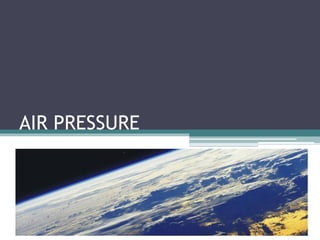
Gravity plays a key role in atmospheric pressure by holding gases close to planetary surfaces. Larger planets with stronger gravity can support thicker atmospheres than smaller planets. Atmospheric pressure on Earth results from the weight of nitrogen, oxygen, and other gases in the air above. Pressure decreases with increasing altitude as there is less air above. Temperature and humidity also impact air pressure, with warmer or more humid air having lower density and pressure than cooler or drier air at the same location. Molecular motion principles like Bernoulli's principle explain how moving air has lower pressure than still air.