PRAYER
RIMBERIO CO
REVIEW OF
THE PAST
LESSON
RIMBERIO CO
SHORT QUIZ!!!
1/4 sheet
RIMBERIO CO
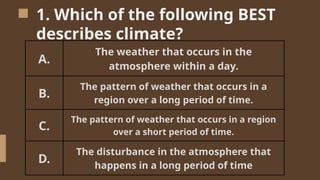
1. Which of the following BEST
describes climate?
A.
The weather that occurs in the
atmosphere within a day.
B.
The pattern of weather that occurs in a
region over a long period of time.
C.
The pattern of weather that occurs in a region
over a short period of time.
D.
The disturbance in the atmosphere that
happens in a long period of time
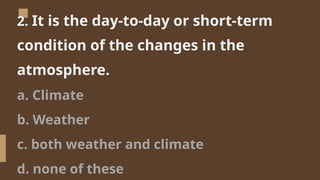
2. It is the day-to-day or short-term
condition of the changes in the
atmosphere.
a. Climate
b. Weather
c. both weather and climate
d. none of these
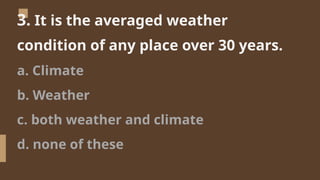
3. It is the averaged weather
condition of any place over 30 years.
a. Climate
b. Weather
c. both weather and climate
d. none of these
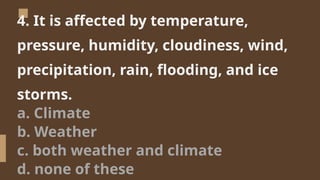
4. It is affected by temperature,
pressure, humidity, cloudiness, wind,
precipitation, rain, flooding, and ice
storms.
a. Climate
b. Weather
c. both weather and climate
d. none of these
5. It is long-term observations of the
atmospheric phenomena such as
humidity, temperature, the sunshine,
wind.
a. Climate
b. Weather
c. both weather and climate
d. none of these
LEARNING
OBJECTIVES
AT THE END OF THE LESSON THE STUDENTS
WILL BE ABLE TO:
OBJECTIVES
EXPLAIN HOW LATITUDE AFFECTS CLIMATE.
DEMONSTRATE THE RELATIONSHIP BETWEEN
LATITUDE AND CLIMATE.
RECOGNIZE THE EFFECT OF PHILIPPINES
LOCATION ON EARTH’S TO IT’S CLIMATE
VIDEO ANALYSIS
GUIDE QUESTIONS:
1. WHAT IS LATITUDE?
2. HOW DOES LATITUDE AFFECT
CLIMATE?
3. WHAT IS THE RELATION OF
LATITUDE TO CLIMATE?
4. WHY THERE IS HOT AND COLD
PLACE?
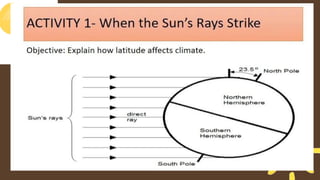
ACTIVITY TIME!!!
“WHEN THE
SUN’S RAYS
STRIKE”
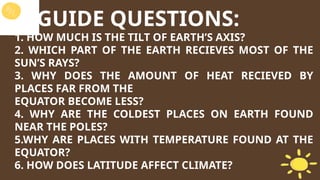
GUIDE QUESTIONS:
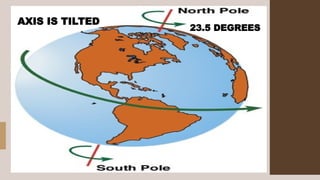
1. HOW MUCH IS THE TILT OF EARTH’S AXIS?
2. WHICH PART OF THE EARTH RECIEVES MOST OF THE
SUN’S RAYS?
3. WHY DOES THE AMOUNT OF HEAT RECIEVED BY
PLACES FAR FROM THE
EQUATOR BECOME LESS?
4. WHY ARE THE COLDEST PLACES ON EARTH FOUND
NEAR THE POLES?
5.WHY ARE PLACES WITH TEMPERATURE FOUND AT THE
EQUATOR?
6. HOW DOES LATITUDE AFFECT CLIMATE?
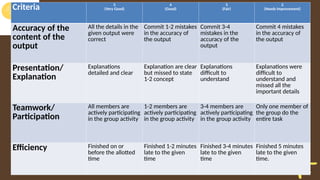
Criteria 5
(Very Good)
4
(Good)
3
(Fair)
2
(Needs Improvement)
Accuracy of the
content of the
output
All the details in the
given output were
correct
Commit 1-2 mistakes
in the accuracy of
the output
Commit 3-4
mistakes in the
accuracy of the
output
Commit 4 mistakes
in the accuracy of
the output
Presentation/
Explanation
Explanations
detailed and clear
Explanation are clear
but missed to state
1-2 concept
Explanations
difficult to
understand
Explanations were
difficult to
understand and
missed all the
important details
Teamwork/
Participation
All members are
actively participating
in the group activity
1-2 members are
actively participating
in the group activity
3-4 members are
actively participating
in the group activity
Only one member of
the group do the
entire task
Efficiency Finished on or
before the allotted
time
Finished 1-2 minutes
late to the given
time
Finished 3-4 minutes
late to the given
time
Finished 5 minutes
late to the given
time.
1. HOW MUCH IS THE
TILT OF THE EARTH’S
AXIS?
THE TILT OF THE
EARTH’S AXIS IS 23.5
DEGREE
2. WHICH PARTS OF THE
EARTH RECEIVES MOST
OF THE SUN’S RAYS?
EQUATOR
3..WHY DOES THE
AMOUNT OF HEAT
RECEIVED BY PLACES FAR
FROM THE EQUATOR
BECOME LESS?
3. IT IS DUE TO THE
TILTING OF THE EARTH’S
AXIS AND THE SHAPE OF
THE EARTH.
4. WHY ARE THE COLDEST
PLACES ON EARTH
FOUND NEAR THE POLES?
4. THEY RECEIVE LESS
AMOUNT OF HEAT.
5. WHY ARE PLACES WITH
THE HIGH TEMPERATURE
FOUND AT THE EQUATOR?
5. DUE TO THE TILTING OF THE
EARTH’S AXIS, PLACES NEAR
THE EQUATOR RECEIVE MORE
HEAT MAKING THE AIR
TEMPERATURE HIGHER.
6. HOW DOES LATITUDE
AFFECT CLIMATE?
6. WHEN THE AREA IS FARTHER FROM
THE EQUATOR, THE AIR
TEMPERATURE IS LOWER RESULTING
IN A COLD CLIMATE. WHEN THE
PLACE IS CLOSER TO THE EQUATOR,
THE AIR TEMPERATURE IS HIGHER
WHICH RESULTS IN A WARM
CLIMATE.
WHAT IS CLIMATE?
IS THE LONG TERM WEATHER
PATTERN IN A REGION,
TYPICALLY AVERAGED OVER 30
YEARS.
FACTORS AFFECTING
THE CLIMATE
1. LATITUDE
2. ALTIDUTE
3. DISTANCE TO A BODY OF
WATER
4. TOPOGRAPHY
5.OCEAN CURRENT
FACTOR THAT
AFFECT CLIMATE
( LATITUDE)
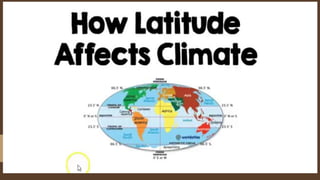
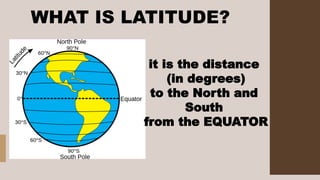
WHAT IS LATITUDE?
it is the distance
(in degrees)
to the North and
South
from the EQUATOR
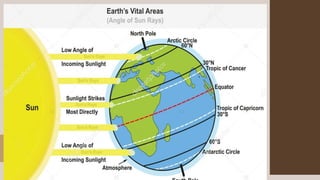
23.5 DEGREES
AXIS IS TILTED
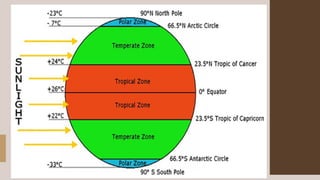
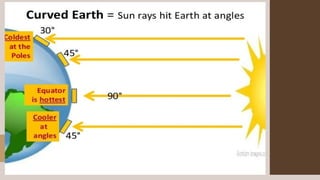
“ THE CLOSER YOU ARE TO THE EQUATOR ,
THE MORE DIRECT SUNLIGHT YOU GET , SO
THE HOTTER IT IS.
THE FURTHER YOU ARE AWAY FROM THE
EQUATOR, THE LESS DIRECT SUNLIGHT YOU
GET, SO THE COLDER IT IS”
DID YOU GET SOMETHING TO
OUR DISCUSSION ?
LET’S TRY WHAT YOU HAVE
LEARN
1. WHAT IS THE MAIN FACTOR THAT AFFECTS THE
GLOBAL CLIMATE?
A. CLIMATE
B. WEATHER
C. LATITUDE
D. ALL OF THESE
2-3 WHICH IS TRUE IN THE FOLLOWING STATEMENT?
A. WHEN THE AREA IS CLOSER FROM THE EQUATOR, THE AIR
TEMPERATURE IS LOWER RESULTING IN A COLD CLIMATE.
B. WHEN THE AREA IS FURTHER FROM THE EQUATOR, THE AIR
TEMPERATURE IS LOWER RESULTING IN A COLD CLIMATE.
C. WHEN AN AREA IS FURTHER TO THE EQUATOR, THE AIR
TEMPERATURE IS HIGHER WHICH RESULTS IN A WARM
CLIMATE.
D. WHEN AN AREA IS CLOSER TO THE EQUATOR, THE AIR
TEMPERATURE IS HIGHER WHICH RESULT IN WARM CLIMATE.
4. WHICH PART OF THE EARTH MOST RECEIVE SUN’S RAYS?
A. EQUATOR
B. NORTH POLE
C. SOUTH POLE
D. TROPIC OF CAPRICORN
5. WHY DOES THE AMOUNT OF HEAT RECEIVED BY PLACES
FAR FROM THE EQUATOR BECOME LESS?
A. BECAUSE THE SUN RAYS STRIKE VERTICALLY.
B. BECAUSE HEAT AFFECTS THE TEMPERATURE.
C.IT IS DUE TO THE TILTING OF THE EARTH’S AXIS AND THE
SHAPE OF THE EARTH.
D. NONE OF THE ABOVE
What is the relation
of latitude to
climate?
Assignment :
Make a research aboout
factors affecting the
climate ( ALTITUDE)
Write it in 1 whole sheet
of paper
when the sun's rays strike.pptx for grade 9

when the sun's rays strike.pptx for grade 9

  • 1.
  • 2.
  • 3.
  • 4.
    1. Which ofthe following BEST describes climate? A. The weather that occurs in the atmosphere within a day. B. The pattern of weather that occurs in a region over a long period of time. C. The pattern of weather that occurs in a region over a short period of time. D. The disturbance in the atmosphere that happens in a long period of time
  • 5.
    2. It isthe day-to-day or short-term condition of the changes in the atmosphere. a. Climate b. Weather c. both weather and climate d. none of these
  • 6.
    3. It isthe averaged weather condition of any place over 30 years. a. Climate b. Weather c. both weather and climate d. none of these
  • 7.
    4. It isaffected by temperature, pressure, humidity, cloudiness, wind, precipitation, rain, flooding, and ice storms. a. Climate b. Weather c. both weather and climate d. none of these
  • 8.
    5. It islong-term observations of the atmospheric phenomena such as humidity, temperature, the sunshine, wind. a. Climate b. Weather c. both weather and climate d. none of these
  • 9.
    LEARNING OBJECTIVES AT THE ENDOF THE LESSON THE STUDENTS WILL BE ABLE TO:
  • 10.
    OBJECTIVES EXPLAIN HOW LATITUDEAFFECTS CLIMATE. DEMONSTRATE THE RELATIONSHIP BETWEEN LATITUDE AND CLIMATE. RECOGNIZE THE EFFECT OF PHILIPPINES LOCATION ON EARTH’S TO IT’S CLIMATE
  • 11.
  • 12.
    GUIDE QUESTIONS: 1. WHATIS LATITUDE? 2. HOW DOES LATITUDE AFFECT CLIMATE? 3. WHAT IS THE RELATION OF LATITUDE TO CLIMATE? 4. WHY THERE IS HOT AND COLD PLACE?
  • 14.
  • 15.
  • 17.
    GUIDE QUESTIONS: 1. HOWMUCH IS THE TILT OF EARTH’S AXIS? 2. WHICH PART OF THE EARTH RECIEVES MOST OF THE SUN’S RAYS? 3. WHY DOES THE AMOUNT OF HEAT RECIEVED BY PLACES FAR FROM THE EQUATOR BECOME LESS? 4. WHY ARE THE COLDEST PLACES ON EARTH FOUND NEAR THE POLES? 5.WHY ARE PLACES WITH TEMPERATURE FOUND AT THE EQUATOR? 6. HOW DOES LATITUDE AFFECT CLIMATE?
  • 18.
    Criteria 5 (Very Good) 4 (Good) 3 (Fair) 2 (NeedsImprovement) Accuracy of the content of the output All the details in the given output were correct Commit 1-2 mistakes in the accuracy of the output Commit 3-4 mistakes in the accuracy of the output Commit 4 mistakes in the accuracy of the output Presentation/ Explanation Explanations detailed and clear Explanation are clear but missed to state 1-2 concept Explanations difficult to understand Explanations were difficult to understand and missed all the important details Teamwork/ Participation All members are actively participating in the group activity 1-2 members are actively participating in the group activity 3-4 members are actively participating in the group activity Only one member of the group do the entire task Efficiency Finished on or before the allotted time Finished 1-2 minutes late to the given time Finished 3-4 minutes late to the given time Finished 5 minutes late to the given time.
  • 19.
    1. HOW MUCHIS THE TILT OF THE EARTH’S AXIS?
  • 20.
    THE TILT OFTHE EARTH’S AXIS IS 23.5 DEGREE
  • 21.
    2. WHICH PARTSOF THE EARTH RECEIVES MOST OF THE SUN’S RAYS?
  • 22.
  • 23.
    3..WHY DOES THE AMOUNTOF HEAT RECEIVED BY PLACES FAR FROM THE EQUATOR BECOME LESS?
  • 24.
    3. IT ISDUE TO THE TILTING OF THE EARTH’S AXIS AND THE SHAPE OF THE EARTH.
  • 25.
    4. WHY ARETHE COLDEST PLACES ON EARTH FOUND NEAR THE POLES?
  • 26.
    4. THEY RECEIVELESS AMOUNT OF HEAT.
  • 27.
    5. WHY AREPLACES WITH THE HIGH TEMPERATURE FOUND AT THE EQUATOR?
  • 28.
    5. DUE TOTHE TILTING OF THE EARTH’S AXIS, PLACES NEAR THE EQUATOR RECEIVE MORE HEAT MAKING THE AIR TEMPERATURE HIGHER.
  • 29.
    6. HOW DOESLATITUDE AFFECT CLIMATE?
  • 30.
    6. WHEN THEAREA IS FARTHER FROM THE EQUATOR, THE AIR TEMPERATURE IS LOWER RESULTING IN A COLD CLIMATE. WHEN THE PLACE IS CLOSER TO THE EQUATOR, THE AIR TEMPERATURE IS HIGHER WHICH RESULTS IN A WARM CLIMATE.
  • 31.
    WHAT IS CLIMATE? ISTHE LONG TERM WEATHER PATTERN IN A REGION, TYPICALLY AVERAGED OVER 30 YEARS.
  • 32.
    FACTORS AFFECTING THE CLIMATE 1.LATITUDE 2. ALTIDUTE 3. DISTANCE TO A BODY OF WATER 4. TOPOGRAPHY 5.OCEAN CURRENT
  • 33.
  • 34.
    WHAT IS LATITUDE? itis the distance (in degrees) to the North and South from the EQUATOR
  • 37.
  • 40.
    “ THE CLOSERYOU ARE TO THE EQUATOR , THE MORE DIRECT SUNLIGHT YOU GET , SO THE HOTTER IT IS. THE FURTHER YOU ARE AWAY FROM THE EQUATOR, THE LESS DIRECT SUNLIGHT YOU GET, SO THE COLDER IT IS”
  • 41.
    DID YOU GETSOMETHING TO OUR DISCUSSION ? LET’S TRY WHAT YOU HAVE LEARN
  • 43.
    1. WHAT ISTHE MAIN FACTOR THAT AFFECTS THE GLOBAL CLIMATE? A. CLIMATE B. WEATHER C. LATITUDE D. ALL OF THESE
  • 44.
    2-3 WHICH ISTRUE IN THE FOLLOWING STATEMENT? A. WHEN THE AREA IS CLOSER FROM THE EQUATOR, THE AIR TEMPERATURE IS LOWER RESULTING IN A COLD CLIMATE. B. WHEN THE AREA IS FURTHER FROM THE EQUATOR, THE AIR TEMPERATURE IS LOWER RESULTING IN A COLD CLIMATE. C. WHEN AN AREA IS FURTHER TO THE EQUATOR, THE AIR TEMPERATURE IS HIGHER WHICH RESULTS IN A WARM CLIMATE. D. WHEN AN AREA IS CLOSER TO THE EQUATOR, THE AIR TEMPERATURE IS HIGHER WHICH RESULT IN WARM CLIMATE.
  • 45.
    4. WHICH PARTOF THE EARTH MOST RECEIVE SUN’S RAYS? A. EQUATOR B. NORTH POLE C. SOUTH POLE D. TROPIC OF CAPRICORN
  • 46.
    5. WHY DOESTHE AMOUNT OF HEAT RECEIVED BY PLACES FAR FROM THE EQUATOR BECOME LESS? A. BECAUSE THE SUN RAYS STRIKE VERTICALLY. B. BECAUSE HEAT AFFECTS THE TEMPERATURE. C.IT IS DUE TO THE TILTING OF THE EARTH’S AXIS AND THE SHAPE OF THE EARTH. D. NONE OF THE ABOVE
  • 47.
    What is therelation of latitude to climate?
  • 48.
    Assignment : Make aresearch aboout factors affecting the climate ( ALTITUDE) Write it in 1 whole sheet of paper

Editor's Notes

  • #4 The students will locate the Philippines in the globe. Guide questions: 1. To what regions is the Philippines located? 2. What climate do we experience now?
  • #5 The students will locate the Philippines in the globe. Guide questions: 1. To what regions is the Philippines located? 2. What climate do we experience now?
  • #6 The students will locate the Philippines in the globe. Guide questions: 1. To what regions is the Philippines located? 2. What climate do we experience now?
  • #7 The students will locate the Philippines in the globe. Guide questions: 1. To what regions is the Philippines located? 2. What climate do we experience now?
  • #8 The students will locate the Philippines in the globe. Guide questions: 1. To what regions is the Philippines located? 2. What climate do we experience now?
  • #9 The students will locate the Philippines in the globe. Guide questions: 1. To what regions is the Philippines located? 2. What climate do we experience now?
  • #10 The students will locate the Philippines in the globe. Guide questions: 1. To what regions is the Philippines located? 2. What climate do we experience now?
  • #11 The students will locate the Philippines in the globe. Guide questions: 1. To what regions is the Philippines located? 2. What climate do we experience now?
  • #12 The students will locate the Philippines in the globe. Guide questions: 1. To what regions is the Philippines located? 2. What climate do we experience now?
  • #13 The students will locate the Philippines in the globe. Guide questions: 1. To what regions is the Philippines located? 2. What climate do we experience now?
  • #14 The students will locate the Philippines in the globe. Guide questions: 1. To what regions is the Philippines located? 2. What climate do we experience now?
  • #15 This is not a group activity but you will be with your groupmates to share the globe. Get your science book open on page 185. prepare 1 whole sheet of paper. In a 1 whole sheet of paper write your name the under your name write Activity no. 1 When the sun’s rays strike. Write the questions and provide a space for your answer.
  • #16 To better understand the direction of the sun rays. You may use a flashlight. Your cellphone flashlight and think of it as a sun rays.
  • #43 c
  • #44 B d
  • #45 a
  • #46 c
  • #47 c
  • #48 c