LEARNING & DEVELOPMENT MANAGEMENT  Basic Airport Operations “AERONOUTICAL INFORMATION PUBLICATION ( AIP )” BY ZAINOL MOHD ISA
AERONAUTICAL INFORMATION PUBLICATION (AIP)
Aeronautical Information Service ICAO Requirements in Annex 15 Contracting State to provide Aeronautical Information Service (AIS): 1. AIP (Aeronautical Information Publication) 2. NOTAM (Notice to Airman) 3. AIRAC (Aeronautical Information Rules and    Control) 4. AIC (Aeronautical Information Circular) 5. Pre-Flight/Post Flight Information
Aeronautical Information Publication DEFINITION A publication issued by or with the authority of a State and containing aeronautical information of a lasting character essential to air navigation  (Chapter 2 Annex 15)
Aeronautical Information Publication An  integral part  of Aeronautical Information Service (AIS) provided  by the State Reference document  primarily to satisfy International requirements for the exchange of aeronautical information Living document subject to amendment in order to ensure it provides  current and accurate  information
Aeronautical Information Publication The content of AIP constitute  Basic information: Necessary for the safety, regularity or efficiency of air navigation  Source for permanent information and long duration temporary changes To facilitate the use in flight.
Aeronautical Information Publication Obligations of Aerodrome Operator: Aerodrome Certificate holder is  responsible  for the provision of aerodrome data and any changes  (Airport Services Manual Part 8, Doc 9137-AN/898, Chapter 22.4.3) Shall  notify  DCA for any change in operational capability  Provide 100% confidence level of  data accuracy  on Aerodrome Notification for operational capability changes are  timely
Aeronautical Information Publication AIP Contents: Part 1 - General (GEN) Part 2 - En-Route (ENR)  Part 3 - Aerodrome (AD) AIP Supplement (SUP)
PART 1 – GEN (General) General: GEN 0 General (Preface) GEN 1 National Regulations and  Requirements GEN 2 Tables and Codes GEN 3 Services GEN 4  Charges for Aerodromes/ Heliports  and Air Navigation
PART 1 – GEN 0 (Preface) a. Publishing Authorities b. Applicable ICAO documents c. AIP Structure and Regular  Amendment Interval d. Service Contact for Errors or  Omissions
PART 1 – GEN 0 (Preface) e. Records of AIP Amendments f. Records of AIP Supplement g. Checklist of AIP Pages h. List of Hand Amendments i. Table of Contents to Part 1
PART 1 – GEN 1  (National Regulations and Requirements) a.  Designated Authorities  b.   Entry, Transit and Departure of Aircraft c. Entry, Transit and Departure of Passenger and Crew d. Entry, Transit and Departure of Cargo
PART 1 – GEN 1  (National Regulations and Requirements) e. Aircraft Instruments, Equipment and Flight Documents  f.   Summary of National Regulations and International Agreements/Conventions g. Differences from ICAO Standards and Recommended Practices
PART 1 – GEN 2 (Tables and Codes) a. Measuring System, Aircraft markings, Holidays  b.   Abbreviations used in AIS Publications c. Chart Symbols d. Locations Indicators e. List of Radio Navigation Aids
PART 1 – GEN 2 (Tables and Codes) e. List of Radio Navigation Aids  f.   Conversion Tables g. Chart Symbols h. Sunrise/Sunset Tables
PART 1 – GEN 3 (Services) a. Aeronautical Information Services b.   Aeronautical Charts c. Air Traffic Services d. Communication Services e. Meteorological Services  f. Search and Rescue
PART 1 – GEN 4 (Charges for Aerodromes Heliports and Air Navigation Services) a. Aerodrome/Heliport Charges b. Air Navigation Service Charges
PART 2 – ENR (En-route) General Rules  Air Traffic Services Airspace ATS Routes Radio Navigation Aids/Systems Navigation Warnings En-route Chart
PART 2 – ENR 1  (General Rules and Procedures) General Rules Visual Flight Rules  Instrument Flight Rules ATS Airspace Classification Holding/Approach and Departure Procedure Radar Services and Procedures Altimeter Setting Procedures
PART 2 – ENR 1  (General Rules and Procedures) Regional supplementary Procedures Air Traffic Flow Management (ATFM) Flight Planning Addressing of Flight Plan Messages Interception of Civil Aircraft Unlawful Interference Air Traffic Incidents
PART 2 – ENR 2  (Air Traffic Services Airspace)   FIR (Flight Information Region) UIR (Upper Flight Information Region)  TMA (Terminal Area) Other Regulated Airspace
PART 3 – AD (Aerodrome)  AD 1 - Aerodromes (Introduction)  AD 2 - Aerodromes (24 details    and list of Aerodromes) Other Aerodromes
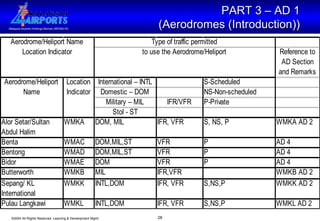
a. Aerodromes/Heliports availability b. Rescue and Fire Fighting Services and   Snow Plan c. Index to Aerodromes and Heliports d. Grouping of Aerodromes PART 3 – AD 1  (Aerodromes - Introduction)
Statement on: a. Aerodromes available for international  and domestic aircraft operations. b.  Private/Military aerodromes not  available for public use without prior  permission c. Omitted Heliports section PART 3 – AD 1 (a)  (Aerodromes/Heliport Availability)
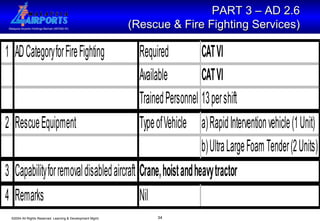
PART 3 – AD 1  (Rescue & Fire Fighting Services)   Statement on: Adequate rescue and fire fighting vehicles, equipment and personnel provided at aerodromes for use by international commercial air transport. Details in AD 2.6 (particular aerodrome data)
1. Aerodrome/Heliport Name - e.g. Sepang/KL International 2. Location Indicator - e.g. WMKA, WMKK 3. Type of Traffic permitted: i. International, Domestic, Military or STOL  ii. IFR/VFR iii. Scheduled (S), Non-schedule (NS)    or Private (P)  4. Reference to AD Section e.g. WMKK AD2. PART 3 – AD 1  (Index to Aerodromes & Heliports)
International Airport – entry and departure of air traffic, CIQ (Animal, Public Health, Plant), ATS regular Domestic Airport – domestic air traffic only,ATS regular Stolport – aerodrome for STOL aircraft 4. Military Airport – aerodrome for military only PART 3 – AD 1  (Grouping of Aerodromes)
PART 3 – AD 1  (Aerodromes (Introduction))
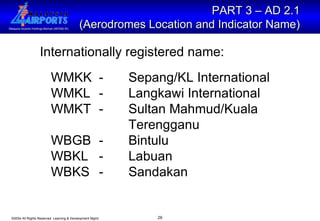
Internationally registered name: WMKK - Sepang/KL International WMKL - Langkawi International  WMKT - Sultan Mahmud/Kuala  Terengganu WBGB - Bintulu WBKL - Labuan  WBKS - Sandakan PART 3 – AD 2.1  (Aerodromes Location and Indicator Name)
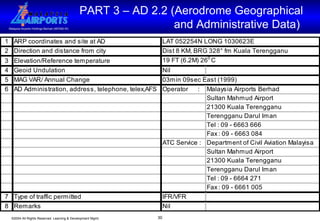
PART 3 – AD 2.2 (Aerodrome Geographical and Administrative Data)
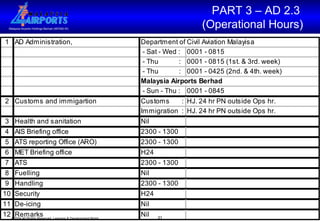
PART 3 – AD 2.3  (Operational Hours)
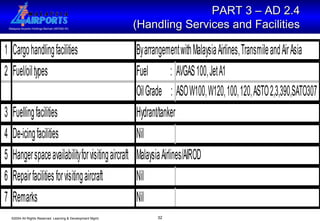
PART 3 – AD 2.4  (Handling Services and Facilities
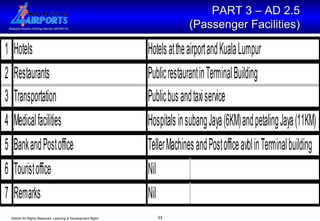
PART 3 – AD 2.5  (Passenger Facilities)
PART 3 – AD 2.6  (Rescue & Fire Fighting Services)
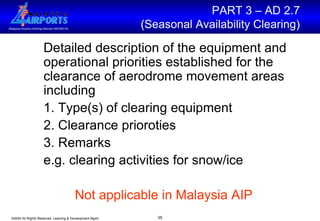
Detailed description of the equipment and operational priorities established for the clearance of aerodrome movement areas including  1. Type(s) of clearing equipment 2. Clearance prioroties 3. Remarks  e.g. clearing activities for snow/ice  Not applicable in Malaysia AIP PART 3 – AD 2.7  (Seasonal Availability Clearing)
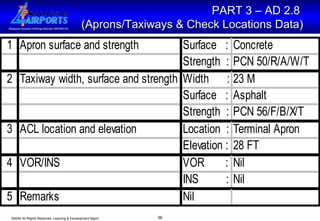
PART 3 – AD 2.8  (Aprons/Taxiways & Check Locations Data)
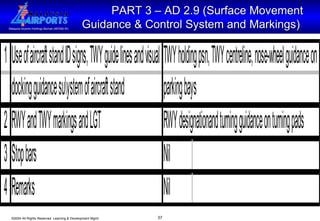
PART 3 – AD 2.9 (Surface Movement Guidance & Control System and Markings)
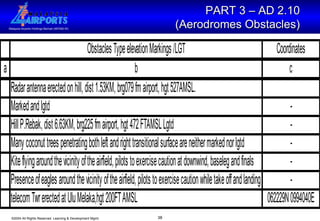
PART 3 – AD 2.10  (Aerodromes Obstacles)
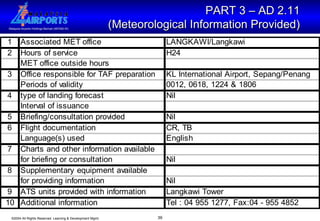
PART 3 – AD 2.11  (Meteorological Information Provided)
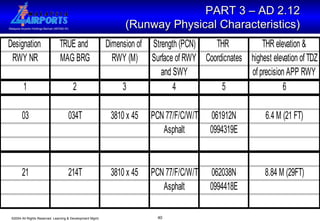
PART 3 – AD 2.12  (Runway Physical Characteristics)
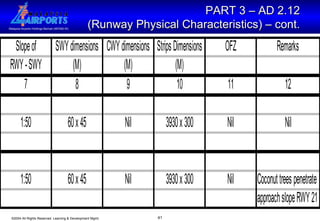
PART 3 – AD 2.12  (Runway Physical Characteristics) – cont.
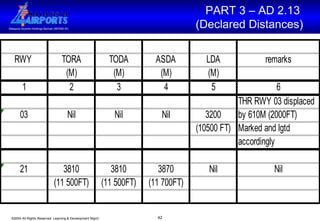
PART 3 – AD 2.13  (Declared Distances)
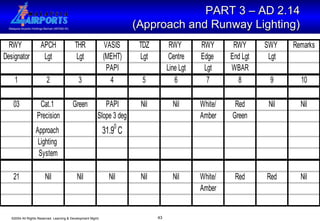
PART 3 – AD 2.14  (Approach and Runway Lighting)
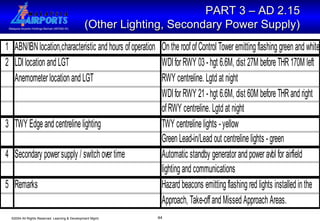
PART 3 – AD 2.15  (Other Lighting, Secondary Power Supply)
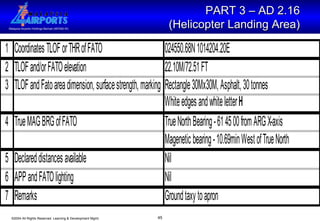
PART 3 – AD 2.16  (Helicopter Landing Area)
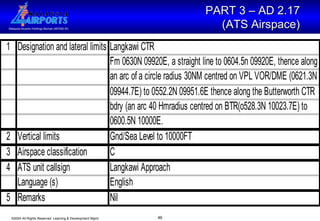
PART 3 – AD 2.17  (ATS Airspace)
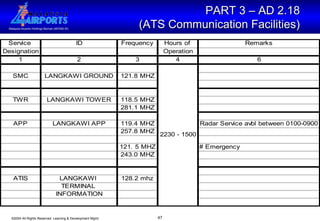
PART 3 – AD 2.18  (ATS Communication Facilities)
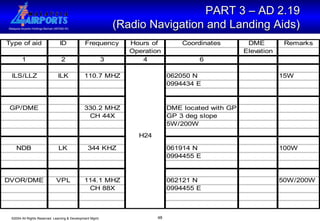
PART 3 – AD 2.19  (Radio Navigation and Landing Aids)
PART 3 – AD 2.20  (Local Traffic Regulations)   Local Flying Restrictions  e.g. Unidirectional Runway in use due to hilly terrain - Take off RWY 21/Landing RWY 03. Circling prohibited except Category A aircraft west of airport. Start Up and Push Back e.g. During aircraft push back it shall be the responsibility of the pilot in command and aircraft marshaller to ensure that the area behind the aircraft is clear of vehicles and other objects. Jet Blast Procedures e.g. B03 and B05 – Aircraft to be pushed back and tow forward to breakaway point 100 Metres from blast fence before taxiing out.
Detailed description of noise abatement procedures established at the aerodrome Not practiced in Malaysia yet. PART 3 – AD 2.21  (Noise Abatement Procedure)
Aerodrome & Apron Control Services – e.g. On runways and designated taxiways atc controls and regulates aircraft to aircraft, vehicles and obstructions Communication Services – e.g. on movement area using VHF, UHF available for non VHF equipped aircraft Runway Operations – e.g. preferred runway, wind criteria for changing direction Approach and Departure procedures – e.g. IFR aircraft departing WMKK must contact LUMPUR APPROACH immediately after airborne RWY 32R/L LUMPUR APPROACH NORTH 124.2 MHZ Low Visibility Operating Procedures – e.g. condition 3 visibility below 600metres PART 3 – AD 2.22  (Flight Procedures)
Bird concentration in the vicinity of the airport  e.g. Flight path of seasonal migration birds. PART 3 – AD 2.23  (Additional Information)
Aerodrome/Heliport Chart  Aerodrome Obstacle Chart -  Type A Radar Vectoring Area Chart Standard Departure Chart Standard Arrival Chart Instrument Approach Chart Visual Approach Chart Bird concentrations in the vicinity of heliport PART 3 – AD 2.24  (Charts Related to Particular Airport)
What have we learned? AIP ownership is with State authority  Aerodrome Operator to provide accurate information for AIP publication. Aerodrome Operator to notify/update any changes and inaccurate information.  Notification for operational changes are timely AIP is a Controlled Document (Quality Management System) CONCLUSION
Malaysia Airports Holdings Berhad (487092-W) Q & A Thank You -End of presentation-
If I am good tell others  if not tell me! Technical Services Division Malaysia Airports Holdings Berhad Sultan Abdul Aziz Shah Airport  47200 Subang Selangor Tel. No: 603 7840 7231 e-mail:  [email_address] .com.my Need more info?
Thank you End of Presentation

AIP Operations Basic Training 020904

  • 1.
    LEARNING & DEVELOPMENTMANAGEMENT Basic Airport Operations “AERONOUTICAL INFORMATION PUBLICATION ( AIP )” BY ZAINOL MOHD ISA
  • 2.
  • 3.
    Aeronautical Information ServiceICAO Requirements in Annex 15 Contracting State to provide Aeronautical Information Service (AIS): 1. AIP (Aeronautical Information Publication) 2. NOTAM (Notice to Airman) 3. AIRAC (Aeronautical Information Rules and Control) 4. AIC (Aeronautical Information Circular) 5. Pre-Flight/Post Flight Information
  • 4.
    Aeronautical Information PublicationDEFINITION A publication issued by or with the authority of a State and containing aeronautical information of a lasting character essential to air navigation (Chapter 2 Annex 15)
  • 5.
    Aeronautical Information PublicationAn integral part of Aeronautical Information Service (AIS) provided by the State Reference document primarily to satisfy International requirements for the exchange of aeronautical information Living document subject to amendment in order to ensure it provides current and accurate information
  • 6.
    Aeronautical Information PublicationThe content of AIP constitute Basic information: Necessary for the safety, regularity or efficiency of air navigation Source for permanent information and long duration temporary changes To facilitate the use in flight.
  • 7.
    Aeronautical Information PublicationObligations of Aerodrome Operator: Aerodrome Certificate holder is responsible for the provision of aerodrome data and any changes (Airport Services Manual Part 8, Doc 9137-AN/898, Chapter 22.4.3) Shall notify DCA for any change in operational capability Provide 100% confidence level of data accuracy on Aerodrome Notification for operational capability changes are timely
  • 8.
    Aeronautical Information PublicationAIP Contents: Part 1 - General (GEN) Part 2 - En-Route (ENR) Part 3 - Aerodrome (AD) AIP Supplement (SUP)
  • 9.
    PART 1 –GEN (General) General: GEN 0 General (Preface) GEN 1 National Regulations and Requirements GEN 2 Tables and Codes GEN 3 Services GEN 4 Charges for Aerodromes/ Heliports and Air Navigation
  • 10.
    PART 1 –GEN 0 (Preface) a. Publishing Authorities b. Applicable ICAO documents c. AIP Structure and Regular Amendment Interval d. Service Contact for Errors or Omissions
  • 11.
    PART 1 –GEN 0 (Preface) e. Records of AIP Amendments f. Records of AIP Supplement g. Checklist of AIP Pages h. List of Hand Amendments i. Table of Contents to Part 1
  • 12.
    PART 1 –GEN 1 (National Regulations and Requirements) a. Designated Authorities b.   Entry, Transit and Departure of Aircraft c. Entry, Transit and Departure of Passenger and Crew d. Entry, Transit and Departure of Cargo
  • 13.
    PART 1 –GEN 1 (National Regulations and Requirements) e. Aircraft Instruments, Equipment and Flight Documents f.   Summary of National Regulations and International Agreements/Conventions g. Differences from ICAO Standards and Recommended Practices
  • 14.
    PART 1 –GEN 2 (Tables and Codes) a. Measuring System, Aircraft markings, Holidays b.   Abbreviations used in AIS Publications c. Chart Symbols d. Locations Indicators e. List of Radio Navigation Aids
  • 15.
    PART 1 –GEN 2 (Tables and Codes) e. List of Radio Navigation Aids f.   Conversion Tables g. Chart Symbols h. Sunrise/Sunset Tables
  • 16.
    PART 1 –GEN 3 (Services) a. Aeronautical Information Services b.   Aeronautical Charts c. Air Traffic Services d. Communication Services e. Meteorological Services f. Search and Rescue
  • 17.
    PART 1 –GEN 4 (Charges for Aerodromes Heliports and Air Navigation Services) a. Aerodrome/Heliport Charges b. Air Navigation Service Charges
  • 18.
    PART 2 –ENR (En-route) General Rules Air Traffic Services Airspace ATS Routes Radio Navigation Aids/Systems Navigation Warnings En-route Chart
  • 19.
    PART 2 –ENR 1 (General Rules and Procedures) General Rules Visual Flight Rules Instrument Flight Rules ATS Airspace Classification Holding/Approach and Departure Procedure Radar Services and Procedures Altimeter Setting Procedures
  • 20.
    PART 2 –ENR 1 (General Rules and Procedures) Regional supplementary Procedures Air Traffic Flow Management (ATFM) Flight Planning Addressing of Flight Plan Messages Interception of Civil Aircraft Unlawful Interference Air Traffic Incidents
  • 21.
    PART 2 –ENR 2 (Air Traffic Services Airspace) FIR (Flight Information Region) UIR (Upper Flight Information Region) TMA (Terminal Area) Other Regulated Airspace
  • 22.
    PART 3 –AD (Aerodrome) AD 1 - Aerodromes (Introduction) AD 2 - Aerodromes (24 details and list of Aerodromes) Other Aerodromes
  • 23.
    a. Aerodromes/Heliports availabilityb. Rescue and Fire Fighting Services and Snow Plan c. Index to Aerodromes and Heliports d. Grouping of Aerodromes PART 3 – AD 1 (Aerodromes - Introduction)
  • 24.
    Statement on: a.Aerodromes available for international and domestic aircraft operations. b. Private/Military aerodromes not available for public use without prior permission c. Omitted Heliports section PART 3 – AD 1 (a) (Aerodromes/Heliport Availability)
  • 25.
    PART 3 –AD 1 (Rescue & Fire Fighting Services) Statement on: Adequate rescue and fire fighting vehicles, equipment and personnel provided at aerodromes for use by international commercial air transport. Details in AD 2.6 (particular aerodrome data)
  • 26.
    1. Aerodrome/Heliport Name- e.g. Sepang/KL International 2. Location Indicator - e.g. WMKA, WMKK 3. Type of Traffic permitted: i. International, Domestic, Military or STOL ii. IFR/VFR iii. Scheduled (S), Non-schedule (NS) or Private (P) 4. Reference to AD Section e.g. WMKK AD2. PART 3 – AD 1 (Index to Aerodromes & Heliports)
  • 27.
    International Airport –entry and departure of air traffic, CIQ (Animal, Public Health, Plant), ATS regular Domestic Airport – domestic air traffic only,ATS regular Stolport – aerodrome for STOL aircraft 4. Military Airport – aerodrome for military only PART 3 – AD 1 (Grouping of Aerodromes)
  • 28.
    PART 3 –AD 1 (Aerodromes (Introduction))
  • 29.
    Internationally registered name:WMKK - Sepang/KL International WMKL - Langkawi International WMKT - Sultan Mahmud/Kuala Terengganu WBGB - Bintulu WBKL - Labuan WBKS - Sandakan PART 3 – AD 2.1 (Aerodromes Location and Indicator Name)
  • 30.
    PART 3 –AD 2.2 (Aerodrome Geographical and Administrative Data)
  • 31.
    PART 3 –AD 2.3 (Operational Hours)
  • 32.
    PART 3 –AD 2.4 (Handling Services and Facilities
  • 33.
    PART 3 –AD 2.5 (Passenger Facilities)
  • 34.
    PART 3 –AD 2.6 (Rescue & Fire Fighting Services)
  • 35.
    Detailed description ofthe equipment and operational priorities established for the clearance of aerodrome movement areas including 1. Type(s) of clearing equipment 2. Clearance prioroties 3. Remarks e.g. clearing activities for snow/ice Not applicable in Malaysia AIP PART 3 – AD 2.7 (Seasonal Availability Clearing)
  • 36.
    PART 3 –AD 2.8 (Aprons/Taxiways & Check Locations Data)
  • 37.
    PART 3 –AD 2.9 (Surface Movement Guidance & Control System and Markings)
  • 38.
    PART 3 –AD 2.10 (Aerodromes Obstacles)
  • 39.
    PART 3 –AD 2.11 (Meteorological Information Provided)
  • 40.
    PART 3 –AD 2.12 (Runway Physical Characteristics)
  • 41.
    PART 3 –AD 2.12 (Runway Physical Characteristics) – cont.
  • 42.
    PART 3 –AD 2.13 (Declared Distances)
  • 43.
    PART 3 –AD 2.14 (Approach and Runway Lighting)
  • 44.
    PART 3 –AD 2.15 (Other Lighting, Secondary Power Supply)
  • 45.
    PART 3 –AD 2.16 (Helicopter Landing Area)
  • 46.
    PART 3 –AD 2.17 (ATS Airspace)
  • 47.
    PART 3 –AD 2.18 (ATS Communication Facilities)
  • 48.
    PART 3 –AD 2.19 (Radio Navigation and Landing Aids)
  • 49.
    PART 3 –AD 2.20 (Local Traffic Regulations) Local Flying Restrictions e.g. Unidirectional Runway in use due to hilly terrain - Take off RWY 21/Landing RWY 03. Circling prohibited except Category A aircraft west of airport. Start Up and Push Back e.g. During aircraft push back it shall be the responsibility of the pilot in command and aircraft marshaller to ensure that the area behind the aircraft is clear of vehicles and other objects. Jet Blast Procedures e.g. B03 and B05 – Aircraft to be pushed back and tow forward to breakaway point 100 Metres from blast fence before taxiing out.
  • 50.
    Detailed description ofnoise abatement procedures established at the aerodrome Not practiced in Malaysia yet. PART 3 – AD 2.21 (Noise Abatement Procedure)
  • 51.
    Aerodrome & ApronControl Services – e.g. On runways and designated taxiways atc controls and regulates aircraft to aircraft, vehicles and obstructions Communication Services – e.g. on movement area using VHF, UHF available for non VHF equipped aircraft Runway Operations – e.g. preferred runway, wind criteria for changing direction Approach and Departure procedures – e.g. IFR aircraft departing WMKK must contact LUMPUR APPROACH immediately after airborne RWY 32R/L LUMPUR APPROACH NORTH 124.2 MHZ Low Visibility Operating Procedures – e.g. condition 3 visibility below 600metres PART 3 – AD 2.22 (Flight Procedures)
  • 52.
    Bird concentration inthe vicinity of the airport e.g. Flight path of seasonal migration birds. PART 3 – AD 2.23 (Additional Information)
  • 53.
    Aerodrome/Heliport Chart Aerodrome Obstacle Chart - Type A Radar Vectoring Area Chart Standard Departure Chart Standard Arrival Chart Instrument Approach Chart Visual Approach Chart Bird concentrations in the vicinity of heliport PART 3 – AD 2.24 (Charts Related to Particular Airport)
  • 54.
    What have welearned? AIP ownership is with State authority Aerodrome Operator to provide accurate information for AIP publication. Aerodrome Operator to notify/update any changes and inaccurate information. Notification for operational changes are timely AIP is a Controlled Document (Quality Management System) CONCLUSION
  • 55.
    Malaysia Airports HoldingsBerhad (487092-W) Q & A Thank You -End of presentation-
  • 56.
    If I amgood tell others if not tell me! Technical Services Division Malaysia Airports Holdings Berhad Sultan Abdul Aziz Shah Airport 47200 Subang Selangor Tel. No: 603 7840 7231 e-mail: [email_address] .com.my Need more info?
  • 57.
    Thank you Endof Presentation